Granting private security firms the power to arrest people shows that this grasping, constitutionally illiterate Tory government does not understand what the state should and should not be outsourcing
The next step in the Tory Party’s slow suicide and abnegation of any remaining conservative principle: a leaked proposal to grant private security companies the power to arrest people, granting their employees the full suite of powers currently held by Civilian Enforcement Officers.
The Daily Mail reports on the latest thoughtless privatisation scheme to be cooked up by the government:
The proposals would allow, for the first time, staff from companies such as G4S to arrest members of the public for failing to pay fines imposed by the courts.
The plans would see HM Courts and Tribunals Service (HMCTS) privatising part of its compliance and enforcement operations in a deal worth £290million.
The measures were slipped out as a tender by the Ministry of Justice during the summer.
Under the proposals, the Government could transfer all services carried out by Civilian Enforcement Officers, who are civil servants employed by HMCTS, to the private sector.
This would include the arrest and detention of individuals who fail to pay off their debts and haul[ing] them to court.
The courts can already allow authorised agencies, including private firms, to send bailiffs to a person’s home to seize possessions to encourage them to pay debts.
But this would potentially be a sweeping expansion of the powers – covering so-called warrants of arrest, which are issued by JPs to compel an individual to attend court.
A separate justice-related proposal bubbled from the Left this week, published in the Daily Mirror, demanding the unification and centralisation all of the police forces in England, because that same creepy exercise in big government authoritarianism worked such wonders in Scotland under the SNP. But now the Tories have gone one better.
First re-opening the divisive fox hunting debate for no good reason on the eve of a general election, and now this. It’s like the Tories are actually trying to self-destruct by living up to every hysterical stereotype about conservatives ever levelled by the Left.
This is a Tory party that claims to be so concerned about fiscal responsibility that it is willing to outsource the arrest and detention of British citizens to poorly managed private companies with appalling records and an ability to screw up and commit fraud even under close oversight, all to save a paltry few million pounds, while shamefully failing to tackle the real drivers of the deficit such as welfare, healthcare and pensions.
Depriving somebody of their liberty – even only briefly, as a means to compel their attendance at court – is one of the most sacred and serious powers that we the people invest in the state. Arresting or imprisoning a citizen, depriving them of their liberty or (in extremis) compelling their draft into the armed forces are powers that could and should never be vested in private hands, outside direct control of local or national government which is directly accountable to the people. No exceptions, no excuses. This is the red line.
And it is a red line which David Lidington and the Ministry of Justice have just nonchalantly stepped on, whistling, hands in pockets, as though the Tories did not already have grave reputational issues and stand on the brink of giving power to hard Left Corbynite socialism.
The arrogance and incompetence that would motivate the Tories to even whisper this proposal are quite simply off the charts. It’s as though Theresa May’s government is effectively shouting to its critics “Fascist? Call us fascist, will ye? I’ll give ye some real fascism to worry about!”
If this proposal goes ahead, the Tory party and I are through. Not an extension of the current temporary breakup, but a permanent schism. I will work to get it cast from power and thrown into the electoral wilderness forever, and agitate for a new right-wing party take its place, one which is not stuffed full of grasping proto-fascists with pound signs in their eyes, one actually worthy of bearing the name “conservative”.
–
Support Semi-Partisan Politics with a one-time or recurring donation:
–
Agree with this article? Violently disagree? Scroll down to leave a comment.
For many young conservatives, political YouTube offers a respite from left-wing dominance of popular culture, universities, the mainstream media and other social networks. But while YouTube’s brash new right-wing stars can be beguiling to watch, they do little to advance conservatism as an intellectual movement – and sometimes actively set it back
Young, brash, right-wing political YouTubers may unwittingly deliver the final coup de grâce to conservatism as an intellectual movement, even as they rack up millions of followers and achieve all the outward metrics of success.
But then I would say that, wouldn’t I? For some foolish reason I work primarily on the already anachronistic medium of the humble blog, tapping out my verbose screeds into WordPress which then get read and shared by that tiny slice of humanity who can wade through eight paragraphs on the meaning of citizenship in the Age of Brexit without wanting to run into oncoming traffic. Given recent advances in technology and journalism, bloggers like me are effectively still marvelling at the Edison light bulb while everybody else is busy projecting holograms or firing lasers at each other.
Ironically, despite being somewhat frustrated by my own lack of online reach, I find myself increasingly impatient when forced through necessity to read other people’s carefully and well-written words, be it those of a fellow blogger, journalist or author. Reading requires concentration and an engaged brain, and who has time for that?
Every evening after the day job is done and I have commuted home to begin work on my perennially unrewarding side hustle (this blog), I am faced with a choice: do I expend what little mental energy I have left reading and thinking deeply about a complex idea, researching and refining my thoughts until I have something compelling and unique to share with my readers, or do I take the path of least resistance – flicking over to YouTube and watching a parade of talking heads ranting about this or that development in the culture wars, finding something suitably outrageous to get worked up about and then hitting “publish” on an identikit, stream-of-consciousness rant in response?
And here’s my guilty secret: I choose the path of least resistance easily over half the time. Thinking is hard. So is challenging long-held assumptions and personal beliefs. But nodding along while a talking head on YouTube affirms one’s existing opinions is easy, and addictively cathartic. Yet anybody can do this; it is the millennial or Generation Z equivalent of watching Fox and Friends. At this point I can crank out one of my old-style “I agree with Brendan O’Neill” or “look what crazy campus SJWs did” response pieces with my eyes closed. Just crank my handle, insert the topic and required word count and 45 minutes later you’ll have a fully formed blog post. Sure it won’t be original or really add anything to the national political debate, but still, it’ll be there, taking up room in cyberspace.
Look at some of the biggest political YouTube or cable TV stars (they tend to be American or at least to focus primarily on American politics). Ben Shapiro is probably the best of the conservative personalities, certainly far more serious than conspiracy theorists like Alex Jones or culture warriors like Paul Joseph Watson or the execrable Milo Yiannopoulos. The less said about Tomi Lahren, Lauren Southern or Mike Cernovich the better. Various people have suggested Stefan Molyneux as a supposedly more serious alternative and the philosopher/podcaster does have his moments. But even this seems to be stretching the definition of “serious” somewhat.
Then you have political comedians like Steven Crowder who at least is funny, one of conservatism’s only solid answers to the leftist monopolisation of comedy – and Lord knows that we need a respite from the unbearable sanctimony of John Oliver, Samantha Bee, poor Jon Stewart replacement Trevor Noah and the pitiful Mash Report in Britain (Bill Maher is one of the few consistently funny and insightful left-wing political comedians). Sargon of Akkad can be quite funny when he gets riled up about leftist excess. And while they generally lag behind conservatives on YouTube, on the Left you have shows like The Young Turks (a growing horde of screechy social justice warriors and Bernie Sanders devotees) and a smattering of others.
(Dave Rubin also deserves an honourable mention as somebody who tackles controversial topics and interviews partisan commentators from both sides of the ideological debate in The Rubin Report).
Conservatives seem to dominate political YouTube, probably for the same reason that an older generation of right-wingers once took refuge in American talk radio – because their views were increasingly misrepresented, slandered, marginalised or ignored by the mainstream media. And today, far away from the reach – and the interest – of those Washington and Westminster journalists marinated in the same groupthink as the politicians they supposedly hold to account, conservative YouTube flourishes:
Twitter is a tiny echo chamber. I'm not sure the left understands the monumental ass-whupping being dished out to them on YouTube.
YouTube has thus provided a useful pressure release valve for the expression of a range of conservative thought, though even on this platform conservatives are now under threat, with demonetisation attacks threatening the livelihoods of content creators whose views fall outside the prevailing pseudo-liberal orthodoxy. But generally speaking, while Twitter, Facebook and Tumblr can be seethingly hostile to right-wing ideas, YouTube has allowed a large number of frustrated conservative and libertarian-leaning people to view and engage with a small number of brash, unapologetic conservative personalities.
But as conservatives disengage from regular media outlets, ceding more ground to the forces of the Left, we do ourselves a disservice. A bit of escapism into the ideological bubble isn’t always a bad thing, but it does become problematic when one spends too much time plugged into a partisan medium which can be both shrill and superficial.
As American conservatives flocked to talk radio and stopped consuming mainstream or supposedly objective news, their worldview became progressively more alarmist and conspiratorial. That’s why so many American conservatives still believe that Barack Obama is a secret Muslim, while opportunistic companies make a fortune selling gold coins, water filters and survival gear for people who have been slowly convinced that the apocalypse is just round the corner. With no centrists or left-wingers to call BS on their more outrageous claims, conservative media increasingly resembles an arms race to provide the most provocative and alarmist commentary in the hunt for viewers and listeners.
We on the Right correctly rail against universities for becoming little more than temples of social justice and identity politics orthodoxy, where dissenting opinion is relentlessly eradicated through re-education programs, trigger warnings and safe spaces. But we are no better when we retreat to YouTube instead of engaging with the world in all of its fallen, identity politics-soaked left-wingery. Our own outlook is in danger of becoming equally insular when we uncritically clap along as part of Ben Shapiro’s Amen Corner, preferring the catharsis of having our opinions confirmed to the rigour and challenge of debate.
It’s not that political YouTube videos are bad per se, it’s that they tend to be more partisan, superficial and sensationalist than print media and even television (though the gap with TV is lesser). A book can offer footnotes. An essay or feature article, knowing that it has its reader’s attention, can devote some space for context and nuance. A YouTube video, by contrast, has about five seconds to grab your focus before you click away, and must work hard to maintain your attention right through to the end. This inevitably leads to a certain reliance on zingers and soundbites which is actually not dissimilar to the grasping, disjointed way in which many media-trained politicians now speak.
The problem is that for political YouTubers (and other commentators whose careers depend on clips of their media performances being shared widely on that platform) success is measured in clicks, views and the number of times people share their videos accompanied by captions like “Bob McConservative just DESTROYED this stupid liberal on abortion” or “Dumb SJW accuses Righty McRightwing of being a fascist, instantly regrets it”.
For the viewer there may be a short-term emotional payoff in watching “Social Justice Warriors Get Owned In Epic Rant By Steven Crowder” or “Douglas Murray Schools A Muslim Commentator On Free Speech“, but the intellectual rewards of grappling with those same issues and ideas at a deeper level, usually in essay or book form, are more elusive and consequently less sought-after. It is human instinct to prefer the instant gratification of a cable TV or YouTube screaming match to the deferred pleasure of quiet, patient study, and YouTube was designed to deal up this addictive instant gratification, one video clip after another.
But this dynamic can be bad for the right-wing YouTubers as well as their fans. Those right-wing personalities who work increasingly or exclusively on YouTube as opposed to other more traditional (particularly written) media sometimes tend to lose their intellectual edge and become unable to sustain a debate at a more detailed, complex level of knowledge. In a recent column, Andrew Sullivan notes how Ben Shapiro came a bit unstuck during the Q&A section of his recent much-hyped speech at Berkeley University:
He was effectively pwned on at least two questions, climate change and abortion. One student asked whether a revenue-neutral carbon tax wouldn’t be both conservative in that it doesn’t require much of a bureaucracy, and prudent, given the possibility that climate change could be disastrous — and why not prepare for the worst? Shapiro said he’d never considered such an idea and needed to look at it further. Weak; lame. The idea has been banging around forever. And Shapiro can’t say whether he’s for it or not?
Then he was trounced by a liberal student on the question of why women who have abortions shouldn’t be prosecuted. If Shapiro believes, as he does, they have killed a human being, how could they not be? He dodged at first simply saying he’d prosecute abortionists. When pressed, he argued that many women have abortions without knowing that they are terminating a human life (they’ve been indoctrinated into believing a fetus is the equivalent of a polyp), and so you couldn’t prosecute them for murder or manslaughter because they don’t have the specific intent — the mens rea — to kill. But what, the student responded, about those women who absolutely do know what they are doing and still go through with it? Why not second-degree murder, or accessory to manslaughter, or some other charge. In any other circumstance, someone who plays an essential part in a killing would absolutely have to be charged, right? Shapiro retreated to an incoherent position that even though such women have committed a serious crime, in his view, no one wants to prosecute women for such a thing. But that wasn’t the question. The question was whether he should logically support prosecution. And of course he should.
Now, I’m not saying for a moment that I could or would have handled these questions any better. But you wouldn’t even know that the great Ben Shapiro had been (at best) fought to a draw on these issues judging by the triumphalist YouTube excerpts and subsequent online write-ups declaring that Shapiro had effortlessly dispatched with every stupid leftist opponent in the debate hall:
Shapiro undoubtedly has a bright and incredibly quick mind, but one cannot help but think that his abilities would be put to better use – and be at less risk of eventual atrophy – were he making some smart policy for the Republicans (Lord knows they need it) or writing for a publication which allows more depth, rather than preaching to the choir at his creation The Daily Wire. Even if you allow that Shapiro’s eloquence helps conservatism by bringing more people into the movement, which it probably does, these people are bound to be disappointed when the Republican Party and its diminished intellectual blood bank fail to generate policies which solve real problems in favour of striking cosmetic poses against former president Barack Obama.
There are others in jeopardy, too. Christopher Hitchens once said in an interview that Tucker Carlson (of all people) was a writer that he greatly admired, and that Carlson should not quit the field of writing in order to pursue his then-nascent television career. Now the Fox News host can be found taking easy pot-shots at social justice warriors in his prime-time nightly TV slot, and turning a calculated blind eye to the scandals and calamities emanating from the Trump White House.
Then there are the big beasts of yesteryear trying to reinvent themselves as viral video sensations. Ten years ago, Dinesh D’Souza could be found holding his own against Christopher Hitchens in a series of debates about religion, atheism and the existence of God. Today he makes hysterical conspiracy movies and rants on Twitter about how the Democratic Party is the true heir to Nazi Germany. D’Souza now chases the “Dinesh D’Souza DESTROYS ignorant liberal on gun rights” affirmation and resultant web clicks as his key performance metric, and his output has suffered as a result.
Carlson and D’Souza get away with their shtick because their primary audience of Fox News viewers and secondary audience of conservative YouTube subscribers give them a free pass for making intellectual shortcuts and uncritically lap up everything they say. Were they blogging or writing a regular newspaper column, however, they would find it somewhat harder to stand by some of their least defensible positions, and be forced to refine or discard the most controversial ones. But as video personas they are protected from serious rebuttals – by the time an opponent has researched, written and published a response to one of their videos, the YouTube star has already moved on to three other topics. No retractions (let alone apologies) are necessary or forthcoming when they are proven to have made errors or told falsehoods.
But this is precisely why D’Souza, Carlson & Co no longer operate primarily in print or written media – it has become thankless work, toiling away in a more rigorous medium and subject to higher standards and much closer scrutiny, when the fame, acknowledgement and most of the cash increasingly goes to those people producing (often far more superficial and reactive) video commentary.
Yet were it not for the beat reporters and public intellectuals who work primarily in print, many of the YouTube stars would be starved of half their inspiration and content. Like the megastar football strikers who are dependent on their midfielders to consistently feed them with goal-scoring opportunities, many of the fiesty conservative YouTubers would soon fall silent or become even more repetitious were it not for the journalists and thinkers providing them with a fresh source of rhetorical zingers.
None of this is to say that highbrow print media is necessarily better. In fact, often quite the contrary – the veneer of respectability abused by a charlatan working in the prestige print media can be infinitely more harmful than the ranting of the most popular YouTuber. Just witness how a concerted effort by the print media has normalised the term “undocumented immigrant” over “illegal immigrant”, deliberately downplaying the lawbreaking aspect.
But at least the mere act of writing for the New York Times or some other outlet, as degraded as many of them have become, forces one to go through the motions of laying out a coherent argument, which can then be publicly critiqued and picked apart by others. A five-minute YouTube video implying that Hillary Clinton has Parkinson’s disease, on the other hand, is harder to call out and refute even when it is unsupported by fact – and the people who watch the incendiary video are increasingly unlikely to also see the print rebuttal, and vice versa. The disaggregation of the media market, beneficial in many other ways, unfortunately means that we increasingly talk past one another and operate from entirely different sets of “facts”.
Social media is fast. This makes it great for hot takes and lively debates, but much less suited to the more ruminative consideration of ideology and policy. But is the allure of becoming a YouTube sensation (often as a launchpad to a career in cable news punditry) distracting people with the talent to make a more lasting intellectual contribution to the conservative movement? I would argue that yes, it is.
Many YouTubers are probably good for nothing more than ranting into their webcams every night, but some – again, I think of Ben Shapiro – could and probably should be doing something better with their time. Shapiro has the #1 rated conservative podcast in America (and hence the world). And that’s great. But somebody with his IQ and intellectual pedigree should be more than an Inquisitor for Socialist Wrongthink – they should be helping to formulate the conservative policies which might one day make the Republican Party worth voting for again.
I get the appeal of being a YouTube sensation though, just as I understand from personal experience the allure of watching these people perform rather than, say, cracking open a difficult book at the end of the day and engaging one’s brain. After all, it is tremendously cathartic to watch people you disagree with – whose fundamental worldview is deeply at odds with your own, and whom you find personally irritating – being rhetorically smacked down night after night, generally with the same unchanging set of workhorse conservative arguments.
But we should be wary. If leftists are allowed to complete their occupation of universities, popular culture and the prestige media while we skulk around on YouTube, their worldview will prevail. YouTube can remain our “safe space”, if we must have such a thing, but we must constantly be operating outside our comfort zone if we want to translate our ideas into policies and our policies into outcomes. Representing the YouTube constituency is not enough – we need an active presence in the places where decisions are actually made.
Right now this is sorely lacking. That a Republican congressional majority in America and a (theoretical) Conservative parliamentary majority in Britain have resulted in almost zero good conservative policies being implemented in either country only proves that ranting about the dangers of leftism (Sanders or Clinton in America, Jeremy Corbyn in Britain) is not the same as coming up with a compelling conservative vision with logical policy offshoots.
So how to effect this conservative renewal? The best thing I’ve done all year is to temporarily unplug from the internet, restrict my use of social media and return to tried and tested ways of learning and thinking – by reading books.
On vacation in Greece last week I actually had time to relax, unwind and read a number of books deeply and critically, rather than scanning them urgently, superficially and with the overriding need to produce a hot take, extract an argument or otherwise take a public position on their content. Instead, I lingered over each book and marked them up with comments and questions to be explored at a later date, and while there will be no immediate payoff for having done so, the gradual increase in the baseline of my knowledge should (hopefully) manifest in the overall quality and empathy of my writing. Recognising my tendency to choose saying what I think over thinking about what I think, it was important for me to flip that around for awhile and spend some time recharging the intellectual batteries.
But that’s just me, as a humble blogger. Those with actual power and influence will need to do more, and yesterday I blogged about one such attempt at conservative renewal in Britain. But while I am willing to be proven wrong, I do not believe that this renewal will come from the depths of YouTube.
Donald Trump is walking proof of what happens when someone is swept to the White House not on the back of a coherent conservative policy platform or a particularly inspiring vision, but by angry rants on YouTube and lurid six-way screaming matches on cable news. Yes, this fractious power base can deliver a majority (in the electoral college, at least) but once in power and tasked with being for something rather than against a list of real and imagined foes, nothing gets done.
For how long will Donald Trump boast about having put Neil Gorsuch on the Supreme Court, as though he himself trawled through endless lists of potential jurists, scouring their opinions and dissents in a personal quest to find the quintessential constitutional originalist needed by America? At this rate, Trump will be dining out on that solitary achievement until the end of his term of office – because no further accomplishments are on the horizon right now, that’s for sure. “Build the wall” worked great on YouTube and Fox News, where a policy consisting of three words (seven if you include “and make Mexico pay”) could not be easily picked apart and proved both pointless and unfeasible. But in Washington D.C., where things have to be paid for, policies justified and egos stroked, having the enthusiastic support of Milo Yiannopoulos doesn’t really count for much.
So by all means indulge in a little YouTube time when the mood strikes. It would be hypocritical of me to say otherwise since it can be darn good fun, and I have no intention of quitting altogether. But many of us, myself included, could probably do with dialling it back a notch – or at least seeking out the better quality lectures and debates freely available on that platform. The second-hand opinions of political vloggers are generally (though by no means always) worth less than the first-hand opinions of serious authors, and even a good book cannot compete with doing one’s own primary research.
But since this is the real world and none of us can become experts in everything, those of us with a public audience and the desire to help rather than hinder the conservative movement should at least ensure that we draw our knowledge from a healthier, more balanced information ecosystem.
So there you go: Sam Hooper TOTALLY DESTROYS political YouTubers, and it only took me 3,669 words.
–
Support Semi-Partisan Politics with a one-time or recurring donation:
–
Agree with this article? Violently disagree? Scroll down to leave a comment.
Don’t waste time laughing at over-enthusiastic Labour activists who claim that their party “won” the 2017 general election despite falling 56 seats short of the Conservatives. Labour will soon be celebrating for real unless the Tories can close the enthusiasm deficit with Corbyn’s motivated activists
Abi Wilkinson makes an important point in Total Politics today, refuting the growing accusations that the ebullient and positive Labour Party conference in Brighton is somehow a sign of derangement or complacency on the part of left-wing activists:
To dismiss the jubilance on display at the party’s recent conference as hubris is to misunderstand what’s going on. The MPs who claimed, at fringe events and on the main conference stage, that they believe Labour will win the next election were not, on the whole, complacent about what such a victory might require. Nor were any of the smiling, energetic young activists I met at Momentum’s The World Transformed parties and panel discussions naive about the challenge the party faces.
These are individuals who’ve spent the past couple of years campaigning and persuading, as the majority of the mainstream media and parts of their own party screamed that they were idiots, wreckers and dangerous hardliners. They’re people who were determined enough to drag themselves out door-knocking even when the polling gap appeared uncloseable. They built apps, organised car pools and slept on sofas to ensure that key marginals were flooded with volunteers. Many of them donated their time and skills to outmatch Tory efforts on a fraction of the budget.
This is absolutely true. Politics is an expectations game just as much as it is a net results game. Surpassing expectations can inject unstoppable momentum into a political party or movement, while failing to meet expectations can drain energy and enthusiasm faster than air escapes a burst balloon. That’s why Theresa May’s Conservative Party has the unmistakable pallor of death about it; grey-skinned, dead-eyed and utterly bereft of purpose, it shuffles forward to its party conference in Manchester like a zombie.
But even more than expectations, politics is about narratives and ideas. This was seemingly forgotten in the centrist, technocratic age ushered in under Tony Blair and growing to full fruition under David Cameron. For a long time, political elites have professed bland managerialism, aiming to do just enough to keep the population quiet with “good enough” public services and not much more. There was certainly no soaring national ambition or optimism for a different future preached the whole time that I grew up under Tony Blair and came of age under Brown, Cameron and Clegg. And the people miss it. You can explain Brexit and the rise of Jeremy Corbyn a million different ways, but one absolutely irrefutable component is the fact that people responded to politicians who offered something more than to hire a few more nurses and make the trains run on time.
Jeremy Corbyn has a compelling narrative because he actually believes in something, and people know he believes in something because he has been banging on about the same things for thirty-odd years, and doesn’t have to consult a focus group before he opens his mouth to respond to a question. So Labour’s confidence comes from a combination of new-found charisma at the top (say what you will about any of Corbyn’s centrist leadership competitors, but none of them could be described as charismatic) and huge energy and enthusiasm within the base. This is a potent combination, not to be sniffed at by cynical journalists and arrogant Tories who utterly failed to predict the 2017 general election result.
Wilkinson continues:
Enthusiasm is one of the most important resources Labour has. A party pursuing an agenda of increased tax and redistribution, regulation and nationalisation is never going to have a cosy relationship with media barons and big business in general (though it’s worth noting that the corporate lobbyists who stayed away from last year’s conference came flooding back this time) but it can reach people in other ways. Keeping activists’ spirits up ensures they’ll keep doing the work that’s necessary to maximise the likelihood of a Labour win.
Maybe it’s possible the current mood could tip over into slack triumphalism, but I’ve seen little sign of it yet. Many of the conference fringe events I attended involved smart discussions about what the party’s strategy going forward should consist of. Is it realistic to think that youth turnout could be increased further? Are the Tories capable of coming up with a decent answer to the housing crisis, and if they do so how will that impact our vote? What can we do to win over pensioners? What about self-employed tradespeople, a demographic we performed comparatively poorly with?
Does this sound like complacency? Hell no – it is determination. Labour might not be measuring the curtains in 10 Downing Street, but they have certainly tapped the address into their GPS and turned towards Whitehall.
This should be enormously worrying for conservatives, not least because the Conservative Party conference in Manchester promises to be a constant parade of recriminations and mediocrity, with Theresa May’s vacuous Labour Lite conference speech the rotting cherry on a very stale cake. The only enthusiasm on display will be among the cheerleaders and acolytes for the various potential Tory leadership challengers, waiting in the wings lest the prime minister make one more fatal error of judgment or messaging.
And if the government falls or the country otherwise gets dragged to the polls again before the Tories have had a chance to get their act together, what then? Corbyn is already on the brink of becoming prime minister, and increasing numbers of Britons are swallowing his story. The Conservatives, meanwhile are organisationally, intellectually and ideologically exhausted after seven years of being in office, but never really in power.
This blog has already warned how Labour’s hard left wing spent their summer busily plotting and organising for the next election to get them over the finish line, not licking their wounds, sunning themselves in Italy or plotting future leadership challenges. Momentum has been actively learning from the surprisingly viable presidential primary campaign of Vermont senator Bernie Sanders, who fought Hillary Clinton nearly all the way to the Democratic convention. And now groups of Momentum activists from sixteen to sixty years old are gathering in meeting rooms to learn how to make better use of online campaigning coordination and voter turnout software, while others are learning how to run a viral video campaign on social media even more successful than the 2017 effort.
Meanwhile, what are we conservatives doing to retool ourselves to better fight the next general election? We are creating juvenile Jacob Rees-Mogg fanclubs on Facebook, engaging in pointless speculation about a cast of future leadership contenders all alike in blandness, and spending more time trying to ingratiate ourselves with the Tory party machine in constituency and at conference than figuring out what we should actually stand for, and how we can persuade others to stand with us.
Abi Wilkinson and I obviously come at this from opposite angles – she does not want Labour complacency and is reassured because she sees the frenetic organisation efforts taking place on the ground, while I would love to see a bit more Labour complacency and am disheartened by the fact that left-wing activism and organisation so utterly outstrips any efforts on the Right.
I campaigned for the Tories in 2010. God only knows why, in retrospect, but I pounded the pavements in my hometown of Harlow, Essex to help unseat Labour incumbent MP and minister Bill Rammell and elect Tory Rob Halfon in his place. But today you couldn’t pay me enough money to slap on a blue rosette and stump for Theresa May’s Conservative Party, which has somehow managed to blend barking authoritarianism, a statist, centre-left approach to the economy and the general incompetence of Frank Spencer. And if the Tories can no longer get enthusiastic conservatives like me to actively support them at the constituency level, then there’s a real problem.
Abi Wilkinson is right – there is no general complacency within the Labour Party, only a frightening seriousness of purpose. The only complacency for the past seven years has been on the Right, and specifically within the Conservative Party.
And now that complacency is metastasising into something even more deadly and hard to eradicate – resignation and defeatism.
–
Support Semi-Partisan Politics with a one-time or recurring donation:
–
Agree with this article? Violently disagree? Scroll down to leave a comment.
Searching for the missing conservative soul in a Berkshire field
Various people have been raving about an event which took place last week in Twyford, Berkshire, where Conservative MP George Freeman set up a few yurts in a field and held an impromptu late-summer symposium on how to renew British conservatism.
The Big Tent Ideas Festival is a laudable ongoing effort to refresh and reset British conservatism while the Tory party is still in government, as opposed to waiting until they languish in opposition. This is easier said than done – as anybody can plainly see, Theresa May’s listless and fratricidal government has run out of what little ideological steam it inherited from David Cameron’s equally muddled tenure. Now they sit, idling in neutral, on the cusp of making an almighty mess of Brexit and being kicked out of office without a single lasting achievement to their name.
The Right’s challenge is that time in government saps the energy, and increases the centralisation, of any movement. The never-ending trials of running the country drag in, and burn through, many of the policies and people. Indeed, we produce our best ideas and develop our greatest new talents when the variety of interests that exist across the centre right movement have room to breathe and freedom to operate. Often that happens in Opposition – the Party’s apparatus, authority and powers of patronage are more limited, and there’s a clear objective to pursue.
That’s as true for Labour as it is for the Conservatives – consider the contrast in energy between the respective camps of Major and Blair, or Brown and Cameron. The task for our movement today is to break that cycle: to renew and innovate now, while the Conservative Party is still in power. To do so requires us to recapture that freedom and urgency enjoyed in the years between 2004 and 2010, which saw such fertile growth of new thinking and campaigning organisations, the development of new outlets to communicate our ideas (not least ConservativeHome), the development of a raft of strong, new policies and the emergence of a generation of talented campaigners, thinkers and communicators.
The Big Tent is currently focusing on three main strands of renewal: Social Renewal, Political Renewal and Economic Renewal. Fair enough – these designations seem to make sense. And some of the questions being debated across all three areas resonate very strongly with topics that this blog cares deeply about, namely:
What are the causes of the deepening crisis of disconnection between government and the citizens it is supposed to serve?
How do we define a meaningful notion of citizenship with reciprocal responsibilities with the state, which works for us all?
How do we better support our third sector and encourage volunteering?
How do we reform our benefits system?
How do we build lifelong learning, from antenatal, through the early years, school and adulthood, and incorporating resilience, emotional and social learning, as well as key skills? How do we get parents and communities to support this in the poorest areas?
Is the rise of extremism – to left and right – a function of failure in the mainstream centre or simple liberation of the radical fringes?
Given the public’s rejection of mass low wage migration, how can we achieve the transformational skills and training revolution of the UK workforce which has defied policymakers for 150 years?
And particularly:
How do we embed lifelong learning to increase workforce resilience for the coming tech change tsunami so we do not make the same terrible mistakes as happened in 1980s mining areas (and from which we have still not recovered)?
Remarkably, though, the housing crisis was not called out as a separate issue for discussion, even though it is the pre-eminent challenge driving a wedge between the Tory party and otherwise potentially sympathetic voters. This is a very curious feat of omission, to the extent one wonders whether it can have been accidental. As with Conservative policy since 2010 there seems to be a deliberate refusal to acknowledge the need to do anything which might annoy the current rural, home-owning, NIMBYish Tory base by threatening the continual upward trajectory in the value of their houses.
This is short-sighted, and needs to be addressed urgently. Housing should be one of the absolute key issues being debated by the Big Tent, not something whispered about on the margins or tangentially as part of another discussion. In the 2017 general election, the Tories did not win a majority of any demographic until the average age ticked over fifty. Fifty! Conservatives no longer merely have a problem with youth voters, though we are certainly more radioactive than ever among this crowd. We are now almost equally unpopular among young professionals and people in early middle age.
At least the Tories of Margaret Thatcher’s day had some slick city Yuppies with stripy shirts and enormous cellphones in their corner. I have lived and worked in a professional capacity in London for a decade now, and can count the number of fellow “out of the closet” conservatives in my social circle on two hands, with fingers to spare. That CCHQ does not presently view this deficit among young, educated voters as an existential crisis speaks volumes about their complacency and sheer incompetence.
This is a demographic time bomb waiting to explode in the Conservative Party’s face. The metaphorical conveyor belt carrying young idealists from left-wingery to conservatism as they age cannot be taken for granted – it has only worked in recent decades because as people get older, government policy has allowed them to acquire a greater stake in society, primarily through home and equity ownership. People do not just magically start voting Conservative when they get their first grey hair, and people who have been consistently screwed over by selfish, short-termist policies which pander to the Tory base at the expense of the wider national interest will develop a lasting antipathy to the Conservative Party and to conservatism in general.
Dodging the housing issue is not an option. It must be tackled head-on, and (unlike Theresa May’s “dementia tax” debacle) it must be done with care and sensitivity. So long as Jeremy Corbyn or somebody like him leads the Labour Party, the Tories will have a bit of political cover to do something radical on housing – even if it enrages a section of their base, few of these people will defect to a Labour Party eager to tax them to death. Failing to act before Labour falls back into centrist hands means that the Conservatives’ scope for manoeuvre will be greatly reduced.
Additionally, while the tripartite focus on social issues is laudable at first glance, this area should not be allowed to dominate the discussion as it dominated much of Cameronism and now Theresa May and Nick Timothy’s very statist, paternalistic brand of conservatism.
Yet Toby Guise at The American Conservative reports that the “society” tent was by far the most popular:
The mainly young delegates heard speakers in tents marked “politics,” “economics,” and “society.” Tellingly, the last of these was the largest—with a program that opened with pitches from the founders of two significant charities focused on social exclusion. This theme reflected the fact that accusations of a compassion-deficit are at the heart of Labour’s attack on the Conservatives.
This reflects the current priorities and incentives for success in conservative Westminster politics. Being seen as a beardy Nick Timothy acolyte seeking to extend government influence into every home and mind is viewed as trendy and forward-thinking, while sitting at a desk thinking about how to encourage entrepreneurship and decrease reliance on the state is seen as excessively “ideological”.
It may sound harsh, but conservative renewal will not come about by focusing relentlessly on social issues, as though the state can and should provide an answer to every single social ill in Britain. It is tempting to believe that government must fill this expansive role these days, especially since the Tories are pounded day after day by Labour’s wobbly-lipped moralisers about how they are supposedly so callous and unfeeling. It is only natural in these circumstances to want to begin offering scattergun policy prescriptions to address every last issue which happens to excite the Joseph Rowntree Foundation.
Indeed, the phrase “compassionate conservatism” only plays into the Left’s hands by wrongly conceding that ordinary vanilla conservatism is somehow cruel and uncompassionate, and that we can only redeem ourselves by accepting statist, left-wing talking points and policies. This is a dangerous nonsense.
People say that they are interested in social justice and equality, particularly at dinner parties, when talking to pollsters or otherwise needing to make themselves look good. But when they are in the privacy of the voting booth they actually care about the economy and the general direction of the country. That means that to make a measurable difference in the fortunes of the Conservative Party, the Big Tent should focus primarily on the Economic and Political renewal branches, trusting that improving the overall health of the nation and spurring the reinvigoration of civil society will improve conditions for all. Rather than more government intervention, we need to create the conditions for a rapid growth of charitable (real charities, not 90% government-funded money laundering outfits) and private solutions to entrenched social problems rather than the clunky, failed attempts at social engineering preferred by New Labour and their successor Tory governments.
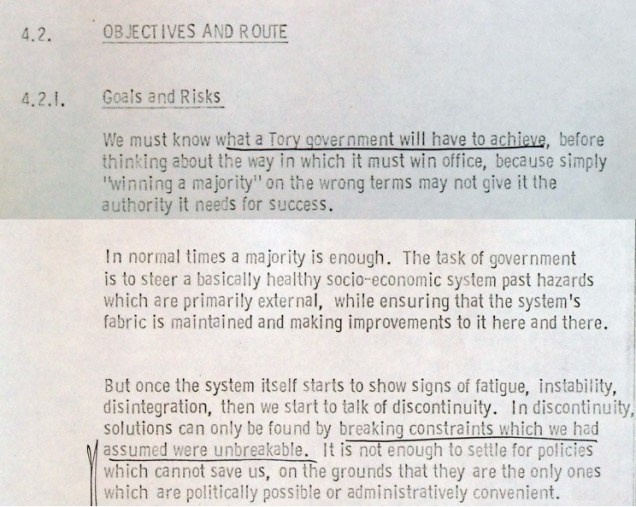
The good news is that there is precedent for all of this. In 1977, the “Stepping Stones” report was published by the late John Hoskyns and Norman Strauss, two businessmen (at IBM and Unilever respectively) who took it upon themselves to diagnose the “British disease” which threatened to doom us to long-term national decline, and propose radical solutions. Crucially, the treatment prescribed by Stepping Stones was not a mixed basket of scattergun solutions to individual problems, but rather a coherent package of reforms which sought to simultaneously treat all of the symptoms of the British disease while also identifying and destroying the root cause (the grip of statist socialism and the unions).
The Britain of the 1970s, wallowing deep in the failing post-war consensus, can hardly be described as being highly receptive to radical right-wing thinking at the time Stepping Stones was published. But that didn’t matter – Hoskyns and Strauss managed to get the ear of aides to Margaret Thatcher back when she was still Leader of the Opposition, and when she walked into Downing Street in 1979 she did so with Stepping Stones in her handbag and on her mind. Then, as now, the important thing to begin with was not that the country understands the entire plan or knows that the Tories view the current status quo as a disease to be cured, but just that the government seems to have energy and purpose again. The plan will reveal itself in good time, just as Stepping Stones did.
That doesn’t mean that the Tories can avoid coming up with a better narrative than “Strong and Stable” or “Brexit means Brexit”. These were appalling battle cries with which to fight the 2017 general election, and deserved to be mercilessly picked apart and ridiculed by the media and a newly-confident Labour Party. A new narrative is certainly needed, but this must be both authentically conservative and it must avoid clashing with policies that the government intends to adopt. For instance, it is no good for the Tories to publicly wring their hands about such-and-such social issue when they have little intention of directly tackling it through the levers of government. That’s why I am hesitant to support the Big Tent’s heavy focus on social renewal – it opens up endless opportunities for the sanctimonious parties of the Left to attack us for weasel words or hypocrisy, while at the very best all we can hope to do is fight the socialists to a draw.
But of course, back in 1977-79 all of this ideological and rhetorical renewal was done from the relative comfort and obscurity of opposition. Now, an intellectually exhausted Tory Party must effectively perform the same feat while in government and seeing their worldview held accountable for every little thing that goes wrong up and down the land. This is a much harder task, bordering on the impossible.
Yet that is exactly what we need. We need a new Stepping Stones report for the Britain of 2017, recognising that the challenges we face today – globalisation, automation, mass migration, Islamist terror and Brexit – are very different to those faced by the incoming Thatcher government in 1979, but that these contemporary problems must be tackled with exactly the same spirit and according to the same conservative values.
Hopefully the Big Tent can play an important role in this process. If nothing else, it is hugely encouraging to see somebody, anybody else finally acknowledge that the Conservative Party does actually need to renew itself and come up with a compelling conservative vision for Britain rather than arrogantly waiting for Jeremy Corbyn to fail. This blog has been something of a voice in the wilderness on this topic since mid way through the coalition government – hammering home the point here, here, here, here, here, here, here, here, here, here, here, here, here, here, here, here, here, here, here, here, here, here, here, here, here, here, here, here, here, here, here, here, here, here and here – but it is good to be belatedly joined by a chorus of establishment journalists and conservative commentators who have finally woken up to the fact that the Tories need an explicitly ideological answer to Jeremy Corbyn and Labour’s resurgent socialism.
Toby Guise is broadly hopeful that the Big Tent has potential:
Disheartened conservatives should remember that cultural Marxism was born out of weakness not strength—specifically, the failure of Western proletariats to obey Marxist doctrine by revolting during World War One. Since the fall of Communism, the strategy has been pursued with ever-greater vigour as a displacement activity from discussing discredited economic ideas. When British Labour politicians are put on the spot about policy, they often flounder spectacularly. Yet the overall direction of travel in Jeremy Corbyn’s speech today at the Labour national convention was clear: towards a Venezuelan-style command economy based on nationalization and authoritarianism. Equipped with this tried-and-failed policy program, it’s no surprise that the party machine diverts as much attention away from economics and onto kulturkampf. By refusing to engage this strategy—and instead directing attention firmly onto clear-minded political solutions that make markets work for all—the Big Tent Ideas Festival is precisely the right type of response.
Mark Wallace was also pleasantly surprised:
I’m pretty sure I saw some Hunter wellies, and some conversations did occasionally threaten to induce a minor wince. But, if we’re honest, there was probably less of each of those phenomena to be seen in the beautiful Berkshire sun than there will be in Manchester next week.
Crucially, they did not outweigh the value of the event, which grew on me as the day went on. Here were Conservatives, entrepreneurs, inventors, charity founders, policy experts, young people, older people and a mix of journalists and politicians talking about ideas for a whole day. That shouldn’t be unusual, but it is. The election, and the problems suffered by the Conservative Party among certain key demographics, was the inevitable backdrop to the discussion, but the Big Tent encouraged people to exchange views openly, to hear experiences alien to their own, and to consider how their principles might be applied to real world issues.
With about 220 people in attendance, it wasn’t a lobbying-fest, or a jockeying arena for glad-handing and card-swapping. It felt more like what I’d imagine to be Steve Hilton’s ideal wedding reception (except with more shoes): tents and bunting, a good buffet, and a bar of sustainably-produced beverages, along with speeches about the environment, prison reform and the impact of technology on democratic culture.
This wasn’t a representative sample of the Conservative Party, still less of the electorate, either socially or ideologically, but I found it refreshing to see people applying their minds and experiences to pressing problems.
I have also now volunteered my time and effort to the cause. And in a way, I will regard whether my offer of help is taken up as a sign of whether the Big Tent has the potential to be a useful vehicle for conservative renewal. Not because I am so amazing, talented and inspired that I can single-handedly save British conservatism, but because if they start listening to independent bloggers and other voices (besides the usual MPs, journalists, Westminster types, charity representatives and community organisers) then it will be a clear sign that British conservatism is willing to entertain ideas from outside the bubble. That having hit intellectual rock bottom they are finally willing to take a dispassionate look at their failings and make some vital changes.
Stepping Stones, which literally formed the blueprint for saving Britain from 1970s-style national decline, was not borne of a cosy conversation between people inside the Westminster political elite. It took outsiders – from the world of business, in this instance – to hold a mirror up to the country and to the establishment, showing them that the old path was unsustainable and that new ideas, previously dismissed as unworkable or politically unpalatable, were required to get Britain back on track.
We need a new Stepping Stones report for the Britain of 2017, and a Conservative Party with the ambition, courage and clarity of thinking to get on and carry out its recommendations, effectively executing a dramatic mid-term course change rather than waiting fearfully for Jeremy Corbyn’s Labour Party to cast them back into opposition.
God speed to the Big Tent and the work they are doing; Lord knows that it is desperately needed.
–
Support Semi-Partisan Politics with a one-time or recurring donation:
–
Agree with this article? Violently disagree? Scroll down to leave a comment.
Whether you believe that Brexit is a brave and noble endeavour or a rash, ignoble folly probably depends a lot on your perception of short and long-term risk
Imagine that in some surreal scenario you mysteriously found yourself on board a huge passenger aircraft flying a multi-stop, seemingly never-ending transoceanic journey to nowhere.
As the hours and days tick by onboard this strange vessel you begin to question where the plane is taking everybody, and who set the flight plan. There’s an old framed picture of the airline’s founder, Jean Monnet, hanging at the front of the plane above the sealed cockpit door, but the captain and the other passengers refuse to clearly state the destination themselves, even though they all seem very anxious to get there. Rather than being candid, they make only vague allusions to the potential destination and arrival time, and repeatedly emphasise the importance of travelling together in a big, stable aircraft to keep us safe from turbulence.
Then suppose that one day you question whether you want to be on this flight in the first place – your fellow passengers keep getting sick, the pilot stops randomly at tiny airfields in seedy-looking places to let a whole bunch of extra people climb aboard without even checking their boarding passes, and while every seat comes with its own plastic toy steering wheel giving the childish illusion of individual control, it is plainly apparent that the pilot is the sole person in charge.
You also have strong suspicions that a certain Lederhosen-wearing passenger sitting in First Class is the captain’s special favourite, and that this is why they get to control the cabin air conditioning, select the in-flight movie, dictate the meal choices for everyone sitting in Economy and sometimes even persuade the pilot to change speed and altitude. Back in 2015, a little scrawny passenger owed Lederhosen Guy some money and was being evasive about paying it back – now he rides in the unheated, unpressurised cargo hold.
So you finally speak up and ask why we are on this flight at all, this Airbus A380 on steroids, when out the window we can see other happy families zipping along in their Cessnas and small private jets, travelling together in a loose formation to reach their preferred destination but also preserving their individual ability to climb, descend, stop at an airfield for lunch or set a new destination altogether if they so choose.
And in response, some wiseguy across the aisle says that you have no right to complain because a mysterious benefactor bought your ticket armed with perfect information as to the plane’s ultimate destination. The travel agent certainly never lied to them, making the journey seem shorter and the destination more pleasant than the reality now unfolding – no, your benefactor apparently was apparently very firm in their desire for you to embark on this particular journey, and approved of every subsequent course change made by the captain, tacitly if not explicitly.
Many of the other passengers also take turns lecturing you that the era of private aviation is over, that only a fool would put his life in the hands of Westphalia Private Aviation Corp., that one family in one aircraft cannot possibly complete a safe and successful autonomous journey in this day and age, and that only by abandoning our trusty Learjet and boarding the enormous Airbus can we protect ourselves from dangerous pockets of clear air turbulence and other assorted perils of the sky. And if that means eating the same cheap airline food day after day, and giving the airline pilot total authority over us while in the air then so be it.
This is unacceptable, so you pluck up the courage and deliver an ultimatum: either the captain gives up his absolute powers and pays more attention to the demands of individual passengers – even if that means amending the route – or you will disembark, return to your own aircraft to fly on your own terms with your own companions in your own squadron, and with your own destination in mind. The captain laughs in your face. Lederhosen Guy stares at you with a kind of impassive curiosity, but says nothing. The aircraft continues humming along at cruising altitude.
What to do? You figure that storming the cockpit, relieving the captain of his duties and attempting to land the plane yourself is inherently risky, yet it seems preferable to reaching the plane’s ultimate destination and then realising that all of your worst fears and suspicions were correct – and that there is no return service.
If the aircraft will not change course and you are unwilling to accept the destination (or continued vagueness about the intended destination), then indeed storming the cockpit is the only option left. You don’t want to permanently hijack the plane and steer it exclusively according to your own preferences, nor do you want to thwart the captain and harm others by crashing the plane altogether. You just want to disembark peacefully.
Would it be nice if another Airbus A380 with a more amenable pilot was waiting at the next refuelling stop, ready for you and likeminded passengers to hop aboard and continue your journey in a more collegiate style, agreeing the destination and flight plan together rather than stubbornly navigating according to the old captain’s worn-out, anachronistic 1950s map? Yes, of course it would. But that’s not going to happen today. There is no alternative jet on the tarmac, and for all the money you have given the airline the small print on the back of your ticket is clearly marked “non-exchangeable and non-refundable”.
So you gather what support you can from among the other passengers, count to three, and charge the door.
At one point in 2016, some of the more extreme conservative political pundits in America began referring to the presidential campaign between Hillary Clinton and Donald Trump as the “Flight 93 election“, a reference to the United Airlines plane hijacked by terrorists on 9/11 and deliberately crashed into a Pennsylvania field after passengers learned of the attacks on the World Trade Center and mounted a fightback against the Islamist hijackers. This risible, overwrought argument posited that a Hillary Clinton presidency would be so damaging to the United States – effectively the equivalent of another 9/11 attack – that it was the duty of every true patriot to “storm the cockpit” of American government by electing Donald Trump president instead.
Britain’s 2016 EU referendum was not quite a “Flight 93 moment”, not only because unlike the 9/11 attackers, the EU’s motivations and trajectory (though severely misguided) are not deliberately malevolent, but also because the speed of European political integration is slow and incremental, not sudden and rapid. Unlike a hijacking situation, we therefore theoretically had time to think and form a more considered plan of escape. Unfortunately Boris Johnson and Nigel Farage, the ringleaders who nominally led the storming of the cockpit, failed to come up with any kind of coherent plan for what to do when they got their hands on the controls. And now they have handed over command to Theresa May, who sits with white-knuckled grip on the yoke, trying and failing to reassure we the passengers over the intercom by repeating the same worn out banalities. Our position, post storming of the cockpit, is therefore significantly suboptimal.
But ultimately, if the captain will not desist from a reckless and undesirable course of action and an orderly disembarkation is impossible then one is left with little choice other than to forcibly set the plane down, blow the emergency exit, jump down the inflatable slide and walk back to the terminal in search of alternative transportation.
With Brexit, as with all flights, there is an outside chance that the new pilots will crash the plane, resulting in total hull loss and our fiery deaths. There is a slightly higher chance of experiencing a landing so rough that there are multiple injuries, the undercarriage fails and the plane requires lengthy and expensive repairs. Right now there are probably even odds that the landing will be sufficiently bumpy that those who do not have their seatbelts fastened securely will get thrown around the cabin a bit and generally have a bad time. But of course, the corollary to this is that remaining on the aircraft despite not knowing its destination and having no individual control over the plane carries a risk of its own. The next stop may be Warsaw or Bucharest, but eventually the plane might head for Pyongyang, carrying us along with it.
The difference between Remainers and Brexiteers is this: Remainers do not seem to much care where they end up (or at least seem willing to smile and suppress any gnawing doubts that they do have) so long as they can be seen to be travelling happily and in total harmony with all the other passengers on the plane. In support of their position, Remainers can point to all of the aircraft’s previous stopovers – many of which were vaguely pleasant or at least neutral – to suggest that we are participating in a wonderful global excursion and would be mad to spurn the promise of future tropical delights.
By contrast, Brexiteers care deeply about the end destination, strongly disagree with the current direction of travel and are willing to go to extraordinary lengths to alter it. Leave voters can bolster their argument by pointing out the unprecedented scope of control passengers have ceded to the captain over time, and noting that ours is the only part of the world where people seem to have lost faith in private aviation and insist on flying together in a single huge aircraft. If abandoning our autonomy and climbing aboard the Airbus is so great, they argue, why are people in Asia, Africa, North and South America not following Europe’s lead?
Neither viewpoint is inherently evil. Rather, each view is formed by a different perception of reality and a varying sensitivity to short and long-term risk.
Or perhaps all Remainers are just flag-hating, anti-patriotic, virtue-signalling traitors who think that supporting the EU is an easy way to check the “internationalist” box on their checklist of trendy-lefty political opinions, and/or every Brexiteer is a harrumphing, xenophobic retired colonel who fetishises the British Empire, hates foreigners and wants to re-impose the social values and norms of the 1950s.
It’s hard to say.
–
Support Semi-Partisan Politics with a one-time or recurring donation:
–
Agree with this article? Violently disagree? Scroll down to leave a comment.













 Semi-Partisan Politics