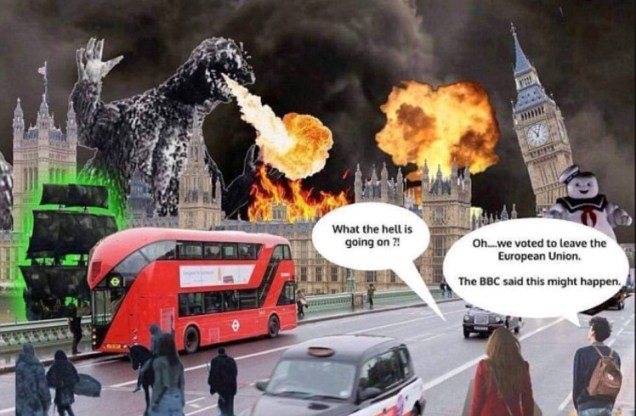
This piece by satirical news site NewsThump accurately sums up the attitude of many disappointed pro-EU Remain supporters, consumed with bitterness at their defeat:
A Remain supporter has confirmed that he would feel much happier for Brexit to be a massive failure and proven right than for Britain to become successful in a post-EU world.
“Well, obviously, I’d like to live in a successful country,” said Simon Williams, a Remain supporter who works in ‘media’.
“But not at the expense of me being proved wrong. That’s unthinkable.
“These are clearly very uncertain times,” he continued while sipping a frappe-mocha-latte-coo-coo-ca-chino.
“So I think it’s important that I, along with all remain supporters, maintain a constant state of gloom and pessimism, and meet any signs of optimism by saying something like ‘well, it’s early days, you wait until the country just falls into a big hole in the ground and everyone dies screaming, then you’ll be sorry’.
“Because otherwise it might mean that Brexit won’t be a disaster, and who wants to live in a world where people like me can possibly be wrong about anything.”
In a sense, it is inevitable that a hard core of bitter Remainers are actively willing political isolation and economic ruin on their own country. When someone’s concept of patriotism and their belief in the capabilities of modern Britain lead them to conclude that sheltering in a failing, anachronistic supranational union is our only shot at maintaining global relevance, it is somehow unsurprising to catch them in the act of rooting for our national failure.
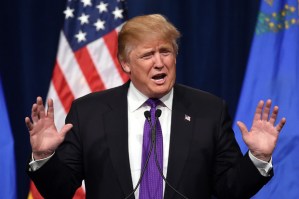
Donald Trump has proven himself incapable of being a serious presidential candidate for more than a few consecutive days. So at this point, behind in the polls, there is really not much to lose by playing to his dubious strengths and pursuing a relentless core vote strategy
There is a pivotal episode of The West Wing (Season 1, Episode 19) in which the entire administration of fictional President Josiah Bartlet appears to be stuck in neutral, under continual fire from the Republican opposition and simultaneously unwilling to seriously tackle the big challenges yet unable to close out the small ones.
The climax of the episode features a showdown between President Bartlet and his loyal chief of staff, Leo McGarry, who tells Bartlet that he and the entire staff serve at the pleasure of the president and would do anything for him, if only he would shake off his caution and timidity, stop second guessing himself and seek to govern more boldly. The assertive new doctrine that they thrash out: “Let Bartlet Be Bartlet”.
Remembering this scene prompted me to remark, in light of Donald Trump’s spectacularly awful campaign:
Many times we feel frustrated with leaders whom we believe in, but who seem to falter at the critical moment or lack the courage of their own convictions. While it was before my time, the tentative early years of Margaret Thatcher’s government spring to mind (the struggles of which are brought vividly to life in Kwasi Kwarteng MP’s excellent book “Thatcher’s Trial”, well worth reading), but there are countless more examples of once promising political candidacies which never got off the ground because the candidate failed to ignite as expected. Rand Paul and Marco Rubio are two such conservative examples from this election cycle alone.
Sadly, when it comes to Republican Party’s current presidential nominee, there is no inspiring higher gear to which the candidate can shift – as Donald Trump seems determined to prove over and over again, this is as good as it gets. And this represents a real problem for the Trump campaign and for the Republican Party, which has tied its fortunes and reputation to this must unstable (and profoundly un-conservative) of individuals.
The anti-establishment schtick and unconventional campaign techniques which propelled Donald Trump to the GOP nomination are not sufficient, it turns out, to sustain a viable presidential campaign. As the National Review’s Jim Geraghty puts it, the conventional campaign rulebook is reasserting itself, and Trump seems frozen, unwilling (but also unable) to adapt.
With just 81 days until election day and new opinion polls showing Hillary Clinton currently having a lock on the electoral college votes she needs to win the White House in November, there isn’t much time for a reset of the Trump campaign. And even if a thorough, genuine reset were to take place it seems unlikely that many of the voters whom Trump has insulted or terrified on his way to the Republican nomination can be persuaded to put their concerns aside and vote for Donald.
So what to do? It is becoming increasingly clear that trying to get Donald Trump to act like a serious, knowledgeable presidential candidate isn’t working – Trump either resentfully ignores the advice he is given, or old habits quickly reassert themselves despite anyone’s best intentions. The “somebody please stop Trump being Trump” mantra is not working. So could the solution be to do exactly the opposite – to Let Trump Be Trump?
Those dreary Trump “presidential” speeches — the “policy” addresses he has lately been reading listlessly from teleprompters — have bought him nothing. Trump is indeed beyond coaching, and, with Manafort sidelined, Trump is free to be Trump full-time again. Bannon and Ailes are both pugilists likely to pump his volume back up to the full Mussolini-Giuliani timbre. It may not make a difference come November, but I’d argue it’s the only way for Trump to go.
As we’ve learned over the past year, Trump’s supporters don’t care about the journalistic investigations debunking his career and ethics, or about his complete disregard for facts, or about his chilling, unworkable, and destructive prescriptions to “make America great again.” When he said that he “could stand in the middle of Fifth Avenue and shoot somebody” and still hold on to his hard-core base, he had a point. So he might just as well be as outrageous and noisy as he possibly can. Reaching every conceivable aggrieved white American out there, particularly the “poorly educated” whom he admires and particularly those who might not be regular voters, is his best hope, however faint, for achieving a putsch. (Particularly if some October surprise upends his opponent.) The time for Trump to woo, say, undecided suburban voters by attempting (incompetently) to mimic lunchtime speakers at the Council on Foreign Relations is over.
In fact, there are already some signs that this is exactly what the Donald Trump campaign now intends to do. Rather than show any evidence of outreach to wavering undecided American voters, Trump has continued playing to the gallery of his true believers with his unprecedented and intemperate attacks on Hillary Clinton. Rather than appearing with Republican politicians who are respected on a bipartisan basis, Trump continues to cement his public image by appearing with partisan carnival barkers like Rudy Giuliani, now a small, aged and perpetually frightened shadow of his former self.
This was cemented by yesterday’s announcement that the Trump campaign will hire Breitbart executive Stephen Bannon as new campaign chief executive – elevating somebody from the loud and unapologetic conservative media with no experience in political campaigns.
Donald Trump, following weeks of gnawing agitation over his advisers’ attempts to temper his style, moved late Tuesday to overhaul his struggling campaign by rebuffing those efforts and elevating two longtime associates who have encouraged his combative populism.
Stephen Bannon, a former banker who runs the influential conservative outlet Breitbart News and is known for his fiercely anti-establishment politics, has been named the Trump campaign’s chief executive. Kellyanne Conway, a veteran Republican pollster who has been close to Trump for years, will assume the role of campaign manager.
[..] Trump’s stunning decision effectively ended the months-long push by campaign chairman Paul Manafort to moderate Trump’s presentation and pitch for the general election. And it sent a signal, perhaps more clearly than ever, that the real estate magnate intends to finish this race on his own terms, with friends who share his instincts at his side.
Dreher thinks we have entered the world of farce:
Woke up this morning to see that Trump had put Breitbart chairman in charge of his campaign. Wait, what? Is this the @TheOnion. Oh, but no.
Frankly, I think American politics crossed over into The Onion territory some time ago now – this latest news is barely a ripple in the sea of absurdity. But from a strategic perspective, in which a political campaign has to make its best shot with the resources available to it, what else is the Trump campaign to do?
I recently described the Trump campaign’s problem like this:
It’s not that Trump chooses not to surprise everyone and confound expectations by playing the policy wonk and actually taking the time to read up on issues before running his mouth off on live television – it’s that he is physically incapable of being a mature, intellectually curious potential leader, even if he wanted to be. And even when despairing aides hold their make-or-break “interventions” in an attempt to set him on the straight and narrow, Trump simply smiles and nods, and two days later he is back off the Teleprompter again, picking another unwinnable fight or pursuing one of his many personal vendettas.
So more of the same then, from now until November. The Republicans had better hope that there is an entire army of low-information, first time voters willing to put on pants and leave the couch for the first time in 30 years to vote for their man, because otherwise Hillary Clinton will be taking the oath of office on January 20th.
This really is Trump’s only shot at winning. Generally I refrain from making any comparisons between the Donald Trump phenomenon and Britain’s historic vote to leave the European Union – mostly because Brexit and the campaign to reclaim nation state democracy is something pure and noble, while authoritarian Trumpism is the antithesis of those high ideals. But it must be noted that the EU referendum campaign here in Britain revealed a sleeping army of people who had in some cases not voted for multiple decades, but who were spurred to action by the gravity of the decision being put to them in the form of Brexit.
Donald Trump needs to hope and pray that there is a similar sleeping army of typical non-voters – made up of the economically left behind, the alienated white working classes or whatever other label one wishes to ascribe – lying dormant in America, ready to spring to life and to the polling booth at his campaign’s command.
And those of us who abhor Donald Trump and his nasty, un-conservative brand of grievance-based authoritarianism need to hope and pray that there is no such army, or at least that Trump fails to find their collective “on” switch before November 8th.
But from Donald Trump’s perspective, there is nothing to lose. The New York demagogue has no precious poll lead to squander and no reputation to protect; he is congenitally unable to portray even the facsimile of a humble, temperate, intellectually curious and ideologically rooted leader. Trump’s only chance of victory – short of Hillary Clinton’s campaign detonating over one of the many scandals which stalk the Democratic Party nominee, or some big extraneous shock like a major terror attack on American soil – is to double down with the strategy which brought him thus far, and to surround himself (as he is now doing) with campaign staff who are willing to go with the flow rather than work against the grain of his personality.
In short, the Republican Party’s last, best hope of winning the White House is to stop fighting electoral gravity and simply let Trump be Trump.
Meanwhile, the rest of us will have to trust that what worked so well for President Jed Bartlet in The West Wing does not work miracles for Donald Trump.
–
Support Semi-Partisan Politics with a one-time or recurring donation:
–
Agree with this article? Violently disagree? Scroll down to leave a comment.
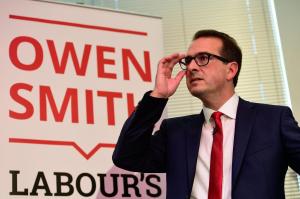
Owen Smith, the supposedly mature and electable alternative to Jeremy Corbyn, is nothing but a pale, naive and cheap imitation
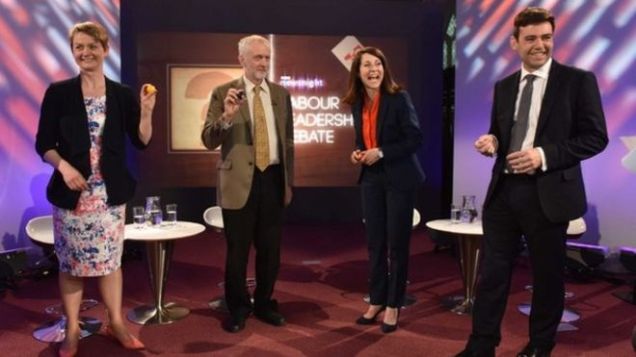
There could hardly have been an easier question asked of the two Labour leadership contenders, Jeremy Corbyn and Owen Smith, during the hustings/debate broadcast on the BBC’s Victoria Derbyshire show this morning.
Moving the focus on to the Islamic State (sorry, so-called Islamic State – this being BBC world), Derbyshire asked both men whether or not they believed that any peace process in Syria should involve representatives from ISIS.
Immediately alarm bells should have been sounding in Owen Smith’s head, for this was the most primitive of political traps. Anything other than a robust “hell no!” would instantly be taken to mean woolly socialist accommodation with Islamist extremism, and so the correct thing to do was clearly to temporarily forget nuance, give the robust “hell no!”, and then move on.
Even Jeremy Corbyn managed to get it right. He was clearly lying through his teeth – given his public statements on Hamas and other violent organisations, everyone knows that a Prime Minister Jeremy Corbyn would fawningly seek to include ISIS in any negotiations. That’s just who he is. But even Jeremy Corbyn, the man who supposedly lacks a political radar, recognised the trap and said “They’re not going to be around the table, no” when put on the spot by Derbyshire.
Meanwhile Owen Smith, desperate to out-socialist Corbyn at every turn while portraying what he mistakenly thinks is an air of grown up realism, charged headlong into the trap, saying:
My record is I’m somebody who has worked on the peace process in Northern Ireland for three years, I was part of the UK’s negotiating team that helped bring together the loyalist paramilitaries, the DUP in particular into the process, alongside Sinn Fein, and my view is that ultimately all solutions to these sorts of crises, these sorts of international crises, do come about through dialogue. So eventually, if we are to try and solve this, all of the actors do need to be involved but at the moment ISIL are clearly not interested in negotiating.
I’m sorry, which one is the waffling socialist dilettante with no understanding of political communications again? Because for all the world it looks as though Owen Smith is the prevaricating incompetent here, not Jeremy Corbyn.
Let us count the ways in which Owen Smith is wrong. Firstly, there is no comparability between the Troubles in Northern Ireland and the ideology-driven, pan-national phenomenon of the Islamic State.
While it sounds statesmanlike and mature (clearly what Owen Smith was striving for) to intone that serious compromises have to be made on both sides in the pursuit of peace, citing the Northern Ireland peace agreement as evidence, it is a very poor comparison. For the Troubles, for all their complex history, were characterised very much by the narcissism of small differences – the furious hatred which built up between two very similar communities living side by side (Catholic vs Protestant, Nationalist vs Unionist).
When peace negotiations were underway, both sides were prevailed upon to accept a power-sharing agreement in a devolved assembly as well as weapons decommissioning and early prison release for convicted terrorists on both sides. The shared pain was ultimately acceptable to both sides because there was an attractive, shared goal to work towards in the form of a peaceful and more prosperous Northern Ireland.
The difference between the West and the Islamic State (or even between peace-loving Syrians and the Islamic State) does not fit this profile in the slightest. We are not talking the narcissism of small differences, but the belligerence of exceedingly large differences. Islamic State seeks to conquer and occupy territory, and impose its impossibly strict, fundamentalist Wahhabist dogma on all those with the misfortune to become its citizens. There is no compromise, no half-way terms of peace for which the subjugated people of Iraq or Syria could sue, let alone countries like Britain, France and America ,which are the Islamic State’s overseas targets.
The kind of negotiations fancifully suggested by Owen Smith in his failed bid to appear mature and statesmanlike are simply not possible with Islamic State. By their own words and actions, ISIS does not compromise or water down its demands or dogma. “Live and let live” is neither possible nor desirable. Nobody is realistically going to get the Iraqi government to agree to a power-sharing deal involving the surrendering or dilution of sovereignty over its cities. And in the case of Syria, the ongoing civil war means that there is no one authority to speak on behalf of Syrians anyway.
More than anything, this incident serves to underline the sheer superficiality of the Owen Smith candidacy. While this blog was previously encouraged that Smith had at least a few policy ideas of his own (one step better than the hapless Angela Eagle, whose pitch for the top job seemed to rest entirely on her winning personality) these have proven to be nothing but a restatement of Jeremy Corbyn’s own ideas, the kind of policies which a Corbyn manifesto would no doubt have outlined prior to the general election anyway.
With almost zero policy difference between the two candidates, Owen Smith’s only remaining advantage over Corbyn was his supposed electability. Unlike Corbyn, we were told, Owen Smith will avoid making the faux-pas, media missteps and party management howlers which have caused the parliamentary party such unease. And yet in his desperation to defend his left flank, Owen Smith walked into the kind of headline-generating trap that even Jeremy Corbyn managed to avoid.
Did the Parliamentary Labour Party really just squander any opportunity to take the fight to the Tories after the EU referendum and the ascension of Theresa May just to replace Jeremy Corbyn with a third-rate flop of a leadership candidate in the form of Owen Smith? Is this oily, vacuous dilettante really the best that they can do?
Where are the latter-day equivalents of Barbara Castle, Peter Shore, Hugh Gaitskell, Clement Attlee, Aneurin Bevan or Tony Benn?
How small are the creatures who now seek to bestride the shrunken Labour Party?
–
Support Semi-Partisan Politics with a one-time or recurring donation:
–
Agree with this article? Violently disagree? Scroll down to leave a comment.
Owen Jones has an epiphany: centrist Labour MPs are responsible for the rise of Jeremy Corbyn
One of the annoying things about being part of Britain’s marginalised political blogging community (see what I did there?) is the regular insult of seeing ideas first expounded on this blog being subsequently “appropriated” by high profile, celebrity journalists who come late to the party and then claim all the credit (and pageviews) for ideas that they did not originate.
I stay up late into the night ranting sometimes (I hope) semi-original analysis into WordPress, and then three months later some SW1-dweller pops up on the Sky News paper review making the same point as though it is astonishingly fresh insight, getting paid for being late to the party and taking all of the credit.
[Pauses]
Meanwhile, on a completely unrelated note, Owen Jones has worked out that Jeremy Corbyn did not sweep to the leadership of the Labour Party in a vacuum, and that the rise of Corbyn was only made possible because of the accumulated failings of Labour’s centrist MPs.
There are many decent Labour MPs, but it is difficult to think of any with the stature of the party’s past giants: Barbara Castle, Nye Bevan, Ernie Bevin, Herbert Morrison, Margaret Bondfield, Harold Wilson, Stafford Cripps, Ellen Wilkinson. Machine politics hollowed out the party, and at great long-term cost. If, last year, there had been a Labour leadership candidate with a clear shot at winning a general election, Labour members might have compromised on their beliefs: there wasn’t, and so they didn’t.
[..] Corbyn’s harshest critics claimed superior political nous, judgment and strategy, then launched a disastrously incompetent coup in the midst of a post-Brexit national crisis, deflecting attention from the Tories, sending Labour’s polling position hurtling from poor to calamitous, and provoking almost all-out war between Labour’s membership and the parliamentary party: all for the sake of possibly gifting their enemy an even greater personal mandate. They denounce Corbyn’s foreign associations, but have little to say about former leader Blair literally having been in the pay of Kazakhstan’s dictator Nursultan Nazarbayev, whose regime stands accused of torture and the killing of opponents. Corbyn’s bitterest enemies preach the need to win over middle-class voters, then sneer at Corbynistas for being too middle class (even though, as a point of fact, polling last year found that Corbyn’s voters were the least middle class). They dismiss Corbynistas as entryists lacking loyalty to the Labour party, then leak plans to the Telegraph – the Tories’ in-house paper – to split the party.
It is the absence of any compelling vision that, above all else, created the vacuum Corbyn filled. Despite New Labour’s many limitations and failings, in its heyday it offered something: a minimum wage, a windfall tax on privatised utilities, LGBT rights, tax credits, devolution, public investment. What do Corbyn’s staunchest opponents within Labour actually stand for? Vision was abandoned in favour of finger-wagging about electability with no evidence to back it up.
Jones concludes:
Corbyn’s opponents have long lacked a compelling vision, a significant support base and a strategy to win. When Labour fails at the ballot box, its cheerleaders are often accused of blaming their opponents rather than examining their own failures.
The same accusation can be levelled now at Corbyn’s opponents. They are, by turns, bewildered, infuriated, aghast, miserable about the rise of Corbynism. But they should take ownership of it, because it is their creation. Unless they reflect on their own failures – rather than spit fury at the success of others – they have no future. Deep down, they know it themselves.
Slow hand clap. Finally, acknowledgement from a “mainstream” political commentator of what this blog has been saying consistently, even back when a Jeremy Corbyn victory in the leadership election was seen as an absurdity.
Jeremy Corbyn did not become leader of the Labour Party in a vacuum. A cloud did not suddenly descend on Labour Party members, making them crazy and amenable to markedly more left-wing politics. There was no extraneous event on which blame can be pinned, save Ed Miliband’s disastrous tenure as Labour leader, culminating in the 2015 general election victory. The problems are far more deeply rooted, and go way back beyond Ed Miliband and Gordon Brown.
Good job, Owen.
Of course, readers of this blog will know that I have been consistently making the same point, repeatedly, stretching back well before the 2015 general election:
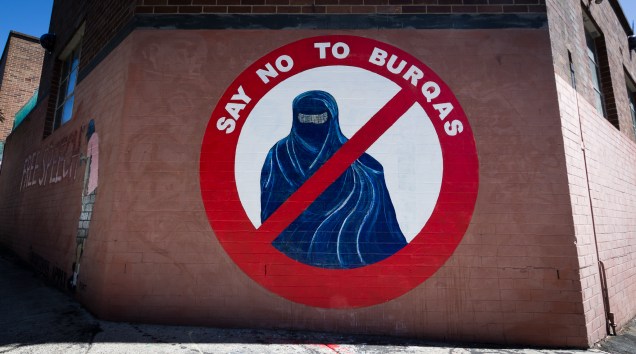
In a liberal democracy, government has no business dictating what clothing is or is not acceptable to wear – and banning the burqa or burkini only further delays the long-overdue day of reckoning between conservative Islam and modern Muslim women
France is now taking its official ban of the burqa one step further, as the mayor of Cannes announces a ban on burkini beachwear on the grounds that the concealing garment poses a security risk.
The mayor of the French resort city of Cannes has barred women from bathing on public beaches in swimsuits that reveal too little skin.
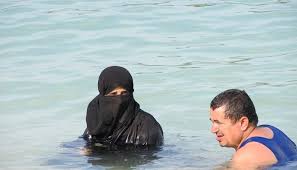
At issue are the full-body, head-covering garments worn in the water by some Muslim women, which have been nicknamed burkinis, an amalgam of burqa and bikini. The mayor’s ban has drawn protests from French Muslims who say it is discriminatory.
That the debate is occurring on the Riviera, the Mediterranean vacation area that has been on edge since the terrorist attack on a Bastille Day celebration in nearby Nice, has only added to the controversy.
Critics of the ban say it risks deepening rifts with France’s Muslims. It is the latest example of the long-running tensions between France’s forceful — some say inconsistent — commitment to secularism and the desire of many Muslims to express traditional values like modesty through their attire.
The mayor’s ordinance, which runs until Aug. 31, bars people from entering or swimming at the city’s public beaches in attire that is not “respectful of good morals and secularism” and that does not respect “rules of hygiene and security.” Offenders risk a fine of 38 euros, or about $42.
Why are burkinis against the rules? “Beach attire that ostentatiously displays a religious affiliation, while France and places of worship are the target of terrorist acts, is likely to create risks to public order,” the ordinance says.
If this were being done in a public place on the grounds of security, the mayor of Cannes would be in a much stronger position, and would gain this blog’s sympathy, particularly after the appalling terrorist truck attack in Nice on Bastille Day. There is a very logical and powerful argument to be made against the prohibition on wearing any overtly concealing clothing when entering public buildings such as town halls, courts, public schools, parks or beaches, just as motorcycle owners are asked to remove their helmets before entering a bank branch.
But the mayor of Cannes has taken this action with specific reference not to security, but in the name of laïcité (the separation of church and state). We know this because French government officials have explicitly said so:
This costume [the burkini], Mr Lisnard [the mayor] declared, “ostentatiously displays religious affiliation”, could “disrupt public order”, and might even, in the words of one official, demonstrate “an allegiance to terrorist movements”.
However, while citizens – even those of faith – should absolutely demand secularism from their government, it does not follow that the government can unjustly impose secularism on the people as they go about their lives. That would be a grave wrong, and the growing movement to ban the burqa represents an abuse of power by governments against their own citizens.
Now it’s hard to muster much enthusiasm for the burkini. It harks back to an age, still dominant in much of the world, when a woman’s worth was measured by her modesty. It belongs to a belief system in which women cannot experience one of the joys of the natural world – feeling the wind and sea on her body. It suggests that the female form is shameful and provocative. But those who want to ban the burkini for these reasons are forgetting one of the most important values of a free society: we don’t all have to believe the same thing in order to live together.
Every day, thousands of Britons wake up and do things I think are crazy and wrong. They drink instant coffee, listen to Magic FM and wear Spandex. Some wear high heels or bowties. Others have plastic surgery, get tattoos, cheat on their spouses, drink too much, shout too much and vote Labour. They get their news from Facebook and watch hours of trashy TV. Many of them pray to a god, convert to Buddhism, believe in crystal healing or sing in Church on Sundays with their eyes closed and their arms in the air. I don’t do or understand any of these things. But I let them get on with it.
[..] Like a theocratic regime, the Cannes burkini ban forces some Muslim women to choose between their religious and their national identity and perniciously suggests that their choice of dress is a political statement, whether they mean it to be or not. It is unsurprising that the French should lead the way in this kind of thinking, because in France nothing is allowed until the law permits it, whereas in Britain, everything is allowed until the law forbids it. So, in the name of enforced secularism, France forbids covering the face in any public setting, whether it’s for religion or Hallowe’en, and bans religious symbols like hijabs (hair coverings) in state institutions such as schools. The burkini ban takes this illiberal trend even further by making it illegal to wear “ostentatious” religious symbols even when going about one’s own private business.
[..] A normal Muslim, who has grown up seeing a hijab as an unremarkable but important symbol of womanhood, finds herself forced to choose between respect for the law and her family’s everyday customs. Is this senseless, banal and brutal ban more likely to awaken a hidden feminist creed and a love of La République in her heart or to make her feel attacked and excluded from mainstream society?
Strong societies cannot permit parallel legal or political systems, such as Sharia courts or caliphates. But they can cope with differences in dress and customs. They should not allow obstructive religious clothing like face‑coverings to disrupt teaching or court hearings. But if a Muslim woman wants to wear a baggy wetsuit and go for a swim on a public beach, that does not make her a threat to Western society. The real enemies of freedom are not the burkini-wearers, but the politicians who want to ban them.
Amen to this. Samuel is quite right to fear the politicians over the burkini-wearers, even if we may disagree with their sartorial and religious motivations. Indeed, we should fear any further legitimisation of the idea that our rights derive from the state, who can suspend our freedoms at will in the name of “security”.
One of the most alarming things about this century has been the rejuvenation of authoritarianism, spurred on by the growing threat of Islamist terror. Whether it is manifested in airport security theatre, the banning of religious jewellery or other symbols from the workplace or the dystopian suppression of free speech in universities, public squares and social media, we have become markedly less free in sixteen years with precious little to show for it.
But more than all of that, if we are serious about tackling the skewed ideology and belief system which preaches that women must be modest to the point of having to bathe fully clothed, then a government ban is the absolute worst way to go.
Such a diktat of law effectively exonerates conservative Islam (or fundamentalists of other religions) from any responsibility to reform and recognise the equality of women, gay people and other minority groups. Ban the burqa (or burkini) and conservative Muslims may obey. But not only will they immediately be able to portray themselves as victims in the process, claiming persecution for their religious beliefs, they will be under no further internal pressure to reconsider and reform centuries-old religious diktats in the changed context of modern society.
If we want a world where the burqa is relegated to fringe extremists and museums, then the pressure must come primarily from Muslim women. Only when they demand their right to dress as they please and force the reluctant accommodation of religious authorities will they be able to win the parity of treatment which has been missing for so long.
The job of Western governments in all of this is not to interfere or seek to be a white knight, banning the burqa or burkini on the behalf of oppressed women. Government’s role is to make sure that Muslim women have full access to the legal system to sue for their equal treatment in court where it is being infringed, and to clamp down insidious efforts to set up parallel justice systems based on Sharia law or any other religious code instead of shamefully welcoming them in the name of “multiculturalism”.
But ultimately, this is an internal enlightenment which must take place within Islam. It is not the job of provincial mayors in France or government departments in Britain to “rescue” their female Muslim citizens from oppression; nor would any such rescue hold any legitimacy. Western society can take certain actions to encourage this revolution among its Muslim communities, but ultimately the heavy lifting must be done by Muslim women standing up to claim their own full rights as citizens.
Widespread bans on the burqa or burkini may make us feel good or even allow some of us to burnish our feminist credentials, but that is the only good that they will accomplish. And meanwhile, the long-overdue day of reckoning between modern Muslim women and the conservative wing of the Islamic faith will be deferred indefinitely, to everyone’s cost.