No Patriotism Please, We’re British

really-british-chris-ostwald-muswell-hill-london-patriotism

Only in North London’s leafy enclaves would a shop selling British goods and memorabilia be at risk of being run out of business by snarling locals convinced that union jack cushions are one step away from fascism

Another day, another painful reminder that London voted strongly against Brexit and is, in many ways, a different country within a country.

Local newspaper Ham&High reports:

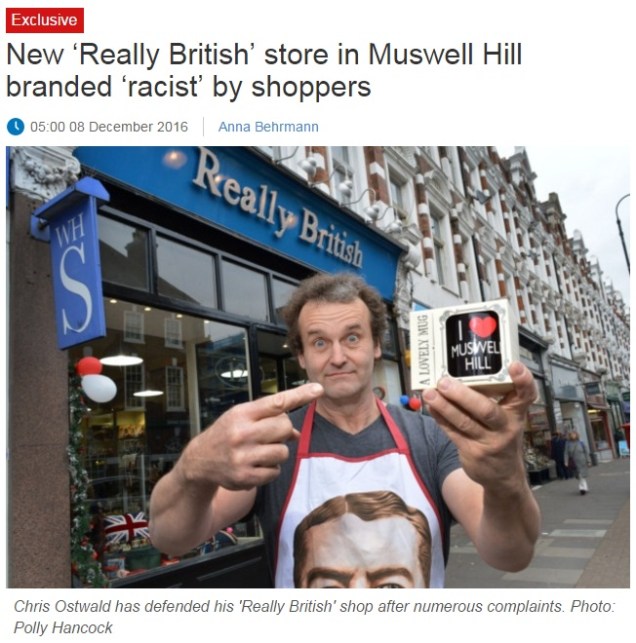
A shopkeeper has defended his novelty gift shop after it has been boycotted by shoppers who branded it ‘pro-Brexit’ and ‘racist’.

The shop in Muswell Hill caused a storm on social media with owner Chris Ostwald, 54, forced to remove his British flags on the opening day on November 26 because he received so many complaints.

One of the shop assistants, who is Spanish, left after just one day because of all the snide remarks she received.

The shop sells British-themed gifts and homeware. Their products include condiments, such as brown sauce, London underground tea towels and “Muswell Hillbillies” mugs, which references the Kinks album. There are also suffragette aprons and stocking fillers such as old fashioned compasses.

Mr Otswald, 54, told the Ham&High: “The shop is in no way meant to be ‘political’ or ‘pro Brexit’, but we have had a lot of complaints saying it is or we are ‘racist!”

“A guy came in the other day and said, ‘what’s this, a charity shop?’ and we said, ‘no, not at all’, and he said, ‘well it’s racist’, and stormed out.”

Mr Ostwald added: “People have been coming in and just tutting and walking out.”

There have been other comments on Facebook, with one person arguing that the name is not inclusive.

One man wrote on public Facebook group Muswell Hill and Friends: “Chris, while I applaud you setting up a business in Muswell Hill and employing local people I’m curious as to why you decided to call your shop ‘Really British’ (besides the obvious point that you will sell British made goods)?

“Like many people I live in London because of its international nature, and for me personally having a big sign on the Broadway saying ‘Really British’ makes me feel you’re implying that other local businesses in the area are therefore somehow ‘not really British’.

“Some will no doubt say I’m over-sensitive but I can’t help thinking that given the recent divisive referendum and the current political climate you might have chosen a more inclusive name in 2016.”

This invidious disease of proud anti-patriotism is particularly British. In America, whether you are on New York’s Fifth Avenue or Main Street in some small Mid-Western town, a shop which celebrates Americana and American heritage would be celebrated and universally popular. In France, shops which sell traditional French produce and goods are happily frequented by tourists and locals alike.

Only in Britain are we cursed with a sub-population of pinch-faced killjoys who have been bred to believe that any expression of pride in Britain is “scary” and somehow tantamount to racism. Only in the fashionable and gentrifying parts of London and Britain’s other major cities does one find this pitiful tribe of people who are allergic to their own flag.

Only in places like London’s Muswell Hill do people hold the country which gives them life and liberty in such horrified, sneering contempt.


European Union - United Kingdom - Britain - Flags

Support Semi-Partisan Politics with a one-time or recurring donation:

Agree with this article? Violently disagree? Scroll down to leave a comment.

Follow Semi-Partisan Politics on TwitterFacebook and Medium.

Tales From The Safe Space, Part 50 – University of Maryland President And Students Vie For Coveted Victim Status

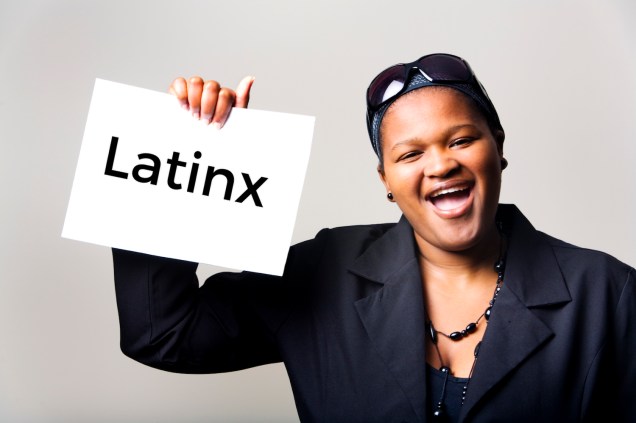
latinx

Waah, waah, waah

What happens when SJW students and their university president become locked in a social justice victimhood showdown, each trying to claim offence and present themselves as having been somehow harmed by the other in a gruesome yet compelling display of whinnying, childish immaturity?

The University of Maryland shows us exactly what happens.

Campus Reform reports:

University of Maryland President Wallace Loh inadvertently outraged liberal students by using Spanish while pledging to protect illegal immigrant students, a move deemed “offensive” to UMD’s immigrant population.

Much of Loh’s annual State of the Campus Address was a “a clear call to embrace diversity,” according to The Diamondback, including a promise to protect illegal immigrant students on campus by barring immigration officials from campus if they don’t have a warrant and refusing to voluntarily share undocumented student information.

“These are the things that we will commit to, that we will do and will not do in order to create a safe and supportive learning environment,” he declared.

His repetition of the same statement in Spanish, however, raised eyebrows among some members of the crowd, even though he had employed a similar tactic in a campus-wide email last month in which he first outlined UMD’s intent to resist federal immigration enforcement efforts.

Student Senator Ashley Vasquez, for instance, complained that Spanish “does not represent the entire immigrant community here” during a post-speech Q&A, asking Loh if he would like to apologize for repeating his promise in Spanish.

Vasquez later told The Diamondback that she found Loh’s use of Spanish offensive because it implied that the only immigrants on campus are “Latinx.”

This is brilliant on so many levels.

Firstly, why make the comment in Spanish at all? Is anybody studying at the University of Maryland incapable of speaking English? (Hint: No) Is this part of a policy of general bilingual communications, signs, written and verbal instructions at the university? (Hint: No again). The only reason for President Wallace Loh to make such a gesture is that it affords him a quick and easy way to signal his own virtue, his acceptance of absolutely all kinds of immigration, legal and illegal, moral and immoral.

To see Wallace Loh then called out by a professional offence-taking student for oppressing immigrant students of other backgrounds by failing to pander obsequiously to their own native languages is in many ways inevitable. Just as straight gay men are often no longer considered sufficiently “oppressed” to warrant full coverage under the Social Justice umbrella, so it may soon come to pass that “Latinx” students, being so plentiful in the United States, find themselves summarily deemed relatively privileged and cut adrift as the SJWs go looking for rarer and more exotic immigrants to defend.

And if one accepts SJW logic, who can argue with the student’s complaint? Hispanic people are a rapidly growing demographic in America. In the Rio Grande Valley of Texas, where I have family, the Hispanic population far exceeds the white and there are some stores and businesses where I am disadvantaged as a non Spanish speaker. But in terms of how much their language is catered for in America, Hispanics are immensely “privileged” compared to, say, German, French or Mandarin speakers. The student is therefore doing what any good SJW student should do – casting aside the interests and concerns of a relatively privileged group and focusing on more “marginalised” ones instead.

But President Loh’s response makes this story even better:

Loh, who is Peruvian and a native Spanish speaker, did not initially address the question, but later responded to the accusations after a second student asked him to apologize, as well.

“I simply said that I completely support—I said in Spanish what I previously said in English,” Loh remarked with surprise. “Are you asking me to apologize because I’m speaking in Spanish, which is the first language I learned?”

Loh probably realises that he actually committed a bit of a culturally imperialistic faux-pas by translating his Ode to Undocumented Immigrants only into Spanish, thus suggesting that immigrants and illegal immigrants can only come from an Hispanic background. But he doesn’t want to back down, so instead he chooses to take public offence at the student for criticising him for speaking in his native language.

In other words, we have here a grown man and somebody who rose to the position of president of a state university flopping around on the floor like a wounded victim and playing the role of a wide-eyed innocent child whose ice cream was just stolen because rather than confess to a mistake, his social justice ideology commands him to always play the victim to get out of a tight spot.

Naturally the student was unimpressed with his deflection:

UMD senior Lauryn Froneberger apparently didn’t find Loh’s response sufficient, mainly because he did not concede that his use of Spanish was offensive.

“As a student you want to know that your university stands by you and won’t use language that sort of offends you,” Froneberger said. “And even if you let them know they offended you, I think it’s important to acknowledge that. I don’t think he acknowledged that at all.”

I’ve said it before and I will no doubt say it many more times on this blog – the Cult of Social Justice and Identity Politics is not about doing good or liberating people from genuine oppression. It is a first world, middle class cult of power, a virtual country club with its own finicky rules and seething, petty power struggles.

And this pathetic little exchange at the University of Maryland’s “State of the Campus” (ha!) address is just one of what will be many more tussles between students and faculty, both of whom drink the identity politics Kool-Aid and both of whom intend to use identity politics principles to bolster their own tawdry arguments and undermine their foes.

The University of Maryland’s own president is apparently unable to think properly in public or respond to a challenge when called out by a student in any way other than curling up into a ball and asserting hurt feewings victim status himself.

Where’s rock bottom again?


decolonizing-latinx-feminisms-course

Safe Space Notice - 2

Support Semi-Partisan Politics with a one-time or recurring donation:

Agree with this article? Violently disagree? Scroll down to leave a comment.

Follow Semi-Partisan Politics on TwitterFacebook and Medium.

The Cult Of Social Justice and Identity Politics Has No More Worlds To Conquer, Yet Still It Marches On

hans-gruber-die-hard

There may be no more worlds for the regressive Left to conquer, but the warriors of the Social Justice Army still see enemies all around

This blog has spent some time explaining that the Cult of Social Justice and Identity Politics is far less about helping genuinely oppressed people and far more about a small, snarling pseudo-intellectual clerisy seeking to use the often dubiously legitimate suffering of various proscribed victim groups as a means of wielding power and influence over wider society.

It follows, then, that for this cult to perpetuate itself there must be a constant stream of wronged victims at all times, on whose behalf the social justice priests and priestesses can claim to speak. When your career and entire worldview is built on the bedrock of seeking to end “oppression”, one inevitably sees oppression everywhere and in the smallest of things. To acknowledge that we actually live in an historically free and prosperous era would be to admit that their services are no longer required – that their whole raison d’être is no more.

And this is why even now, when the fruits of SJW hyper-sensitivity, snarling authoritarianism and utter contempt for ideological agnostics lie strewn across the political landscape in the form of President-elect Donald Trump and a Republican-dominated Congress, that portion of the American Left which has fallen under the spell of the Cult of Social Justice and Identity Politics cannot admit wrongdoing or overreach, and refuses to change tactics or re-examine their mission.

This is why despite having lost the White House by racking up superfluous votes in liberal enclaves while actively chasing away votes in key swing states with their out-of-touch policies and narratives, the bulk of the American Left and the Democratic Party are unable to conceive of any other possible course of action than shouting the same shrill, divisive message even louder.

Ben Shapiro captures the essence of the problem in a great piece for the National Review:

For decades, the Left consistently put front and center its vision of an America in which Republicans were victimizers: Either they were evil racists, or they were John Lithgow–in-Footloose holier-than-thou sexual prudes, or they were old-style Mad Men sexists looking to shove women back into the kitchen. Celebrities helped push these narratives through the stories they told, the movies they filmed, the books they wrote.

And Americans accepted the critiques.

Americans accepted racial equality. Americans celebrated female empowerment. Americans went libertarian on sexual behavior.

And the Left had to go searching for a new civil-rights struggle with which to cram conservatives back into their “victimizer” cubbyhole.

There was, however, one problem: All the good civil-rights issues have been dealt with already. And so the Left, which focuses all of its efforts on social issues, was relegated to pushing crime-increasing myths about the evils of cops; the celebrities were forced to pretend that men peeing next to women was the next great Martin Luther King, Jr.–style struggle; Democrats were forced to march on their next target, not merely church involvement in state, but private beliefs of churchgoers.

And herein lies the biggest problem facing the American Left: America is the most tolerant country in world history. There are no more serious civil-rights struggles for the Left to push. In fact, the Left now pushes against civil rights in its ignorant search for the new struggle: Religious bakers must be destroyed if they won’t bake a cake for a same-sex wedding; young girls must be forced to go to the same bathroom as middle-aged men, hosts on HGTV must be policed for belief in Scripture regarding sexual sin.

No wonder Americans reacted by telling the Left to shove it.

That phenomenon could very well continue. The Left has run out of aggressors to target; instead, they’ve become the aggressors, self-righteous morality police dedicated to wiping out dissenting thought. Americans aren’t up for that sort of thing. We think we’re pretty tolerant people, and, by and large, we are. Trump won, at least in part, by refusing to kowtow to the Left’s newest social crusades, in word if not in deed.

And Shapiro’s conclusion may well prove prophetic, unless the American Left change course:

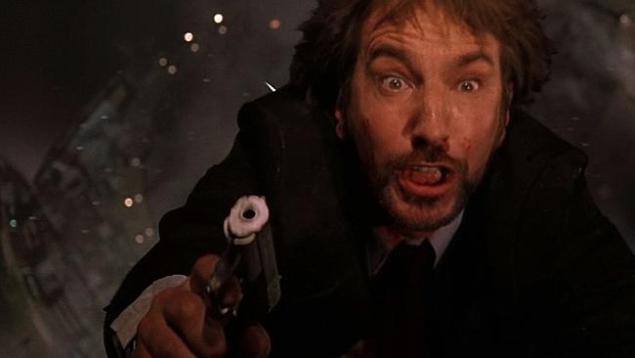
In Die Hard, villain Hans Gruber misquotes Plutarch: “And when Alexander saw the breadth of his domain, he wept, for there were no more worlds to conquer.” The Left will never recognize that simple fact — and so they will push ever onward, steadily encroaching on liberty and driving a blowback they cannot comprehend.

There may be no more worlds to conquer, but the Left is strangely unwilling to disband its standing army – or rather is unable to do so, knowing that their electoral coalition of competing special interests and designated victim classes is only held together so long as there is a clear Enemy Oppressor to fight.

Having helped to achieve civil rights, women’s equality and gay rights, the American Left should now be beating its swords into ploughshares, hanging up the social justice armour and generating a tide to lift the boats of all Americans (including the maligned white working class), not only their favoured interest groups.

Hint: this might have something to do with trying to solve the great political question of our time, as frequently mentioned on this blog.

But they can’t. There are too many greedy over-powerful generals to feed and reward with war spoils, and these generals (the leaders of the various social justice movements) in turn must keep their troops happy by providing them with bounty in the form of political victories, legislative accomplishments and tangible real-world perks – including those which encroach on individual freedom, as Ben Shapiro notes.

Thus the American Left has become an unstoppable social justice juggernaut, perpetually seeking out new offences to take outrage over, in order to give the troops something to do and keep the fractious coalition together a little longer.

Even if Democratic Party leaders could see the folly of their present path (and the re-election of Nancy Pelosi as House Minority Leader clearly shows that the vast majority still do not get it) they would be powerless to change course. The unfolding slow-motion car crash is not pleasant to watch. As Ben Shapiro notes, the fury of the American Left (and the British Left too, to a slightly lesser extent) is “driving a blowback they cannot comprehend”.

While plenty of Donald Trump supporters may spend their leisure hours percolating in an online ideological echo chamber, their necessary interaction with a broadly large-L Liberal media and culture means that they are at least constantly aware of the existence other political viewpoints. Conservative college and university students often learn how to debate, defend and refine their ideas through having them constantly challenged and disparaged on campus.

Not so for the Left. Depending on geography and occupation, it is entirely possible for many on the Left to go for long periods (interrupted only by the odd traumatic microaggression experienced when venturing beyond their safe space or carefully curated social media feeds) without ever bumping into the Other America at all. Judging by the ongoing howls of outraged incomprehension, some on the Left only ever glimpse this America once every four years, at presidential election time.

This is why the American Left is unlikely to change course, even now. When your view of the path ahead is skewed to the side so that you cannot see the iceberg field directly ahead, the first light impact may not persuade you of the need to stop or change course. Nor may the second, slightly more jarring collision with reality. And only when a massive head-on collision holes your social movement and political party beneath the waterline does the folly become truly apparent.


when-alexander-saw-the-breadth-of-his-domain-he-wept-for-there-were-no-more-worlds-to-conquer-hans-gruber-die-hard

Support Semi-Partisan Politics with a one-time or recurring donation:

Agree with this article? Violently disagree? Scroll down to leave a comment.

Follow Semi-Partisan Politics on TwitterFacebook and Medium.

Article 50 Appeal: How Can The British People Respect A Remote And Opaque Judiciary They Do Not Understand?

uk-supreme-court-brexit-article-50-ruling-challenge-parliament-mps

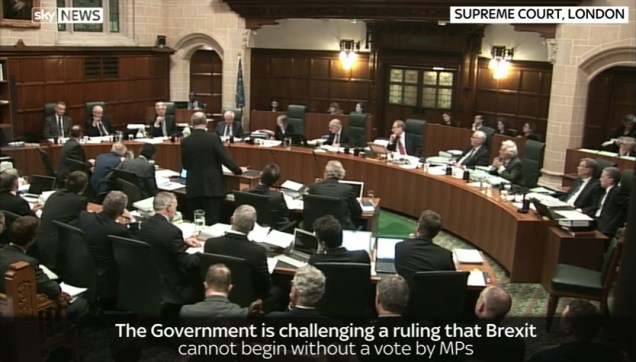
The nation’s eyes were fixed today on the UK Supreme Court as it hears the government’s appeal to overturn a High Court ruling that ministers cannot trigger Article 50 and begin the formal Brexit process without first winning a vote of MPs in parliament. But the arcane, complex and remote British judicial system makes it almost impossible for even informed citizens to follow proceedings or judge the validity of the court’s eventual findings for themselves

Unlike the much more famous United States Supreme Court, the UK Supreme Court is televised – anybody can log onto the court’s website and watch cases being heard via live webcast, including the momentous case currently before the court, in which the government is appealing a High Court ruling that ministers cannot trigger Article 50 of the Lisbon Treaty to formally begin the Brexit process without first gaining the assent of MPs in a parliamentary vote.

And so today the British news channels spent large parts of the day simply broadcasting the goings-on in Court room 1, where the appeal is being heard. Anybody with a passing interest was able to tune in and watch for themselves as the government’s legal team, led by the Attorney General, made their case to the eleven justices (incidentally the first time that all eleven had sat together for the same case).

And yet despite this wall-to-wall media coverage, I doubt that more than a fraction of those who watched any of the proceedings really understood what was happening, or could place the appeal and the arguments being made in the context of Britain’s judicial system and how it fits into our system of government. I include myself in that group of confused onlookers. And if citizens do not understand the basic workings of one of the three branches of government, how are they to know whether the decisions reached are just and legitimate? And how are they to confer their own legitimacy of acceptance upon those institutions?

If a case about mass surveillance makes it to the US Supreme Court, many Americans will automatically recognise that this concerns the Fourth Amendment (forbidding unreasonable searches and seizures of property by government). They may not know much more than that, but the fact that America has a written constitution gives even ill-educated citizens a basic frame of reference when discussing newsworthy legal matters, while a fundamental education in civics teaches them that a president or Congress cannot simply override the rulings of the Supreme Court if they find them inconvenient – and that trying to sidestep the court by amending the Constitution is prohibitively difficult, thus forming one of the famous “checks and balances” in the American system of government.

Contrast this basic civic awareness in America with the dire state of affairs in Britain. Although I do not have an opinion poll to back me up, I would be surprised if one third of British citizens knew that we even had a Supreme Court (it was only founded in 2009, taking over from the previous Law Lords), let alone the names of a single one of its justices.

(Incidentally, the PC Left and rabid practitioners of identity politics are missing a trick here – ten of the eleven current justices of the UK Supreme Court are old white men, with the remaining justice an old white woman. Are these people really the most qualified for the job, or did they get their positions through the chumocracy and establishment connections? Why is there no public confirmation process, to give democratic oversight to the selection of new justices, as there is in America? And yet how many times has the UK Supreme Court been picketed by angry Social Justice Warriors demanding gender and ethnic balance on the court? Never.)

I will be honest and start by admitting that prior to the EU referendum campaign this year, I could only name one justice of the UK Supreme Court – Lord Neuberger, the court’s president. And that’s awful. I write about politics and UK current affairs every day and consume several hours of news on television, the internet and social media besides, but I could only name one person on the bench of the UK Supreme Court. I could speak for hours about the US Supreme Court, its current and past justices and many of the famous cases it has decided, but not so for the Supreme Court of my own country. And if I can’t rattle off a handful of facts and names together with a brief commentary on their respective legal and ideological outlooks, how many people are actually able to do so?

How many laymen – people without a direct professional or personal interest in the workings or judgements of the court – actually do know who sits on the UK’s Supreme Court? How many could explain at a high level how the judicial system works, with the division between civil and criminal court, the work done by solicitors and barristers, and the hierarchy of trial and appellate courts? Or the difference between the Scottish system and that of England and Wales? All that I currently know, I learned from an Introduction to Business Law course while studying at university – there were no civics lessons in the 1990s National Curriculum while I was at school. And many others will not have even received this basic primer.

But how are we to fulfil our potential as informed and engaged citizens when we fail to understand how one of the three major branches of government works? Most people have a passable grasp of the executive and the legislature, even if they don’t recognise the Government and the Houses of Parliament using those terms. But I very much doubt that one adult in twenty could explain the fundamentals of our legal system, let alone the many layered intricacies.

But flip it around. Why would we know how our legal system works, or recognise the major personalities in the British legal scene? And why should we bother to take the time to educate ourselves?

People in America know the names and ideological leanings of the justices on their Supreme Court for a number of reasons. For a start, they take their civics a little bit more seriously on that side of the Atlantic – something that we could learn from.

But more than that, the American legal system is far more responsive to the citizenry than the British system is to us. One major difference is that many local judges are elected. Now, this may or may not be a good idea – and having watched a number of local races for positions on the bench, I have my grave doubts as to the wisdom of elected judges. But you can’t deny that you are likely to feel much closer to the legal system if you have a direct say in who gets to don the black robes.

Even more important is the fact that unlike we Brits, Americans have a written constitution to act as a common frame of reference when talking about legal matters. Even half-educated Americans will talk about whether something is “constitutional” or not, and apply this test to all manner of public policy debates, from government surveillance to gay marriage. This is important, because it gets people thinking beyond the mere fact of whether they agree or disagree with a particular law, and toward the broader question of exactly why the law in question is good or bad. That’s not to say the ensuing debate cannot still be ignorant and intemperate – it often is – but at least everyone is able to take part in the debate along the same parameters.

Consider the Edward Snowden leaks, when one whistleblower’s actions laid bare the extent of secret government surveillance in Britain, America and the other “Five Eyes” countries. In America, the people – outraged at this secret, systemic violation of their privacy – were able to haul officials in front of congressional committees and debate the legality of the government’s actions with reference to the Fourth Amendment, which prohibits unreasonable searches and seizures of property. And in due course, the American government had to make a number of concessions and restrict its surveillance activity. In Britain, by contrast, we had David Cameron and Theresa May pompously telling us that they respect the “tradition of liberty” but are basically going to do whatever they want. And what recourse had we to stop them? None.

Then there is the central role which the US Supreme Court often plays in matters of great social importance in America. In Britain, Parliament’s “elected dictatorship” is the Alpha and the Omega for nearly all significant decisions made in this country – the government can pass or repeal any law almost at will and with no reference to any higher text or law, so long as it can muster the votes in the House of Commons. The courts then simply apply what has been handed down by Parliament, which is sovereign. Refreshingly, this is not so in the United States.

Consider just some of the most famous cases – household names, even to those of us living in Britain. Dred ScottCitizens United. Roe vs Wade. Brown vs Board of Education. We may know next to nothing about American current affairs, but we know that these relate to slavery, campaign finance, abortion and racial segregation. Because in America, the president is not the only person who matters in politics. Nor are the leaders of Congress. The third branch of government matters equally, and how the Supreme Court chooses which cases to hear and applies their interpretation of the Constitution to those cases constitutes a vital check and balance in the American system.

Can you name a comparably important British legal case? They do exist – the Al Rawi case, for example, with its implications for the legality of secret hearings, or Nicklinson vs Ministry of Justice, which confirmed the current illegality of voluntary euthanasia, or the “right to die”. But few people know about these cases or why they are important, because the British legal system is so much more remote and unaccountable to the people.

Finally, there is the question of sovereignty. The United States Supreme Court is the final arbiter of what is and is not constitutional, and therefore applicable to American citizens. It cannot be shunted aside by an impatient government if it holds up or overturns key legislation, and nor can it be undermined from the outside – the court determines for itself which cases it will hear, and a majority decision made by five out of nine Supreme Court justices will then bind the government and lower courts. This goes against everything that the current British establishment – who are only too happy to wreck every institution and overturn any tradition in pursuit of their short term goals – stands for.

But crucially, the US Supreme Court is also not subordinate to any external or foreign body. By contrast, until Brexit is completed, the UK Supreme Court is treaty-bound to defer to the decisions of the Court of Justice of the European Union (CJEU), and must interpret all UK legislation not through the lens of compatibility with a British constitution, but rather to ensure its compliance with EU law and the European Convention of Human Rights.

This begs the question why we as a country do not trust ourselves enough to be the final arbiter of important issues affecting our society. Are we naturally more corrupt, untrustworthy or barbarous than our European neighbours, and in need of constant judicial restraint by our moral betters on the continent? Whatever the answer, the inescapable truth is that legal subjugation to an external, supranational body is the antithesis of national democracy.

So to recap, there exist a number of deficits between the American and UK legal systems in terms of ensuring citizen understanding and engagement with the judicial branch of government, namely:

1. A weaker sense of civic duty and engagement in Britain

2. Greater democratic distance between the people and the legal system in Britain, compared to America

3. Lack of a written British constitution as a common frame of reference when discussing legal matters

4. A much clearer link between decisions made in the US Supreme Court with American social policy

5. Lack of sovereignty: the American legal system is sovereign and subordinate to no external body, unlike the British legal system which (for now) remains subordinate to EU law

But in 2016, in the wake of the Brexit vote and with a key court case relating to the government’s execution of the referendum mandate to leave the EU having reached the Supreme Court, there is simply no good argument for continuing to abide such a remote, elitist and unaccountable legal system as we suffer in Britain. None. Especially when other countries, including our closest ally, have demonstrated a far better approach.

And anybody tempted to sniff haughtily at the American system, with their elected lower court judges and Scopes Monkey Trial culture wars should remember that however passionate and unseemly the public discourse can sometimes be across the Atlantic, this is only because more American people are actually engaged citizens with a moderate grasp of how their country actually works, and therefore confident enough to participate in that process. We should be so lucky to have a system as simple, accessible and easy to explain as they have in the United States.

And it should be a source of great shame to us that our journalists, politicians and private citizens often know more about another country’s legal system through watching Hollywood movies or Law & Order than they do about our own.

Right now, the American public is fixated on the issue of who President-elect Donald Trump will nominate to fill the Supreme Court seat left vacant by the late Antonin Scalia – a first rate mind and writer of opinions and dissents which are accessible and entertaining even to laymen like myself. Americans care about who takes up the ninth seat on their Supreme Court, because unlike Britain, their legal system is clearly more than a plaything of the establishment or a rubber stamp for the government of the day.

The ninth justice of the US Supreme Court may well end up casting crucial swing votes in important matters of human governance in the next decades, such as the right to bear arms in self defence, the right to privacy and the right to free speech. And these decisions could well have tangible, real-world consequences for the 330 million people who live under the court’s jurisdiction.

Elevating the people and the institutions into the public consciousness is not crass sensationalism, as some may charge. On the contrary, focusing on the personalities helps to elevate the issues to a place of prominence in our public discourse, which is exactly what we should be doing here if our own elites were not so busy trying to hide from public accountability anywhere they can scurry – be it behind the black veil of EU lawmaking in Brussels or the bewigged, dusty obscurity of the British legal system.

It will be ironic if it takes a bitter legal dispute over a referendum fought partly over the principle of restoring the supremacy of British laws to force Britain to finally take a proper, critical look at our currently impenetrable legal system. But public interest in legal matters peaks only very rarely, and so those of us who want to see real legal and constitutional reform have a slim opportunity – but also an obligation – to make our case.

For as things stand, a constitution and legal system in force over 3,000 miles and an ocean apart often feels more familiar – and less remote – than our own.

As things stand, the highest court in our country is hearing arguments and preparing to make a decision concerning the most significant political change to come to Britain since the Second World War, yet for most of us, the judges and lawyers may just as well be speaking in Klingon for all that we will learn from the proceedings.

And a legal system which is made deliberately opaque and inaccessible by definition can neither claim legitimacy nor deliver justice, on the Article 50 appeal or anything else.
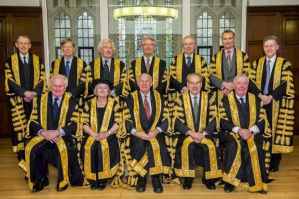
 

Supreme Court Justices - United Kingdom

Support Semi-Partisan Politics with a one-time or recurring donation:

Agree with this article? Violently disagree? Scroll down to leave a comment.

Follow Semi-Partisan Politics on TwitterFacebook and Medium.

Virginia Schools Butcher The English Literature Curriculum To Appease Social Justice Zealots

n-word

Humanity’s intellectual and artistic horizons must not be limited by the delicate sensitivities of society’s most easily-offended members

It has happened again – another oversensitive, censorious American school district has suspended the works Huckleberry Finn and To Kill a Mockingbird from their high school curriculum pending a full review of the two novels’ artistic merit versus their supposed offensiveness. And this time, all because of one solitary parental complaint.

The Guardian reports:

To Kill a Mockingbird and The Adventures of Huckleberry Finn have been suspended from the curriculum in some Virginia schools, after a parent complained about the use of racial slurs.

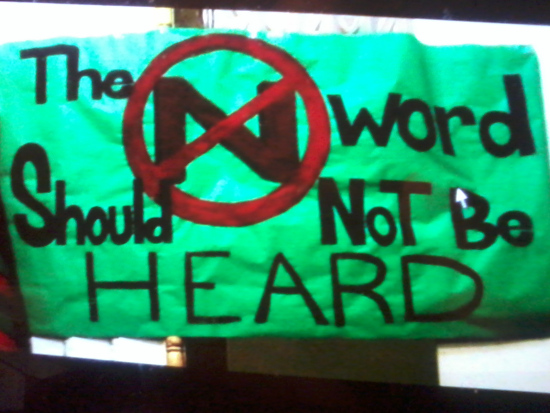
Harper Lee and Mark Twain’s literary classics were removed from classrooms in Accomack County, in Virginia after a formal complaint was made by the mother of a biracial teenager. At the centre of the complaint was the use of the N-word, which appears frequently in both titles.

The woman who made the complaint said her son struggled to read the racist language, telling the Accomack County public schools board: “There’s so much racial slurs and defensive wording in there that you can’t get past that.” The challenge also appears to be motivated by the current political landscape in the US, as the mother told the board: “Right now, we are a nation divided as it is.”

What a pathetic person, and what terrible parenting. If her son “struggled to read the racist language”, it is only because he was deliberately made fragile. Made fragile by his own parent(s) and by the society in which he grew up, which constantly, wrongly taught him that sticks and stones may break his bones, but words can kill him stone dead.

The danger is that by bowing to these petty, whinnying requests for censorship, our overall society is dragged down to the level of the weakest and most intolerant members. Little Timmy can’t read this book without weeping and being triggered, so now nobody can read it.

Are we really to shuffle books in and out of the school syllabus according to how sensitive people feel following a presidential election? Is a book’s inherent worth subject to fluctuate according to the changing political fortunes of the Democratic and Republican Parties? This is ludicrous.

As this blog has argued numerous times, the “N-word” has no power to harm beyond that which we give it by pretending that there is no difference between using the word in anger and clinically discussing it in a classroom, court of law or television news broadcast.

And there is a difference. Being called a nigger is not tremendously pleasant. As a mixed race young man (like the child whose insufferable parent demanded the ban), I have had occasional direct experience myself. But this is a world apart from reading or hearing the word in the context of studying a great work of literature. And people who are unable to make this distinction should not be allowed to hold the rest of society back by virtue of their self-inflicted fragility.


Safe Space Notice - 2

Support Semi-Partisan Politics with a one-time or recurring donation:

Agree with this article? Violently disagree? Scroll down to leave a comment.

Follow Semi-Partisan Politics on TwitterFacebook and Medium.