–
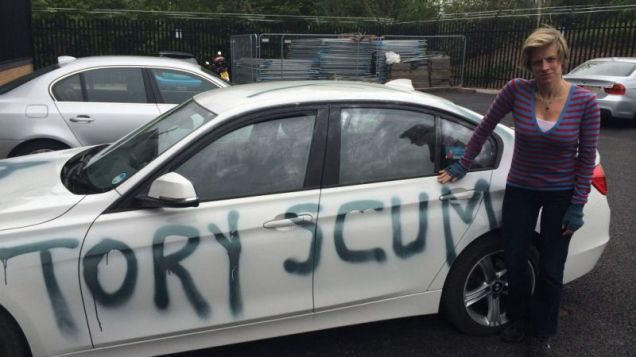
When ordinary people with perfectly mainstream opinions are hesitant to express themselves for fear of being accused of racism, prejudice, stupidity or worse, our democracy is in real trouble
If you voted Conservative or UKIP at the 2015 general election, you could be forgiven for wondering where the other fifteen million people who made the same choice are currently hiding themselves. David Cameron’s leadership may be uninspiring and his government’s achievements few, but these are hardly the paranoid, dying days of the Brown government – ordinarily there should still be a level of authentic, spontaneous support to be found out and about the country.
Equally, you may wonder how on earth it was possible for Ed Miliband and Labour to have lost that election, given the fact that social media and popular culture roar their hatred of the Evil Tories louder than ever, that it is almost impossible to find kindred spirits willing to admit to voting Conservative or UKIP, and the fact that conservative policies and beliefs are routinely derided as ignorant and selfish at best, and violent and vengeful at worst.
The current political environment can be quite lonely for anybody with conservative leanings – and it makes one wonder why the people who delivered David Cameron his House of Commons majority and propelled UKIP into a remarkably strong third place are so desperate to avoid drawing attention to themselves.
There have been a couple of worrying pieces in the media this week which highlight the fact that furious open hostility toward anything vaguely conservative or eurosceptic – often emanating from a small but determined band of opposing activists – is having a chilling effect on the political discourse and preventing small-c conservatives from openly articulating their opinions.
First, the Independent carries a letter from former Labour MP Tom Harris, who only felt able to “come out” as a eurosceptic after having left elected office. Sounding as though a weight had been lifted off his shoulders, Harris writes:
I was never a fully paid-up member of the Euro team. Early signs of unsoundness manifested themselves in my outright opposition to British membership of the euro when it was first launched. The whips’ office had its eye on me after I added my signature to a letter, back in 2002, warning the then Chancellor, Gordon Brown, to resist committing to abolishing the pound. And once you’ve decided to oppose that central mechanism for the creation of a European superstate, it’s a fairly short step to being painted as “anti-EU”.
But my instinct to vote Leave (probably running at 53 to 55 per cent right now) is not something that can be confessed in polite middle-class company. Such an admission might too easily be interpreted as a dislike of foreigners or, worse, a tolerance of Nigel Farage.
[..] The question is precisely the same one we were asked in 1975: should we stay or should we go? In the meantime, if asked over dinner how I intend to vote, I’ll do the sensible thing and change the subject to the range of breads in the Marks & Spencer food hall. Or The Archers.
And follows up in the Telegraph:
As for me, I will continue to pursue this enigma known as “the normal life” by having, expressing, then rejecting various opinions. No doubt they will be variously correct, wrong, misplaced, insightful and dangerous. I may believe in all of them, some of them, or none of them.
What’s it to you?
But among Labour circles and much of the wider Left, it is simply no longer “permissible” to hold eurosceptic views, or to believe that Britain’s democracy and vital national interests would be better served by leaving an explicitly political and ever-more closely integrating union which we never realised we were joining in the first place. The Tories are perceived to be eurosceptic (even though many of them are not), and so the prevailing dogma has it that one must be pro-EU to be anti-Tory.
Aside from the few brave (and mostly decidedly retro) souls who form Labour Leave, the question of Britain’s ongoing EU membership simply is not up for discussion. And to express any doubt whatsoever about Britain playing an enthusiastic part in this European political union is seen as treachery, automatic disqualification from membership of the movement.
Look at Jeremy Corbyn’s reversal on the issue. Love or hate Corbyn, he has been willing to stand up to a mostly hostile Parliamentary Labour Party on issue after issue, from military action in Syria to the Paris attacks to the question of Trident renewal. On all of these issues, the Labour leader has proven himself willing to enrage many of his MPs by holding firm to his deeply held convictions.
But what of his eurosceptic convictions? Jeremy Corbyn has been a lifelong eurosceptic, and voted for Britain to leave the European Community in the 1975 referendum. Corbyn holds this view about as strongly as any other, and yet it was on this issue alone where he instantly capitulated to the establishment and became a pro-EU advocate. What should rightly be a non-partisan issue pertaining to sovereignty and self-determination is instead imbued with nearly the same cultural weight and quasi-religious fervour as one finds in the American culture wars. Such is the power of the Left’s infatuation with the EU.

The second article of concern is this worrying testimonial from a conservative-leaning history supply teacher who found himself drummed out of the school where he taught because colleagues complained when he failed to join in their frequent denunciations of the Tory government and all things conservative.
Joe Baron writes in The Spectator:
After keeping schtum for two months, I finally challenged a colleague’s view of the Tories. ‘Why are Tory voters thick?’ I asked. ‘Is it just because they happen to disagree with you?’
‘No,’ he replied. ‘Because they voted for cuts’.
‘Perhaps they saw the cuts as necessary,’ I said. ‘Surely it’s better to make savings now, rather than keep spending money we don’t have, go bankrupt and, like the Labour government of 1976, be forced to make even deeper cuts after going cap in hand to the IMF.’
‘That’s rubbish!’ said another colleague. And so it continued, though no one actually raised their voices, until they brushed off my argument with a blasé ‘yeah, yeah, yeah’ before gesturing towards the office door as if dismissing a recalcitrant child.
If Joe Baron had been loudly and forthrightly expressing his views in favour of Ed Miliband and the Labour Party, he would have been met with a chorus of approval and the respect of his colleagues. But in choosing to defend conservative ideas like government fiscal responsibility and personal self-sufficiency, Baron chose another path. A darker path:
I was called into the head’s office and told that, after a complaint from colleagues in my department, the school would no longer require my services. So I was effectively being dismissed for holding the wrong views, though of course the head dressed it up in a different garb: it was my manner rather than my opinions. Apparently I was ‘too assertive’.
As I remember it, my interlocutors were both red-faced and angry, and more than willing to use inflammatory language. I was told, at one point, that I was unfit to teach.
Interestingly, the head of department who refused to work with me — effectively calling for my dismissal — had several weeks previously decried the cruelty of zero-hours contracts. Where was her left-wing compassion when it came to sacking me, a married man with two children to support?
I suppose I’ve only got myself to blame. For a brief moment, I deluded myself into believing that schools actually encouraged tolerance and the questioning of orthodoxies through intellectual exploration, freedom of thought and speech. How silly of me.
Both cases – Tom Harris the former MP and Joe Baron the supply teacher – are examples of the visceral, real-world retribution which is threatened (and sometimes carried out) by those on the Left against people who have committed the thought crime of being a conservative. And this climate of anti-Tory hate-mongering not only distorts our political discourse, but undermines the health of our democracy, whose proper functioning relies on people with political differences being able to speak their consciences in good faith.
My own personal experience of this phenomenon has thrown up more depressing anecdotes than I can relate here. Friends who have sat next to me on the couch shouting at the television when one smug-faced Question Time panellist (or audience member) after another have deliberately misinterpreted and sanctimoniously condemned Nigel Farage or David Cameron, but who fall fearfully silent when the inevitable anti-Tory hate mobs form around the water cooler or on social media.
Or the senior PR executive I was chatting with at a recent event for the launch of Dan Hodges’ excellent chronicle of the 2015 general election, “One Minute To Ten”, who furtively looked around and dropped her voice to a hushed whisper before confiding to me that she actually voted Conservative, picking David Cameron over Ed Miliband.
Or the look on the faces of people I speak with in my hometown of Harlow, Essex, at the precise moment when a voice in the back of their head tells them to self-censor their speech and hold back their real opinions, for fear of ridicule or attack. They may have re-elected an excellent local Conservative MP in Robert Halfon, but few are willing to proudly and publicly stand by their decision months later, away from the privacy of the polling booth.
You just don’t see this same reticence on the other side. For a political movement which makes a great performance of supposedly being the voice of the voiceless and most marginalised people in the country, left-wingers have a near monopoly in many areas of the public discourse, particularly in the arts and entertainment sectors. And there are far fewer occasions or settings where it is necessary to pause and “read the room” before confessing one’s left-wingery than there are situations where conservatives have brutally learned the wisdom of self-censorship.
The problem is that it is not just the unhinged crazies sharing misspelled memes on the internet and typing in ALL CAPS below the line on news website articles. People like that exist on all points on the political spectrum from left to right, and the misogynistic ranting of one barking CyberKipper no more represents UKIP than the conspiratorial, anti-Semitic sermons of a self-declared Corbyn supporter reflect on Labour.
No, the real problem is the softer bigotry of bien-pensant public opinion – the arrogant assumptions of the dinner party set, well-heeled professional people in the office or having dinner at Carluccio’s – the middle class clerisy, Brendan O’Neill called them. Their willingness to lazily believe and repeat hysterical left-wing smears about conservatism and to virtue-signal in front of their friends by flaunting their vague and incoherent opposition to the Evil Tory government are the problem.
And it becomes a self-fulfilling prophecy. The more that left-wingers openly flaunt their views while attacking or shunning anybody who thinks differently, the more likely they are to only ever hear ideas and opinions which chime with their own worldviews, and falsely assume that they are universal.
But it’s not true. The 2015 general election proved that there is no silent left-wing majority in Britain, and there will be no “rainbow coalition” of left-wing political parties coming together to kick the Evil Tories out of office any time soon.
In fact, the only question is how much longer the Left can continue to punch above their rhetorical weight before the British people finally tire of the sanctimonious yapping of a bunch of ideologically incoherent, virtue-signalling, anti-aspirational opportunists and the temper tantrum they are throwing in the face of a very mild and utterly unremarkable centrist government.
How much longer will the silent majority-makers of this country be willing to silence themselves, censor their speech and edit their public opinions solely to avoid the screeching disapproval of these losers?
Right now, it may be hard for some to “come out” as conservatives. But the Left are loudly and brazenly overplaying a very weak hand, and the sooner that more of us start calling them out on it, the easier it will be for more people to stand up and take pride in not being just another centre-left drone.
–
Agree with this article? Violently disagree? Scroll down to leave a comment.
Follow Semi-Partisan Politics on Twitter, Facebook and Medium.






 Semi-Partisan Politics