No, Jesus Would Not Demand Open Borders

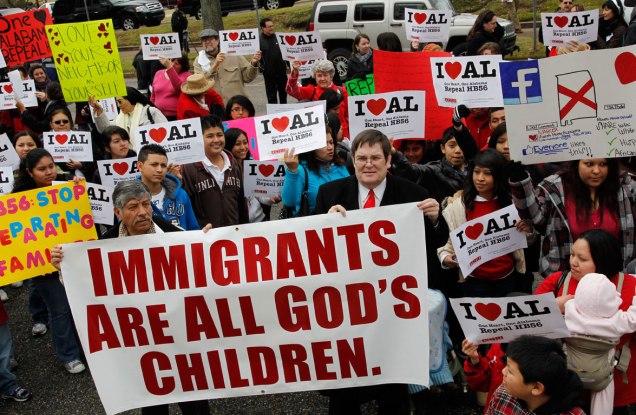
Immigrants are all Gods children - Christian immigration protest

Those who make a Christian case for open borders and uncontrolled mass immigration do not apply the same altruism they demand of society to their own personal lives, and neither would tearing down national borders improve the common good. Those who use their faith (or even more cynically, the faith of others) as a bludgeon to agitate for open borders do so based on a deliberately superficial reading of Christianity, in which Jesus is little more than an easy-going aging hippie, or a benevolent Santa Claus figure

The Windrush scandal – in which British permanent residents and citizens, either naturalised immigrants or descendants of immigrants, were wrongly targeted for deportation because of bureaucratic incompetence and the eagerness of a fawning, rootless government to appear tough on immigration – has pushed the issue of immigration back up the list of top voter priorities in the United Kingdom.

At times like this, it is customary for cynical and opportunistic voices on the Left to exploit developments in order to agitate for their broader goal of open borders (or at least something perilously close to open borders – few left wing politicians are now willing to publicly articulate any restriction on immigration or sanction for immigration law violations which they actually support). And so it was this time, with a parade of Labour and other left-wing politicians effectively making the preposterous case that bureaucratic callousness with regard to the affected Windrush immigrants means that the government has now morally forfeited the right to control the borders at all.

Unfortunately, these voices are often also joined by left-wing Christians who waste no time extrapolating from one appalling example of Big Government callousness to press entirely tangential arguments about a more permissive immigration system. The Church of England’s own Migration policy subsite rather deceptively makes mention only of asylum and refugee issues, utterly ignoring the dominant economic migrant subgroup. One can only assume that this is because the CofE knows as well as the rest of us that pretending that the great migration wave consists entirely of the former type and not the latter is more likely to generate sympathy and lead to pressure for looser immigration policy.

As the depth of the government’s failure and mismanagement with regard to Windrush immigrants became evident, social media was swiftly flooded with tweets and sentiments suggesting that any attempt by politicians or civic leaders to dissuade or expel illegal immigrants – people entirely unconnected with the Windrush scandal – from maintaining unlawful residence in the United Kingdom is prima facie evidence of a missing or defective conscience:


Even Martyn Eden, political editor of Premier Christianity magazine, equivocates:

Some will see this affair as reflecting an underlying racism in British culture. Given that the density of population in the UK is 268 people per square kilometre, second only to Holland in the EU, a case can be made for limiting immigration, but the Brexit campaign certainly showed evidence of a xenophobic hostility to foreigners.

Our duty to love our neighbours regardless of their racial and family backgrounds, following Jesus’ teaching and example, will shape how Christians understand and respond to this distressing and shameful episode in our national life.

This mirrors the vague, evasive wooliness and anti Brexit bigotry which swathes of the Church of England (including all the senior hierarchy) displayed so prominently during the 2016 EU referendum campaign and its aftermath (see here, here, here and here).

Recently, Pope Francis has made noises (in the form of an apostolic exhortation) deeply suggestive that he believes open borders to be “pro-life” and the correct starting point for any Christian view of immigration:

102. We often hear it said that, with respect to relativism and the flaws of our present world, the situation of migrants, for example, is a lesser issue. Some Catholics consider it a secondary issue compared to the “grave” bioethical questions. That a politician looking for votes might say such a thing is understandable, but not a Christian, for whom the only proper attitude is to stand in the shoes of those brothers and sisters of ours who risk their lives to offer a future to their children. Can we not realize that this is exactly what Jesus demands of us, when he tells us that in welcoming the stranger we welcome him (cf. Mt 25:35)? Saint Benedict did so readily, and though it might have “complicated” the life of his monks, he ordered that all guests who knocked at the monastery door be welcomed “like Christ”,[85] with a gesture of veneration;[86] the poor and pilgrims were to be met with “the greatest care and solicitude”.[87]

We see exactly the same climate in the United States, where the progressive wing of the Church is enthusiastically embracing the concept of “sanctuary cities” and taking an increasingly extreme position against any kind of immigration enforcement. The argument usually goes along the lines of that advanced here by Michael Clark in Sojourners:

I currently live in Houston, Texas, the nation’s fourth largest city and most diverse metropolitan area. We’re a city with no racial or ethnic majority, where nearly 1 in 4 people were born outside the U.S. We’re also home to 400,000 undocumented immigrants, earning us the label “sanctuary city” from some.

[..] but Houston’s status as a sanctuary city requires a response from everyday residents, nearly three quarters of whom claim to be Christians. Will Christians make a sanctuary in our city?

Before we put our defenses up (They’re here illegally! They’re taking our jobs! They need to come in the right way!), let us remember that our allegiance is not primarily to this nation. Jesus himself said, “My kingdom is not of this world” (John 18:36). Paul reminds us that “our citizenship is in heaven” (Philippians 3:20), and though we are to respect earthly authority (Romans 13:1), when push comes to shove, “we must obey God rather than men” (Acts 5:29).

Will we be a sanctuary in the tradition of the early church? Will we heed God’s commandment: “the stranger who resides with you shall be to you as the native among you, and you shall love him as yourself, for you were aliens in the land of Egypt” (Leviticus 19:34)?

Will Christ say to us, “I was hungry and you gave me something to eat, I was thirsty and you gave me something to drink, I was a stranger and you invited me in, I needed clothes and you clothed me, I was sick and you looked after me, I was in prison [or an immigration detention center] and you came to visit me”?

Let us remember his words, “Truly I tell you, whatever you did for one of the least of these brothers and sisters of mine, you did for me” (Matthew 25:40).

This is manipulative schmaltz of the worst kind. All of it. Anybody can harvest quotes from the Bible to build a case that Christian compassion involves rolling over and doing whatever a particular activist wants at that moment in time. But what we lack in this argument (and we see this over and over again in Christian arguments for mass immigration or open borders) is any acknowledgement that the immediate benefit to one new incoming migrant is not the only important consideration at stake.

When Jesus performed miracles there was no tradeoff, with one individual newly afflicted by the disease which Jesus cured in another, or the alleviated suffering of one person displaced onto somebody else. Nobody died because Lazarus was raised from the dead. Those who were healed at Gennesaret by touching Jesus’ cloak were not offset by a similar number who were struck down in their place. Uncontrolled mass immigration does not work like this. While there is a clear personal benefit to each marginal unskilled migrant  (and we are talking economic migrants here, remember, not refugees) allowed into a developed country, there are offsetting costs to be considered, too.

Sometimes these costs are tangible and quantifiable, such as the additional burden on infrastructure, services and the welfare state. Other times these costs are uncertain and appear only in the form of risk (such as risk to public order or national security). But the net effect is that the “good” done by letting in unlimited numbers of unskilled migrants from poor countries is offset by a commensurate cost. And this cost is no less important or worthy of consideration just because it is diffused across society as a whole rather than concentrated on one individual.

Rod Dreher makes a similar point in religious terms, rebutting the idea that Christian hospitality must be open-ended to the point of self-destruction:

This is why St. Benedict’s rule of hospitality is not open-ended. Monks will certainly welcome guests as if they were Christ, but that welcome does not imply that visitors have the right to stay in the monastery for as long as they like. What’s more, monks cannot welcome guests who, whether by their behavior or their sheer numbers, prevent a monastery from fulfilling its purpose. No stranger has a right to expect the monks to abandon their way of life to accommodate his desires. It’s simply dishonest and manipulative for the Pope to invoke St. Benedict’s example in this way. One likes to think that even Pope Francis would not expect a monastery to fling its gates open and house as many migrants as want to set up camp there, indefinitely.

We know that these negative costs of open borders will be incurred, and that they will be borne by society at large. So why is it more Christ-like to prioritise one over the other? Welcoming the stranger is absolutely the right thing to do when there are no offsetting costs to that act of charity, but what if welcoming the stranger causes a completely innocent third party to suffer harm? What we see, though, is many Christians prioritising the needs of the former over the latter. And in a way this is understandable – the benefit to the migrant is obvious, easy to measure and enjoyable to bestow, while the cost to society is diffuse, sometimes intangible and only detectable on the macro level, not at the individual level. Choosing the tangible and immediate over the intangible and time-delayed is a natural human instinct, albeit a harmful one in this instance.

So perhaps the real question we should be asking ourselves is this: does Jesus want us to think purely from with hearts, or does He also want us to engage our brains?

Viewed this way, the emotionally incontinent “Jesus would let in all the migrants” line of argument is becoming increasingly tiresome and threadbare. Maybe He would, and maybe not – perhaps instead He would work miracles to improve the broken and dysfunctional countries which feed mass migration in the first place, rather than feeding an urban leftist’s fetish for infinite diversity. Presuming that Jesus would opt for the immediate solution, the easy answer, the quick fix, grant the superficial human desire rather than the deeper human need, is to fundamentally misunderstand how Jesus’ ministry unfolded. Claiming that Jesus would advocate open borders is to subscribe to an incredibly two-dimensional, aging hippie version of Jesus, one which reduces the Son of God to little more than a genial Santa Claus figure.

If – as the Christian open borders activists insist when it comes to welcoming strangers – we sought to emulate Jesus’ dealings with and instructions to his contemporaries in our geopolitical dealings then the world would be a very different, and likely much darker place. Nazism and Soviet Communism were not defeated through pacifism, after all. And if we were to take Jesus’ instructions to his immediate disciples and contemporaries as granular instruction for twenty-first century life we would forever be forsaking all material goods, leaving our families to pursue nomadic and ascetic lives of service and chasing after muggers offering them the few personal effects they haven’t already stolen from us. I know of very few Christians who meet – or even seek to meet – this standard, not because they are selfish and evil but because it is generally understood by everyone (except the far Left) that a one-time charitable binge or government wealth expropriation exercise is not a sustainable long-term solution to poverty and want. Dropping everything and working for the immediate benefit of the person in front of us is not necessarily in the interest of millions of other deserving people beyond our vision. Sadly, our loaves and fish do not miraculously multiply; ultimately, we can only improve the common good by teaching the five thousand how to bake and fish for themselves.

It is also very telling that the “Jesus would let them all come in” brigade only seem to want to apply His teachings so far as they can be twisted to support open borders. The activists who go to protests chanting “no human being is illegal”, the often-wealthy coastal leftists who support unconditional amnesty for all and the establishment media who make a point of proudly failing to distinguish between legal and immigration, very few of them would open their New York or San Francisco homes to those cities’ many homeless, share their shiny new Tesla car to help a poor family do the school run every day or hand over their iPhone X to whomever demanded it. Yes, some profess a willingness to pay a higher marginal tax rate themselves in order to fund more plentiful public services, but that is about as far as it goes – keeping the needy firmly at arm’s length. Otherwise, their “generosity” actually consists of nothing more than calling for the government to tear down borders and disregard immigration law, and loudly screaming that anyone who expresses doubt about this reckless course of action is a racist.

But the costs of unskilled immigration (for the kind of mass immigration entailed by open borders would inevitably be of the unskilled kind) tend not to impact the wealthy enclaves where the cognitive, financial and social elites live, falling instead on far less privileged groups and communities. Many of those calling for open borders or more immigration in the name of Jesus also conveniently stand to get cheaper maids, gardeners and cleaners as a result, or live in neighbourhoods where the principle consequence of immigration is a wonderful explosion of diversity in art, culture and food. They are not the ones who typically rely on increasingly stretched public services, compete for low wage jobs or live in areas of higher crime or social tension. Nestled within gated communities or exclusive neighbourhoods, many will be insulated from the kind of widespread social unrest which the implementation of open borders would quickly deliver.

These activists are, in effect, disguising their naked self interest as generosity, benefiting economically and making themselves feel good and progressive while pushing nearly all of the negative externalities of mass immigration onto others. Jesus, let us remember, said nothing about giving away one’s neighbour’s possessions – the whole point is supposed to be one of personal devotion and sacrifice. The Jesus 4 Open Borders crowd, on the other hand, seek largely to give away something which is not theirs, promising to bear a cost which in actual fact they have every intention of palming off onto people further down the social ladder. How very Christian.

Ultimately, if the Jesus 4 Open Borders brigade are to maintain intellectual integrity while holding to their extremist stance they must concede that the policy they want, if retroactively applied decades or centuries ago, would mean that human development would be far less advanced today than is currently the case and that net human suffering might well be significantly higher. They must also concede that if the policy were implemented today, there will be an unknowable but significant opportunity cost in terms of curtailed future human progress and relief of suffering. They must admit that one or other or both of these seismic and overwhelmingly negative changes would be a price worth paying to achieve their particular conception of social justice.

Why? Because the nation state forms the bedrock of our current prosperity and the stability of the world order, and open borders are an all-out assault on the concept of the nation state. Humanity is not homogeneous – some cultures and value systems are objectively superior to others, and even in the case of immigration between broadly similar countries, human nature is such that too fast a rate of immigration creates political resentment and the potential for societal unrest. Implementing open borders in this age, when access to information is so widespread and fast modes of transport so ubiquitous, would immediately trigger a wave of migration from poor and dysfunctional countries that make the present global migration crisis look like a slow trickle.

While immigration activists love to tout the many economic benefits that immigration brings, and rightly so, they generally neglect to point out that there is often a (significant) time lag between the marginal new immigrant arriving and local housing and infrastructure expanding in proportion to service the increased population. In fact, unless deliberate steps are taken by local and national populations, that increase might never happen at all. Even in the best case where the marginal immigrant is a net fiscal contributor, this does not instantly make the freeway a fraction of an inch wider or add a few thousandths of a new bed to the local hospital. This necessary growth in service provision requires political direction and civic planning, and must often be commenced in advance, long before the tax revenue stream from the new immigrant comes online (thus requiring deficit spending in the interim).

Now imagine a situation where developed countries receive greatly inflated numbers of new immigrants who are not in a position to be immediate positive fiscal contributors due to language, cultural or educational barriers which may also hinder quick and easy assimilation into the host country’s culture. Not only do housing and infrastructure continue to lag behind demand, now social tensions are also likely to spike, leading to scenes which make recent anti-immigration protests look like a model of peaceful, reasoned civility. We may well be looking a riots. Martial law. Deepening social division, violence and even deaths.

This kind of environment is not one in which great prosperity is easily created. Unless open borders were implemented everywhere in a coordinated way there would likely be a brain drain of the most educated and productive native citizens (many of whom had likely cheered on open borders while possessing the ability to skip out of town the moment their Utopian fantasy turned into a nightmare) to other more sensible developed countries with functional immigration systems, leading to a self-perpetuating spiral of decline among those advanced Western countries (and it is always Western countries – activists are not demanding that Japan drop its exclusionary immigration practices) which decided to throw open their borders.

In short, one does not have to play the tape forward very far to realise that there are alarmingly few steps between implementing a policy decision which makes woke, “no human being is illegal”, Jesus 4 Open Borders activists feel warm and virtuous on the inside and a situation where everything that makes their country an attractive destination for mass immigration in the first place is utterly snuffed out. Open borders is the kind of rash, ill-considered “Jesus, take the wheel!” policy proposal which its most ardent advocates would never replicate in any other area of their lives.

But of course, none of this matters. Christian immigration activists can adopt the “good-hearted” open borders position at zero cost to themselves, knowing that fully open borders (and the chaos that would be unleashed) will never plausibly be implemented. Campaigning for open borders is an opportunity to appear compassionate without having to either dip one’s hand into one’s pocket or seriously risk the unravelling of one’s present, privileged existence. And rather than wrestling with the far more thorny questions of why so many countries remain so dysfunctional and deeply unattractive to their own citizens, and driving solutions to help those countries help themselves, many Christians can opt instead to abdicate the intellectual work and simply shroud themselves in moral outrage that evil Western governments don’t let anyone and everyone breeze into the country.

As John Zmirak writes in Quadrant Magazine:

When we inflict such radical changes on our society, we should ask ourselves whether we are being faithful stewards of the prosperous, free societies for which our ancestors struggled, fought and sometimes died. Perhaps instead we are squandering our inheritance, for the sake of that happy frisson we experience when we do or say something supporting “openness”, “tolerance”, and “social justice”. We are purchasing approval from our fellow upper-middle-class citizens, with social capital stolen from our children and grandchildren. We are feathering our own cosy nests, while making life even more wretched for our own nations’ native poor—whose ancestors did fight and die, alongside ours, for their descendants’ stakes in the nation. We are stealing the precious gifts of freedom and order from our least-advantaged fellow citizens—the blue-collar workers, the unemployed, the troubled war veterans—in order to salve our confused consciences, and feed our self-esteem.

In the case of mass migration, Christian outrage would be far better directed at the fact that all too often, the West ignores or downplays pressing questions relating to the root cause and does little to help solve the drivers of continued poverty and instability in much of the world, often actively contributing to the problem rather than helping, be it though haphazard military interventions or discriminatory trade policies. This criticism would be absolutely justified, though the solutions are nowhere near as simple as clamouring for open borders.

It may not fit quite so neatly on a protest placard, but I am personally inclined to believe that the more Christian thing is to wrestle with these difficult questions and to make intelligent national and personal self-sacrifice in targeted areas to improve the lot of poor and unstable countries, while pressing for an immigration system which is fair and non-discriminatory to applicants and seeking to find the optimal “sweet spot” where the benefits and costs of immigration, however defined (and it should be an expansive measure) break even.

I’m no theologian, but something tells me that a well-considered policy which diligently aims to deal with the root drivers of mass migration is both superior and more authentically Christian than a rash, emotion-driven and deeply harmful policy whose primary benefit is to make overwhelmingly privileged, first world activists feel better about themselves.


Update: A thoughtful and balanced Christian reflection on the proper response to mass migration, written by Luke Bretherton in 2014, can be read here.

Update 2: See also this very thoughtful piece by Stephen Kneale of the Building Jerusalem blog.

Update 3: This is an excellent reflection from Fr. Alexander Lucie-Smith, published late last year in the Catholic Herald, concluding:

When it comes to welcoming the stranger, the wise must look to the future, and ask what the long term effects will be. What happens to the stranger five, ten, or twenty years down the line? This is the real question. Does the stranger return home? Does the stranger assimilate? Does the stranger live as what the Bible calls a “sojourner”, a resident alien who is not assimilated? Is it a violation of their human rights to ask new arrivals to assimilate?

[..] my impression is not that the Catholic Church has not got a firm teaching on immigration, but rather that the Church has not yet worked out the implications of what welcoming the stranger means. “Welcoming the stranger” sounds like a good principle, but what does it mean in practice? It would be an excellent idea for the Universal Church to hold some sort of synod on this matter. Then the American and European bishops could hear from bishops whose countries have welcomed large numbers of refugees and migrants, such as Kenya, South Africa, and in particular, Jordan and Lebanon. The latter is an important case study, as the huge influx of Palestinians into the country after 1948 and 1967 is generally regarded as one of the contributing factors to the country’s destabilisation and descent into 17 years of savage civil war. Even today Jordan and Lebanon are under huge pressure thanks to the effects of the Syrian conflict.

As for border controls, annoying as they are for first world travellers as well, these have to stay. Every country needs to know who is coming in, who is going out, as this information is useful in the matter of governing the territory. For in immigration matters the greatest of virtues is prudence, which must work hand in hand with justice and charity.
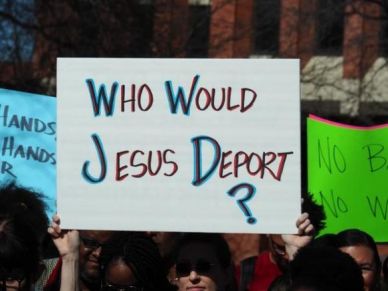
 

Who would Jesus deport - protest placard - Christian immigration debate - open borders

Support Semi-Partisan Politics with a one-time or recurring donation:

Agree with this article? Violently disagree? Scroll down to leave a comment.

Follow Semi-Partisan Politics on TwitterFacebook and Medium.

Who Is Truly Marginalized?

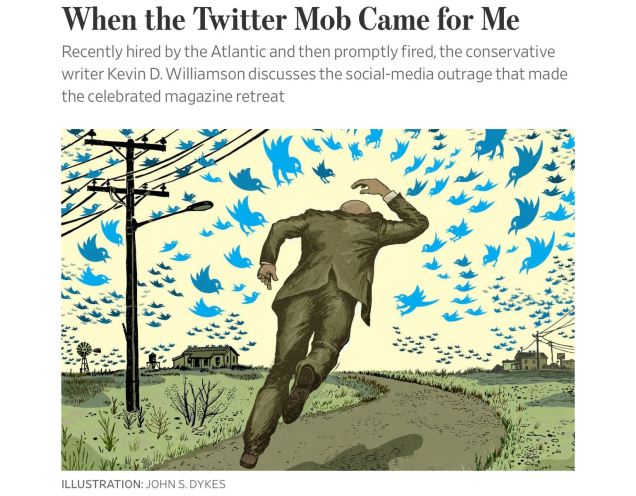
Kevin Williamson - The Atlantic - When the Twitter mob came for me

The marginalization of people and the marginalization of supposedly harmful ideas are very different phenomena, and the continued existence of the former neither requires nor excuses the latter

Rod Dreher has a great reflection on his blog today about who and what viewpoints in our present society are truly marginalised. Unsurprisingly, he is of the opinion that the side which bleats the loudest about its vulnerability and powerlessness is, more often than not, actually the one which is not only ascendant but effectively dominant, wielding both the power to destroy nonconformists and an increased willingness to deploy that power for social and political ends.

Dreher quotes a powerful passage from fellow writer Kevin D. Williamson, who made much news this month for being first hired and then swiftly fired from The Atlantic because of previously-expressed heterodox opinions. Williamson writes of a journalistic panel event he attended at South by Southwest on the subject of marginalized points of view:

Which brings us back to that event at South by Southwest, where the Atlantic was sponsoring a panel about marginalized points of view and diversity in journalism. The panelists, all Atlantic writers and editors, argued that the cultural and economic decks are stacked against feminists and advocates of minority interests. They made this argument under the prestigious, high-profile auspices of South by Southwest and their own magazine, hosted by a feminist group called the Female Quotient, which enjoys the patronage of Google, PepsiCo, AT&T, NBCUniversal, Facebook, UBS, JPMorgan Chase and Deloitte. We should all be so marginalized. If you want to know who actually has the power in our society and who is actually marginalized, ask which ideas get you sponsorships from Google and Pepsi and which get you fired.

My emphasis in bold above. Note Williamson’s correct observation that the “advocates of minority interests” increasingly see themselves as persecuted underdogs, not just the minority groups on whose behalf they claim to speak.

Dreher goes on to give another example provided by a reader, all the more serious because it impacts a private citizen who is simply attempting to go about their daily life (as opposed to making a living by expressing opinions in the public square like Kevin Williamson):

True. This past weekend, I heard from a reader who holds a management position in a Fortune 100 company. The reader is a Christian, and is struggling because the reader’s company has been pushing its employees, especially at that level, to get involved in their community as advocates for LGBT inclusion. The reader, who is closeted as a Christian inside the company, has stayed very quiet, but the reader’s bosses are starting to wonder why the reader isn’t signing on. The reader is dealing with a serious medical disability, and cannot afford to lose this job. Understandably, the reader is really starting to get anxious.

[..] This Christian reader is at the mercy of this woke corporation. But as a traditional Christian, this reader will always and everywhere be the Oppressor in the eyes of this company, even though people with the views of this reader are powerless within its culture.

Dreher’s conclusion:

Williamson is on to a truly remarkable thing about the way the power-holders in our society work: their ideology allows them to tell themselves that they are advocates for the oppressed, and stand in solidarity with the marginalized, etc. But it’s a sham.

I think it is important here to distinguish between those on the sharp end of lingering prejudice and discrimination to a greater or lesser degree – groups which certainly include ethnic minorities, non-heterosexuals and those who place themselves outside what is now called the “gender binary”, but also other far less favoured groups like white working class boys, people whom it is not fashionable to pity – and those who experience blowback either voluntarily expressing their own opinions on social issues in the public sphere (including journalists and public figures) or in the course of their daily lives (people of faith working for corporations, etc.)

In the case of the former, reasonable people still ought to be able to agree that historically disadvantaged minorities still have it worse on aggregate, despite often-tremendous strides of progress and occasionally even surpassing parity with the “privileged” majority. The aggregate experience of most minorities in countries like Britain and America is significantly better than would have been the case just two decades ago, but it would be churlish to deny that the legacy of past discrimination and its lingering remnants do not have a disproportionate effect on those who are not white, male and wealthy (though we can certainly quibble over the degree).

Where it gets far more interesting, though, is who wins the “marginalization contest” when it comes to publicly expressing viewpoints or living one’s values in modern society. And here, I think both Rod Dreher and Kevin Williamson are right that the situation is almost completely reversed. When it comes to which worldview and values dominate our society (from the political and corporate worlds down through academia, high and low culture) social progressivism is utterly ascendant. More than ascendant, in fact; it has won the battle of ideas and done so without grace or magnanimity towards those it vanquished along the way.

When somebody like former Google engineer James Damore can be summarily fired from his job for publishing a controversial but eminently reasoned and defensible memo on Google’s hiring policies, it is not the supposed “victims” of his memo who lack agency, power or a platform to defend themselves. When so many prestigious and supposedly trustworthy news sources can casually refer to Damore’s “anti-diversity screed” without critically reading it or placing it in proper context, how is Damore the all-powerful oppressor who must be purged from society for the protection of others?

And when writers like Kevin Williamson are hounded out of their jobs by baying Twitter mobs before they even get their feet under the desk, and not once contacted by any of the major news outlets who extensively covered the story in order to seek his comment and version of events, how is Williamson the snarling ideological hegemon with his jackboot on the neck of the innocent masses?

This all points to a contradiction at the heart of the debate over social justice and identity politics which is often overlooked in the glib media debate: those traditionally considered vulnerable and marginalised minorities often do continue to experience an unequal playing field and have just cause for complaint, even while the most extreme elements of progressivism (fully unrestricted abortion, open borders, the imposition of radical new gender theory) are now established orthodoxy nearly everywhere that it matters. Or to deploy a military analogy, while many foot soldiers and protectorates of their movement continue to be pinned down by sporadic enemy resistance on the ground, they are also secure in the knowledge that their side enjoys total air superiority and that ultimate victory is all but assured.

One then has to ask whether it is right that the progressive air campaign is allowed to dominate in such a fashion. Many would glibly answer “yes”, and perhaps suggest (not unreasonably) that the right of a minority individual to be physically safe and undiscriminated against in the affairs of life far outweighs the rights of the newspaper columnist or blogger to express their dissenting opinion on social issues. As a rhetorical device this argument is quite effective, but it is also a deceptive false dichotomy. While social justice advocates may claim that dissenting speech is the equivalent of physical or mental harm, this is nothing but cynical, censorious manoeuvring on their part. Kevin Williamson writing for The Atlantic no more made anybody unsafe than James Damore’s respectfully-worded memo. To the extent that harm of any kind is suffered, it is entirely through the self-imposed mental fragility of the identity politics movement, which often takes grown people and renders them screechy, adult-sized babies.

As Rod Dreher notes elsewhere:

It’s like everybody just wants to be offended, and so offended that they become emotionally disabled, because that’s how they know who they are. I am offended, therefore I am. Not too long ago, to admit to being undone by the least little thing would have been seen as a sign of weakness, of feeble character. The man or woman who was able to endure all kinds of insults and threats to their lives — think James Meredith and Ruby Bridges — without desisting from their path were real heroes.

Now? The therapeutic mindset has triumphed so thoroughly that the faintest flap of a butterfly’s wing will cause an emotional hurricane within anyone who feels the air quiver. It’s the way to achieve power.

Ultimately, we need to be able to acknowledge that while discrimination against minorities continues and is appalling, that the victim status does not extend to those fighting on their behalf. A woke Hollywood A-lister with the power to direct his legions of social media followers to hound and destroy the livelihood of a working class citizen who expresses less than politically correct views or attempts to live out traditional values in their own life is no brave underdog – he is a bully. A corporate CEO who cuts short a vacation and flies home to summarily fire a diligent employee for making a thoughtful contribution is not a good corporate citizen – she is a mini tyrant, seeking to control her worker’s thoughts and actions with the same impersonal intensity as the industrial revolution mill-owner of old.

Victimhood is not transferable from those who genuinely suffer disadvantage to those who ostentatiously advocate (or posture) on their behalf. The sympathy or compensatory advantages due to somebody who suffers the barbs of ongoing racism or discrimination must not be appropriated by those who make a profitable cottage industry of fighting for “equality”. Yet this is precisely what currently happens, even though these two wrongs in no way make a right.

Censoring or otherwise persecuting those who dissent from the slightest aspect of progressive orthodoxy is not a just punishment for past discrimination against minorities, particularly when those doling out the punishment are among the most successful and privileged people in society. Destroying innocent careers or purging heterodox or dissenting viewpoints from the public square must not become seen as a valid reparation for society’s past sins.

Diversity

Support Semi-Partisan Politics with a one-time or recurring donation:

Agree with this article? Violently disagree? Scroll down to leave a comment.

Follow Semi-Partisan Politics on TwitterFacebook and Medium.


Three Little SJWs From School

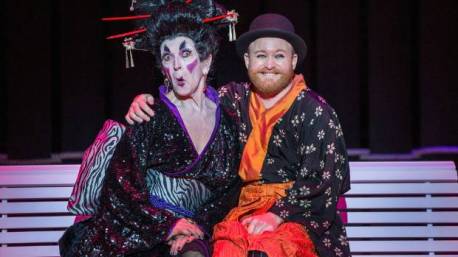
The Mikado poster

Nobody’s safe, for they care for none

I must admit that I have been waiting for this one. I knew that it was only a matter of time before the social justice censors came for The Mikado, that beloved Gilbert & Sullivan operetta set in a highly fictionalized version of Japan, and here we are.

(My other long-standing test for the final capitulation of our society to the Cult of Social Justice and Identity Politics is the inevitable future banning of George Gershwin’s sublime Piano Concerto in F, a work of jazz and blues rendered in classical form for orchestra, due to its “cultural appropriation” of musical forms pioneered by African Americans. I guarantee you that this will happen, and that picket lines will appear outside the Lincoln Center and Walt Disney Concert Hall much sooner than you think.)

Back to the present day, though, and Fort Hays State University has become the latest epicenter of SJW protests after the FHSU Music and Theatre student organization dared to put on a production of Gilbert & Sullivan’s “The Mikado”.

Campus Reform reports:

Some students at Fort Hays State University (FHSU) in Kansas say a school-sponsored operetta production is not only “racist,” but also rife with “cultural appropriation.”

Naturally, the idea of an operetta based on late-nineteenth century stereotypes of Japanese culture and customs provided the perfect opportunity for various SJW saviour types to go charging to the defence of any innocent contemporary Japanese (or Japanese-American) people who may be offended. Never mind that the real target of W. S. Gilbert’s humour in The Mikado, as in so many of his works, is British bureaucracy and imperial custom. No; instead we must see only artistic cruelty and the helpless victimhood of a designated minority group.

One of the most damaging facets of the current craze for scouring old artistic treasures for reasons to hate and ostentatiously denounce them is the fact that everything interesting about the work in question must take a backseat to the confected outrage of the professionally offended. And sometimes the outrage obscures truly interesting detail, such as that noted by Caroline Crampton in the New Statesman:

Gilbert and Sullivan were first and foremost creating a satire, not a musical comedy. They were working at a time of wide-ranging, if implicit, censorship of the theatre, where easily affronted middle-class audiences would simply not turn up if a work had a whiff of scandal or immorality about it. Gilbert himself likened the challenge of being a late-19th-century dramatist to “doing a hornpipe in fetters”.

Like Shakespeare hundreds of years earlier, using a fictional version of Italy to host his comedies about the Elizabethan court, Gilbert and Sullivan used their “Japan” as a proxy to enable them to satirise the very middle-class audiences they courted. The Mikado’s central plot device that I find so frustrating – that flirting is a crime punishable by death – is a dig at the theat­rical censorship that would not allow any extramarital romance to be portrayed on the London stage.

Utterly ignorant of this nuance and context, a Fort Hays State student going by the name of Fatima took it upon herself to deface several of the posters advertising the event, attaching a semi-literate rebuttal in which she takes W.S. Gilbert to task for being insufficiently woke:

https://twitter.com/Fatima_015/status/981554461029076997


The student’s list of accusations against the production is long and rambling:

The Mikado is racist for many reasons so when I saw the Dr. Joseph Perniciaro picked this for the opera I was appalled. The Mikado is cultural appropriation, it is RACIST, it is “yellow face”, and it sure as hell shouldn’t be a production that still exists.

To begin, the opera is about Japanese People … *BUT* … it is being performed here at Fort Hays State University with an all NON-ASIAN CAST.

Quelle horreur – the student musical theater group failed to observe the unwritten rule that characters of a certain race can only be portrayed by actors of the same race. Presumably, Fatima the Outraged Student is also up in arms that Lin-Manuel Miranda’s hit musical Hamilton dares to use an all-minority cast to tell the story of the white male Alexander Hamilton’s rise and rivalry with fellow white male Aaron Burr. Except of course that we all know that Fatima would cheer this casting.

The charge sheet continues:

All this production is, is an exaggeration of Japanese stereotypes. The actors put on kimonos, black wigs, color their brows black, wear sandals, use fans and small umbrellas, *OH* – and also put white powder on their face. ‘Blackface’ is universally unacceptable, so why is it okay to do a ‘yellowface’ production? Well, NEWSFLASH, it’s not. If this production was about African American people, it WOULD NOT be cast with all white people.

Absolutely. My mother took me to a production of The Mikado at the English National Opera when I was a teenager and now when I think of modern Japan, I immediately picture severe-eyebrowed, black haired warrior men and porcelain-skinned, umbrella-twirling Geishas. The world’s third largest economy and historical imperial power has never had any opportunity whatsoever to export its true culture and neither have I, a citizen of the United Kingdom with two eyes, a (Japanese brand) television set and an internet connection ever had the opportunity to see real Japanese culture and creations for myself.

More:

The show was created by Gilbert and Sullivan (who are known for such racist productions) in the late 1800’s, and it reduced the Japanese culture to an item of curiosity, fetishizing them for a profit.

I think that the widespread Western fetishization of certain things Japanese began somewhat later than 1885 and with very little assistance from late Victorian operetta, but how thoughtful, how brave of this FHSU student to get outraged at the cultural misrepresentation of Japanese people who lived and died a century before she was born, and who undoubtedly practised meticulous open-minded tolerance at every opportunity in their own lives.

This production was not okay when it was created and it definitely isn’t ok today – like COME ON, it’s 2018. Not to mention that they had to cut the N-WORD out to make it more acceptable *(like that changed how racist it was)*.

Yes, this student actually wrote the phrase “like COME ON”.

On a semantic point, how can something be both a stereotype and cultural appropriation? At one point FHSU’s student censor claims that The Mikado is based on an inaccurate pastiche of Japanese culture and custom, and on the other she accuses Gilbert & Sullivan of cultural appropriation. But how can one culturally appropriate a stereotype? And if a stereotype is culturally appropriated, who is actually harmed? Surely not the Japanese people (either contemporary or those of 1885), since what appears on stage was not a true representation of their lives when it first appeared, and certainly bears no resemblance to life in the technologically advanced, urbanised Japan of today. If one were particularly sensitive and pedantic one could say that The Mikado is glib and insulting, but cultural appropriation is an inaccurate charge.

But on a broader level, I am intrigued about the other contradictions inherent in this charge against The Mikado. Japan is a rich, powerful and historically imperial nation, and has certainly not always been a childishly innocent or benevolent actor on the world stage. Modern-day Japanese cultural and commercial reach is strong, though curiously Japan itself does not have a reputation as a cultural melting-pot particularly welcoming to immigrants. Japanese people are among the most privileged in the world, and scarcely in need of defence by do-gooder social justice warriors, fighting on their behalf from American university campuses.

Would the FHSU students protesting The Mikado also be up in arms at a production lampooning the British, either historical or contemporary? Obviously not, because Britain has been placed squarely into the White Imperialist Aggressor box, and therefore made ineligible for sympathy or outrage when her citizens or culture are mocked, parodied or criticised. Yet Japanese imperial “crimes” in recent history are real. People alive today still bear witness to them. So what precisely is it which pardons and rehabilitates Japan in the eyes of SJWs but continues to damn countries such as Britain and America?

The answer can only be a resoundingly arrogant, America-centric view of the world – a quasi-imperial view, if you will, expounded by the identity politics Left. This worldview assumes firstly that the supposed experience of a Japanese individual is the same as a Japanese-American individual, that both are in need of defending against the risk of offence or emotional harm. and that it is the place of American university students who can barely string together a coherent paragraph to act as self-appointed guardians of their wellbeing. But the Japanese are certainly not a persecuted minority in their own country, and thus far the only publicised objections to The Mikado have come from outside Japan. It takes a peculiar kind of arrogance to think that the Japanese culture and people are so weak as to need the help of American campus SJWs.

The English National Opera regularly stages productions of The Mikado. One of the ENO’s corporate partners is the Japanese piano manufacturer Yamaha. If there were any organic upset or consternation at the continued staging of this operetta whatsoever then Yamaha, a Japanese corporation, conscious of its domestic reputation and eager to avoid being associated with a supposedly white supremacist event, might well consider ending its association with the opera company. They do not do so because there are probably only a handful of individuals on Earth who are genuinely upset at the existence of The Mikado, and of those souls an infintessimally small number would actually be Japanese, the rest comprising of deluded young Western campus activists with too much time on their hands and not enough legitimate causes to support.

In fact, a similar protest did apparently take place in 2014 when another musical theater group dared to put on a production of The Mikado in Providence, Rhode Island. The Taiwanese individual who launched that particular protest was at least willing to countenance possible acceptable productions of the work:

I am aware of a production that had Asian actors in the lead roles while wearing British costumes. There is also a film “The Mikado Project” by chil kong, that shows an Asian-American theatre company producing the opera. These are both great moves. I can support a production of this material that shows some consciousness of the present day, but not a straightforward, uncritical celebration of these 1800s racial stereotypes.

The decidedly non-Japanese student(s) who launched this latest protest at Fort Hays State University, on the other hand, think that only total censorship and banishment of the work down the memory hole will do, proving that each concession to the authoritarian, regressive Left only fuels and encourages even more draconian future demands.

There is no victory great enough to sate their appetites because ultimately this is not about protecting a beleaguered minority (I have yet to read of instances of Japanese people traumatised by Gilbert & Sullivan) but rather about the exercise of power by identity politics-soaked leftist activists.

We tolerate this illiberal, censorious nonsense at our peril. Allow the SJW brigade to take down The Mikado and it will be swiftly on to the next target.


The Mikado - racist - cultural appropriation - FHSU

Support Semi-Partisan Politics with a one-time or recurring donation:

Agree with this article? Violently disagree? Scroll down to leave a comment.

Follow Semi-Partisan Politics on TwitterFacebook and Medium.


Why I Am Glad To Be Leaving Britain

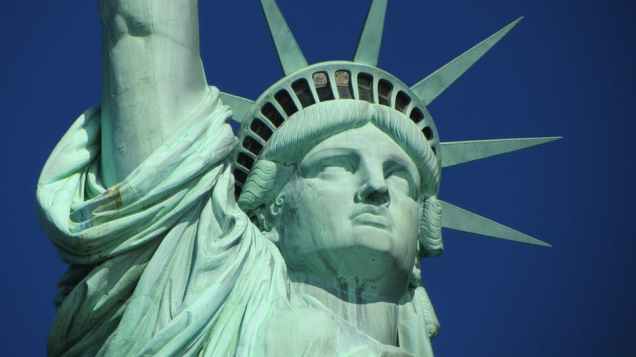
Statue of Liberty

[As I continue to wend my way through Southeast Asia en route from London to my new home in the United States, below are some reflections on leaving Britain which have been percolating in my mind. Regular political commentary to resume once our travel itinerary calms down a bit and I reach a country with more reliable internet connectivity.]

I’d like to say that it has been a pleasure…

Britain will always be home to me. I will never renounce my citizenship, even though I will proudly take American citizenship and become a joint citizen of the other country to which I feel love and loyalty when I become eligible to do so. But speaking strictly from the perspective of someone who thinks about policy and writes about politics more than is probably healthy, I’m very glad to be escaping Britain for America at this particular juncture.

Not because of Brexit. I hear the keyboards of fifty Twitter wags clattering to life in my mind right now: “Ha, look at this die-hard Brexiteer who wanted out of the EU so badly but now won’t live in the apocalyptic hellscape he has bequeathed us”. Save the wisecracks, this has nothing to do with Brexit (though Brexit certainly shines an unforgiving light on the institutional and intellectual rot which makes me glad to move across the Atlantic).

I’m happy to be leaving Britain because we have become a small, petty and insular country. Not because of Brexit; we have been gradually becoming so for years prior, helped in large part by our EU membership, the stultifying centrist Westminster consensus and decades of bland technocratic government. The smallness I refer to has nothing to do with military or diplomatic power, though there are certainly warning signs in both these areas. It has nothing to do with our immediate economic prospects, since growth continues and the fundamentals of our economy are no more or less wobbly than they were prior to the EU referendum. It has nothing to do with the rise of other powerful countries or Britain’s supposed isolation outside the comforting embrace of supranational European political union.

The smallness afflicting Britain is a smallness of aspiration, of confidence, of purpose. It is the gradual draining away of any self-belief among those who run, report or comment on this country that decisions made here could actually matter, or influence human events and progress in a significantly beneficial way. It is the even more alarming realisation that the people with the potential intelligence and vision to help Britain recover our place as a visionary leader among countries increasingly self-select out of political life for reasons which are as obvious as they are tragic.

Why climb the greasy pole in a broken party system which rewards group conformity over ideological consistency or necessary pragmatism? Why inch one’s way up from town councillor to county councillor to MP’s bag carrier to ministerial SpAd to junior MP to parliamentary private secretary to junior minister to Cabinet minister to prime minister, compromising one’s ideas every step of the way, when one can have a far more fulfilling career in every respect working in the private sector, and have a more lasting and profound influence on humanity in the process?

For a couple of years now I have been writing about the great challenges facing Britain and the world in the new period of discontinuity which we are entering – an era when the old political settlement with its associated policies neither solve the new challenges we face nor command widespread public support any longer. The last such period of discontinuity in British politics took place in the late 1970s, when a sclerotic economy and over-powerful vested interests (particularly the trades union) were gradually choking the life out of Britain. Back then, we responded with the Thatcherite revolution, which for all its faults (and yes, those faults were real) revitalised our economy and rolled back the worst excesses of the socialist post-war consensus.

This new period of discontinuity is different, with new challenges in the form of globalisation, outsourcing, automation, mass migration and uncertainty over the role and long-term survival prospects for the nation state. These are problems which affect nearly every advanced economy, and which most countries are currently sidestepping or delaying their day of reckoning to some extent. Brexit offered Britain the golden opportunity to be not a helpless canary in the coalmine but rather an innovative testing laboratory and beacon to the world, confronting some of these challenges head on, breaking open political taboos and experimenting with heretofore unconsidered policy alternatives to meet the challenges we face. Britain could have seized this opportunity to genuinely lead the way for the first time in the post-war era, certainly in my lifetime.

This opportunity has been squandered, and the squandering is both tragic and unforgivable. In the 1970s there was enough intellectual life left in Britain for new policy ideas to germinate in places like the Centre for Policy Studies, then-revolutionary think tanks who brought in outside talent and evaluated ideas based on their innate worth rather than the connectedness or insider reputation of the individual putting them forward. That’s how the famous Stepping Stones Report came to be written in 1977, which Margaret Thatcher then took with her into Downing Street in 1979 and used as a blueprint for many of the policies and reforms which ultimately saved Britain from seemingly inevitable national decline.

In 2018, there is nobody left to do this kind of radical, disruptive work. Some of the same think tanks and organisations still exist (in name), but to a large extent they are rusted out old shells of their former selves, living on past glories and eking an existence by flattering government ministers or acting as a mouthpiece for existing party policymaking theatre rather than doing anything genuinely revolutionary or independent.

When I proposed a new Stepping Stones Report for 2022, a document which would seek to identify and classify all of the issues and threats facing modern Britain in order to discover their interlinkages and arrive at a suite of mutually-supporting policies to tackle and overcome them, I received a few polite and non-committal words or emails from various MPs and think tanks, and then no more. On one occasion I was cordially thanked and then told that there is “nothing in particular for you to do at this time”. You see, I am from outside the inner Westminster bubble so it is inconceivable that I might have stumbled upon a good idea or have anything whatsoever to contribute to government policy.

A few fruitless efforts at gaining the attention of influential figures within the Conservative Party made it abundantly clear that while normal people like me are good for stuffing envelopes or knocking doors to get out the Tory vote, best leave the policymaking and strategic thinking to those inside the bubble. And so the Conservative Party’s effort to make policy continues to throw up random half-baked ideas to solve the housing crisis, the productivity crisis, the migration crisis, the healthcare crisis, the education crisis and the so-called crisis of capitalism (many of these ideas lifted straight from the Miliband playbook) without any attempt to consider how these challenges might be linked or best be solved in conjunction with one another. A few genuinely heroic Tory MPs – George Freeman, Nick Boles and Robert Halfon, to name the most active – are engaged in serious work attempting to reimagine conservative policy for the 21st century, but they are receiving precious little air cover from CCHQ or Downing Street.

Things are no better on the other side of the aisle, where Jeremy Corbyn’s Labour Party is permanently one anti-Semitic tweet away from total self-destruction. This blog celebrated Corbyn’s victory in the Labour leadership contests of 2015 and 2016, not out of any admiration for or agreement with his policies but because he represented a bold step away from the suffocating centrist consensus whose policies overlook so many Britons and which has been hugely resistant to change. And there have on occasions been genuinely encouraging signs of intellectual life within Labour, such as with Corbyn’s proposed National Education Service – a horribly statist idea, but one which at least sought to recognise the limitations of our present system and try something different rather than continuing to shoot for the middle.

However, much of the political backing behind Jeremy Corbyn – Momentum in particular – is anything but modern or forward thinking, offering nothing so much as reheated 1970s statism. Worse, it comes infected with rabid and widespread anti-Semitism which the leadership ignores in order to avoid offending certain other fellow ideological travellers at home and abroad. Such has been the infighting that one can scarcely discern a Corbynite platform more nuanced than raising taxes and renationalising industry. Meanwhile, the displaced Labour centrists, full of entitlement and utterly lacking in introspection as to how their moral and intellectual failures led to this nadir, have done precious little policy thinking of their own and when given the chance to displace Corbyn in 2016 were so concerned for their own precious political careers that none of the remaining big beasts would stand, leaving it to the malodorous Owen Smith.

Ah, but what about the smaller parties? Well, UKIP has collapsed into now inevitable (if once avoidable) irrelevance, the Green Party continue to wage their ostentatiously anti-prosperity agenda and the Liberal Democrats have become nothing more than a futile Stop Brexit Party (and even on this ground they are challenged by new upstart anti-Brexit parties such as Renew). If there are signs of intellectual life or political courage to be found on the political periphery they have escaped my attention.

Look at education, healthcare, housing, automation and AI. Britain isn’t even currently aspiring to emulate best practice in (or achieve parity with) other countries, let alone pioneer new policy solutions which might see us leapfrog our competition and point the way for other nations. Take just education as an example, where technology could be revolutionising our current conception of school, opening up new possibilities for remote learning and real-time interaction with experts and other classes across distance and borders, and research in the social sciences has long hammered home the importance of proactive parental involvement in order to inculcate success at an early age. Where is the new technology in our classrooms? Where is the digital learning strategy? Where is the government promoting more responsible parenting?

Instead of these necessary endeavours to face up to policy failure and change direction, we either indulge in vainglorious British exceptionalism and imagine that the world has nothing to teach us (see the Tory Right’s insistence on a hard Brexit and our national obsession with the NHS, according to its hagiographers the world’s only compassionate universal healthcare service) or else resignedly believe that we are so feeble a country that there can be no hope in striking out on our own to road-test new ideas. How pathetic. How cowardly. What a betrayal of the next generation. How utterly, utterly small.

None of this is to say that things are significantly better in the United States. Lord knows that my new adopted home has not got everything all figured out just yet; America is also idling in neutral to a large degree, an unpredictable and vastly underqualified new president at the helm, his own worst enemy, and an opposition party which has sold its soul to the false god of identity politics rather than offering any uniting, uplifting alternate platform. But at least the big issues are still debated in America, however crudely may sometimes be the case.

As I wrote last year when lamenting the decline in British political rhetoric:

Maybe part of the reason that there are no great contemporary British political speeches reflects our diminished status in the world, no longer a superpower or the pre-eminent actor in world affairs. Lofty words are easier to reach for when one reasonably expects that they might reshape the world.

Despite having every opportunity to take the lead, Britain seems determined to be a follower – either cowering fearfully within the EU or attempting to roll back the clock to a time when economic integration, regulatory alignment and international just-in-time supply chains didn’t make a mockery of the Tory Right’s hard Brexit fantasies. We even import our social movements these days, with British universities racing to copy their American counterparts in capitulating to the censorious cult of identity politics and organisations like Black Lives Matter UK springing up despite lacking any of the context or triggers which prompted the formation of the original.

I have very little desire to spend my time engaged in the minutiae of political debate in a country which stubbornly refuses to lift its gaze above its own navel, whose activists have enough spare time on their hands to worry about non-issues or capriciously import social movements from abroad yet no time to agitate for universal reform, true egalitarianism or issues which do not immediately benefit their own wallets. America may not be the country it once was in terms of the richness and profundity of its civic life (though this is not to dismiss the great and necessary advances in civil rights and equality) since many of its greatest thinkers left the stage, but it is a darn sight healthier than contemporary Britain.

Interventionism versus non-interventionism? That debate burns more brightly in America because it is the United States which must do the bulk of intervening in an age of parsimonious European retrenchment. Healthcare reform? The American system may exist primarily to make Britain’s NHS look good by comparison, but at least radical healthcare reform is possible in the United States, unlike Britain where NHS worship is a mandatory religion for those in power. Education? The federal system and greater role for local government in America means that far more experimentation with new policies and technologies can take place than in Britain, where “postcode lotteries” are feared and policy competition is severely limited. The benefits and costs of laissez-faire social liberalism? Nearly all of the most thoughtful writing can be found in American journals, not the incestuous British publications.

Only on the question of national identity and societal cohesiveness is the political debate more interesting and pressing in the UK and Europe than in the United States, and even then only because years of bad and arrogantly-imposed policy have bequeathed Europe with significant subpopulations which feel little loyalty to or affinity with the countries which give them life and liberty, thus making it an existential issue. It is now fashionable among many elites to bemoan the decline of liberal democratic values, yet there is precious little introspection as to how policies which deliberately undermine the nation state and erode a common sense of identity accepting of liberal values might have played a part in their demise.

America is presently less far down this destructive path, and thus freer from the risk of the kind of societal unrest and breakdown which would make other policy experimentation impossible. In other words, if you don’t have to continually fight to justify your country’s existence (either from plotting euro-federalists on one side or unintegrated subpopulations and post-patriotic citizens of the world on the other) then one can comfortably think about other policy concerns, but if national survival underpinning essential liberal values is not assured then everything else becomes largely irrelevant.

So why this long, somewhat bitter screed as I depart the United Kingdom? After all, in the grand scheme of things I don’t matter at all. I’m not a genius, a policy wunderkind or a charismatic future political leader, so me quitting these shores to make my mark in the United States is no great loss for Britain. But if even people like me survey the state of British politics and civic life and feel overwhelmed by a feeling of resigned ennui, how must those individuals blessed with real talent and inspiration feel? You think they are going to stick around to watch Owen Jones, Ian Dunt and EU Supergirl slog it out with Nigel Farage, Jacob Rees-Mogg and Liam Fox, or feel compelled to step forward and offer their leadership skills to a country which itself has no desire to lead?

Britain can survive me flouncing off across the Atlantic; indeed, the country may well be much the better for it. But the pathetic state of British politics and civic life that I have described here is not only repulsive to me; it alienates talent and discourages innovation at nearly every level.

When British politics becomes little more than a technocratic debate about making the trains run on time or ensuring by national decree that hospital waiting times hit a certain target, we are thinking far too small.

When British political debate is more about desperately ignoring obvious truths (the unsustainability of the NHS, the failure of unmitigated multiculturalism, our broken welfare state) than tackling those problems head-on, we are being far too cowardly.

And when the desire and capacity of British elites to confront and overcome 21st century challenges gives way to a sense of resigned powerlessness and a petulant impatience for somebody else to do the difficult work, I can’t muster much sorrow to be taking a step away from that dismal stage.

I will never stop following or writing about British politics, and this blog continues. Britain is my homeland, a place towards which I will always retain a deep attachment and where I will undoubtedly spend some future years raising a family – and indeed, one of the unique selling points of this blog – I hope – is my ability to provide a familiar Brit’s perspective on American politics and a (nearly) American perspective on British politics, which would make unplugging from the debate quite counterproductive to my work.

But since Britain has repeatedly shown itself to be disinterested in domestic or global leadership of any kind, my focus will naturally gravitate more toward the politics of my new adopted home, a country which despite its many dysfunctions still retains that optimism and self-belief that matters debated and decisions made in America can shape the world for the better.

And Lord knows I am looking forward to that change of scenery.


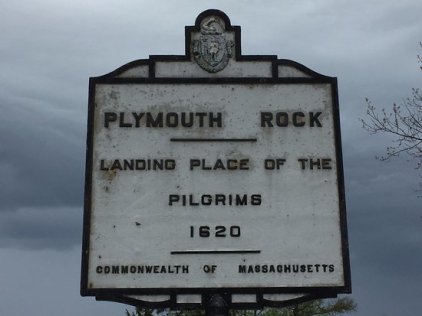
Sign at Plymouh Rock - landing place of the pilgrims - 1620

Support Semi-Partisan Politics with a one-time or recurring donation:

Agree with this article? Violently disagree? Scroll down to leave a comment.

Follow Semi-Partisan Politics on TwitterFacebook and Medium.

The Pro-EU Artistic Bubble Goes From Pitiful To Sinister

Act for Democracy - artists European Union bias propaganda

European artists prepare to “act for democracy” by deploying their talents to subvert democracy in the service of European political union

Having been spat out of the British educational system knowing virtually nothing of history, classical music came to serve as the primary window through which I discovered nearly everything I now know, love or am fascinated about culture, art and history.

For instance, after discovering the music of Dmitri Shostakovich and learning about the composer’s life working under threat from the Soviet state, I came to appreciate with horror the inevitable toll taken by authoritarian communist governments on the psyche and artistic output of composers striving (under orders) to produce works reflective of socialist realism. Indeed, knowing its history, who can listen to the opening Nocturne from Shostakovich’s first violin concerto and not feel a chill reflecting on the circumstances in which it was written, and then suppressed until the death of Joseph Stalin?

Perhaps naively, from then onward I always believed that a healthy artistic community was one which kept government firmly at arm’s length, which at its best sought to challenge prevailing dogmas and policies, or at the very least refrained from acting as a willing shill, promoting establishment doctrine. Though more democratic countries have also blurred the line between artistic expression and government policy – one might think of the Public Works of Art project during depression-era America – participation is typically voluntary and the messages generally far less scripted.

How wrong I was. It should be evident to anyone with a functioning neocortex that the contemporary artistic community in Britain in particular (and the West more generally) long ago gave up any desire to seek truth or offend establishment sensibilities, opting instead for fawning repetition of modern centrist orthodoxy and acts of ostentatious virtue-signalling intended to flaunt an artist’s holding of the “correct” views. Witness superstar Lorde’s oh-so right-on cancellation of her concerts in Israel and call for a cultural boycott (while happily continuing to perform in other countries such as Russia). Even so recently as the 1980s, major stars were willing to court controversy or take a stand against official policy – witness Paul Simon’s concerts in apartheid-era South Africa – but such independence of mind seems almost entirely absent from today’s artists.

Indeed, since country group The Dixie Chicks torpedoed their career by denouncing the Iraq War during a London concert, later issuing an humiliating apology under duress, few artists (popular or otherwise) have dared give voice to any heterodox opinion they may hold. When it comes to finding pop or rock stars willing to say kind things about Brexit, one has to turn to 1970s icons such as Morrissey or Sex Pistols frontman John Lydon – the younger generation of stars either subscribe to the holding-hands-beneath-a-rainbow view of enforced European political union or else maintain a fearful silence.

While the instinctive pro-EU bias within the arts world is well known, what still retains capacity to shock is the proactive willingness of some artists to proactively praise and promote the nascent European government. The European Union has form when it comes to holding competitions or doling out grants and awards contingent on the creation or performance of works of art flattering to its own self-image; that much is nothing new. However, we reach a new level of fawning servility when artists arrange the production of tributes to the EU of their own accord and with no direct financial inducement. Yet this is precisely what we are now witnessing:

An open call for ideas to re-brand the European Union has been issued by artist Wolfgang Tillmans and architect Rem Koolhaas. ‘The brief is to send us proposals for communicating the advantages of cooperation and friendship amongst people and nations,’ they write, adding: ‘We need messages, how the Union works and how life would be without it. And we need ideas how to challenge the organisation itself, how to make it better.’

Vocal pro-EU advocates Koolhaas and Tillmans are part of the group Eurolab which is participating in a four-day forum titled ‘Act for Democracy!’ taking place in Amsterdam from 31 May – 3 June: ‘Eurolab is a fact-finding mission of what went well and what went wrong in the last 25 years of communicating Europe’ their statement says.

‘Eurolab wants to collect ideas about how cooperation and solidarity can be spoken for in a fresh and compelling way to large audiences. How can the European Union be valued by its citizens and be recognized as a force for good, rather than as a faceless bureaucracy?’

If I were an artist, I would be ashamed to be associated with such tedious, worshipful bilge – not because it is supportive of the EU, but because the reasoning behind it is so dreadfully unoriginal and derived purely from well-worn establishment political talking points. Like the centrist politicians in Britain and the EU who were shocked by Brexit’s disruption of their normally-unchallenged worldview and smoothly planned-out pathway toward deeper political integration, so these artists think that the only problem with the European Union is a lack of effective branding.

They begin by regurgitating the asinine notion that opposition to the European Union inevitably means a rejection of the very idea of “cooperation and friendship amongst people”, which is as insulting as it is moronic. They go on to express a desire for more messaging about how the EU works, which is ironic since an understanding of the EU institutions and the history behind the push for ever-closer union is quite closely correlated with a healthy dislike of the entire project. Of course there is the obligatory throwaway line about challenging the EU to be better, but it is very clear from the project brief that its originators see public dissatisfaction with the EU as a function not of a flawed project or horrendously antidemocratic execution, but rather an ignorant, benighted population who lamentably fail to realise what a wonderful blessing the EU really is.

This is why pro-EU forces have utterly failed to regain the initiative in Britain and elsewhere – they are so utterly divorced from the broad stream of EU-agnostic sentiment within their countries that they truly believe that those who dislike the institutions of Brussels also reject the human values of cooperation and solidarity. Worse, they are so politically tone-deaf that they admit this publicly, seemingly without any idea how insulting it is to Brexit supporters and other opponents of the EU (and deleterious to their own goal of winning over public support).

The project’s sponsors are involved in the risibly-titled project “Act for Democracy!“, part of the Forum on European Culture, which seeks less to celebrate the rich cultural heritage of the various countries of Europe than invent ever-more tortured ways of pressing art into the service of agitating for continental political union.

The event’s programme includes such gems as:

A 4-day Eurolab during which initiators Wolfgang TillmansRem Koolhaas and Stephan Petermann will make a start to rebrand Europe.

A unique Spoken Beat Concert with two artists from across the Channel: Madi Maxwell-Libby & Jacob Sam-La Rose.

Debate programmes in which we come to the core of populism across Europe. With among others Jan-Werner MüllerUlrike Guerot and Flavia Kleiner

The centrepiece of the whole event seems to be a symposium laughably called “An Independent Mind” in which exclusively pro-EU essays are discussed and celebrated ad nauseam.

A more saccharine, groupthink-infused circle-jerk you could not imagine. These creative types are gathering with pre-ordained conclusions in mind, based on the crudest and most insulting caricatures of their opponents, with the plan of using their diverse talents in service of a childishly naive conception of what the EU actually is and what it represents.

But all of that is fine compared to the fact that they are gathering under the banner of supporting democracy when in fact their entire movement is an upper middle-class, elitist howl of outrage at popular disillusionment with the European project. They are effectively adopting the classic Karl Rove-ian tactic – where George W. Bush’s hatchet man guided his candidate to success by successfully accusing W’s opponents of his own glaring weaknesses, these pro-EU artists do the inverse, claiming possession of the very virtue (support for democracy) which they are desperately seeking to corrupt.

Particularly disconcerting is the self-chastising tone of the project’s announcement, in which Tillmans and Koolhaas come close to outright suggesting that it is A) the job of artists to serve as organs of the state and that B) they failed in that duty by proselytising for European political union with insufficient vigor.

This resembles nothing so much as the fawning forced apology given by Shostakovich following the communist party’s denunciation of his opera “Lady Macbeth”, entitled “A Soviet Artist’s Response To Justified Criticism”, with one key exception – nobody is making these artists do anything. They choose to exalt the supranational European government they so adore of their own volition. How much more debased is this?

More fundamentally – do artists have a responsibility to speak truth to power as a cacophany of different voices questioning the existing orthodoxy, or to cheerlead for the status quo? Should they produce works of art or sleazy government commercials? Tillmans and Koolhaas make their position quite clear:

In workshops and interview sessions we aim to compile a comprehensive toolbox of arguments, strategies, and ideas that can be applied to campaigns across different demographics and used by different professional groups (e.g. ‘Teachers for Europe’ ‘Scientists for Europe’ ‘Farmers for Europe’).

This is literally a project to brainstorm and create propaganda. What self-respecting artist talks of their work process as one of creating “toolboxes” and “strategies” for the use of astroturf political campaign groups? None. This is the language of marketing professionals or management consultants, not aesthetes or artisans.

Yet while these die-hard activists may not yet represent the broader artistic community, with vanishingly few exceptions (see the heretical new group Artists for Brexit) they all share the same unthinking, instinctive pro-EU impulse. The difference between your average pro-EU orchestral conductor, pop singer or modern artist and the people who will shortly be assembling in Amsterdam to create pro-Brussels communications strategies is one of degree, not kind.

If European artists want to deploy their talents to promote supranational government then it is their prerogative. I may find it distasteful, but it is certainly well within their rights. What is upsetting is the lack of fresh, critical thinking they seem to bring to bear to the question of European political union, instead either parroting simplistic pro-EU political talking points or else challenging themselves to come up with their own propaganda pieces.

And I can’t help thinking that legions of brave artists whose works were suppressed and lives disrupted because of an unhealthily close relationship between arts and government throughout history are turning over in their graves at the willingness of their latter-day colleagues to do this work of glorification unbidden and uncoerced.


Save EUYO - European Union Youth Orchestra - Propaganda

Support Semi-Partisan Politics with a one-time or recurring donation:

Agree with this article? Violently disagree? Scroll down to leave a comment.

Follow Semi-Partisan Politics on TwitterFacebook and Medium.