Patriotism Done Right – A Lesson For Britain, From Kentucky

The slavish worship of diversity is not enough to keep our fraying social fabric from coming apart in these difficult times; we need symbols and rituals that unite us, and we must defend these symbols from those who wrongly portray them as divisive or exclusionary

Take three minutes to watch this beautiful video of the Kentucky All-State Choir giving a moving and pitch-perfect rendition of the US national anthem from the balconies of the Hyatt hotel in Louisville, where they are currently staying while participating in a conference and competition.

Now try to picture this scene, or anything like it, taking place in Britain. Laughably impossible, isn’t it? Overt displays of gentle patriotism, and by schoolchildren? If such a scene did occur at an inter-school competition anywhere in the UK, it would more likely make the news because a group of parents complained that their children were forced to take part in some terrible, jingoistic ceremony, the first step toward the formation of a new Hitler Youth.

There would be earnest think-pieces in the Guardian about how teaching or singing the national anthem at public school events was oppressive to those who live here while wanting nothing to do with our shared culture, or who harbour a seething dislike of the various symbols and rituals which represent the country that gives them life and liberty. The matter would be hotly debated on BBC Question Time. Change.org petitions would be started, Twitter memes created and MPs would take sides.

One can just imagine Cathy Newman then hauling the poor choir director in to the television studio for one of her famously objective and well-researched interviews on Channel 4 news:

Cathy: So what made you decide to force these impressionable young children, many of whom might not even be comfortable identifying as British, to sing an anthem which they dislike and show respect to a country about which they might feel ambivalent at best?

Choir director: Well, there is far more that unites us than divides us, and our thinking was what better way to show that all of our students are united by something deeper, something which transcends the differences in their race, national origin or religion than by performing —

Cathy: So what you’re saying is that you wanted to brainwash these children into mindlessly supporting UK foreign policy and worshipping the government, just like North Korea?

Choir director: No, I —

Cathy: Aren’t you just normalising the ugly wave of nationalism and bigotry which has swept over the country since the EU referendum?

Lord knows that overt displays of patriotism do not come naturally to most British people. Many on the Left in particular seemed to discover their inner patriot for the first time when they watched the opening ceremony of the 2012 Olympic Games in London, and only then because director Danny Boyle turned half the show into an all-singing, all-dancing Mass in worship of the NHS and centralised, government-provided healthcare.

But this needs to change. Cold, hard circumstances mean that the quintessentially British “softly softly” approach to patriotism is now inadequate when it comes to forging and maintaining a unified, vaguely harmonious society.

Even if Brexit hadn’t come along and revealed (not caused) a split right down the middle of the country in terms of outlook and values, high levels of immigration combined with a laissez-fair “integrate if you want to or stay in your own enclaves and ghettoes, whatever works best for you” attitude from the government mean that the United Kingdom is nowhere near as united as it should be. Throw in the recent Scottish independence referendum, the rise of Islamist extremism and the West’s failure to celebrate, defend and transmit our small-L liberal enlightenment values, and the net result is that our national body is very badly frayed indeed.

At times like this, unifying symbols matter hugely. Just ask the European Union, which has spent countless taxpayer pounds and launched dozens of initiatives in a desperate (and largely futile) attempt to inculcate a sense of European-ness strong enough to justify the vast institutions and creeping supranational government being built in Brussels. The EU has a flag and an anthem for a reason, and it has nothing to do with friendly trade and co-operation between autonomous nation states.

The United States, so long a successful melting pot for immigrants from all over the world, succeeds because it unapologetically promotes and celebrates its values and culture in a way that make new arrivals want to embrace the traditions of their new home, even while often carefully maintaining and cherishing their historical traditions too.

My wife grew up in a border town in south Texas, only miles from Mexico, where a huge percentage of the population are first and second generation immigrants, both legal and also some without legal rights of residency. Yet nobody in that town thinks twice about honouring the symbols of America, and nearly everybody considers themselves to be American and takes pride in being so. Everyone stands for the national anthem at sports games. All of the children recite the pledge of allegiance at school in the morning, and those first or second generation immigrant children do so without feeling that honouring America in any way diminishes their attachment to their other respective cultures.

In Britain, however, even displaying the Union flag causes some post-patriotic progressives to break out in hives or worry that they are about to get caught up in a BNP rally. And decades of constitutional vandalism by successive governments have resulted in Wales, Scotland and Northern Ireland rightly being given more devolved powers and space for home-nation patriotic self-expression while England has remained constrained in this regard, the result of which is that many British people outside of England no longer view the UK national anthem as “their” anthem.

Meanwhile, the Times Educational Supplement frets:

For schools, the problem remains of how to ensure that populist political initiatives to create shared citizenship are not be at the expense of embracing diversity.

In the US, courts notwithstanding, for years many children have had to salute the flag and recite the oath of allegiance every morning. The aim, supposedly, is to unify, yet it is inevitable that such exercises also exclude and exacerbate divisions. In France, for example, millions of children have family links to other countries including, of course, the UK. Are they supposed to renounce these links – or feel less “French” because of a failure to do so? Academics speak of governments imposing “societal cultures” and devaluing what they call, rather grandly, “differentiated citizenship”. They contrast the simplistic appeal of unity with celebrations of cultural diversity and philosophical values, such as equality of opportunity, that transcend nationalities.

What corrosive nonsense. The progressive blob would have us do away with E Pluribus Unum – out of many, one – and replace it with “out of many, even more”. They would have diversity be the only value worth celebrating, and practically discourage us from creating and celebrating deeper, transcendent connections between people of different backgrounds. And such is their faith in the god of diversity that they believe that liberal democracy can survive such a Utopian experiment.

The wonderful thing about these Kentucky school children singing the national anthem together is that they are E Pluribus Unum in action. Many may be native born, but some are doubtless immigrants or the children of immigrants. Many are likely Christian but others are of different faiths or none. Some are conservatives and even Donald Trump supporters while others are liberals who perhaps shed tears when Hillary Clinton delivered her concession speech in November 2016. They are rich, poor, black, white, male, female, Caucasian, Hispanic, gay or heterosexual. And yet however important those identities may rightly be to them, still they are able to come together in harmony to deliver a beautiful performance of the Star Spangled Banner. All of them are American.

This is a lesson that we in Britain urgently need to learn. We do not need to copy the United States in every respect, nor should we. But we should recognise that unifying symbols matter deeply if we want to maintain a cohesive society built on the liberal values for which Britain has long stood. And if not the national anthem, we need to identify and promote other unifying symbols, and withstand the manufactured outrage of those who would have us frantically celebrate our diversity until our increasingly atomised society crumbles completely beneath our feet.

We must stand up to the post-patriotic progressives and their destructive motto Diversitas, Heri, Hodi, Semper and instead re-embrace E Pluribus Unum.


Note: The high school choir members who take part in the KMEA All State Choir Conference in Kentucky do this every year, a wonderful annual tradition. Here is last year’s performance at the same venue.


Pledge of Allegiance - Stars and stripes

Pledge of Allegiance

Support Semi-Partisan Politics with a one-time or recurring donation:

Agree with this article? Violently disagree? Scroll down to leave a comment.

Follow Semi-Partisan Politics on TwitterFacebook and Medium.

NHS Hagiographers Continue To Use Commonwealth Fund Survey As A Shield Of Bias Confirmation

NHS commonwealth fund study analysis 1

Britain’s NHS idolaters cling to the Commonwealth Fund’s rosy but skewed assessment of the National Health Service like shipwreck survivors cling to floating wreckage

Brexit is not the only issue which reveals the intellectual limitations and paucity of vision of our politicians. Simply whisper the letters “NHS” and the vast majority of parliamentarians instantly turn into zombies, mindlessly repeating the same worn-out old paeans of praise to centralised government healthcare as though they were under the control of a hypnotist.

There are few better demonstrations of this pathology than yesterday’s segment on BBC This Week, in which Andrew Neil questioned uncritical acceptance of the Commonwealth Fund study (the only survey which routinely rates the NHS favourably) and Kate Andrews of the IEA gamely tried to advance the heretical notion that Britain might do well to learn from other advanced countries when it comes to organising healthcare delivery.

This went down like a lead balloon with bipartisan couch-warmers Anna Soubry and Alan Johnson, whose minds are both welded shut against any information that might suggest that the NHS is not, in fact, the “envy of the world”. Neither host Andrew Neil nor Kate Andrews are able to break through this veil of self-imposed ignorance:

From the segment:

Andrew Neil: Let’s just take the Commonwealth Fund now, because you politicians on both sides, you’re always using it —

Alan Johnson: Well, it’s the only one —

Andrew Neil: No, it’s not. It’s the only one in which the NHS does well, and actually in the Commonwealth Fund it measures inputs, not outputs, not patient care. Indeed, on the patient care – on actual health outcomes – even in the Commonwealth Fund the NHS comes tenth out of eleventh. The Guardian remarked on the Commonwealth Fund: “the only serious black mark against the NHS in Commonwealth Fund research was its poor record of keeping people alive”.

Alan Johnson: Yeah, America came eleventh, by the way, but…

Kate Andrews: Why America? Why not Germany or Belgium or Switzerland or France?

Alan Johnson: Because you came on here and said Trump has a point, are we supposed to talk about Sweden when you said Trump has a point?

Kate Andrews: You’re right, I did say Trump had a point, this whole point is that the NHS is failing, that doesn’t make America any better. Look, I’m from America, I’m not coming over here saying look, adopt the American system”, as I said in the video I wish both countries would look at Switzerland. But let’s stop painting this black and white decision because it’s not about USA versus NHS.

Alan Johnson: The Commonwealth Fund is the only one who measures things like health inequalities and fairness and how it affects the poorest —

Kate Andrews: What is fair about thousands more people in European countries surviving? What is fair about that? What is fair about the fact that 13,000 more people in Germany every year will survive the five most common types of cancer? What is fair about that?

Alan Johnson: [Becoming more incoherent and hysterical with every passing moment] You quote that without saying — as if the NHS was very keen for people to die of cancer —

Kate Andrews: No, of course they’re not, but we can do something about this —

Alan Johnson: One of the biggest problems is early reporting, is people going to their GP, particularly men —

Anna Soubry: Absolutely, it’s the biggest factor.

Kate Andrews: Great. Well, you need access to the GP, don’t you? You need shorter waiting times.

Anna Soubry: We have – please, please, don’t tell me that you don’t have – depends on where you live —

Kate Andrews: The waiting times for this country are appalling compared to their European counterparts.

Anna Soubry: [Disingenuously talking about same-day emergency appointments rather than scheduled GP appointments] Excuse me. Your GP, it depends exactly where you live, because certain GP surgeries like mine, I can see my GP if I want to on the morning that I have – I can ring up and can get in straight away. It depends where you live —

Kate Andrews: That doesn’t sound like a very fair system. It doesn’t sound like a postcode lottery is a very fair system.

Anna Soubry: No, it’s not a postcode lottery.

Kate Andrew: Well he [Alan Johnson] is talking about fairness, and that’s what the NHS is good at, but you were talking about a postcode lottery system. There’s nothing fair about that system, and there’s not a lot that’s very good about it either.

So the NHS is perfect, equality of dismal outcome is preferable to aspiring toward excellence, and if you are one of those people whose deaths would have been prevented by another, superior healthcare system it’s your own stupid fault for not seeing your GP (the unnecessary gatekeeper to practically all NHS care) on time. So say Tory wets and Labour centrists alike.

This is mental subservience to the Cult of the NHS, pure and simple. Every day, the high priests of the NHS surpass themselves in new feats of bias confirmation. One might think that the NHS coming second from last in the rather key metric of keeping people alive might give pause for introspection, but throw up any fact or scenario which suggests that the NHS is inferior and immediately two things happen.

Firstly, up goes the wall of ignorance and denial. Why are you fussing about health outcomes anyway, they splutter. Don’t you know that fairness, ease of access and cost-effectiveness are the only metrics worth considering? And if that doesn’t work, then out comes the good old US/UK false dichotomy, where NHS defenders pretend, quite slanderously really, that anybody who questions the NHS model or expresses an interest in learning from other countries secretly wants to emulate the US system.

Kristian Niemietz has also been fighting this lonely fight against uncritical acceptance of the Commonwealth Fund survey for a long time:

The Commonwealth Fund study is the outlier among health system rankings, because it pays little attention to outcomes – it is mainly based on survey responses and general system characteristics. But it has one category which does relate to outcomes, and in that category, the UK comes out 10th out of 11 countries. So even the preferred study of NHS cheerleaders confirms that in terms of outcomes, the NHS is one of the worst systems in the developed world.

Niemietz concludes:

The jingoism of Little Englanders is sometimes unedifying, but it is not nearly as cringeworthy as the NHS patriotism of the left. The NHS is the country’s most overrated institution. It is the Carling of healthcare systems. It achieves nothing that dozens of other healthcare systems do not also achieve, and usually better – and it’s time we admitted that to ourselves.

I made the same point in a television interview several years ago, pointing out that if you want to make a staunchly internationalist, post-patriotic left-winger sound like the stereotypical swivel-eyed Ukipper all one has to do is whisper the letters “NHS”, at which point they will immediately start ranting about British superiority and exceptionalism, waxing lyrical about how we alone have unlocked the secret of compassionate, universal healthcare delivery, while the other, benighted nations of the world look on at us in envy.

If the NHS is ever to be meaningfully reformed, if healthcare outcomes are ever to improve in Britain relative to the countries which are overtaking us, this wall of ignorance and denial must be torn down. But just from the facial expressions and physical demeanour of Anna Soubry and Alan Johnson in this BBC This Week segment, you can see that they will not be reasoned with. And if politicians who style themselves as pragmatic centrists cannot take the emotion out of an argument and drop the NHS hagiography for an honest discussion of healthcare reform, what chance is there?

This is a cult, plain and simple. When people cannot look dispassionately at a government service but instead debase themselves by sanctifying it (as though universal healthcare were in any way unique to Britain), observing its holy days, quoting its founders and worshipping its historical figures, what you have is a cult.


NHS Logo - Cross - National Religion - Worship - Idolatry

Support Semi-Partisan Politics with a one-time or recurring donation:

Agree with this article? Violently disagree? Scroll down to leave a comment.

Follow Semi-Partisan Politics on TwitterFacebook and Medium.

Building A Britain Fit For The Future: Theresa May’s Dismal New Agenda

Tattered Union Flag - Britain - United Kingdom - Building a Britain Fit for the Future - Tories - Conservatives - Theresa May

Building a Britain fit for the future requires a detailed vision of the desired end state as well as a plausible policy roadmap to reach the promised land. But three months after coining their new slogan, all the Tories have are seven bland and unremarkable aspirations.

Last year, we learned that the Tories had come up with a shiny new slogan – “Building a Britain Fit for the Future”.

Despite my deep cynicism that anything useful could ever emerge from Theresa May’s intellectually moribund leadership team, I said at the time that the slogan had potential because it at least acknowledged that the current state of Britain is in fact unfit for the future – that we have entered a period of discontinuity where old policy solutions neither work nor command popular support, and that new, hitherto unimagined solutions would be required to overcome the challenges now facing our country.

Unfortunately, three months later and it appears that the slogan was no more than window dressing. Having done nothing to flesh out the statement until another rash of negative headlines and outbursts from concerned ministers and MPs last week forced her hand, Theresa May finally revealed the next layer beneath the slogan – a set of seven principles and objectives for government so bland, vague and forgettable that they may as well have been generated by a computer, printed out and put straight in the waste paper bin.

The Times reports:

An internal statement laying out Theresa May’s political strategy has been attacked by ministers as “pathetic” and “anaemic”.

The seven-point summary, called Building a Britain Fit for the Future, was prepared by senior Downing Street aides for ministers and backbenchers to head off accusations of political drift and timidity. For some, however, it has simply deepened concerns that the prime minister lacks a coherent plan to take on Labour.

The document summarises the government’s mission as ensuring the best Brexit deal, balanced government spending, more jobs, more homes and improving educational standards. The two final points are entitled “backing the innovators” and “tackling the injustices”. The environment is not included in the main bullet points but is said to “underpin” all of them.

[..] One of those shown the document — in a presentation by Gavin Barwell, Mrs May’s chief of staff, and Robbie Gibb, the director of communications — was dismissive. “This is just a list of anaemic bromides. It doesn’t amount to a political strategy or a call to arms. If this is supposed to inspire us I despair. It’s pathetic.” Another said: “It’s hardly going to get you all fired up.”

This government does not understand the meaning of ambition, beyond the leadership’s narrow, selfish desire to cling to power and prevent anyone else from having a go. But worse than being cynically without purpose, the government is also incompetent and lacking a functional political radar.

Even a government of chancers and fakers, having been warned numerous times that their lack of a bold and clearly defined positive vision for Britain was alienating voters, would have concocted a plausible fake programme for government by this point, if for no other reason than to keep the newspaper editors of its back. But Theresa May’s rudderless government can’t even fake having an agenda, beyond producing a list of seven wishy-washy bullet points probably cooked up at 3AM by an overworked SpAd:

  1. Getting the best Brexit deal, guaranteeing the greatest possible access to European markets, boosting free trade across the world and delivering control over our borders, laws and money.
  2. Taking a balanced approach to spending, getting debt falling but investing in key public services, like the NHS, and keeping taxes low.
  3. Helping businesses to create better, higher-paying jobs with a modern industrial strategy that invests in the skills, industries and infrastructure of the future.
  4. Building the homes our country needs, so everyone can afford a place to call their own, restoring the dream of home ownership and helping people on to housing ladder.
  5. Improving standards in our schools and colleges, so our young people have the skills they need to get on in life.
  6. Backing the innovators who deliver growth, jobs, lower prices and greater choice for consumers — while stepping in when businesses don’t play by the rules.
  7. Tackling the injustices that hold people back from achieving their true potential.

This would be a worryingly vague list of aspirations if it were presented by the official Opposition, but coming from a government and party which has been in power for the better part of a decade it is unforgivable.

This isn’t the product of a government with a burning vision for Britain – it is the work of a terrified office junior trying to convince an overbearing boss that he is keeping a handle on his workload when in reality it is spinning out of control. Looking at these scattergun solutions to mentally compartmentalised crises, there is no sense that any thought has been put into how the various issues – housing, infrastructure, jobs, education etc. – are interlinked with one another, particularly the crucial link between jobs and education. There is no sense that formulating government policy for the sole purpose of avoiding negative headlines might not be an optimal strategy.

Worse, a number of vital issues are left off this list altogether. At a time when Britain’s armed forces chiefs are making unprecedented public interventions warning that our national defence – already cut to the bone – cannot take another round of cuts or spending freezes, the issue doesn’t even make Theresa May’s Top Seven. And again, this isn’t about having a certain type of armed forces for the sake of it – it is about deciding what we stand for as a country and what kind of footprint we want to have on the world stage, and then working forward to the kind of defence capabilities we need to meet current and anticipated future threats.

And then there are those items such as housing, where the government outlines a bold intent only to underwhelm with the policies which follow the grandiose pledges. The £2bn for social housing pledged by Theresa May during her car crash of a party conference speech last year equates to just 5000 extra homes per year, a puny figure, almost worse than doing nothing at all. And even positive signs such as Housing Secretary Sajid Javid’s plan to encourage homeowners and developments to build upward rather than outward – absolutely the right thing to do – includes a massive sop to the Tory base of existing homeowners by leaving sufficient loopholes for councils and NIMBY protesters to thwart any such developments or at least tie them up in endless appeals.

But worst of all, there is no sense from looking at this wretched list of bullet points that these policies are remotely conservative, or flow from an authentically conservative vision for Britain’s future. There is nothing in this list which would not sound remotely abnormal coming from the mouth of Tony Blair, Gordon Brown, Ed Miliband or David Cameron. Even Jeremy Corbyn would feel comfortable reeling some of them off. And this is the real sign of Tory complacency – at a time when public dissatisfaction with and loss of faith in the frayed centrist consensus has never been greater, Theresa May and her acolytes are still stuck in a dated rhetorical world where bland platitudes about improving public services are all that is needed to win the hearts and minds of voters.

In her incompetence and desperation, Theresa May is trying to work backwards – coming up with a basket of reactive and ill-considered policies designed to placate various stakeholder groups who are causing her government political problems, and then working backwards from these disparate ideas to try to divine an overarching mission for her government. No successful, transformative government in history has succeeded by adopting that approach, and none ever will.

Both for reasons of policy effectiveness and political messaging, you need to start with the big picture. We all know what Labour’s big picture is under Jeremy Corbyn – “For The Many, Not The Few“. It is an explicit call for radical redistribution of wealth and for the full bearing of the state to be deployed in order to encourage equality of outcome. And from this mission statement flow a hundred policies, all in service of that aim, from plans to raise tax to the renationalisation of industry. These policies are alternately naive, coercive, authoritarian and just plain futile, but there are few politically engaged people in the country who could not briefly summarise what Jeremy Corbyn stands for and how he wants to achieve his vision.

Meanwhile, Theresa May offers nothing and remains the most boring enigma in British politics. She was elevated to the Tory leadership despite lacking any discernible vision for Britain besides her trademark authoritarianism, and twenty dismal months later not only are the public none the wiser, her own MPs and ministers lack any sense of real purpose or direction too. Any other Opposition would have wiped the floor with the Tories at this point and dispatched them for a richly deserved spell on the other benches, and right now the only question remaining is whether the Tories are so dismal precisely because they lack a stronger challenge.

This blog has already proposed an alternative approach – the writing and publication of a new Stepping Stones report based on the seminal 1977 report authored by John Hosykns and Norman Strauss during the last period of discontinuity to face this country. Stepping Stones summarised the various problems facing Britain together with their root causes and the ways in which they were interlinked, and then proposed a suite of cohesive, mutually-reinforcing policies to tackle those issues. It was more than a pathetic soundbite backed by a list of seven woolly aspirations – it was was the blueprint taken up and used by the 1979 Thatcher government to rescue Britain from seemingly irreversible national decline. And crucially, it relied on input from people outside the world of politics, people not beholden to existing institutions, centres of power or ways of thinking.

Who within the wider conservative movement will step up and provide the vision and leadership which this government so conspicuously lacks? Who will put this failed prime minister out of her misery, not simply to have her replaced with one of the various grey substitutes in the Cabinet but with someone whose charisma and leadership ability is remotely equal to the task at hand?

It took Theresa May three months to take a vague statement of purpose and flesh it out into a dismally unexciting list of seven banal, obvious and unambitious national aspirations, none of which her government appears remotely capable of delivering. Three whole months.

“Pathetic” is too kind a word.


UPDATE – 6 February 2018

If anybody who reads this article feels called to action and could contribute in any way to a potential Stepping Stones 2022 project, please do get in touch with me, either using the “contact” menu link at the top of the page, or directly at semipartisansam@gmail.com

Thanks.

Conservative Party Logo - Torch Liberty - Tree

Support Semi-Partisan Politics with a one-time or recurring donation:

Agree with this article? Violently disagree? Scroll down to leave a comment.

Follow Semi-Partisan Politics on TwitterFacebook and Medium.

Jacob Rees-Mogg vs Leftist Thugs, And Another Depressing Weekend For British Conservatism

The Conservative Party would deserve more sympathy when their MPs are shouted down by leftist thugs if the prime minister herself were not such an enthusiastic suppressor of free speech

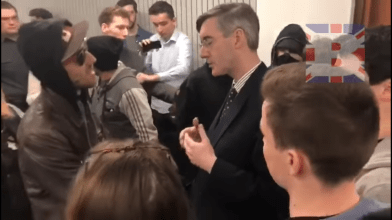
By now I assume everybody has seen footage of the impressively unflappable Conservative MP Jacob Rees-Mogg attempting to break up a physical altercation after an event in which he was speaking was stormed by leftist, Momentum-aligned protesters.

This is the kind of scene we have come to expect from American university campuses, where roving bands of masked Antifa-style goons, wearing their intolerance for diversity of thought like a perverse badge of honour, now routinely storm the meetings and public events of student organisations or external speakers they consider to be haram.

University campuses in Britain, by contrast, tend to be far more sedate places with much less visible security. Since we are fortunate enough in this country not to have to pause every couple of months to mourn another deadly mass shooting incident in an educational establishment, our university campuses do not have their own dedicated police forces as is sadly necessary in America. Neither is there some kind of private security guard for every three or four students.

This, however, may need to change if Members of Parliament and other speakers, people routinely invited onto university campuses to give talks or participate in student debates, find themselves pitched into the middle of violent confrontations with balaclava-clad goons whose devotion to the Cult of Social Justice and Identity Politics leads them to shut down the expression of any opposing thought.

On this occasion, the situation was defused before any real violence could take place, but Jacob Rees-Mogg has experience of standing up to aggressive leftist protesters and bravely stood his ground. Other MPs or public figures might understandably be less keen to put themselves in harm’s way while security guards or police are called to quell a developing problem.

And be assured, this will happen again – not because the speakers invited onto campus are becoming any more controversial or provocative, but because those opposed to their presence are becoming ever more sensitive to what they see as heresy – and too often are being indulged in their precious sensitivity by leftist academics, university administrators and politicians. The protesters cannot be reasoned with, and will not engage respectful debate when offered the chance, so the only way to preserve and protect freedom of expression on university campuses is to have a heavy security presence ready to haul out disruptive people who would censor events with their incessant yammering.

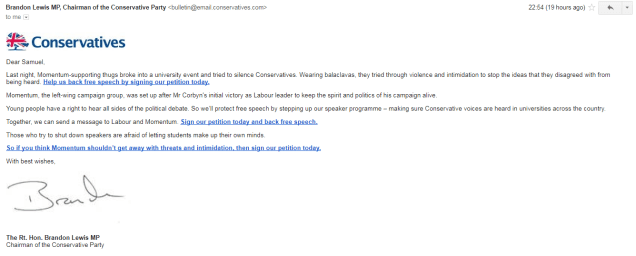
Unfortunately, what we saw from the Conservative Party in response to these events at the University of West England was not a muscular defence of free speech and a commitment to ensuring that universities which take public money also take seriously their responsibility to crack down hard on would-be student censors; rather, we saw a whinnying display of self-pitying victimhood:

Brandon Lewis - Conservative Party email - free speech petition

In wheedling tones, the new Conservative Party chairman writes:

Last night, Momentum-supporting thugs broke into a university event and tried to silence Conservatives. Wearing balaclavas, they tried through violence and intimidation to stop the ideas that they disagreed with from being heard. Help us back free speech by signing our petition today.

Momentum, the left-wing campaign group, was set up after Mr Corbyn’s initial victory as Labour leader to keep the spirit and politics of his campaign alive.

Young people have a right to hear all sides of the political debate. So we’ll protect free speech by stepping up our speaker programme – making sure Conservative voices are heard in universities across the country.

Together, we can send a message to Labour and Momentum. Sign our petition today and back free speech.

To whom is this petition addressed? The Conservatives are in power, for pity’s sake. Are we to waste our time signing a petition at the request of the party of government, encouraging the party of government to do something which it could and should have been doing all along? A government which has to pass around tear-stained petitions encouraging their own ministers to do their jobs does not deserve to hold office.

The title of the email is “It’s not ok”, which is exactly the same scolding, infantilising kindergarten phrase used by the Social Justice Left in America to describe behaviours which they deem to be “harmful” or “oppressive”. And so rather than taking the fight to those who would shut down free speech in this country, the Tories instead prefer to flaunt their scars in an appeal for public pity and then ask us to sign a petition calling on them to do something about the very problem over which they have so ineptly presided.

This is untenable stupidity. As Home Secretary, Theresa May did as much as anyone else to suppress freedom of expression in numerous forms, using exactly the same arguments as the Social Justice Warriors – to protect the supposedly weak-minded citizenry from corruption or offence from undesirable sources.

As Brendan O’Neill noted in 2016, soon after Theresa May ascended to the office of prime minister:

May and the student Safe Spacers she’s railing against are one and the same in their belief that bad or eccentric ideas are best dealt with by censorship. May bans a pastor who has a problem with the Koran; students ban secularist critic of Islam Maryam Namazie. May bans Tyler, the Creator for being sexist; 30 students’ unions ban Robin Thicke’s ‘Blurred Lines’ for being sexist.

And both use the Stalinist language of ‘safety’ or ‘the public good’ to justify their speech-strangling antics. Students’ unions claim, with spectacular paternalism, to be protecting the ‘mental safety’ of their student charges; May says she bans people who say weird things because they aren’t ‘conducive to the public good’. It’s almost funny: student leaders fancy themselves as anti-Tory, yet ape Tory intolerance of difficult ideas; May positions herself as a critic of Safe Space nonsense, yet she’s Britain’s Safe-Spacer-in-chief, treating not only students but all of us as infants to be guarded from controversy.

You cannot busily construct a Safe Space at the national level – a dystopian society where people are woken up in the middle of the night and dragged off to jail for placards they create, songs they sing or words they publish on social media – and then be overly surprised or outraged when a gang of young college thugs, raised in a society where it is constantly preached that people have the divine right not to be offended, decides to take matters into their own hands.

As this blog has repeatedly pointed out, the battle for free speech is won or lost at the margins – it is only by defending the vile and unconscionable speech of extremists that a firewall is created to protect mainstream political discourse. Sadly for Britain, the battle for free speech was never even fought at the margins – the government instead chose to unilaterally surrender on all of our behalfs, and restrict speech considered offensive by nearly every designated victim group or professional offence-taker in the land.

Now the barbarians are at the gate, and it is not just “extreme” language or opinion under threat, or even loud-mouthed and controversial provocateurs like Katie Hopkins, but mild-mannered right-of-centre politicians like Jacob Rees-Mogg. And now that the Faith Militant of the Cult of Social Justice and Identity Politics threatens the physical safety of Conservative MPs as they address perfectly respectable student organisations, finally the government is stirring lazily to action, unjustifiably offended that anyone other than the police might seek to enforce the very cultural and linguistic taboos that in their incompetence they allowed to spread unchecked across the land.

Well sorry, but this is too little and too late. The idea that a government led by the same authoritarian zealot who waged war on civil liberties in this country for six years as Home Secretary is suddenly going to bravely fight for freedom of thought and expression on university campuses or elsewhere is utterly risible. Even if she were to totally flip-flop on the issue, devoid of any other ideological backbone as she is, the prime minister no longer has the political authority to take a serious stand on a domestic political issue.

The litany of political failures which can be chalked up to the Conservative Party since 2010 – failures of ambition, vision, intellect, principle and courage – is growing too long to recount in any one blog post or article. But ending up in the same ideological hemisphere as masked thugs who threaten the physical safety of their own MPs surely has to rank near the very top of the list.

Jacob Rees-Mogg - University of West England - Momentum leftist protesters

Support Semi-Partisan Politics with a one-time or recurring donation:

Agree with this article? Violently disagree? Scroll down to leave a comment.

Follow Semi-Partisan Politics on TwitterFacebook and Medium.

Journalists Buying Fake Twitter Followers, Another Symptom Of Institutional Decay

Journalists buying fake Twitter followers - fraud

Some journalists and political pundits choose to buy artificial Twitter followers because being good at their job matters (and is incentivised) less than appearing like the Next Hot Thing.

I’ll admit it – in earlier years, in my weaker moments as a struggling political writer, I have idly thought about purchasing Twitter followers. But I have not and never will do so, and deplore those in journalism and politics who choose to sell out in this way.

The New York Times recently reported that a company called Devumi was offering dummy Twitter followers (either fabricated individuals or the fruits of identity theft) to those seeking to boost their social media stature for mere cents per follower. A whole swathe of celebrities were implicated (most of whom promptly rolled over and blamed their managers or PR people) but so too were a number of journalists at supposedly respectable outlets of the legacy media.

From the New York Times:

Genuine fame often translates into genuine social media influence, as fans follow and like their favorite movie stars, celebrity chefs and models. But shortcuts are also available: On sites like Social Envy and DIYLikes.com, it takes little more than a credit-card number to buy a huge following on almost any social media platform. Most of these sites offer what they describe as “active” or “organic” followers, never quite stating whether real people are behind them. Once purchased, the followers can be a powerful tool.

“You see a higher follower count, or a higher retweet count, and you assume this person is important, or this tweet was well received,” said Rand Fishkin, the founder of Moz, a company that makes search engine optimization software. “As a result, you might be more likely to amplify it, to share it or to follow that person.”

Twitter and Facebook can be similarly influenced. “Social platforms are trying to recommend stuff — and they say, ‘Is the stuff we are recommending popular?’” said Julian Tempelsman, the co-founder of Smyte, a security firm that helps companies combat online abuse, bots and fraud. “Follower counts are one of the factors social media platforms use.”

In some ways, this temptation is just one of many ways that using social media can warp our behaviours and motivations, as Jacob Brogan writes for Slate:

Twitter is a machine designed to generate ugly feelings. Here everything is subject to quantification: the number of people who like the things you tweet, the number who share your words with their own followers, and, perhaps most of all, the number who follow you. If you spend too much time on the platform, those numbers quickly become an index of your own self-worth, and no matter how high they get, they will always be too small.

Purchasing fake followers is thus rather grubby and slightly pathetic, but perhaps still fair game if you are a TV star looking to make a bit more money sending promotional tweets for haemorrhoid cream. But what if the person deceiving the public is somebody whose job it is to inform, educate and tell the truth? Surely then it becomes quite unambiguously wrong?

Well, lots of political journalists clearly don’t think so, according to NBC News:

Big media outlets have embraced Twitter as a distribution platform but still struggle with how reporters and editors use the social media service, particularly when they appear to be breaching journalism ethics.

This sizable gray area came into clearer focus this week, after a New York Times exposé revealed that more than a dozen news media figures had paid to artificially pump up the number of followers they have on Twitter.

Journalists and commentators, who presumably joined the platform to enhance their stature, instead found themselves grasping to explain why they had paid for counterfeit supporters. When contacted by NBC News, the journalists identified by The Times as having bought Twitter followers had a range of responses: Many ducked requests for comment, others blamed associates, while just one sounded chastened.

This practice doesn’t bother me so much when it takes place in other fields; if you’re a mediocre provincial stand-up comedian who wants to pretend you have an audience of half a million eager people hanging on your every word, so be it. Good luck to you. Same if you’re a B-list actress, a celebrity chef, an unremarkable footballer or a giver of lousy TED-style talks about personal development. I expect no realism from such people, and personalities from these fields who choose to over-inflate their popularity do no real harm.

Not so with journalists and political commentators, both those who parade around beneath the banner of the blue-tick Twitter verified logo and those scrambling for the Ultimate Recognition. Political Twitter is a nasty swamp of obnoxiousness at the best of times, but those of us who choose to lurk within it do so in the vague hope of coming across useful information or commentary once in awhile. And since nobody has time to vet every account that crosses one’s timeline to determine whether they deserve a follow or a clickthrough, a quick glance to see whether they have a decent (or at least a baseline) level of followers is a useful first line of due diligence.

Is this person for real? Well, their profile picture is the default egg icon and they have eleven followers. Hmm, probably not going to click that link or believe their sensational “report” about Theresa and Philip May using a ouija board in the Downing Street basement to seek inspiration and advice from Britain’s failed prime ministers of the past (plausible though that one actually sounds).

Buying Twitter followers makes a mockery of what the rest of us are trying to do, and undermines one of the few metrics left for gauging success (financial reward having long since ceased to be either a possibility or a useful indicator). I have a mere 2,500 followers on Twitter. However, unlike the cheaters, I earned my entire following by providing consistently useful or entertaining (intentionally or otherwise) content to my audience. Whether it is links to my blog, links to bloggers in my circle, flagging news articles of interest, engaging in feuds with trolls or writing in-depth threads on a particular topic, around two thousand people care enough about what I have to say to stay tuned on an ongoing basis (I imagine that many of the remaining 500 are either businesses or largely dormant accounts).

A study from 2016 suggested that of those people who had tweeted once within a six month period, their average number of followers was 707. This figure seems a little high to me, as I routinely interact with people whose following/follower figures are only in the double figures – but this may be a function of swimming almost exclusively in the political niche rather than venturing out into the deeper oceans of celebrity Twitter. Anyhow, the study would suggest that anything over 707 is then a pretty good sign, and in lieu of an affirmative action-gifted writing gig for The Spectator I am proud of my 2,500 followers as a sign that my hours in front of the keyboard are not entirely wasted.

Ultimately, all this predictable scandal tells us is what a fraud so much of journalism and political commentary has become. Portentously spewing words into the void of Twitter knowing that most of your audience is actually imaginary can’t bring positive feelings of journalistic pride, since one would be aware of the fraud. All that those followers can do is burnish one’s reputation and make one seem like an important person to get drinks with or be seen talking to at one of the many insufferable events that take place every day in Westminster or Washington, D.C.

And the problem is that for those journalists who buy Twitter followers, that’s just fine. They don’t want to organically build an engaged audience of followers who find what they say to be genuinely insightful. They may not object were it to happen, but actual professional accomplishment is clearly no longer the prize to these people. What they want is the aura of success, to be seen as uniquely knowledgeable, titillating or controversial without putting in the labour to do it themselves.

We see the same thing with many of our politicians. Twenty months on from the EU referendum and the number of MPs who have even a basic grasp of the technical issues relating to trade arising from Brexit can probably be counted on two hands. An even smaller number have paid much thought to the constitutional ramifications and the opportunities and threats to our future governance, if any at all. The most significant political development to happen in Britain in decades, and only a handful of our parliamentarians have bothered to stop spouting slogans from the referendum campaign to actually master the issues at hand.

Why is this? Because sitting down with books and consulting advisers in a spirit of humility and willingness to learn is boring and unsexy. The personal payoff just isn’t there, particularly when one can do so much more for one’s career by bleating an angsty speech about the Evil Tor-ees in the Commons chamber or going viral on social media with a well-timed quip on Question Time. And the only reason that our star journalists – the ones who pull in the big bucks and now get terribly worked up at the thought that their celebrity pay packets might not be “equal” – have not rumbled the politicians and revealed the extent of their ignorance is because much of the legacy media is in an equally benighted state.

The whole reason our politics are currently so dysfunctional is that being good at your actual job is no longer adequately incentivised. Looking good and frantically maintaining all the appropriate outward signs of success and positive momentum are what matters most, not solid work diligently performed in the spirit of self-improvement. That’s why people cut corners and do things like participate in Twitter follower-purchasing frauds – because they believe, often correctly, that the rewards which flow from mastering an issue or having an original idea are far less than those which flow from being on some insufferable “Westminster’s 100 people to watch in 2018” list.

You can write for months or years before establishment journalists (as I did) that the Tories were going on an ideology-free jaunt into political oblivion, or that Jeremy Corbyn ought to be taken seriously because the public responds to conviction and consistency, but it doesn’t matter. You won’t get the slightest credit, because nothing has officially been thought or written until it has come from certain approved sources within the Westminster Bubble. And even within the bubble exists a hierarchy, with all of the attendant temptations to level-up by artificially boosting one’s standing.

And that’s why I never have and never will buy Twitter followers. It represents everything that is rotten, sleazy and stupid about modern politics, and the alarming frequency with which people who shouldn’t be within ten promotions from the top of their respective fields end up prancing around at the pinnacle, lording it over the rest of us (be that the prime minister, whole swathes of Parliament, the editors of several newspapers, numerous television news personalities and various assorted celebrity columnists).

We will never live in a perfect meritocracy, and it is stupid to set unrealistic goals which ignore human nature. But one thing you ought to be able to trust in this day and age is that the Very Serious Journalist with the blue “verified” tick next to their Twitter account name is not perpetrating a fundamental fraud every time they broadcast their news, analysis and opinions.

I earned my Twitter audience, and my follower count rises and falls according to the value I deliver. Anything short of this basic standard of behaviour is akin to selling a used car having first tampered with the odometer. And while social media juicing may not be illegal, we should look upon those who engage in it with the same scorn and distrust one might reserve for a convicted fraudster.


Twitter for journalists

Support Semi-Partisan Politics with a one-time or recurring donation:

Agree with this article? Violently disagree? Scroll down to leave a comment.

Follow Semi-Partisan Politics on TwitterFacebook and Medium.