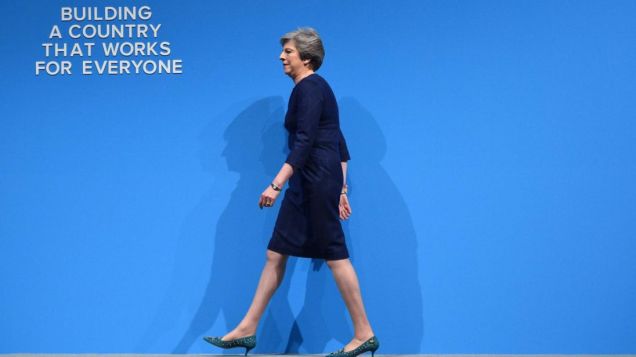
Building A Britain Fit For The Future

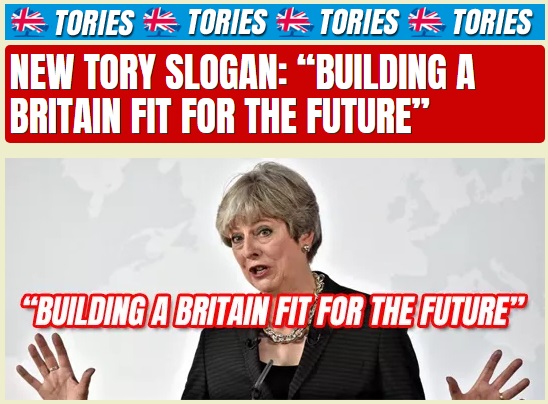
Building a Britain fit for the future - new Conservative Party Tory slogan

Strong and stable, version 2.0

Word on the street is that the Tories have got themselves a shiny new slogan. Guido Fawkes reports:

Here are seven words you can expect to hear a lot more of over the next few weeks and months: Guido understands the new Tory slogan is “Building a Britain fit for the future”. Theresa May used it three times at PMQs on Wednesday, telling the Commons: “this government is building a country fit for the future”, “we are building a Britain fit for the future” and “We in the Conservative Party are building a Britain that is fit for the future”. This morning the CCHQ Twitter account used the same phrase.

As slogans go, I suppose that “Building a Britain fit for the future” could be a hell of a lot worse. It is certainly better than “strong and stable”, though according to Guido it seems as though the Tories are already in danger of wearing out their new slogan through enthusiastic over-use.

BABFFTF has potential because it at least acknowledges that we are entering a period of discontinuity – a time where the current system or political consensus is starting to fray and show signs of fatigue, where new and previously politically unfeasible policies are required to break the impasse or respond to the concerns of the electorate. The rise of Jeremy Corbyn as Labour leader and the vote for Brexit are just two of the most prominent signs that we have entered such a time of discontinuity, with the pro-EU, centrist consensus adopted by Labour and the Conservatives through 2015 increasingly failing to address the hopes, fears, concerns and priorities of many people.

The problem, though, is that the slogan seems to have been trailed before the necessary supporting ideas – the vital national reboot checklist which can steer Britain through Brexit and on to the other challenges – have been developed. Now, it’s possible that Theresa May has been huddled in Downing Street with her SpAds brainstorming some breathtakingly original new ideas, and that we will all be bowled over when they are announced in the coming weeks – but it seems unlikely. Firstly, she would be breaking the habit of a lifetime (doing something bold and visionary) and secondly it is hard to tell when such inspired policymaking might have taken place given all of the shenanigans going on in her Cabinet.

While we can finally detect a few faint signs of new intellectual life in the Tories – notably the Big Tent programme launched by George Freeman, and the Square Deal initiative led by Nick Boles – these groups are barely getting formed, and are months away (if not more) from reaching full fruition. And as I have previously written (and will continue to expand upon in coming days and weeks), we are still missing anything like an overarching framework to diagnose the issues facing Britain, draw out the links between them and produce an electorally viable set of policies to tackle them. Discontinuity requires policymaking through extraordinary means; the same old processes tend to yield the same old solutions.

That being said, the Tories cannot remain silent altogether while they try to get their act together. It is good, in a way, that Brexit is currently consuming most of this government’s energy because that means that they have little time (and even less political capital) to push through some of the authoritarian, statist, anti-market policies which one suspects Theresa May would now be rolling out had she won a thumping majority. A de facto “first, do no harm” doctine has thus been partially imposed on this government, like it or not.

But still the Tories must do something, starting with the Budget next week, to show that they are starting to understand the depth of public dissatisfaction with the old political settlement, particularly on housing (since this is a vital policy area more separated from some of the others). Years of disappointment mean that I have zero positive expectations of Phillip Hammond when he gets to his feet to deliver the Budget next Wednesday. I fear that even if there is noticeable movement on housing, it will be a big sop to Labour by focusing on the building of new council housing rather than the big unleashing/encouraging of private development (upward, not outward) which we need. This is Hammond’s chance to prove me wrong, as well as everybody else who has lost faith in the current government being anything more than a very clumsy caretaker.

The pessimistic part of me still believes that a mid-term rescue for the Tories is simply impossible; that it will take a (hopefully) short, sharp spell in opposition to rid the current Tory frontbench of much of its dead wood and see some new talent push forward – hopefully talent less beholden to the current political consensus, and which wants to do more than simply make a few cosmetic tweaks to win back public opinion. Readers will no doubt correct me if I am wrong, but I cannot think of one example of a successful political turnaround that was driven by refreshed policies rather than the good fortune of events.

But a Jeremy Corbyn government is not something to be entertained lightly. The next government will likely set the tone and direction of Britain’s immediate post-Brexit years, and so will play a large role in stamping their imprint on whatever the new emerging political consensus or centre of gravity happens to be. After years of leftward drift under both New Labour and Conservative governments, it is important that the next significant course change is to the right. In a world of pure ideology one may well want the Tories decimated at the next election so that they can grow back stronger and with a renewed sense of purpose, just as controlled forest fires can ultimately benefit an ecosystem even as they destroy in the short term. But since we all have to live in this forest for the duration, dropping a match onto dry leaves by ushering Jeremy Corbyn into 10 Downing Street really must be an option of last resort.

Therefore let us hope that “Building a Britain fit for the future” and whatever quickly-concocted policies lie beneath it buy the Tories sufficient breathing room to attempt a more fundamental policy review – to create the new Stepping Stones report for 2018 that Britain needs to chart our way from one failed political consensus to a new one which addresses today’s challenges.

Let’s hope that it falls to conservatives to build the Britain of the future, and not Jeremy Corbyn’s Labour Party.

Conservative Party Logo - Torch Liberty - Tree

Support Semi-Partisan Politics with a one-time or recurring donation:

Agree with this article? Violently disagree? Scroll down to leave a comment.

Follow Semi-Partisan Politics on TwitterFacebook and Medium.


The Centre Must Not Hold

WTF is Centrism

Calls for the Tories to pursue and embrace the non-existent “radical centre” are a dangerous Siren song for conservatism at a time when the country needs conviction and clarity of purpose

We must know what a Tory government will have to achieve, before thinking about the way in which it must win office, because simply “winning a majority” on the wrong terms may not give it the authority it needs for success.

In normal times a majority is enough. The task of government is to steer a basically healthy socio-economic system past hazards which are primarily external, while ensuring that the system’s fabric is maintained and making improvements to it here and there.

But once the system itself starts to show signs of fatigue, instability, disintegration, then we start to talk of discontinuity. In discontinuity, solutions can only be found by breaking constraints which we had assumed were unbreakable. It is not enough to settle for policies which cannot save us, on the grounds that they are the only ones which are politically possible or administratively convenient.

– John Hoskyns and Norman Strauss, “Stepping Stones Report”, 1977

For over a week now I have not been able to bring myself to write anything new for this blog. Why? Because the patterns of failure in British politics are now tediously familiar beyond all endurance, as are the mistakes, missed opportunities and blunders routinely committed by politicians and thinkers who call themselves “conservative”.

Yes, the past week was a particularly torrid one for Theresa May’s shambolic government, but it did not teach us anything new. So more evidence emerged that Boris Johnson is totally unfit to be Foreign Secretary, the Tories no longer even seek to act like the party of Defence while the prime minister is utterly dependent on her questionable deputy Damian Green – these are not new revelations. They have been relentlessly, depressingly drummed into our consciousness over a matter of months and (in some cases) years.

Besides, even if Theresa May’s Cabinet were a precision-engineered Rolls Royce jet engine operating at maximum power and efficiency it would not matter – we would simply reach the same dismal destination somewhat faster than is currently the case. This is not an ambitious and visionary government let down by flawed execution and unfortunate scandal; it is a government which never had any real purpose to begin with.

Every two-bit conservative commentator is now saying what this blog has been screaming for years – that aimless, centrist government devoid of purpose is a dogma of the quiet past, inadequate to the stormy present; that we may as well not have bothered deposing New Labour in 2010 if we were only going to replace Gordon Brown with a bunch of slavish centre-left devotees wearing blue rosettes instead of red ones.

Well slow hand clap, guys. What do you want, a medal? Some of us have been making this point for years now, back when the well-paid and ubiquitous journalists and TV commentators were purring over David Cameron and Theresa May, predicting an uninterrupted decade of energetic, fruitful Tory rule even as their timidity and incompetence led us ever closer to the abyss.

Already there are a number of travelling quacks offering their own dubious potions and cures for the Tory malaise, most of which are vague at best or completely misguided at worst. A few thoughtful people have genuinely interesting ideas, but many seem to propose a further shift to the left, as though additional concessions to Corbynism will do anything other than validate Labour policies in the eyes of the electorate. Others suggest that “compassionate conservatism“, that hateful, self-sabotaging and worn-out phrase, is the magic solution. But most common are the tedious, meaningless calls for the Tories to recapture the “radical centre” of British politics.

The latest to take up this cry is Tory MP Johnny Mercer, who offers a fairly blistering (and by no means inaccurate) critique of past Conservative failures, taking Theresa May to task for her failures of leadership and the party as a whole to task for their ideological drift.

From the Telegraph:

“It smells of decline, and the people won’t have it” said Mr Mercer, MP for Plymouth Moor View, who bucked the national trend and increased his majority by five-fold at the last election.

“There becomes a cross-over point in seats like mine, it becomes about your personal integrity, about your credibility. You have to step back and question what your party is doing – of course.  Yes we are beginning to get there I fear”.

[..] He went on: “A Corbyn/McDonnell Government would fundamentally change Britain and what it means to be British. We would not be forgiven as a party for 20 years. We must remain, if nothing else at the moment, credible.”

[..] “We have a duty to the Nation to ensure the Cabinet is comprised of the best people in parliament, not the most famous names. Theresa May had to make a decision where she formed her cabinet: whether to select members to manage the fall-out from Brexit or select the best modernisers to bring about social change. She chose the former – I understand that, but now is the time for bold, outward facing leadership in my view.”

But then, just as you are expecting something radical or attention-worthy proposed as an alternative, Johnny Mercer merely proposes a further attempt to “grab the middle ground”.

This is so incredibly disheartening, coming from somebody whose profile and biography would potentially make him a very attractive future leadership candidate. Having diagnosed the problem, where is Mercer’s solution? More grasping for the centre?

People: THE CENTRE IS NOT A FIXED PLACE. It merely describes a point equidistant between two other, polarised positions on the political spectrum – usually the status quo, or today the groupthink of a pro-EU establishment who are becoming increasingly extreme in their contempt for democracy. The centre is not and cannot be a place from which to build effective policy because it is rooted in nothing but triangulation and brazen political calculation as opposed to any kind of firm conviction as to how society should be ordered, or the rights of the people and the role of government set out.

If the last few years in British politics have taught us anything, it is that the people respond surprisingly warmly to sincere politicians who hold clear convictions springing from a coherent and easily explainable worldview. People may not agree with Jeremy Corbyn, but even many of his detractors admire the fact that he has held and advocated for many of his ideas in good times and bad, back when they were on the discredited fringe and now, when they are being taken more seriously once again.

The Tories need a Jeremy Corbyn of their own, but instead they got Theresa May, who frittered away the Conservative majority because she stood for nothing. She is an authoritarian pseudo-traditionalist whose intellectual blood bank (in the form of Nick Timothy) has thankfully been exiled from government, but not replaced by anything better.

May’s risible pitch in the 2017 general election was strength and stability, but these are states of being, not a direction of travel. People jetting off in an aeroplane together would generally prefer less turbulence to a more bumpy flight, but more than anything they care about arriving at the correct destination. Jeremy Corbyn made his flight plan crystal clear to the British electorate. Theresa May didn’t even bother to produce one, preferring to pander to the Politics of Me Me Me.

You don’t win a convincing mandate to govern by chasing the centre. You win such a mandate by coming up with a clear plan of action flowing from a coherent and easily explainable view of the world, one which is so compelling that it makes sense to an election-winning majority of voters, thus causing the floating centre to shift in that direction.

Margaret Thatcher’s government did not rescue Britain from a failing post-war consensus and 1970s national decline by cautiously seeking consensus and the same elusive centre ground fought over by the previous Heath, Wilson and Callaghan administrations. She made her mark on Britain by charting a new course, braving resistance rather than capitulating to it, and dragging the centre to the right so that after the Tories finally lost power, New Labour had neither the ability nor the desire to undo many of the changes she wrought.

That’s how you run a government worthy of the history books. The Tories should stop slavishly chasing the centre, and come up with a new blueprint for Britain – the new Stepping Stones Report which we so desperately need, updated for 2017 – which will shift the centre of British politics back in the direction of liberty underpinned by the autonomous nation state (or some compelling improvement on it).

Whatever differs from this, to the extent of the difference, is just noise.

Conservative Party Logo - Torch Liberty - Tree

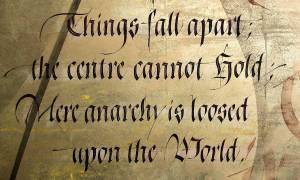
Things fall apart the centre cannot hold - Yeats quote

Support Semi-Partisan Politics with a one-time or recurring donation:

Agree with this article? Violently disagree? Scroll down to leave a comment.

Follow Semi-Partisan Politics on TwitterFacebook and Medium.

The Battle For British Conservatism: Are The Tories The Enemy Within?

Theresa May - Downing Street - Conservative Party - Tories

What if the current Tory Party represents a dangerous, long-ascendant fifth column within British conservatism?

In a blistering attack on the party of Theresa May, Philip Hammond, David Cameron and George Osborne, Laura Perrins of The Conservative Woman declares that the Tories are now the “enemy within” and the single greatest threat to what remains of British conservatism.

Perrins’ dissatisfaction with the Conservative Party – like that of this blog and other malcontents of much longer pedigree such as Peter Hitchens – has clearly been building for some time, but finally reached boiling point when the Conservatives cooked up their  “presumed consent” scheme for organ donation, yet another policy which sounds fluffy and caring at first glance but which would effectively make one’s body the property of the state, merely on loan to you not from God or nature but from Her Majesty’s Government, to which it must be returned upon death unless one specifically requests an exemption.

Perrins thunders:

The last straw for me was the proposed ‘presumed consent’ organ donation scheme, more accurately described as the State organ appropriation scheme. This is small fry in the scheme of things but it sums up the whole rotten party. The concept that your body is yours, and remains yours and then under the control of your family after death, is so fundamental, so obvious, so visceral and so conservative that it should not need explaining.

Now Theresa May tells us that in fact your body belongs to the State, unless you have taken the time and trouble to tell the State otherwise. This is wrong in principle and in practice. I was on a radio show with a chap who was waiting for a kidney and he said that his surgeons told him there were not even the beds or doctors to take advantage of this scheme. So, the Conservatives are grabbing organs just, as usual, to look nice. See, neo-Statists.

I had a very similar reaction at the time, not because I am any less keen to see organ donation rates improve and waiting lists decrease, but because this way of going about it represents about as big a power grab by the state as it is possible to make:

https://twitter.com/SamHooper/status/915636056732655616

But this is just one of the many ways which the impostor party which bears the name “Conservative” has made a mockery of the principles they supposedly stand for, and Perrins goes on to recount the full litany at length.

Let’s face it, the Conservative party are neo-Statists and have done more damage to conservatism in this country than Labour ever could. The current leader of the party believes actual conservatism – small government, strong families and the free market – is nasty. She actually said this, yet we are all to go merrily along backing this wretched party no matter what, as we did in the last election – much to my regret.

This is the party that believes an energy gap is a good idea, and that continued government guarantee of tuition fees is sensible. The Tories are as ideologically wedded to the socialised health system that is the NHS as the Labour party is, all because they think they will look mean if they point out that in fact the Emperor has no clothes.

The Tories have interfered with the childcare market, causing the costs to rise year in, year out. They want more mothers in work, whether they want to be there or not. They lecture us on what to eat and drink; no detail of our life is beyond government note-taking. Now they have instructed GPs to ask what your sexuality is. This is Nanny turned Nurse Ratched.

The Conservatives love big government. There has been no reduction in quangos – they have quangos lobbying their own government, for goodness’ sake. They use the school system to try to solve every social problem: FGM, toothbrushing, sex education, pornography, drugs, healthy eating, on and on it goes. The national debt could hit £2trillion in the next ten years.

And so it goes on – Perrins inevitably touches on the march of the Cult of Social Justice and Identity Politics, noting that the Tories have bent over backwards at every turn to accommodate increasingly avant-garde and unproven leftist orthodoxies around gender and family life. And to each accusation there is little which can be said in defence.

Of course, there are exceptions, and I do not agree with all the charges laid by Perrins at the foot of the Conservative Party. I would certainly argue that some of the concessions to modernity made by the Tories are good and entirely necessary, particularly the opening up of the stabilising, enriching influence of civil marriage to same-sex couples. But even where one agrees with the thrust of Tory policymaking on social issues there can be little denying that the fears, objections and liberties of dissenting individuals and religious organisations have been trampled in the process.

So what to do, given that the present-day Tory Party is at best ambivalent and at worst hostile to many conservative values and priorities? Must we really shrug our shoulders, be grateful that we don’t have Prime Minister Jeremy Corbyn and put up with the dismal, directionless leadership we currently have?

Laura Perrins hints that maybe we do not have to put up with this Coke Zero Conservative government after all:

A Labour government would be grim, don’t get me wrong. But I wager that they won’t last long, they will split, and they will not get to do half the things they say they will do. They have already ditched the tuition fee promise and they are not even in power. In sum, they are not the long-term threat to this country.

I am inclined to agree. As I have written numerous times before, at present small-C conservatives have the worst of all worlds. We are nominally in power, yet virtually none of our values and priorities are being addressed by the government. We are continually assailed by the Left for supposedly being heartless, callous and cruel towards the generically “vulnerable”, yet the budget deficit persists, the national debt grows and the idea of real fiscal conservatism remains as remote as ever. We are accused of seeking to destroy the “beloved” socialist edifices of post-war Britain like the welfare state and Our Blessed NHS, yet Universal Credit rollout by 2022 is apparently the best we can do.

As I once wrote:

If I’m going to be accused of callously taking a jackhammer to the welfare state I at least want to see a little bit of rubble as my reward. But there is no rubble, only the stench of craven capitulation to the leftist forces of perpetual dependency.

So given the near-futile hope of meaningful conservative ideological renewal while in power, how much worse could a Corbyn premiership actually be? Here, I again agree with Perrins. While Jeremy Corbyn himself would probably love to take the country galloping off to a hard leftist destination, in practice he is constrained by the centrists within his party. And as we are all currently witnessing with the Brexit debate, establishment centrists have a way of grinding down objections and diluting any idealism in order to get the self-serving stability which they want for themselves.

While at present this centrist handbrake serves to stymie Brexit and torpedo any possibility of real small-government conservative reform, in the event of a Jeremy Corbyn premiership the same centrist blob would also serve as a drogue parachute, arresting any sudden leftist moves attempted by Labour and limiting the damage that such a government could inflict. Therefore, revoking all support for the current Tory government need not be calamitous. After all, when we already have a government which is willing to decimate the armed forces, firehose foreign aid at countries in a manner totally unaligned with our foreign policy goals, trample civil liberties and spend taxpayer money like a sailor on shore leave then how much worse could it possibly be?

What Perrins’ article does not do, however, is spend much time looking at what kind of party the Conservatives should become if only they can be retaken. And here there is a genuine tension, not between the kind of social conservatism presumably favourable to The Conservative Woman and craven submission to the identity politics cult, but between social conservatism and free markets.

This is a battle for the soul of British conservatism which has been suppressed for far too long. A new balance must be struck between social conservatism and free markets which addresses the key challenges of our time – globalisation, automation, migration, national identity, defending Western values and defeating Islamist terror – in a way which attracts and inspires voters. The Conservative Party’s current policy mix isn’t turning any heads, and is actively alienating most people under fifty years of age. Our sole saving grace is that Labour haven’t yet come up with a compelling solution either.

There remains an opportunity for conservatives to answer these critical questions and arrive at a new balancing of priorities which works for the country, though doing so while still in office is a tall order. But if we are to have any chance of success we must begin by acknowledging that the contemporary Conservative Party is not and has not been a friend of small-C conservatism for many years.


Conservative Party Logo - Torch Liberty - Tree

Support Semi-Partisan Politics with a one-time or recurring donation:

Agree with this article? Violently disagree? Scroll down to leave a comment.

Follow Semi-Partisan Politics on TwitterFacebook and Medium.

Conservatives Are Conceding The Battle Of Ideas Without A Fight

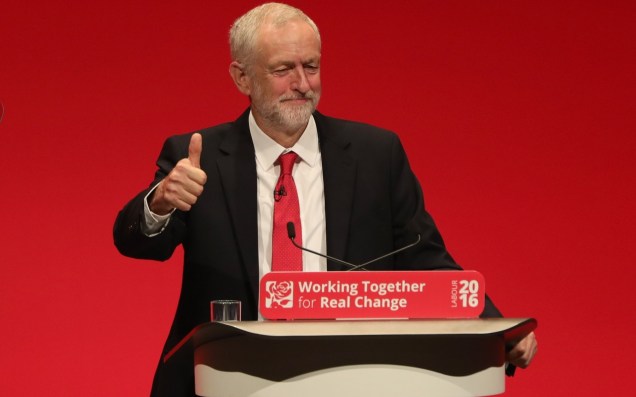
Jeremy Corbyn thumbs up

Jeremy Corbyn’s Labour Party is hard at work promoting their beguiling new left-wing vision for Britain while the Tories offer nothing but drudgery and incompetence

Every day now brings more ominous warning signs for the squabbling, directionless Tory government that the only people in Britain offering a clear, articulable vision for the country are those on the Corbynite hard-left wing of the Labour Party.

Four months after the general election, and all of the political energy and momentum is still on the Left. Jeremy Corbyn is more wily than he was in 2015, less prone to gaffes or accidentally handing his enemies the initiative. His centrist rivals have fallen into line, discredited and with no strong candidate to unite behind. Moreover, while most conservatives spent the summer licking their wounds far from the ideological field of battle, Momentum continued to organise and prepare for what they believe is one final push required topple the Tories and seize power.

And this newfound confidence is starting to creep into the rhetoric used by Labour politicians. Jon Trickett, Shadow Minister for the Cabinet Office, writes this week in LabourList:

There was a time after the second world war when government saw its central role as creating a socially just Britain where full employment, adequate housing for all and free education was the right of the many.

In that time, there was always more to achieve but the national sense of purpose was clear.

It was a time when jobs were secure and for the long term. Policy was designed to make communities feel secure, when the past was a bad place of mass unemployment, slum housing and no hope. But the future was full of promise, where strangers were welcomed into communities because no one felt their jobs were under threat.

And in the time, it was not acceptable that the growing wealth of the country was only distributed to the wealthiest.

A coherent set of progressive values aimed at building a social contract in which we had a sense of duty to the community, and the country agreed to stand behind those who could not care for themselves.

Note what Trickett is doing here. He is building a narrative, talking about the kind of country we once were and citing the great endeavours from our past in order to build a link with the present and generate enthusiasm for future Labour policies.

President Lyndon B. Johnson did something very similar (albeit at a much more sophisticated level) when introducing the Great Society initiative in 1964, not merely proposing a raft of random new socialist programmes but making them collectively seem almost inevitable by deliberately linking them with the American founding, history and national destiny:

The purpose of protecting the life of our Nation and preserving the liberty of our citizens is to pursue the happiness of our people. Our success in that pursuit is the test of our success as a Nation.

For a century we labored to settle and to subdue a continent. For half a century we called upon unbounded invention and untiring industry to create an order of plenty for all of our people.

The challenge of the next half century is whether we have the wisdom to use that wealth to enrich and elevate our national life, and to advance the quality of our American civilization.

Your imagination, your initiative, and your indignation will determine whether we build a society where progress is the servant of our needs, or a society where old values and new visions are buried under unbridled growth. For in your time we have the opportunity to move not only toward the rich society and the powerful society, but upward to the Great Society.

In fact, this is a simple device which even mediocre politicians and rhetoricians were once capable of using before technocratic centrism sucked the soul and energy out of politics. It is the exact opposite of anything written or spoken by a Conservative minister in Theresa May’s administration, because great political rhetoric can only exist when there are great ideas to be expressed or arguments to be won.

Trickett goes on to give a perfunctory but devastating indictment of the state of Britain under the Conservatives:

But now you would struggle to discover a shared sense of national purpose. You could describe a sense of anomie in Britain where a sense of common values, duty to others and co-operation for shared ends are, to one extent or another, lacking.

Too often: post-industrial communities have been abandoned; young people have less hope than ever before of acquiring a home at reasonable cost; education has become a commodity rather than a public good; where that which was common is frequently private or suffering from severe spending cuts; and, where the wealth of the most privileged is growing exponentially at the expense of the rest.

How do we explain this shift in the national culture?  Or rather, how do we account its disintegration and fracturing? Is this a uniquely British problem? And can we begin to rebuild a renewed socialist project based on 21st century.

At this point a five-alarm fire warning should be sounding in CCHQ and inside the head of every single Tory or small-C conservative in Britain, because Jon Trickett has just eloquently and concisely diagnosed the ailments of modern Britain – the fact that we are effectively drifting as a nation with no core unifying purpose or attachment to one another and a diminishing sense of obligation to our fellow citizens. In other words, Trickett has created an itch, a burning discomfort with the status quo, and now stands ready to offer voters the calamine lotion of Jeremy Corbyn’s socialist policies.

One does not have to agree that building “a renewed socialist project” is the answer. The point is that Trickett has clearly defined a problem and proposed a solution, all in the space of three short paragraphs. The Tories, meanwhile, are stuck defending a mediocre record with the huge distraction of Brexit, and seem to be loudly insisting that everything is great despite mounting evidence to the contrary (see Universal Credit). They have chosen to be cheerleaders for the status quo rather than agitators for change, even though the Conservative leadership election-that-wasn’t last year presented the perfect opportunity for unflinching self-assessment followed by an ideological reset.

That opportunity was squandered. And it has really come to something quite appalling when a Labour politician is responding to the priorities of this blog before the Tories pay proper attention. Jon Trickett is hardly known as Labour’s greatest thinker, but at least he understands that mandate-bestowing electoral victories are won on the back of selling the electorate an inspiring vision for the future.

Having a narrative is important. Good leaders and successful political movements understand this. The Attlee government alluded to by Jon Trickett certainly had a clear vision of the New Jerusalem they wanted to build out of the rubble of war. Margaret Thatcher had her urgent mission to save Britain from a failing post-war consensus and terminal national decline. Even David Cameron had his “Big Society”, an idea which might have been genuinely transformative if only it was bolstered with more thought and political courage.

In America, Franklin Delano Roosevelt had his “New Deal”. LBJ championed the “Great Society”. Ronald Reagan beguiled the nation with his promise of “Morning in America” after years of perceived stagnation under presidents Ford and Carter. And while President Obama’s soaring rhetoric often exceeded his relatively pedestrian governing agenda, his 2008 message of “hope and change” also strongly resonated with many Americans (including millions who deserted the Democrats to vote for Donald Trump in 2016 after no positive change appeared in their lives).

British politics has been stuck in such a dismal slump because for two decades an incredibly narrow, self-serving consensus was allowed to crowd out all other perspectives. And while this consensus served many people fairly well, its policy outcomes focused almost exclusively on funnelling material benefits (either wealth and career opportunities or literal welfare benefits) to certain specified groups of people rather than calling all of us together as a society united by a common bond, culture and purpose.

That approach has been found wanting. When the bipartisan political consensus (favouring EU membership, social liberalisation, globalism and corporatism) goes unchallenged it feels no need to respond to the concerns of those who do not benefit from existing policy. That is why for all the material progress seen in Britain we are still blighted by low productivity, family breakdown, divisions over immigration and a lack of any meaningful government response to the negative side-effects of automation, outsourcing and globalisation.

By electing Jeremy Corbyn as leader, some within the Labour Party recognised that continuing to stand up for a failing political consensus was no way to address these problems or win a decisive mandate for left-wing government. As incumbents, the Tories were left as the only major party championing the status quo, and rather than develop a radical, inspirational right-wing message of their own they continued to double down on bland, uninspiring centrism under Theresa May.

What makes it especially galling that the Left rather than the Right have recognised the need for a positive, bold new narrative is that it is the Left who are most in thrall to the Cult of Identity Politics which does so much to atomise society and make people see themselves as members of persecuted identity groups first and foremost rather than fellow citizens of a united country. Somehow, despite this increasingly prevalent mindset within their ranks, some on the Left still managed to recognise the need for a coherent, inspiring national message, a message with the potential to unite a broad swathe of society behind it (though whether it succeeds is another matter).

As John Prescott boasted earlier this year:

Finally, we’re talking about ideas and policies – not splits and personalities. Twenty years ago next month, Labour won an ­election landslide because we were united, trusted and had policies people could understand. When we lost in 2010, I felt we lost our way. We didn’t want to defend our record in government and by 2015 we accepted Tory austerity.

At least Labour is now ­developing clear red water between us and May. Not with soundbites and brickbats, but with popular policies.

Ideas and policies over splits and personalities.

Meanwhile, what do the Tories offer? False promises of being “strong and stable”, a moronic slogan which described an unattainable state of being rather than a clear direction for the country. More dull, technocratic drudgery in which eliminating the budget deficit (painstakingly slowly) is considered an aspiration worth putting in neon lights and making the focus of their government. Division and incompetence on Brexit, with the only optimistic Tory voices now belonging to free trade fantasists who want Britain to unilaterally lower barriers to trade and who think that crashing out of the EU and defaulting to WTO trade terms is a smart decision. Barely concealed leadership rivalries between a cast of identikit Cabinet ministers who seem to be competing with one another based on personality rather than different visions for the country.

Yet even now, the Conservative Party has no idea of the terminal danger it is in. Despite a few plucky efforts to re-inject some proper thinking and ideas into the party, the prime minister and her Cabinet offer no real ideological leadership whatsoever. Consumed by Brexit (and doing a pretty poor job at that) they seem to have abdicated any responsibility for using government to lead the country to a better place. Everything they do is reactive and cynical, like Theresa May’s university tuition fee freeze and Chancellor Philip Hammond’s age-based tax proposals, transparently cynical attempts to court the youth vote which are laughable in their inadequacy.

A couple of days ago I mused about whether the Conservatives can renew themselves ideologically and spiritually while still in office. This already slim prospect looks less and less likely by the day, both because senior people within the Tory Party seem to be too busy lurching from crisis to crisis to see the bigger picture and because all of the ideological energy and political momentum is on the Left right now.

And where there is new conservative thinking, it tends to counsel more, not less, accommodation with the Left. Some MPs, like Sam Gyimah, talk the right language of purpose and ambition but then disappointingly default to predictable, Left-leaning “compassionate conservative” solutions. And even these efforts at conservative renewal tend to focus more on what the government could and should do for us rather than what we collectively might accomplish together as a people. Time and again, the present Conservative Party capitulates to the Left and apologises for its own principles.

This is frustrating because conservatives should be able to come up with a far more inspirational, compelling message than the one they have been peddling. The Left’s entire focus is fixed firmly on inequality. Yet even die-hard Social Justice warriors would surely admit that equality is a hygiene factor, the absolute baseline for which society should aim (though they might then go on to disagree about whether equality or opportunity or outcome should be the goal).

Therefore, as eloquent as Jon Trickett’s words are – and as much as they should scare conservatives who are yet to join the ideological battle – equality remains insufficient as an organising principle for society or a shared national ambition. We need more concrete goals toward which we can all strive and move together, while in the background we are working hard to achieve a just society (however we choose to define it).

And luckily for conservatives, this is what the Left still does not get. Though they have woken up to the need to talk in terms of vision and ambition while the Tories are still lost at sea, the Left still sees achieving equality as the ultimate goal. One gets the distinct impression that many on the hard Left would not much care if we never really accomplished anything great as a country and even regressed somewhat in terms of material comfort and economic development, so long as society was flattened and the gap between rich and poor reduced. To listen to many a Labour speech, one almost pictures a country with a state-of-the-art NHS hospital on every street corner but a population so busy marvelling at their wonderful state of equality that they forget to go out and change the world.

So there remains an opportunity for conservatives to sneak in with an improved narrative and national ambition, one which aspires to something more than mere equality. Something which actually seeks to organise and harness the best of our energies and skills as we strive to make our country and the world better, not just more equal. Such a vision, carefully crafted and persuasively argued, would beat the Left’s narrow-minded focus on equality any day of the week.

So who will step up to the challenge and help develop a worthy conservative response to the re-energised Left? Because right now they are the ones fizzing with energy and ideas, while conservatism seems content to trudge wearily to its grave, quite possibly dragging the country along with it.


UPDATE – 17 October

Evgeny Pudovkin makes some good points over at Comment Central, specifically around how the Tories can potentially keep Theresa May in place as a “bad bank” repository for public dissatisfaction with the status quo while developing new ideas and new talent in parallel:

Some argue for replacing May with a fresh candidate who could offer the Tories a new vision. Yet May is still at Number 10 due to the very reason of her being a fulfiller and not a prophet. Her main role entails overseeing already introduced reforms – Iain Duncan Smith’s Universal Credit, George Osborne’s Northern Powerhouse, the house building programme and, indeed, Brexit. That doesn’t leave much time for blue-sky thinking, at least not until future relations with the EU are at least broadly defined. Just what exactly will toppling May achieve, apart from spawning new rivalries?

Any vision for post-Brexit Britain must be cultivated in parallel with May’s premiership. First of all, prospective candidates should establish a stronger presence on social media. The time when David Cameron could simply dismiss digital communication with his “Britain is not Twitter” jibe is over. As historian Niall Ferguson explained (here and here), the successes of both Donald Trump and the Leave campaign can be explained at least partially by their presence on social media. Secondly, the next leadership candidate might want to spend more time with the grassroots. Finally, a prospective challenger could create a new platform for developing policy. The Centre for Policy Studies served an important vehicle for Thatcher’s revolution, while Policy Exchange helped to inject a more coherent vision into Cameron’s project.

The dichotomy between May’s stable rule and the need to reinvigorate the Tory party is false. You can do both at the same time.

I agree in principle. Of course, this approach depends entirely on the public retaining patience with the Tories long enough for them to come through the other side of Brexit with an attractive new philosophy of government ready to go and an equally attractive leadership candidate to pick up the torch.

Right now, I struggle to see where the seeds of a new 21st century conservatism are germinating. Certainly the think tanks are nothing like the humming centres of creative energy that they were back when they propelled Margaret Thatcher to power with a copy of the Stepping Stones report in her pocket.

On paper, what Evgeny Pudovkin proposes makes perfect sense. In practice, I don’t see where the new ideas or the leadership talent are going to come from. I sincerely hope that this is due to my political myopia rather than a genuine dearth of new ideas within the British conservative movement, but I do not think it likely.

 

British Ambition - underground tube sign

Support Semi-Partisan Politics with a one-time or recurring donation:

Agree with this article? Violently disagree? Scroll down to leave a comment.

Follow Semi-Partisan Politics on TwitterFacebook and Medium.

In My Version Of The British Dream, Leaders Acted With Integrity

BRITAIN-POLITICS-EU-BREXIT

The World, Transformed

I saw this:

A traumatised and bedraggled family, still wearing the pyjamas in which they fled their smoke-filled flat in Grenfell Tower, were huddled together when the prime ministerial motorcade swept up outside the impromptu crisis centre and Theresa May strode through the open door accompanied by a single aide and minimal security, having dismissed police advice to maintain close-quarter protection at all times.

There were jeers, boos and some pointed profanity shouted in her direction as her entourage passed the crowd gathered outside, but the prime minister walked on unfazed and immediately approached the family, pointedly spurning the reception line of Kensington & Chelsea Borough Council officials assembled to greet her. The husband looked brittle, angry and ready to snap while his wife, in shock, stared blankly ahead.

But before either of them could speak, Theresa May knelt down and spoke to their two small young children. It was as awkward for those watching the scenes on television as it was to be there at the scene – the prime minister was not a natural empath at the best of times and as uncomfortable around children as she was in any other unscripted setting. But still she spoke quietly and reassuringly to the children while the cameras flashed, and produced some little toys from her bag before standing up to speak with the parents.

Again, it was awkward. The parents, still in shock, were monosyllabic and uncertain of what to say, but already some left-wing agitators gathered outside had decided that the inferno was the fault of the Conservatives and were chanting about the Evil Tories having blood on their hands. Over the muffled chants, however, the prime minister could be heard promising the family that they would be spending the next night together in a local hotel, and she would personally ensure that the Office of the Prime Minister, not anybody else, would secure them alternate local accommodation as soon as possible. As she went off to speak to other survivors, her aide followed behind, taking the details of each family and repeating the same assurances. Firefighters were still pumping jets of water onto the smouldering tower as the sun rose in the sky; the Mayor of London and Leader of the Opposition would not arrive for several hours yet.

As it became clear that Britain’s disaster preparedness and response plans were woefully outdated and inadequate, with poor coordination between the local council, emergency services and the Red Cross, Theresa May became a frequent fixture in the shadow of Grenfell Tower over the coming days. The hostility of the crowds became worse, if anything, and some of the survivors were understandably very angry, providing newspaper editors with choice quotes of criticism and TV news editors with more than one video of the prime minister being angrily dressed down by survivors.

But undeterred, the prime minister kept coming back. Though her security detail now maintained a more high-profile presence, the prime minister was frequently onsite, being briefed by response leaders and answering questions while her husband helped to coordinate donations and supplies. Once the immediate crisis was over, May gave a speech admitting that Britain’s disaster response plans were not fit for purpose, and pledging to create a new unified agency to take charge of Britain’s resilience against disasters both natural and man-made. Even many of her political enemies had to grudgingly admit that she had displayed real leadership in difficult circumstances.

This all happened shortly after the prime minister had finally imposed some order and discipline on her fractious Cabinet, pointing out to the Brexit Ultras that getting 100 percent of what they wanted on the back of 52 percent of the vote and an EU referendum question and campaign which deliberately avoided specifics was not reasonable.  Boris Johnson and several others had made their displeasure known and even sought to destabilise her position as leader, with Boris effectively drafting his own personal Brexit manifesto in the Telegraph. Theresa May’s response was swift and unforgiving, warning Boris Johnson and other rebels to fall in line or be sacked and personally denounced from the podium at 10 Downing Street. The next day Boris gave a contrite press conference in which he acknowledged May’s leadership and admitted that he was in fact not the sole custodian of Brexit, before being sent by the prime minister on a long diplomatic tour of South America.

There was still loud discontent in Parliament about the government’s Brexit stance, not helped by mischief-making and uncertainty from the Labour Party. But Theresa May made it clear in all of her speeches, press releases and PMQs appearances that Brexit is a process, not an event, and that the best way to abide by the verdict of the 52 percent while acknowledging the 48 percent was to seek continued participation in the single market in the short term by applying to rejoin EFTA and trading with EU countries through the EFTA-EEA agreement in the short to medium term. She acknowledged that this interim step out of the orbit of the EU would offer only limited and largely untested tools to manage the free movement of people, a sticking point for so many, but pointed out that through this mode of Brexit, any retaliatory measures taken by the EU in the face of democratically determined UK immigration restrictions would at least not then automatically impact the entirety of our trade with the EU.

But still there was discontent and rumours of plots. So Theresa May issued a public challenge from the garden of Downing Street, daring Labour to call a vote of no confidence in her government and plunge the country back into chaos, and to her disloyal Cabinet members to fall in line or prepare to hand their ministries over to Jeremy Corbyn’s government-in-waiting. This bold, conciliatory stance on Brexit paid off. The grumbling died down, and Theresa May went into the Tory Party conference in Manchester strengthened and respected, if still widely disliked by many.

And what a conference it was. Nobody had any great expectations for the Conservatives, particularly given the distrustful atmosphere in Cabinet and after Jeremy Corbyn cemented his iron rule of the Labour Party by delivering a triumphalist, ambitious left-wing credo. But for once in her political life, Theresa May surprised everyone. Freed from the pernicious influence of her old Red Tory brain trust, May showed a new willingness to listen to the Right of the party, on the condition that they applied their small government values to coming up with new solutions rather than simply reheating the old Thatcherite medicine of the 1980s.

Her conference speech, though marred by a prolonged coughing fit, a juvenile protester and the gradual collapse of part of the stage, was the complete opposite of her first outing in 2016. It was an acceptance that the dour, paternalistic, technocratic approach to government she had championed in her first year had inspired zero enthusiasm in the public, and that the Conservatives could not expect to win based on scaremongering about Venezuelan socialism or overwrought insults to Jeremy Corbyn.

The prime minister took responsibility for the awful 2017 general election campaign, pledging that henceforth the Conservatives would be a party of ideas, that the status quo was something unacceptable, not something to be preserved, and that only the Tories could be relied upon to preserve the best of tradition while orienting Britain to meet the challenges of this century. And the British media, showing a renewed dedication to serving the public interest by reporting seriously on policy over spectacle, gave the speech the hearing it deserved. Within two days, nobody remembered the prankster or the coughing fit.

But having set out these goals in her speech, Theresa May also made clear that she would not fight the next general election, but rather would step down at some point after the formal EU secession was complete to make way for new leadership. She did this knowing that it would ignite speculation about her likely successor, but maintained that neither the Conservative Party nor the country would benefit from a hasty leadership election – that potential Tory leaders needed time to think about their ambitions Britain as well as their career ambitions. By announcing this long-term intent, May enabled the Conservatives to finally begin a meaningful debate about what conservative government should look like in the 21st century. Ideas were debated, not policies floated, dissected, discarded or refined.

After a long period of questionable value added to British politics, the right-wing think tanks took on a new lease of life, finally becoming incubators of radical, civic-minded policy rather than mere enablers and cheerleaders for a very narrow agenda. The IEA, Centre for Policy Studies and Adam Smith Institute became among the most exciting places to work in Westminster, the mediocre-but-well-connected hires having been pushed out to make room for thinkers of real vision and expertise.

Because of this ideological renewal, when potential future Tory leaders did eventually start to manoeuvre for position they were forced to appeal to would-be supporters by convincing other MPs (and the general public) that they had the best ideas, as well as the courage and leadership skill to enact their agenda. No longer was it enough to appeal to the vanity or career aspirations of junior MPs with offers of advancement, or woo them over sushi and sandwiches.

And when Theresa May eventually stepped down as promised, one year before the next general election, her strategy paid off handsomely. In hindsight, her successor was a natural choice – someone with solid small government credentials but not an ideologue imprisoned by 30-year-old dogma. Someone able to talk up rather than down to the nation, unafraid to show a bit of poetry in their rhetoric but equally comfortable talking with voters at the local pub.

Theresa May’s successor came from a humble background and a history of community and philanthropic involvement, a walking refutation of leftist charges that conservatives are selfish, callous and born to privilege. But more than all that, the new prime minister was someone with a burning mission to improve Britain and a desire to help their fellow citizens help themselves. Someone who promised to inject some ambition and a sense of direction back into Britain. Someone whose conception of the journey ahead extended beyond the moment they stepped across the threshold of 10 Downing Street.

The 2022 general election would be a close-fought race, but at least the Tories now respected the threat posed by Corbynite Labour and stepped up their own efforts in response. The Conservatives had pulled off that most difficult of manoeuvres – a major ideological course correction whilst in government – but Jeremy Corbyn’s Labour Party were still riding high, level in the polls. For the new prime minister to truly cement their authority, a convincing general election result was needed to usher in an intake of new Tory MPs fully committed to the new project – and to sweep out a lot of dead wood from previous administrations (though Theresa May had graciously agreed to remain in Cabinet as Minister for Citizenship).

And there were some encouraging signs. While Jeremy Corbyn continued to attract support by offering free things to millennials, it appeared that Generation Z which followed them were more independent and receptive to a conservative message now that it was being delivered boldly and unapologetically. A nascent conservative youth movement was reborn. Campaign events were held in real public squares encouraging real public interaction rather than being clinical press photo opportunities with distant party activists brought in by bus. These campaign stops were used to discuss ideas, not transmit soundbites, and when the inevitable public heckles and hostile media questions occurred, the prime minister was fond of quoting John F. Kennedy, calling for people to ask not what their government can do for them, but what they can do for their country, and for their fellow citizens.

There was even a positive public and media response to the Conservatives’ new slogan and title of their 2022 election manifesto, which rejected the usual pandering platitudes and simply read: Dare Mighty Things.

It made me feel as though there is hope for our political class, for conservatism and for our country.

That is what I saw this week.

I should note – this part is true – that I saw much of this while slumped over, asleep at my desk after a long and tiring week. For an hour afterward, even knowing it was either a fantasy or a dream, I felt so . . . hopeful. Cheerful. Proud. I give it to you.


This article is inspired by the great Peggy Noonan, an homage to her recent Wall Street Journal Op-Ed re-imagining the Trump presidency in an alternate America where civic virtue is still valued. If I manage to become one tenth of the writer that Noonan is, all these years of blogging will not have been in vain.

Dare Mighty Things

Support Semi-Partisan Politics with a one-time or recurring donation:

Agree with this article? Violently disagree? Scroll down to leave a comment.

Follow Semi-Partisan Politics on TwitterFacebook and Medium.