Defenders Of The Nation State Are Not The Authoritarians Here – That Would Be The Unrepentant Globalists

One does not need to be a snarling authoritarian to reject the anti nation state, globalist worldview – and if being wary about the survival of our rights and liberties in a post-patriotic world makes one a populist then so be it

During his recent Intelligence Squared debate/discussion with Nick Clegg on the causes of the populist backlash currently roiling British, European and American politics, Jonathan Haidt makes an interesting observation:

Once you have these incredibly prosperous, peaceful, progressive societies, they people there begin to do a few things. First off, not everybody has those values. Everybody in the capital city and the university towns, they have these values. So if you look at our countries, in America we’re pretty retrograde in some ways, but if you look at our bubble places they’re just like Sweden. And that means that these people now think that, you know, nation states, they’re so arbitrary. And just imagine if there were no countries, it isn’t hard to do. Imagine if there was nothing to kill or die for, and no religion too! So this is the way the values shift, and this is what I and others are calling – the new left/right is the globalists versus the nationalists.

And so the globalist ethos is “tear down the walls, tear down the borders, nation states are arbitrary, why should my government privilege the people who happen to be born here rather than people who are much poorer elsewhere?” And so you get this globalist idea, you begin to get even a denial of patriotism, the claim – there are some pictures going around right wing media now in the United States of anti-Trump protesters holding signs that say “patriotism is racism”. So you get people acting in this globalist way, inviting immigration, spitting on the nation state, spitting on the country and people who are patriotic, and very opposed to assimilation when there is integration because that, as people on the Left in America would say that’s cultural genocide.

So you get wealthy, wonderful, successful societies that are so attractive to poor people around the world you get a flood of immigration, and they are met by the globalists who say “welcome welcome welcome, don’t assimilate because we don’t want to deny you your culture”. And this triggers an incredible emotional reaction in people who have the psychological type known as authoritarianism.

Now it’s a very negative term, but there’s a lot of psychological diversity in this world; there are some people who are attracted to the Lennonist vision, the John Lennon vision and there are other people who are more parochial – I don’t mean that in a bad way, I mean there are people who really care about hearth and home and God and country, and they are actually friends of order and stability, and they are friends of many good things about civic life.

But when they perceive that everybody is coming apart, that the moral world is coming apart, that’s when they get really racist, homophobic, they want to clamp down, they want to restore moral order, and if anybody here saw Donald Trump’s acceptance speech at the Republican National Committee that’s exactly what he said, he modelled himself after Richard Nixon’s 1968 speech, a time when cities are burning, there are riots, and Nixon came in – law and order will be restored, and that’s basically what Trump’s whole speech was.

So what I’m saying is successful democratic capitalist societies create – they change values, they generate wealth, they invite people in and then they make some of the people act in ways that trigger the other people to be furious, and those other people actually have a point because you have to have trust and social capital to have a redistributive welfare state. My point is that yes the economy matters and economic changes matter, but they matter in ways which always run through psychology.

I follow Haidt’s argument, but I do not see myself or many others of my acquaintance in the binary model he describes. For a start, I see nothing particularly liberal about the starry-eyed EU-supporting globalists, particularly when one examines the full palette of their typical political opinions. And there is certainly nothing inherently authoritarian about being a small-c conservative and fearing the jettisoning of the nation state in favour of an ill-defined globalism built upon the foundation of supranational institutions which are flawed, remote from the people and totally lacking in democratic legitimacy.

I and this blog are about as far from authoritarianism as it is possible to get, despite being staunchly pro-Brexit and anti-elite. I alternately use the labels conservatarian and libertarian to describe this blog’s desire for a much smaller state and greatly enhanced personal liberty – give me classical liberalism or give me death! The difference is that I see a strong and healthy nation state as being essential to the defence of these personal liberties, while the globalists (as described by Haidt) seem to lazily imagine that these liberties will automatically continue to endure beyond the era of the nation state.

Our experience with supranational governance – whether the United Nations or, more viscerally, the European Union, has not been a pleasant one in terms of democracy, accountability or the amount of control that ordinary people feel they have over their lives. Perhaps there are ways to reform those institutions in theory, but in practice they are loath to change and almost allergic to close scrutiny. Recall, even the prospect of losing its second largest economy and most powerful military member could not persuade the EU to consider the smallest of meaningful reforms.

Thus the European Union plods blindly onward towards a federal destination set decades ago by grey old men who presumed to decide for us how we ought to govern ourselves in the years following the Second World War, but who never thought to ask our permission. And the result is a remote and unloved supranational government whose “founding fathers” are unheralded and whose true leaders lack all accountability.

More worryingly, the ability of organic popular movements to influence the direction of supranational juggernauts like the EU is almost non-existent. Whether it is anti-austerity movements in Greece or the need for domestic industries to influence vital global trading rules in forums at which the EU speaks for all of us while really representing none of us, it is almost impossible to get the attention of EU leaders or encourage them to change direction. Just ask Greece’s Alexis Tsipras, or anybody who used to work in Britain’s beleaguered fishing industry.

I am patriotic because I love my country and consider it special and exceptional, yes. But I am also patriotic because I believe that the basic unit of the nation state remains a crucial building block in the world order, essential to the defence of our rights and liberties, and will remain so until humanity finds a way to make the various supranational institutions now undermining nation states more democratically legitimate and more responsive to popular opinion.

And so when confronted with a movement full of people who talk eagerly about being post-patriotic, who revel in being “more European than British” and who want to dissolve our democracy into a remote and dysfunctional supranational government of Europe without a second thought for our own distinct history and culture, I oppose them. Because however well-intentioned they may be, they are actively undermining the one institution (imperfect though it may be) which has thus far kept us relatively free and prosperous for centuries – our own nation state, the United Kingdom.

Does this make me an “authoritarian”? I hardly see how. While Britain has its share of authoritarian tendencies (which I despise and frequently campaign against), these tend to be even stronger on the continent. If hate speech laws seem draconian here, they would only become stricter if we were to harmonise our laws with those of much of mainland Europe. Want the police to regularly use water cannon to break up public protests? Again, look to Europe, not Britain. Much of Europe is ambivalent about property rights, to the extent that no watertight right to property is truly enshrined in the European Convention on Human Rights.

And putting all that aside, the vast majority of people in this and other European countries, when asked, do not want their countries to become dissolved into a federal European government and assume the subordinate rank of American states. Maybe rejecting this Utopian vision is backward and foolish, but a fully federal Europe is not what people want (which is why the EU has been forced to move in this direction by unapologetic stealth and deception for over half a century). So since the majority of people in the countries of Europe are not yet post-patriotic, how does opposing an institution which seeks to covertly undermine their wishes make me an authoritarian? And how does it make the people who know the truth but still support this vision enlightened “liberals”?

So much as I admire Jonathan Haidt, hail his work in exposing the Cult of Social Justice and Identity Politics and agree with most of his diagnosis of the reasons behind the current populist backlash, I cannot support his conclusion because it totally fails to take into account people like me and other liberal Leavers and Brexiteers.

Indeed, Haidt’s usual perceptiveness appears to desert him when he suggests that something simply snaps and makes people “get really racist, homophobic” when confronted with pro-globalism policies and sentiments. That is simply not how it works. All racists may be anti-globalist almost by definition, but that does not mean that everybody with reservations about globalism (as it currently exists) is remotely prone to racism.

Clearly there are other reasons for opposing globalist projects (or the current state of globalism, at least) that have nothing to do with authoritarianism, including those I have outlined here, which Haidt fails to take into consideration.

The full picture behind 2016’s populist backlash has yet to be fully understood.

 

globalism-versus-culture

Support Semi-Partisan Politics with a one-time or recurring donation:

Agree with this article? Violently disagree? Scroll down to leave a comment.

Follow Semi-Partisan Politics on TwitterFacebook and Medium.

Hysterical Remainers Are Inadvertently Making ‘Hard Brexit’ More Likely

Sam White has a great piece in Country Squire Magazine, in which he warns that the juvenile behaviour of bitter and hysterical Remainers is doing more than anything else to imperil the prospects of a smooth and orderly Brexit.

White writes:

One of the false charges levelled at Leave voters is that Brexit is an act of self-harm. That whatever reasons a person might have for voting to escape from the European Union, the amount of damage caused will always outweigh the benefits.

But from where I stand, the only masochistic inclinations come from hardcore Remainers themselves, as they attempt to hinder or halt a clean, well executed departure.

As they snipe and circle in a constant, bad tempered performance, drawing attention to their own discontent like hormonal adolescents, it becomes clear that they’ll try every trick at their disposal to oppose democracy.

An already impatient Leave camp is being made twitchy by the Remain contingent’s obstructive posturing, but can the Europhiles do any real damage?

The most vocal Remainers are so entrenched and irrational that they’ve actually shifted general opinion toward the very thing they’ve spent the past few months ardently demonising: a hard Brexit.

There are Leave supporters who’ve consistently argued that the only real Brexit is hard Brexit, and Remain have unwittingly reinforced this view. In fact, the idea of simply repealing the 1972 European Communities Act and walking nonchalantly away as if we’ve never heard of Article 50 now has a certain nihilistic, up-yours attraction. It’s the kind of thing Sid Vicious would do if he was in charge. Not so much a hard Brexit as a brick to the face Brexit.

That might give credibility to the charges of self harm though, and it’s unlikely our politicians would have the poised recklessness to pull it off. Instead, given the space to play smart, our negotiators would do best to take that most composedly British of approaches, and play the long game.

And were we united behind Brexit, they could do that.

However, with Remain jabbering and poking in the background like irritating, spoiled children, the considered approach becomes less attractive. What Brexiteer would feel comfortable with such a cautious route now, in the knowledge that amoral Remainers would have more time to subvert the plan?

Suddenly we’re a little less Roger Moore, and a bit more like John Cleese in Clockwise—quite prepared to steal a Porsche while dressed as a monk, as we race to trigger Article 50 before the entire glorious achievement can be stolen from us.

My emphasis in bold.

Sam White is quite correct. If we are determined to look at Brexit as a purely economic matter, as Remainers often seem to do, then right now there is no bigger threat than the possibility that the pro-EU crowd’s whiny filibustering might fuel a backlash which forces the government and MPs to take a harder (or more foolhardy) line in the secession negotiations than would otherwise be the case.

Pete North has previously picked up on the same danger, with reference to Nick Clegg an the Liberal Democrats:

And that is a problem if the Lib Dems are setting themselves up as the voice of the obstructionist remainers. It pretty much makes the EEA politically toxic. The option itself is hated among the majority of leavers, not least because they have, hook, line and sinker, bought the remainer narratives about it.

That puts us all in very dangerous territory. It forces the government to double down on seeking any solution but the EEA and consequently has them fumbling around in the dark for something politically palatable when the options are few. What that likely means is further delay and an attempt to bring about some kind of bespoke agreement that is the EEA in all but name.

As White notes, there is already a tedious contingent of Brexiteers, particularly online, who insist that despite the very clear wording of the referendum question, the British people also secretly gave an instruction to leave the single market, and that anything short of full and immediate divorce is some kind of dishonourable betrayal.

Throw in the fact that dishonest Remainers who only months ago were arguing that Britain’s prosperity depends on remaining in the political union have now retreated to the fallback position of calling for continued participation in the single market, and one can understand how the narrative of an elite anti-Brexit conspiracy is gaining traction and potentially leading to a hardening of stances among some Brexiteers.

White concludes:

Something these anti-democrats can never get their heads around is patriotism. The idea that a citizenry could be willing to risk a short-term financial hit in order to secure priceless, permanent sovereignty is apparently unfathomable.

They also have difficulty reconciling national integrity with being an outward looking, internationally-minded country, but of course there is no conflict between these things. Right now it’s the EU that appears stagnant and insular, while an independent, agile Britain looks fresh and ready to do business.

Perhaps it’s this intractable refusal to consider the value of nation states—in their most inclusive and forward thinking colours—that holds the Remainers back.

It’s true – many Remainers simply do not “get” patriotism, at least according to any reasonable definition of the word. Those who style themselves as “citizens of the world” are in fact no such thing. For as long as the nation state remains the basic building block of the global community and the ultimate guarantor of our rights and freedoms, permitting Britain’s sovereignty to be undermined is highly counterproductive.

But as this blog has argued, it goes deeper than that. It is not just that Remainers see concerns about self-determination and democracy as entirely secondary to short-term economic scaremongering concerns. It is that they are actively hostile to patriotism-based arguments, or indeed any harmless expression of patriotism.

And this haughty attitude risks fuelling a backlash which, when translated into domestic political pressure, may make it much harder for Theresa May’s government to pursue the kind of Brexit deal that we should be making.


European Union - United Kingdom - Britain - Flags

Support Semi-Partisan Politics with a one-time or recurring donation:

Agree with this article? Violently disagree? Scroll down to leave a comment.

Follow Semi-Partisan Politics on TwitterFacebook and Medium.

No Patriotism Please, We’re British

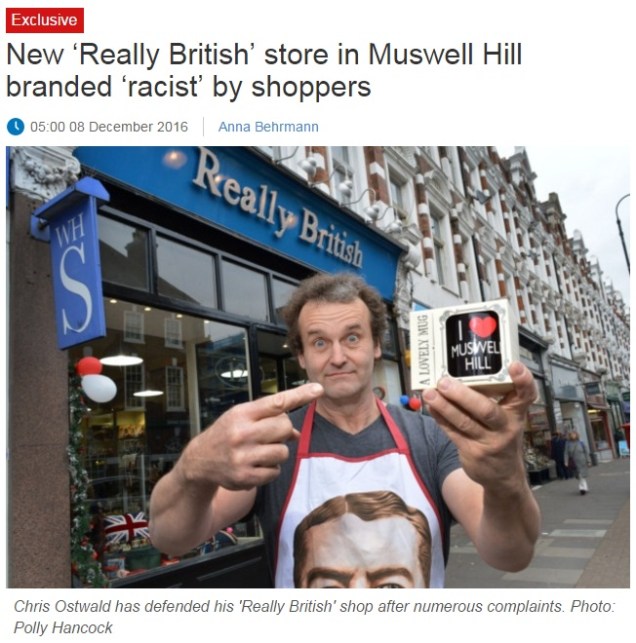
really-british-chris-ostwald-muswell-hill-london-patriotism

Only in North London’s leafy enclaves would a shop selling British goods and memorabilia be at risk of being run out of business by snarling locals convinced that union jack cushions are one step away from fascism

Another day, another painful reminder that London voted strongly against Brexit and is, in many ways, a different country within a country.

Local newspaper Ham&High reports:

A shopkeeper has defended his novelty gift shop after it has been boycotted by shoppers who branded it ‘pro-Brexit’ and ‘racist’.

The shop in Muswell Hill caused a storm on social media with owner Chris Ostwald, 54, forced to remove his British flags on the opening day on November 26 because he received so many complaints.

One of the shop assistants, who is Spanish, left after just one day because of all the snide remarks she received.

The shop sells British-themed gifts and homeware. Their products include condiments, such as brown sauce, London underground tea towels and “Muswell Hillbillies” mugs, which references the Kinks album. There are also suffragette aprons and stocking fillers such as old fashioned compasses.

Mr Otswald, 54, told the Ham&High: “The shop is in no way meant to be ‘political’ or ‘pro Brexit’, but we have had a lot of complaints saying it is or we are ‘racist!”

“A guy came in the other day and said, ‘what’s this, a charity shop?’ and we said, ‘no, not at all’, and he said, ‘well it’s racist’, and stormed out.”

Mr Ostwald added: “People have been coming in and just tutting and walking out.”

There have been other comments on Facebook, with one person arguing that the name is not inclusive.

One man wrote on public Facebook group Muswell Hill and Friends: “Chris, while I applaud you setting up a business in Muswell Hill and employing local people I’m curious as to why you decided to call your shop ‘Really British’ (besides the obvious point that you will sell British made goods)?

“Like many people I live in London because of its international nature, and for me personally having a big sign on the Broadway saying ‘Really British’ makes me feel you’re implying that other local businesses in the area are therefore somehow ‘not really British’.

“Some will no doubt say I’m over-sensitive but I can’t help thinking that given the recent divisive referendum and the current political climate you might have chosen a more inclusive name in 2016.”

This invidious disease of proud anti-patriotism is particularly British. In America, whether you are on New York’s Fifth Avenue or Main Street in some small Mid-Western town, a shop which celebrates Americana and American heritage would be celebrated and universally popular. In France, shops which sell traditional French produce and goods are happily frequented by tourists and locals alike.

Only in Britain are we cursed with a sub-population of pinch-faced killjoys who have been bred to believe that any expression of pride in Britain is “scary” and somehow tantamount to racism. Only in the fashionable and gentrifying parts of London and Britain’s other major cities does one find this pitiful tribe of people who are allergic to their own flag.

Only in places like London’s Muswell Hill do people hold the country which gives them life and liberty in such horrified, sneering contempt.


European Union - United Kingdom - Britain - Flags

Support Semi-Partisan Politics with a one-time or recurring donation:

Agree with this article? Violently disagree? Scroll down to leave a comment.

Follow Semi-Partisan Politics on TwitterFacebook and Medium.

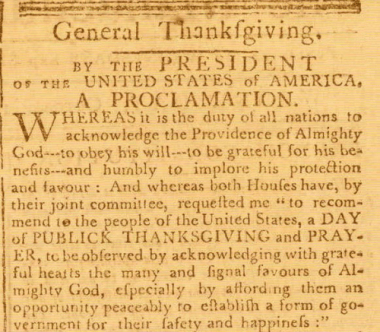
Happy Thanksgiving

O beautiful for glorious tale of liberating strife

Happy Thanksgiving to all of my American readers, as well as everyone in Britain preparing for the Black Friday sales which we seem to have greedily imported without the heartwarming national holiday which precedes them.

Here is James Taylor, performing “America The Beautiful” at the second inauguration of President Barack Obama on January 21, 2013.

And perhaps, at this rather fraught and contentious time, we might all do well to take particular inspiration from the oft-overlooked second verse, too:

O beautiful for spacious skies,
For amber waves of grain,
For purple mountain majesties
Above the fruited plain!
America! America!
God shed His grace on thee,
And crown thy good with brotherhood
From sea to shining sea!

O beautiful for pilgrim feet
Whose stern impassioned stress
A thoroughfare for freedom beat
Across the wilderness.
America! America!
God mend thine ev’ry flaw,
Confirm thy soul in self-control,
Thy liberty in law.


Thanksgiving Proclamation - Abraham Lincoln

Support Semi-Partisan Politics with a one-time or recurring donation:

Agree with this article? Violently disagree? Scroll down to leave a comment.

Follow Semi-Partisan Politics on TwitterFacebook and Medium.

A Crisis Of Identity: When Global Elites Forget How To Be Patriotic

global-elite

The global, liberal elite are increasingly transcending any lingering commitment to patriotism and national identity, setting them on a collision course with the small-c conservative majority

Michael Lind has an unmissable essay in the National Review this week, entitled “The Open-Borders ‘Liberaltarianism’ of the New Urban Elite“, which manages to explain so much about the rise of Donald Trump and the growing inability of political elites in America and Britain to speak to whole swathes of the country they supposedly control.

The crux of Lind’s argument seems to be that the educated, liberal (to use American parlance) inhabitants of the large cities have increasingly taken on what were always fringe libertarian ideas about open borders and the irrelevance or undesirability of the nation state, leading them to pursue policies and espouse values which alienate the more suburban and rural population.

Key quote:

To date, the public conversation on both sides of the Atlantic has been dominated almost entirely by the elite inhabitants of Densitaria, interrupted only by occasional populist revolts such as the Trump phenomenon or the Brexit vote. In a relatively short period of time, a new elite ideology has emerged that contrasts the dynamic, multicultural, libertarian city-state with the allegedly anachronistic and immoral nation-state. This ascendant worldview unites the open-borders economics and cosmopolitan, utilitarian morality of old-fashioned libertarianism with an idealization of the largest cities and their denizens.

In the 1970s and 1980s, libertarians made all of the major arguments heard from globalists since the 1990s: Favoring citizens over foreign nationals is the equivalent of racism; national borders impeding the free flow of labor and goods are both immoral and inefficient; the goal of trade and immigration policy should not be the relative security or relative wealth of particular countries, but the absolute economic well-being of all human beings.

Until the 1990s, this was an eccentric minority perspective in the U.S. and other democracies, encountered only in small-circulation libertarian journals or in the work of the occasional unworldly academic theorist of cosmopolitan ethics. But in the 2000s, as affluent whites from the professional class and their Latino, immigrant, and black allies displaced working-class whites as the base of the Democratic party, the traditional labor-liberal opposition to low-wage immigration and offshoring of industry was replaced by a new open-borders progressivism distinguishable from traditional libertarianism only by its unworkable combination of support for unrestricted immigration with a generous national welfare state.

This certainly accounts for one of the main reasons behind the Labour Party’s civil war in Britain – from the Blair era onward, Labour has been entirely captured by the open-borders progressives and increasingly turned its back on its former working class voter base. Even under the current Labour leadership election, both candidates hold open borders convictions to their core, even if only Owen Smith is stupid enough to rant about overturning the EU referendum result in public.

It also accounts for the increasing public rage (among non-progressives) about immigration in America, where the Democrats are proud and unrepentant in their support for illegal immigration while the Republicans have talked a tough talk for decades yet done nothing, precisely because the Republican political elites benefit from the current immigration status quo as much as anyone. Enter Donald Trump to an arena where nobody else is even seriously talking about the impact of mass immigration on wages and cultural cohesion, and one cannot be surprised when his crude, simplistic solutions gain political traction.

More:

The combination of open-borders “liberaltarianism” and trendy urbanist hype might lead one to wonder whether leagues of dynamic city-states should replace moribund modern nation-states. Benjamin Barber has published a book titled If Mayors Ruled the World: Dysfunctional Nations, Rising Cities. Barber is one of the founders of the Global Parliament of Mayors, which, according to his website, can help “fill the void left by nation states who [sic] are increasingly dysfunctional.” The economist Paul Romer has proposed boosting Third World development by means of semi-autonomous “charter cities,” which to his critics look remarkably like Western colonial enclaves.

Not even Barber and Romer propose actual urban independence. While cities may teach one another best practices, there is not the slightest chance that leading American cities will secede from the United States, link up with other city-states around the world, and form a new, global version of the Hanseatic League or the Delian League.

We saw the same loose talk after the EU referendum vote, with many Londoners (most of whom have no conception of what the EU really is or how it works) furious at having part of their cosmopolitan identity ripped away from them (as they see it) suggesting that London should somehow secede from the rest of the “backward” United Kingdom and become its own independent city state.

Of course this would never actually happen, but it shows just how disconnected the metropolitan elites are becoming from the country as a whole, and the sheer contempt with which they regard other regions which dared to express their patriotism and belief in self-determination by voting for Brexit. It is also misplaced arrogance of the worst sort – the lights would go out and people would begin to starve in London within days were it not for the arterial links of people and goods from the supposedly terrible and backward rural and suburban regions.

And it is this continual feeling of disrespect, I think, which does so much to drive populist insurgencies like the rise of Donald Trump, and (if I am honest) even those populist causes that I actually agree with, like Brexit. People in the industrial and commuter heartlands, as well as rural folk, are getting increasingly sick of being told that they are too backward, too intolerant, too racist, that their own priorities and concerns do not matter and that they should be led in all regards by an urban elite who don’t even seem terribly attached to the country that gives them life and liberty, and who find the slightest display of national pride or patriotism almost painfully embarrassing.

I’m fortunate. I got into a good university and managed to embark on a career which has seen me work in numerous countries across three continents. But if this had not been the case – if, like many of my peers, an international business career was either never on the cards or simply not what I wanted to do – then I would probably be quite put out by people whose interest and commitment to any one country seems transitory at best telling me what I should think about immigration, global governance and democracy.

Now living in remain-voting West Hampstead, I am surrounded by the kind of people who are aghast at the Brexit vote and who consider it a calamity brought down upon the heads by the kind of ignorant, unwashed oiks whom they would never normally speak to unless they were fixing their car or serving them a burger. I can see how it must grate with Middle England, because it grates with me.

Lind goes on to touch on this point:

What appears to be a debate among globalists and nationalists, then, is really a debate about the structure of the 21st-century nation-state. There are real dangers associated with the coalescing elite ideology of post-national globalism or, to be precise, national-elite pseudo-globalism.

One danger is groupthink resulting from the attempt by the new globalists to equate even enlightened and civic nationalism with racism. When the economist Larry Summers, nobody’s idea of a pitchfork-waving populist, tentatively called for “responsible nationalism,” he was criticized by The Economist, whose open-borders libertarianism, once eccentric, has become near-orthodoxy among the trans-Atlantic elite.

And closes with this stark warning:

The most significant threat is the possibility that the abandonment of national patriotism by many elite citizens of the nation-state for make-believe cosmopolitanism will weaken national unity, to the benefit of sub-national racism, ethnocentrism, and regionalism. The loyalties that succeed national solidarity are likely to be narrower, not broader. If history is any guide, the victims of tribalism and illiberal populism are likely to include would-be citizens of the world who despise the nation-states that make possible not only their wealth but also their security.

Absolutely. This blog has been banging on for years about the continued importance of the nation state as the final guarantor of most of our most precious rights and freedoms. But the nation state is also, in the democratic age, a relatively harmless way of allowing people to feel and express a sense of belonging and community pride without tipping over into other, much darker expressions of identity.

Those weepy europhiles mourning Britain’s imminent departure from the EU because they consider themselves “European citizens” might want to pause and think through the consequences of further undermining the nation state, which is the primary aim of their beloved project. Because enlightened, one-world government is a few centuries away yet, and whatever crops up to replace the nation state that they so eagerly undermine will likely be unpleasant, even violent.

And while it may not be purely libertarian, this blog would much rather live in a world of moderate, familiar nationalist rivalry than descend into the known horrors of ethnic or religious sectarianism. We already see the early fruits of this blinkered commitment to “multiculturalism” in self-segregated and un-policed communities here in Britain among certain immigrant populations. We don’t need to extend those delights to the entire population.

What is the solution? Michael Lind does not offer one, and this blog does not see an easy fix either. But when global elites (Davos Man and the like) and the next tier down (those with international lives and careers) have more in common with each other than with those of other socio-economic groups and communities in their own countries, it is a recipe for political alienation and the eventual fracturing of our civic life.

To avoid disaster and a true crisis of democracy, our ruling elites in the political and commercial sphere must somehow learn to be patriotic again – for if the nation state has no champions it will go on being relentlessly undermined on all fronts. But right now there is little evidence that they are remotely interested in bridging the growing chasm between their own interests and those of the people they supposedly “serve”.

This leaves the field wide open for the likes of Donald Trump and UKIP 3.0 to make inroads with voters left cold by the other options available to them. And the time may soon come when the political elites sorely regret ceding this territory.


globalism-versus-culture

Bottom Image: Stefan Molyneux, Globalism versus Culture

Support Semi-Partisan Politics with a one-time or recurring donation:

Agree with this article? Violently disagree? Scroll down to leave a comment.

Follow Semi-Partisan Politics on TwitterFacebook and Medium.