History Will Judge Left-Wingers Who Betray Their Principles To Support The Anti-democratic European Union

Jeremy Corbyn - Labour In for Britain - 2

Shining an unforgiving light on the wishful thinking and self-deception powering the naive left-wing campaign for Britain to remain in the EU

Your best read of the day comes from Elliot Murphy at Counterpunch, a writer from the Left who systematically deconstructs the fatuous assertion by the likes of Owen Jones, Jeremy Corbyn and Yanis Varoufakis that the EU can be reformed and turned into some kind of Utopian socialist paradise.

Certainly the EU as it is presently constituted is hardly friendly to traditional leftist interests and obsessions, as Murphy points out:

This groundswell of support for Remain across substantial parts of the Left is hard to square with the facts. State aid to declining industries, along with renationalisation, are not permitted by current EU laws (under directive 2012/34/EU), and any mildly progressive government which managed to get elected in 2020 would be hindered from the outset by the EU. Considerable reforms of the energy market would also be illegal under EU directives 2009/72EU and 2009/73/EU. Collective bargaining is becoming much weaker across the EU, most vividly in France and Germany.

McDonnell’s plans for People’s Quantitative Easing? Outlawed by Article 123 of the Treaty on the Functioning of the European Union. The series of anti-trade union laws introduced in Britain over the past few decades? The EU has no qualms with these whatsoever, showing no interest in providing even modest forms of protection for workers.

As the Labour Leave campaign points out, the EU would also outlaw an end to NHS outsourcing, tougher measures on tax avoidance, and general improvements to workers’ rights. The soft Left’s talk of international solidarity and the brotherhood of man in relation to the EU is absurd, especially as it continues to drive forward deeply militaristic and undemocratic (or rather, anti-democratic) policies. The EU is, after all, one the world’s major post-war imperialist projects, boasting an inherently and aggressively exploitative relation with the global South. The entirety of the EU parliament could be filled with McDonnells and Iglesias’s and no substantial reform would be forthcoming: The parliament is an institution purely of amendment and all power lies with the civil servants and the unelectable Commission.

Brilliant. How marvellous it is to hear the fatuous, paper-thin leftist defence of the European Union being properly shredded by somebody who isn’t willing to furiously ignore their own political convictions, suppress the cognitive dissonance and blindly cheerlead for the Remain campaign.

And of course Murphy is quite right – you could pack the European Parliament full of Owen Joneses and Jeremy Corbyns and still it would make no difference to the work and impact of a body which cannot propose or strike down EU laws and policies. There is a reason why the EU’s architects made sure that the one “democratic” component of the entire project was utterly toothless, and this is it.

But what of these nascent leftist “change” movements like Democracy in Europe 25 (DiEM25) or Another Europe is Possible (AEiP)? Murphy has surveyed the work of these and other fantasist left-wing Remainers, and is unimpressed:

When Michael Chessum, a major organiser of the pro-Remain ‘Another Europe is Possible’ (AEiP) movement, is questioned about what concrete ‘changes’ he would like to see in EU, he simply dodges the question. Chessum’s behaviour generalises. To my knowledge, not a single supporter of Remain has presented a satisfying answer to the question of how we are supposed to go about reforming the EU. Even Yanis Varoufakis during his recent ‘Lunch with the Financial Times’ interview confessed that in reality the EU isn’t going to be reformed to anywhere near the extent the Remainers are hoping for (attempts to reform ‘will probably end in failure like all the best intentions’, he claimed). Even Remain supporter Ed Rooksby can write on his blog about how he is ‘not particularly convinced by arguments emanating from [AEiP] in relation to the possibility of transforming EU institutions in a leftist direction’. How is a new, reformed EU possible? How can we change it to break from the Washington Consensus? The answers are, worryingly, not forthcoming.

Quite rightly, Murphy has no time for those who waffle on about reform – “Of course the EU needs reform” being perhaps the most overused phrase of this entire referendum campaign – while failing to outline any concrete or probable steps to achieving that elusive change:

Airy-fairy proposals for ‘another Europe’ to ‘protect our rights’ and so forth simply fill a void lacking any concrete solutions to achieve this and any proposals for how to achieve a new EU constitution. In theory, another anything is possible: Another New Zealand, Another Skelmersdale, Another Isla Nublar, Another Tamriel. It is not as if another EU is inherently unreachable, but rather that without any posited, realistic steps to achieve it, the hopes of the Remain camp will quickly dissolve after June 23rd, no matter which side wins.

Concrete solutions are lacking, then, as it is no good for the Left camp of Remain to simply point voters in the direction of Owen Jones columns and Caroline Lucas YouTube videos instead. The powers of the European Commission, European Central Bank and European Court of Justice are guaranteed by EU treaties and can only be reformed as a result of a unanimous agreement within the Council of Ministers. AEiP may exert some moderate degree of influence over the UK’s soft Left, but it will have to become substantially more commanding if it hopes to influence the Council of Ministers. Likewise, the foundational pro-austerity, market liberalisation principles of the EU are established by the same treaties, which can be modified only by a unanimous agreement by all 28 member states.

Quite so. All of this, one must recall, is taking place in the context of David Cameron having singularly failed to extract even one substantive concession from his fellow EU heads of government during his damp squib “renegotiation” effort.

Now, this blog will be the first to concede that the entire exercise was a sham – the government didn’t even bother to properly consult the people as to the nature of reform which we wanted, arrogantly assuming that they already knew. But in any case, even when faced with the potential departure of the European Union’s restive second-largest contributor, the EU offered nothing by way of sweeteners. Would it have been different had Angela Merkel et al been dealing with a genuinely eurosceptic British prime minister? Perhaps. But if David Cameron couldn’t get any kind of deal from the EU, what chance do a fuzzy coalition of leftists have of achieving reform in another direction?

Neither does Murphy have time for the weak reasoning of foreign leftists who have sought to parachute themselves into the debate with a minimal understanding of the facts:

The Left Remain camp have also recently been galvanised by Noam Chomsky’s tenuous support for their cause, with Owen Jones and AEiP posting quotations of the professor’s brief statements on the matter. Chomsky’s reasons for supporting Remain are extremely weak and don’t stand up to much scrutiny. His reasoning is as follows: The racist Right is in favour of Leave, therefore we should Remain. But the racist Right is also in favour of Remain. Chomsky’s logic seems to be as follows: If P, therefore Q, so why not Z? Indeed, if an Out vote would simply ‘leave Britain more subordinate to US power’, as Chomsky claims, then why did Obama urgently, even desperately call for Britain to Remain? Owen Jones has in the past ridiculed what he calls ‘Chomsky fans’ on Twitter (while also labeling those who politely disagree with him ‘Stalinist’, ‘sectarian’, ‘ultra-left’ and ‘Gallowayite’), but deems it appropriate to sign up to his views when they align with his own. Chomsky’s opinions about the UK are naturally not going to be thoroughly well-formed and articulated, unlike his criticisms of US domestic and foreign policy: For instance, during a visit to the University of St Andrews in 2012 he expressed pro-monarchy feels for the rudimentary reason that if people enjoy it and find it fun, then who’s to object to it?

Many on the left simply cannot begin to address the limitations of the Remain camp: For instance, Media Lens, UK leftists sympathetic to Chomsky, have been oddly silent about the entire EU referendum. A certain level of unease and awkwardness pervades a lot of discussion about the EU, with many preferring simply to abstain or delay decision making until later. At Chomsky’s university, Matt Damon recently addressed MIT’s class of 2016 with ideas that Will Hunting would be far from impressed with, calling for a Remain vote with his typical mixture of casual arrogance and self-assurance, but devoid of any argument or apparent understanding. Damon ultimately retreated into the safe territory of banker-bashing, forgetting to justify his reasoning for supporting Remain.

So Matt Damon thinks that Brexit is a bad idea. Who the hell cares? Damon clearly has no understanding of the history or political issues at stake, and is merely parroting what he believes to be the “correct”, right-on opinions in order to signal his own virtue. More worrying is the fact that when it comes to the specific question of the EU, many thinking leftists are doing the same thing – temporarily switching off their brains and switching themselves over to “mindless repetition of approved talking points” mode.

As this blog conjectured when Owen Jones abandoned his nascent euroscepticism and went back to loyally cheerleading for the EU:

It is a shame to see Owen Jones – at his best an intelligent and articulate voice on the Left – frittering away his time on the EU referendum campaign by pointing out the foibles and tactical hypocrisies of the Leave campaign. But what other choice does he have? Despite knowing full well that the EU is unreformable, Jones has committed to supporting Britain’s continued membership.

I think that this is a betrayal of the democratic accountability and local control that Jones spends much of his time promoting. And I suspect that he does, too. Which is why we can all expect to see lots more “gotcha” videos on YouTube criticising individual members of the Leave campaign, but not a damn thing praising the European Union or explaining how this magical socialist “reform” of the EU is to be achieved.

After all, nothing distracts from a guilty conscience like pointing out the flaws, failings and inconsistencies of other people.

The behaviour of the British Left during the EU referendum campaign would probably make quite an interesting psychological study as an exercise in mass delusion. Thousand of not millions of people with solid left-wing beliefs and a rightful distrust of the establishment are now simultaneously trying to convince themselves that voting for the establishment and the status quo is somehow the brave, left wing thing to do.

European Union - EU Referendum - Tony Benn - Brexit

This coping mechanism takes its toll, which is why left-wing Remainers are so much happier when they are criticising the behaviour of the Leave campaign (making their slanderous allegations of racism and so on) – the more they talk about the wretchedness of the Evil Tories, the less time they have to consider their own betrayal of left-wing principles.

And just look at what it is the supposedly compassionate, generous and open hearted Left are endorsing by campaigning for a Remain vote:

One of the major disasters of the Remain endorsement by substantial parts of the Left is that many seem incapable of acknowledging that the EU has by now become masterful at generating racism and promoting finance capitalism. Acknowledging this dynamic is frankly essential in understanding the rise of Far-Right forces across Europe. The EU was more than willing to impose sanctions on Greece when it became tempted to disobey orders to kowtow to European banks, but it seems far less willing to do anything about the rise of the Far-Right in Germany, France, Croatia, the Czech Republic, Austria and Hungary. As Kevin Ovenden recently put it in Counterfire: ‘Far from countering the far right and authoritarian tendencies, the EU – with its austerity, Fortress Europe, anti-democratic diktats and endemic national antagonisms – is generating those reactionary features: and not only on the far right. The EU is fully behind the French government of Francois Hollande. It has suspended basic freedoms under an eight-month old state of emergency and is using the militarised police to batter through new austerity measures passed not by parliament, but by executive decree’.

[..] The ‘choice’ of austerity in Britain is no such thing in the EU, being part of its treaty. Anyone who claims that the EU is beneficial to workers’ right clearly hasn’t read the text of its treaty, which makes it very clear what the EU’s intentions are, and always have been. The ‘freedom’ for big firms to move capital, labour and commodities without any restrictions in order to maximise profits, regardless of social or environmental cost, is something no genuine socialist, communist or anarchist could ever support. Moreover, the EU is infamously driven towards privatisation, ‘free markets’ and the Transatlantic Trade and Investment Partnership (largely the work of the Troika) – which signifies game over for much of Britain’s indigenous industries if adopted, as the EU’s 28 states engage in a race to the bottom in order to diminish living standards and workers’ rights.

Hardly the kind of behaviour that a good comrade should be defending, surely?

Oh wait, this explains it:

In the face of this apparently austere ideology, the EU is nevertheless careful to generously fund British quangos, charities, arts groups, museums and universities to ensure the recycling of a healthy pro-EU sentiment amongst the influential middle class intelligentsia, academia and commentariat, ensuring that most of its major limitations are sidelined or forgotten about. It manages to do all this after having intentionally destroyed Britain’s fishing industry. This system amounts to one of the clearest definitions of a racket.

But it is more than a racket, isn’t it? It is almost what you might call class warfare – the privileged and well connected upper middle classes aggressively asserting their interests (continued funding for their quangos and charities) over the interests of the working classes. Again, Murphy is absolutely right to call out the hypocrisy.

Murphy is also right to ask how the Left will be viewed if Britain does vote to Leave, in a future where smoothly exiting from political union while maintaining access to the single market ensured that none of the Remainers’ apocalyptic warnings of economic ruin come true:

A serious Left argument against the EU needs to be presented both in the event of a Leave or Remain vote, since without the presence of any serious Lexit arguments being presented, in the event of a Leave vote left-wing Remainers will be thoroughly cornered and will be forced to rapidly re-orient their tactics to accommodate for the likely UKIP gains (among many other things). When Remainers focus purely on the positives of the (often dubious) positives of EU, we should ask how this dishonest and skewed set of priorities will be interpreted post-referendum.

Absolutely so.

When the dust settles, and when Britain continues its slide away from democracy in the event of a Remain vote, all that people will remember is the likes of Jeremy Corbyn and Owen Jones – people who pride themselves on their right-on credentials – standing shoulder to shoulder with the establishment in defence of the status quo. And when they tremulously offer their “battered spouse” excuse (but I thought we could change the EU!) they will rightly be scorned, and mocked and then ignored.

Already UKIP is starting to encroach on Labour’s heartland vote. Labour MPs and former ministers are lashing out in confusion and outrage at the unwillingness of local councillors and ordinary party activists to help them in their great establishment effort to keep Britain in the EU. On this issue, the parliamentary party and the grassroots are starting to come apart at the seams. And in the event of a Remain vote, you can be sure that UKIP will be there, ready to pick up swathes more disaffected Labour votes.

The question of Britain’s independence is not a partisan issue. It is equally as shameful when conservatives are willing to sell out their own democracy as when socialists do the same. But given the nature of the EU, and how this corrupt supranational political union benefits the wealthy and well connected elites far more than the people, it is Labour’s dogged support for Remain that stinks to high heaven.

Tony Benn would be ashamed of what his party has become. Labour are supposed to be the party of ordinary people. We know because they never shut up about it. And yet nearly the entire Labour Party is uncritically cheering the status quo and our ongoing membership of a dysfunctional political union which nobody would invent if it didn’t exist, and nobody would join if it did.

But of course, there were always two sides to the Labour Party – the cerebral middle class ideologues and internationalists, and the working class movement borne out of the trades union movement. Well, we know what happened to that particular branch of Labour in the age of the SpAdocracy. Now all that’s left is the middle class clerisy.

Now, the middle class left-wing clerisy want desperately to stay in the European Union – it funds their research, universities, development schemes, artistic projects and businesses, funnelling them British taxpayer money without the unseemly need to beg the taxpayers directly in elections.

They love the EU because it enables them to virtue-signal their enlightened progressivism, while also delivering a whole host of lucrative in-house side benefits. And if it means betraying democracy, betraying the poor and betraying the interests of Labour’s core voters, that’s just fine. So long as that grant money keeps flowing, of course.

Sadly for these parasitic folks and their defenders on the pro-EU left, some of us are watching, observing and taking note. And when the time for blame and judgement comes around, there will be no escaping accountability for having sided against democracy in their arrogance, fear, ignorance and greed.

We will make sure of it.

 

European Union - United Kingdom - Britain - Flags

Top Image: Economist

Support Semi-Partisan Politics with a one-time or recurring donation:

Agree with this article? Violently disagree? Scroll down to leave a comment.

Follow Semi-Partisan Politics on TwitterFacebook and Medium.

Maurice Glasman Makes A Thoughtful Left Wing Case For Brexit

Maurice Glasman - EU Referendum - Blue Labour - Brexit

Maurice Glasman’s thoughtful intervention in the EU referendum debate is more proof that left-wing thinkers who value democracy naturally gravitate toward Brexit

The glib, feeble left-wing case for Britain remaining in the European Union can basically be summed up as “don’t give us back democracy, because the British people might be so foolish as to demand conservative policies and vote for conservative politicians”. It is, in other words, profoundly and actively anti-democratic, springing from a toxic and elitist mindset which hates and distrusts the people.

Unsurprisingly, the great and the good of the modern Labour Party have therefore flocked to its banner, endlessly repeating the shocking (to them) warning that if Britain did not have certain values imposed from above by a higher authority in the form of the EU, the British people themselves might not be so enlightened as to choose left-wing policies for themselves.

This is a weak and contemptible argument, and those advocating it – from Jeremy Corbyn to Owen Jones to Yanis Varoufakis – should know better, and quite probably do know better, deep down. This makes their betrayal of British democracy all the more unforgivable.

But there is a left-wing case for Brexit of more substance and nuance, and Maurice (Lord) Glasman now makes it in LabourList. At its core is still the desire to favour left-wing politics in particular rather than seek to regain democracy in the abstract, but at least Glasman puts some actual thought into his argument.

Glasman concedes that the EU was flawed from the start:

Unfortunately, probably from the outset, and certainly by the Rome Treaty of 1957 a Jacobin tradition of unmediated space, emptied of decentralised institutions had asserted itself, particularly through the head of the High Authority, that became the European Commission, Jean Monet.  He asserted that economic exchange and legal uniformity would, over time, produce political unification.

Perhaps naturally, Glasman traces the EU’s decline firmly back to the accession of Britain in 1973:

Under the leadership of Edward Heath, who had a genuine feeling for the fate of Europe, Britain did join the Common Market, as it was called it for a long time.  It did not go well from that time on as the Common Market was not based on a shared political economy. 

Britain is an island and was always at an angle to Europe.  It avoided the continental territorial struggle for domination and developed a maritime rather than a landed economy as well as distinctive political institutions based upon the balance of powers within the Ancient Constitution. 

De Gaulle, in continuation with Napoleon, thought that all Britain cared about was free trade and the primacy of the City of London. He argued that the British State could never agree with either the administrative directives favoured by the French or the institutional co-operation embodied in the German Social Market. 

The difference between territorial rule underpinned by an army and central directives and a maritime economy based on the Navy and free trade was what was at stake in the Napoleonic wars.   In boycotting Britain and building a Europe of administrative conformity Napoleon continually blasted Russian, German and Austrian leaders for continuing to trade with Britain, which as a maritime power traded with the world.  Napoleon’s career ended when he voluntarily boarded a Royal Navy ship and was taken to a faraway island where his board and lodging was paid for by the City of London.  Despite the conclusive result of that conflict it was not the end of the argument. 

The political and economic systems of Britain and France was very significantly different.  Britain had dispensed with its peasantry during the last stages of enclosure and the Corn Laws, it had embraced the market at home as well as free trade abroad. On joining the Common Market the very unhappy marriage of Napoleonic directives and free trade objectives began which threatened the European Community’s earlier achievements of agricultural protection and worker participation.  The Common Market, or European Economic Community as it then became known, had been built on a substantive conception of an economy based upon agriculture and industry, land and labour.  Britain, in contrast, brought a model of a financial and services based economy in which free movement rather than social partnership was the primary goal of political union. 

And correctly identifies the anti-democratic black hole which appears when the EU technocracy instinctively recoils from the people and their dangerous passions:

As the European Union becomes more general, abstract and administrative it will naturally side with capital and directives, viewing politics itself as populist.  The reaction is already present within each European State. When I was in Berlin last weekend the AfD had surpassed the SPD in the polls.  When reason itself becomes desiccated and exclusively rational, severing itself from institutional judgement and historical experience it turns all forms of resistance into demagogy and madness.  And yet, democracy is the European way of resisting the outrageous claims of capitalism to own, commodify and de-contextualise human beings, nature and all civic institutions.  The tension between democracy and markets can no longer be resolved at the level of the EU, which through its inverted definition of subsidiarity in which the larger subsumes the smaller, is hostile to democracy, distinctive local and national institutions.

Obviously Glasman is particularly interested in democracy as a means for the people to resist what he sees as the “neo-liberal” agenda of the EU – he is not advocating Brexit for the pure sake of democracy. But at least democracy gets a look-in in Glasman’s argument, which is more than can be said of the Jeremy Corbyn / Owen Jones position, which unashamedly seeks to cling on to the European Union precisely as a means of suppressing British democracy.

Glasman’s conclusion is particularly devastating (my emphasis in bold):

For many years the European project has served as an alternative to Labour having a serious politics of national transformation, of building the coalitions necessary to constrain capital and strengthen democracy. It was a national political weakness that led to the enthusiastic embrace of the EU and it remains a refuge from domestic political defeat.  Labour should be robust in supporting free and democratic trade unions throughout Europe, in championing a balance of interests in corporate governance and strong civic self-government with a deep partnership between universities, cities and firms.  The question is whether being part of the EU hinders this.  Britain is already outside the Eurozone and the Schengen agreement.   It is gratuitous to remain part of a political union that is so hostile to diversity and democracy and so disposed to the consolidation of big capital that it has become a remorseless machine for the liberalisation of trade and the disintegration of society, in which the demand for liquidity has dissolved solidarity. Perhaps it is time to think again.

This really gets to the heart of it – the EU has indeed been an poor alternative to having a serious national political conversation about how we wish to govern ourselves. Labour are not exclusively to blame in this regard. Politicians from all parties have gladly surrendered power to the European Union, eagerly seizing the opportunity to keep the trappings of power for themselves while divesting themselves of ever more responsibility for the outcomes of decisions now made in Brussels.

And how refreshing it is to hear a personality from within the Labour Party actually suggest that maybe – just maybe – it should be the job of left wingers to argue their case in public and seek to convince the British electorate of the attractiveness of socialist policies rather than seek to bypass the electorate and impose social democracy from above via the EU.

In fact, Maurice Glasman, founder of Blue Labour, is exactly the type of voice that the Labour Party needs to listen to and place front and centre of their policymaking if they want to staunch the exodus of working class support from a party which increasingly resembles a middle class, creative industry, virtue-signalling talking shop.

A party which lost seats to the Tories because of traditional voters defecting to UKIP – and facing the prospect of Nigel Farage’s party nipping at its heels in a swathe of Northern constituencies – would make a place of honour for someone like Maurice Glasman, and perhaps even listen to what he has to say about the European Union.

But they can’t do it. Jeremy Corbyn and co. were happy to enrage the party establishment and donors on all manner of issues, from the Syria military action vote to their perceived tolerance of anti-Semitism. But on the crucial issue of Britain’s membership of the European Union, suddenly Stockholm syndrome kicks in and everybody robotically sings from the same worshipful hymn sheet. It’s pathetic.

There is still an element within the Labour Party that actually cares about the hopes, dreams, fears and priorities of the working class. But you won’t find it within Jeremy Corbyn’s inner circle, or the mainstream party in exile. This dwindling branch of the Labour Party is now much like the Popular Front in Monty Python’s “Life of Brian” – a solitary man, sitting on his own, ignored by everybody else.

In their unthinking support for the European Union, the shining practitioners of the New Politics have thrown the working class – indeed , everyone who loves democracy – well and truly under the bus. And at some point there will probably be a reckoning for that.


European Union - United Kingdom - Britain - Flags

Top Image: The Times

Agree with this article? Violently disagree? Scroll down to leave a comment.

Follow Semi-Partisan Politics on TwitterFacebook and Medium.

The Moral And Intellectual Cowardice Of The Pro-EU Left

Ken Loach - Another Europe Is Possible - EU Referendum

The modern Left loves the EU because having lost the public argument for socialist policies, they see in Brussels their last and best hope of imposing their left-wing ideology on an unwilling population

Tom Slater has an excellent piece in Spiked, in which he takes to task all of the big name lefties – some of whom previously toyed with supporting Brexit as they watched the EU’s antidemocratic behaviour with growing horror – who are now supporting the Remain campaign, and thus betraying democracy when it truly matters.

Slater writes:

The last few prominent Eurosceptics on the left have started to peel away. They’ve been confronted with a once-in-a-generation opportunity to smash power, to strike out for democracy and to put the future of European politics firmly in the hands of the people, rather than a faceless, byzantine bureaucracy. And they’ve bottled it.

First there’s Yanis Varoufakis, the flash stepdad of European leftism and the former finance minister of ailing Greece. This is a man who has experienced the tyranny of the Brussels set firsthand. His modest proposals for rescuing debt-laden Greece from EU-enforced austerity were ignored. ‘Elections’, he was told by German finance minister Wolfgang Schäuble, ‘change nothing’. He quit government in protest as his Syriza comrade Alexis Tsipras signed an agreement that would once again shackle Greece to Troika diktat. What is the self-styled ‘erratic Marxist’ up to now? He’s touring the UK, telling Brits to say ‘Oxi’ to Brexit so that we can ‘reform the EU from within’.

Then there’s Owen Jones, the Corbyn choir boy who has followed the Labour leader’s transformation from Bennite Eurosceptic to apologetic Remainer. Last summer Jones called for the left to campaign for Brexit. After the horrors of Greece, he wrote, it’s time to ‘reclaim the Eurosceptic cause’. Now, just 10 months on, he’s joining Varoufakis on the campaign trail. His flirtation with principle over, he wants to ‘unite with people across the continent to build a democratic, workers’ Europe’. How propping up a democracy-thwarting institution puts you in line with the little guy is beyond me. Not least when said institution has effectively abolished workers’ rights in austerity-battered countries like Greece.

But perhaps the most glaring retreat of them all has come from Paul Mason. The former Channel 4 economics editor and ‘radical social democrat’ actually had the brass to pen an article titled ‘The left-wing case for Brexit (one day)’. One day. Those two, trembly words sum up the sentiment of these fair-weather Eurosceptics. Yes, yes, democracy – one day. Not now. Especially when, as Mason sees it, a Brexit would allow Michael Gove and Boris Johnson to ‘turn Britain into a neoliberal fantasy island’. He’s in favour of democracy, you see, just not when the pesky demos elects a government he doesn’t like. This is hypocrisy dressed up as strategic nous.

Tom Slater is absolutely correct to denounce each and every one of these reversals as a shameful failure of courage. His piece is entitled “The Progressives Afraid Of Change”, and regrettably that is exactly what we see from the supposedly ideologically pure Corbynite Left. Yet after having grown in prominence and power primarily by denouncing the compromises and betrayals of the centre-left, these virtue-signalling true believers are now selling out British democracy in exactly the same way, proving that they are no better than the Blairite New Labour government which they so despise.

This blog has also taken each of the prominent leftists identified by Tom Slater to task for their utter failure of courage and vision. My critiques of Owen Jones are here, herehere and here, Yanis Varoufakis here and Paul Mason here.

Slater continues:

In fact, it’s worse than that. It’s often said that the shift in left-wing attitudes towards the EU over the past few decades has been the result of pure political contingency. When, in the 1970s and 80s, the EU was seen as an avowedly capitalist project, Labourites and trade unionists took arms against it. Now that it’s been given a social-democratic lick of paint, replete with talk of workers’ rights and free movement, it gets the nod. But there’s something even more sickening going on here. These turncoat Remainers, these radicals for the status quo, don’t just bristle at the turn of public opinion, on economics or migration – they’re scared of it. Their Brexit-phobia is really a fear of the demos itself.

You see this in their panic-stricken talk of the furies Brexit might unleash. ‘We don’t know… how the plebeian end of the Leave campaign will react if they lose. My instinct says: badly’, writes Mason. Varoufakis, meanwhile, is even more pessimistic. Only fascists and racists, he says, will profit from the demise of the EU. A Brexit now would mean ‘anti-migrant racism, pandered to by the political establishment for decades’, writes a commentator in the New Statesman. There is constant talk of chaos. Democracy is seen not only as disagreeable, but as dangerous. The left, once intent on stirring the passions of the people, now wants to keep a lid on them at all costs.

This is why you shouldn’t take the left appeals to ‘reforming the EU from within’ seriously. Not only because Cameron’s paltry renegotiation revealed an EU incapable of making even minor concessions. Not only because the only salient proposal Varoufakis’s Democracy In Europe Movement has managed to come up with is livestreaming council meetings. But because the cowardice of the left in the face of Brexit is bred of the very same fear of an unshackled demos that forged the European Union in the first place.

Devastating, and utterly correct. For the European Union itself was deliberately designed to muffle and constraint the voices of national electorates, replacing them with the cool, cerebral and detached government of a supranational European elite, which is exactly what the pro-EU Left now want – a tool to suppress what they see as the “dangerous” authentic voices of the people.

Slater concludes:

The modern left’s detachment from the masses, its sneering distaste for our habits and desires, has fostered a profound fear of change itself. Their paranoia about where unleashed public passions might flow has led them to cling to the status quo for dear life. These are progressives terrified of change – and terrified of us. Faced with the opportunity to demolish an anti-democratic order, they are standing athwart, yelling Stop. History will not be kind to them.

But it is worse than a mere lack of vision and fear of change. Most offensive of all is the grubby desire of the pro-EU left to bypass democracy altogether, to give up on trying to persuade national electorates of the value of left wing policies and simply impose them from the EU’s unaccountable, supranational higher level of government.

As this blog recently put it:

The Left look around and see free markets accepted and delivering prosperity in nearly every country, including those who have sworn eternal opposition to capitalism. And despite the Corbynite takeover of the Labour Party in Britain, there is still no evidence of a groundswell of public longing for 1970s style statist economic policies to be brought out of mothballs. What chance, then, does the Left have to bring more of the economy under state control other than the extreme long shot of seizing control of Europe’s supranational layer of government on the back of the supposed European left-wing popular movement (DiEM25) talked up by Varoufakis and Jones?

As Varoufakis admits, “the retreat to the nation state is never going to benefit the Left”. The Left can only advance their cause by sidestepping nation states altogether, which means taking control of the EU, where national legislatures are bypassed and unpopular and even hated policies can be imposed on the peoples of Europe with very limited opportunity for effective resistance (see Greece). This may seem laughably unrealistic – and it is. But it is the Left’s only remaining hope, and so they cling stubbornly to their delusion even if it means betraying democracy and supporting the EU in its current form (and with its current policies) until the time comes for their popular revolution.

And that, to my mind at least, is the most disappointing thing of all. Even pugnacious, articulate left-wingers like Owen Jones and Paul Mason are unwilling to achieve their desired ends by first winning the public debate and then winning a national election. Their commitment to democracy is so feeble that they would rather see their preferred policies foisted on an unwilling British people from above by the European Union rather than do the hard work of winning support for those policies among the British electorate.

Of course, they don’t explain it this way themselves. Talk to Owen Jones and Paul Mason and you’ll get an earful about their deep concern for workers’ rights or some other emotive issue. But when push comes to shove, they would rather live in a country where their minority opinions were forced on the majority by Brussels than do the hard work of convincing voters of the necessity for left-wing policies.

And the Left are perfectly entitled to that opinion. They are entitled to advocate for Britain to remain in the European Union because they do not trust the British electorate to support what they see as essential policies at the ballot box. They can do all that. But they cannot any longer call themselves supporters of democracy.


Postscript: Look at the image at the top of this article, showing a quote by filmmaker Ken Loach, in which he openly boasts that the chief advantage of the European Union is that it thwarts the will of democratically elected national governments. This is the toxic, antidemocratic position which left wing favourites like Owen Jones and Paul Mason have decided to embrace. Shame on them.


European Union - United Kingdom - Britain - Flags

Agree with this article? Violently disagree? Scroll down to leave a comment.

Follow Semi-Partisan Politics on TwitterFacebook and Medium.

Remain Supporters Are In Denial About The Nature And Purpose Of The EU

Owen Jones - EU Referendum

I’m voting Remain because Puppies For Everyone!!! The denialism and wishful thinking about the European Union’s true purpose and direction of travel exhibited by pro-EU left-wingers is off the charts

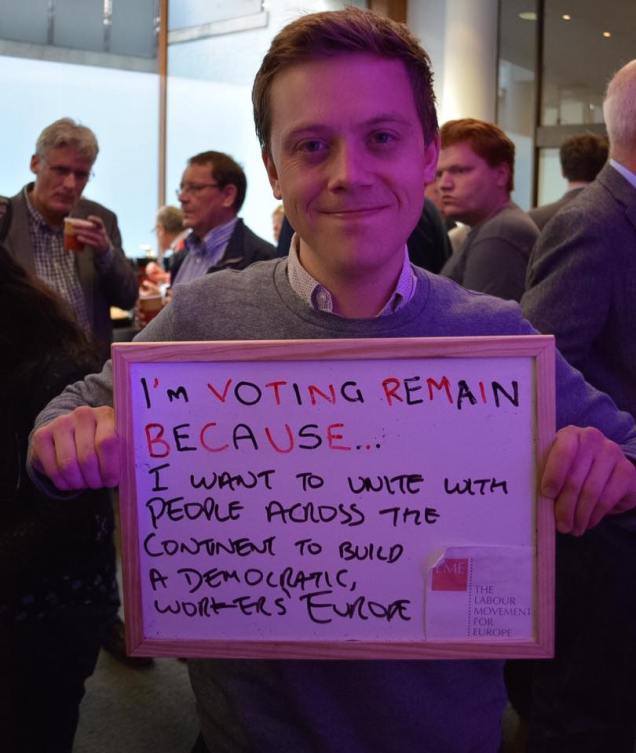
The Great Disappointment of the eurosceptic Left, Owen Jones, has popped up with a new contribution to the EU referendum debate in the form of the picture shown above, being widely shared on social media (albeit sometimes in cheekily photoshopped format with the message changed).

While this blog does not usually bother commenting on internet memes, this one is noteworthy because it simultaneously

  1. Sums up the entire basis of left-wing EU apologetics, and
  2. Reveals just how flimsy is that argument

The sign held up by Owen Jones proclaims:

“I’M VOTING REMAIN BECAUSE… I want to unite with people across the continent to build a democratic, workers Europe”

And I want to own a unicorn that shoots fruit based candy out of its ass and grants me three wishes a day, but sadly that is not on offer from the EU, just like the “workers’ paradise” lusted after by Owen Jones isn’t on the menu from Brussels either.

This referendum is serious business. So can Remainers please stop projecting whatever they desperately wish the EU to be onto an organisation which has never really been about friendly trade and cooperation, but is actually all about slowly and inexorably becoming a supranational government of Europe. And which is not going to abandon that long-held goal just because the British are now expressing a few doubts.

I’ve read the history of the EU. I strongly advise others to do the same. And if they still want to Remain, having understood the true nature of the grand projet, they should at least have the decency to admit out loud precisely what it is that they know they are committing us to.


For those interested in that history, here is a good starting point.


European Union - United Kingdom - Britain - Flags

Agree with this article? Violently disagree? Scroll down to leave a comment.

Follow Semi-Partisan Politics on TwitterFacebook and Medium.

Yanis Varoufakis And Owen Jones – The Failed Promise Of The Eurosceptic Left

This joint therapy session between Owen Jones and Yanis Varoufakis fails to dispel the cognitive dissonance created by their respective decisions to argue against Brexit despite being such vocal critics of the European Union

Less than a year ago, this blog was remarking on what a good time it was to be a eurosceptic in Britain.

Our longed-for referendum was finally on the way after the UKIP surge and David Cameron’s desperate concession to staunch the bleeding of his own MPs to Nigel Farage’s insurgent party. Meanwhile, the Left finally seemed to be rediscovering their long-misplaced euroscepticism after witnessing Greece’s treatment at the hands of the eurogroup and finally realising that post-democratic, supranational governance is not the shining utopia they had been so sanctimoniously claiming.

Back to the present day, and once again there are many reasons for thinking British eurosceptics to despair, and precious few reasons to hope. The Leave campaign is being conducted by an official group comprised primarily of B-list politicos who actually seem to think that a group of mostly right-wing politicians prancing around the country screeching that Brexit will Save Our NHS will be a) remotely believable, and b) a referendum-winning issue.

But perhaps most depressing of all is the fact that the awakening left-wing eurosceptic movement seems to have rolled over in bed and gone back to sleep.

This is most evident in Owen Jones, who last year seemed on the cusp of rediscovering the euroscepticism of Tony Benn, only to fall back into irrational support for the European Union as the Greek crisis receded and the EU referendum drew closer.

But we also see the same syndrome appear in people who have direct and harsh experience of the European Union’s antidemocratic ways, but who nonetheless come rallying to its aid – as though their limited imaginations simply cannot comprehend a world without the EU. The prime example here is that of Yanis Varoufakis, who should know better than almost anyone the degree to which Brussels is antidemocratic by design and utterly resistent to fundamental change.

And now, in a new YouTube video [see top] we have Owen Jones and Yanis Varoufakis together in a joint therapy session, perhaps to work through the immense cognitive dissonance that both must currently be feeling from spending 2015 railing against the EU, and 2016 telling us how it is our humanitarian duty to keep the rotten enterprise afloat.

Varoufakis’s view in a nutshell:

The Left should never lose sight of the history of the 1930s. After 1929, the Left failed to create the coalition with other democrats that was necessary to prevent the descent into the abyss of the 1930s.

Now, I see such an abyss opening up in front of our eyes in the centre of Europe today. And if it does, we are going to unleash very vulgar and brutal ultra right wing forces throughout Europe, and various xenophobic tendencies that will be turbocharged by the disintegration of the European Union.

Brexit would speed up the disintegration of the European Union and in the end the only beneficiaries will be those ultra-nationalists, xenophobes, racists everywhere, including in Britain.

In other words, Britain should sacrifice her own freedom and democracy because the rest of Europe is a perpetually backward powder-keg of barely suppressed “ultra right-wing” populism and resentments which will lead us back to war faster than you can say “Treaty of Versailles”, unless we dissolve our individual national identities into a common European body.

Note how Varoufakis says that Brexit would “speed up” the collapse of the EU, not that it would precipitate the collapse. That suggests that he strongly believes that the EU is doomed regardless, but still wants Britain to remain inside the burning building along with Greece to the bitter end. Quite why Britain should sacrifice our own democracy and future economic and even political stability in this way is never explained by Varoufakis or Owen Jones.

Note too how Varoufakis is keen to say that the only ones looking forward to Brexit are the foaming-at-the-mouth racist mobs which are apparently just waiting for their signal to wreak havoc on the streets of Britain. This is a variant on the claim that we should remain in the European Union because Vladimir Putin would apparently like nothing better than for us to leave. That’s certainly an interesting way to run a country – doing the precise opposite of what Vladimir Putin might want at every single decision point – but as a general rule one would have thought it was best to focus more on what is best for Britain rather than what is worst from the imagined perspective of some other world leader.

Then we get the same pigs-might-fly optimistic leftist vision for Europe that Owen Jones has also promoted, and which Jeremy Corbyn spoke of in his recent pro-EU speech at Senate House:

Our criterion should be a broad, pan-European, democratic movement for preventing the post-modern 1930s from hitting us and future generations.

[..] I feel it in my bones that to all of us we have a duty to band together across borders throughout Europe to prevent this decline, this degeneration into an ultra right wing cesspool of xenophobia, of deflation, of loss of jobs, and this is something we can only fight at the level of Europe. It cannot be fought at the level of Scotland, of Wales, of northern England.

This is an attempt, maybe Utopian, to say “Okay, forget that we are Greek, Scottish, English, German, Italian, let’s get together as European progressives and ask ourselves a very simple question: ‘how do we stop this decline?'”

So it’s not about democracy at all. It’s about leftists from across the European continent banding together to inflict their particular worldview on a reluctant continent. Varoufakis may want to use the European Union as a megaphone to amplify his neo-Marxist message and leftist policies, but he has no intention of his Brave New Europe being a democracy – at least, not if the majority of voters prefer more right wing, capitalist ideas.

Note that Varoufakis says that these right wing terrors (mostly existing only in his mind) cannot be fought at the home nation or English regional level. But he conspicuously fails to mention that they cannot be addressed at the UK level – because, presumably, he believes that they can. Which once again brings up the question of why Britain should remain part of the European Union when Varoufakis himself tacitly admits that Britain is not in need of Europe’s help.

Varoufakis goes on to make legitimate criticism of the lack of real democratic accountability and responsiveness within the member states themselves:

What is the enemy? The enemy is the contempt for democratic processes in our national capitals and in Brussels, because the contempt that the elite has in London for democracy is only reinforced by the contempt that Brussels has.

We make decisions in pure opacity. You have no idea what George Osborne says in Ecofin on behalf of you.

But while he keeps offering More Europe as a solution, at no point is it explained why each member state should not simply strive to become more democratic in their own way and in accordance with their own traditions, culture and history.

The British parliament’s oversight of the government’s handling of EU matters is abysmal at present, with ministers, diplomats and MEPs rarely being held to anything like proper account for the decisions that they make on our behalf in Brussels. That is something which could be changed with sufficient political will – ideally as part of a far more widely reaching constitutional convention, but as a lone issue if necessary. But this is change which must come from within – the EU is never going to start issuing directives instructing national parliaments to pay much closer scrutiny to their own government’s interaction with Brussels.

Ultimately, the problem with Varoufakis’s argument is that it basically amounts to a vain struggle to bring greater transparency to European institutions which nobody wanted in the first place. Live streaming meetings of European finance ministers (to use one of his examples) is all well and good, but it does not change the fact that the entire foundations of the EU were built without the expressed democratic consent of the people.

If your right to decide unilaterally what new car you want to buy is taken away and vested in a group including of 27 of your neighbours, your family is unlikely to be greatly mollified by being allowed to watch your joint deliberations on the internet as together you hash out a compromise. Because they reject the fundamental premise of the exercise, attempting to add a thin layer of democratic gloss over the top doesn’t make it any better.

But half way through the video, Varoufakis makes an important concession, with great emphasis, saying:

The retreat to the nation state is never going to benefit the Left. Never.

And there you have it – the real reason why even the EU’s strongest critics, like Yanis Varoufakis and Owen Jones, ultimately just can’t abandon their commitment to the European Union. Because the only realistic chance they see of imposing their left-wing policies on broadly centrist or centre-right populations is by doing it through the remote and unaccountable auspices of the EU.

The Left look around and see free markets accepted and delivering prosperity in nearly every country, including those who have sworn eternal opposition to capitalism. And despite the Corbynite takeover of the Labour Party in Britain, there is still no evidence of a groundswell of public longing for 1970s style statist economic policies to be brought out of mothballs. What chance, then, does the Left have to bring more of the economy under state control other than the extreme long shot of seizing control of Europe’s supranational layer of government on the back of the supposed European left-wing popular movement (DiEM25) talked up by Varoufakis and Jones?

As Varoufakis admits, “the retreat to the nation state is never going to benefit the Left”. The Left can only advance their cause by sidestepping nation states altogether, which means taking control of the EU, where national legislatures are bypassed and unpopular and even hated policies can be imposed on the peoples of Europe with very limited opportunity for effective resistance (see Greece). This may seem laughably unrealistic – and it is. But it is the Left’s only remaining hope, and so they cling stubbornly to their delusion even if it means betraying democracy and supporting the EU in its current form (and with its current policies) until the time comes for their popular revolution.

Meanwhile, the young Left have simply grown up with the European Union, do not see it as a threat or even a problem of any kind, and have been repeatedly told that opposition to the European project is synonymous with racism and ignorance – and so they support it unquestioningly. And this puts left-wing figureheads like Owen Jones and Yanis Varoufakis (and even Jeremy Corbyn) in a pickle, because there is only so far they can lead their flocks or step outside their side’s own Overton window before the people take fright at being made to think unthinkable, heretical thoughts.

This was not a problem for the late Tony Benn. Benn was able to trash talk the European Union and talk about democracy, and he was indulged much like a crazy but beloved uncle or grandfather. And that enabled Benn to make a compelling case against the European Union and for Brexit, drawing not on left-wing or right-wing political objectives but purely on his respect for democracy.

As this blog explained:

When asked his own thoughts about the European Union, Tony Benn did not do what most contemporary Labour Party personalities do, and talk about the virtues of undemocratically imposing more stringent social and employment laws on Britain (an irritatingly less social-democratic country than our continental friends). Because Tony Benn understood that the left-wing case against the European Union was about democracy, democracy and more democracy.

Tony Benn understood that some things are more important than whether Britain might happen to move in a slightly more left or right wing direction as a short and medium term consequence of Brexit. He understood that self-determination and democracy – particularly the ability for the citizenry to remove people from office – is the first and most important consideration in determining the democratic health of a country.

And Benn understood that living in a democracy where his own side would sometimes win and sometimes lose was far preferable to living in a dictatorship where his own preferred policies were implemented through coercion with no public redress.

Unfortunately for Corbyn, Jones and Varoufakis, they do not command the universal love and respect enjoyed by the late Tony Benn. They cannot make a case for Brexit to their followers based on democracy, because in truth their followers generally do not care about democracy – they care about getting their way, and imposing their values and policies on Britain whether the people want them or not. In other words, the Left’s most high-profile EU apologists are being led by their followers – and it shows in the paucity and half-heartedness of their arguments against Brexit.

And it is in this context that we should view this fifteen minute televised therapy session between Owen Jones and Yanis Varoufakis, two intelligent people who know deep down they are on the wrong side of democracy, and are desperate to find as many reasons as possible to soothe their burning consciences.


European Union - United Kingdom - Britain - Flags

Agree with this article? Violently disagree? Scroll down to leave a comment.

Follow Semi-Partisan Politics on TwitterFacebook and Medium.