No, watching an arthouse movie twice a year doesn’t count
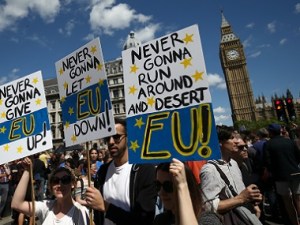
Pete North puts into rather forceful words a sentiment which inchoately bubbles up within me every time I see a tearful Remainer painting the EU flag on their face and weeping into an eagerly waiting television camera about how the cruel, racist vote for Brexit has somehow ripped their “European identity” away from them.
For all that cretinous bilge from remainers about us Brexiteers “stealing my European identity”, I say bollocks. You have no European identity. It is a figment of your imagination. You weren’t watching [a] French cop show on Netflix last night were you? You didn’t go and see a Spanish superhero film at the cinema last week. You know more about US politics than you do about the EU. Culturally, militarily and politically we are Anglospheric. That is a fact.
For all that we have seen remainers amphibious with grief, I say go and look at the traffic jams and the behaviour of drivers in Rome or go and watch the Spanish torture a bull to death and tell me that your culture is in any way reflected in Europeans. That’s when I tell you to fuck right off.
If I have to pick an empire to be allied with, I choose the USA every single time. The land of The Wire, South Park, Rick and Morty, the First Amendment. The country that never needed any persuading that Communism is the manifestation of evil on earth.
Say what you like about Donald Trump, but Donald Trump is not America. Trump is for four years or so. Moreover, Trump is a good sign. Yes, he’s a brash, oafish wrecker but he was elected on the back of a total rejection of American leftism. That which has aggressively moved to bury all moral norms and free speech along with it.
This is why Trump is weakening relations with the EU. Ultimately the diseased politically correct establishment in the USA is the consequence of a detached and corrupt liberal elite. In that respect the USA is in a more advanced state of decay than the EU – but we should view it as a warning. The soft left political consensus of the EU, with its deeply ingrained NGOcracy is that same disease. Brexit is not Trump. Brexit means we avert having one of our own.
I concur wholeheartedly.
Ask a Remainer what their favourite television show is, and they are far more likely to cite an American show than a European one.
Ask a Remainer what their favourite movie is, and they are far more likely to cite something from Hollywood than a worthy-but-subtitled movie from France, Spain or Italy.
Ask a Remainer who their favourite pop music artist is, and they are far more likely to cite an American artist than a European one.
Ask a Remainer to name a political hero or inspiration and I would wager that they are far more likely to reach for Abraham Lincoln, Franklin Delano Roosevelt, John F Kennedy or Barack Obama than Jacques Chirac, Gerhard Schröder, Silvio Berlusconi or Angela Merkel.
Ask a Remainer to cite a famous legal case or decision from a jurisdiction other than their own, and they are far more likely to name a famous case from the US Supreme Court – Brown v Board of Education, Roe v Wade – than a case from the European courts, or those of any member state.
For that matter, look at our legal system of Common Law, which influenced the formation of the American legal system (in the original colonies through to the federal system) and which is markedly different to the civil law traditions prevalent on the continent.
There are exceptions, of course. There are some areas where Europe does exert a stronger gravitational pull over us than North America or the wider Anglosphere. But besides geographic proximity, they are few and far between. Those who claim that we are somehow predominantly “European” in culture tend to either do so from a position of wishful thinking, wanting to position us closer to European social democratic tradition because they wish that our politics would move further in that direction, or from the blinkered perspective of their own narrow social circles.
None of this is to claim that British people lack an affinity for Europe, have nothing in common with other European countries or are in any way hostile to European culture. Many Brits do have deep and abiding links with the continent, myself included – I have a deep and abiding affinity with France and the French culture and people dating back to my teenage years, but I am clear in my mind that this is a relationship nurtured with a culture distinct from and different to my own, not a mere extension of my own culture.
And anybody who seriously surveys the full sweep of cultural connections – legal, governmental, artistic, musical, touristic, commercial – and tries to tell you that the British people have more in common with mainland Europe than with our friends in the Anglosphere (particularly the United States and Canada) is deliberately trying to deceive you, and deluding themselves in the process.
–
Support Semi-Partisan Politics with a one-time or recurring donation:
–
Agree with this article? Violently disagree? Scroll down to leave a comment.
I begged once, back in 2014. I will not beg again.
Thus far I have refrained from commenting on Nicola Sturgeon’s tunnel-visioned decision to agitate for a re-run of the 2014 Scottish independence referendum following last year’s vote for Brexit.
Back then, I poured my heart into the pro-Union campaign because I strongly believe in our United Kingdom, and do not want to see what I believe to be one of the two greatest and most consequential countries on Earth torn apart unnecessarily to the diminution of all. My beliefs have not changed since then.
However, I do not intend to make another argument or write even one more article seeking to convince the Scottish people to realise the self-evident, inherent wisdom of remaining in our United Kingdom. As the 2014 campaign drew to a close, I quoted the peroration of President Abraham Lincoln’s famous first inaugural address, which sums up my feelings far better than I can put into my own words:
In your hands, my dissatisfied fellow-countrymen, and not in mine, is the momentous issue of civil war. The Government will not assail you. You can have no conflict without being yourselves the aggressors. You have no oath registered in heaven to destroy the Government, while I shall have the most solemn one to “preserve, protect, and defend it
I am loath to close. We are not enemies, but friends. We must not be enemies. Though passion may have strained it must not break our bonds of affection. The mystic chords of memory, stretching from every battlefield and patriot grave to every living heart and hearthstone all over this broad land, will yet swell the chorus of the Union, when again touched, as surely they will be, by the better angels of our nature.
Substitute “separation” for “civil war” and you have my distilled viewpoint on the matter of Scottish independence. But Scottish nationalism is a blind and unreasoning beast, appeals to logic and sentiment will get us nowhere, and we should recognise this fact. If one seriously believes that the Scottish people are being oppressed and having their democratic rights trampled by the Evil English, or that they somehow lack their due influence in our nation’s government despite enjoying political devolution and autonomy far greater than that enjoyed by the UK’s most populous home nation, then a sensible discussion cannot be had.
Neither am I willing to involve myself in another referendum campaign which will consist of those on the side of Scottish independence prancing around pretending that they are the sole custodians of compassion and progressivism (not that I claim the latter label for myself), and that the only thing preventing Scotland from becoming a modern-day socialist Utopia is the cold, dead hand of English conservatism. I will not buy into the pernicious myth that people’s hearts get a little bigger and their spirits more generous the moment they move north of Berwick-upon-Tweed. Scottish nationalists: try building that compassionate welfare state with a 15% annual government budget deficit and the economy-suffocating tax rises which would be required to close it, and then talk to me about compassion.
Nor am I willing to debate on the skewed terms of the Scottish National Party, which is an authoritarian, centralising machine (one fire and police service for an entire country, really?!) which would happily turn Scotland into an undemocratic one-party state under the cult of personality of Nicola Sturgeon or Alex Salmond given the opportunity. I will not debate further concessions or autonomy for Scotland when the SNP government refuses to avail itself of the fiscal autonomy which has already been granted, and when similarly populous English regions (like, say, Yorkshire) are equal in population but have a fraction of the voice, and yet bear this injustice with more stoicism than that of every last Scottish nationalist combined. The SNP does not debate or negotiate in good faith, as should be evident by the mere fact that we are even discussing a re-run of the independence referendum after the matter was supposedly settled for a generation.
All of that being said, and despite the known disingenuousness and bloody-mindedness of the SNP, I was rather surprised by Nicola Sturgeon’s widely reported public statements and recent series of tweets, which amount to nothing more than another hysterical hissy fit about Brexit coupled with an Olympian denial of reality – Trumpian “alternative facts”, if you will:
.@scotgov is not proposing #scotref now…but when the terms of Brexit clear and before it is too late to choose an alternative path. 1/4 https://t.co/ZR6LDtA8v8
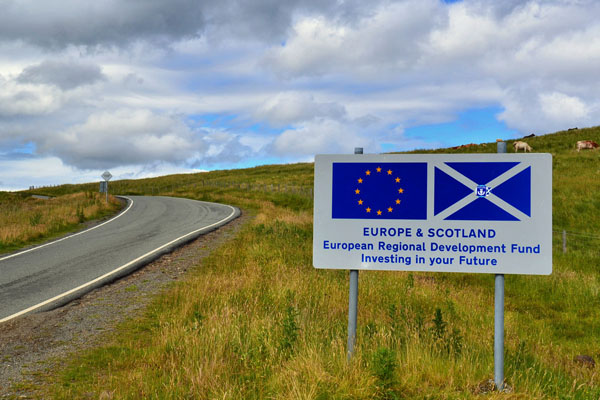
Sturgeon wants to hold another referendum when “the terms of Brexit [are] clear and before it is too late to choose an alternative path”. But it is clear to everyone with a functioning brain that there will be no alternative path. No matter how much the UK government screws up the negotiation and process of Brexit, there is no alternative for Scotland to remain an EU member. It has been stated and restated by one EU leader after another that there is no mechanism either for a region to remain part of the European Union when its parent member state secedes, or for a seceding region to claim automatic, continuous or even expedited EU membership on the basis of the former parent country’s membership.
One can argue about whether this is right or wrong – the political motivations behind it are quite clear, with certain other EU member states none too keen to give succour to restive independence movements in their own regions – but one thing a government should and cannot do is base its policy and public pronouncements on a denial of basic reality which can best be described as howl-at-the-moon stupid. If Scotland wants to be an “independent country” and an EU member (to the limited extent that the two overlap) then it must apply to rejoin the EU as a new entity from the outside, whereby its application will almost certainly be vetoed by Spain. Those are facts.
So what does Sturgeon mean when she says that the Scottish people must be free to pull the eject lever on the United Kingdom “before it is too late to choose an alternative path”? She is basically lying to her own citizens, pretending that the ejector-seat she is selling them is connected to a functioning parachute when in fact it is weighed down by the iron anvil of reality. And what is that awkward reality? The fact that voting to secede from the United Kingdom necessarily and automatically means that Scotland would find itself out of the UK and the EU, certainly for a long time and almost certainly forever.
Of course, many Scottish nationalists and their finger-wagging apologists in the rest of the UK love to argue that it is somehow ironic for pro-Brexit Unionists to warn Scotland of the dangers of finding itself locked outside of a larger political entity. These people think that they have hit on a clever, winning argument when in fact all they have done is reveal the paucity of their own understanding of patriotism and national identity, let alone why people voted for Brexit.
There never was (and likely never will be) a culture and common feeling of “European-ness” that outweighs British identity, and so it never made sense for such a powerful and dominant level of supranational government – one with determinedly expansionist, federal aspirations, no less – to sit over us in Brussels. There is, however, a strong sense of Britishness and shared British history, no matter what contemporary pundits say about the decline of Britishness and the rise of English nationalism.
If you doubt it, answer this one question: what was the name of the decisive Second World War air battle fought between July and October 1940? (Hint: even a post-patriotic millennial can tell you that it wasn’t the Battle of England, just as Pearl Harbor and 9/11 were attacks on the United States of America and not on Hawaii and New York respectively). Our sense of identity is overwhelmingly forged as a unified British entity (albeit one with proud constituent home nations), no matter what narratives of fracture that the pro-EU media class try to feed us. And so there is all the difference in the world between wanting to preserve the United Kingdom, to which most of us have at least some sentimental attachment, and wanting to free the United Kingdom from antidemocratic supranational European government which didn’t exist half a century ago and which most people barely comprehend.
Brexit, at its core, sought to return the highest and most consequential level of government to a polis with a commensurate sense of shared identity. If Scottish nationalists try to suggest that it is somehow hypocritical for Brexiteers to support the United Kingdom and warn of the cultural costs of separation then they either think that you are stupid or else are being catastrophically stupid themselves. Both options are equally plausible.
So by all means let Scotland hold another referendum, at the appropriate time. If they choose to defy the current polls and vote for true isolation on the world stage as a tiny country in poor fiscal health, determined to antagonise its larger neighbour, then that is their right. But they must do so only when the temper tantrum of their attempted divorce from the United Kingdom does not further imperil what is already a fraught and difficult Brexit negotiation for the rest of us.
Since Scotland is coming out of the European Union anyway (as even Nicola Sturgeon realises in her more lucid moments), it makes absolutely no sense for Scotland to pull the eject lever and jettison from the United Kingdom before the Brexit negotiations and process are complete. Sturgeon pretends that the referendum must be held virtually overnight, before it is “too late to choose an alternative”, but she is deliberately deceiving the people she represents. There will be no alternative other than the binary of life inside Brexit Britain or life as an independent country, whether the vote is held tomorrow or in 2025. All that holding IndyRef2 before Brexit is complete will accomplish is prioritising the vainglorious fantasy of Scottish nationalists over the UK government’s solemn responsibility (shoddily discharged thus far, admittedly) to secure the best deal and optimal future relations for our entire United Kingdom.
So go ahead, Scotland. Have your second referendum – at the appropriate time, once the United Kingdom you so despise has successfully finished negotiating its way through our present great national trial. I will not say a single further word to convince you to stay – the decision is yours, and if Project Fear worked back in 2014 then I can only hope that Project ‘Mystic Chords of Memory’ will ultimately do the job next time around.
So do what you will. But in 2014 you voted to remain part of the United Kingdom, and as a full and equal part of the UK you don’t now get to sabotage the Brexit process in pursuit of the SNP’s unachievable fantasy of leaping smoothly from our Union to that of Brussels.
–
Support Semi-Partisan Politics with a one-time or recurring donation:
–
Agree with this article? Violently disagree? Scroll down to leave a comment.
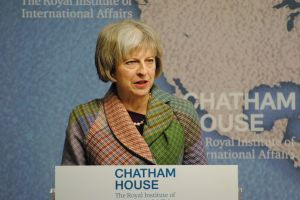
Here was a speech almost in the American political tradition – reaching back through history to affirm the roots of British exceptionalism, the challenge now before us and the promise that an even greater Britain can be ours if only we strive for it:
It’s why we will put the preservation of our precious Union at the heart of everything we do. Because it is only by coming together as one great union of nations and people that we can make the most of the opportunities ahead. The result of the referendum was not a decision to turn inward and retreat from the world.
Because Britain’s history and culture is profoundly internationalist.
We are a European country – and proud of our shared European heritage – but we are also a country that has always looked beyond Europe to the wider world. That is why we are one of the most racially diverse countries in Europe, one of the most multicultural members of the European Union, and why – whether we are talking about India, Pakistan, Bangladesh, America, Australia, Canada, New Zealand, countries in Africa or those that are closer to home in Europe – so many of us have close friends and relatives from across the world.
Instinctively, we want to travel to, study in, trade with countries not just in Europe but beyond the borders of our continent. Even now as we prepare to leave the EU, we are planning for the next biennial Commonwealth Heads of Government meeting in 2018 – a reminder of our unique and proud global relationships.
And it is important to recognise this fact. June the 23rd was not the moment Britain chose to step back from the world. It was the moment we chose to build a truly Global Britain.
The peroration was particularly good, as May eschewed the temptation to bribe the electorate with glib promises of riches today and instead asked us to consider the longer term good, as well as our place in the history books:
So that is what we will do.
Not merely forming a new partnership with Europe, but building a stronger, fairer, more Global Britain too.
And let that be the legacy of our time. The prize towards which we work. The destination at which we arrive once the negotiation is done.
And let us do it not for ourselves, but for those who follow. For the country’s children and grandchildren too.
So that when future generations look back at this time, they will judge us not only by the decision that we made, but by what we made of that decision.
They will see that we shaped them a brighter future.
They will know that we built them a better Britain.
When nearly every other major set piece speech in British politics is little more than a dismal effort to placate a restive and self-entitled electorate by promising the people Free Things Without Effort or Consequences (ask not what you can do for your country but what your country can do for you), here was a speech that set its sights a little higher and actually aspired to statecraft.
May’s criticism of the European Union and justification of the UK’s decision to secede from the EU was very good, particularly coming from someone who herself supported the Remain side and kept her head firmly beneath the parapet during the referendum campaign:
Our political traditions are different. Unlike other European countries, we have no written constitution, but the principle of Parliamentary Sovereignty is the basis of our unwritten constitutional settlement. We have only a recent history of devolved governance – though it has rapidly embedded itself – and we have little history of coalition government.
The public expect to be able to hold their governments to account very directly, and as a result supranational institutions as strong as those created by the European Union sit very uneasily in relation to our political history and way of life.
And, while I know Britain might at times have been seen as an awkward member state, the European Union has struggled to deal with the diversity of its member countries and their interests. It bends towards uniformity, not flexibility.
Without straying into undiplomatic language, May firmly placed responsibility for Brexit at the foot of a Brussels supranational government which is inflexibly committed to endless political integration by stealth, with member state individuality subordinate to European harmonisation.
The prime minister was also at pains to point out that dissatisfaction with the EU is by no means a uniquely British phenomenon, and that significant numbers of people in other member states hold many of the same legitimate grievances:
Now I do not believe that these things apply uniquely to Britain. Britain is not the only member state where there is a strong attachment to accountable and democratic government, such a strong internationalist mindset, or a belief that diversity within Europe should be celebrated. And so I believe there is a lesson in Brexit not just for Britain but, if it wants to succeed, for the EU itself.
Because our continent’s great strength has always been its diversity. And there are 2 ways of dealing with different interests. You can respond by trying to hold things together by force, tightening a vice-like grip that ends up crushing into tiny pieces the very things you want to protect. Or you can respect difference, cherish it even, and reform the EU so that it deals better with the wonderful diversity of its member states.
Of course this blog, unconstrained by any need for diplomatic restraint, would have gone further. Theresa May was at pains to state that a strong and united European Union is in Britain’s interest, which sounds magnanimous and sensible until you actually recognise the punch which is being pulled.
If the EU is an antidemocratic straightjacket imposing unwanted political integration on national populations who are ambivalent at best, why do we wish that the organisation prospers for decades to come? Do we not think our European friends and allies as deserving of democracy and the right to self-determination that we demand for ourselves? But this is nitpicking – the Brexit negotiations would hardly be served if May openly salivated at the prospect of the breakup of the European Union.
In her outreach to other European leaders, assuring them of Britain’s continuing goodwill, one almost hears an echo (okay, a very, very distant and diminished echo) of Lincoln’s first inaugural (“The Government will not assail you. You can have no conflict without being yourselves the aggressors…”) as May asserts that the UK government will negotiate in good faith so long as the EU reciprocates:
So to our friends across Europe, let me say this.
Our vote to leave the European Union was no rejection of the values we share. The decision to leave the EU represents no desire to become more distant to you, our friends and neighbours. It was no attempt to do harm to the EU itself or to any of its remaining member states. We do not want to turn the clock back to the days when Europe was less peaceful, less secure and less able to trade freely. It was a vote to restore, as we see it, our parliamentary democracy, national self-determination, and to become even more global and internationalist in action and in spirit.
We will continue to be reliable partners, willing allies and close friends. We want to buy your goods and services, sell you ours, trade with you as freely as possible, and work with one another to make sure we are all safer, more secure and more prosperous through continued friendship.
You will still be welcome in this country as we hope our citizens will be welcome in yours. At a time when together we face a serious threat from our enemies, Britain’s unique intelligence capabilities will continue to help to keep people in Europe safe from terrorism. And at a time when there is growing concern about European security, Britain’s servicemen and women, based in European countries including Estonia, Poland and Romania, will continue to do their duty.
We are leaving the European Union, but we are not leaving Europe.
All of this is good. So why am I not celebrating?
Because then the prime minister proceeded to outline her government’s plans and priorities for the upcoming Brexit negotiation. And at that point it became clear that we are not dealing with Abraham Lincoln but rather with James Buchanan.
In other words, the real problem with Theresa May’s speech came when she pivoted from the background context to the government’s 12-point plan (or exercise in wishful thinking).
In just a few short passages May has driven a horse and cart through all good sense.
For starters May has misunderstood the exam question. The process of leaving the EU is to negotiate a framework for leaving and a framework for continued cooperation. Instead she has taken it as the process of securing a trade deal – which doesn’t even begin to acknowledge the depth and complexity of the task. Because of this Theresa May will ensure we pay the maximum price possible.
By any estimation there is no possibility of securing a comprehensive agreement in two years and if we reach any kind of impasse then all of the leverage falls to member states as we beg for an extension.
Worse still, May has fallen for the mantra that no deal is better than a bad deal and is prepared to walk away from the table. This would result in the WTO option and would be the single most egregious act of economic self harm ever recorded. As much as that is to be avoided there is now every chance that it will happen by accident as our time expires.
May has drunk deeply from the Brexiteer kool aid and Britain is about to find itself substantially poorer with fewer opportunities for trade. This will be the Tory Iraq. Blundering with half a clue and no plan and no real understanding of the landscape, resting the fate of the adventure on some overly optimistic patriotic nostrums that fold at first exposure to reality.
Mrs May has set her face against a rational, measured Brexit and is embarking on a wild gamble, the outcome of which she has no way of predicting.
Such is her idea of pursuing “a bold and ambitious Free Trade Agreement with the European Union”, an undertaking which others have tried in the recent past – the most recent being Canada, which has spent eight years now in trying to bring an agreement to fruition, and we’re still waiting. The possibility, therefore, of the UK negotiating a deal (and getting it ratified) inside two years is, to say the very least, remote.
Nevertheless, there are those who think otherwise. They argue that, because the UK is already in the EU and achieved full regulatory convergence, transition from one type of agreement to another should be relatively straightforward and swift.
That, however, is completely to understate the complexity of modern trade agreements. In addition to regulatory convergence, there must be a dynamic arrangement that will ensure the automatic uptake of new regulation, and also the changes mandated by ECJ judgements. There must also be internal market surveillance measures, agreed conformity assessment measures, customs agreements, dispute settlement procedures, agreements on competition policy, procurement and intellectual property rights, as well as systems to deal with rules of origin.
These and much else, will require an institutional structure to facilitate communication and ongoing development, a form of arbitration panel or court, and a consultation body, which allows input into, and formal communication with the EU’s regulatory and institutional system.
And concludes:
This is my way of saying that to achieve a “bold and ambitious” free trade agreement with the EU inside two years is not just difficult. It is impossible. It cannot be done. And it doesn’t matter how many times it is discussed amongst the chattering classes, it still can’t be done.
It has been over eighteen months since this blog woke up to the fact that lazy Brexiteer tropes about quick-n-easy free trade agreements being the golden solution to every problem simply do not cut it in the face of such an unimaginably complex undertaking as extricating the United Kingdom from the European Union.
Since that time, it has become clear to me and many others that forty years of political integration cannot be unpicked within the two-year timeframe granted through Article 50 of the Lisbon Treaty, and that any attempt to negotiate a bespoke solution within this timeframe would see us hit the deadline without a deal in sight, leaving us at the mercy of the EU27 as we scramble for an extension or risk going over the cliff and resorting to WTO rules.
But what has been clear to this blog (since I first read of the Flexcit plan for a phased and managed Brexit with an eye to developing the new global single market which must eventually replace the parochial EU) and to a growing number of Brexiteers remains completely opaque and mysterious to Her Majesty’s Government:
So as a priority, we will pursue a bold and ambitious free trade agreement with the European Union.
This agreement should allow for the freest possible trade in goods and services between Britain and the EU’s member states. It should give British companies the maximum freedom to trade with and operate within European markets – and let European businesses do the same in Britain.
But I want to be clear. What I am proposing cannot mean membership of the single market.
European leaders have said many times that membership means accepting the ‘4 freedoms’ of goods, capital, services and people. And being out of the EU but a member of the single market would mean complying with the EU’s rules and regulations that implement those freedoms, without having a vote on what those rules and regulations are. It would mean accepting a role for the European Court of Justice that would see it still having direct legal authority in our country.
It would to all intents and purposes mean not leaving the EU at all.
And that is why both sides in the referendum campaign made it clear that a vote to leave the EU would be a vote to leave the single market.
So we do not seek membership of the single market. Instead we seek the greatest possible access to it through a new, comprehensive, bold and ambitious free trade agreement.
That agreement may take in elements of current single market arrangements in certain areas – on the export of cars and lorries for example, or the freedom to provide financial services across national borders – as it makes no sense to start again from scratch when Britain and the remaining Member States have adhered to the same rules for so many years.
But I respect the position taken by European leaders who have been clear about their position, just as I am clear about mine. So an important part of the new strategic partnership we seek with the EU will be the pursuit of the greatest possible access to the single market, on a fully reciprocal basis, through a comprehensive free trade agreement.
Okay, great. And you plan to accomplish this in just two years, at a time when we are rebuilding our national trade negotiation competency from scratch? And what about the numerous other aspects of our co-operation with Brussels that do not directly relate to the single market? What process is there to be for evaluating and renegotiating these?
Ministers clearly still view Brexit through the narrow lens of wanting to sever all of the ties that bind us to Brussels and hope that a “quick and dirty” free trade agreement will somehow be a good substitute for patiently considering and unpicking each individual strand of co-operation between London, Brussels and the EU27.
And unless Theresa May has another, top secret Brexit ministry devoted to unglamorous issues like mutual recognition of regulatory standards (rather than burbling inanities about tariffs) then we are in for a very rude awakening at some point within the next two years.
Look: I like the ambition and confident tone of Theresa May’s speech. I like some of the swagger and self-confidence. And if May had been speaking about any subject other than Brexit in this manner I would be on my feet, giving a standing ovation. But unfortunately the prime minister has chosen to be smug and blasé about the one topic where airy self-assurance alone cannot win the day.
The prime minister accurately summed up many of the problems with the European Union, and did a good job in reminding people what an indispensable country Britain really is to the future economic, cultural and geopolitical prospects of Europe. That’s great. But it doesn’t begin to explain how Britain is going to negotiate an entirely bespoke new relationship with the European Union within two years when far less extensive deals focusing purely on trade routinely take over a decade to complete.
Unpicking forty years of political integration within two years would be an unimaginably tall order at the best of times, even if the organisation into which we are subsumed had not gradually drained us of the critical competencies required to complete the task. Theresa May promising a clean Brexit given our current national capabilities and negotiating climate is like President Theodore Roosevelt promising a moon shot in 1903, when the Wright brothers rather than Wernher von Braun represented the pinnacle of aviation technology.
So mixed feelings. How nice to finally hear a political speech that is so outward-looking and ambitious in content, positive in rhetoric. How sad that this particular one is likely to end in disappointment and recrimination.
–
Support Semi-Partisan Politics with a one-time or recurring donation:
–
Agree with this article? Violently disagree? Scroll down to leave a comment.
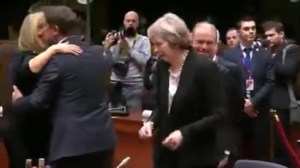
No, Theresa May was not mortally humiliated at the current EU summit underway in Brussels. Somehow, probably after a few nights in intensive care and some trauma therapy, the prime minister of the United Kingdom of Great Britain and Northern Ireland will bounce back from being denied the opportunity to make idle small talk for a few minutes with the likes of Federica Mogherini.
Let’s be serious. Were there non-stop footage of every political leader to ever attend an EU summit, we could undoubtedly find instances where each one of them stood alone with nobody to talk to for a short while, even the sainted Angela Merkel. Keep watching the video beyond the first twenty seconds and you actually see May engaged in several conversations with other European leaders. This is a complete non-story.
But seizing on the footage of Theresa May looking momentarily awkward, however, helps to reinforce a narrative that Remainers (and their friends in the media) are desperate to encourage – that of pathetic, little old Britain being banished to the margins of the world having voted to isolate ourselves “from Europe”.
This is an idiotic and superficial analysis, and it speaks volumes about the people pushing the theory that they seem to take delight in what they see as the humiliation of their own prime minister (who, let’s not forget, represents all of us). If Brexiteers have been too harsh in impugning the patriotism of Remainers, as is sometimes claimed, then now is the time for Remainers to finally take their patriotism out for a spin. They claim that our prime minister has just been insulted on the world stage – therefore they should be encouraging a collective national outrage rather than trying to score smug political points.
Remainers claimed throughout the referendum campaign that the EU is a bastion of rationality, of grown up countries cooperating sensibly with one another. Well, what is grown up and sensible about deliberately ostracising one head of government just because the member state she represents is exercising its right to leave (not that any such ostracisation took place)? What is enlightened and admirable about such childish behaviour? And why is this snarling, punitive and insecure little club something of which we would want any further part?
It’s a funny video, although not in the way May’s opponents might think. Funny meaning odd, curious, in that your response to it is probably shaped by your existing view of May and Brexit.
For Leavers – and quite a few Remainers who accept the reality that Brexit will happen and no amount of shenanigans by Blair, Mandelson and Clegg (what a dream team!) will stop it - a British Prime Minister being treated in a rude fashion will only encourage Brits to say “if that’s your attitude then please get stuffed” to the EU.
In that gathering I see a room that is overwhelmingly male – a sausage party of smugness. May is too polite or diffident to charge up to them and start “handbagging” and beating up the boys Thatcher-style, so she hovers. Millions of people, most people, who lack liberal elite social confidence will know the feeling from school or parties ever since. It induces sympathy.
We’re not talking to you, you smell, we don’t like you, is the message. Oh, and the UK is not invited to dinner.
The response all this provokes – in me, anyway – is incredulity at the continuing stupidity of the EU’s leaders in their determination to rough up Britain in a manner that amounts to self-harm. Yes, we voted to leave the EU, which is our right and had been coming for ages, but we cannot leave Europe. That would be a geographic, culinary, cultural, commercial impossibility, thank goodness. That means we are going to have to get along, and find new ways of co-operating and co-existing. Punishing Britain and being rude to Theresa May is simply a waste of time and energy, when the world is changing this fast.
I would caution Iain Martin against going down the identity politics route, trying to drum up additional sympathy for Theresa May by portraying her as a lone female in a room of arrogant and threatening men. I see no evidence that gender has anything to do with this non-story. Martin (I assume) is not a fan of the Cult of Social Justice and Identity Politics, and he should avoid resorting to their tactic of playing the oppression card when engaging in argument.
But that minor quibble aside, Martin is quite right. Many people will indeed empathise with the awkwardness of walking into the middle of a room of people who generally already know each other quite well and who are already engrossed in conversation. Throw in the fact that the television cameras were rolling and May becomes quite a sympathetic character. So if Remainers’ best argument is now “see how they treat you when you scorn them and try to leave the club” then I think it will largely backfire.
If anything, the history of recent British diplomacy has been one of excessive fawning and deference, punching well beneath our weight considering our status as Europe’s second biggest economy, one of only two nuclear powers and possessing the continent’s most deployable and skilled armed forces, not to mention the popularity and dominance of our culture. Martin also picks up on this point:
Britain has the leading listening, intelligence and security capability in Europe, at a time when the place is under assault from jihadist maniacs and the Russians are out to discredit democracy and create mischief in elections in Germany and France. Even in its depleted state, Britain is a leading player in Nato, which is dedicated to the defence of Western Europe. On the cyberwarfare front in particular that defence is now an urgent priority.
The UK also provides in the City of London the capital of the eurozone, which makes the giant debt machine go round. The British economy is growing and we buy a lot of cars and much else from Europe.
What will it take to wake up the countries of the EU? Their post-1989 experiment is in a terrible state, with the euro and open borders proving to be a disaster. They need a bit of humility and a rethink.
I don’t normally go for “we buy lots of cars from them!” style arguments, but it is not wrong, and everything else that Martin says is persuasive.
If anything, the trouble is that our goodwill and cooperation is too easily taken for granted by our partners. We tend to enforce EU laws and directives while other countries skirt, bend or flout them. We generally honour our obligations with little fuss. And so we should, when that behaviour is equally reciprocated. But right now that reciprocity is missing.
The fact that Britain will be a supplicant during the secession negotiations is currently emboldening the leaders of some otherwise quite unremarkable and forgettable countries to “play the big man” and swagger around, lecturing or threatening Britain safe under the wing of Brussels. They would be advised to realise that at some point Brexit will be complete, and that future goodwill and cooperation from Britain – which many of them need – should not be taken for granted if things become too heated or punitive during the exit negotiations.
Martin notes that the shift is already starting to happen:
Away from Brussels the smart Poles have realised that Britain will remain a partner, and are talking of the UK being the key country in the defence and security space in Europe. The Germans too, seem to be waking up to the need for a different way of thinking about these questions. The conversation at a dinner I was at recently with German policymakers and business people was one of the most interesting, open and illuminating things I’ve heard all year.
But Brussels blunders on, playing its usual games, thinking it clever to humiliate the naughty British. Carry on like this and they really can get stuffed.
It is altogether time for less EU-style holding hands beneath a rainbow (which is all fake, anyway) and more good old fashioned self-interest and realpolitik. Immediately following Brexit we witnessed a number of gestures of solidarity and support from true allies outside the EU while our supposed partners and allies within dealt in condescending language and veiled threats. That alone tells us that membership of the European Union has forced us to pour time and effort into nurturing partnerships which were never natural or terribly fruitful while having to ignore closer and more natural alliances beyond the artificial construct of the EU.
But if the EU and its member states are behaving irrationally and emotionally it is only because they remain in thrall to a beguiling, powerful but unachievable vision of continental political union by stealth from which Britain thankfully escaped. Sensing an existential threat to the group delusion, other countries may naturally wish to lash out at Britain, to make us “pay the price” (and there will be a price – serious Brexiteers have never shied away from that fact).
But while this may explain intransigent or punitive behaviour from the European Union, it will not excuse such antics for much longer. The time for childish temper tantrums and playground insults is over. Voters in Britain and across Europe did not elect their politicians with a mandate to create unnecessary drama just because one country chose to reject a rusting mid-century vision of political union and peaceably extricate itself from that union. And unnecessary drama they must absolutely not create.
A deal must be done and the deal will be done. Hopefully it will be a deal based on common sense, achieving the goal of extricating us from the political union we voted to leave while taking a transitory and measured approach (through continued EEA participation) to avoid any cliff-edges or avoidable economic disruption.
But whatever kind of deal emerges, it will not be influenced by video footage of Theresa May standing alone at an EU summit, no matter how much the images may warm the hearts of strangely-motivated Remainers.
–
Support Semi-Partisan Politics with a one-time or recurring donation:
–
Agree with this article? Violently disagree? Scroll down to leave a comment.
The Labour Party is doomed to break apart on the issue of immigration because the Metro-Left has become so ideologically insulated and closed-minded that they can no longer speak the same emotional language as half of their own voters (and the country)
Martin Kettle has some advice for the Labour Party as it wrestles to come up with a compromise between the blithe open borders attitude of the Corbynites and the suddenly nativist instinct of Midlands and Northern MPs whose seats may be in jeopardy unless the party moves convincingly on the issue of immigration.
After the issue of Brexit itself, voters think immigration is the most important question facing the country. But Labour’s poll ratings on immigration are terrible. Only 11% of voters in the most recent YouGov poll think Labour is the best party on immigration, with only 29% of Labour voters from the 2015 election – which Labour lost badly – agreeing. A mere 5% of leave voters think Labour is best on immigration.
If Labour’s priority is to re-secure its core voters on the issue, that is a very bad place to start from. Latest research by Chris Hanretty of the University of East Anglia suggests that 64% of Labour’s 232 parliamentary seats voted leave in June. So if it is correct that immigration control was the decisive issue in the leave win, Labour MPs are right to demand that, at the very least, their party says something about immigration that engages with that stark reality.
And suggests a solution based on dubious historical precedent:
There’s a framework for this. For most of the last half-century Labour’s policy was that managed migration made community integration and mutual trust possible. The policy had periods of success and failure. It was too repressive in the 1970s and it was too insouciant in the early 2000s, after EU enlargement. But until recently it worked reasonably, and won electoral consent.
Labour’s challenge in 2017 is to renew that same approach around the realities of Brexit. It won’t be easy, and it will involve compromises of the sort that Crossman expressed half a century ago. The policy cannot be based solely on liberal principles. But it cannot be based solely on ignoring those principles either.
It has to place intervention in the labour market to ensure fair treatment, alongside an unsentimental approach to immigration control. If Labour’s factions can at least agree to start from there, there’s just a chance that enough of the rest will fall into place.
But there can be no agreement between Labour’s factions. One faction – the metropolitan Regressive Left faction, incorporating everybody from leftists like Jeremy Corbyn to virtue signalling centrists – hold it as an article of faith that to even question whether everybody who wants to come to Britain should immediately be allowed to do so constitutes damning evidence of racism. The other faction – call them Old Labour, rooted in the party’s historic Northern, industrial and post-industrial heartlands – have not yet sacrificed patriotism and a belief in the uniqueness of British values and culture on the altar of globalisation, and fail to understand why immigration controls such as those imposed by countries like the United States or Australia are somehow racist.
These two sides simply cannot reconcile – certainly not so long as the metropolitan Regressive Left continues to arrogantly insult agnostics and sceptics, either accusing them of moral deficiency for failing to meekly toe the party line or ignoring their arguments altogether. In fact, with immigration currently a high priority political issue, one can argue convincingly that there is no longer any place for the two factions within the same political party, and that Labour must split (and probably should have done so some time ago).
Kettle, however, would have Labour look back to 1965 for a solution to their dilemma:
Yet the disagreement is not a new one, and Labour has succeeded in managing it before. Back in the summer of 1965, Harold Wilson’s Labour government published a radically restrictive white paper on immigration from the British commonwealth that shocked even cabinet ministers. “This has been one of the most difficult and unpleasant jobs the government has had to do,” the housing minister Richard Crossman wrote in his diaries. “We have become illiberal,” he mourned. “This will confirm the feeling that ours is not a socialist government.”
Nevertheless Crossman was absolutely sure that the controls were necessary. “I am convinced that if we hadn’t done all this we would have been faced with certain electoral defeat in the West Midlands and the south-east,” he went on. “Politically, fear of immigration is the most powerful undertow today … We felt we had to out-trump the Tories by doing what they would have done … I fear we were right.” Antisemitism and racism were endemic in Britain, Crossman suspected. “One has to deal with them by controlling immigration when it gets beyond a certain level.”
The fact that left-wing politicians and commentators would turn to the overtly racially tinged 1965 White Paper Immigration from the Commonwealth as a blueprint for dealing with Brexit and present-day immigration concerns only goes to show how little they understand the totally different present day context or appreciate the different public attitudes toward immigration in 2016.
The regressive leftist mind is seemingly unable to compute the idea that objections to unlimited immigration could be based upon anything other than racism. And perhaps this is partly understandable, when historically racism has formed one of the key objections to immigration. But no longer. Racism is now, thankfully, a fringe issue in Britain (despite the continual efforts of SJWs and others whose livelihoods depend on representing official victim classes to inflate the problem). Today’s concerns centre around integration and assimilation into society, and the affect on employment, infrastructure and public services.
None of these concerns are remotely race-based, and yet the response of the Labour Party has historically been to dismiss them all as a thin veneer covering for xenophobia. When voters plead with Labour politicians to believe them when they say that their objections are not connected with race, too often the response has been sneering dismissal. And even now, when some MPs and commentators are considering making concessions on immigration, it is done in the spirit of “we must join the British people in their racism as a matter of political survival” rather than a genuine attempt to understand legitimate public concerns.
And thus we have Martin Kettle essentially arguing that the Labour Party should hold its nose and support something which it believes to be overtly racist in order to stave off political annihilation. Why else cite the case of the 1965 White Paper, written at a time when “coloured immigration” was still openly spoken of as a specific problem?
High-minded it isn’t. But those words echo today because the essence of the argument in which Crossman’s generation participated – hard times, more migrants, native resentments, press and public prejudice, liberal principles under challenge, electoral defeats – has not altered all that much. Yet just as the Wilson Labour party was right to grasp the issue, though it could have grasped it far better, so the Corbyn party needs to grasp it in an equivalent way too.
This is the infuriating thing about leftists. They manage to be insufferable bordering on slanderous even in their attempts to be conciliatory and find compromise. Because they sincerely believe that any departure from their worldview can only be prompted by malice or grave moral failure, their attempts at dialogue with political opponents are awkward and strained as they inadvertently insult the people they are trying to flatter.
Martin Kettle has gotten it into his head that Brexit proves that the British people are having one of their funny turns and have come over all racist, just like we did in the 1960s. Unable to even consider that the Leave vote was prompted by sincere and virtuous political disagreement about the merits of EU membership, Kettle therefore suggests that the Labour Party recycle some good old fashioned racist outreach from 1965 as a kind of olive branch to persuade swivel-eyed Labour Brexiteers back into the fold.
This is the kind of clumsy gesture we have come to expect from a political elite which has become so isolated from much of the country that they can barely speak the same language. Listening to Martin Kettle try to strike up a rapport with Brexiteers would be like listening to me using Google Translate to talk to someone in Korean. The rough message might get through, but the garbled syntax would prove that I am not really speaking their language, that I do not truly understand them.
I’ve said it numerous times, and I will say it again: the Labour Party will not taste power or enjoy another general election victory until they stop giving off such strong signals that they openly despise the voters and hold more than half of the country in open disdain.
The British people do not want to be told “okay, we’ll try racism for awhile!” by an exasperated and uncomprehending Labour Party. They want to be listened to, to have their ideas and concerns heard and engaged with rather than being summarily dismissed.
This should not be a lot to ask, yet it is proving to be an almost impossible challenge for a bitterly divided Labour Party. And time is of the essence. Even assuming that the next general election takes place in 2020 and not earlier, it takes years to execute a convincing policy reversal while re-establish public credibility and familiarity.
If the Labour Party are to make a change and decide to meet the British people half way on the subject of immigration, then now is the time to do it. But with Jeremy Corbyn and John McDonnell in charge and an increasingly London-centric party behind them, don’t bet on it happening.










 Semi-Partisan Politics