Late Night TV Hosts vs Trumpland

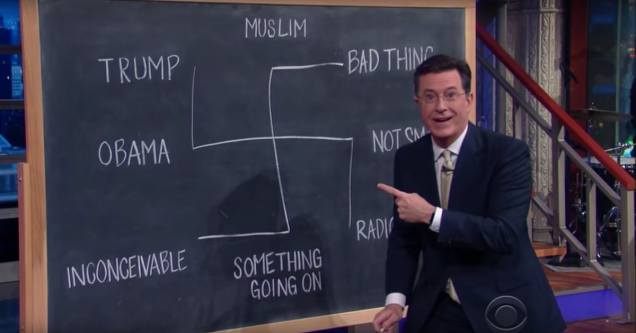
Stephen Colbert - Donald Trump - chalkboard swastika

When it becomes good business for left-wing late night comedy hosts to actively alienate and belittle half the country, it is clear that Donald Trump is not the only force stoking hatred and division in America

While in New York City last December, my wife and I were fortunate to get tickets to see The Late Show with Stephen Colbert being recorded at the Ed Sullivan Theatre.

It was a good show and ended up being a really fun experience, but as somebody who cannot reliably tick the “Yes, I agree” box next to every progressive cause under the sun, it was only fun because I knew what I was letting myself in for and readied myself in advance for an hour’s worth of dripping condescension, mockery and misrepresentation of conservatives and conservatism.

And increasingly that’s how it is for conservatives – and even some moderates – who want to consume the fruits of mainstream culture, be it network television, Hollywood movies, stand-up comedy or even classical music. Sure, you can watch – nobody barred me from entering the studio or administered an ideological test before I was allowed to sit and watch Stephen Colbert spit-roast Donald Trump in his monologue for the hundredth time. But in order to derive uninterrupted enjoyment from proceedings, those on the right increasingly have to perform a certain degree of mental disassociation from their political views before taking part. One has to fake laughter and perfect the wryly amused smile so as not to look out of place while everyone else clutches their sides and laughs at the Stupid Backward Conservatives.

During the warm-up act before Stephen Colbert came out, the warm-up comedian scoured the audience looking for interesting or odd people, and then made them stand up and engage him in conversation for the delectation of the audience. Pretty standard for a warm-up act, but one person in particular seemed to pique the warm-up comedian’s interest – a slightly patrician-looking, grey-haired and well-dressed man in his late fifties or early sixties. “A Republican in the audience!”, the comedian exclaimed.

The comedian got the man to stand up, confirmed that he was indeed a conservative and then went to town on him in a way which was superficially good-natured but as it dragged on (far longer than his other interactions) quickly became quite awkward both for the gentleman involved and a number of other audience members. This isn’t to resort to snowflakery – go to a comedy show and one should expect to get picked on by the person on stage, after all – but it was notable and entirely predictable that none of the conspicuously progressive stereotypes sitting in the audience received similar treatment. And of course this was but a foreshadowing of what would happen when Colbert himself took the stage (we in the audience were under strict instructions not to “spoil the fun” by booing at any point, though this rule was liberally disregarded when any mention was made of a conservative figure or policy).

Left-wing satire can be brilliant. I always felt that during his long tenure at The Daily Show, Jon Stewart did a fantastic job skewering the many foibles and failings of the George W. Bush administration without coming across as aggressively bitter or hostile to everyday conservative voters. He may not have been speaking to them for much of the time, but neither was Jon Stewart actively belittling those people who twice voted for Bush. Other late night hosts such as Bill Maher often make more pointed barbs directed at ordinary conservatives, but in Maher’s case his jokes are much funnier and are balanced with a frequent willingness to call out the excesses, failings and hypocrisies of his own side (such as the free pass given by much of the American Left to retrograde attitudes toward women in parts of the Islamic world).

Stephen Colbert, while often very funny, is less nuanced. As a non Trump-supporting conservative I personally fall down the awkward gap between agreeing with nearly all of Colbert’s criticisms of President Trump’s personal conduct and suitability for office while also wishing that not every single monologue had to be come a teachable moment about the supposed deficiencies of conservatism, the self-evident correctness of progressive positions and the supposedly inherent wisdom of even the dimmest people who happen to cheer for the progressive cause.

And this brings us to fellow late night talk show host Jimmy Kimmel, who took the opportunity (in front of an extremely friendly crowd of fellow progressives) to use a guest appearance on left-wing podcast Pod Save America to declare that progressive domination of late-night television was entirely right and proper, Darwinian natural selection at work within showbusiness.


From Ben Shapiro at The Daily Wire:

Following President Trump’s State of the Union address last week, CBS late night host Stephen Colbert had on the former Obama staffers of “Pod Save America” to bash Trump. Those same gentlemen welcomed ABC late night host Jimmy Kimmel to the stage for an event on Saturday night, where Kimmel proceeded to explain that all late night hosts are on the Left thanks to their vast intellect.

What a ridiculous and unnecessarily smug thing for Kimmel to say. One cannot rend one’s garments about hatred and division in America and then declare everyone on the winning side of a highly contentious election to be intellectually inferior. These are not the shocked and panicked moments immediately after election night in 2016 – by this point the American Left has had a long period of time to dwell on their missteps and shortcomings in that electoral cycle, but many Democrats and others on the left choose instead to marinade in their own anger, as though shouting at the other half of the country will win them around.

I have also been to a live recording of Pod Save America. It is actually a podcast to which I subscribe and listen frequently, and so when the hosts came on tour to London in January I went with a group of friends to Cadogan Hall to hear them do their thing. At its best, Pod Save America is entertaining and informative, albeit from an avowedly left-wing stance, and there is a real value to hearing how some of the most prominent alumni from the Obama administration view today’s politics. Being a left-wing podcast, nobody expects them to do anything other than preach to the choir in every episode, which is no worse than what many right-wing talk radio hosts do. But surely we should expect a little more from late-night network television?

Nothing good can come from the bitterness and rancour which currently seeps from the late-night talk shows. Network television comedy should bring people together, or at least not needlessly alienate them from one another. It may be good business for late night TV hosts to cater almost exclusively to staunchly Democratic voters – NBC’s Jimmy Fallon, who deliberately stays less political, is certainly suffering in the ratings for failing to bash conservatives on a nightly basis – but it is bad for our society as a whole.

A cohesive society requires that we maintain a public square where everyone is welcome, where people are not encouraged to self-segregate as progressives or conservatives, Christians or Muslims, whites or racial minorities. Where everybody can be American (or British) first and subordinate their various other identities and affiliations, albeit temporarily, to the one which we all hold in common. But time and again we see what should be common territory – places like  late night television or NFL football games – being tussled over by partisans until one side is forced to cede the field. When everything is political, everything becomes divisive and toxic.

In his latest show, Ben Shapiro makes a similar point with reference to last weekend’s Superbowl LII in Minnesota:

One of the things that football needs to understand – one of the things that the NFL needs to understand – is that the popularity of the sport is deeply entwined with the good feeling about the country. If you feel bad about the country it’s hard to enjoy sports, because you feel like sports are frivolous. If you feel good about the country then sports are a distraction from the mundane, sure, but they are also a reminder that all of our conflict is really play-acted.

And that’s not true in politics, you know, in politics there’s a lot of our conflict that’s not, that’s real, that’s about issues that matter and I care deeply about. But it’s good for Americans to recognise once in awhile – and I think that’s what the Superbowl is for – it’s good for us to recognise every once in awhile that there are these moments where we have more in common than we are separated by. So it’s amazing that in an evening that’s really about conflict between two teams is really more about the love for fans for one another. It’s really more about a love of country. It’s really more about what we are unified in favour of, and that’s why it was so entwined with the flag, with the military, and it’s why it alienated so many fans when the players started kneeling.

This is a time when we need to urgently be creating more shared, civic spaces where people of differing political views, backgrounds and identities can come together as fellow citizens first and foremost, not as victims, oppressors or activists. America actually fares better than Britain in this regard, since displays of patriotism and national pride are not yet considered quite so embarrassing or gauche as they are in Britain (though some on the American Left would doubtless love to change that fact), but neither country can afford to be complacent.

And here, late night television serves as a good barometer of just how polarised society has become. There are many excellent and respected comedians at the top of their field who do not feel it necessary to turn their acts into another campaigning wing of the Democratic Party. But many conservatives having already largely abandoned late night television, it does not make sense for ratings (and therefore for business) to do anything other than give the remaining progressive audiences exactly what they want – just ask Jimmy Fallon, who lags in the ratings precisely because he refuses to turn his show into a platform for progressive revivalism.

We see exactly the same situation in Britain, where new satirical news show The Mash Report (itself billed as hybrid of the Daily Show and British current affairs shows like Have I Got News For You) make endless fun of Brexit voters and conservatives as though being left-wing and pro-EU is the “natural” position, from which any departure should rightly trigger outrage and mockery. From a business and professional standpoint there may be every reason to continue along the current trajectory (including high ratings, monetary rewards and approval from fellow bubble-dwellers in the industry), but that doesn’t mean that the status quo is good for societal cohesion. It isn’t. There was a time (before Brexit) when people on the Left used to understand that not everything of value could be quantified, but apparently no more.

The best satirical comedy tends to punch upward, not down (though of course in a free society it should be free to punch wherever it likes). It should be possible to punch up at Donald Trump while reserving a few blows for other highly deserving fixtures of American political life, including the cadaverous and inept figures who make up the Democratic Party leadership. It should be possible to punch upward at ludicrous Tory Brexiteers like Boris Johnson while also using humour to point out the starry-eyed naivety of those on the Left who see the European Union as the fount of all good things.

But most importantly, it should be possible to punch up at the political class while avoiding punching down at entire groups of voters, let alone nearly half the country. Because when it becomes good business sense to deliberately alienate half the country to wring laughter and advertiser dollars from the other half, something has gone terribly wrong.
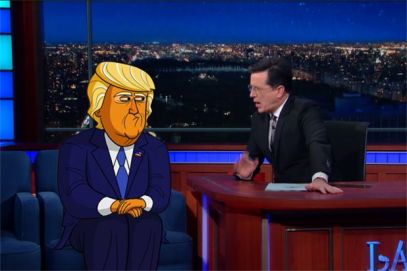
Stephen Colbert - Cartoon Donald Trump

Support Semi-Partisan Politics with a one-time or recurring donation:

Agree with this article? Violently disagree? Scroll down to leave a comment.

Follow Semi-Partisan Politics on TwitterFacebook and Medium.


Jacob Rees-Mogg vs Leftist Thugs, And Another Depressing Weekend For British Conservatism

The Conservative Party would deserve more sympathy when their MPs are shouted down by leftist thugs if the prime minister herself were not such an enthusiastic suppressor of free speech

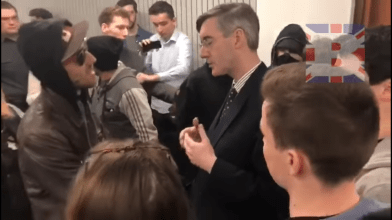
By now I assume everybody has seen footage of the impressively unflappable Conservative MP Jacob Rees-Mogg attempting to break up a physical altercation after an event in which he was speaking was stormed by leftist, Momentum-aligned protesters.

This is the kind of scene we have come to expect from American university campuses, where roving bands of masked Antifa-style goons, wearing their intolerance for diversity of thought like a perverse badge of honour, now routinely storm the meetings and public events of student organisations or external speakers they consider to be haram.

University campuses in Britain, by contrast, tend to be far more sedate places with much less visible security. Since we are fortunate enough in this country not to have to pause every couple of months to mourn another deadly mass shooting incident in an educational establishment, our university campuses do not have their own dedicated police forces as is sadly necessary in America. Neither is there some kind of private security guard for every three or four students.

This, however, may need to change if Members of Parliament and other speakers, people routinely invited onto university campuses to give talks or participate in student debates, find themselves pitched into the middle of violent confrontations with balaclava-clad goons whose devotion to the Cult of Social Justice and Identity Politics leads them to shut down the expression of any opposing thought.

On this occasion, the situation was defused before any real violence could take place, but Jacob Rees-Mogg has experience of standing up to aggressive leftist protesters and bravely stood his ground. Other MPs or public figures might understandably be less keen to put themselves in harm’s way while security guards or police are called to quell a developing problem.

And be assured, this will happen again – not because the speakers invited onto campus are becoming any more controversial or provocative, but because those opposed to their presence are becoming ever more sensitive to what they see as heresy – and too often are being indulged in their precious sensitivity by leftist academics, university administrators and politicians. The protesters cannot be reasoned with, and will not engage respectful debate when offered the chance, so the only way to preserve and protect freedom of expression on university campuses is to have a heavy security presence ready to haul out disruptive people who would censor events with their incessant yammering.

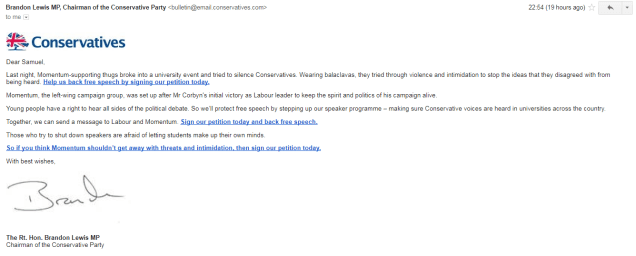
Unfortunately, what we saw from the Conservative Party in response to these events at the University of West England was not a muscular defence of free speech and a commitment to ensuring that universities which take public money also take seriously their responsibility to crack down hard on would-be student censors; rather, we saw a whinnying display of self-pitying victimhood:

Brandon Lewis - Conservative Party email - free speech petition

In wheedling tones, the new Conservative Party chairman writes:

Last night, Momentum-supporting thugs broke into a university event and tried to silence Conservatives. Wearing balaclavas, they tried through violence and intimidation to stop the ideas that they disagreed with from being heard. Help us back free speech by signing our petition today.

Momentum, the left-wing campaign group, was set up after Mr Corbyn’s initial victory as Labour leader to keep the spirit and politics of his campaign alive.

Young people have a right to hear all sides of the political debate. So we’ll protect free speech by stepping up our speaker programme – making sure Conservative voices are heard in universities across the country.

Together, we can send a message to Labour and Momentum. Sign our petition today and back free speech.

To whom is this petition addressed? The Conservatives are in power, for pity’s sake. Are we to waste our time signing a petition at the request of the party of government, encouraging the party of government to do something which it could and should have been doing all along? A government which has to pass around tear-stained petitions encouraging their own ministers to do their jobs does not deserve to hold office.

The title of the email is “It’s not ok”, which is exactly the same scolding, infantilising kindergarten phrase used by the Social Justice Left in America to describe behaviours which they deem to be “harmful” or “oppressive”. And so rather than taking the fight to those who would shut down free speech in this country, the Tories instead prefer to flaunt their scars in an appeal for public pity and then ask us to sign a petition calling on them to do something about the very problem over which they have so ineptly presided.

This is untenable stupidity. As Home Secretary, Theresa May did as much as anyone else to suppress freedom of expression in numerous forms, using exactly the same arguments as the Social Justice Warriors – to protect the supposedly weak-minded citizenry from corruption or offence from undesirable sources.

As Brendan O’Neill noted in 2016, soon after Theresa May ascended to the office of prime minister:

May and the student Safe Spacers she’s railing against are one and the same in their belief that bad or eccentric ideas are best dealt with by censorship. May bans a pastor who has a problem with the Koran; students ban secularist critic of Islam Maryam Namazie. May bans Tyler, the Creator for being sexist; 30 students’ unions ban Robin Thicke’s ‘Blurred Lines’ for being sexist.

And both use the Stalinist language of ‘safety’ or ‘the public good’ to justify their speech-strangling antics. Students’ unions claim, with spectacular paternalism, to be protecting the ‘mental safety’ of their student charges; May says she bans people who say weird things because they aren’t ‘conducive to the public good’. It’s almost funny: student leaders fancy themselves as anti-Tory, yet ape Tory intolerance of difficult ideas; May positions herself as a critic of Safe Space nonsense, yet she’s Britain’s Safe-Spacer-in-chief, treating not only students but all of us as infants to be guarded from controversy.

You cannot busily construct a Safe Space at the national level – a dystopian society where people are woken up in the middle of the night and dragged off to jail for placards they create, songs they sing or words they publish on social media – and then be overly surprised or outraged when a gang of young college thugs, raised in a society where it is constantly preached that people have the divine right not to be offended, decides to take matters into their own hands.

As this blog has repeatedly pointed out, the battle for free speech is won or lost at the margins – it is only by defending the vile and unconscionable speech of extremists that a firewall is created to protect mainstream political discourse. Sadly for Britain, the battle for free speech was never even fought at the margins – the government instead chose to unilaterally surrender on all of our behalfs, and restrict speech considered offensive by nearly every designated victim group or professional offence-taker in the land.

Now the barbarians are at the gate, and it is not just “extreme” language or opinion under threat, or even loud-mouthed and controversial provocateurs like Katie Hopkins, but mild-mannered right-of-centre politicians like Jacob Rees-Mogg. And now that the Faith Militant of the Cult of Social Justice and Identity Politics threatens the physical safety of Conservative MPs as they address perfectly respectable student organisations, finally the government is stirring lazily to action, unjustifiably offended that anyone other than the police might seek to enforce the very cultural and linguistic taboos that in their incompetence they allowed to spread unchecked across the land.

Well sorry, but this is too little and too late. The idea that a government led by the same authoritarian zealot who waged war on civil liberties in this country for six years as Home Secretary is suddenly going to bravely fight for freedom of thought and expression on university campuses or elsewhere is utterly risible. Even if she were to totally flip-flop on the issue, devoid of any other ideological backbone as she is, the prime minister no longer has the political authority to take a serious stand on a domestic political issue.

The litany of political failures which can be chalked up to the Conservative Party since 2010 – failures of ambition, vision, intellect, principle and courage – is growing too long to recount in any one blog post or article. But ending up in the same ideological hemisphere as masked thugs who threaten the physical safety of their own MPs surely has to rank near the very top of the list.

Jacob Rees-Mogg - University of West England - Momentum leftist protesters

Support Semi-Partisan Politics with a one-time or recurring donation:

Agree with this article? Violently disagree? Scroll down to leave a comment.

Follow Semi-Partisan Politics on TwitterFacebook and Medium.

Journalists Buying Fake Twitter Followers, Another Symptom Of Institutional Decay

Journalists buying fake Twitter followers - fraud

Some journalists and political pundits choose to buy artificial Twitter followers because being good at their job matters (and is incentivised) less than appearing like the Next Hot Thing.

I’ll admit it – in earlier years, in my weaker moments as a struggling political writer, I have idly thought about purchasing Twitter followers. But I have not and never will do so, and deplore those in journalism and politics who choose to sell out in this way.

The New York Times recently reported that a company called Devumi was offering dummy Twitter followers (either fabricated individuals or the fruits of identity theft) to those seeking to boost their social media stature for mere cents per follower. A whole swathe of celebrities were implicated (most of whom promptly rolled over and blamed their managers or PR people) but so too were a number of journalists at supposedly respectable outlets of the legacy media.

From the New York Times:

Genuine fame often translates into genuine social media influence, as fans follow and like their favorite movie stars, celebrity chefs and models. But shortcuts are also available: On sites like Social Envy and DIYLikes.com, it takes little more than a credit-card number to buy a huge following on almost any social media platform. Most of these sites offer what they describe as “active” or “organic” followers, never quite stating whether real people are behind them. Once purchased, the followers can be a powerful tool.

“You see a higher follower count, or a higher retweet count, and you assume this person is important, or this tweet was well received,” said Rand Fishkin, the founder of Moz, a company that makes search engine optimization software. “As a result, you might be more likely to amplify it, to share it or to follow that person.”

Twitter and Facebook can be similarly influenced. “Social platforms are trying to recommend stuff — and they say, ‘Is the stuff we are recommending popular?’” said Julian Tempelsman, the co-founder of Smyte, a security firm that helps companies combat online abuse, bots and fraud. “Follower counts are one of the factors social media platforms use.”

In some ways, this temptation is just one of many ways that using social media can warp our behaviours and motivations, as Jacob Brogan writes for Slate:

Twitter is a machine designed to generate ugly feelings. Here everything is subject to quantification: the number of people who like the things you tweet, the number who share your words with their own followers, and, perhaps most of all, the number who follow you. If you spend too much time on the platform, those numbers quickly become an index of your own self-worth, and no matter how high they get, they will always be too small.

Purchasing fake followers is thus rather grubby and slightly pathetic, but perhaps still fair game if you are a TV star looking to make a bit more money sending promotional tweets for haemorrhoid cream. But what if the person deceiving the public is somebody whose job it is to inform, educate and tell the truth? Surely then it becomes quite unambiguously wrong?

Well, lots of political journalists clearly don’t think so, according to NBC News:

Big media outlets have embraced Twitter as a distribution platform but still struggle with how reporters and editors use the social media service, particularly when they appear to be breaching journalism ethics.

This sizable gray area came into clearer focus this week, after a New York Times exposé revealed that more than a dozen news media figures had paid to artificially pump up the number of followers they have on Twitter.

Journalists and commentators, who presumably joined the platform to enhance their stature, instead found themselves grasping to explain why they had paid for counterfeit supporters. When contacted by NBC News, the journalists identified by The Times as having bought Twitter followers had a range of responses: Many ducked requests for comment, others blamed associates, while just one sounded chastened.

This practice doesn’t bother me so much when it takes place in other fields; if you’re a mediocre provincial stand-up comedian who wants to pretend you have an audience of half a million eager people hanging on your every word, so be it. Good luck to you. Same if you’re a B-list actress, a celebrity chef, an unremarkable footballer or a giver of lousy TED-style talks about personal development. I expect no realism from such people, and personalities from these fields who choose to over-inflate their popularity do no real harm.

Not so with journalists and political commentators, both those who parade around beneath the banner of the blue-tick Twitter verified logo and those scrambling for the Ultimate Recognition. Political Twitter is a nasty swamp of obnoxiousness at the best of times, but those of us who choose to lurk within it do so in the vague hope of coming across useful information or commentary once in awhile. And since nobody has time to vet every account that crosses one’s timeline to determine whether they deserve a follow or a clickthrough, a quick glance to see whether they have a decent (or at least a baseline) level of followers is a useful first line of due diligence.

Is this person for real? Well, their profile picture is the default egg icon and they have eleven followers. Hmm, probably not going to click that link or believe their sensational “report” about Theresa and Philip May using a ouija board in the Downing Street basement to seek inspiration and advice from Britain’s failed prime ministers of the past (plausible though that one actually sounds).

Buying Twitter followers makes a mockery of what the rest of us are trying to do, and undermines one of the few metrics left for gauging success (financial reward having long since ceased to be either a possibility or a useful indicator). I have a mere 2,500 followers on Twitter. However, unlike the cheaters, I earned my entire following by providing consistently useful or entertaining (intentionally or otherwise) content to my audience. Whether it is links to my blog, links to bloggers in my circle, flagging news articles of interest, engaging in feuds with trolls or writing in-depth threads on a particular topic, around two thousand people care enough about what I have to say to stay tuned on an ongoing basis (I imagine that many of the remaining 500 are either businesses or largely dormant accounts).

A study from 2016 suggested that of those people who had tweeted once within a six month period, their average number of followers was 707. This figure seems a little high to me, as I routinely interact with people whose following/follower figures are only in the double figures – but this may be a function of swimming almost exclusively in the political niche rather than venturing out into the deeper oceans of celebrity Twitter. Anyhow, the study would suggest that anything over 707 is then a pretty good sign, and in lieu of an affirmative action-gifted writing gig for The Spectator I am proud of my 2,500 followers as a sign that my hours in front of the keyboard are not entirely wasted.

Ultimately, all this predictable scandal tells us is what a fraud so much of journalism and political commentary has become. Portentously spewing words into the void of Twitter knowing that most of your audience is actually imaginary can’t bring positive feelings of journalistic pride, since one would be aware of the fraud. All that those followers can do is burnish one’s reputation and make one seem like an important person to get drinks with or be seen talking to at one of the many insufferable events that take place every day in Westminster or Washington, D.C.

And the problem is that for those journalists who buy Twitter followers, that’s just fine. They don’t want to organically build an engaged audience of followers who find what they say to be genuinely insightful. They may not object were it to happen, but actual professional accomplishment is clearly no longer the prize to these people. What they want is the aura of success, to be seen as uniquely knowledgeable, titillating or controversial without putting in the labour to do it themselves.

We see the same thing with many of our politicians. Twenty months on from the EU referendum and the number of MPs who have even a basic grasp of the technical issues relating to trade arising from Brexit can probably be counted on two hands. An even smaller number have paid much thought to the constitutional ramifications and the opportunities and threats to our future governance, if any at all. The most significant political development to happen in Britain in decades, and only a handful of our parliamentarians have bothered to stop spouting slogans from the referendum campaign to actually master the issues at hand.

Why is this? Because sitting down with books and consulting advisers in a spirit of humility and willingness to learn is boring and unsexy. The personal payoff just isn’t there, particularly when one can do so much more for one’s career by bleating an angsty speech about the Evil Tor-ees in the Commons chamber or going viral on social media with a well-timed quip on Question Time. And the only reason that our star journalists – the ones who pull in the big bucks and now get terribly worked up at the thought that their celebrity pay packets might not be “equal” – have not rumbled the politicians and revealed the extent of their ignorance is because much of the legacy media is in an equally benighted state.

The whole reason our politics are currently so dysfunctional is that being good at your actual job is no longer adequately incentivised. Looking good and frantically maintaining all the appropriate outward signs of success and positive momentum are what matters most, not solid work diligently performed in the spirit of self-improvement. That’s why people cut corners and do things like participate in Twitter follower-purchasing frauds – because they believe, often correctly, that the rewards which flow from mastering an issue or having an original idea are far less than those which flow from being on some insufferable “Westminster’s 100 people to watch in 2018” list.

You can write for months or years before establishment journalists (as I did) that the Tories were going on an ideology-free jaunt into political oblivion, or that Jeremy Corbyn ought to be taken seriously because the public responds to conviction and consistency, but it doesn’t matter. You won’t get the slightest credit, because nothing has officially been thought or written until it has come from certain approved sources within the Westminster Bubble. And even within the bubble exists a hierarchy, with all of the attendant temptations to level-up by artificially boosting one’s standing.

And that’s why I never have and never will buy Twitter followers. It represents everything that is rotten, sleazy and stupid about modern politics, and the alarming frequency with which people who shouldn’t be within ten promotions from the top of their respective fields end up prancing around at the pinnacle, lording it over the rest of us (be that the prime minister, whole swathes of Parliament, the editors of several newspapers, numerous television news personalities and various assorted celebrity columnists).

We will never live in a perfect meritocracy, and it is stupid to set unrealistic goals which ignore human nature. But one thing you ought to be able to trust in this day and age is that the Very Serious Journalist with the blue “verified” tick next to their Twitter account name is not perpetrating a fundamental fraud every time they broadcast their news, analysis and opinions.

I earned my Twitter audience, and my follower count rises and falls according to the value I deliver. Anything short of this basic standard of behaviour is akin to selling a used car having first tampered with the odometer. And while social media juicing may not be illegal, we should look upon those who engage in it with the same scorn and distrust one might reserve for a convicted fraudster.


Twitter for journalists

Support Semi-Partisan Politics with a one-time or recurring donation:

Agree with this article? Violently disagree? Scroll down to leave a comment.

Follow Semi-Partisan Politics on TwitterFacebook and Medium.

Over-Emoting Is A Growing Distraction In Live Music Performance

Overwrought emotional displays which detract from the music are not new to live performance, but are they becoming more pervasive and insufferable?

In an interesting segment from last night’s Ben Shapiro Show, Shapiro focuses on one stand-out act of celebrity leftist virtue signalling at the recent Grammy Awards in order to riff on performer over-emoting in more general terms.

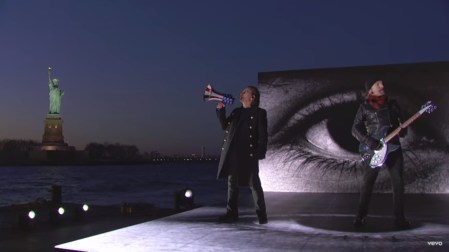
The specific performance that raised Ben’s ire featured U2’s Bono – an Irishman, it’s worth remembering, not a US citizen – singing in front of the Statue of Liberty, and praising the “shitholes of the world” as the source of America’s greatness, intended as a rebuttal to President Trump’s use of the vulgar phrase in a meeting with members of Congress about immigration.

While looking wistfully at the sky and prancing around in front of the Statue of Liberty, Bono portentously intones into a megaphone:

Blessed are the shithole countries, for they gave us the American Dream.

And to this nonsense, Shapiro responds:

As a musician for many many years, my favourite violinist – as is every violinist’s favourite violinist – is Jascha Heifetz. One of the things I love about Jascha Heifetz is that there is no histrionics. Jascha Heifetz, when he plays the violin – go look at a tape of him – is just stone faced. He just plays, and it’s great.

One of the things I hate the most about modern music is modern music is all based on energy and histrionics. It’s all based on you making faces while you sing, and looking up to the sky like Bono. Look at him, looking up to the sky with his red, white and blue loudspeaker.

This is something that I also find incredibly annoying and distracting. Of course this kind of preening and prancing has long been connected with music, and performers caring more about how they look and portray their socio-political opinions than how they sound on record is hardly a new phenomenon.

Nineteenth century Romantic pianist and composer Franz Liszt cultivated such a following that it coined a term – “Lizstomania” – where women would fight even over his coffee dregs and discarded cigars. And Lizst himself egged on this behaviour, being one of the first concert pianists to rotate the piano so that he would face the side of the stage at a right-angle to the audience, the better that they could appreciate his dashing profile.

Neither are all of the musicians I admire entirely innocent of this behaviour. Conductor-composer Leonard Bernstein also cut a dashing figure and was famous for the “Lenny leap” where he would sometimes clear a full foot from the podium. Glenn Gould, long my favourite pianist, is almost as well-known for his eccentricities – such as humming as he played, sitting on a battered folding chair when giving concerts and dressing for winter even in the height of summer – as he is for his revelatory interpretations of Bach, Beethoven or Brahms. But in the latter’s defence, many of his defining idiosyncrasies were clearly innate rather than studied, and in fact Glenn Gould had so little time for being a celebrity that he stopped giving concerts altogether at a young age to focus his energies on the recording studio.

British violinist Nigel Kennedy could likewise hardly be described as a staid, boring performer, yet his eccentricities somehow draw one into the performance rather than distracting or repelling the audience or listener. Watch Kennedy break normal concert protocol by addressing this BBC Proms audience immediately before launching into Elgar’s violin concerto and you’ll see what I mean:


But to me there is a definite order of magnitude between the baseline level of emoting that we see in classical music today and the more restrained (on average) approach of even thirty years ago. I confess that as technically brilliant as the likes of superstar pianists Lang Lang or Daniil Trifonov may be, I struggle to watch them because of the on-stage theatrics (in my opinion Yuja Wang does a far better job of being engaging and contemporary without appearing like a cholera patient on a storm-tossed sailboat).

I don’t care if you’re hamming up the rubato while playing some Chopin, there’s no need to lash your head around or make anguished faces as though someone is lurking under the piano pulling out your toenails as you play. But then maybe that’s just because I like my classical musicians the same way I like my journalists and TV news anchors – scruffy and unkempt, too dedicated to their craft to waste time worrying about being a walking shampoo commercial.

Now some of these behaviours and tics – maybe even a majority – can be put down to the understandable exuberance and vanity of youth. But I think a significant minority are inspired by a recognition that being brilliant is not enough unless one also looks and acts the part. And the look and act that audiences increasingly demand and reward is high on emoting, high on dazzling feats of technical brilliance (what Glenn Gould once derisively referred to as “piano-playing” in a self-critique of his earlier work) and lower on the kind of subtlety and introspection which is often needed to bring out the best in even some of the more bombastic repertoire.

And so might it be the case that the real problem with efforts to expand the market for classical music are not the things that usually get traditionalists so worked up – wearing jeans to the opera, mandatory white tie for orchestral musicians, informal lunchtime concerts and so on – but rather the fact that more and more classical performers are adapting to the Age of YouTube by attempting to groan and grimace their way to profundity just like every street busker who sings Lady Gaga’s “Poker Face” at a quarter speed, or Ke$ha’s overwrought performance at this year’s Grammys?

The point of classical music is, unsurprisingly, to convey ideas through the medium of music itself. Of course individual musicians will want to put their own stamp and interpretation on works, either in service of what they believe to be the composer’s original intent or to shed new light on what can sometimes be over-familiar works in the repertoire. But if you frequently find yourself pounding the piano keyboard like you’re playing Whack-A-Mole or sawing away at the violin while grimacing like your appendix just ruptured, you’re probably doing it wrong. The emotion should go through the music and not be lost in the gaudy, inefficient heat exchange of on-stage pantomime.

Performer eccentricities, when unintentional and/or in service of the music, are fine, and sometimes even a blessing. But Ben Shapiro is right; when they detract from the music itself then that can become a problem – in classical music as much as pop music with all the schmaltzy, simplistic political preening of Bono’s preachy Grammy performance.


Bono - US - 2018 Grammy Awards Performance - Virtue Signalling - Immigration - Blessed are the shithole countries

Support Semi-Partisan Politics with a one-time or recurring donation:

Agree with this article? Violently disagree? Scroll down to leave a comment.

Follow Semi-Partisan Politics on TwitterFacebook and Medium.


The Story Of Hamilton Is Also The Story Of Brexit

Hamilton musical - London - Brexit

What do the latest imported smash hit musical from America and Britain’s historic vote for Brexit have in common? The answer, it turns out, is nearly everything.

It has been frequently remarked, that it seems to have been reserved to the people of this country, by their conduct and example, to decide the important question, whether societies of men are really capable or not, of establishing good government from reflection and choice, or whether they are forever destined to depend, for their political constitutions, on accident and force
—  Federalist No. 1, Alexander Hamilton

Yesterday evening I succumbed to the hype and went to see the London production of Lin-Manuel Miranda’s hit musical Hamilton, newly opened at the Victoria Palace Theatre.

Hamilton tells the story of Alexander Hamilton, American statesman and Founding Father, most famous for having been a delegate at the constitutional convention of 1786, writing many of the Federalist Papers, moulding the new country’s financial system as Treasury Secretary during George Washington’s presidency and having been killed in a dual by political rival Aaron Burr. Through his words and intellect, Hamilton made an enormous contribution to the birth of America, yet his untimely death robbed him of as prominent a place in history as his legacy deserved.

At first glance this might not seem the most promising material for a musical show, but theatre aficionados have been buzzing about Hamilton since it premiered in New York to rave reviews back in 2015. Such has been the show’s rapturous reception that it is fairly hard to find a negative review, let alone a ticket, especially in New York where tickets for the Broadway production have traded hands on the secondary market for insane sums of money.

Being something of a contrarian, I arrived at the theatre in sceptical mood, perhaps too eager to find fault with something that was being universally praised by everyone else. I was sceptical that the rap and hip-hop musical styles which predominate would be a good fit with the narrative material, and worried that the much-discussed “colour-conscious casting” might be little more than a convenient excuse to shoehorn an identity politics lecture into what should be an evening of entertainment.

As it turned out, my scepticism was blown away and any worries about ideological virtue signalling were (mostly) unfounded. Hamilton is an excellent show, the musical genres and clever allusions to other composers from Gilbert & Sullivan to The Notorious B.I.G. draw you in to the story rather than distracting from it, and the source material (Lin-Manuel Miranda based his show on the 2004 biography of Alexander Hamilton written by Ron Chernow) is catnip for history and constitutional geeks like me.

But as I watched the first act build to a climax – after Alexander Hamilton has arrived in New York, become involved in the revolutionary movement, served as General George Washington’s aide-de-camp, fought at Yorktown, studied law in New York after independence was won and ultimately chosen to be that state’s junior delegate to the constitutional convention in Philadelphia, which laid the foundations for the United States of America as we know it today – something else occurred to me.

It provoked groans and assorted expressions of incredulity from my wife and our friend when I confessed my epiphany during the interval, but as the show progressed I realised that the story of Hamilton – of people forging a new and uncertain path through a world in flux – is also the story of Brexit. Bear with me, and I shall explain why.

After they won the War of Independence, Americans didn’t know exactly what they were creating or the experiment they were embarking on. They knew that remote and authoritarian rule from an overseas power was intolerable and injurious to their right to freedom and self-determination, but having thrown off the shackles of monarchy there was no set template for them to follow, no clear-cut alternative to which they should naturally gravitate.

Much of the detail as to how freedom from empire would actually work in practice had to be hashed out in contentious discussions, first formalised in the 1777 Articles of Confederation between the thirteen original states and later in the 1787 Constitutional Convention. This was a time of uncertainty, but it was also an exciting time ripe with promise. Then, as now, there was a new world to build.

Today, we face similarly profound questions about how humanity should best govern itself in changing times, as the epoch of the nation state finds itself threatened and undermined by powerful forces such as globalisation, automation, mass migration and the need to balance smart regulation of international trade in all its technical complexity with the need to preserve democracy and the ability of ordinary people to defend their local priorities and concerns in the face of corporate technocracy.

The existing political order has never looked less equipped to deal with these challenges, or been so discredited and seemingly unequal to the serious task at hand. In Britain, the political class have forged ahead with a centrist, corporatist vision regardless of which political party was in power for the past three decades, an incredibly narrow Overton Window effectively shutting out a huge range of reasonable, non-extremist political ideas from the national political debate. And in the United States, politicians of both parties peddled the illusion that the post-war manufacturing economy could be resurrected together with the promise of a comfortable middle-class lifestyle sustained by semi-skilled manual labour requiring limited education.

In both cases the people themselves were partially to blame for falling for false promises and in some cases practically demanding to be lied to by pandering politicians, but regardless of ultimate fault it has increasingly dawned on people that national and international institutions as presently configured have not met the challenge of our times and can not keep pace with a world increasingly knitted together by technology.

The European Union, held up by its naive supporters as the unquestionably superior way for nations to peacefully cooperate (despite not being replicated on any other continent), has conspicuously failed to effectively tackle nearly all of the big challenges thrown its way, from the migration crisis to the pitfalls of monetary union to rampant corruption in some member states and growing authoritarianism in others. And through all this, despite Herculean efforts and vast sums of money spent with the aim of forging a cohesive European demos – a body of people who hold their European identity in equal or greater worth than their national identity – no such demos has formed.

The EU’s “if you build it, they will come” strategy, creating all of the institutions required for a supranational political state in the expectation that a demos would magically follow along to grant them legitimacy, has failed. Outside Britain, where misguided and low-information young idealists sing Kumbaya and paint the EU flag on their faces, euroscepticism among young people is increasing as more people recognise that the institutions of Brussels present a beguiling but erroneous vision of the future. To all these challenges and more the European Union has nothing to offer save more political integration for the sake of political integration. The EU has no answer, just as remote and exploitative monarchy failed to redress the legitimate grievances of the American colonists.

A recent article by Bradley Birzer in The American Conservative about the limited lifespan of any system or institution of government certainly applies to the European Union and other pillars of the post-war world order as much as it does to the nation state:

One must remember that no republicans believe their republic can last forever. A republic, by its very essence, must rely on its organic nature, a living thing that is born, flourishes, decays, and dies. It is, by nature, trapped in the cycles of life, bounded by the walls of time. While a cosmic republic might exist—as understood by Cicero’s “Cosmopolis” and Augustine’s “City of God”—it existed in eternity and, therefore, aloof of time.

For better or worse, the Roman Republic reflected not just nature, but the Edenic fall of nature as well. We can, the Roman republican Livy recorded, “trace the process of our moral decline, to watch, first, the sinking of the foundations of morality as the old teaching was allowed to lapse, then the rapidly increasing disintegration, then the final collapse of the whole edifice.” The virtues of the commonwealth—the duties of labor, fate, and piety—gave way to the avaricious desires for private wealth. When young, the Romans rejoiced in the little they had, knowing that their liberty from the Etruscans meant more than all the wealth of the material world. “Poverty, with us, went hand in hand with contentment.” As the republic evolved and wealth became the focus of the community, not sacrifice, so the soul decayed. “Of late years,” Livy continued, “wealth has made us greedy, and self-indulgence has brought us, through every form of sensual excess, to be, if I may so put it, in love with death both individual and collective.”

Who can deny that some aspects of our present society – our materialism, individualism and instinctive fear of anything that might (no matter its virtue or long-term benefits) temporarily disrupt the steady accumulation of wealth, assets and positive experiences which we increasingly expect and demand – are worryingly reflected in Livy’s words?

To paraphrase Birzer, all things must come to an end. The Britain of today is not the Britain of thirty years ago, just as the dogmas of Ronald Reagan’s “Morning in America” no longer automatically apply to the American present. We have witnessed tremendous progress in that time, but also political and social atrophy. We are not what we once were, and neither should we cling on in futility to what is past. Many Remainers, having fixed in their minds the false image of Brexiteers as Mafeking stereotypes – curmudgeonly old retired colonels pining for lost empire – fail to realise that through their devotion to the European Union it is they who yearn to preserve the past, slavishly devoted to an anachronistic mid-century blueprint for a new world order, one which came to partial fruition, peaked and then found itself wholly inadequate to the stormy present.

Brexit is not a magical elixir sufficient to address the stormy present or dissipate the challenges we face, but it is a necessary first step to confronting them, just as Alexander Hamilton and the other Founding Fathers could not fully contemplate and realise their revolutionary new system of government until they had first thrown off the shackles of monarchy. Looking at Brexit as a narrow and obstinate project to reclaim full sovereignty or purely as a technocratic matter of trade regulations is to miss the point – we are seeking not to go back but forward, and Brexit is a necessary (though not a sufficient) condition to enable this progress.

It pains me to read much of the coverage and commentary around Brexit, which overwhelmingly ignores the big picture and the long term to obsess over speculative short term costs. It is vital to consider short-term costs and risks in any endeavour, but good policymaking is only possible when short-term considerations are balanced with a broader, longer-term perspective. Remainers often react with incredulity to the suggestion that anything might matter beyond next year’s GDP growth rate, but the American colonists of Hamilton’s day were every bit as concerned about their economic prosperity and security as their modern-day British counterparts; they just also realised that other issues were at stake, issues worth enduring the hardship and destruction of a revolutionary war to correct.

We in modern Britain are called to make no sacrifice remotely comparable to that of the inhabitants of the thirteen colonies as they struck out on their own to form a more perfect union. It would be laughable to compare even the worst of mismanaged Brexits to the price that Hamilton’s peers paid for their freedom and for the opportunity to advance the model of human governance. Yet so great is our present culture of consumerism and so diminished our sense of citizenship or civic duty that few of us are capable of thinking in terms greater than the pursuit of whatever might sate our present desire for comfort and stability. And even when this stability is under long-term threat, such is our fear of disruption that we would rather cling on to the slow, familiar degredation than take any risk by seeking to prevent it.

Today we have a tendency to think of ourselves as having transcended our past, that we inhabit what Francis Fukuyama called “The End of History”, a time when all major human challenges have been vanquished and we inhabit some kind of permanent, beneficent steady-state from which any departure would be an intolerable disruption. And from this perspective, Brexit does indeed appear to be a crazy, irrational endeavour, threatening to unleash a backslide into the fascism and totalitarianism with which we struggled in the twentieth century.

But of course we have not reached the end of history. We are continually presented with new challenges and opportunities, and try as we might to pretend that our existing institutions and policies need only tweaking or adjusting to meet them, recent events have proven this to be patently false. Not all Brexiteers may have voted to leave the European Union based on these high ideals but as Shakespeare wrote, “There is a tide in the affairs of men. Which, taken at the flood, leads on to fortune. Omitted, all the voyage of their life is bound in shallows and in miseries.”

Through Brexit, history has gifted us the opportunity to imagine a new and improved form of government, one which strives to meet our future challenges rather than cower from them (all that EU membership offers, most telling in the rhetoric used by Remainers) or pretend that they do not exist (favoured by the more retrograde Brexiteers who envisage a simple rollback to the old nation state). We must seize this opportunity and be a beacon for other nations, all of which must ultimately grapple with the same issues though they may deny or postpone them for a time.

As I recently wrote:

It has been decades since Britain truly took the lead in influencing world affairs. But having voted for Brexit and thrown into the open many pressing debates which other countries remain desperate to defer or ignore, we can now be both a laboratory and a beacon for the world.

Rather than feeling rancour or relitigating the 2016 referendum result, we should feel the same sense of excitement and possibility that Alexander Hamilton and his co-revolutionaries felt as they debated among themselves how to keep the new republic that they had created. We must rediscover that spark within ourselves.

Perhaps it is no coincidence that a stirring tale about forging a new, more democratic future, a story kindled in America, is set to take Britain by storm as we negotiate our secession from the European Union and look questioningly but optimistically towards the future. Perhaps it is no coincidence that the spirit of Alexander Hamilton is flickering back to life on a London stage at this specific time and place.

Because when you strip away the political games and the media sideshow, the catastrophisation, recriminations, denunciations, speculations and bifurcations, the story of Hamilton may just also be the story of Brexit – if we have the courage and vision to make it so.


Hamilton tickets and information here.


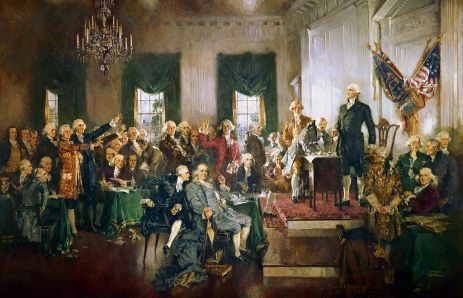
Scene at the signing of the Constitution of the United States - Howard Chandler Christy - Hamilton musical - Brexit

Support Semi-Partisan Politics with a one-time or recurring donation:

Agree with this article? Violently disagree? Scroll down to leave a comment.

Follow Semi-Partisan Politics on TwitterFacebook and Medium.