I’m currently back in the United States to celebrate Christmas in Texas. These short “Postcards from America” will document a few of my thoughts as I escape the political whirlwind of Westminster and look back at Britain from the vantage point of our closest ally
–
In America, not everyone waits passively for government to improve their life circumstances. Aided by a thriving community college sector, people take their futures into their own hands
While sitting in the cinema waiting for Star Wars: The Force Awakens to begin, I was struck by the number of local advertisements for regional schools, community colleges and universities which were shown.
By my reckoning, at least 40% of the commercials screened over a fifteen minute period were promoting some kind of educational service. Contrast this with the United Kingdom, where local commercials of any kind are a rarity, and most national commercials these days tend to be for banks, fast-moving consumer goods, the EE mobile phone network (featuring Kevin Bacon) or one of the limited number of other companies able to afford a national cinema campaign.
An example of the type of commercial screened at the south Texas cinema I attended is shown above. Typically, they feature personal testimonials from ordinary people who explain simply and positively how going back into education has helped them in their careers, how the various modes of study fitted in around their existing home and work commitments, and how easy/affordable it turned out to be.
These degrees and diplomas provide a springboard into skilled, middle class jobs, many of which are well paid and non-outsourceable. Dental nurses, IT engineers, electricians, car mechanics and many other such career opportunities. Recognising that not everybody can be – or wants to be – an elite lawyer or doctor, these institutions equip people with tangible skills which actively help them in the labour market, ensuring that their career options are far greater than the prospect of 40 years working at the 7-eleven, or some other minimum wage drudgery.
This emphasis on adult education is one sign of a more active and engaged citizenry, of a people who understand that their self advancement and personal destiny is in their own hands, not those of the government.
To be fair, some British politicians are also coming to realise the importance of adult education to keep our own workforce skilled, adaptable and capable of commanding high wages rather than minimum wages. During the Labour leadership campaign, Jeremy Corbyn floated his plan for a National Education Service to do for lifelong learning what the NHS did for healthcare.
Banging on about apprenticeships is all very well, but what of adults over 25 who cannot take an apprenticeship under the current schemes, or who want to work in a field where none exist? What of the 55-year-old steelworker made redundant with few other transferable skills?
A conservative government worth its salt would look at Jeremy Corbyn’s proposal for a National Education Service, balk at the more nakedly socialist aspects, but then consider how a smaller and leaner government might be able to promote the education of the adult workforce in pursuance of the national interest. But of course our current Coke Zero Conservative government is not worth its salt.
If Britain is to prosper in this globalised age – and if our poorest, most disadvantaged fellow citizens are to be spared from a harsh life of minimum wage drudgery – we need a learning revolution in the United Kingdom, a British Apollo Program for education.
What party, what future leader will rise to the occasion and propose a solution equal to the task at hand?
–
Agree with this article? Violently disagree? Scroll down to leave a comment.
If you buy the NHS Choir’s mediocre Christmas ditty you are part of the problem, not the solution
Imagine that a large, critical government department was gradually but incessantly becoming less and less fit for purpose.
Suppose that (say) HM Revenue & Customs suffered from major failures of management and leadership, an outdated structure, a confused remit and an ever-increasing list of responsibilities coupled with constantly changing priorities. What should be done?
Was your first thought the idea that a group of HMRC employees should get together and release a song with the hope of reaching the Christmas No. 1 slot in the charts? Did you think – in a moment of epiphany – that recording a Christmas song would in any way address the issues with that organisation, or that any public goodwill generated by the song would somehow make the various deep-rooted organisational problems and resource constraints melt away?
Probably not. You would most likely want to see some kind of hard-headed, evidence-based action plan to turn things around, not a cheesy song that pretended everything was great. But this “sing your problems away” approach is exactly what is happening today, not with HMRC but rather with the NHS. And now we are all being asked to allow ourselves to be swept up in the self-deception, mindlessly tweeting our support for an organisation – and model of healthcare delivery – which becomes more out of its depth and more inadequate to our needs with every passing day.
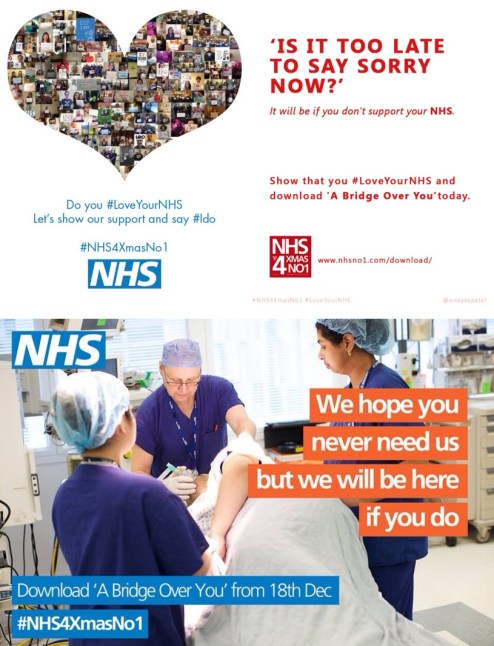
The Lewisham and Greenwich NHS Choir are leading the in way in the race for the 2015 Christmas Number one, as the battle to secure the top spot heats up.
According to initial reports from the Official Charts Company, the choir’s track A Bridge Over You – a mash-up of Simon and Garfunkel’s Bridge Over Troubled Water and Coldplay’s Fix You – is currently ahead of rivals Justin Bieber and Louisa Johnson.
But with the track leading the way by just under 5,000 sales, it’s still looking likely to be a three way race for the top spot.
The NHS choir could also receive a boost following the release of the accompanying video earlier this week.
That video is the one shown at the top of this piece.
But this piece of lazy, self-congratulatory, virtue-signalling NHS worship is nothing to be proud of and certainly not something which any engaged and informed citizen should support.
Why? A couple of reasons:
1. First of all, it’s a poor piece of music making. It’s a bad mashup, even by the low standards of most mashups. It takes one timeless classic (the Simon & Garfunkel) and one decent contemporary song (the Coldplay) and unimaginitively smooshes them together in a way which somehow manages to destroy or obfuscate the best of both pieces.
But of course, we can’t possibly acknowledge this fact, because:
2. Second, the video is emotionally manipulative twaddle, yet more unthinking pro-NHS propaganda of the kind that will ensure Britain’s healthcare system continues to lurch, unreformed, from crisis to crisis for another seventy years. And the fact that the propaganda is produced not by government diktat but by zealous citizens who believe they are working for the Greater Good only makes it all the more insidious.
“Aren’t NHS workers wonderful?”, the video asks us to ponder. Yes, I suppose so, but no more so than those who work for HM Revenue & Customs. Both perform a vital service, and both draw a government paycheque at cost to the taxpayer. And yet we all know that if George Osborne’s Treasury barbershop ensemble released an album of Christmas classics it would already be festering in bargain bins and languishing at the very bottom of the charts.
Thus, over five tedious minutes of this particular pseudo-inspirational dirge, we are treated to scenes of saintly NHS workers helping wobbly old people stand up from chairs, therapists teaching amputees how to walk again, premature babies being nursed to health, and other everyday scenes of hospital life. Are these heartwarming scenes? Sure they are. Are they unique to the NHS? Hell no.
“What other organisation but the NHS could possibly do any these things?”, screams the message from the video. After all, we all know that old people, premature babies and the disabled are simply thrown into woodchipping machines and disposed of in other advanced countries without an NHS. Only in Britain with “our NHS” (genuflect) do people receive healthcare free at the point of use.
Except that none of that is true. Britain is not an island of enlightened compassion in a sea of cruelty and denied cancer treatments. And precisely zero countries are knocking on our front door and sending in their experts to learn about how we organise healthcare in this country so that they can replicate our system back at home. Shouldn’t that maybe tell us something, and cause us to take a pause from the incessant, self-satisfied boasting?
Emotional blackmail / NHS propaganda
This isn’t an attack on NHS workers. It’s not even an attack on the Lewisham and Greenwich NHS Choir, even though their unremarkable song no more deserves to be Christmas No. 1 than will the next inevitable re-release of “Feed the World”.
This is an attack on our unthinking, embarrassing commitment to the NHS model, our apparent desire as a nation to worship what is in fact an immensely powerful government department, and the sanctimonious belief that by propelling this mediocre song to the top of the charts in time for Christmas we are making any positive contribution toward the future of British healthcare (beyond the admittedly welcome charitable donation).
We can sing songs about the NHS until we are blue in the face (and the number of songs is growing – how long until they coin an official anthem?), but it will do nothing to change the fact that a centralised model of state-funded and state-delivered healthcare designed in the post-war 1940s is highly unlikely to be the optimal solution in the year 2015.
Singing songs in praise of Aneurin Bevan’s rusting creation will do nothing to address the cold, hard truth that rising life expectancies and the continual developments of new, expensive treatments can only be tackled by an unreformed NHS if there are immediate, dramatic increases in personal taxation. For everyone, not just the Evil Bankers, of whom there are sadly not enough.
But sure, let’s make the NHS Choir song the number 1 Christmas single. Then let’s all sit back and smugly reflect on what right-on, progressive people we are for spurning Simon Cowell’s latest manufactured hit-by-numbers offering in favour of doctors and nurses who sing in their spare time. Let’s keep pretending that we alone, of all nations, stumbled upon the optimal way to deliver top quality healthcare to a growing, ageing population, back when we were still digging ourselves out of the rubble of World War 2.
It’s ironic. The NHS Choir is warbling away about “trying to fix” us this Christmas, when it is hagiographic stunts like this which mean we may never summon the political will required to fix (or replace) the NHS.
–
Agree with this article? Violently disagree? Scroll down to leave a comment.
Who will condemn the bishops for exploiting our fear of terrorism in their grubby bid to preserve taxpayer funding of the BBC’s religious output?
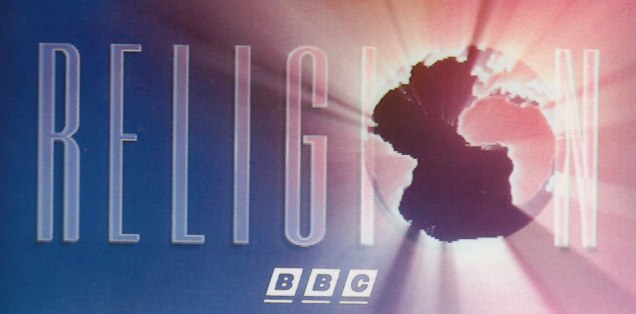
The Church of England is very upset that the BBC is considering cutting the amount of taxpayer money it spends on (predominantly) Christian television output.
A spokeswoman confirmed that the BBC was planning to “look at ways we can reduce costs” as it faced “huge financial challenges” but added that cuts would come from across the corporation.
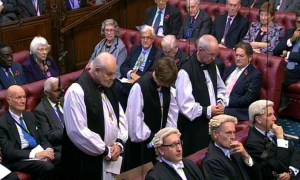
The Bishop of Norwich, the Rt Rev Graham James, the Church of England’s lead spokesman on media issues, said the move could threaten something which was “fundamental to our public life”.
“It seems to me that religion has already taken a hit,” he said.
“It has already been reduced certainly in terms of its scope as an independent part of the BBC, at a time when we already need – as everyone acknowledges – more religious literacy in the nation.”
Nothing unusual there. The Church of England is a well oiled lobbying machine, and any private organisation lucky enough to have a bloc of 26 unelected representatives sitting in parliament to influence our laws in their favour would be foolish not to make good use of them. Thus it is no surprise that the unelected theocrats of our state church have been hard at work speaking out against the BBC’s planned actions.
But the fact that the Church of England’s behaviour is understandable does not make it any less reprehensible. Firstly, because it makes a total mockery of the idea of the BBC as an independent broadcaster. Nobody seriously believes that an organisation whose budget is nearly totally dependent on taxpayer money can be truly independent, but the fact that the Lords Spiritual are now actually speaking in parliament about the internal decisions and strategy of the BBC makes any pretence of the BBC’s impartiality or the government’s non-involvement utterly ridiculous.
Worse than this, though, is the flimsy rationale now offered by the bishops as a pathetic excuse for more taxpayer funded religious programming:
Bishops have warned the BBC it risks turnings its back on efforts to tackle extremism and aid integration by slashing spending on religious programming.
[..] The first female cleric in the House of Lords, the Bishop of Gloucester, the Rt Rev Rachel Treweek, remarked that the decision had presumably been taken “to reduce the possibility of offending people with too much God stuff over the holiday”.
It is good to see the newly enobled Rachel Treweek, my Lord Bishop of Gloucester, is wasting no time in rolling up her sleeves and interfering in our national democracy as generations of theocrats have done before her. She will be making the home team very proud. But unfortunately, she and her fellow Lords Spiritual are talking nonsense.
The argument that cutting the amount of taxpayer money devoted to religious television and radio programming on the state broadcaster is somehow a threat to anti-extremism efforts is as ridiculous as it is unfounded.
More moderate Christianity on TV will not result in less Islamic extremism on the margins of British society. And pontificating, busybody bishops who abuse their parliamentary platform to suggest otherwise should provide evidence for the supposed link, or else retract the claim and admit that they are simply exploiting serious issues of national security in a cheap ploy to gain more taxpayer-funded airtime.
The real issue is not so much the pull factor of extremism as the push factor of the alienation of too many young Muslims from British society. It’s the fact that we have living among us too many self-segregated societies comprised of people who hold the same passports as us, but look upon us – and the enlightenment values of reason, education, liberty and democracy to which we try to adhere – as alien and unwelcome. By failing to inculcate a strong and inclusive sense of Britishness, out of craven fear of causing offence, we provide the Islamist recruiters with easy fodder.
Do my Lord Bishops of Gloucester and Norwich (flowery titles for a bygone age) seriously believe that the kind of alienated youths and their families who are now quietly slipping away to ISIS in Syria or seeking out radicalising materials online are the same type of people who tune in to BBC Two at six o’clock in the evening, ready to be reached out to and placated with a documentary about public spirited imams, rabbis and priests working together to open a new community centre? What nonsense.
The people most in need of the BBC’s moderate religious programming and generally liberal worldview are those whose eyes are glued to YouTube videos of anti-American 9/11 conspiracy theories or seditious social media conversations on their smartphone screens. More government intervention – be it through Prevent or the BBC – is not going to make meaningful inroads to these people. The only lasting solution must come from the bottom up, a revitalisation of patriotism and pride in Britain, and the promotion of a common British identity which transcends racial divides (rather than revelling in a multicultural dystopia which sees groups living side by side but separately in parallel, alienated lives.
This is in no way intended as an attack on religion, or on the Church of England (so long as it stays within its own boundaries and stops trying to play an undue role in our public life). I grew up watching Songs of Praise on a Sunday, and have happy memories of doing so. But it is not right for general taxpayers of an increasingly secular country to continue funding religious programming using a model that invites some appointed bureaucrat or another to choose which religions or denominations are to be favoured above others.
Perhaps the Lords Spiritual begin to grasp this. Perhaps they are grasping at these increasingly ludicrous excuses for their continued influence because deep down, they realise that they have no place in the government of a twenty-first century democracy.
But if these are the death throes of theocracy in Britain, they are still very offensive indeed. Claiming that the BBC should continue to spend taxpayer money on religious output favouring the established church because failing to do so will unleash more extremism – and note how the bishops cannot bring themselves to utter the name of the religion from which that extremism currently emanates – is cynical and manipulative, playing on the fears of British people just to win more free promotion.
I’m currently back in the United States to celebrate Christmas with family in Texas. These short “Postcards from America” will document a few of my thoughts as I escape the political whirlwind of Westminster and look back at Britain from the vantage point of our closest ally
–
A musical contrast between Britain and America
I have been trying to find a way to describe the feeling I always get when I arrive back in the United States of America, a land I consider to be my spiritual home even though I am not yet a citizen (though married to one).
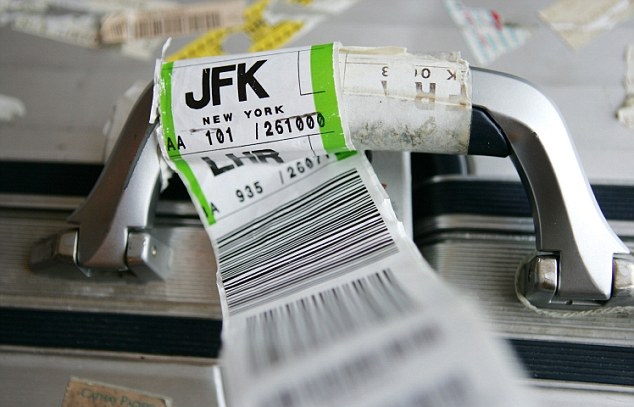
It is very difficult to put into words the emotion that wells up even before exiting the airport, whether it be New York JFK, Chicago, Cleveland, Dallas, Houston, Miami, Seattle or any of the other gateways I have used on my well over fifty arrivals here. The feeling of having arrived in a land of promise and possibility, an electricity in the air and a repose for the spirit which I feel even while waiting to collect the suitcases from the carousel.
But when words fail, music sometimes speaks. And the best way I can find to describe the difference experienced when travelling from the United Kingdom to the United States is with this musical analogy.
Two performances of the same piece of music, recorded by two legendary artists. Prelude no. 3 in C Sharp Major, BWV 872 fromThe Well-Tempered Clavier by Johann Sebastian Bach, performed first by Sviatoslav Richter and then by Glenn Gould, my favourite pianist.
Imagine that this first recording represents life in Britain:
This is the Richter version of the Bach prelude. Languid and undeniably beautiful, yes, with the edges softened by extensive use of the pedal. You can almost sense the nearly three centuries spanning the prelude’s composition and the present day in this warm but muffled recording.
Now imagine moving from this setting to the utterly different world of the Glenn Gould version, representing America:
The two recordings could hardly be more different.
The musical notes are the same, just as Britain and America share a common language and very similar cultures by virtue of our shared history. But the two interpretations are worlds apart, just as everything from local culture to local government is different on either side of the Atlantic.
Nobody had ever played the music this way until Glenn Gould came along. Prior to Gould, playing Bach on the piano was a dry and dusty affair, characterised by performances and recordings which shrouded the intellectual beauty and emotional resonance with thick layers of stultifying sameness. And then Glenn Gould turned things upside down and showed that Bach’s keyboard music did not have to be a revered but inherently boring exercise; that by engaging with the music with a creative mind, it was possible to bring dead music to life.
The Gould version is bright and clear. The first half of the prelude is strutting and unselfconscious, while the second part takes off like a rocket – joyful, vibrant and carefree. The individual lines of both the prelude and fugue are more clearly articulated and easier to distinguish, while still contributing to a powerful and musically convincing whole. E pluribus unum. That’s America, right there in this recording.
To my mind, this is the experience of moving from Britain to the United States. From an ancient land of history and heritage – the mother country – to the bright promise of the newer, bold and assertive superpower. The place where even in these difficult times, all things still seem possible.
A land where the sun shines infinitesimally brighter (my first action on arriving in Louisiana was to purchase new sunglasses. In December.) A land where the sky literally seems bigger, and the horizon wider. A land where the flavours are bolder, the entertainment glitzier, the music more vibrant and the people unfailingly friendly.
A country whose best features and deepest flaws are both so much more exaggerated than is the case in Britain – whether it be the remarkable philanthropic and community spirit on one hand, or the endemic tragedy of gun violence on the other.
But more than that, a country which still feels consequential in terms of shaping human events. A country whose politics and politicians – however glib and anti-intellectual they can sometimes be – still possess the aspiration and self-confidence to deal with weighty matters, to forge ahead in search of the best pathway to freedom and prosperity. And whose people still believe in their country as a force for good in the world, when they stay true to their values.
You can see the difference by comparing the raucous presidential primary debates currently underway here in America with the spirit-crushingtelevised encounters in Britain ahead of the May general election. In America, issues like healthcare, immigration, government surveillance and foreign intervention are debated fiercely in public – with both sides making reference to that most wonderful of things, a written constitution which makes the people sovereign and grants government strictly limited powers, rather than the other way around.
On existential matters like Britain’s place in the world, the best way to promote economic growth or to ensure future national security, the British political debate during the election campaign could not have cared less – and there was virtually no difference in the statist paternalism of the two main parties, other than in rhetoric. No political party had the courage to suggest that our outdated, 1940s model of state healthcare delivery might need serious reimagining in the twenty-first century, and only a handful of us cared enough to call them out for their craven refusal to acknowledge this difficult truth, and many others besides.
Fewer than four million of us believed strongly enough in the principle of national democracy and sovereignty that we cast a vote for the one party which explicitly objected to the gradual absorption of Britain into the supranational state known as the European Union.
And through it all, this blog has felt like something of a voice in the wilderness, with no politician or party to champion the causes of personal liberty, free markets and national sovereignty upon which everything else rests – but which too many other people seem happy to forsake in exchange for a chimerical, temporary measure of security and prosperity.
Here in the United States, for the precious couple of weeks until we go home, I don’t have to think about any of that. Of course America has issues of its own – big, intractable problems and burning injustices which befit a country of her size and consequence to address and overcome. But at least Americans still (just about) know who they are. At least they have not yet fractured into a messy coalition of competing special interest groups, to the extent which Britain has now splintered.
Patriotism and love of country still mean something in America. Yes, sometimes the sentiment expresses itself badly, through an ignorance of the rest of the world and the lazy assumption that America is always the best at any given thing. But perhaps unnoticed by many in Britain, there is also here an abundance of that quiet patriotism – the celebration of Independence Day and Thanksgiving, the flags flown in school classrooms without the ludicrous fear that it might “offend” someone of minority ethnic heritage, or the way that veterans are honoured and soldiers in uniform routinely invited to fill empty first class seats on airplanes – symbols and gestures which are the bedrock of a strong and cohesive society.
Of course debates rage fiercely in America – over Donald Trump, Hillary Clinton, the Koch brothers, the Tea Party, the Iraq war, the ISIS threat, birtherism, abortion, LGBT rights, church and state, the mainstream media and much more. The many are not always one. But when it really counts, they are one people. They bleed red, white and blue together.
America the beautiful: this is where I come to recharge my spiritual batteries. And as I prepare to throw myself into the battle for Brexit – defending the country of my birth and the concept of the nation state itself from an insidious form of supranational governance whose advocates have repeatedly failed to explain how democracy will be preserved in their brave new world – I will need all the power I can muster.
God bless Texas.
God bless America.
God save the Queen.
–
Agree with this article? Violently disagree? Scroll down to leave a comment.
Have you ever found yourself thinking that Star Wars could do with a lot less Jar Jar Binks and lightsaber duels, and a lot more marathon eighteen-hour Galactic Senate sessions featuring impassioned filibusters against the authorisation of mass surveillance?
Just in time for the holidays, The Star Wars Libertarian Special features Senate filibusters, border patrol stops, eminent domain, a guest appearance by Edward Snowden, and rarely seen footage from Chewbacca’s galaxy-trotting documentary series about free-market economics.
That’s the stuff. My favourite line:
“The government has increased the cost of risk and so our supplier is increasing the cost of his services – it’s basic economics, Luke. We’re gonna do a little bit of lightsaber work and then I’m gonna have you read a LOT of Milton Friedman.”
More debate on the pressing question of whether Jedi knights are libertarian or socialist can be found here.
–
Agree with this article? Violently disagree? Scroll down to leave a comment.









 Semi-Partisan Politics