Like, Why Can’t British Politicians Talk Fancy No More?

Great political speeches are only possible when there are great ideas to be expressed, and great leaders to express them

After watching the semi-famous video of former Labour minister Peter Shore arguing passionately against Britain’s membership of the EEC during a 1970s Oxford Union debate, Mark Wallace of Conservative Home has realised that the quality of contemporary British political oratory is perhaps not what it once was.

Wallace observes:

What’s striking is to try to list the modern speeches by Parliamentarians which have achieved the same quality. I’ve wracked my brains and, frankly, I can’t think of any. To be quite honest, while there are many excellent MPs in today’s House of Commons, I can’t think of a single one who speaks so well. Probably the most famous good speech of recent years was delivered by Hilary Benn, in the Syria debate – but watch it back, and you’ll see that while it was effective, it was done with notes and is still seen as exceptional rather than normal.

Depressingly, most of our Parliamentarians do not seem to prize public speaking. Indeed it’s a fairly regular occurrence to see some of them apparently struggling to convincingly read out loud from a bit of paper. Many are perfectly serviceable speakers, but compare modern performances to those from 40 or 50 years ago and it seems that today’s greats are not as great, the average is somewhat worse than it was, and the worst are now really quite dire.

Indeed. In actual fact, Hilary Benn’s speech on Syria wasn’t particularly good at all – it is memorable mostly because of the dramatic circumstances of its delivery during a period of unrest over Jeremy Corbyn’s leadership of the Labour Party, not the rhetorical exhortations of a man with all the charisma of a Quentin Blake illustration.

People also frequently praise the speeches of leftist politicians such as Mhairi Black (whose maiden speech in the House of Commons went drearily viral all over social media), but these speeches are also not particularly well-constructed or persuasive – they are simply very emotive, which makes them seem good in an age when feelings trump reason and reality TV has diminished our collective capacity to think.

Wallace continues:

Somewhere along the way, we ceased to value oratorical skill in our politicians. Perhaps it was the decline of the public meeting and the rise of soundbite-dominated TV campaigning that did it. Or maybe the decision not to teach school pupils how to debate left millions unduly intimidated by the idea of even trying to speak in front of an audience. There’s also a suspicion in some quarters that public speaking is somehow inherently elitist – a fallacy, given the many great orators who once arose, largely self-taught, from the union movement in particular, but a self-fulfilling belief, in that if you tell the majority of kids that only the rich and posh do speeches then you run the risk that they will believe you.

This is a clear loss to the character and effectiveness of our politics. How often do we hear people lament that politics is boring, that its main characters are bland, or that they don’t understand what it’s all about? It cannot have helped to have reduced the art and feeling in how we communicate about politics, and abandoned a means to compellingly communicate often complex concepts to mass audiences.

I am very glad that Mark Wallace and Conservative Home have woken up to the crisis in British political rhetoric. This blog has been lamenting the abysmal quality of British political speechwriting (and delivery) for years, not least here, here, here, here, here and here. Hopefully with the “bigger guns” of ConHome now trained on the problem we might force the discussion into the mainstream.

But good political rhetoric does not exist in a vacuum. Contra Mark Wallace and Peggy Noonan, the internet and social media are not a guaranteed friend of good political speechwriting, heralding a coming renaissance in speechifying. While it is true that some political YouTubers are able to gather massive numbers of followers with their witty or acerbic rants, I can’t think of any high profile social media activists who communicate in a genuinely persuasive way.

Case in point: if one looks at the likes of Owen Jones on the hard left or Paul Joseph Watson on the conspiratorial/alt-right (nobody outside the extremes has much of a following), these people are good only at preaching to the converted in order to generate clicks and likes. They will hardly ever cause somebody to reconsider their own deeply held convictions unless a process of personal political transition is already underway. This also applies to the likes of The Young Turks, Steven Crowder, Ben Shapiro and other voices in American politics, some of whom are good, but who tend not to do bipartisan outreach.

No, the art of British political speechwriting can only be revived if there is a simultaneous renaissance in British political thinking. And there are precious few signs of such a revival taking place any time soon. Right now both main parties are pretty much intellectually dead. The Labour centrists, utterly exhausted and discredited after the Blair/Brown years, are finished – and in their place is a holdover from the 1970s in the form of Jeremy Corbyn. Meanwhile, the soft and non-threatening quasi-conservatism of Cameron/Osborne gave way to the statist paternalism of Theresa May, another throwback to the 1970s which can hardly be considered progress.

Nowhere was this dearth of visionary thinking mirrored by equally uninspired rhetoric reflected more clearly than in the EU referendum campaign. This was a highly consequential, even existential political decision for the people of Britain, and yet rather than bold speeches and compelling narratives on either side we were offered little more than glib soundbites and canned catchphrases.

As I wrote at the time:

When the history of Britain’s 2016 EU referendum comes to be written, what will we remember? Of all the particularly dramatic moments in the campaign to date, none of them have been speeches. Sure, sometimes the fact of a speech has been newsworthy, such as when an unexpected establishment figure has been wheeled out to say that Brexit will usher in the apocalypse, but the content – the oratory itself – has rarely raised hairs or stiffened spines.

In fact, proving Eleanor Roosevelt’s famous assertion that great minds discuss ideas, average minds discuss events and small minds discuss people, the media has determinedly reported almost exclusively on the latter two. Of course that is always the temptation for journalists, but our politicians have hardly given the media much to work with on the ideas front, even if they were minded to cover them.

This is a depressing state of affairs. This most important debate should be bringing out the best in our politicians and our media. We should be witnessing a straight-up fight between advocates of the democratic, independent nation state and those who ardently believe in the euro-federalist dream, adjudicated by a press corps  beholden to neither side and always willing to challenge baseless assertions rather than merely provide a “fair and balanced” platform for two partisan idiots to yell at each other for an equal amount of time.

We will not see a revival in political speechmaking in this country until British politicians actually start having ideas and advocating policies worthy of grander rhetoric. So long as there remains in place a technocratic, managerialist consensus between centre-left and centre-right (which very much remains the case and has only been partially broken by Brexit), there will be no bold new ideas in British politics, and in turn there will be no speeches worth listening to.

When even the prime minister of our country sees her role as more of a glorified Comptroller of Public Services than a world leader representing a great and consequential nation, why would we expect her speeches to be any more memorable than the platform announcements at Waterloo station? And if the prime minister’s words are so utterly uninspiring and inconsequential then why bother listening to the words of those who are not even at her level, but merely vying to replace her in that diminished role?

Our current political debates are often petty and parochial, and so are the words we use to fight them. And those issues which might potentially generate bold ideas matched by bold words tend to be furiously ignored by political leaders – look at their refusal to properly confront the Islamist threat, or the staggeringly superficial debate about Brexit.

Great political rhetoric only occurs when there are great issues at stake and great minds willing and able to tackle them. Think of Franklin Delano Roosevelt’s “The only thing we have to fear is fear itself“, delivered as the American economy buckled under the Great Depression. John F. Kennedy’s “We choose to go to the moon” speech at Rice University, setting the United States the ambitious goal of landing a man on the moon and returning him safely to earth. Winston Churchill’s “We shall fight on the beaches“, given after Britain’s deliverance at Dunkirk. Ronald Reagan’s “Tear down this wall“, made at the Brandenburg Gate in Berlin (and ironically helping to usher in the post-Cold War world which for all its wonders also sucked much of the vitality from Western politics, together with our raison d’être).

And maybe part of the reason that there are no great contemporary British political speeches reflects our diminished status in the world, no longer a superpower or the pre-eminent actor in world affairs. Lofty words are easier to reach for when one reasonably expects that they might reshape the world. Perhaps this is why American political oratory has undergone a similar decline in the post-Reagan era, now that Pax Americana is drawing to an end and the uncertain new multipolar world emerges.

But one thing is certain: without conviction politics, there can be no speeches of great conviction. At best, a centrist or technocratic politician might be able to mimic the grandeur and cadences of famous speeches – as President Obama did so effectively, talking loftily of hope and change while a very different reality played out on the ground – but they will never truly achieve that perfect synergy of subject, argument and tone that is the hallmark of a great speech.

Why are there no great contemporary British political speeches? Well, try picturing one in your head, given the kind of issues we typically argue about and the politicians who represent us.

Imagine future historians studying the impact of rousing speeches about lowering corporation tax by a few percentage points or abolishing the so-called “bedroom tax”.

Imagine schoolchildren memorising the words to that famous speech opposing HS2 or supporting the renationalisation of Southern Rail.

Picture a crowd of thousands of people brought to its feet in genuine excitement by a pledge to reduce NHS waiting times by 15 percent in the next parliament, hire a few hundred more nurses or increase the minimum wage to an astronomic £8 an hour by the year 2020.

And there’s your answer.
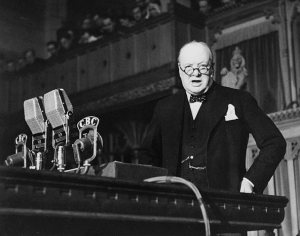
Winston Churchill speech to Canadian Parliament - 1941

Support Semi-Partisan Politics with a one-time or recurring donation:

Agree with this article? Violently disagree? Scroll down to leave a comment.

Follow Semi-Partisan Politics on TwitterFacebook and Medium.

Edinburgh Fringe Comedy Routine Mocking Leftist Dogma Falls Flat With Leftists

Dawsons Creek - Dawson Crying

After pious leftist orthodoxy is mocked by several comedians at the Edinburgh fringe, po-faced Guardianistas suddenly decide that comedy is too divisive

The Guardian is up in arms because several stand-up comedians performing at this year’s Edinburgh Festival fringe have dared to include material poking gentle fun at the Left’s growing elitism and obsession with identity politics in their routines.

Comedy critic Brian Logan wails:

Identity politics has gone too far. PC has gone mad. These aren’t unfashionable opinions: they’re practically mainstream. What’s new in fringe comedy is that we’re now hearing it from leftwing comics. That’s both a fascinating phenomenon, and a troublesome one. Fascinating because there may be some truth in these propositions, and the left needs to interrogate them. Troublesome because standup doesn’t always favour nuance and fine margins, and one or two of these leftwing comedians – whether they’re mocking champagne socialists, rehabilitating slavery or defending the Iraq war – can start to sound (accidentally or on purpose) pretty rightwing.

Dear God. Jokes made at the expense of leftist orthodoxy are insufficiently nuanced, and therefore fail to reinforce the point that left-wing groupthink is actually correct and inviolable? The horror!

Arousing the particular ire of Brian Logan is standup comedian Fin Taylor, who receives this cool response to his routine:

It begins with Taylor recalling his resolution to give up being leftwing for January; to stop, in other words, “being a whiney little bitch”. Leftwing people, he goes on, are dismissive, pedantic and smug. Labour has been captured by the middle classes, who can afford to be blase about actually winning. Virtue signalling is their (our?) obsession, alongside political correctness, which “is about demonising and shaming people”. You’ve probably already identified the problem with all this – as an argument, if not as comedy. In short, Taylor’s screed is a carnival of generalisations and misrepresentations. Again and again, he alights on legitimate arguments, then comes at them from the most extreme or crude available position. It’s fair enough to mock Stoke Newington’s (hipster, “ethical living”) local economy, but to argue that those communities “don’t know what reality is”, or that their lifestyles “aren’t making the world better, just making it worse in a different way”? Not so much. Likewise, the left’s lack of clarity on Islamic fundamentalism – that’s fair game, but Taylor’s assertion that “white liberals don’t want to criticise Saudi Arabia” is nonsense.

Another left-wing “apostate” (Brian Logan’s word, not mine) comedian, Andrew Doyle, is also called out for failing to cast leftist thinking in a sufficiently positive light:

I have seen Andrew Doyle at the Stand, whose show describes – with as easy a recourse to generalisation as Taylor’s – his post-Brexit falling out with all his liberal friends. Again, the bogeyman is the middle-class lefty, caricatured as ever as a privately educated, quinoa-guzzling exile from reality. Against them, Doyle claims – via a working-class grandad, seemingly – a hotline to the common man, whom the left now hates.

Logan frets about whether “these shows are … starting the conversation” that needs to be had – because comedy can’t just be comedy, it has to be a vehicle for social change and browbeating people into accepting one’s own political views.

And he closes his review by plaintively asking “whether, in these antagonistic, divisive times, we really need this kind of divisive, antagonistic comedy”. Yes, heaven forfend that comedians do anything to demonise people or be divisive. We certainly wouldn’t want that, would we? Except that it was apparently just fine when nearly every British comedian from Frankie Boyle to Russell Howard eagerly divided the country into decent moral (left-wing) people and evil (far right-wing) eurosceptics.

No, the only kind of division that leftist Guardianistas can’t stand is the kind which places them anywhere but first place on the podium of wisdom and moral virtue. They happily threw nuance out of the window and chuckled along when their favourite leftist comedians mocked, misrepresented and demonised conservatism and Brexit, but having dished it out in such generous portions they seem unable to take even the smallest amount of similar treatment in return.

How awful that they are now experiencing what it feels like to have their own dearly-held political beliefs less than lovingly, accurately and sympathetically treated by comedians. Conservatives and Brexiteers certainly couldn’t possibly begin to imagine how that feels. Could we?

Could we?


h/t The Sparrow and Angharad, who I trust will forgive me for making her thoughtful tip the focus of my latest rant.


The Mash Report - Nish Kumar - BBC - Satire - Comedy - Bias - Leftism

Support Semi-Partisan Politics with a one-time or recurring donation:

Agree with this article? Violently disagree? Scroll down to leave a comment.

Follow Semi-Partisan Politics on TwitterFacebook and Medium.

Tales From The Safe Space, Part 56 – ‘Compassionate’ Leftist Professors Bully Their Students

Professors are now free to bully and harass their students with impunity on American college campuses, but don’t worry – it is all done in the name of social justice

Things are getting seriously out of hand on the American college campus.

Watch this video, which depicts several professors – professors! – at the University of Nebraska-Lincoln, circling around a conservative student who was recruiting for her campus chapter of Turning Point USA (TPUSA), a national conservative student organisation, taunting and insulting her.

Addressing TPUSA chapter president Katie Mullen, one graduate teaching assistant screams “Neo-fascist Becky right here! Becky the neo-fascist right here. Wants to destroy public schools, public universities, hates DACA kids” while stalking around holding a sign declaring “Just say no to neo-fascism!”.

Other professors and teaching assistants then join in a chant of “No KKK, no NRA” (because a white supremacist movement and an organisation set up to defend the Second Amendment are clearly comparably sinful).

The first professor – a middle aged white woman – then paces around shouting “Fight white nationalism! Fight white supremacy!”, yards from the TPUSA stall.

Campus reform reports:

Mullen told Campus Reform that a university administrator eventually came out and told her she could not table because she was in a free speech zone. Campus police were called, however, and after assessing the situation they informed Mullen that she had the right to stay and table.

“I was honestly shocked and scared. I was there for a couple hours and had no real issues but a couple debates,” Mullen told Campus Reform. “They came with posters screaming profanities at me and people passing by.”

“I didn’t even engage, but I kept tabling as I wasn’t going to let them silence me,” she continued, but conceded that after a while, “I got overwhelmed and scared and started to cry,” at which point the professors “screamed [that] I was crying for attention.”

“It shocks me that these are professors that are supposed to teach and support students and they were bullying me,” she remarked.

And what was Katie Mullen’s crime? Simply recruiting for her lawful university society and handing out literature with slogans such as “Socialism Sucks!”. And for this transgression against the new illiberal order on campus, these professors, these supposed custodians and mentors of young minds, felt it appropriate to bully Mullen to the point where she started to cry.

Watch this video and then tell me that the social justice and identity politics movement is one based on love and tolerance.

No, this is evil. There is no other word, and following a recent wake-up call I have resolved not to mince my words any more. These professors are behaving in an evil fashion, and their hearts are clearly filled with something dark and malicious, not something benevolent and empathetic.

Note the professor shouting about white supremacy. She is doing what all white members of the Cult of Social Justice and Identity Politics are required to do to remain part of the movement – namely debase herself, publicly acknowledge her own supposed white privilege and be seen to be agitating against all forms of oppression at all times.

Elliot Kaufman made this point in the National Review, with reference to the ACLU’s recent craven capitulation before the idol of identity politics:

But that may be what it takes to be a good “ally,” the term the Left has developed for white supporters of social-justice movements. Their job is to subordinate themselves to non-white “marginalized peoples,” and help those peoples to be heard. As Mia McKenzie, a queer Black feminist who founded the popular website Black Girl Dangerous, has written, the key to being a good ally is to “shut up and listen.”

Almost every article about how to be an ally begins with some version of this advice. Ben & Jerry’s created a list of eight steps. The first two are “It’s not about you” and “We must listen up.” This reflects the ideology of the identity-politics Left: Who you are, and where that places you on the hierarchy of victims, determines the merit accorded to your views.

These movements will take what help they can get, but whiteness can never escape from the doghouse. It will always be suspect. White allies, many in the movement worry, will always be insufficiently invested in the cause because of their whiteness. For them social justice can be a game, whereas for truly marginalized “people of color,” it is real-life. It is for this reason that white leftists are constantly being “called out” for stepping out of line or “crowding out marginalized voices” with their own — that is, for claiming to know better than people who are more oppressed.

The only way to prove oneself as an ally is to demonstrate absolute devotion and selflessness; for an ally, Dhimmitude will always be the name of the game. And the best way to demonstrate that is to defer to “marginalized” social-justice warriors even when it makes no sense to do so.

And now the desperate quest to retain one’s place within the Cult of Social Justice and Identity Politics is leading professors to publicly bully and shame their own students in an hysterical attempt to prove their woke bona fides.

Note that even if these University of Nebraska-Lincoln professors were correct to harass one of their students to the point of tears simply for holding different political views – and they most certainly were not – their behaviour is still counterproductive, because they are devaluing the definition of “white supremacy” to such an extent that it becomes meaningless.

When tremulous social justice warriors see white supremacy in garden variety conservatism, or even being marked down for bad spelling or grammar, then what word do we have left to describe lynchings, cross-burnings, assaults and discrimination? And when grown adult professors behave as though fascism is returning to the United States, they magnify a serious but containable issue out of all proportion.

But none of these considerations matter to the bully-professors. These leftist academics must now continually prove their allyship by prostrating themselves and persecuting dissenting students in servile and fearful hope that they will win some small scrap of favour from their new masters, the leftist SJW activists – particularly those who claim some exalted position on the hierarchy of victimhood.

And depressingly, the spineless academics are increasingly willing to do so, knowing that the social justice activists will soon come for them unless they taunt and terrify an innocent student and commit other similar acts of public fealty to the movement.

In 56+ posts on the subject of campus censorship in the name of social justice, I have typically reported instances of angry leftist students bullying their professors and university administrators into fearful compliance with their childish demands. But now it seems that some of these professors are turning around and redirecting that bullying right back at students who dare to express heretical, out-of-favour political opinions.

May God help them to see the error of their ways.


Katie Mullen - University of Nebraska-Lincoln - Turning Point USA - professors bully campus conservative

Support Semi-Partisan Politics with a one-time or recurring donation:

Agree with this article? Violently disagree? Scroll down to leave a comment.

Follow Semi-Partisan Politics on TwitterFacebook and Medium.

When Corporations Become Parents: The Infantilisation Of Professional Knowledge Workers

Kidzania - where kids do big things

Corporations purchase your labour in exchange for a salary and other defined benefits. Yet skilled professional workers are increasingly demanding that their employers also play the role of a nurturing, identity-affirming auxiliary parent.

Today, on my weekly scroll through corporate networking social media site LinkedIn, I came upon that most annoying of phenomena – the corporate humblebrag.

In case you are unfamiliar, the corporate humblebrag is a status update or article generally written by some cretinous individual who takes excessive pride in their firm (outside of which they have no life) and thinks that their organisation’s craven feats of pandering to the social justice priesthood somehow reflect a deep-seated virtue in themselves.

LinkedIn is chock full of such posts. Just as online pornography is said to account for up to 30% of total internet traffic, so the vast majority of posts on LinkedIn now consist of corporate humblebrags, people trying to ingratiate themselves with their current and future employers and colleagues by conspicuously and repeatedly trumpeting even the most banal of news items about their companies.

The corporate humblebrag which prompts this blog post is particularly bad, and centres on global consulting firm Accenture’s efforts to bring about harmony between world religions – a feat which has eluded the world’s greatest thinkers, theologians and statesmen, but which is apparently all in a day’s work for a modern global professional services outfit.

Ellyn Shook, Chief Leadership and Human Resources Officer of Accenture writes:

Those of you who are regular readers have heard me talk about Accenture’s aspiration to be the most truly human organization in the digital age. As we continue to peel back the layers on what “truly human” means, at the heart is helping our people be successful both professionally and personally. And, to be at our best, we need to be comfortable being our true selves and expressing our feelings at work.

Peeling back the layers on what “truly human” means? This is the type of existential question which has consumed humankind for millennia, without resolution. It hardly seems likely that Accenture’s drive to be “the most truly human organization in the digital age” is going to crack the secret of life when the most prominent philosophers, theologians, artists and scientists throughout history have all come up short.

The self-aggrandising article continues:

We started our “Building Bridges” journey last year in the midst of racial unrest in the U.S. Our people told us that it’s stressful when they feel they can’t talk openly in the workplace about things that happen in the world or at home that affect them deeply. It makes them feel like they don’t belong and that perhaps their co-workers are unaware or don’t care about things that are important to them.

Why do I get the distinct feeling that Accenture’s “Building Bridges” scheme is probably only receptive to some viewpoints and perspectives about the racial unrest in America – and that the people being encouraged to speak and rewarded for doing so are those who propagate the current identity politics dogma which dictates that race is not something to be ignored but rather scrupulously and punishingly observed, with everybody seen not as an individual, not as an American but as a member of an oppressed community (or the oppressing white male group)?

Somehow I imagine that were an Accenture employee to stand up in one of these “Building Bridges” meetings and venture the kind of opinion typically made on this blog – that we should be colourblind in our interactions with people and that identity politics only serves to fracture society and create a self-fulfilling culture of passive victimhood – that they would find themselves up in front of HR pretty fast, and out the door escorted by security not too long afterwards. But perhaps I am being uncharitable.

More:

We recently convened a Building Bridges session in New York on the topic of religion. Yes, one of those supposed taboo topics that you’re advised to avoid – along with politics – right?!  Well, the bottom line is religion is important to many of our people. And, it’s critical to foster cross-faith and multicultural understanding and respect. At the very least, it helps us understand the religious observances of our colleagues. But what I really see is deeper connections among our people.

Oh goody, religion in the workplace. At this point, Ellyn Shook hands over to her sycophantic underling Dan Eckstein, head of Accenture New York’s Interfaith Employee Resource Group – which apparently started out as a Bible study group for Christian employees before being hijacked and taken over in order to fulfil the glorious higher purpose of social justice activism.

Here’s Dan, in his own words:

As an observant Jew, I’ve always been passionate about inclusion and diversity, especially the topic of one’s faith at work. After graduating college, it was a challenge to figure out how I wanted to balance my religion and my work. I found myself trying to compartmentalize my work life from my religious life. But it didn’t feel right. I asked my parents, grandparents and mentors for advice. I’ll never forget the story of my Grandpa when he arrived in NY after the Holocaust and surviving the Auschwitz concentration camp. He was a fur matcher and he told me that almost every Friday in the winter he would leave work early to get home for the Sabbath by sundown. When Monday came around he would go back to work and they would fire him for leaving early. As a survivor, my Grandpa taught me to always be proud of who I am and to stand up for my beliefs.

I ultimately decided to wear my Kippa to work because I wanted to be transparent about who I am, and be consistent both inside and outside the office. I feel it represents my true self and is something that I’m proud of. As a leader, I also hope that I am a role model to others, encouraging authenticity.

Fine. That’s all well and good – people should certainly be free to express themselves at work as far as practicable and in line with their role. But then it starts to get weird:

Our Interfaith ERG hosted a Building Bridges session on August 11 where over 100 people packed into the NY office training room to talk about faith at work. We decided to anchor this session around the theme of “story telling.” Everyone has a story, but we’re often so busy or distracted at work that we don’t take time to ask or share.

[..] We ended our session by asking local faith leaders – Rev. Doyeon Park, Brahmachari Karuna, Rabbi Larry Sernovitz, Mohammed Al-Mathil and Rabbi Bob Kaplan – to reflect on the day and offer messages around hope, transparency, courage and community. Mohammed Al-Mathil encouraged us to ask questions from a place of respect and to do a bit of homework when coming to conversations about religion. Brahmachari Karuna shared a story of his father, a Human Resources leader, who seeks to find points of beauty in other religions, which helps to spark conversations with colleagues to explore commonalities and points of beauty across their different faiths.

It’s amazing that anyone in Accenture’s New York office finds time to align boxes in PowerPoint, sit on 3-hour client conference calls or just do some good old fashioned smoke testing on a new SAP deployment when they are all so busy learning about other faiths and affirming one another’s chosen identities.

And this is just the tip of the iceberg. The same culture now pervades nearly every large company with offices in major world cities or key industry hubs – any place where college educated knowledge workers gather in high concentration. For example, it is now almost compulsory for corporations to conspicuously endorse Pride Month and acknowledge it with a veritable festival of sponsorships and office activities.

There is nothing particularly wrong with this – if executives want to engage in corporate virtue-signalling then this is their choice. But these forays into social activism inevitably come down hard on one specific side of the debate, with little tolerance for those with differing views – even if they are conscientious and upstanding employees.

For example, this is what the Head of HR Strategy for one multinational firm had to say on LinkedIn about the recent Google Memo saga, in which developer James Damore was summarily fired for publishing a frequently and deliberately-misrepresented memo calling for Google to look again at the policies through which it aims to increase diversity:

Inclusion and diversity can be a prickly topic, although these issues don’t need to be sticky if handled in an appropriate manner. A great example set by Google’s CEO following the engineer’s ‘anti- I&D manifesto’. Having sent a clear email to all employees, he fired the employee in question and returned from his holiday immediately to take time to discuss the topics further with Googlers. Bravo for great leadership, mirroring words with actions. #strongleadership #diversity #inclusion

How then is an employee of this corporation who happens to agree with James Damore’s perfectly reasonable argument supposed to feel when it becomes clear that their own Head of HR strongly supports the firing of people such as themselves simply for failing to agree with the prevailing social justice groupthink; that every kind of diversity is encouraged in their firm, except for ideological diversity?

More to the point, why is it now necessary for our employers to continually nurture and affirm us as though we are needy toddlers? Why do we look to the corporations we work for to be our moral lodestar, a source of emotional support and a powerful auxiliary parent to adjudicate every petty interpersonal dispute that may arise between us and our coworkers?

When you work for a company you are selling them your labour – manual, mental or sometimes emotional – and in exchange you get paid a wage or a salary. That’s the sum total of the relationship that should exist between employer and employee in a capitalist system, and that’s a good thing. We don’t want to go back to the Victorian days where wealthy industrialists took it upon themselves to watch over the moral fibre of their workforce, regulating speech, recreation and behaviour in purpose-built company towns.

Of course people form important professional connections and bonds of friendship with colleagues, and employees are required to buy into whatever company culture exists in the various ways that it manifests (at least if they want their careers to prosper), but this still falls under the remit of labour. And the corporation has traditionally only been interested in nurturing such relationships to the extent that they help the employee perform their job and improve their skills (and consequently the value of their labour) – through training and intra-company networking events, for example.

I won’t deny that it is nice when corporations take sensible measures to improve the wellbeing of their workforce and increase employee engagement – and there are a whole range of ways to accomplish these goals, from bonus systems and employee reward schemes to the nature of performance appraisals and even small token gestures like free fruit or snacks for staff. I have personally benefited from many such initiatives in my own corporate career. But again, these schemes were designed to incentivise me to stay with the company or to work harder, not to fill in gaping holes in my psyche.

Yet apparently thousands if not millions of well-educated and gainfully employed people look to their employers – huge corporations which ultimately often have little allegiance to either their home country, country of operations or indeed their employees – to help realise their potential as human beings. That’s just plain creepy.

And note also that this is a mental affliction which only seems to affect middle class workers in the creative, tech or professional service industries. You don’t get minimum wage burger-flippers at McDonald’s demanding that the corporation “peel back the layers” of their humanity or otherwise validate their existence and identity at every turn. The relationship is purely transactional – they show up for work, put in a shift, go home and get paid. The same goes for retail work, semi-skilled clerical work and those in the service industries.

(In fact the only organisation where such intimate involvement in the private lives, personalities and identities of their staff seems remotely appropriate is the military, which in order to make people into effective warriors and leaders must essentially deconstruct and rebuild people from the ground up during basic training, with very different boundaries of privacy and intimacy to other private or public sector employment).

In other words, this phenomenon or corporate coddling is something that upper middle class professional knowledge workers are bringing on themselves, not something which is imposed upon them (as one might have imagined from following the Google Memo saga). It is no longer enough for corporations to provide a water cooler, cheap coffee and a relatively consistent ambient air temperature – now rank and file employees are effectively demanding that their employers pander to their every emotional need as well, be it support with their sexuality, gender identity, religion or any number of other issues which are best tended to in one’s own personal time.

I must say that I find this trend fascinating and repellent, in equal part. I genuinely struggle to identify with the kind of mindset that would prompt an intelligent, driven employee to organise an interfaith religious symposium for their office, or to facilitate a training workshop in LGBTQ+ allyship on company time – other than the obvious excuse of wanting to avoid the tedium of doing real, actual value-adding work (which I totally get).

If I were still working in a large professional services firm with one of these gung-ho HR departments, I would sooner that they fire everybody with the word “diversity” in their job title and raise my salary by a couple of quid than be continually validated in my identity as an trans-class, mixed-race, semi-privileged cisgender heterosexual male by some gimlet-eyed, Kool-Aid drinking corporate apparatchik. But apparently I am in the minority.

Admittedly, LinkedIn isn’t the best gauge of these things, being populated mostly by fellow corporate Kool-Aid drinkers who share endless posts about how “proud” they are that their firm won some industry award for sustainability in toilet paper consumption. But there are clearly enough people who value – nay, demand – being condescended to in this way by their employers that large firms are willing to pull out all the stops and treat their employees like the children they apparently yearn to be.

Perhaps I am a grouch and an outlier on this, and I would certainly welcome the input and perspective of anybody who works in corporate HR or one of these diversity or employee-nurturing workstreams. But to me, this trend is just another casualty of the Cult of Social Justice and Identity Politics, not to mention a symbol of the relentless infantilisation of Western society, with grown adults in prestigious jobs now seeking to regress back into coddled childhood, one insipid LinkedIn status update at a time.


Kidzania - corporate children - infantilisation

Support Semi-Partisan Politics with a one-time or recurring donation:

Agree with this article? Violently disagree? Scroll down to leave a comment.

Follow Semi-Partisan Politics on TwitterFacebook and Medium.

Stephen Hawking vs Jeremy Hunt: The Insidious Cult Of The NHS

BRITAIN-POLITICS-HEALTH-DEMO

Stephen Hawking vs Jeremy Hunt, a beloved national treasure going up against somebody who actually knows a thing or two about healthcare systems – in NHS-worshipping Britain, this could only end one way

If your car breaks down in the middle of the desert, who would you rather have come to your aid – the world’s most famous and accomplished concert pianist, or a fully equipped mechanic with a bit of a bad reputation?

Unless you particularly want to die of dehydration amid the sand dunes you pick the dodgy mechanic every time. At least he has some experience with the subject matter at hand, after all. And would you listen to angry protestations from other people who said that the concert pianist was equally entitled to tinker with your car, just because he has been driven around in many cars throughout his career? Of course not. Making use of the functions of an automobile is not the same as understanding how a vehicle works or being able to diagnose technical faults with the engine.

And yet as soon as the national conversation turns toward Our Blessed NHS, this kind of common sense goes out the window. So desperate are many British people to receive confirmation bias-affirming propaganda about “Our NHS” that when theoretical physicist Stephen Hawking got into a debate with Health Secretary Jeremy Hunt on the subject of healthcare, people essentially chose the concert pianist over the mechanic. Proudly and unequivocally.

This is the mental poison spread by the Cult of the NHS. It warps thinking, is impervious to reason and transforms what should be a measured, rational and unemotional debate about how best to provide healthcare services to a country of 70 million people into a frenzied orgy of emotionalism and unconditional praise for government bureaucracy, combined with a seething intolerance of anybody who dares to question the status quo.

Most unbecoming for a scientist, Stephen Hawking leaned heavily on emotional rather than empirical arguments to make his case, writing in the Guardian:

Like many people, I have personal experience of the NHS. In my case, medical care, personal life and scientific life are all intertwined. I have received a large amount of high-quality NHS treatment and would not be here today if it were not for the service.

The care I have received since being diagnosed with motor neurone disease as a student in 1962 has enabled me to live my life as I want, and to contribute to major advances in our understanding of the universe. In July I celebrated my 75th birthday with an international science conference in Cambridge. I still have a full-time job as director of research at the Centre for Theoretical Cosmology and, with two colleagues, am soon to publish another scientific paper on quantum black holes.

Whereas in France, Germany, Australia, Canada or Japan he would have been left to die in the street? This is misleading, emotionally manipulative balderdash of the first order. Newsflash, Stephen Hawking – the NHS did not save your life. Doctors and nurses and technicians and administrators did. And all of these professions can be found outside of our own creaking nationalised healthcare system.

Universal healthcare and treatment free at the point of use are not innovations unique to the United Kingdom. Other countries manage to do it too, using a variety of different delivery models – many of which achieve better healthcare outcomes (ultimately the only thing that matters to patients) than Our Blessed NHS.

And Stephen Hawking knows this full well. Yet he is happy to take advantage of the British public’s sentimentality for the NHS and lack of awareness of healthcare in other countries to create a false impression that motor neurone disease patients such as himself – indeed, people suffering from any disease or injury – are somehow left to die on the street in other countries, and that it is only in socialist Britain that people enjoy modern healthcare. This is the kind of dishonesty and low skulduggery that belongs in the field of politics, not science. Hawking should be ashamed of himself.

But he isn’t done yet. He continues:

Last year my personal experience of the NHS and my scientific life came together when I co-signed a letter calling for healthcare policy to be based on peer-reviewed research and proper evidence. The specific issue addressed in the letter was the “weekend effect”. Jeremy Hunt, the health secretary, had claimed that thousands of patients died unnecessarily because of poor hospital care at the weekend, and used this to argue that we needed to implement a seven-day NHS. I had mixed feelings about the issue. Having spent a lot of time in hospital, I would like there to be more services available at weekends. Also, it seems possible that some patients spend more time in hospital than is necessary because certain diagnostic tests can only be done on weekdays.

However, as we showed in the letter, Hunt had cherry-picked research to justify his argument. For a scientist, cherry-picking evidence is unacceptable. When public figures abuse scientific argument, citing some studies but suppressing others to justify policies they want to implement for other reasons, it debases scientific culture. One consequence of this sort of behaviour is that it leads ordinary people to not trust science at a time when scientific research and progress are more important than ever.

Yes, we wouldn’t want to cherry pick evidence now, would we Stephen? Like resolutely pretending that the only alternative to the NHS is “a US-style insurance system”, conveniently ignoring the wealth of other examples out there?

But even more asinine than this is Hawking’s assertion that healthcare policy should be based on “peer-reviewed research and proper evidence”. This is all well and good as far as it goes, but we are talking about designing complex human organisations here, not conducting a controlled physics experiment.

The only peer-reviewed research and evidence that can possibly be brought to bear on the question of how to design an optimal healthcare system for a medium-sized advanced economy will come from the social sciences, which are inexact and often unquantifiable by their very nature. What’s more, in academia the social sciences are populated almost exclusively by leftists and are effectively locked into a self-perpetuating purity spiral. When there is no diversity of perspective or political thought in the field, how can one have the slightest confidence in the outcome of the resulting studies?

Do you really think that scientists check their political opinions at the door of the library or laboratory? If so, where were all the economists during the EU referendum declaring in TV interviews that Brexit might be bad for the economy but still worthwhile overall? They were nonexistent. Why? Because they all started from a place of liking the European Union and wanting Britain to remain a member. Facts and evidence which contradicted this desired outcome were determinedly pushed aside, again and again.

Oliver Norgrove gets it right on this point:

The other issue I have with Professor Hawking’s comments is that they essentially capture the nauseating emotional connection that Brits have with healthcare provision. It is odd because healthcare needs are, by their very nature, private and oughtn’t represent bargaining chips for politicians at election time. ‘Groupthink’ surrounding the NHS is rife and poisonous. I particularly loathe the term ‘our NHS’. In using it we promote unhealthy tribalism, which blockades against meaningful debate about how we improve a stagnant system of healthcare. Diluting this poisonous emotional attachment is perhaps the first step to achieving a market-based system, similar to those seen all around the continent.

Notice also the reliance upon using the American healthcare system as some kind of stick with which to beat free marketeers in Britain. It is as if there are only two structures globally, and we must protect one from becoming the other. Professor Hawking, a clever man, knows full well that by instigating comparison with the United States he can more aptly generate support for the maintenance of the NHS. Which I believe, given changes to demographics, life-expectancy and population-induced strains, is bad for our healthcare outlook.

Increasingly, academics believe that, almost by right, they are entitled to transfer their authority in a particular field to other fields, often for the sake of making noise and boosting their own public profile. This became especially apparent during Britain’s referendum on European Union membership. Of course, I am not saying that academics should not have the right to speak and be heard. Nobody values the importance of free speech more than I do. The issue is that by association alone they are afforded disproportionate exposure and their words a special (and often unwarranted) significance. This is damaging to debate as it promotes laziness and useless conventional wisdom.

And besides, Stephen Hawking doesn’t really want to design an optimal healthcare system. No, he is attached to the present system for emotional reasons, and is busy corralling facts and figures which confirm his own biases and preferences. A rational scientist would start with a blank sheet of paper, not a crayon drawing of the NHS logo with girlish hearts scribbled all around it, à la Hawking.

Yet Hawking preposterously claims to be a dispassionate observer in all this:

A physicist like me analyses a system in terms of levels of approximation. To a first approximation, one can see the situation facing healthcare in this country in terms of forces with different interests.

Quite. So let’s talk about the NHS Industrial Complex, that byzantine and interconnected web of special interests from pharma companies to suppliers to logistics providers to medical schools to clinical staff on the taxpayer dollar, to the army of administrators and bureaucrats required to run what is – astonishingly – the fifth largest employer on the face of the Earth. All of these actors have a vested interest in the current system perpetuating itself – it’s how they get their pay cheques and make their profits. Disruption to steady-state operations is therefore unwelcome and to be resisted at all costs, even if there are potential windfalls for patients.

But these are not the malevolent forces that Stephen Hawking wishes to discuss. He wants to go on a generic leftist rant about the “multinational corporations, driven by their profit motive” – forgetting that the profit motive he so despises helped to spur the development of many drugs and healthcare technologies which save lives every day. He also takes the economically illiterate view that there is a fixed amount of money in the economy and healthcare system, and that shareholder profit necessarily means less funding available on the front line. This is nonsense, as any sixth-form economics student could have explained.

Hawking ends his cri de coeur with this rousing message:

If that all sounds political, that is because the NHS has always been political. It was set up in the face of political opposition. It is Britain’s finest public service and a cornerstone of our society, something that binds us together. People value the NHS, and are proud that we treat everyone equally when they are sick. The NHS brings out the best in us. We cannot lose it.

Isn’t it funny that if you want to make an establishment leftist sound like a frothing-at-the-mouth Ukipper all you have to do is whisper the letters “NHS”, at which point they will immediately start ranting about British culture and values, the importance of our unique island history and our unquestioned superiority over every other country.

And yet we see smug, superior headlines from the likes of the Independent, sardonically declaring “It’s brave of Hawking to take on an intellect like Hunt“, as though Stephen Hawking’s brilliance when it comes to physics somehow automatically translates to the complex political and organisational considerations involved in healthcare reform. This is basic, superficial thinking of the first order – and yet nearly every newspaper clapped along like trained seals, without stopping to think whether Hawking really has any credentials to be pontificating on the future of the NHS. He doesn’t.

Stephen Hawking is little more than an NHS Ukipper, with no more right to meddle in British healthcare reform than your garden variety Ukipper should be allowed to go up against Michel Barnier in the Brexit negotiations. But his ignorance and emotional manipulation are given cover by a bovine public raised to worship the NHS unquestioningly, and by a sycophantic media who prefer to make smartass headlines about Jeremy Hunt’s intellectual deficit rather than stopping to question who makes the better argument.

And as it happens, both men are wrong. Stephen Hawking is busy trying to reanimate the mortal remains of Aneurin Bevan, while Jeremy Hunt is tinkering around the edges of a failing system which needs redesigning from the ground up.

This is what passes for a debate about healthcare reform in this country, and the cost of all the virtue-signalling, NHS-worship and half-hearted reforms can be counted in human lives.


Stephen Hawking - Jeremy Hunt - NHS debate

Support Semi-Partisan Politics with a one-time or recurring donation:

Agree with this article? Violently disagree? Scroll down to leave a comment.

Follow Semi-Partisan Politics on TwitterFacebook and Medium.