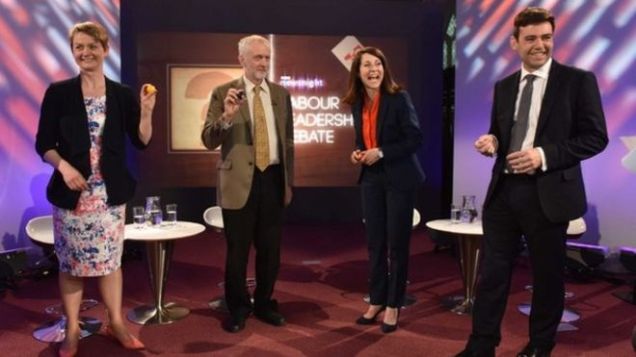
Owen Jones Has An Epiphany, Figures Out The Root Of Jeremy Corbyn’s Appeal

Labour Party - Labour Leadership - 2015

Owen Jones has an epiphany: centrist Labour MPs are responsible for the rise of Jeremy Corbyn

One of the annoying things about being part of Britain’s marginalised political blogging community (see what I did there?) is the regular insult of seeing ideas first expounded on this blog being subsequently “appropriated” by high profile, celebrity journalists who come late to the party and then claim all the credit (and pageviews) for ideas that they did not originate.

I stay up late into the night ranting sometimes (I hope) semi-original analysis into WordPress, and then three months later some SW1-dweller pops up on the Sky News paper review making the same point as though it is astonishingly fresh insight, getting paid for being late to the party and taking all of the credit.

[Pauses]

Meanwhile, on a completely unrelated note, Owen Jones has worked out that Jeremy Corbyn did not sweep to the leadership of the Labour Party in a vacuum, and that the rise of Corbyn was only made possible because of the accumulated failings of Labour’s centrist MPs.

From Owen’s totally original Guardian column (my emphasis in bold):

There are many decent Labour MPs, but it is difficult to think of any with the stature of the party’s past giants: Barbara Castle, Nye Bevan, Ernie Bevin, Herbert Morrison, Margaret Bondfield, Harold Wilson, Stafford Cripps, Ellen Wilkinson. Machine politics hollowed out the party, and at great long-term cost. If, last year, there had been a Labour leadership candidate with a clear shot at winning a general election, Labour members might have compromised on their beliefs: there wasn’t, and so they didn’t.

[..]  Corbyn’s harshest critics claimed superior political nous, judgment and strategy, then launched a disastrously incompetent coup in the midst of a post-Brexit national crisis, deflecting attention from the Tories, sending Labour’s polling position hurtling from poor to calamitous, and provoking almost all-out war between Labour’s membership and the parliamentary party: all for the sake of possibly gifting their enemy an even greater personal mandate. They denounce Corbyn’s foreign associations, but have little to say about former leader Blair literally having been in the pay of Kazakhstan’s dictator Nursultan Nazarbayev, whose regime stands accused of torture and the killing of opponents. Corbyn’s bitterest enemies preach the need to win over middle-class voters, then sneer at Corbynistas for being too middle class (even though, as a point of fact, polling last year found that Corbyn’s voters were the least middle class). They dismiss Corbynistas as entryists lacking loyalty to the Labour party, then leak plans to the Telegraph – the Tories’ in-house paper – to split the party.

It is the absence of any compelling vision that, above all else, created the vacuum Corbyn filled. Despite New Labour’s many limitations and failings, in its heyday it offered something: a minimum wage, a windfall tax on privatised utilities, LGBT rights, tax credits, devolution, public investment. What do Corbyn’s staunchest opponents within Labour actually stand for? Vision was abandoned in favour of finger-wagging about electability with no evidence to back it up.

Jones concludes:

Corbyn’s opponents have long lacked a compelling vision, a significant support base and a strategy to win. When Labour fails at the ballot box, its cheerleaders are often accused of blaming their opponents rather than examining their own failures.

The same accusation can be levelled now at Corbyn’s opponents. They are, by turns, bewildered, infuriated, aghast, miserable about the rise of Corbynism. But they should take ownership of it, because it is their creation. Unless they reflect on their own failures – rather than spit fury at the success of others – they have no future. Deep down, they know it themselves.

Slow hand clap. Finally, acknowledgement from a “mainstream” political commentator of what this blog has been saying consistently, even back when a Jeremy Corbyn victory in the leadership election was seen as an absurdity.

Jeremy Corbyn did not become leader of the Labour Party in a vacuum. A cloud did not suddenly descend on Labour Party members, making them crazy and amenable to markedly more left-wing politics. There was no extraneous event on which blame can be pinned, save Ed Miliband’s disastrous tenure as Labour leader, culminating in the 2015 general election victory. The problems are far more deeply rooted, and go way back beyond Ed Miliband and Gordon Brown.

Good job, Owen.

Of course, readers of this blog will know that I have been consistently making the same point, repeatedly, stretching back well before the 2015 general election:

Why Isn’t Labour Working?

Why Jeremy Corbyn’s Labour Leadership Candidacy Matters

No, Jeremy Corbyn’s Leadership Candidacy Is Not A Disaster

In Memoriam – Labour Party: 1900-2015

Stop The Anti Jeremy Corbyn Hysteria – ‘Entryism’ Is Not A Dirty Word

Why Is The Right Suddenly Scared Of Jeremy Corbyn

Is Jeremy Corbyn The Cure For British Conservatism’s Centrist Virus?

Are You A Populist Simpleton?

Labour Has Lost The Ability To Persuade Its Own Members, Let Alone The Voters

Time For Jeremy Corbyn Detractors To Put Up Or Shut Up

What Are The Aims And Values Of The Labour Party?

The Latest Victim Of The Labour Purge: The Party’s Soul

Stop Worshipping ‘Centrist’ Voters

The Labour Party’s Soul Searching Exercise Is Off To An Unpromising Start

In Defence Of Jeremy Corbyn

The Hypocrisy Of Centrist Labour’s War Against Jeremy Corbyn


So well done Owen. You got there in the end, nearly a year late.

But now that this blog’s ideas have been given voice by the boy wonder, maybe they will actually receive some due consideration and debate.

Who needs acknowledgement or recognition or money or credit, anyway?
 

Owen Jones talks back on the EU referendum - European Union - Brexit

Support Semi-Partisan Politics with a one-time or recurring donation:

Agree with this article? Violently disagree? Scroll down to leave a comment.

Follow Semi-Partisan Politics on TwitterFacebook and Medium.

Pathologising Donald Trump Supporters Will Not Diminish His Appeal

The voices in this New York Times video of Donald Trump supporters may be “unfiltered”, but they were chosen very carefully indeed to reinforce every negative liberal stereotype about people who have the temerity to support Donald Trump

It is hard to understand exactly the New York Times thinks it is trying to accomplish with videos like this one, published today, scornfully “studying” Donald Trump supporters with a keen anthropologist’s eye, while tarring his many moderate supporters by associating them all with the most intemperate, rude and racist characters that their camera can find.

The Times helpfully explains to its readers that “at Donald Trump’s rallies, some supporters express themselves with slurs and violent language”, before linking them to a video in which the absolute worst dregs of the Trump campaign are paraded before the Times’ liberal audience like it were some kind of Victorian circus freak show.

And sure enough, after the obligatory trigger warning from the Times, the video’s subjects make themselves look extremely stupid, as well as racist and misogynistic in places. But this in itself is hardly surprising – it is obvious that racists and other undesirables will be disproportionately (though not exclusively) drawn to a populist politician like Trump, but this does not mean that a majority of Trump supporters share these vile sentiments.

In fact, one wonders why the liberal media which goes to excessive pains to avoid linking all Muslims with the actions of Islamist terrorists, and which frets about broadcasting the names and biographies of mass shooting perpetrators suddenly loses all squeamishness when it comes to linking all Donald Trump supporters with the specimens shown in their video. Why does the Times titillate its readers by showing the worst side of the Donald Trump campaign rather than making a hard-hitting and informative piece  debating the issues with some of the many Trump supporters who turn up to his rallies minus white robes and burning crosses?

If anything, this video reveals the bias of the New York Times, and the desperate liberal (in the American sense of the word) need to paint anything contradictory to their own worldview as being seeded in intolerance, bigotry and hate. This bias is never clearer when the Times’ video attempts to portray Trump supporters as anti-immigration, period. At one point in the video, an editor’s caption reads “vitriolic language is often aimed at immigrants”.

If the filmmakers wanted to produce a respectable, balanced piece rather than juicy footage for their Trump freak show, they might have engaged those supporters in conversation. But had they done so, it would have quickly become apparent that the Trump supporters oppose illegal immigration, not all immigration. These days, of course, the decadent New York Times is completely incapable of distinguishing between the two. All immigrants are saintly figures holding hands beneath a rainbow to the Times, a newspaper which long ago ceased any mention of illegality and started talking about “undocumented” migrants instead (whoops, where did their documents go, one wonders). And so the camera rolls, the supporters chant “build the wall!” and New York Times readers are bolstered in their prejudice that anybody who opposes illegal immigration is a big fat racist who actually opposes all immigration.

And so it goes on, for issue after issue. Legitimate questions and concerns about Hillary Clinton’s conduct and record are ignored while footage of a Trump supporter shouting “Hillary is a whore!” feeds the narrative that Trump supporters are entirely unreasoning and uncouth creatures. Serious questions about how the American political establishment speaks about and responds to Islamist terror attacks are swatted aside so that we can focus on the redneck wearing a “Fuck Islam” shirt. Forget nuance. Forget the decent people who go to Trump rallies as a fun family day out. Just focus on the morons and reinforce the message: the people who support Donald Trump are as unacceptable as the candidate himself.

Watching the New York Times (and much of the establishment media) report on Donald Trump supporters is like watching a David Attenborough wildlife documentary in which the grizzled naturalist attempts to explain to us the feeding and mating rituals of some lower primate species – recognisably similar to us in some ways, but far more primitive and with rituals and customs which we civilised people cannot possibly understand without their expert interpretation.

Watch the video. I challenge you to watch it and come away feeling anything other than that this is an unbearably condescending hit piece on Trump supporters, a nauseating attempt by a Clinton-backing newspaper to “play to the gallery” with a compilation of all the worst Trump supporters imaginable rather than an attempt at serious journalistic enquiry.

I’ve said it before (in the context of the Brexit debate and, repeatedly, the US presidential election) and I’ll say it again: pathologising one’s political opponents and assuming (or at least publicly declaring) that they are motivated by hatred and malevolence is the sure path to defeat, and is no way to unite a fraying country. And prissy little video explainers like this one by the New York Times only serve to further divide Americans, giving liberals more reason to be smug and Trump supporters more reason to feel besieged.

Imagine that you are a wealthy, Times-reading East Coaster. Does this video make you question any of the beliefs which currently make you want to vote for Hillary Clinton? Does the video make you question whether the Trump supporters have even the kernel of a legitimate point about immigration, or trade, or national security? Or does the video boldly reinforce all of your existing prejudices about Trump supporters, reassure you that you are quite right to fear and despise them, and encourage you to keep shouting your own message louder and louder rather seeking dialogue with people the New York Times clearly portrays as being impenetrable to reason?

This is coastal elitist mockery of flyover country writ large. It is unbearably sanctimonious, and does nothing to further understanding and dialogue between Americans of different political and cultural backgrounds. It serves to further validate the accurate perception among Trump supporters that they are looked down on and belittled by the rest of the country. And, if another external economic, security or political shock turns this election into a dead heat between Hillary Clinton and Donald Trump, the high-handedly arrogant way in which the establishment media treats the insurgents could push Donald Trump over the line on Tuesday 8 November.

This blog has no time whatsoever for Donald Trump. But I have endless time for his supporters, the majority of whom are decent people – to think otherwise would be to write off a massive proportion of the country based on their political views. And while I firmly believe that Trump’s simplistic solutions, policy ignorance and prickly ego would do immense harm if set loose in the Oval Office, right now I am more offended by the New York Times’ portrayal of all Trump supporters as though they are somehow less than human, less intelligent, with less self control and possessed of unique and grievous character defects which are supposedly entirely missing from their more enlightened, liberal compatriots.

One expects this kind of two-dimensional, good vs evil, sanctimonious ra-ra nonsense from the Huffington Post or other leftist agitprop sites. But the New York Times supposedly aspires to something higher, something more closely resembling journalism.

Everything about this video fails that test.


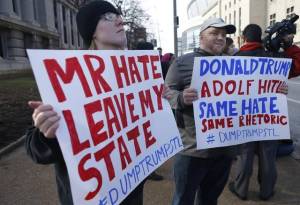
Donald Trump Protesters - St Louis

Support Semi-Partisan Politics with a one-time or recurring donation:

Agree with this article? Violently disagree? Scroll down to leave a comment.

Follow Semi-Partisan Politics on TwitterFacebook and Medium.

The Greatest Threat To American Democracy Is The Sensationalist, Ratings-Obsessed Television News Media

It took two monsters to create Donald Trump, Presidential Candidate Edition: the debased Republican Party of Sarah Palin, and the slavish, contemptible American television news media

After getting heartily sick of watching the British rolling news channels the past few weeks, I decided to spend the last couple of days watching CNN (the US version, not the godawful international version).

It wasn’t pretty. In fact, it was almost enough to make one long for the BBC’s barely concealed hysteria at the thought of Brexit and being forcibly ripped apart from their beloved supranational European political union, or Sky’s never-ending quest to be the first news organisation to get their newscopter hovering directly above anything which may or may not turn out to be of interest.

Take today as an example.

For the past four hours, CNN has been reporting the “breaking news” that Donald Trump claims that his campaign has “never been more united” when various Republican talking heads that CNN was able to lure into the studio were willing to say the exact opposite – and hardly surprising, since their presidential candidate is is a proudly ignorant egomaniac with a borderline personality disorder.

This couldn’t even be charitably described as “breaking news” when I first tuned in at around 8PM London time, and it certainly isn’t breaking news four hours later. But still, there it is: “Awaiting Trump Rally In Florida” proclaims the banner, while five disembodied talking heads float on a giant screen behind Wolf Blitzer, waiting to air their opinions.

What you notice watching American news – besides the constant advertisements for dubious pharmaceutical products whose long lists of compulsorily recited side-effects often outweigh their curative properties – is the degree to which everything, and I do mean everything, is about Donald Trump.

(At this point it is worth pointing out to uninitiated British readers that CNN is the closest you’ll get to “objective” cable news reporting in America, with fair ‘n balanced Fox News skewing firmly to the right and MSNBC leaning forward equally firmly left. Not being overt partisan shills for one or other of America’s two main political parties is a nightmare for CNN executives who need high ratings, and so in desperation CNN latches on to every single technical gimmick you can imagine – drone cameras! holograms! – in a desperate bid to make their offering more exciting to fickle viewers).

It is fair to say that were it not for the American television news media, Donald Trump would be filming a new season of The Apprentice and lending his name to another shoddily-made range of “luxury” businesswear right now, rather than facing Hillary Clinton as the Republican Party’s presidential nominee.

This blog has already raked the GOP over the coals for their pitiful part in these dismal proceedings. But in despairing at the intellectually and morally debased Republican Party we should not let the media off the hook.

For the fact is that America’s news networks failed to fulfil their democratic duty by treating a presidential election like it was sweeps week rather than a serious decision with long-term consequences for the future of the republic. Donald Trump makes a great television candidate because he is willing to do and say things – exciting, attention grabbing things – which no other candidate will say. Unfortunately, this nearly always involves Donald Trump being rude, immature, spiteful or wrong about something or someone. But the news networks don’t care. It makes for great TV. And so they show more and more Trump, and less and less of everyone else.

When the Republican Primary campaign was still being fought, at one point we reached the ludicrous position where Senator Marco Rubio made the tactical decision to emulate Donald Trump’s style and start making gratuitously offensive insults and statements of his own, just to try to wrest the attention of the television cameras away from Donald Trump for one wretched moment. Needless to say, it backfired – Rubio could never match Trump’s ability to mock and belittle people, and so he ended up tarnishing his own reputation while doing nothing to halt Trump’s rise.

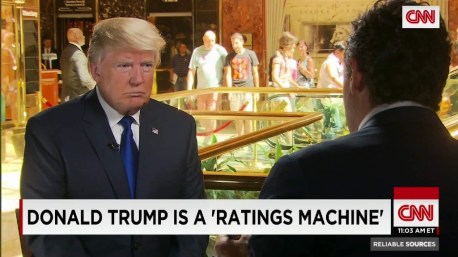
Donald Trump - Ratings Machine - CBS - Les Moonves - CNN - Television News

My point, I suppose, is this.

There is nothing funny or entertaining about this American presidential election. Voters are faced with a rather dismal choice between a far from universally loved Democratic Party candidate on the one hand and an absolute megalomaniac on the other. And they have been put into this position of not having a decent choice between two valid, honourable but competing political philosophies largely thanks to the decision of the television networks last year to break into their regularly scheduled programming every time Donald Trump raised an eyebrow, while giving the other Republican candidates (let’s face it, many of whom were so hopeless that they really needed a media leg-up of their own) almost zero screen time.

The other candidates had to drop what they were doing and go to Washington or New York if they wanted to be featured on the Sunday shows. Trump was permitted to appear by satellite link or even telephone, so eager were American news executives for a bit of Trump’s verbal gold. And whenever Donald Trump has been interviewed, the questions have frequently been of the most depressingly softball variety. America does not have a Jeremy Paxman figure, or even an Evan Davis (God help them). Nor do they have as strong a tradition of confrontational political interviews as we have in Britain – the tradition of deference to authority is, rather counter-intuitively, very strong in America. And so during all of his unearned media time, Donald Trump has very rarely been faced with a single question which caused him to stumble, despite his lengthy back catalogue of cruel and ignorant public pronouncements. Rarer still has Trump faced a searching follow-up question when he replies with one of his repetitious, opaque defensive statements.

All of which makes Amy Goodman’s excoriation of the American news media very true, and rather refreshing:

The media manufactures consent – for war, for candidates in elections, by bringing you more, for example, of one person. Like Donald Trump. He is pumped into everyone’s home. He can just stay in a gold gilded mansion in New York or one of them in Florida. The rest of the candidates trudge from one state to another. Why does he get this unfiltered pipeline into everyone’s brain, into your eyes and to your consciousness?

It matters. The Tyndall Center did a report in 2015, they looked at the whole year, and they found Donald Trump got 23 times the coverage of, say, Bernie Sanders. They found ABC World News Tonight did something like 81 minutes on Donald Trump and I think they gave Bernie Sanders 20 seconds.

[.] In this high-tech digital age, with high-definition television, digital radio, all we get is static, that veil of distortion and lies and misrepresentations and half truths that obscure reality, when what we need the media to give us is the dictionary definition of static. Criticism. Opposition. Unwanted interference. We need a media that covers power, not covers for power. We need a media that is the fourth estate, not for the state. And we need a media which covers the movements that create static and make history.

Obviously Goodman’s interest was promoting the candidacy of Bernie Sanders (the video was made several months ago before he officially dropped out of the Democratic primary contest), but her critique of the wildly excessive time and attention lavished on Donald Trump by the television news media is dead accurate.

As a Brexit campaigner during the EU referendum, representing an organisation (The Leave Alliance) which was the only group to actually offer a comprehensive Brexit plan yet struggled to get any meaningful media attention, all of these same criticisms apply to the British media too. It’s nice to know that these problems are universally felt on either side of the Atlantic, I guess.

As a small campaign organisation it was almost impossible to get our word out when the television news was racing to cover every last syllable which dribbled from the mouth of Boris Johnson, while our own esteemed experts – including one of Britain’s foremost authorities on the EU – struggled to get journalists to show up to a launch event right in their own Westminster back yard.

Nobody expects perfection from the media. Media companies have to pay the bills too, and often keep shareholders happy. But for so long as telegenic ignoramuses dictate television (and print) coverage to the extent that they do, our democracy will remain vulnerable to demagogues like Donald Trump.

On election night in America, we will see (as we always do) the great and the good of American TV journalism pat themselves on the back and endlessly congratulate themselves about the moving spectacle of democracy which they are helping to transmit to a grateful nation. Brian Williams, Rachel Maddow, Wolf Blitzer, Diane Sawyer, Lester Holt, Dana Bash, Joe Scarborough, Shepard Smith, Chris Wallace, Bret Baier, Greta van Susteren, Andrea Mitchell and all the rest of them will be churning out platitudes about the beauty of democracy faster than you can stick knitting needles in your ears.

This year, they might consider dwelling on the role they have played in debasing and jeopardising that democracy in the tawdry pursuit of ratings.


Donald Trump - Make America Great Again

Support Semi-Partisan Politics with a one-time or recurring donation:

Agree with this article? Violently disagree? Scroll down to leave a comment.

Follow Semi-Partisan Politics on TwitterFacebook and Medium.

Fr. Jacques Hamel, Martyred By Islamist Thugs Acting In The Name Of ISIS

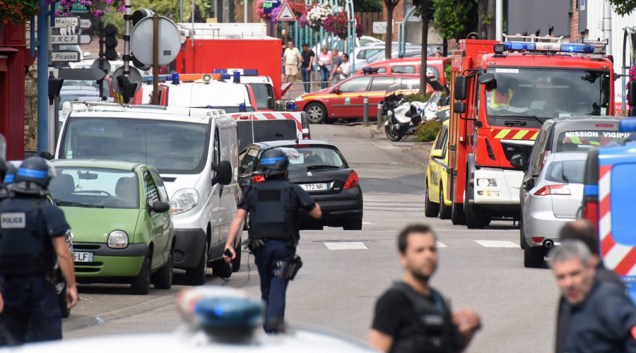
ISIS hostage - catholic church

The cold blooded murder of a Catholic priest, executed at the altar of his own church by young Islamist thugs, demands a greater response from us than the usual standard, sorrowful Twitter hashtag

Another day, another abhorrent, despicable and unacceptable Islamo-fascist terror attack in France, this time targeting a Catholic church in which an 86 year old priest had his throat slit – while celebrating Mass – by Islamist thugs acting in the name of ISIS.

What happens when the sheer number of small and medium size Islamo-fascist terror attacks (or the aura of politically correct unease at confronting them) becomes so great that the media simply stop reporting them fully?

Melanie McDonagh wonders in The Spectator:

In Michel Houellebecq’s novel, Submission, about a Muslim Brotherhood takeover of the French government (liberals and conservatives agreed this would be preferable to a National Front government), the interestingly prescient element was the non-reporting by television and papers of outbreaks of violence prior to the change of government (Twitter didn’t really feature in this novel). And that rings true. We’ve already got self-censorship when it comes to reporting attacks by Muslim refugees (the gun attack by a German-Iranian patently fell into a different category) in Germany and Scandinavia, and an almost comical reluctance anywhere in Europe to identify Islamist attacks as such – until IS takes credit for them, even the work of freelances. Plainly we have to guard against language that would demonise an entire community, but within that reasonable limit, we must require both politicians and public service broadcasters to talk plainly. And when Muslim extremists slit the throat of a priest in his own church, we’re looking at religiously motivated murder, entirely of a piece with the same religiously motivated murder of Christians and others being carried out in the Middle East. Shall we say so?

This is my concern too. While reading Houllebecq’s Soumission last year I was struck by the plausibility of the author’s scenario – a craven political/media class desperate to avoid facing up to the nature of the threat ultimately ceasing to report on the fundamentalist religious violence even as it grew. One scene features a wealthy society event attended by the academic elite of Paris, interrupted by the sounds of distant gunfire in Paris – an Islamist attack or far-right counter-attack which was barely acknowledged by the partygoers let alone mentioned on the later television news bulletins.

Already we have seen the first signs of “terror fatigue” in the mainstream media. When a suicide bomber detonated his explosives at the gates of a music festival in Ansbach, Germany late on Sunday night, Britain’s rolling TV news channels briefly mentioned that an incident was underway, but otherwise continued with their normal programming. By the early hours of Monday morning they had bothered to get a couple of eyewitnesses on air via telephone, but it was not until the breakfast news that they gave it the full terror attack treatment which we have come to expect from the news. Evidently these incidents are now coming so thick and fast that the BBC did not consider it worthwhile waking up their A-team presenters or reporters in the middle of the night for “just another” suicide attack on the streets of Europe.

This is the new normal. And as this blog argued yesterday, Europe’s political class and virtue-signalling members of the public must shoulder their share of the responsibility for our increased vulnerability to attack. Whether it is by cheering on the opening of Europe’s gates to millions of improperly-vetted migrants, a small number of whom have deadly intent, or furiously refusing to confront the fundamentalist religious nature behind that evil intent, we have denied ourselves the ideological, spiritual, procedural and technological means to properly defend ourselves and our civilisation.

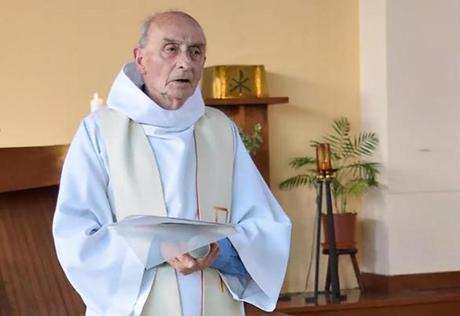
Father Jacques Hamel died doing what he had done for 58 years of faithful service – proclaiming the Word of the Lord and celebrating the Eucharist. Though his death was unimaginably barbaric and violent, at least the name of Fr. Jacques will live on as somebody who proclaimed his truth and defended his values to his last day. Can the same be said for many of us, especially those of us who seek to reach some kind of appalling and unachievable truce with the Islamo-fascists? How will those of us be remembered in history who seek to excuse Islamist terror, laughably excusing it or explaining it away on the grounds of foreign policy or housing policy or welfare cuts?

On this one grim occasion we can at least be grateful for France’s historically strong secular traditions. The cold-blooded murder of a priest celebrating Mass in a more devout country could well have lit the touchpaper for religious war and serious civil strife. France, being more secular, will likely not see as great an anti-Islamic backlash as if this had happened in more Catholic country like Poland.

But there the good news ends. If they were not already high on the list of potential targets, churches, synagogues and the priests and rabbis who lead worship in them will now be in the crosshairs of every budding wannabe jihadist already in Europe, as well as those who have yet to arrive. Every parishioner going to Mass will now have pause to stop and consider their safety as they fill the pews this Sunday, and every subsequent Sunday. It is physically impossible to protect every church in the country, particularly against assailants armed only with knives and fake explosives.

On the plus side, President Francois Hollande has finally been shamed by events (the weekly accumulation of terrorist atrocities and the growing death toll) into declaring that France is at war with the Islamic State and therefore, by extension, with the extremist fundamentalist ideology behind it. But it is too little, too late.

As Harry de Quetteville puts it in the Telegraph:

So we should remember this: the truly great leaders now, those who can genuinely bring security and are worth voting for, will not be those such as Marine Le Pen who seek to exploit division for power. But neither, crucially, will they come from the ranks of those who fail to address what voters see as blindingly obvious: that terror and immigration are connected. If Angela Merkel persists in doing so, even she will be brought low by it. If the Democrats continue not to talk about terror, it could cost Hillary Clinton the White House.

In Britain we have grown used to talking throughout the Brexit campaign about a disconnect between politicians and the public. “They just don’t get it,” said the ranks of the disaffected, as they deserted Labour for Ukip and voted Leave. Even now, our main parties are struggling to offer even an initial response to the economic impacts of globalisation.

But the consequences of a similar disconnection between public and politicians over terror would be unthinkable – menacing to the liberty and liberal values that define our societies.

The politicians to prize, then, are those who can pull their heads out of the sand without stirring up the mob.

Such prize politicians seem few and far between in France, Germany and Britain. In fact it is hard to remember a time when the quality of leadership was held in such low esteem by a political class who now prize the ability to pander to chosen voting constituencies above all else. With the partial exception of Jeremy Corbyn on the Left, Britain’s major political parties have zero interest in telling hard truths to the British people or proposing anything other than glib, painless (and ultimately unworkable) fixes.

One faction of the country in particular – the Guardianista metro left – is not even yet willing to describe these attacks as religiously motivated, ascribing them simply to “troubled individuals”. When half the country is unable (or stubbornly, desperately refuses) to identify the ideology which murdered an octogenarian priest at the altar of his own church, how do we ever confront it?

May God grant eternal rest to His faithful servant Fr. Jacques Hamel.

May he rest in peace and rise in glory.

And may we finally come up with a response to this sustained Islamist assault on democracy and freedom of speech and religion which amounts to more than a Twitter hashtag and a few bunches of flowers.


Fr Jacques Hamel - Catholic Priest

Support Semi-Partisan Politics with a one-time or recurring donation:

Agree with this article? Violently disagree? Scroll down to leave a comment.

Follow Semi-Partisan Politics on TwitterFacebook and Medium.

Many People In Britain Deserve Sympathy. Labour’s Centrist MPs Do Not.

The sycophantic Westminster media identify and empathise much more with Labour’s centrist MPs than the ordinary people who make up the party membership. And it shows.

In a rather nauseating review of Theresa May’s first outing in Prime Minister’s Questions, The Spectator’s Steerpike column gushes with sympathy for the rebellious Labour centrist MPs perched behind (and around) Jeremy Corbyn:

In recent weeks, Jeremy Corbyn’s popularity has hit a new low with the Parliamentary Labour Party. Things are so bad that he is unable to assemble a full Shadow Cabinet — instead having to assign some people with more than one position.

So, it was an interesting move of the Labour leader to bring up job insecurity and difficult bosses at today’s PMQs. Corbyn suggested that Theresa May had much work to do when it came to making employment rights fairer. Alas, the Prime Minister was unimpressed with Corbyn’s complaints. Channeling her inner Thatcher, May went on to suggest that it was he who was the guilty one when it came to inequality in the work place.

The Spectator goes on to quote the new prime minister’s (admittedly very effective) withering putdown of Corbyn:

‘I’m interested that he refers to the situation of some workers who might have some job insecurity and potentially unscrupulous bosses. I suspect that there are many members on the opposition benches who might be familiar with an unscrupulous boss.

A boss who doesn’t listen to his workers. A boss who requires some of his workers to double some of their workload. Maybe even a boss who exploits the rules to further his own career. Remind him of anybody?’

This is all part of a dismally familiar effort in the Westminster media to paint Labour’s rebellious centrist MPs as the wronged and oppressed group, and Corbyn as their unlikely tormentor in chief (when if anything it is clearly the other way around).

The Spectator – and they are far from alone – expect our hearts to brim over with sympathy for the poor Labour centrists whose ineptitude made Jeremy Corbyn’s rise possible in the first place, and who now stomp around Westminster mutinously, trying to destroy the mirror which Jeremy Corbyn holds up to their faces, showing them their own vacuity.

This is a fawning, sycophantic attitude which screams “screw the people and the Labour Party membership! What really matters are the hurt feelings and stymied career aspirations of 230 members of the Westminster political class, people who didn’t go to Oxbridge, secure prize political internships and shimmy their way up the greasy pole only to find their dreams of a Cabinet career dashed because their party is locked out of power for a generation.”

That’s not to say that Corbyn is some kind of faultless, saintly figure. Far from it. But while his ideology may have been plucked unreformed from the 1970s, it is at least coherent and sincerely felt. The same cannot be said for the restive cohort of centrists who are so busy trying to find an “electable” alternative that policy and passion and principle barely register at all.

Post-Brexit, it seems to be fashionable for well-connected journalists, commentators and intellectuals to publicly muse about the possible reasons for the anti-establishment rage simmering at the surface of British politics. Why oh why have the British people stopped listening to the expert opinion of their betters in the Establishment, goes the frequent cry. Why have the people lost faith in the political class?

Hint to the Spectator: journalists openly fretting about the mental welfare of supposedly poor, downtrodden centrist Labour MPs rather than the genuinely poor and downtrodden squeezed middle and working classes goes a long way toward explaining this impenetrable riddle.


Jeremy Corbyn - PMQs

Support Semi-Partisan Politics with a one-time or recurring donation:

Agree with this article? Violently disagree? Scroll down to leave a comment.

Follow Semi-Partisan Politics on TwitterFacebook and Medium.