Discontinuity, Leadership And Britain’s Place In The World

Stepping Stones Report - Discontinuity and Leadership - Sam Hooper.jpg

We don’t face a Brexit crisis, a migration crisis, a housing crisis, an NHS crisis, a social care crisis, an energy crisis, a productivity crisis, a deficit crisis or an education crisis — there is one universal and interconnected crisis of British politics and government

Yesterday I attended an event held by the Centre for Policy Studies, to launch a new initiative for the renewal of British conservatism. The event promised to elevate the voices of the 2015 and 2017 intakes of Tory MPs and certain “other voices”, though it was never made clear who these other voices would be, and no mention of them was made during the event itself.

The CPS is known as Margaret Thatcher’s think tank – it was founded by Thatcher and Sir Keith Joseph in 1977 to promote the cause of economic liberalism and a turn away from the statist post-war consensus. And so far as I could tell, its composition has not changed greatly in that times. Their hair may have greyed and receded, but as I waited for the event to start I saw many of the same figures standing around guzzling wine and congratulating themselves for the glories of decades past.

The event itself was both heartening and discouraging – heartening because many of the right words were said and sentiments expressed, discouraging because we have heard the same protestations that the Tories will open up their policymaking process on numerous other occasions in the past. The guest of honour that evening was Home Secretary Amber Rudd, who is hardly the fresh face of bold conservative renewal, and her speech was bland, utterly forgettable and targeted exclusively at the Tory MPs present rather than the wider conservative movement. Graham Brady, chair of the 1922 committee, spoke after Rudd, cementing this occasion as more of a Tory Party pilgrimage to Soho rather than an insurgent attempt to change the course of an ideologically lost political party.

It was sad to see that the Centre for Policy Studies has become in many ways part of the fossilised establishment which they did so much to uproot in the 1970s. When Maurice Saatchi opened proceedings by bragging that Henry Kissinger had given the initiative his personal seal of approval, I abandoned any hope of conservative revival even before the first speaker took the floor.

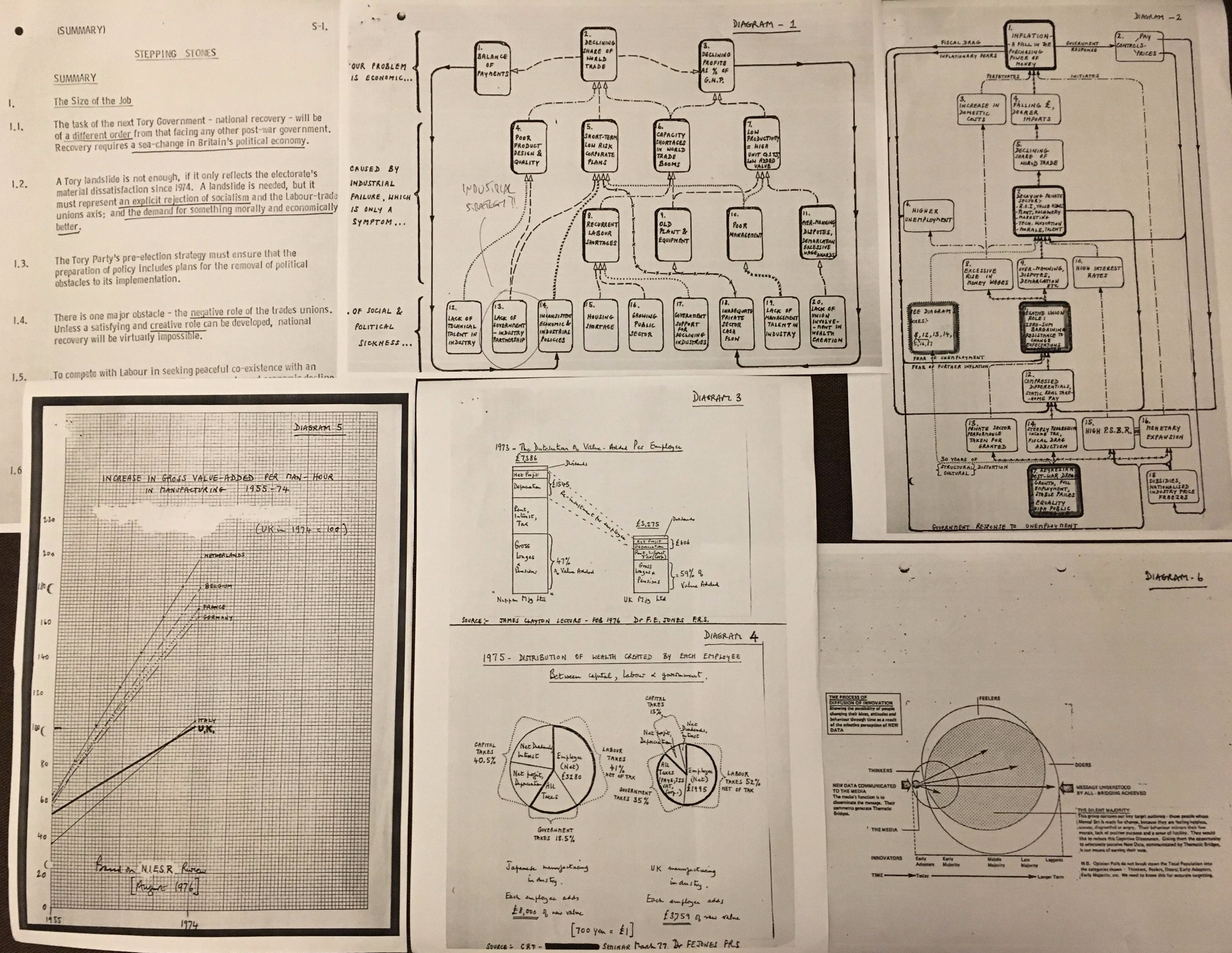
This is a great pity, because from the CPS came the influential and ultimately transformative Stepping Stones Report, an incredible document which summarised a body of work which sought to classify and diagnose all of Britain’s economic ailments of the 1970s and propose a comprehensive solution and communication strategy which Margaret Thatcher then effectively took with her into 10 Downing Street and started implementing in 1979.

I know I keep banging on about this report, but I can’t encourage people enough to go and read it – the thing is sixty short pages of condensed insight and wisdom. Britain in the 1970s was in a very perilous economic and social position, facing challenges which are entirely different to those we face today, but of similar pressing urgency. The central premise of Stepping Stones was that Britain could not be saved through haphazard and piecemeal efforts to tackle each various problem individually – rather, a coordinated approach would be required.

Back before Thatcher

Back in the 1970s, Britain suffered from a budget deficit problem (called the PSBR back then), high inflationary pressures, uncompetitive nationalised industries, bad management, appalling industrial relations and low productivity. In 2017, some of these problems have been quelled while others remain and have been augmented by the challenges of globalisation, automation, global migration, an acute housing crisis and a terminally broken healthcare model in the sanctified NHS.

Just as it was in the 1970s, the problems of the early 21st century can not be solved in isolation from one another or as a series of individual “damage control” measures by a worn-out and rudderless government desperate to stay in power but totally unsure what to do with it. Today in 2017, we need to bring to bear the same comprehensive (one might even say “intersectional”) style of analysis pioneered in the Stepping Stones Report to arrive at a new, mutually supporting suite of policies which are both politically feasible and equal to the task at hand.

As the preamble to the report plainly states:

We must know what a Tory government will have to achieve, before thinking about the way in which it must win office, because simply “winning a majority” on the wrong terms may not give it the authority it needs for success.

One of the key concepts discussed in the Stepping Stones Report is that of “discontinuity”, which is described thus:

In normal times a majority is enough. The task of government is to steer a basically healthy socio-economic system past hazards which are primarily external, while ensuring that the system’s fabric is maintained and making improvements to it here and there.

But once the system itself starts to show signs of fatigue, instability, disintegration, then we start to talk of discontinuity. In discontinuity, solutions can only be found by breaking constraints which we had assumed were unbreakable. It is not enough to settle for policies which cannot save us, on the grounds that they are the only ones which are politically possible or administratively convenient.

Reading or watching the news today, one observes endless argument over what policies or decisions may be politically feasible (be it in British domestic politics or the EU secession negotiations with Brussels), but scant discussion as to whether those policies actually rise to the challenge of our times – whether they actually solve the very specific and intractable problems at hand. Both sides of the equation must be addressed if good policies and decisions are to be reached, but in nearly all cases our shrunken horizon considers only what is possible, not what is actually needed.

1977 all over again?

Who can argue that Britain in 2017 is not experiencing another such period of discontinuity? The symptoms are everywhere and have been visible for some time, notably in the defection of Tory MPs to UKIP in 2014, Jeremy Corbyn’s humbling of the Labour centrists in the 2015 leadership election (and again in 2016), and Britain’s seminal vote to leave the European Union.

The latter in particular was fuelled by public disgust with a political class who contented themselves to operate within the narrow tramlines of EU rules and social policy without any regard for those voters whose values and priorities fell outside the narrow Overton Window prescribed by Brussels.

But that’s just the start. Automation, outsourcing and globalisation have incrementally, relentlessly eaten away at the idea of a steady, 9-5 factory or retail job being sufficient to raise a family or buy a house. Millions of people who in decades past went through an education system which prepared them for little else now find themselves having to learn new computer or service-based skills from scratch, with almost no support or coordination from local or national government.

Even university graduates find that their degrees are of increasingly dubious value, and are obliged to virtually fight to the death for a coveted place on a corporate graduate scheme. The losers go back to live with their parents or work in minimum wage drudgery, wondering why their BA in critical gender theory hasn’t proven to be the passport to the slick professional city life they crave. Call centres and giant Amazon distribution centres have become the new dark satanic mills of modern Britain. Our present education policy should be focused entirely on this looming precipice, yet we distract ourselves by arguments over grammar schools or whether boys should be allowed to wear tiaras and tutus in class.

Meanwhile, there is a huge global human migration underway, prompted by the fact that countless millions more people are connected to the world through the internet and have the means to move from struggling countries to new lands of perceived opportunity – sometimes legally, usually illegally. Political leaders have openly or tacitly welcomed and even fuelled this flow, seemingly oblivious to the fact that the required housing, infrastructure and services do not smoothly and automatically increase in direct proportion to a rising population – and then dare to act startled and affronted when the resident population complains about the impact.

At the same time, elites have preached a gospel of absolute tolerance and multiculturalism while refusing to promote British or Western values, or encourage new immigrants to assimilate, and then cry “racism!” when inevitable tensions occur. They have created a country where some British-born people feel more affinity and allegiance to a barbaric Islamist death cult than the country which gave them life and liberty – and then prove it by stealing away to join ISIS or launching terror attacks which kill and maim their fellow citizens.

And then, of course, there is our national religion, the National Health Service. As surgeons once operated under the dictum cor non tangeredon’t touch the heart – today’s politicians abide by the even stricter rule NHS non tangere, terrified to acknowledge that a nationalised, centralised health system built from the rubble of 1940s war might no longer be the optimal way to deliver healthcare to an advanced, ageing country of 65 million people. And so the fifth largest employer in the world (right behind McDonald’s) is not some world-beating British retail giant or consumer goods company, but a creaking nationalised bureaucracy in perpetual crisis.

A failed centrist consensus

Each one of these issues forms part of a crumbling edifice representing the failed, discredited and obsolete centrist political consensus. Tinkering with the EU – to the limited extent that Britain could ever effect meaningful directional change in Brussels – was never going to happen, despite the constant disgruntled, exculpatory outbursts from Remainers that “of COURSE the EU needs reform!”.

An open migration policy may well be best in raw economic terms, but it should be for the British people to democratically decide whether they want to take the economic pain of slowing immigration, not for politicians who “know better” to overrule them.

Globalisation delivers tangible benefits to many of us and previously unimaginable opportunities to a smaller, highly educated elite, but those at the bottom are tired of being thrown into the furnace to keep the engine running for everyone else.

The NHS model has not been copied anywhere else in the world for a reason, and while it does urgent care fairly well, when overall medical outcomes (notably cancer survival rates) are increasingly falling behind other countries then it should not be off limits to ask whether a nationalised, centralised system is the best way to deliver routine or preventative care to the whole population.

In other words, this is a time of extreme discontinuity in British politics and society. But people do not necessarily recognise discontinuity when it happens, at least not all at the same time. The Stepping Stones Report notes in section 6.1 (addressing the situation in 1977):

Discontinuity may not yet have been recognised by the electorate. In fact, with skilful propaganda and suitably ‘pragmatic’ – not to be cynical – government policies, it need not be recognised until the exhaustion of North Sea oil, by which time our last chance will have gone. Once it is recognised, however, the electorate is unlikely to give a mandate to a political party which has not itself changed sufficiently to match the changed prospects. On the other hand, a party which changes itself, because it fully understands how the rules of the game are changing, is more likely to awaken an electorate to a belated recognition of discontinuity and thus win its confidence.

Here, the situation we face in modern Britain actually differs from that facing the authors of Stepping Stones, because the electorate is increasingly aware that we are in a period of discontinuity. Dissatisfaction with the state of modern Britain is quite widespread, and the people are crying out for change. Rather, today it is centrist politicians (and much of the media) who fail to recognise the discontinuity around them, and often openly yearn to cling on to the failing but familiar consensus.

Opportunity knocks – but it needs leadership

Yet Stepping Stones is clear about the need for political parties to acknowledge discontinuity and to realign their policies and messaging in response to it. As leader of the Labour Party, Jeremy Corbyn has done this incredibly well. One may disagree vehemently with everything Corbyn stands for – this blog certainly does – but his election as leader and conduct since that time reflect a realisation among (at least parts of) the Labour Party that standing for the same old failing political consensus was not just wrong, but bad politics too.

No such reckoning has taken place within the Conservative Party, and despite the emergence of a few green shoots of recovery/new thinking, there are precious few grounds for hope that a sufficient reckoning is imminent. The Tories don’t even have a Jeremy Corbyn of their own. Amber Rudd being invited to speak as guest of honour at an event about conservative renewal is hard evidence that the sense of urgency and horizon of thinking is still not nearly equal to the task at hand.

This is why good, decisive leadership is so incredibly important at a time when Britain is not running in “steady state” but rather entering a period of sharp discontinuity. The report makes this crucial observation:

For at a time of discontinuity, leadership is at a premium. When the future is simply an extrapolation of the past, so that we are all tramping over familiar ground, the choice of someone to lead the procession may not be critical. But if we are setting out on unfamiliar terrain, we look for leaders who, at the very least, appear to have imagined what that terrain would be like in fact.

In discontinuity, conventional wisdom cannot get us out of the problems. Indeed, innovation is almost certainly the best way through discontinuity. Almost any vision, any programme, is better than confusion and uncertainty, for it can at least be modified in the light of experience, once it has broken the paralysing spell of past failure and present pessimism.

It scarcely needs to be said that the Conservative Party is not currently offering the country the kind of ambitious, proactive and visionary leadership which is required in this time of discontinuity. Theresa May was an awful choice for prime minister from Day One, seeing the future of conservatism as occupying traditional Labour territory on state intervention in the economy. Now, in addition to having all the wrong instincts, she is also a political lame duck, shorn of her intellectual brain trust (Nick Timothy) and waking up every day reacting to a new crisis rather than boldly setting the national agenda. Much of this is not her fault, yet it is undeniably true.

Pete North is one of few other thinkers and writers I know who regularly explores the systemic nature of Britain’s problems rather than churning out compartmentalised pieces about the housing crisis, the social care crisis, the obesity epidemic etc. And he is correct when he identifies Brexit as the catalyst which will force all of these other problems out into the open:

I take the view that nothing short of a radical shock to the system will drag our politicians out of their self-indulgent navel gazing. Even now as we coast toward a cliff edge Brexit they are still trapped in the pre-referendum paradigm unable to usefully influence the proceedings and easily distracted by trivia.

[..] In this, the Remainers can’t see the woods for the trees. They point to the dysfunction “unleashed” by Brexit as evidence that Brexit of itself is bad. But this is the dysfunction that has been festering for two decades under a well crafted and stage-managed veneer of competence.

If you are not familiar with Pete’s work then at first it can seem unduly alarmist and pessimistic, but Pete gets the systemic, interconnected nature of these issues and understands that Brexit and the political unpreparedness/incompetence it has exposed are just part of this general discontinuity, all of which must be addressed – including our politics, something the original Stepping Stones report did not have to deeply consider.

A new Stepping Stones Report for post-Brexit Britain

And this leads to my conclusion: we need a new Stepping Stones Report for our times. We need a comprehensive and dispassionate analysis of the problems we face as a country, and understand where and how they are linked together. Having diagnosed these problems (which in the case of many politicians many involve some painful introspection) we must decide where we want to go as a country – what we realistically want Brexit Britain to look like in 2020, 2025, 2030 and beyond – and then devise a programme of mutually supporting, politically feasible policies to get us there, and a way of framing and communicating this programme that can unite a sufficient amount of our fractured country to earn an electoral mandate.

It may be noted that many of the issues we face today – globalisation, automation, migration, terrorism – span national borders and can not be solved by any one country alone. This is not a concession to angry Remainers who naively view the European Union as the ultimate platform for all international cooperation, but it is a statement of fact. This means that for the first time in decades – since the Second World War, really – Britain must lift its eyes above our own domestic concerns and seek to use our position on the world stage to promote and coordinate the adoption of the new solutions we devise. Having voted for Brexit and upended our politics, embracing the discontinuity which most other countries still ignore, we are the canaries in the coal mine and other nations will look to us to see how they might navigate the same issues. For once, rather than lowering our national ambitions and ducking a challenge we must rise to the occasion.

This job is too big for any one person, any one group, and probably any one think tank or political party. It will require people on all sides to let go of long-held articles of political faith and ideological crutches. It will require discipline and commitment, but above all it will require strong leadership to get us there.

I don’t know how we go about doing this, whether it should be an open competition, a more academic exercise, a think tank project, a Parliamentary initiative or a citizen-led effort. But the work needs to be done, and soon, if Britain is to emerge from this period of uncertain discontinuity in an advantageous state.

Of course there is no convenient time for strategic thinking, especially when a party is in government and fending off daily crises. But realistically, if the Conservative Party does not do this then it will be left to Jeremy Corbyn to determine what kind of country emerges from the present discontinuity. Labour’s statist, socialist policies may then quickly become ossified as the new British political consensus, though the rest of the world certainly will not be following us if this transpires.

It has been decades since Britain truly took the lead in influencing world affairs. But having voted for Brexit and thrown into the open many pressing debates which other countries remain desperate to defer or ignore, we can now be both a laboratory and a beacon for the world.

And if we do so, whatever the outcome, when we are called to account for our life’s work at least we can say that we tried to accomplish something more significant, more impactful on the world, than hiring a few extra nurses for the NHS or making the trains run on time.


UPDATE – 16 November

It appears that people have been discussing my article and the concept of discontinuity in British politics over on another forum. One user made the comment:

That Hooper bloke makes a lot of sense, in my opinion. Where do I sign, to join his social movement? Oh, I’m instead encouraged to make a Comment or leave a Donation.

Well first of all, thank you for the compliment – nice to know that this Hooper bloke can occasionally still talk sense! And in fact I am actually trying to do something to turn this idea from more than a mere blog post to an actual project or initiative in the real world. We clearly can’t leave it to the usual inhabitants of Westminster to do this on their own – new ideas and fresh faces will be needed, just as they were in 1977.

If anybody else who reads this article feels called to action, please do get in touch with me, either using the “contact” menu link at the top of the page, or directly at semipartisansam@gmail.com

Thanks.

Conservative Party Logo - Torch Liberty - Tree

Globalisation

Support Semi-Partisan Politics with a one-time or recurring donation:

Agree with this article? Violently disagree? Scroll down to leave a comment.

Follow Semi-Partisan Politics on TwitterFacebook and Medium.

The Two Brexits

Cultural Brexit - Culture Wars - Establishment

Not everything of value can be measured or counted, and Remainers opposing Brexit purely on economic or materialistic terms are doomed to forever misunderstand half the country when they refuse to view Brexit through any other prism

If we are to have any hope of knitting Britain back together after Brexit, Remainers must first acknowledge and seek to understand an entire aspect to Brexit which until now they have tended to ignore or crudely dismiss as xenophobia or nostalgia for Empire.

Brexit is two separate phenomena in one. First there is Economic Brexit, the world of quantifiable (if still largely speculative) prognostications and arguments over just how impoverished Britain will be after Hard Brexit versus the untold riches which will be ours once we have concluded that mega trade deal with New Zealand.

But there is another Brexit, too. I struggle to define it – some days I feel like it is “Constitutional Brexit”, the Brexit which concerns itself with high-minded questions of governance, statecraft and geopolitics. But on other days it feels more visceral, more inchoate, though no less important for that. This is “Cultural Brexit” – sneered at by the Economist but best understood as secession from the EU partly as a reaction against supranational European government, yes, but also an enormous cultural backlash against years of self-serving, centrist, technocratic government within the narrow boundaries of an incredibly restrictive Overton Window.

While many smug or outraged Remainers try to hang Vote Leave’s idiotic “£350 million for the NHS” bus slogan around my neck, I never believed any of that nonsense and did my best to dispel it while other Brexiteers who should have known better were still propagating the idiocy and sowing the seeds for our current impasse. Personally, I always pursued “Constitutional Brexit”. What mattered to me was not immigration numbers or trade deals per se, it was the fact that decisions like these – crucial to the development, prosperity and nature of any nation state – should be made at that national level, not set as an unsatisfactory 28-way supranational compromise in Brussels (at least until a tipping point is reached where majority of us feel more strongly European than British).

But the more I observe the furious establishment backlash against Brexit (and last year’s opportunistic centrist coup against Jeremy Corbyn’s leadership of the Labour Party) the more I find that Cultural Brexit also resonates quite strongly within me. Ultimately, I cannot separate the constitutional issues from the fact that for too long Britain has been run by cautious, unambitious identikit drones who nominally belong to Team Red or Team Blue but ultimately hold the same basic worldview and seek to inch us incrementally toward their shared vision of the future, without even thinking to meaningfully consult with the people or explain their actions.

Are the numbers important? Absolutely. To the extent that we can actually make meaningful forecasts (and note: nearly every self-professed or well-credentialed economic expert has been wide of the mark, from when they told us that staying outside of the euro would be economic suicide right up to the OECD’s continually shifting forecasts of Brexit doom) of course numbers and the impact of Brexit on the economy matters. An economically weakened Britain is a diminished Britain, even if only in the short term, and we cannot forget that government policy and spending decisions can be measured by their impact on real human lives.

But simultaneously, numbers are often very good at capturing nearly everything besides that which actually makes life worth living. That’s why I never warmed to the Tony Blair / Gordon Brown / Ed Miliband / Jeremy Corbyn view of the world. They all had their own emphases, but to listen to these leaders speak was to imagine a clinical and soulless Britain, impeccably multicultural, endlessly tolerant even as Western values were eroded, with punctual trains, benefits for everyone, a gleaming new NHS hospital on every other street corner filled with identically-uniformed staff – but very little else.

Public Services (and the taxpayer money which needed to be extorted to pay for them) are everything to this type of leftist. Civil society and the idea of individuals coming together to do anything besides consume public services or petition the government for More Stuff barely registers in their mind, because their conception of a Utopian society has little room for anything outside the public sector. Schools, hospitals and trains – absolutely. Churches, the Women’s Institute, innovative start-ups, world-beating corporations, the ambition to strive for anything besides total equality of outcome – not so much. There is (or at least there should be) more to our shared national life than the public services which we consume together.

People of this mindset simply cannot fathom why we might want to leave the European Union, because it represents risk, and to them risk doesn’t mean possibility or potential. It means the fear of less money for public services and a potential reduction in the kind of perks which middle class people like myself are supposed to be beguiled by – free movement, low roaming charges, the European Union Youth Orchestra. The idea of risking material comfort or stability for mere democracy or the chance of further constitutional change seems absurd to them – if it can’t be counted on an Excel spreadsheet and slapped onto a smug infographic to be shared on Twitter, it can’t possibly count as a valid argument about Brexit, goes their thinking.

Such people can only think in terms of Economic Brexit, and will not debate with you in good faith on any other topic – many refuse to even acknowledge the existence of constitutional or cultural concerns other than dismissing them as “xenophobia”, or angrily saying “of COURSE the EU needs further reform!” without ever specifying what this reform should look like. There is, in other words, a huge empathy gap between the two Britains, and since Remainers are often not shy in declaring themselves “better” than us unwashed Brexiteers I would submit that the duty is primarily theirs to close it.

Pete North has for a long time done a great job of dissecting both aspects of Brexit – the Economic Brexit with its need to get to grips with the minutiae of trade agreements and regulatory systems, and also the Constitutional/Cultural Brexit which gets too little attention from most commentators. But he really knocks it out of the park in his latest piece, writing:

I am often told that we Brexiters are pining for long lost glory – fighting for a better yesterday. But what if we are and what if we are not wrong? What if the relentless march of “prosperity” is eradicating the best part of us? No misty-eyed tales will be told of sitting in a Frankie and Benny’s while tapping one’s foot to the generic tones of Shania Twain.

[..] One thing one notes about modern British cultural history is that every recession is marked by a musical revolution. We had 70’s punk, 80’s metal, 90’s rave and ever since, especially since the smoking ban, culture has gone into hibernation. The place you would have booked for your face melting techno all nighter is now a Debenhams complex. If there is one defining quality of modern progressive Britain then it is the relentless commercialised tedium of it.

As we have gradually sanitised our living spaces we have also sanitised our culture and one cannot help thinking we are now sanitising thought. This is clear from the onslaught of safe space culture so that our delicate metrosexual hipster children are protected from ideas that that may lead them to stray from the path of bovine leftist conformity.

I can’t really speak to rave culture, so I’ll have to take Pete’s word for that. But there is much truth in what he says. Nobody can deny that we live in an age of technological miracles. People of my age, who experienced the early internet in our teenage years and just about remember a life before it, have to concede that much. And as a country – as the West – we are undoubtedly more prosperous. I am continually astonished walking through London, thinking back to how much scruffier and run down everything looked in the 1990s when I came on daytrips from Harlow as a boy, how dramatically the skyline has changed, how few restaurants there were compared to now, how much less variety and choice there was in all things only a decade ago.

By nearly every measurable metric we are better off and our prospects are brighter, and yet something intangible has been lost. The economic heart has been ripped out of my hometown of Harlow, Essex, with many of the prestigious large employers now gone and replaced with vast distribution centres offering only minimum wage work. The town centre is decayed and scruffy; a town of nearly 100,000 people that can no longer sustain a Marks & Spencer’s department store; charity shops and temporary seasonal stores occupying the places where more permanent, upmarket businesses once were.

Meanwhile, when my wife and I go shopping at the upmarket Westfield mall in White City everything is polished and perfect, but you could be anywhere – Houston, Paris, Dubai, Melbourne, Hong Kong. Globalisation and economic growth have brought gleaming homogeneity to the places frequented by globe-hoppers like me, but slow decay to towns like the one where I was raised.

By no means can all of this be laid at the foot of the European Union. But stories like these need to be repeated over and over again because there are still many people who fail to understand that the months and years prior to the EU referendum were in fact not Golden Years for many people.

And “Golden Years” brings me on to David Bowie, and back to the point Pete North was making. When Bowie died early in 2016, writer Neil Davenport lamented that our current youth culture could never create anything like him again:

It’s worth remembering that Bowie slogged on the margins for ages, in two-bit bands, recording very minor songs, before finally finding his voice. Back then, British society created a kind of free space in which young people who were willing to take the unpredictable route of cultural experimentation could do so.

This, too has been lost, which I think is what Pete means when he says that our culture has “gone into hibernation”. As I remarked at the time:

Who would have thought that calls to outlaw clapping and booing, tearful temper tantrums about dress codes, stifling ideas by labelling them ‘problematic’, the insistence on safe spaces and mandatory sexual consent workshops for students would have such a repressive, suffocating effect on our society?

That’s not to say that there is no great new talent emerging seven decades after the birth of David Bowie – clearly there is. But time and again, we see the biggest acts and pop stars of today are more eager to ostentatiously embrace prevailing social values as an act of public virtue-signalling rather than court controversy by cutting across today’s strictly policed social norms.

Lady Gaga took no risk when she sang “I’m on the right track baby, I was born this way” – indeed it opened the door to stadiums full of even more lucrative fans. That’s not to say that she was wrong to do so; but how often do you see an emerging pop star court real controversy or confound society’s expectations these days? You can blame some of this on commercialisation, sure, but not all of it. Something deeper is at work.

When emerging artists see ordinary people shamed and ostracised for saying the “wrong” thing or even just adopting the wrong tone on social media, how many will have the courage to incorporate anything truly daring or potentially “offensive” in their acts, or create spontaneously from the heart without first processing everything through the paranoid filter of societal acceptability?

The societal changes we have undergone in the last three decades are not insignificant, and they have not been to the benefit of all people. I think I feel this keenly and am able to empathise with Cultural Brexiteers because I have a foot in both worlds.

I have a pretty nice middle class life in North London surrounded by fellow “citizens of the world”, but I was born and raised in a Brexit town. To me, the inhabitants of Brexitland are not abstracts or nasty composite caricatures painted by the Guardian – they are fundamentally decent human beings, real people of flesh and blood who want the best for their families and children. They are friends and former work colleagues for whom voting Tory or Labour made very little difference over the past twenty years because both main parties represented the same basic consensus (of which support for the EU was emblematic).

Pete concludes with what passes for a message of hope:

In effect I see the natural consequence of Brexit being what Cameron imagined as the Big Society, where ideas like free schools and “CareBnB” can take root. In the absence of state provision people can and do fill the void. All these ideas have been tested but not allowed to take root because they are a threat to various blobs who are well served by ossified state structures.

I hope so. Aside from Brexit, David Cameron’s aborted Big Society was the last thing which passed for a significant political idea in this country, and it had merit.

The revitalisation of our civil society has a value, as does the revivification of our democracy (if only we can build on Brexit and demand that powers reclaimed from Brussels filter down further than Westminster). It may not be possible to count them up in a spreadsheet but their value is real, as is the positive impact of living in communities which are more than homogenised temporary landing pads for globe-hopping citizens of the world or run-down ghettos to house the people who serve them.

This is cultural Brexit. It’s not that the European Union is the source of every last one of these woes. It’s that many people who defend the EU and supported Remain are as deaf to the concerns of Constitutional Brexiteers as people who think globalisation is all benefit and no downside are deaf to the criticisms of those who oppose the centrist consensus. The deafness to both concerns is the same, because in both cases they are overwhelmingly the same people.

It is this failure of empathy and imagination which first gave the Labour Party Jeremy Corbyn, and then gave us Brexit. The anti-establishment backlash which powered Donald Trump to the White House was also similar, though Brexit is much more coherent than Trump’s grievance-fuelled manifesto.

Remainers can keep shouting about Brexiteers being wrong, stupid or evil. They can delude themselves that we were all hoodwinked by a red campaign bus or Russian propaganda. But if they want to tackle that pervasive feeling of divorce and estrangement from their own country which many of them painfully feel, they will simply have to consider that theirs is not the only valid or reason-based prism through which to view Brexit.

Remainers must be bold and confront rather than dismiss Cultural Brexit. And they must dare to imagine that regardless of how this government’s rather ham-fisted attempt at Brexit plays out, those who voted for Britain to leave the European Union may just be on the right side of history after all.

David Bowie - Beckenham Free Festival

Support Semi-Partisan Politics with a one-time or recurring donation:

Agree with this article? Violently disagree? Scroll down to leave a comment.

Follow Semi-Partisan Politics on TwitterFacebook and Medium.

Catalonia Independence And Brexit – Not The Same Thing

Catalan Catalunya president Carles Puigdemont speech - declaration of independence

The Catalan declaration of independence does not prove your point, whether you are for or against Brexit

There has been an inevitable tendency among many people to co-opt the events surrounding the recent Catalan independence referendum and resulting declaration of independence from Spain for their own distinct purposes. This is unhelpful. Recent events in Spain illuminate Brexit little more than the election of Donald Trump explains Brexit – in other words, a few headline similarities obscure a wealth of differences.

First, we can all acknowledge that Spain hugely mishandled the entire affair. Whether this is partly due to weaker institutions and the less embedded traditions of democracy in Spain or just sheer incompetence on the part of Prime Minister Mariano Rajoy’s government is not fully clear to me, but the actions of the Spanish government clearly fuelled rather than defused the situation.

Rajoy should have learned from the UK’s experience with the Scottish independence referendum of 2014. Faced with Scottish separatists with similar delusions of statehood, David Cameron called the bluff of the Scottish National Party. The referendum was held on fair terms and the nationalists lost – despite an awfully dreary and uninspiring “No” campaign which pushed an entirely negative message and had little positive to say about the value of the United Kingdom. And though this led to the rise of Nicola Sturgeon and the arrival of the Tartan Tea Party of SNP MPs in Westminster after the 2015 general election, the nationalist tide has since receded.

Madrid took a different approach, opposing the referendum at every turn. I can’t speak to the legality of the constitutional court’s decision to ban the referendum, but the violent way in which it was put down by the police and Guardia Civil handed the separatists a huge and unnecessary propaganda victory. I can fully believe that the Catalan regional government has behaved reprehensibly and childishly throughout, but a mature national government in Madrid would have handled this in a way which took the sting out of the Catalan independence movement, putting it to bed for a generation. Mariano Rajoy achieved the exact opposite.

The decision of former Catalan president Carles Puigdemont to proceed with a declaration of independence, as ratified by the Catalan parliament, was opportunistic, antidemocratic and immature. Yes, the referendum was violently put down by the Spanish authorities. But the referendum was also deemed illegal  in the first place by the proper Spanish courts, and many of those who would have voted against independence did not go to the polls. To take this botched referendum as a mandate for independence is a huge overstepping of Puigdemont’s authority, and is fundamentally antidemocratic.

Simultaneously, Spain has been far too laid back in dealing with this threat. It was shocking enough that it took until the days before the Scottish independence referendum for anti-independence campaigners to hold a mass rally in London in support of the United Kingdom – but at least it happened. Spain waited until days after the unilateral declaration of Catalonian independence to hold a similar rally in Barcelona. Where was this public outrage and shows of loyalty to Madrid when Carles Puigdemont was prancing around acting like the living embodiment of all Catalan public opinion? It is hard to attribute this to anything but laziness on the part of the citizenry. As he left the US constitutional convention in 1787, Benjamin Franklin told an enquirer that he had bequeathed the American people “a Republic, if you can keep it“. At times, the Spanish seemed too lazy to make much of an effort to keep theirs.

How does all of this tangentially relate to Brexit? In one sense, Brexiteers can draw some basic parallels to Catalan independence. Both are primarily cultural movements consisting of people who do not accept the legitimacy of the larger political entity which they seek to leave. But the British EU referendum was conducted under the rule of law and its outcome was legitimate. One can raise valid points about the precise mode of Brexit being unstated and the lack of a plan on the part of the official Leave campaign – all true. But the instruction from voters to the UK government to commence secession from the political entity known as European Union was clear. In the case of Catalonian independence, not so. In many cases, the Catalan government behaved provocatively and with great immaturity. These are not smart, measured people whom anybody should seek to drape their arms around.

But there is also a contradiction at the heart of the Catalonian separatist movement. Both in Catalonia and Scotland, advocates for independence seek to leave the political purview of Madrid and Westminster respectively, but remain very much part of the European Union. In doing so they engage in a feat of denial and political fancy which exceeds that of the most ignorant of Hard Brexiteers. Leaving Spain means Catalonia leaving the EU, just as leaving the United Kingdom inevitably meant Scotland leaving the EU when Scotland voted back in 2014. In both cases, separatists sought to downplay or even deny this truth. Carles Puigdemont and his followers need to accept this difficult fact if they are to be remotely taken seriously. But they do not accept reality, just as the SNP refused to accept reality.

It is also curious that the separatists are so desperate to escape the clutches of Madrid (one protester today said that Catalonians were currently “oppressed” by Spain) but are entirely comfortably – even eager – to remain under the authority of Brussels, and inevitably as a much smaller and less influential member state were they to be readmitted. I would very much like to read an argument explaining how modern Spain suppresses Catalonian culture and freedom in a way that the EU would not. As an independent country and small EU member state, Catalonia would be much less able to influence EU policymaking than Spain is currently able to do. They would be in an infinitely weaker position to defend and advance Catalonian national interest.

And yet if this is still the choice of the Catalonian people they should be free to make it – through a lawful, democratic and legitimate referendum. If they do so, it will be a clearly cultural and constitutional decision, just as Brexit was. This doesn’t automatically mean that it is the “wrong” decision – it would simply mean that as with Brexit, some things matter more than short term political and economic stability. This is an argument which I have strongly made about Brexit, and which could hold true for Catalonian independence too. If the people of Catalonia genuinely feel that Madrid is hostile to their own interests then they should have the right to secede from Spain and take the consequences and potential benefits upon themselves. I supported Brexit because I do not feel that our cultural affinity to Europe – our sense of ourselves as part of a cohesive European demos – warrants as powerful and extensive a government as we currently have in Brussels. If Catalonians feel the same about Spain then so be it.

But if nothing else good comes from this turmoil in Spain, hopefully it will disabuse separatists throughout Europe of the childlike, naive notion that Brussels is their friend, and that the European Union in any way cares about their freedom or right to self-determination. It most assuredly does not. The European Union has its own journey – toward greater political integration and centralisation – to pursue. Brexit is enough of a bump in the road for EU leaders; they have no desire to see Europe fragmenting further at a time when they are trying to busily absorb everyone into the grand project, even as their undermining of established member states fuels these separatist movements.

Besides that, this is an internal matter for Spain to deal with. One might plausibly consider taking sides from a personal perspective had the referendum been conducted legally under terms agreed by both sides, or if the Catalan government could make an irrefutable case that no further dialogue with Spain was possible for the redress of their grievances. But in the absence of these mitigating factors we ought to refrain from jumping into a foreign debate purely to score cheap political points about matters in our own country.

The Catalan independence movement is not like Brexit, as anybody who supported the continuation of the United Kingdom in 2014 and Brexit in 2017 should have the humility to accept. No matter how low your opinion of Nigel Farage, Aaron Banks and Dominic Cummings may be, they did not press ahead with an unlawful referendum and claim (quite) such an implausible mandate from it. And whatever constitutional vandalism the UK government is currently engaged in as it seeks to implement Brexit is nothing to the constitutional vandalism currently being perpetrated in Spain.

At its core, Brexit is about securing the continued relevance and autonomy of the nation state (at least until such time as public opinion shifts more definitively in favour of the kind of supranational government offered by the European Union). And that means keeping our personal opinions about Catalan opinions quite distinct from any other political agenda.


Catalonia is not Spain - declaration of independence flag

Support Semi-Partisan Politics with a one-time or recurring donation:

Agree with this article? Violently disagree? Scroll down to leave a comment.

Follow Semi-Partisan Politics on TwitterFacebook and Medium.

The Centrist Persecution Complex

Tony Blair

Discredited centrists, locked out of power and influence for the first time in decades, mount a crisis PR campaign to salvage their reputation

It reached a peak immediately after the surprise victory for Team Brexit in the 2016 EU referendum, with weepy centrists tearfully quoting W. B. Yeats to each other (“Things fall apart; the centre cannot hold; Mere anarchy is loosed upon the world“) and huddling in fear of the oncoming fascist terror, as though Britain had been suddenly stripped of all decency and reason overnight.

But truthfully, the Lamentation of the Centrists began the moment that Jeremy Corbyn’s unlikely bid for the Labour Party leadership started picking up steam in the summer of 2015. It began when a cohort of bland, unremarkable political nothings (to call them technocrats would bestow an undeserved suggestion of expertise and competence) suddenly realised that the comfortable, predictable career progression and access to power they took for granted was in jeopardy, and all because some obscure, dusty old backbencher with these strange things called “principles” and “political convictions” was generating widespread grassroots enthusiasm.

Since these events, any suggestion or development which threatens to marginally expand the narrow Overton Window of British politics has been greeted by the centrists of both parties as a disaster waiting to happen. Back when Ed Miliband proposed energy price to limit consumer utility bill increases, the Tories treated it like a 1970s-style demand for socialist renationalisation of industry, which was made all the more ironic since Jeremy Corbyn’s Labour Party then actually proposed the renationalisation of industry in their 2017 manifesto while Theresa May’s Tories now think that price controls are a wonderful idea.

The window of political possibilities has thus been expanding, but primarily in a leftward direction, since the present-day Conservative Party lacks anybody willing or able to make a robust, inspiring and unapologetic argument for right-wing policies. Jeremy Corbyn’s leadership has single-handedly proved to a sceptical political and media establishment that having a coherent political ideology and policies which naturally flow from it can still be attractive to voters, particularly when communicated clearly and unapologetically.

And this has the centrists scared. What once looked like a temporary, aberrant blip on the horizon and was later nervously dismissed as a brief interruption to their natural right to rule is now starting to look like a permanent, existential threat. And predictably enough, something of a desperate fightback is now underway.

Of course, being centrists, they cannot help but belittle and condescend to the millions of people who grew tired of their self-serving shtick and started looking elsewhere for political inspiration, even as they seek to win back their favour. Thus we are told over and over again that the centrists are the wise adults in the room, the mature grownups who see the world as it is rather than as they wish it were and choose their dismal policies accordingly, while we partisan hotheads on the left and right are being immature and unrealistic by daring to “dream of things that never were, and ask why not”.

The centrists sometimes go on to argue that theirs is also a coherent political ideology, and that their political “beliefs” should not be dismissed simply because they do not hew towards one extreme or another. This is most often brought up in response to my remarking that a leftist sees a river and demands that a bridge be built across it at any cost, the conservative sees the same river and says that a new bridge would be expensive and unnecessary, but a centrist compromises and builds half a bridge halfway across the river and congratulates himself on his pragmatism.

Their defence against this charge is false – true centrism is absolutely not an ideology or worldview of its own, since in a strict sense it merely defines the midpoint between two more polarised political worldviews. When one side manages to push the centre of political gravity left or right, the centre will move with it, maintaining an equidistant position. This is the definition of reactionary opportunism, not principle.

But in another sense, the whining “centrists” are absolutely right. They do indeed have a unique and defined worldview, it just happens to be more of an establishment worldview than a truly centrist one. For a long time, the two terms were interchangeable since Labour and the Conservatives had staked out very predictable and largely static positions since the dawn of the New Labour government. Today’s so-called “centrist” politicians therefore tend to be those people who personally benefit (and/or advocate for those who benefit) from the current status quo, the pathetic tug of war between a not-very-conservative Tory Party and what was until recently a Blairite “sons of Thatcher” Labour Party.

And nobody can say that the United Kingdom as a whole has not prospered, materially at least, under the aegis of the centrists, particularly to look at London or the regeneration of other major British cities. But at the same time, other places have been hollowed out. Regional cities, market towns and suburban commuterville have often become scruffy, more deprived and less pleasant, characterised by vacated high street shop units rather than vegan hipster taco bars.

My own hometown of Harlow, Essex has been very hard hit in recent years, with nearly all the large employers either moving out or significantly downscaling, and the opening of a new retail area only causing businesses to migrate from the other end of the town centre, leaving it a wasteland of charity shops, second hand stores and a few Eastern European mini-marts. Meanwhile, firms which once offered entry-level office work and the possibility of advancement have been replaced by vast distribution centres which offer minimum wage warehouse work and no career progression.

If the centrists even noticed the hollowing out of large parts of the country on their watch, they had over a decade to show that they cared by coming up with new policy prescriptions to make Britain better equipped to face the challenges of globalisation, automation, outsourcing and localised mass immigration. But no sympathy was forthcoming, let alone concrete solutions. And now, with Brexit and the rise of Jeremy Corbyn, the establishment is being forced to pay in a lump for pretending to care about the entire country while looking out only for very specific segments of society.

Naturally, the centrists do not see it this way. In their alternative narrative, they are the victims. The likes of Chuka Umunna, Liz Kendall, Sir Nicholas Soames and Anna Soubry probably imagine themselves as Cicero banished from Rome, stellar public servants unfairly cast from favour by an unreasonable mob whose passions will eventually cool and allow them to resume their rightful position in charge of the nation’s affairs.

A new piece by Helen Lewis in the New Statesman perfectly encapsulates this sense of self-entitled grievance, beginning with the headline “Are you now, or have you ever been, a centrist?”, actually likening their plight to the victims of the communist witch-hunts of the 1950s (modesty and a sense of perspective are not the centrist’s forte).

Lewis writes:

Yes, we’ve been here before. The word “neoliberal” migrated from describing a particular kind of political ideology to a catch-all for anything vaguely capitalist the speaker didn’t like.

[..] “Centrist” is now doing a similar job. In the way it is used by the Labour left, the world is divided into three categories: them, Actual Nazis, and everyone else, who is a centrist.

Boo hoo. How sad that the denizens of centristland, who for years maintained their vice-like grip on power by smearing everybody else as a dangerous extremist, now find themselves being criticised, sometimes unfairly. I can’t possibly imagine what that must feel like.

None of this is to say that there is not a time for more centrist, technocratic leadership. There undoubtedly is. When times are good, threats are few and both society and the economy are in a reasonably satisfactory steady-state then choosing politicians and leaders without much of an ideological compass but the pragmatic ability to get things done can be absolutely the right choice. The problem only comes when the centrists and technocrats outstay their welcome, lingering on with their cautious and unambitious  approach in the face of impending danger or disruption.

One could certainly argue that early New Labour acquitted this “steady state” management job fairly well, inheriting the Thatcher economic transformation and reaping its benefits through studious inaction rather than torpedoing Britain with an immediate return to 90 percent top tax rates. But it is also clear that Blairite and Brownite Labour then went wrong by maintaining their cautious, plodding approach in the face of globalisation, spiking immigration from the new accession EU countries and the 2008 crash and recession.

It should now be clear to all that this is no longer a time for centrist, technocratic leadership. The challenges we face on the domestic, foreign and national security fronts – reviving the economy and ensuring that more Brits are equipped to prosper in it, asserting British influence on the world stage and tackling the evil ideology of Islamist terror – will not be solved by tweaking the dials or turning the tiller half a degree in a particular direction. Far more radical and ambitious government is required to meet these challenges.

Now, I will be the first to admit that I do not have a ready-made answer for what this new governing agenda should be. Conservatives in particular have a real challenge to come up with a policy mix which does not simply ape Labour’s go-to solution of waving a magic wand and creating a new government programme to deal with every single social or economic ill. But just as the need for the Thatcher government’s monetarism and supply-side policies was realised by only a few people in the 1960s and 70s, so the answer to our present difficulties may presently be seen as equally marginal and controversial. As Lincoln once said, the dogmas of the quiet past are inadequate to the stormy present.

I am often gently mocked or criticised by friends and readers for being too negative about contemporary politicians, as though by objecting to the various shades of beige offered by Labour and the Conservatives I am somehow setting my standards unreasonably high. I strenuously disagree. Would somebody in the early 1970s have been unreasonable to be disillusioned with both Labour and the Conservatives? Hardly. The Heath, Wilson and Callaghan governments were all wedded to the same failing post-war consensus which was slowly dragging Britain toward terminal national decline. Rejecting the statist politics of the 1970s was absolutely the right thing to do – the dogmas of the immediate post-war years were inadequate to the stormy seventies. And so it is now, when the dogmas which served some people so well in the nineties and early 21st century are being rejected by a majority of the country.

And this is what the centrists just don’t get. They seem to think that everything was ticking along just fine until this awful populist revolution came and ruined their perfect existence. They hold this belief because from their perspective everything was fine – a continual upward trajectory in terms of wealth, living standards, career and leisure opportunities. Though they furiously deny the charge, many centrists possess the ability to simply forget about the parts of the country and all the people who have been hurting, stagnating and not seeing their concerns reflected in our electoral politics, and having thus exempted themselves from the need to show empathy they view both Corbynism and Brexit as movements based on pure irrationality.

One might have hoped that a brief period in the political wilderness – two years in the case of the Labour centrists and now just over one year in terms of the pro-EU establishment – might have taught the centrists some humility or instilled a modicum of respect for those people who are now finally beginning to make their voices heard. But of course we have seen the exact opposite – disbelief that these people dare to seek to influence the politics of their own country followed by a dismissal of their ideas and often a seething hatred of what they stand for. And still the centrists might have gotten away with this elitism, were it not for the fact that they are incapable of keeping their contempt for the people to themselves. On the contrary, they feel compelled to continually remind the rest of the country just how backward, stupid, communist, racist or evil they consider us to be.

The centrists may win some victories yet. The almighty mess being made of the Brexit negotiations by the UK government may, if things go badly, allow the centrists to prance around screeching “I told you so!” as though flawed execution and lack of planning somehow discredit Brexit as an idea. And Jeremy Corbyn may yet be turfed out of the Labour leadership if the centrists get their act together and rally around a single candidate, particularly if they can find a Emmanuel Macron-type character, an empty suit who can stalk around on stage roaring empty platitudes to get people fired up.

But the centrists have now been exposed. Rather than the wise, measured and pragmatic types who chart an intellectual course between two political extremes that they pretend to be, they have been revealed as unimaginative and thoroughly self-interested defenders of the status quo.

And all their overwrought and exaggerated complaints about evil populists, “things falling apart”, having their opportunity to “live, work and love in Europe” cruelly ripped away or being the supposed victims of a McCarthyite purge will not save them from the judgment of the people.


Tony Blair - Open Britain - centrism

Support Semi-Partisan Politics with a one-time or recurring donation:

Agree with this article? Violently disagree? Scroll down to leave a comment.

Follow Semi-Partisan Politics on TwitterFacebook and Medium.


How Not To Talk To Brexiteers

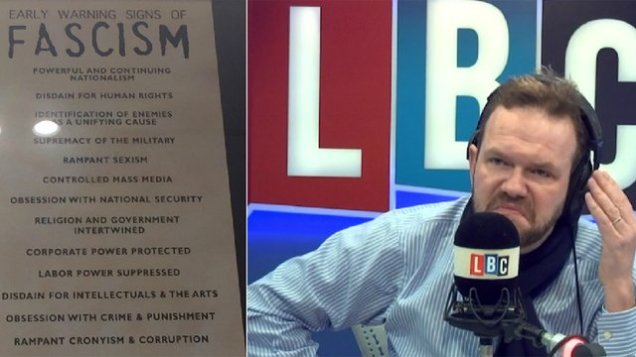
James Obrien Brexit Trump Fascism Hysteria

If Remainers truly want to reverse or soften Brexit, they should spend less time flaunting their own enlightenment and more time engaging with the valid concerns of Brexiteers

I am continually astonished that otherwise intelligent, politically astute Remainers repeatedly choose the catharsis of insult, showing off to their peers and “talking down” to their opponents over engaging with wavering Brexiteers on terms which might produce some kind of compromise, if not a total change of heart and mind.

Say what you want amongst yourselves, Remainers, in university lecture halls or March for Europe demonstrations, but speaking and acting in public as though the Brexit vote was motivated primarily by ignorance or xenophobia is a surefire way to harden opinions and fail to convince potentially winnable Leave voters. Besides the fact that such a blanket statement is patently untrue, how many political arguments are won (permanently) by the side which mocks and taunts their opponent?

In order to change hearts and minds in debate, one must find a common frame of reference or (where that is genuinely impossible) at least feign to understand and sympathise with the underlying motivations of the opposing side. Tell somebody that you hate them and everything they stand for and you have permanently destroyed any chance of building the rapport needed for persuasion. But tell someone that while you understand their deepest motivations yours is the better path to satisfying them and maybe you have a fighting chance.

Unfortunately, so much of political debate is now little more than preening and performing for one’s own side rather than genuine attempts to inspire or change minds. I am guilty of this myself at times, having written pieces that I know will be eagerly picked up and shared by my “Amen corner” of fellow conservatives, libertarians and Brexiteers. But this is inreach, not outreach. And the losing side cannot indulge forever at inreach as a substitute for doing the harder work of talking to those who disagree. This approach is guaranteed to shrink your base to a diminishing band of Ultras rather than grow the broad – in this case, huge – coalition that would be required to overturn the EU referendum result.

While facts are important, emotion plays a big role when it comes to Brexit (on both sides). And at the risk of opening myself up to public ridicule, I will share some of the non-factual claims and actions which rub me (and at least some other Brexiteers) up the wrong way, and immediately make me less receptive to Remainer arguments. I do this as a public service, and because I am getting really tired of encountering the same insults, straw men and non sequiturs in my social media interactions with Remainers.

I don’t claim to be the archetypal Brexiteer, but hopefully some of what I say may be generally applicable and fall on receptive ears. So here goes.

First of all, as with other Brexiteers I am quite patriotic. That is not to suggest that many decent Remainers are lacking in patriotism. But it cannot be denied that there is a coven of hardcore anti-patriots harboured within the Remain community, people who actively dislike or (at best) are ambivalent about the nation state in general and the United Kingdom in particular.

For pity’s sake, stop giving these people the microphone. And take the conch away from AC Grayling, JK Rowling and Ian Dunt while you’re at it. I readily concede that true patriotism and love of country goes much deeper than jingoistic flag waving – the national anthem NFL protests in America, whilst I personally disagree with them, show that it is possible to make a calculated snub of certain national symbols while remaining more true to the country’s founding values than any shallow populist. But if you think that you are going to persuade Brexiteers by painting a negative or pessimistic vision of Britain then you are sorely mistaken.

Brexiteers believe – quite rightly – that Britain is a great, powerful and influential country, and while we personally may have played no part in making it so we are nonetheless proud to be part of this cultural (not racial) heritage. It is not that Britain “punches above its weight” in the world, to use that tiresome phrase surely coined by the pessimistic days of 1970s national decline. On the contrary, we punch exactly in line with our weight given that we have the world’s sixth largest economy, second most deployable military, nuclear power status and a permanent seat on the UN Security Council, not to mention our unmatched contributions to culture, commerce, arts and science.

So talking about Britain as a “small” country in terms of geopolitical power not only flies in the face of objective reality, it actively raises the hackles of many Brexiteers who are justifiably proud of our country’s status. You can disagree as to whether this pride is justified, but descend into mockery and you will not get a hearing from many Brexiteers, nor deserve one. Shrieking that the UK cannot survive outside the EU is not a smart debate tactic. If your parents continually told you that you were useless and totally unable to succeed on your own in the world without their smothering helicopter parenting, would you stay living in their basement forever or become even more determined to move out and prove them wrong?

Now, this doesn’t mean that you cannot make a compelling argument that Britain will be economically or diplomatically harmed by leaving the EU – indeed, this staunchly eurosceptic blog has repeatedly warned that Brexit done wrong could be calamitous. But far better to make the argument in terms of future growth and prosperity at risk rather than paint a picture of a small, helpless Britain adrift in the world, buffeted by “great powers” like Malaysia or Mexico. It’s really annoying.

Then there is the tedious “Open vs Closed” talking point, voiced endlessly since the referendum result came in. It goes something like “we voted Remain because we are open-minded, forward-looking and ambitious while you voted Leave because you are closed-minded, backward-looking, insular and fearful of the future”. Stop for a moment and think about how you would feel if somebody tried to win you over by condescending to you in this manner.

I am an ardent Brexiteer, but like many of us I speak a foreign language, am married to a foreign-born citizen and have travelled and worked abroad. I read the Economist, for heaven’s sake. There are doubtless many unsavoury words which could be thrown at me with some justification, but “closed-minded” and “ignorant” are probably not on the list. If your post-mortem analysis of the EU referendum is telling you that Brexit appealed exclusively to a group of people who are paranoid, stupid, vaguely racist and fearful of the future then your analysis probably needs fine-tuning more than my values.

And while we’re at it, let’s talk about education. Yes, a majority of people with formal higher education voted to Remain. But aside from academia’s general left-ish bias and desire to maintain current systems and sources of funding, this is a youth effect as much as an education effect – far fewer people from older generations went to university. Are these people not clever enough to understand geopolitics, unlike the sagacious newly-minted gender studies graduate? Some of my best friends from home have become smarter and more well-rounded than me, and I went to university while they cracked on with work. So enough sanctimony about being smarter and better-informed, please. I can count the number of Remainers I have interacted with who possess a basic understanding of the EU and its institutions on two hands, with fingers to spare.

Next, stop assuming that Brexiteers mean something other than the words which come out of their mouths. If they complain that mass immigration is straining local services and infrastructure or changing the nature of their communities, then uncomfortable as it may be for you to accept, that is probably what they mean. It is not code for “we want massive increases in taxation to deliver gold-plated public services” or “stop unscrupulous businesses from undercutting the minimum wage”.

If you are a more economically successful Remainer, try to check your “wealth privilege” (to use the current stupid social justice terminology). People in poorer or more suburban communities often have quite a different experience of large-scale immigration than city slickers, who tend to see only benefits and no costs. If you want to make traction with those Brexiteers for whom immigration is a major issue then some empathy will be required, even if deep inside you feel like you are palling around with Hitler.

Next, let moderate or more thoughtful Remainers finish speaking before jumping down their throats. There are probably twenty other things which I could say about Brexit which might add some nuance to my own views and enrich the broader debate slightly, but I am never going to say them because they can be so easily misinterpreted, made to sound bad or otherwise used as a weapon against me and my side. The national debate would benefit from hearing some of these things, but if talking openly about doubt, provisos and exceptions is going to be used by short-term charlatans lacking the patience to reel in the big fish then they will never see the light of day. Again, the short-term urge to perform and score easy points undermines the long-term goal of changing minds.

Finally, be more honest and open about your own beliefs. If you are a closet euro-federalist, probably better to just come out and say so at this point. Half of the antipathy and resistance to the European Union in Britain is borne of the fact that all these years of steadily-deepening integration have taken place under furious protestations from the ruling class that anything significant was happening at all. You will never get what you want (or be able to properly enjoy it if you do) through deception, so be honest about your vision for a federal Europe and try to win people over on the merits.

But even if you are not a beady-eyed euro-federalist with EU flag pyjamas as I once was (well, an EU polo shirt and lapel pin at least) you should still make your case honestly and positively. As Theresa May and Jeremy Corbyn can attest, people respond warmly to positive messages and coherent narratives, while looking sceptically on constant fearmongering and haphazard messaging. People grudgingly respect Jeremy Corbyn because he says what he actually believes and doesn’t moderate his message (much) for short-term political expediency. Be like Jezza.

Don’t be like all those pro-EU campaigners and politicians, trotting out the same tired catchphrases about needing to cooperate with other countries or allowing the doe-eyed youth to “live, work and love in Europe”. Newsflash: Brexiteers know that international cooperation is important, they just don’t see why Britain necessarily needs the EU to facilitate this for us when even small countries like Norway and Switzerland are outside political union, and while other continents and parts of the world have conspicuously not followed our lead in setting up supranational governments of their own. If the EU model of cooperation is so great, show off that superior education of yours by telling us why. Best use lots of pictures, though, because us Brexiteers are a bit thick.

But if (as I sneakingly suspect is more likely) deep down you also believe that the EU is ill-designed, dysfuntional, furiously resistant to change and unnecessary for most international cooperation outside the realm of trade, then come clean and say that, too. We will respect these concessions to reality far more than if you just keep on humming Ode to Joy and telling us that Brussels is the only reason our parents were not annihilated in a nuclear war.

So in summary, if you want to have a fruitful discussion with a Brexiteer instead of just retweeting AC Grayling and feeling smug, remember these simple tips:

Acknowledge the UK’s genuine strengths and do not denigrate patriotism.

Stop talking about the “Open vs Closed” dichotomy, as though Remainers represent the apotheosis of human enlightenment and Brexiteers the dismal nadir. It’s really, really annoying. Talk about “Somewheres vs Anywheres” if you must, because that at least is actually rooted in reality and can spawn a useful debate.

Stop banging on about education as though a 2:2 degree in a soft subject at an unremarkable university makes you Henry Kissinger and uniquely qualified to hold forth on matters of statecraft and diplomacy. It doesn’t. And when evidently simple people start prancing around as though they are Isaac Newton and Nikola Tesla combined, by sole virtue of the fact that they voted with the Remain herd, it can rapidly become quite tedious. Some very smart people voted to remain in the EU, but so did some complete and utter cretins.

Stop trying to divine secret hidden motives in what Brexiteers say, and take them at their word. Their concerns about sovereignty are not actually an inchoate cry for a new NHS tax, or any other left-wing pipe dream.

If you encounter a Brexiteer with whom you think you might have a productive dialogue, engage with them in good faith. Don’t just mine your exchange for nuggets of Brexiteer stupidity to titillate your Twitter followers.

And finally, be honest about your own beliefs. If you want a United States of Europe, just own your euro-federalism and wear it with pride. If you have a more nuanced position, stop feeling like you have to pretend that the European Union represents everything that’s good in the world as though this will do anything other than attract bovine applause from other Remainers.

I probably should not be offering these words of advice. Indeed, it is very much in my short-term interest to see Remainers carry on exactly as many of them have been doing since the referendum result was announced last year – it makes you look shrill and hysterical, and only hardens many Brexiteers in their convictions.

But I also have a longer-term interest in living in a country where the standard of political discourse is set a few levels higher than two monkeys throwing faeces at each other, and good (or at least productive) political debate requires at least some degree of empathy for the other side’s position. In this spirit, I have tried to explain a little bit of what makes some Brexiteers tick, and what downright ticks us off. You can laugh at this information and ignore it, or you can use it to improve the quality and tenor of your arguments so that we don’t just keep shouting the same talking points at each other ad nauseam.

Remainers, the choice is yours.


Talking down - people dialogue

Support Semi-Partisan Politics with a one-time or recurring donation:

Agree with this article? Violently disagree? Scroll down to leave a comment.

Follow Semi-Partisan Politics on TwitterFacebook and Medium.