It has become fashionable of late to say that it’s high time we had a frank, open and honest discussion about immigration.
Never mind that this empty platitude is primarily uttered by the same demagogues who owe their political or media careers to either whipping up excessive fears on the subject, or sweeping it under the rug while smearing dissenters with the toxic charge of racism; that particular irony, though amusing, is beside the point. Zealots on both sides have come to realise that there is political capital to be made in positioning oneself as the straight-talking voice of reason, and pulling off that particular deception in the eyes of the voters requires going on the record saying how terribly important it is that we talk honestly about immigration.
Even casual followers of the news cycle will notice that the most strident calls for this long-awaited symposium on immigration funnily enough happen to coincide with each advance in the polls made by UKIP, or with every time that Nigel Farage contrives to leave the legacy party leaders looking impotent, or worse still, in active collusion with one another. This has led to accusations of cynicism – they’re only calling for a discussion about immigration now because UKIP are breathing down their necks, comes the predictable refrain. But in fact we have been holding a reasonably thorough and robust conversation about immigration for some time now – or, to be more precise, we have all been talking a lot about the subject. Where we have consistently fallen short, though, is the listening part, without which a truly meaningful conversation can never take place.
It took Hitler’s Luftwaffe to provoke the last great exodus of people from London. First went the children, evacuated en masse to the care of strangers in the countryside, and then after the war whole families were relocated from the rubble of the Blitz to the post-modern New Towns of Britain’s brave new world.
Fast-forward seventy years, and a new displacement is underway. But in 2014, people are being driven from their homes and communities not by bombs from the air but by the process of gentrification and the callous indifference of London’s housing market.
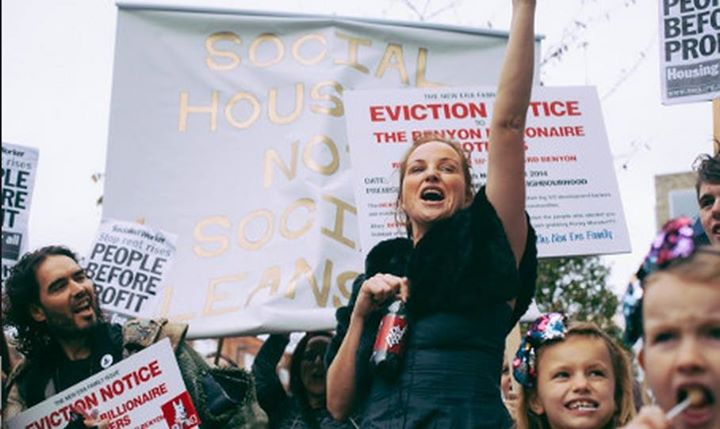
Today’s high-profile case is that of the New Era housing estate in Hoxton, which houses over 90 families at below-market rate rents. Earlier this year, the estate was bought by American property management company Westbrook Partners, who announced their intention to serve notice to the tenants, refurbish the flats and let them at market prices.
[The estate was] built by a charitable trust in the 1930s in order to offer working-class residents affordable private rented accommodation. Even when the blocks were sold this spring, residents say they were assured that the old tenets would apply. Within weeks, new owners told them that rents would rise to market values: spiralling from £600 a month for a two-bed flat to something closer to £2,400. That was meant to happen by summer 2016. After [Conservative MP Richard] Benyon’s firm pulled out of the deal last week, residents were told that Westbrook would accelerate the process.
Back in August I was on London Live TV alongside politics.co.uk editor Ian Dunt, debating the contentious issue of gentrification, and whether it is something to be welcomed or a shameful exercise in social cleansing. Never one to duck a challenge, I argued in cautious defence of the principle of gentrification and the seemingly interminable dereliction-hipsterisation-bankertown cycle, and said that the benefits of gentrification would outweigh the costs – if only Britain would start building new housing supply at the rate and volume we need.
Three months later and I stand by my argument. But as successive governments have failed to stand by their pledges to tackle the housing crisis, gentrification rightly remains a hot-button issue; we should all be concerned that increasing numbers of people are not just being priced out of their neighbourhoods into slightly cheaper adjacent areas, but are having to contemplate moving half way across the country, far from families and support networks, in order to be able to afford to keep a roof over their heads.
This blog has always been an enthusiastic proponent of free markets and maximal personal freedom, and will continue to fight that corner. But when housing supply is artificially restricted through NIMBYism, political cowardice and simple bureaucratic ineptitude, interventions in the market become not only plausible but even desirable. Since the government is in effect already picking winners – choosing to bless existing homeowners with rapidly increasing house prices at the expense of those trying to get on the property ladder or live anywhere in the south east of England – any possible reticence about siding firmly with the underprivileged, the vulnerable and the low paid goes out the window.
The time has come to institute an annual British Thanksgiving holiday
Take a trip to your friendly local Asda superstore in the next day or so and you will be treated to back-to-back in-store announcements about their upcoming Black Friday sale. “Get ready for Black Friday!” chirps the voiceover, as a cheerful, disembodied man tempts you with sweet promises about this magical event of a retail experience. Yes, Black Friday is coming to Britain.
This is as strong a contender for Tasteless Corporate Act of the Year (Large Retailer category) as we are likely to witness this side of Christmas. Asda, owned by Wal-Mart, has successfully imported the grubby, commercially lucrative, post-coital rump of a cherished American national holiday – Thanksgiving – while neatly skipping over all the pesky fundamentals that give it meaning in the first place: you know, those interminably dull things such as love, family, gratitude and patriotism, tiresome distractions that will never generate a good Return On Investment.
I was outnumbered, but I made the case as strongly as I could that what Britain desperately needs is a public holiday that can bring us all together as one people – not another cynical, politically correct nod to multiculturalism.
The possibilities for such a unifying British public holiday are endless – after all, what other country has as rich a history on which to draw when trying to choose a new national holiday? I suggested a few potential examples at the time of the debate, but my list is by no means exhaustive. Britain has achieved so many military, scientific, cultural and social victories that continue set us apart as a truly exceptional, indispensable nation, the only difficulty would be narrowing the crowded field to a single expression of who we are and what we have accomplished.
But this year, perhaps more than ever, we need a British Thanksgiving holiday. Despite Britain’s economic recovery, many of us continue to live in the long, cold shadow of the great recession, with squeezed, stagnant or non-existent wages spread too thinly to pay for the basics and comforts of life. As our mainstream political parties scrap over the elusive centre ground and ideologically merge with one another, the British people themselves are becoming increasingly polarised and less able to empathise with or respect those with differing political views. There is a steady trickle of young, disaffected British Muslims who feel so little allegiance to their mother country that they are stealing away to Syria to pose with guns, play soldier and fight for ISIS. And it was less than three months ago that our United Kingdom nearly tore itself apart for good, as Scotland came unnervingly close to voting to secede from the union.
Whatever the improving economic indicators say, all is not well in today’s Britain. Whether you are indignant about ongoing austerity or mad as hell about uncontrolled immigration and its effect on the labour market, chances are that you believe Britain is on the wrong path, and are probably also sceptical that things will significantly improve in the near future. Now, of course giving Britain’s hard workers another statutory day off every year won’t make all of these problems go away. But if we picked the right day, selected the right cause or event to commemorate our shared British civic heritage, it might just shore up the foundations a little bit and help us to ride out the storm together.
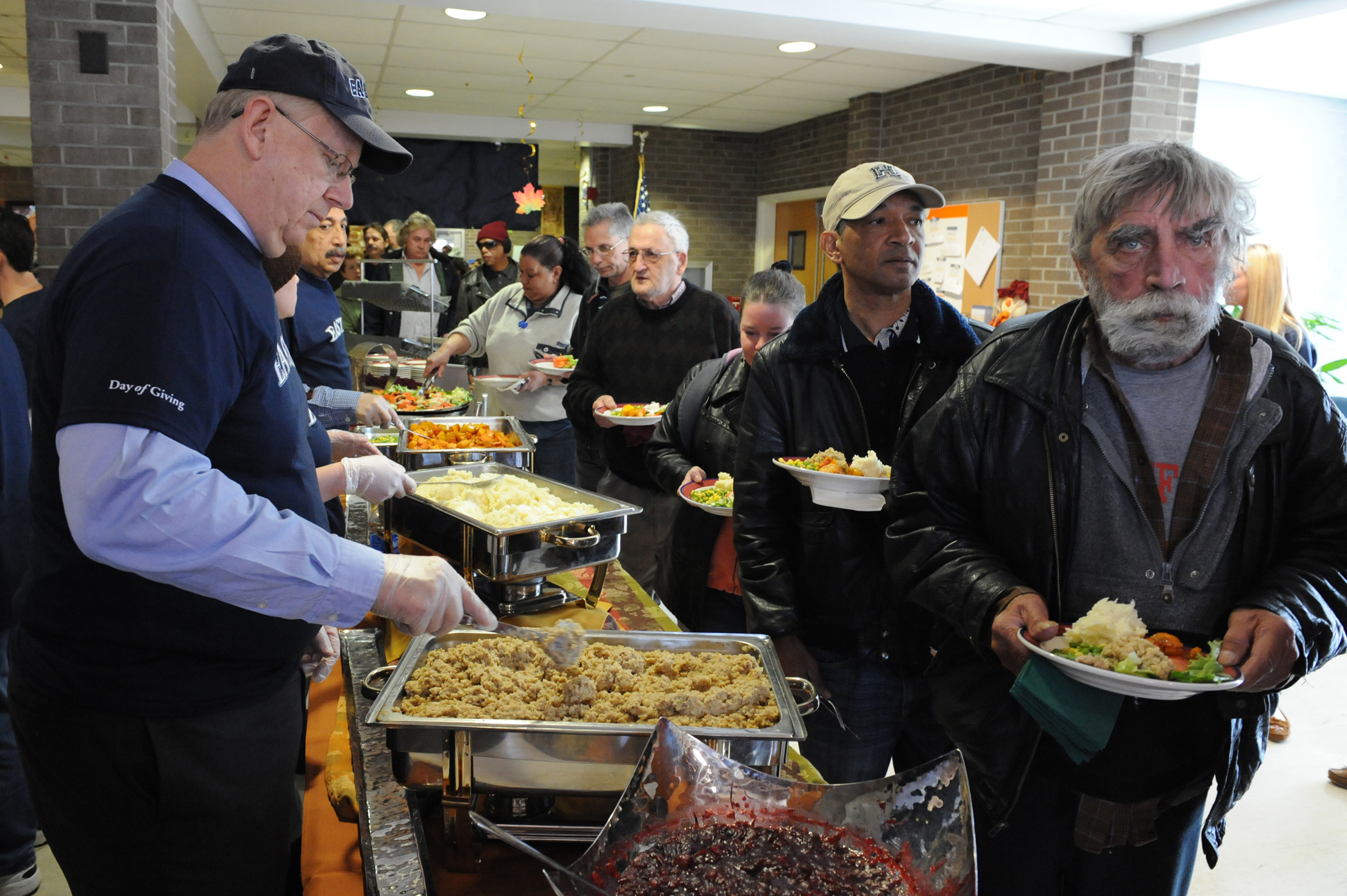
Americans continue to faithfully observe their national Thanksgiving holiday in good times and bad, showing the world that it doesn’t necessarily require a fat wallet to get together with loved ones and be grateful for what we have. But perhaps we British need an extra reminder of this fact – we tend to obsess a lot more than our American cousins about what we should be getting from the government, be it benefits or public services, and are consequently more likely to feel continually aggrieved and bitter at the inevitable shortfall. Maybe it would do us all good if we had imposed on us a day where we were strongly encouraged to think about our blessings, and the difference that we – not government – can make in the lives of our fellow citizens.
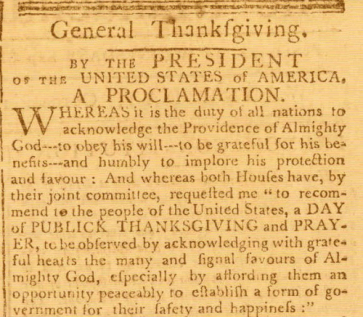
For the sceptics out there, there is ample precedent for starting a new holiday – Canada has also long observed a day of thanksgiving, though its present position in the calendar was not fixed until 1957. American expressions of thanksgiving were also sporadic and uncoordinated until President Abraham Lincoln fixed the date as the final Thursday in November, while the Civil War still raged. These timings proved wise – contemporary Thanksgiving in North America acts as a bulwark against the encroachment of Christmas, and stores only get into the swing of Christmas once the Black Friday sales are over, a state of affairs which would be very welcome here.
Wouldn’t a British Thanksgiving be the perfect antidote to the incessant commercialisation and forward creep of Christmas, the decorations raised in late September, supermarket mince pies that expire in November, discordant Christmas songs blasting out from every shopfront and the inevitable, vapid re-release of “Feed The World”?
After a long, hard recession, a bruising recovery and a year in which the idea of what it means to be British has become increasingly muddled and uncertain, let’s humble ourselves and dare to take a lesson from our former colony. Let us find inspiration in our storied history, our unsurpassably rich culture and also from within our own hearts. Let us find that elusive common thread of Britishness that should unite us all, transcending race and religion and politics, and cling to that thread in these difficult times.
And even though gratitude does not always come easily and the words may sometimes stick in our throats, let us remember to give thanks for one another, and for our United Kingdom, the guarantor and protector of all that we have.
–
Support Semi-Partisan Politics with a one-time or recurring donation:
–
Agree with this article? Violently disagree? Scroll down to leave a comment.
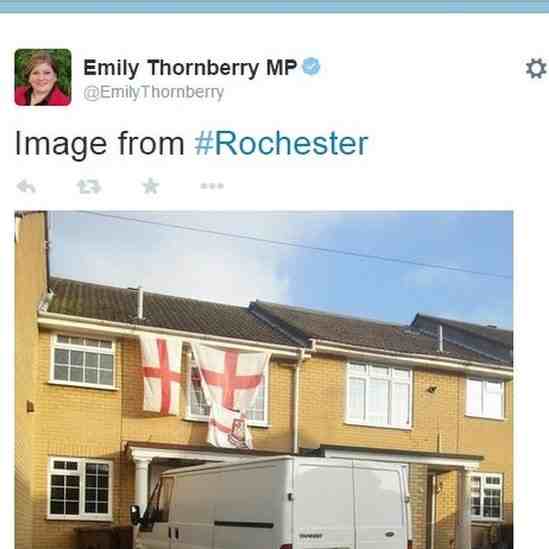
That’s all it took to bring Labour MP Emily Thornberry‘s front bench career as Shadow Attorney General to an end, after being tried and found guilty in the High Court of Social Media of the crime of… taking a picture of a house, and posting it on Twitter whilst out campaigning in Rochester and Strood on the day of the by-election.
Emily Thornberry has resigned from the shadow Cabinet for sending a Tweet that appeared to mock a Rochester voter who was flying several St George’s Cross from their window and had a white van parked outside. Thornberry’s resignation follows Miliband aides briefing that the leader was the angriest they’d ever seen him after being told about the tweet. All this shows just how sensitive Labour is to the charge that it is now a party run by a metropolitan elite who have little connection with the party’s traditional working class base.
Let’s step back. The tweet “appeared to mock” the Rochester and Strood resident? Only someone with the psychic ability to read Emily Thornberry’s mind could know whether she intended to mock him or not. A picture of a house and vehicle cannot by themselves constitute mockery, and the terse caption “Image from Rochester” is equally inscrutable. Anyone other than Emily Thornberry claiming to possess full knowledge of the spirit in which the picture was taken and posted is vastly overestimating their journalistic, political or clairvoyance skills.







 Semi-Partisan Politics