The Labour Party’s Rocky Road To Redemption, Part 2 – Pat Glass Edition

The Labour Party still shows no signs of having learned to stop hating half the country

Earlier this week, this blog looked at Tristram Hunt’s effort to combine feedback from various personalities within the Labour Party into a coherent narrative explaining why they lost the 2015 general election. As we saw, it hasn’t got off to the best of starts.

But quoting extensively from a failed parliamentary candidate who unabashedly declared that there is nothing good about British culture and power (as Tristram Hunt did when he quoted the losing Harlow candidate Suzy Stride) is nothing compared to the latest self-inflicted wound administered to the party by one of its own sitting MPs.

Next to enjoy her moment in the sun is Europhile Labour MP Pat Glass, who while campaigning in Derbyshire for Britain to remain in the European Union had some rather choice words to describe her encounter with a man who raised concerns about immigration.

From the BBC:

A Labour MP campaigning for the UK to remain in the EU has apologised after being recorded calling a voter a “horrible racist”.

Shadow Europe minister Pat Glass made the comments after an interview with BBC Radio Derby in Sawley, Derbyshire.

She said: “The very first person I come to is a horrible racist. I’m never coming back to wherever this is.”

[..] The man Ms Glass is believed to have been referring to said he had spoken to her about to a Polish family in the area who he believed were living on benefits, describing them as “spongers”, but denied being racist.

The North West Durham MP said: “The comments I made were inappropriate and I regret them.

“Concerns about immigration are entirely valid and it’s important that politicians engage with them.

“I apologise to the people living in Sawley for any offence I have caused.”

Let’s be honest – Pat Glass isn’t sorry that she made the remarks. She is sorry that she was caught making the remarks, which is very different. For just as surely as rich Californian donors bankrolling then-candidate Barack Obama understood exactly what he meant when he made his dog-whistle comments about backward Southerners clinging to their guns and religion, so Pat Glass’s intended audience knows exactly what she means when she recoils in mock horror after an everyday encounter with someone sceptical about immigration.

Because like the current Labour Party as a whole, Pat Glass’s audience is not the entire country. Her audience is not even everyone on the Left. And it certainly isn’t the “white working class”, with whom Labour now have such a fractious relationship. Pat Glass’s preferred audience is the same middle-class clerisy which cheered on Ed Miliband, whose sheltered home counties wishy-washy Fabianism renders them utterly capable of identifying with the hopes, fears and dreams of whole swathes of the country.

As is often the case, the initial reflex tells us everything that we need to know. And Pat Glass’s reflex on being confronted with the voter in question was not to attempt to understand their viewpoint and see the world through their eyes, but rather to high-handedly dismiss them as being beneath her dignity. Glass knows that both the EU and high net migration are both unabashed goods, and anybody who deigns to disagree with her is uneducated at best, or “racist” at worst. Why bother to hide it?

(Incidentally, Andrew Neil does a great job skewering Labour apologist Zoe Williams in the Daily Politics clip shown above, taking her to school on the difference between racism, xenophobia and bigotry).

We have seen this story play out before, and we will see it again. Mostly because it is how many Labour Party MPs and activists actually feel, and speaking the truth in an unguarded moment is a perennial occupational hazard in politics. Of course, under Jeremy Corbyn, Pat Glass can comfortably expect to receive no censure. Ed Miliband, obsessed with outward appearances, went too far the other way in the case of the Emily Thornberry St. George’s flag Twitter picture, purging Thornberry from his shadow cabinet.

But whether the Labour Party is breezily ignoring the issue or wildly overreacting out of concern for bad PR, the one thing that the party still shows no inclination for doing is actually reaching out to their scorned working class base and asking – pass the smelling salts – whether they might actually have a point? Until now, the best that Labour have managed to do in this regard is to put up a few spokespeople to say something along the lines of “of course it’s not racist to be concerned about immigration”. But this is then immediately followed by the pivot to “but here’s why they are wrong, and the EU / unlimited immigration is actually great”. In other words, the Labour Party are trying to tackle this gulf between the party leadership and the disaffected working class base as a problem of optics rather than a fundamental disagreement over policy.

Maybe the Labour Party will struggle along all the way through until the next general election without resolving the inherent tension between the multiculturalist direction set by the leadership and the more nativist attitudes held by those of their supporters who drifted away to UKIP or stayed home during the 2015 election. But unless Jeremy Corbyn or someone else steps forward with a concerted act of leadership, effectively “choosing a side” once and for all, the party will continue to be embarrassed in the polls when sneering Labour MPs accidentally reveal their true feelings about the working classes.

As this blog recently put it:

First, Labour must learn simply to tolerate the country again – to look upon the white working class and others of their former supporters not as godless infidels who spurned the One True Faith and threw their lot in with the genocidal Tories and racist Ukippers, but as decent and rational human beings who simply don’t like what the Labour Party is currently selling.

Meanwhile, Labour shadow ministers and the army of activists who knock on doors and deliver leaflets need to dial down the moral sanctimony from 100 to about 50, and accept that maybe they, rather than the electorate, made the mistake on May 7 (and the days leading up to it) last year.

At present, whether it is Pat Glass or the Labour In For Britain crowd in general, the scorn and contempt heaped by major party figures on otherwise natural supporters who fail to toe the correct line on immigration and the EU speaks volumes. The people are not stupid. They know when they are being mocked, and they will not buy the subsequent walkback and fake expressions of contrition.

So perhaps this is a split which needs to happen. Just as the Tories desperately need a cleansing fire to purge their ranks of all the wets and panting europhiles post-referendum, maybe the Labour Party needs to split into two new parties – one comprised of middle class luvvies who think they know best about what the working classes need, and another new party comprised of actual working class people who do not need sanctimonious young Corbynistas, Hampstead dwelling champagne socialists or the likes of Pat Glass to defend their interests.

Right now, this is an open question. But the antics of people like Pat Glass are making it a slightly less difficult one to answer.


Pat Glass - Labour In For Britain - EU Referendum - Immigration - Racist - Sawley Derbyshire

Bottom Image: BBC

Support Semi-Partisan Politics with a one-time or recurring donation:

Agree with this article? Violently disagree? Scroll down to leave a comment.

Follow Semi-Partisan Politics on TwitterFacebook and Medium.

Remain Supporters Are In Denial About The Nature And Purpose Of The EU

Owen Jones - EU Referendum

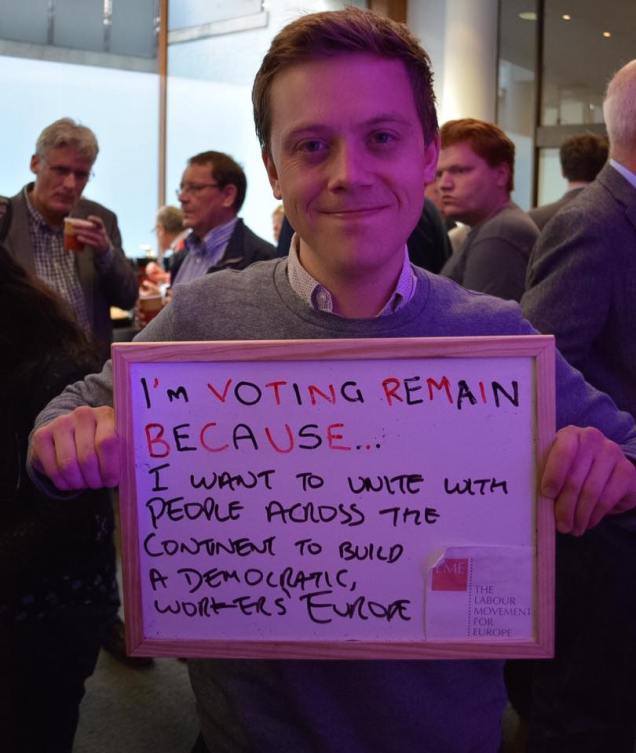
I’m voting Remain because Puppies For Everyone!!! The denialism and wishful thinking about the European Union’s true purpose and direction of travel exhibited by pro-EU left-wingers is off the charts

The Great Disappointment of the eurosceptic Left, Owen Jones, has popped up with a new contribution to the EU referendum debate in the form of the picture shown above, being widely shared on social media (albeit sometimes in cheekily photoshopped format with the message changed).

While this blog does not usually bother commenting on internet memes, this one is noteworthy because it simultaneously

  1. Sums up the entire basis of left-wing EU apologetics, and
  2. Reveals just how flimsy is that argument

The sign held up by Owen Jones proclaims:

“I’M VOTING REMAIN BECAUSE… I want to unite with people across the continent to build a democratic, workers Europe”

And I want to own a unicorn that shoots fruit based candy out of its ass and grants me three wishes a day, but sadly that is not on offer from the EU, just like the “workers’ paradise” lusted after by Owen Jones isn’t on the menu from Brussels either.

This referendum is serious business. So can Remainers please stop projecting whatever they desperately wish the EU to be onto an organisation which has never really been about friendly trade and cooperation, but is actually all about slowly and inexorably becoming a supranational government of Europe. And which is not going to abandon that long-held goal just because the British are now expressing a few doubts.

I’ve read the history of the EU. I strongly advise others to do the same. And if they still want to Remain, having understood the true nature of the grand projet, they should at least have the decency to admit out loud precisely what it is that they know they are committing us to.


For those interested in that history, here is a good starting point.


European Union - United Kingdom - Britain - Flags

Agree with this article? Violently disagree? Scroll down to leave a comment.

Follow Semi-Partisan Politics on TwitterFacebook and Medium.

The Labour Party’s Soul Searching Exercise Is Off To An Unpromising Start

Finally, a glimmer of self-awareness from within the perennially self-satisfied Labour Party. But there is a long, difficult road ahead if Labour are serious about reaching out to their legions of disaffected former voters, and it is far from certain that senior party figures have either the stamina or the humility to make the journey


What makes us great as a country is not our culture, it’s not our wealth, and it’s definitely not currently our footballing abilities.” – Suzy Stride, Labour Parliamentary Candidate for Harlow, 2014


Apparently Tristram Hunt has been filling the time freed up through refusing to serve in Jeremy Corbyn’s shadow cabinet by having a good, long think about why the Labour Party imploded quite so badly under the hapless leadership of Ed Miliband.

Hunt’s principle contribution to this process of soul-searching has been to assemble and edit a book of essays by various people within the party, each one ruminating on the cause of their defeat. The common thread which emerges, unsurprisingly, is the profound extent to which the increasingly metropolitan, middle-class core of the modern Labour Party has diverged from the “white working class”, to the extent that the Labour leadership (and many activists) had almost nothing to say to Britain’s strivers going in to the 2015 general election.

Hunt previews this new book – “Labour’s Identity Crisis” – in an article for the Guardian, and it makes fascinating reading, though probably not for the reasons that its author would like. For it reveals the absolute mountain which Labour has to climb just in order to appear relevant to those voters who have deserted the party for UKIP or the Tories.

Hunt begins:

“I’m a white working-class Englishman who isn’t on benefits, Labour isn’t for people like me.” That was the brutal message that confronted the Labour party candidate Suzy Stride on a doorstep in Harlow, Essex, during last year’s general election.

It was a sentiment repeated across the country: Labour didn’t speak for England. Worse, in that remarkable tweet from the Islington MP Emily Thornberry  – picturing St George’s crosses adorning a semi in Rochester – we seemed to mock it.

It’s very interesting that Tristram Hunt should kick off his article with a quote from failed 2015 Labour parliamentary candidate for Harlow (my hometown), Suzy Stride. Because this is what Stride had to say about the country which gives her life and liberty back during the 2014 Labour Party Conference:

“What makes us great as a country is not our culture, is not our wealth, and it’s definitely not currently our footballing abilities. What makes us great is that we have the dignity to care for those who are most vulnerable. So when did it become acceptable to make parents queue for food at foodbanks?”

This is someone who stood before the electorate asking for their vote only months after boasting on television that she believes there is nothing special about her country, its culture, history or achievements, and that the only thing which we on this rainy island have to be proud of is the fact that we confiscate ever more money from the most productive people in society and blast it indiscriminately at anybody declared by the Labour Party to be “vulnerable” (currently hovering at around 50% of the population, in terms of net welfare recipients).

And yet up pops Suzy Stride in Tristram Hunt’s book, acting as though the seeds of her defeat were sown not by her own contemptuous attitude toward her country, but rather by the mistaken priorities and poor leadership of the national party. The man who went on to beat Stride by 8,350 votes, incumbent Conservative MP Robert Halfon, understands that in fact our culture is great, as is our history, our wealth and global power. And while he is far from being a Thatcherite right-winger, Halfon at least appreciates that the greatness of our country is more than the sum of our public services. Faced with a choice between the two candidates, it was no contest for the voters of the bellwether constituency of Harlow.

Tristram Hunt quotes Stride again, at the end of a long passage on immigration:

For too many voters, we were still the party that had once dismissed Gillian Duffy as “bigoted” for raising the question of mass migration and cultural change. Labour still has a long way to go to acknowledge the post-2004 influx as one of the most dramatic demographic surges in the history of England. As a result, England has changed in cultural and ethnic composition with an intensity many voters understandably find deeply unsettling.

For at the same time as new migrants found work, manufacturing was laying off workers in the face of increased global competition. There was no direct link between the jobs gained and those lost, but the conjunction of immigration, globalisation and job losses left a toxic political legacy: industrial communities in England saw their way of life change under a Labour policy for which democratic consent was never sought, let alone given. Even worse was an unwillingness by Labour activists to acknowledge the problem. According to Tim Bale, professor of politics at Queen Mary, University of London, eight out of 10 Labour party members think that immigration is good for the country. This is not the case on most doorsteps in Labour areas. And when, in 2015, English voters raised cultural concerns about changes in language, dress and social norms, we answered with crass, material responses. “Many middle-class Labourites scoffed at such views,” according to Suzy Stride in Harlow. “Where would the NHS be without immigrants?” was a common response from canvassers, she said.

This is actually a very good passage, and is the closest we have yet come to anything approaching contrition for the way that the New Labour government of Tony Blair waved through an unprecedented influx of immigrants without so much as mentioning it to the British electorate, let alone seeking their permission. Whether one is generally pro or anti-immigration (and this blog is very much pro), we should all be able to agree as democrats that such a significant national change, brought about by stealth, was an unconscionable act of arrogance by the Blair government. The fact that many Labour activists still have to be coaxed ever so gently toward this realisation is itself a sign of how much atoning the party still has to do.

Tristram Hunt then gets to the core of it:

A failure to appreciate the value of Englishness played an important role in our 2015 defeat and nothing Corbyn has done as leader has changed this. Indeed, his cosmopolitan views on immigration, benefits, the monarchy and armed forces are likely to have exacerbated the disconnect.

As George Orwell put it: “In leftwing circles it is always felt there is something slightly disgraceful in being an Englishman and that it is a duty to snigger at every English institution, from horse racing to suet puddings.” He was right: in no other progressive European tradition – from the French Socialist party to Spain’s Podemos – do you find a similar reluctance to fly the flag.

So there are obvious reforms for Labour to pursue: an English Labour party; a referendum on an English parliament; radical devolution to cities and counties. Alongside that, we have to be careful during the EU referendum campaign not to alienate those millions of Labour voters opting for Brexit. But more than that, what these tales from the 2015 campaign expose is Labour’s need to shed its metropolitan squeamishness about England. It needs to express its admiration and love for the people and culture of this great country.

An admirable sentiment, but at present a futile hope. As Hunt himself admits, the election of Jeremy Corbyn to the leadership of the Labour Party has done nothing to change the core of the party’s disdain for that bulk of people lumped together under the umbrella term “white working class”. While this blog hailed Corbyn’s leadership bid not because of his odious foreign policy opinions but because of the opportunity he represents to inject some real partisan choice back into our domestic political debate, there is sadly little evidence that the army of new members Corbyn helped attract to the party hail from outside the urban, middle class clerisy first identified by Brendan O’Neill as the Labour Party’s new de facto rulers.

You see the effect in Jeremy Corbyn’s immediate U-turn on the European Union the moment he became Labour leader. Corbyn had always held a principled eurosceptic stance and had voted to leave back in the 1975 referendum, and yet here he is in 2016, chanting the praises of Brussels. Why? Because while the Labour party membership will forgive many things (including supporting the IRA, as Alex Massie reminds us), the one thing they cannot abide is a failure to support the mindless, anti-democratic pseudo-internationalism of the EU, or the failure to take a firm, unapologetic stance in favour of unlimited immigration. Those things are simply non-negotiable for Labour activists, most of whom can scarcely conceal their disdain for anybody who fails to hold the “correct” view on immigration in particular.

And that’s the problem. Too many Labour activists actually hate the people of this country – or at best they view those not already convinced of Labour’s righteousness as dangerously ignorant, as Tristram Hunt goes on to explain:

Jamie Reed, MP for Copeland, in Cumbria, takes the analogy further by suggesting that, if Labour fails to embrace Englishness, it will face in northern towns and villages the same fate as the Democrats in the US south: a failure to connect “culturally” with a socially conservative working-class electorate, increasingly willing to vote against their own material interests.

Jamie Reed presumptuously declares that it is the cultural issues surrounding English identity which make natural Labour supporters spurn the party and vote against their own material self interest. But this lazy “what’s the matter with Kansas?” attitude is itself part of the problem – the arrogant assumption that people are voting Tory or UKIP despite rather than because of their right wing economic policies, and that of course they would see that good old fashioned socialist policies would be much better for them, if only they were a little more educated.

The headline of Hunt’s piece in the Guardian is “There’ll always be an England – and Labour must learn to love it”. But from all the evidence currently on display, aspiring for love is setting the goal far too high. First, Labour must learn simply to tolerate the country again – to look upon the white working class and others of their former supporters not as godless infidels who spurned the One True Faith and threw their lot in with the genocidal Tories and racist Ukippers, but as decent and rational human beings who simply don’t like what the Labour Party is currently selling.

Meanwhile, Labour shadow ministers and the army of activists who knock on doors and deliver leaflets need to dial down the moral sanctimony from 100 to about 50, and accept that maybe they, rather than the electorate, made the mistake on May 7 (and the days leading up to it) last year.

If these extracts from “Labour’s Identity Crisis” – and the behaviour of Labour supporters in the year since that fateful general election – are anything to go by, the party has a lot of unresolved anger toward the British electorate. If this were a marriage, couples therapy would most definitely be in order. All of which is quite ridiculous, because it is Britain which has every right to be angry at the Labour Party, and not vice versa.

The white working class and many others spurned the Labour Party in 2015 not because they are morally defective, but because the centre-left, urban, woolly Fabianism of the Miliband era had absolutely nothing to offer them.

And what remains uncertain, despite a radical change in leadership and a plucky first attempt at introspection from Tristram Hunt, is just how the Labour Party ever expects to win a future majority when they continue to hold such a large segment of the population in open contempt?


Tristram Hunt - Labour Leadership

Support Semi-Partisan Politics with a one-time or recurring donation:

Agree with this article? Violently disagree? Scroll down to leave a comment.

Follow Semi-Partisan Politics on TwitterFacebook and Medium.

The Only Thing Paul Mason Hates More Than The EU Is Democratically Chosen Conservative Government

Paul Mason - 2

Paul Mason, enemy of democracy

“Postcapitalism” author and former Channel 4 economics editor Paul Mason is a truly nasty piece of work. For proof, one need only look at his latest sickening column in the Guardian, in which he diligently catalogues all of the European Union’s faults and inherent anti-democratic tendencies before going on to say that he can’t possibly support Brexit when the Tories are in charge, because doing so might mean that some awful right-wing people get to implement policies democratically chosen by the British electorate.

Mason begins well enough, albeit with a predictably left-wing slant:

The leftwing case for Brexit is strategic and clear. The EU is not – and cannot become – a democracy. Instead, it provides the most hospitable ecosystem in the developed world for rentier monopoly corporations, tax-dodging elites and organised crime. It has an executive so powerful it could crush the leftwing government of Greece; a legislature so weak that it cannot effectively determine laws or control its own civil service. A judiciary that, in the Laval and Viking judgments, subordinated workers’ right to strike to an employer’s right do business freely.

Its central bank is committed, by treaty, to favour deflation and stagnation over growth. State aid to stricken industries is prohibited. The austerity we deride in Britain as a political choice is, in fact, written into the EU treaty as a non-negotiable obligation. So are the economic principles of the Thatcher era. A Corbyn-led Labour government would have to implement its manifesto in defiance of EU law.

And the situation is getting worse. Europe’s leaders still do not know whether they will let Greece go bankrupt in June; they still have no workable plan to distribute the refugees Germany accepted last summer, and having signed a morally bankrupt deal with Turkey to return the refugees, there is now the prospect of that deal’s collapse. That means, if the reported demand by an unnamed Belgian minister to “push back or sink” migrant boats in the Aegean is activated, the hands of every citizen of the EU will be metaphorically on the tiller of the ship that does it. You may argue that Britain treats migrants just as badly. The difference is that in Britain I can replace the government, whereas in the EU, I cannot.

This is fair and accurate criticism of the EU. Mason rightly senses the unaccountable nature of the supranational government in Brussels, and hones in on the key point – that the EU is antidemocratic because we have absolutely no way of removing its leaders if we wish to do so.

Unfortunately, it then quickly begins to go off the rails, as Mason’s snarling anti-democratic authoritarian streak surges to the foreground:

Now here’s the practical reason to ignore it. In two words: Boris Johnson. The conservative right could have conducted the leave campaign on the issues of democracy, rule of law and UK sovereignty, leaving the economics to the outcome of a subsequent election. Instead, Johnson and the Tory right are seeking a mandate via the referendum for a return to full-blown Thatcherism: less employment regulation, lower wages, fewer constraints on business. If Britain votes Brexit, then Johnson and Gove stand ready to seize control of the Tory party and turn Britain into a neoliberal fantasy island.

They will have two years in which to shape the post-Brexit economy. Worse, the Tories will be free to use the sudden disappearance of our rights as EU citizens to reshape the UK’s de facto constitution. The man who destroyed state control of education and the man who shovelled acres of free land into the hands of London developers will get to determine the new balance of power between the citizen and the state. So even for those who support the leftwing case for Brexit, it is sensible to argue: not now. The time to confront Europe over a leftwing agenda is when you have a Labour government, and the EU is resisting it.

Waah, waah, waah. In other words, Paul Mason fully appreciates that the European Union is hopelessly undemocratic and utterly unreformable, but he refuses to either campaign or vote for Brexit because reclaiming democracy for Britain might mean that we then go on to do the “wrong” thing with our new-found freedom.

Britain’s parliamentary system of government is not a shocking new reality. Our present system of mini “elected dictatorships” spanning the length of a parliamentary term is how Britain has always been governed in living memory. And unfortunately for Paul Mason, our electoral system produced a Conservative majority government one year ago. You can argue that most people did not vote for the Conservative Party. True. But if we don’t like the system by which our governments are chosen, it is within our power to change it. Indeed we had just such an opportunity back in 2011, and decided to stick with the status quo.

So when Paul Mason frets that a Brexit under the Tories might lead to two years of “neoliberal fantasy” government, what he actually means is that Britain might be led by the government which we only recently elected together. He is fretting that an anti-democratic impediment to Conservative rule in the form of Brussels might be removed, and that the government might then seek to fulfil its manifesto outside the constraint of the EU’s political union. He is effectively presenting democracy as the scary thing to be avoided, and the European Union as the “least worst option”, one step better than democratically chosen conservative government.

Mason then goes on to make it worse:

All this suggests that those of us who want Brexit in order to reimpose democracy, promote social justice and subordinate companies to the rule of law should bide our time.

And there’s the problem, right there. Paul Mason doesn’t support an eventual Brexit because he believes in democracy or the importance of British sovereignty. He wants Brexit only as a means to imposing his own radical left-wing policies and “social justice” values on the country. When the people look likely to support these concepts at the ballot box, he chafes at the democratic impediments thrown up by the European Union barring their implementation. But when the people spurn his left wing fantasyland and choose a conservative government, suddenly Brussels becomes his best friend, his bulwark against the people he views as “closet Nazis”.

Behold the face of the Mason/Corbynite Left. This is a movement which, to their credit, has no natural love for the European Union, often seeing it for what it is, but who have shamefully taught themselves to accept Britain’s EU membership as the price which must be paid in order to successfully “lock out” conservative viewpoints and policies.

This is a movement chock full of people who love nothing more than to prance around screeching about how wonderfully tolerant and accepting they are, right up until the moment they encounter somebody with a different political philosophy, at which point any previous lip service paid to the importance of democracy or even free speech goes straight out the window.

It’s hard to say  which is worse – the fact that Paul Mason harbours these seething anti-democratic sentiments in the first place, or the fact that he is so shameless that he openly admits his desire to thwart the general election result by forming a temporary alliance with the hated European Union, swinging around to support Brexit only when the prospect of giving democracy back to Britain seems likely to deliver the kind of government he wants.

One thing is for certain, though – Paul Mason is no man of the people, and no friend at all of democracy.


European Union - United Kingdom - Britain - Flags

Top Image: Guardian

Support Semi-Partisan Politics with a one-time or recurring donation:

Agree with this article? Violently disagree? Scroll down to leave a comment.

Follow Semi-Partisan Politics on TwitterFacebook and Medium.

Yanis Varoufakis And Owen Jones – The Failed Promise Of The Eurosceptic Left

This joint therapy session between Owen Jones and Yanis Varoufakis fails to dispel the cognitive dissonance created by their respective decisions to argue against Brexit despite being such vocal critics of the European Union

Less than a year ago, this blog was remarking on what a good time it was to be a eurosceptic in Britain.

Our longed-for referendum was finally on the way after the UKIP surge and David Cameron’s desperate concession to staunch the bleeding of his own MPs to Nigel Farage’s insurgent party. Meanwhile, the Left finally seemed to be rediscovering their long-misplaced euroscepticism after witnessing Greece’s treatment at the hands of the eurogroup and finally realising that post-democratic, supranational governance is not the shining utopia they had been so sanctimoniously claiming.

Back to the present day, and once again there are many reasons for thinking British eurosceptics to despair, and precious few reasons to hope. The Leave campaign is being conducted by an official group comprised primarily of B-list politicos who actually seem to think that a group of mostly right-wing politicians prancing around the country screeching that Brexit will Save Our NHS will be a) remotely believable, and b) a referendum-winning issue.

But perhaps most depressing of all is the fact that the awakening left-wing eurosceptic movement seems to have rolled over in bed and gone back to sleep.

This is most evident in Owen Jones, who last year seemed on the cusp of rediscovering the euroscepticism of Tony Benn, only to fall back into irrational support for the European Union as the Greek crisis receded and the EU referendum drew closer.

But we also see the same syndrome appear in people who have direct and harsh experience of the European Union’s antidemocratic ways, but who nonetheless come rallying to its aid – as though their limited imaginations simply cannot comprehend a world without the EU. The prime example here is that of Yanis Varoufakis, who should know better than almost anyone the degree to which Brussels is antidemocratic by design and utterly resistent to fundamental change.

And now, in a new YouTube video [see top] we have Owen Jones and Yanis Varoufakis together in a joint therapy session, perhaps to work through the immense cognitive dissonance that both must currently be feeling from spending 2015 railing against the EU, and 2016 telling us how it is our humanitarian duty to keep the rotten enterprise afloat.

Varoufakis’s view in a nutshell:

The Left should never lose sight of the history of the 1930s. After 1929, the Left failed to create the coalition with other democrats that was necessary to prevent the descent into the abyss of the 1930s.

Now, I see such an abyss opening up in front of our eyes in the centre of Europe today. And if it does, we are going to unleash very vulgar and brutal ultra right wing forces throughout Europe, and various xenophobic tendencies that will be turbocharged by the disintegration of the European Union.

Brexit would speed up the disintegration of the European Union and in the end the only beneficiaries will be those ultra-nationalists, xenophobes, racists everywhere, including in Britain.

In other words, Britain should sacrifice her own freedom and democracy because the rest of Europe is a perpetually backward powder-keg of barely suppressed “ultra right-wing” populism and resentments which will lead us back to war faster than you can say “Treaty of Versailles”, unless we dissolve our individual national identities into a common European body.

Note how Varoufakis says that Brexit would “speed up” the collapse of the EU, not that it would precipitate the collapse. That suggests that he strongly believes that the EU is doomed regardless, but still wants Britain to remain inside the burning building along with Greece to the bitter end. Quite why Britain should sacrifice our own democracy and future economic and even political stability in this way is never explained by Varoufakis or Owen Jones.

Note too how Varoufakis is keen to say that the only ones looking forward to Brexit are the foaming-at-the-mouth racist mobs which are apparently just waiting for their signal to wreak havoc on the streets of Britain. This is a variant on the claim that we should remain in the European Union because Vladimir Putin would apparently like nothing better than for us to leave. That’s certainly an interesting way to run a country – doing the precise opposite of what Vladimir Putin might want at every single decision point – but as a general rule one would have thought it was best to focus more on what is best for Britain rather than what is worst from the imagined perspective of some other world leader.

Then we get the same pigs-might-fly optimistic leftist vision for Europe that Owen Jones has also promoted, and which Jeremy Corbyn spoke of in his recent pro-EU speech at Senate House:

Our criterion should be a broad, pan-European, democratic movement for preventing the post-modern 1930s from hitting us and future generations.

[..] I feel it in my bones that to all of us we have a duty to band together across borders throughout Europe to prevent this decline, this degeneration into an ultra right wing cesspool of xenophobia, of deflation, of loss of jobs, and this is something we can only fight at the level of Europe. It cannot be fought at the level of Scotland, of Wales, of northern England.

This is an attempt, maybe Utopian, to say “Okay, forget that we are Greek, Scottish, English, German, Italian, let’s get together as European progressives and ask ourselves a very simple question: ‘how do we stop this decline?'”

So it’s not about democracy at all. It’s about leftists from across the European continent banding together to inflict their particular worldview on a reluctant continent. Varoufakis may want to use the European Union as a megaphone to amplify his neo-Marxist message and leftist policies, but he has no intention of his Brave New Europe being a democracy – at least, not if the majority of voters prefer more right wing, capitalist ideas.

Note that Varoufakis says that these right wing terrors (mostly existing only in his mind) cannot be fought at the home nation or English regional level. But he conspicuously fails to mention that they cannot be addressed at the UK level – because, presumably, he believes that they can. Which once again brings up the question of why Britain should remain part of the European Union when Varoufakis himself tacitly admits that Britain is not in need of Europe’s help.

Varoufakis goes on to make legitimate criticism of the lack of real democratic accountability and responsiveness within the member states themselves:

What is the enemy? The enemy is the contempt for democratic processes in our national capitals and in Brussels, because the contempt that the elite has in London for democracy is only reinforced by the contempt that Brussels has.

We make decisions in pure opacity. You have no idea what George Osborne says in Ecofin on behalf of you.

But while he keeps offering More Europe as a solution, at no point is it explained why each member state should not simply strive to become more democratic in their own way and in accordance with their own traditions, culture and history.

The British parliament’s oversight of the government’s handling of EU matters is abysmal at present, with ministers, diplomats and MEPs rarely being held to anything like proper account for the decisions that they make on our behalf in Brussels. That is something which could be changed with sufficient political will – ideally as part of a far more widely reaching constitutional convention, but as a lone issue if necessary. But this is change which must come from within – the EU is never going to start issuing directives instructing national parliaments to pay much closer scrutiny to their own government’s interaction with Brussels.

Ultimately, the problem with Varoufakis’s argument is that it basically amounts to a vain struggle to bring greater transparency to European institutions which nobody wanted in the first place. Live streaming meetings of European finance ministers (to use one of his examples) is all well and good, but it does not change the fact that the entire foundations of the EU were built without the expressed democratic consent of the people.

If your right to decide unilaterally what new car you want to buy is taken away and vested in a group including of 27 of your neighbours, your family is unlikely to be greatly mollified by being allowed to watch your joint deliberations on the internet as together you hash out a compromise. Because they reject the fundamental premise of the exercise, attempting to add a thin layer of democratic gloss over the top doesn’t make it any better.

But half way through the video, Varoufakis makes an important concession, with great emphasis, saying:

The retreat to the nation state is never going to benefit the Left. Never.

And there you have it – the real reason why even the EU’s strongest critics, like Yanis Varoufakis and Owen Jones, ultimately just can’t abandon their commitment to the European Union. Because the only realistic chance they see of imposing their left-wing policies on broadly centrist or centre-right populations is by doing it through the remote and unaccountable auspices of the EU.

The Left look around and see free markets accepted and delivering prosperity in nearly every country, including those who have sworn eternal opposition to capitalism. And despite the Corbynite takeover of the Labour Party in Britain, there is still no evidence of a groundswell of public longing for 1970s style statist economic policies to be brought out of mothballs. What chance, then, does the Left have to bring more of the economy under state control other than the extreme long shot of seizing control of Europe’s supranational layer of government on the back of the supposed European left-wing popular movement (DiEM25) talked up by Varoufakis and Jones?

As Varoufakis admits, “the retreat to the nation state is never going to benefit the Left”. The Left can only advance their cause by sidestepping nation states altogether, which means taking control of the EU, where national legislatures are bypassed and unpopular and even hated policies can be imposed on the peoples of Europe with very limited opportunity for effective resistance (see Greece). This may seem laughably unrealistic – and it is. But it is the Left’s only remaining hope, and so they cling stubbornly to their delusion even if it means betraying democracy and supporting the EU in its current form (and with its current policies) until the time comes for their popular revolution.

Meanwhile, the young Left have simply grown up with the European Union, do not see it as a threat or even a problem of any kind, and have been repeatedly told that opposition to the European project is synonymous with racism and ignorance – and so they support it unquestioningly. And this puts left-wing figureheads like Owen Jones and Yanis Varoufakis (and even Jeremy Corbyn) in a pickle, because there is only so far they can lead their flocks or step outside their side’s own Overton window before the people take fright at being made to think unthinkable, heretical thoughts.

This was not a problem for the late Tony Benn. Benn was able to trash talk the European Union and talk about democracy, and he was indulged much like a crazy but beloved uncle or grandfather. And that enabled Benn to make a compelling case against the European Union and for Brexit, drawing not on left-wing or right-wing political objectives but purely on his respect for democracy.

As this blog explained:

When asked his own thoughts about the European Union, Tony Benn did not do what most contemporary Labour Party personalities do, and talk about the virtues of undemocratically imposing more stringent social and employment laws on Britain (an irritatingly less social-democratic country than our continental friends). Because Tony Benn understood that the left-wing case against the European Union was about democracy, democracy and more democracy.

Tony Benn understood that some things are more important than whether Britain might happen to move in a slightly more left or right wing direction as a short and medium term consequence of Brexit. He understood that self-determination and democracy – particularly the ability for the citizenry to remove people from office – is the first and most important consideration in determining the democratic health of a country.

And Benn understood that living in a democracy where his own side would sometimes win and sometimes lose was far preferable to living in a dictatorship where his own preferred policies were implemented through coercion with no public redress.

Unfortunately for Corbyn, Jones and Varoufakis, they do not command the universal love and respect enjoyed by the late Tony Benn. They cannot make a case for Brexit to their followers based on democracy, because in truth their followers generally do not care about democracy – they care about getting their way, and imposing their values and policies on Britain whether the people want them or not. In other words, the Left’s most high-profile EU apologists are being led by their followers – and it shows in the paucity and half-heartedness of their arguments against Brexit.

And it is in this context that we should view this fifteen minute televised therapy session between Owen Jones and Yanis Varoufakis, two intelligent people who know deep down they are on the wrong side of democracy, and are desperate to find as many reasons as possible to soothe their burning consciences.


European Union - United Kingdom - Britain - Flags

Agree with this article? Violently disagree? Scroll down to leave a comment.

Follow Semi-Partisan Politics on TwitterFacebook and Medium.