Taking Advantage Of The EEA To Ensure A Soft Landing After Brexit

All the benefits of Brexit without the risk of a “hard landing”

Could Britain avail itself of our existing EEA membership to continue trading with EU member states as part of the single market while leaving the EUs’ explicitly political organisation and structures? In a word, yes.

Ben Kelly sets out the process by which this would work – and the many advantages of this transitional step – in an ongoing series over at Conservatives for Liberty.

And in the video above, Dr. Richard North of eureferendum.com discusses the solution in detail, in an interview for Icelandic TV.

Up-to-the-minute information and commentary here.

Download Flexcit here.

European Parliament

Agree with this article? Violently disagree? Scroll down to leave a comment.

Follow Semi-Partisan Politics on TwitterFacebook and Medium.

Is Widespread Voter Apathy Acceptable In a Country Like Britain?

Voter Apathy Party - Futurama

Britain’s relative peace and prosperity are no excuse for us to shirk our duty to be informed and engaged citizens

This blog has little time – and much contempt – for voter apathy and the politically disengaged.

Only last September, while the Labour leadership contest raged, I was complaining about low-information “swing voters”:

What if the fabled political centre doesn’t exist – or is only a small group casting a large shadow, while another unacknowledged mass of voters goes unnoticed and un-courted by the main political parties?

[..] What if rather than there being a rich goldmine of real centrist voters out there – people who pay close attention to politics and legitimately arrive at a position somewhere between Labour and the Tories – there is instead just a massive, congealed fatburg of low-information voters bobbing around, people who simply haven’t paid enough attention to come to an informed opinion about the great issues of the day?

By contrast, Janan Ganesh has an interesting and thoughtful piece in the Financial Times, basically defending non-voters and holding them up as an example of everything that is going right with our society:

All politicians understand Yes, No and Undecided. Only the winners understand Don’t Much Care. Mr Cameron communicates crisply because he knows most people only tune in for a few minutes a day. He does not lose himself in marginalia that no swing voter will ever notice. Rousing a nation through force of personality is something leaders do in films: the real art of politics is accepting apathy and bending it to your purposes.

[..] Apathy is a respectable disposition in a country where, for most people most of the time, life is tolerable-to-good. There are nations with much hotter politics, and they tend to send refugees to tedious old Britain.

This should be the most obvious thing in the world. You will have several friends who match this profile of contented languor. But among politicos, on the Labour side especially, it is a shock finding. They priggishly elide apathy with dysfunction: if voters do not care, something must be wrong with the body politic.

Ganesh concludes:

Apathetic Britons are not waiting to be redeemed. They just have lives to get on with. Not only are they apolitical; they rouse themselves to vote every five years precisely to stop hot heads and crusaders from running their country. They like Mr Cameron because he governs well enough to save them having to think about politics. He is prime minister because someone has to be.

I don’t necessarily disagree with Janan Ganesh’s view of the political landscape and voter apathy as it currently stands. But I do take strong exception to any suggestion that this is how things should be in an ideal Britain, or a prosperous Britain.

Do I have the right to expect and demand that everyone else share the same interests and obsessions as me, or that they campaign for them and partake of them as loudly and vociferously as I do? Clearly not. Everybody should be free to pursue their own happiness in any way that they like, so long as they do not infringe on the rights of anyone else.

But what happens when one bloc of people acting as a bovine herd of politically disinterested consumers allows the dominant political class to get away with just about any scheme, machination or conspiracy that they choose? Such people may have the right to stay glued to Britain’s Strictly Come Bake Off On Ice while our democracy erodes and collapses from within, but does their apathy and lack of interest not infringe on my right to live in a society where the government is properly held to account? I would argue that yes, it does.

Now, I can’t tie the politically disengaged to a chair, clamp their eyes open and force them to watch Today In Parliament on an endless loop. Nor should I be able to do so. Even if we could take the hugely illiberal step of forcing such people to pay attention to politics or even make voting mandatory, by their bovine nature many of them would make ill-informed, capricious or spiteful voting choices which would hardly enrich our democracy.

But if we can all accept that the right of the non-voters to sit on the couch and fester in their own KFC grease trumps my desire to make them sit up and pay attention to several highly pressing political questions which will have profound consequences for how Britain (and even humanity as a whole) is governed in future, can we at least stop putting these bovine people on a moral pedestal?

Where Janan Ganesh goes too far in his article is when he praises the politically disengaged as a symptom of a well functioning system where all of the major existential and ideological questions have been settled, leaving nothing to argue over besides pernickety points about the technocratic management of our public services.

For in truth, some of the biggest questions facing human civilisation have indeed not yet been settled. They have just been masked and papered over by an artificial political consensus among the major British political parties and the Westminster-dwelling establishment.

There is a political consensus that the NHS is a glorious institution, a bureaucratic idol to be worshipped and uncritically praised from dawn to dusk, as well as the best way of delivering universal healthcare to a large, developed country. But the NHS model does not exist in any other major modern democracy – there is, in reality, no intellectual consensus that it is the best solution. There is just a lazy ideological consensus of convenience among the political class, who prefer to pander for votes by singing hymns of praise to the NHS rather than talking critically about how to make British healthcare better.

There is a near-universal political consensus among the establishment that the European Union is a Good Thing. That this one particular very dated mid-century form of internationalism represents the future of European governance, and that the nation state is antiquated and passé. A vocal minority of British people begged to differ, and now – despite the kicking and screaming of the establishment – we are going to have a referendum to decide whether or not we want to remain part of the Brussels club. The Westminster elite always claimed that there was such a popular pro-EU consensus that a referendum was unnecessary, but clearly this was not so.

And so it goes, from issue to issue. What are in fact gross and damning failures of imagination or political courage from the main political parties are continually presented as some high-minded form of consensus that Britain has got all of the major questions figured out. But the rise of UKIP, the Green Party, the SNP and the coming EU referendum tell us that this is in fact not the case at all.

Therefore it is worth going back to Janan Ganesh’s assertion and asking which came first: the chicken or the egg? Are many voters really disengaged and apathetic because they are broadly satisfied with the status quo and an often-artificial consensus between the main political parties? Or is this dull, suffocating consensus actually the reason why so many people are politically disengaged in the first place?

Nothing in Ganesh’s article provides convincing proof that it is the former – that millions of people stay home on election day because they are broadly happy with the way things are. That’s not to say that such people do not make up an element – potentially a sizeable part – of disengaged voters. But even these voters are not excused.

Maybe these people really are content with the status quo and impatient to get on with their lives, more concerned with moving up the property ladder or buying the latest iDevice to show off to their friends than they are with tedious subjects like welfare reform or the EU referendum.

But such people should be criticised and urged to step up, not praised or held out as an proof that the system “works”. There is nothing noble about forgetting one’s duties as a citizen as soon as one reaches a position of economic comfort and security. Having 2.4 children, a house with a paid-off mortgage and some cash in the bank does not alleviate one’s responsibility to think about how best to secure prosperity, security and freedom for everyone else. And so long as the state has the power to regulate the things which we are allowed to drink, smoke, eat, read, hear, associate with or say, we are derelict in our duty as citizens if we blithely ignore what the government of the day is doing.

Janan Ganesh does an excellent job of summarising where we are, of describing what Britain is like at the moment. But where he and I part company is our differing view of whether the status quo is anything to be remotely pleased about.

Swing Voters - Couch Potato

Agree with this article? Violently disagree? Scroll down to leave a comment.

Follow Semi-Partisan Politics on TwitterFacebook and Medium.

No, Mr. Cameron – This Is Not “Your Referendum”

As far as David Cameron is concerned, the coming EU referendum is nothing more than his personal plaything, an event to be moved about and manipulated as he pleases in order to achieve the “right” result

One throwaway line in the prime minister’s speech to the World Economic Forum in Davos yesterday captured at a stroke the sheer arrogance and duplicity behind the government’s approach to the EU referendum.

From the Independent’s summary of the speech:

David Cameron has told an audience at Davos that he would walk away from a Brussels summit in February if an agreement can not be reached on the UK’s EU Referendum.

“I want to put that to people in a referendum and campaign to keep people in the European Union. If there’s a good deal, we’ll take it. But if there’s not a good deal, I’m not going to hurry, I can hold my referendum any time until 2017,” Cameron said.

“My referendum”. Not Britain’s referendum. Not the public’s referendum. His referendum. David Cameron’s personal referendum.

Strangely, that might actually be the most honest thing that David Cameron has ever said on the subject of Europe and the coming EU referendum. Because given the fact that this cosmetic “renegotiation” has been taking place behind closed doors, with no formal demands and without any input from the British people themselves, the only fingerprints to be found on the whole rotten affair are indeed those of David Cameron and his ministers.

It is becoming increasingly clear to me (not that there was every any doubt) that this referendum will not be a fair fight – in fact, that it will be about as far away from a fair fight as it is possible to be. Just as Russia holding elections does not make that country a democracy, so the fact that the British people are being offered a Remain/Leave vote on the EU question does not mean that the outcome will be in any way legitimate.

It is possible to go through the rote motions of democracy, but do so without observing the spirit of democracy. And when that happens, neither side has cause for happiness with the outcome. If the Remain side win the referendum, their victory will be hollow, having been won on the back of a campaign built on fearmongering, outright deception and tactical manoeuvring by the government. And if (as currently seems probable) the Leave side loses the referendum, the issue will be far from settled. Many Leave campaigners, having been so blatantly cheated, will continue to rail against the European Union and do everything possible to raise awareness of its flaws and undermine the creaking structure from within. I certainly will.

The continued speculation over when exactly “David Cameron’s referendum” will take place is tedious and dispiriting. It should not be considered naive to hope for a prime minister – a leader – who sets out to do the work of the people, representing them and fighting for their priorities and interests in an honest, transparent manner. But in David Cameron we have a prime minister who gives every appearance of negotiating with the British people (or at least manipulating them) on behalf of the European Union, rather than the other way around.

All of this takes place between David Cameron’s repeated assurances to the European media that he feels “deeply European” from the “bottom of his heart” – either forgetting that in the year 2016 it is not possible to say something while abroad without it instantly filtering back home, or simply no longer caring about enraging eurosceptics by flaunting his own passionately pro-EU position.

Fine. Be that as it may. David Cameron was never a eurosceptic or a supporter of the Brexit cause, and at this point nobody expects anything else from him. But having so obviously sought to stack the deck in order to achieve his desired outcome from the referendum, the prime minister has no right to expect us to shut up and accept a future “Remain” vote when he has interfered with the process and undermined democracy at every turn.

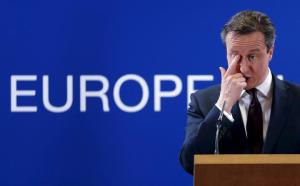
David Cameron - European Union

Agree with this article? Violently disagree? Scroll down to leave a comment.

Follow Semi-Partisan Politics on TwitterFacebook and Medium.

Small Minds Discuss People: The Media’s Coverage Of The EU Referendum

Boris Johnson - Theresa May - EU Referendum - Brexit - Conservative Party

The EU referendum is about the British people, not the Westminster game of thrones

Another day brings another tiresome round of court gossip about which Conservative ministers might potentially campaign for Britain to leave the European Union in the coming referendum.

This time the breathless gossip is reported in Guido Fawkes:

A co-conspirator tucking into his ravioli in Westminster’s Quirinale restaurant looked up to see Theresa May and Liam Fox settling down to lunch. An hour earlier Fox had asked the Home Secretary for assurances over the government’s line on Russia, so you can bet that was on the menu. Though the main topic for discussion will almost certainly have been Europe.

There has been speculation that May has been meeting with leading Eurosceptics as she keeps her options open ahead of the referendum. Where better for Dr Fox to lobby her to lead the Out campaign than one of the pricier Italian restaurants in SW1? 

While the Evening Standard gushes about Boris Johnson:

What vexes the fledgling campaign to stay in the EU is the prospective behaviour of Boris Johnson and Theresa May: in the words of one Westminster insider, “they are the only players who could change the weather”.

True enough. Boris has the popular appeal to make the Out campaign blossom with optimism and good cheer, ridding it at a stroke of its negative, wintry disposition. May, on the other hand, would bring the authority of a great office of state to the Brexit campaign. Both politicians are taken seriously within the Tory tribe as prospective successors to Cameron. Small wonder that their every move is being scrutinised so closely.

Seasoned Boris-watchers (or Bozzologists) admit that his behaviour is presently inscrutable. Those I have spoken to incline — just — to the view that he will decide eventually to stick with the In camp, though without much conviction.

Before going on to say of Theresa May:

In 2010 May was startled to be given such a senior brief. Since then she has become incrementally persuaded that she has what it takes to succeed Cameron. Like Boris, she knows her leadership prospects are intimately entangled with her conduct in the EU referendum. But if she is serious about taking on the boys for the top job, she should give the Out camp a wide berth.

As Michael Heseltine used to say as he prepared his challenge to Margaret Thatcher, most contenders only have one bullet in the chamber. If May aligns herself with the Out movement, she will be handing the gun to others and inviting them to do as they please with her accrued political capital. So if her head has indeed been turned by the flattery of the Brexit crew, it should be turned back — and fast.

Because we all know that the really important thing in this referendum is not the profound and historic choice that the British people will make about how we wish to be governed in the twenty-first century, but rather the salacious court gossip over which cabinet ministers and wannabe future Tory leaders will risk their bright young (or not-so-young) careers by allying themselves with the Brexit cause.

Never mind that awkward S-word, sovereignty. That’s boring. Never mind a detailed and difficult discussion about the realities of global governance. That would require research. Proving the adage that great minds discuss ideas, average minds discuss events and small minds discuss people, most of the British media is happy to talk about people and the petty personalities involved in the public debate, to the near total exclusion of everything else.

If you want serious, granular analysis and argument on either side of the referendum debate, there is no point looking in the pages of the Times, the Telegraph, the Guardian, the Spectator or any other publication claiming prestige. All you will find there are thinly veiled press releases from one or other of the groups squabbling for lead designation, or worryingly naive editorials from household name commentators who sound suspiciously like they have done no independent research of their own. Very unimpressive.

No, for serious analysis you have to turn to the blogosphere, and sites like eureferendum.com and Leave HQ on the Brexit side, or Hugo Dixon on the Remain side. And the difference is like walking from a junior school classroom to a tutorial room at Oxford or Cambridge. Absent are the mindless platitudes and stale (often long-ago disproven) talking points that are so often repeated on television and in the broadsheets, and in their place are references to the real, murky world of global regulation – a world which, once discovered, proves that the EU is not the “top table” as europhiles blithely claim, but also that an orderly Brexit would not lead to an instant “bonfire of the regulations” as some on the Leave side stubbornly insist.

Some eurosceptics and Brexiteers would say I am wasting my time by even bothering to mention low-grade newspaper gossip such as the Boris Johnson vs Theresa May game of thrones. And they have a good point, to a degree. This referendum is about the British people and what they think is best, not what government ministers, opposition politicians or establishment media figures may want. Fair enough.

But you can’t just look at these shenanigans in isolation. Is the coming Brexit referendum the most important thing to happen politically in a generation? Yes, absolutely. But that does not mean that we should focus on the referendum outcome to the extent that we ignore the failings and misdeeds of the political class who were here before the referendum became a reality and will (sadly) be here long after it is but a footnote in history.

There is the future stewardship of the country to think about. And I want Britain’s future political leaders to be (so far as possible) principled people with the courage of their convictions. If they claimed to hold a certain view on an important issue like Britain’s membership of the European Union to get elected, they should then follow that through once in office.

Consequently, this blog will be taking a very dim view indeed of any Conservative politician who wrapped themselves in the cloak of euroscepticism to win selection, only to run loyally to David Cameron’s heels like an obedient dog and campaign for a “Remain” vote when it really counts.

This debate should be about ideas first and foremost. That is where this blog will focus. However – and maybe this a sign that I lack a great mind – I for one will certainly remember those people who put their personal careers ahead of their commitment to democracy when it comes to this existential referendum.

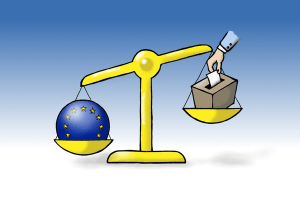
EU Democracy - Brexit

Agree with this article? Violently disagree? Scroll down to leave a comment.

Follow Semi-Partisan Politics on TwitterFacebook and Medium.

The Daily Toast: Peter Oborne, A Fellow Jeremy Corbyn Admirer

Peter Oborne is a journalist of uncommon principle; what he says should be taken seriously and treated with a measure of respect. But Peter Oborne has publicly stated his admiration for Jeremy Corbyn…

This blog has often felt like something of a voice in the conservative wilderness for not viewing Jeremy Corbyn as an unmitigated disaster for British politics.

One does not have to agree with Jeremy Corbyn’s sometimes loopy policies to admire the way his unexpected leadership of the Labour Party has shaken up a dull, lumpen, self-satisfied consensus among the Westminster elite, and put the fear of the voters back into a good many Members of Parliament who were more focused on the smooth progression of their own careers than the trifling concerns of the electorate.

That’s where this blog stands. I’m the first to criticise Jeremy Corbyn for his particularly crazy policies (like building a paper tiger nuclear deterrent with all the expensive submarines minus the all-important warheads) and his naive political operation (as embarrassingly revealed during the so-called Revenge Reshuffle). I’m also willing to give credit where credit is due, such as the holistic way Corbyn looked at education during the Labour leadership contest (and his proposed National Education Service).

What I don’t understand are conservatives who endlessly criticise Jeremy Corbyn because he doesn’t think or say all the same things as David Cameron or Tony Blair (and who could pick those two apart if blindfolded?)

Surely having two party leaders who think and say different things is the point of democracy. The fact that Britain has increasingly been afflicted with party leaders who say and think nearly identical things (once the rhetorical embellishment is stripped away) since Margaret Thatcher left office is the root of our current centrist malaise, and one of the primary reasons why a third of the electorate don’t show up to vote at general elections.

What’s the point in voting if the choice is between Prime Minister Bot A and Prime Minister Bot B, both of whom will automatically praise the NHS without looking more seriously at fixing healthcare, both of whom will tinker around the edges of welfare reform to get the Daily Mail off their backs but without doing anything substantive to fix our broken non-contributory system, both of whom are achingly politically correct at all times (“It’s Daesh, not ISIS! I can’t believe you called it Islamic State!“) and both of whom have so little faith in Britain’s ability to prosper as an independent, globally connected democracy that they strive (overtly or covertly) to keep us yoked to the European Union?

I’m a conservative libertarian. I have enough of a task on my hands trying to push the Conservative Party in a less authoritarian, more pro-liberty direction without worrying about what the Labour Party is doing every minute of the day. And I have enough confidence in my political worldview that I believe conservative principles will win the battle of ideas when promoted and implemented properly (hence my ongoing despair with the current Tories).

But many of my fellow conservatives, particularly those in the media, are in despair at the rise of Jeremy Corbyn and the return of real partisan politics. Why? Their professed concern that Britain have a “credible” opposition (meaning one almost identical to the governing party in all respects) stretches belief to breaking point and beyond. I can only think that their fear of Jeremy Corbyn reflects some personal doubt that their own political ideas and philosophies might not be superior after all – that Jeremy Corbyn might actually win people over in large numbers and have a shot at taking power.

I have no such fear. I believe that the principles of individual liberty and limited government beat discredited, statist dogma hands down, every day of the week. And I believe that the rise of Jeremy Corbyn might force conservatives to remember why they hold their views in the first place, and even refine and improve their own ideas through rigorous debate – if only they could get over their collective outrage that a socialist is in charge of the Labour Party.

In this spirit, I share the video of Owen Jones’ recent conversation with former Telegraph columnist Peter Oborne – see above. Oborne is an articulate writer, an unapologetic conservative and a thoughtful journalist of real integrity. That Peter Oborne also finds something to admire in Jeremy Corbyn (despite disagreeing with him politically) is helpful reassurance that I am not alone.

I don’t agree with everything that Oborne says in the video. But on the near-conspiracy of the political class and the media to undermine Corbyn (not to merely disagree with him but to portray his ideas as “unthinkable”) and on foreign policy (castigating our closeness with Saudi Arabia, an odious regime with whom we fawningly do business and lend our diplomatic legitimacy in exchange for oil and intelligence) he is spot on.

And I think that’s what makes Jeremy Corbyn’s detractors so angry. No man can be consistently wrong about everything all the time, and on rare occasions Jeremy Corbyn gets it conspicuously right – such as with his criticism of our closeness with the Saudi regime. People accustomed to either being in power or just one election away from power look at somebody who (whatever other baggage he may have) is unsullied by the continual act of compromise and ideological drift, and it makes them mad. It forces them to ask themselves how many of the compromises, reversals and deals from their own careers were strictly necessary, and how many resulted either from failures of courage or pursuing power for its own sake.

Sometimes, the haters were probably right to do what they did. Governing a diverse nation of 65 million people is not possible without the art of compromise, as Jeremy Corbyn would soon discover if the impossible happened and he became prime minister. But sometimes they were not. And the cumulative effect of all of these small compromises by Labour and the Conservatives over the years were two very slick but ideologically bankrupt political parties that looked and sounded nearly exactly the same on a whole host of issues. Issues (like the EU) which the political class had arrogantly deemed to be settled once and for all, though the voters had other ideas.

I understand this. I sense that Peter Oborne understands this. And if that means there are still only two non-Corbynites in Britain who don’t think that Jeremy Corbyn’s leadership of the Labour Party is an unmitigated disaster – well, at least I’m in good company.

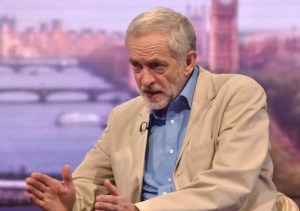
Jeremy Corbyn - Labour Party - Andrew Marr Show - BBC

Agree with this article? Violently disagree? Scroll down to leave a comment.

Follow Semi-Partisan Politics on TwitterFacebook and Medium.