Tales From The Safe Space, Part 50 – University of Maryland President And Students Vie For Coveted Victim Status

latinx

Waah, waah, waah

What happens when SJW students and their university president become locked in a social justice victimhood showdown, each trying to claim offence and present themselves as having been somehow harmed by the other in a gruesome yet compelling display of whinnying, childish immaturity?

The University of Maryland shows us exactly what happens.

Campus Reform reports:

University of Maryland President Wallace Loh inadvertently outraged liberal students by using Spanish while pledging to protect illegal immigrant students, a move deemed “offensive” to UMD’s immigrant population.

Much of Loh’s annual State of the Campus Address was a “a clear call to embrace diversity,” according to The Diamondback, including a promise to protect illegal immigrant students on campus by barring immigration officials from campus if they don’t have a warrant and refusing to voluntarily share undocumented student information.

“These are the things that we will commit to, that we will do and will not do in order to create a safe and supportive learning environment,” he declared.

His repetition of the same statement in Spanish, however, raised eyebrows among some members of the crowd, even though he had employed a similar tactic in a campus-wide email last month in which he first outlined UMD’s intent to resist federal immigration enforcement efforts.

Student Senator Ashley Vasquez, for instance, complained that Spanish “does not represent the entire immigrant community here” during a post-speech Q&A, asking Loh if he would like to apologize for repeating his promise in Spanish.

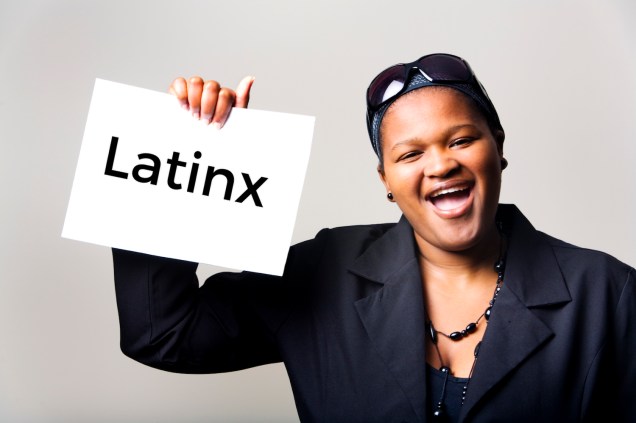
Vasquez later told The Diamondback that she found Loh’s use of Spanish offensive because it implied that the only immigrants on campus are “Latinx.”

This is brilliant on so many levels.

Firstly, why make the comment in Spanish at all? Is anybody studying at the University of Maryland incapable of speaking English? (Hint: No) Is this part of a policy of general bilingual communications, signs, written and verbal instructions at the university? (Hint: No again). The only reason for President Wallace Loh to make such a gesture is that it affords him a quick and easy way to signal his own virtue, his acceptance of absolutely all kinds of immigration, legal and illegal, moral and immoral.

To see Wallace Loh then called out by a professional offence-taking student for oppressing immigrant students of other backgrounds by failing to pander obsequiously to their own native languages is in many ways inevitable. Just as straight gay men are often no longer considered sufficiently “oppressed” to warrant full coverage under the Social Justice umbrella, so it may soon come to pass that “Latinx” students, being so plentiful in the United States, find themselves summarily deemed relatively privileged and cut adrift as the SJWs go looking for rarer and more exotic immigrants to defend.

And if one accepts SJW logic, who can argue with the student’s complaint? Hispanic people are a rapidly growing demographic in America. In the Rio Grande Valley of Texas, where I have family, the Hispanic population far exceeds the white and there are some stores and businesses where I am disadvantaged as a non Spanish speaker. But in terms of how much their language is catered for in America, Hispanics are immensely “privileged” compared to, say, German, French or Mandarin speakers. The student is therefore doing what any good SJW student should do – casting aside the interests and concerns of a relatively privileged group and focusing on more “marginalised” ones instead.

But President Loh’s response makes this story even better:

Loh, who is Peruvian and a native Spanish speaker, did not initially address the question, but later responded to the accusations after a second student asked him to apologize, as well.

“I simply said that I completely support—I said in Spanish what I previously said in English,” Loh remarked with surprise. “Are you asking me to apologize because I’m speaking in Spanish, which is the first language I learned?”

Loh probably realises that he actually committed a bit of a culturally imperialistic faux-pas by translating his Ode to Undocumented Immigrants only into Spanish, thus suggesting that immigrants and illegal immigrants can only come from an Hispanic background. But he doesn’t want to back down, so instead he chooses to take public offence at the student for criticising him for speaking in his native language.

In other words, we have here a grown man and somebody who rose to the position of president of a state university flopping around on the floor like a wounded victim and playing the role of a wide-eyed innocent child whose ice cream was just stolen because rather than confess to a mistake, his social justice ideology commands him to always play the victim to get out of a tight spot.

Naturally the student was unimpressed with his deflection:

UMD senior Lauryn Froneberger apparently didn’t find Loh’s response sufficient, mainly because he did not concede that his use of Spanish was offensive.

“As a student you want to know that your university stands by you and won’t use language that sort of offends you,” Froneberger said. “And even if you let them know they offended you, I think it’s important to acknowledge that. I don’t think he acknowledged that at all.”

I’ve said it before and I will no doubt say it many more times on this blog – the Cult of Social Justice and Identity Politics is not about doing good or liberating people from genuine oppression. It is a first world, middle class cult of power, a virtual country club with its own finicky rules and seething, petty power struggles.

And this pathetic little exchange at the University of Maryland’s “State of the Campus” (ha!) address is just one of what will be many more tussles between students and faculty, both of whom drink the identity politics Kool-Aid and both of whom intend to use identity politics principles to bolster their own tawdry arguments and undermine their foes.

The University of Maryland’s own president is apparently unable to think properly in public or respond to a challenge when called out by a student in any way other than curling up into a ball and asserting hurt feewings victim status himself.

Where’s rock bottom again?

 

decolonizing-latinx-feminisms-course

Safe Space Notice - 2

Support Semi-Partisan Politics with a one-time or recurring donation:

Agree with this article? Violently disagree? Scroll down to leave a comment.

Follow Semi-Partisan Politics on TwitterFacebook and Medium.

Virginia Schools Butcher The English Literature Curriculum To Appease Social Justice Zealots

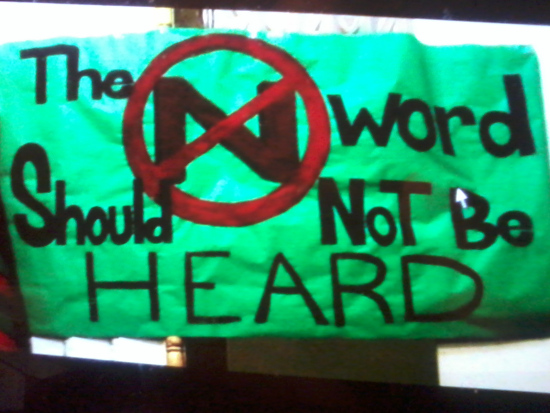
n-word

Humanity’s intellectual and artistic horizons must not be limited by the delicate sensitivities of society’s most easily-offended members

It has happened again – another oversensitive, censorious American school district has suspended the works Huckleberry Finn and To Kill a Mockingbird from their high school curriculum pending a full review of the two novels’ artistic merit versus their supposed offensiveness. And this time, all because of one solitary parental complaint.

The Guardian reports:

To Kill a Mockingbird and The Adventures of Huckleberry Finn have been suspended from the curriculum in some Virginia schools, after a parent complained about the use of racial slurs.

Harper Lee and Mark Twain’s literary classics were removed from classrooms in Accomack County, in Virginia after a formal complaint was made by the mother of a biracial teenager. At the centre of the complaint was the use of the N-word, which appears frequently in both titles.

The woman who made the complaint said her son struggled to read the racist language, telling the Accomack County public schools board: “There’s so much racial slurs and defensive wording in there that you can’t get past that.” The challenge also appears to be motivated by the current political landscape in the US, as the mother told the board: “Right now, we are a nation divided as it is.”

What a pathetic person, and what terrible parenting. If her son “struggled to read the racist language”, it is only because he was deliberately made fragile. Made fragile by his own parent(s) and by the society in which he grew up, which constantly, wrongly taught him that sticks and stones may break his bones, but words can kill him stone dead.

The danger is that by bowing to these petty, whinnying requests for censorship, our overall society is dragged down to the level of the weakest and most intolerant members. Little Timmy can’t read this book without weeping and being triggered, so now nobody can read it.

Are we really to shuffle books in and out of the school syllabus according to how sensitive people feel following a presidential election? Is a book’s inherent worth subject to fluctuate according to the changing political fortunes of the Democratic and Republican Parties? This is ludicrous.

As this blog has argued numerous times, the “N-word” has no power to harm beyond that which we give it by pretending that there is no difference between using the word in anger and clinically discussing it in a classroom, court of law or television news broadcast.

And there is a difference. Being called a nigger is not tremendously pleasant. As a mixed race young man (like the child whose insufferable parent demanded the ban), I have had occasional direct experience myself. But this is a world apart from reading or hearing the word in the context of studying a great work of literature. And people who are unable to make this distinction should not be allowed to hold the rest of society back by virtue of their self-inflicted fragility.


Safe Space Notice - 2

Support Semi-Partisan Politics with a one-time or recurring donation:

Agree with this article? Violently disagree? Scroll down to leave a comment.

Follow Semi-Partisan Politics on TwitterFacebook and Medium.

Identity Politics Fights Back

identity-politics

Sensing a growing backlash against their toxic ideology, identity politics cultists are preparing to mount a fightback

Check out this epic rant in the New York Magazine, in which TV producer and playwright Elizabeth Meriwether fumes that even contemplating whether the rise of identity politics may have contributed to political division and a Trump presidency is so dangerous that she needs to seal herself off in a sleeping pod to protect herself from further betrayal by the traitorous “white liberal males” asking the question.

Bear with me…

I’ve decided that the best thing for Democrats to do for the next four years is to stop caring about “identity politics” and focus on the needs of white men all around the country. From now on, as a woman who makes her living and pays taxes in the blue bubble of California, I will shut up and enter a medically-induced coma and only come out when liberal white men ask me to come out. I will develop a special, secret knock that these liberal men can use to wake me up inside my sleeping pod when they deem it safe for me to emerge and start ruining elections again.I hope that other women and minorities will do what I have done. Democrats can either care about income inequality or we can care about “women and minorities,” but we can’t do both. It’s impossible. Just try. Close your eyes right now and try to care about creating jobs, offering debt-free college, redistributing wealth, and protecting the rights of minorities and women. Do you see what I mean? It’s impossible. You either care about class or you care about civil rights. I am being fitted for my sleeping pod as we speak. And, because I am an elite, it’s entirely made from reclaimed wood and the tube that will pump food into my stomach will do so in the form of small tapas-style plates that are meant to be shared. Bon Iver will be playing nonstop, and I will be covered in organic cotton and sprinkled with chia seeds. My rescue dog will be hermetically sealed into my sleeping pod with me, and the whole thing will be plugged into an outlet like an electric self-driving car that also cuts off dicks. I will be allowed out of my sleeping pod if and only if I choose to have sex with a white liberal male. But the terms of this agreement include listening to him monologue about what went wrong in the election and allowing him to prove me wrong with various facts and figures and statistics. I will not be allowed to look any of those statistics up on my phone under any circumstance, although I will be allowed to disagree with him if I quickly concede the point and if I am squeezing my tits together into a pleasing butt-shape.

Way to miss the point. The point of criticising identity politics is not to suggest that we stop trying to fight for genuine egalitarianism and equality of opportunity. The point is that continually dividing Americans and playing off various “victim groups” against one another – and always against “white males”, no matter how desperately poor or marginalised they may themselves be – is actively feeding the toxic political atmosphere which has led to two Americas which can now barely tolerate each other’s presence.

Meriwether then continues her long digression about sex, for no reason other than the fact that people like her seem to have to shoehorn the subject into every political conversation – part of the identity politics cultist’s desperate need to make all politics personal, I suppose.

The diatribe continues:

Finally, talking about protecting the rights of minorities makes white guys feel like we are not talking enough about them — see above when I explained that we can’t care about more than one thing at a time — so it’s better if we all stop seeing ourselves as part of separate groups and start seeing ourselves however white guys want us to see ourselves. That would honestly just make it easier for everyone, and as I said before, is really the only way that Democrats will ever win another election again. The only way to come together as a party and defeat Trump is if we blame women and minorities for everything. This is the end of “identity politics,” by which we mean that this is the end of women and minorities being allowed to talk about issues that white men don’t care about.

Yes. Opposing identity politics means secretly wanting to construct a giant woodchipper, rounding up all the Evil Minorities and dropping them into the machine, one by one. The only possible reason that anyone might oppose the Cult of Social Justice and Identity Politics is a desperate desire by white males to get their boots back on the face of women and minorities. No other possible reason.

Of course we can care about more than one thing at a time. I don’t know of one serious commentator or criticism of identity politics which has argued otherwise – that identity politics or economic growth, identity politics or national defence, identity politics and healthcare reform are zero-sum games, with only one able to prevail. The problem is not that identity politics crowds out other issues. The problem is that for true believers like Meriwether, identity politics becomes the prism through which every single issue must be considered.

The problem with identity politics is that it empowers a select clerisy (the SJWs and politicians who court them) by encouraging everybody who is not a “white male” to consider themselves peculiarly fragile and vulnerable to physical and mental harm, either from normal everyday encounters or from offensive and unpleasant behaviour which would otherwise be written off in a dignity culture, confronted in an honour culture but which are taken as grounds for public complaint and petitions to higher authorities in our increasingly victimhood culture-oriented society.

The problem with identity politics is that it infantilises fully grown adults and teaches them that they are without agency or responsibility for their own lives and decisions – that anything bad which happens to them is the result of oppression (by the afore-mentioned bogeymen, “white males”) which can only be lifted by enacting a suite of leftist policies and laws which restrict what people can say and how they behave, often in ways which run completely counter to the spirit of the US Constitution. And the feedback loop of self interest ensures that

As regular reader of this blog, AndrewZ, put it in a recent comment on another blog post:

If people from a designated victim group are able to overcome difficulties and succeed by their own efforts then they can’t be as “oppressed” and “marginalised” as the theory demands. Therefore they must be indoctrinated into a mentality of helpless victimhood in order to protect the theory from inconvenient realities.

But if the whole world is divided into victims and oppressors then it becomes immoral for a member of a victim group to be strong and successful, because the theory says that they can only succeed by becoming part of the system of oppression. Equally, a person who does not belong to an official victim group can only make themselves socially respectable by embracing a victim identity.

The problem with identity politics is that it has become so much more than a simple struggle for egalitarianism – a cause which nearly everybody (save the real racists in society) should be able to happily get behind.

Hence we find people like Liz Meriwether – successful screenwriter and TV producer, and oh yes, a wealthy white woman – and taking to the pages of New York Magazine to wail that life is so tough for her that she needs to take to an escape pod for the next four years – not to escape from Donald Trump, but from normally like-minded “white liberal males” who committed the heretical thought of asking whether we really need to consider a person’s race, gender, sexuality, and horoscope before assigning weight to their words and arguments.

This is the corrosive power of identity politics. This is why we need to fight back against it with every ounce of strength we have. Because the Cult of Social Justice and Identity Politics takes strong, successful, independent adults (and adolescents perfectly capable of becoming strong, successful and independent themselves) and convinces them instead that they are weak, pitiable victims in need of constant rescuing by external authority figures. And the authority figure is inevitably the government, and the government inevitably seeks to protect each one of the victim groups petitioning for redress by further restricting the freedoms of the general public.

Identity politics is cancer. What else to call it, when somebody as outwardly successful as Liz Meriwether can write a nonsensical, stream-of-consciousness rant about she suffers systemic oppression when her white male liberal contemporaries fail to linger long enough while engaging in oral sex with her, and have that piece published with all seriousness in New York Magazine?

Identity politics is cancer. And it needs to be surgically removed from our political discourse, and any remnants blasted with whatever rhetorical equivalents of chemotherapy and radiotherapy we can lay our hands on, lest it return.


identity-politics-us-presidential-election-donald-trump-white-working-class

Support Semi-Partisan Politics with a one-time or recurring donation:

Agree with this article? Violently disagree? Scroll down to leave a comment.

Follow Semi-Partisan Politics on TwitterFacebook and Medium.

Tales From The Safe Space, Part 49 – Chicago Universities Are Raising A Generation Of Infantilised Young Adults

father-ted-my-lovely-horse-2

Students who are offered Play Doh and “therapy horses” to help them make it through university will be cannon fodder in an unforgiving, competitive global labour market

At this point we are used to seeing outrageous stories of overbearing, coddling universities going to extraordinary lengths to teach the young adults studying on their campuses like delicate, helpless infants.

But the Chicago Tribune has done quite a job in summarising all of the instances of infantilisation-posing-as-stress-management taking place at institutions in and around the city. And the extent of the trend is quite shocking to behold.

Some excerpts:

Sephanie Delgado can feel the stress of her to-do list as she works to finish the semester at Roosevelt University: three essays, a presentation and exams.

To escape the pressure, the 20-year-old college junior, who also works as a restaurant cashier to help pay for school, sculpted a chunk of blue Play-Doh into Popplio, a Pokemon character. She was at a table next to other students who colored and decorated cookies before two miniature therapy horses wearing sneakers trotted into the room Wednesday for the university’s De-Stress Fest.

“I know I still have to do all that work, but coming here I’m able to take some time off to hang out with friends, have fun and empty my mind for a little bit,” said Delgado, who lives on the Southwest Side. “It’s like a refresh. My mind is nice and clear so when I go to start my homework, I’m well focused.”

As the semester nears its end — and students pull all-nighters to cram for exams, type papers and finish projects that weigh heavily on final grades — colleges in the Chicago area are taking steps to help students manage stress. It’s part of a broader approach to focus on students’ mental health and expand proactive outreach efforts instead of waiting for students to seek help. Local schools this week are offering activities ranging from animal visits at Roosevelt to a bubble-wrapped room at the University of Illinois at Chicago to the long-standing tradition of a stress-busting primal scream at Northwestern University.

More:

At Northwestern, “because of the hectic academic pace that exists here, it is stressful and very pressure-packed,” university spokesman Alan Cubbage said.

Students can blow off steam with a visit from miniature horses Friday and release their frustration through a campuswide scream, in which students let out a collective yell at 9 p.m. Sunday before finals week. Next week, a number of activities such as Lego building, board games, midnight coffee breaks and late-night breakfast are planned for exam relief.

More:

The series of events UIC hosts during finals week helps junior Liz Huss manage stress in a healthful way.

Students got a visit from comfort dogs Wednesday and are invited next week to pop bubble wrap at the student center, get chair massages, do candlelight yoga and leave notes of encouragement for fellow students.

“I like to take 10, 15, 20 minutes to rejuvenate, reflect and relax, and these events really help with that,” said Huss, an accounting major.

I’m sure that the large professional services firm that she may one day seek to join will be more than happy to bend over backwards to accommodate Liz Huss’s artificially-instilled need to reach for the soothing presence of a “comfort dog” whenever the going gets tough.

More:

For Andersonville resident Rob Chesler, a junior at Roosevelt, stress can motivate him to get his work done. But he also welcomed the distraction of the De-Stress Fest, during which he took a selfie with Lunar, the oldest miniature horse from the Barrington-based nonprofit Mane in Heaven.

“If you’re living in this world of hard work every second of every hour of your life, then you’re not going to be happy and you’re just going to be all about work,” he said. “If you have little horses every now and then, you have moments where you can just breathe and enjoy life.”

Little horses for everyone!

Fortunately there are also voices of sanity:

Clay Routledge, psychology professor at North Dakota State University, believes universities should be promoting psychological strength and resilience, not coddling students.

“I’m not ignorant to the fact there are vulnerable students that need services,” he said. “I’m not against that at all. My criticism is: Are we promoting more broadly a culture of sensitivity and victimhood than we need to do?”

Many colleges and universities are becoming more than educational institutions and overreaching by not letting students figure things out on their own, he said.

“We need to promote toughness and strength, and we know from decades of research that humans are extremely resilient,” Routledge said. “You have to have real stressors in life. You have to fail. You have to be embarrassed and you have to face situations where you’re wrong and you’re challenged — and you’ll be strong as a result.”

A rare voice arguing for building resilience the way that university has done for decades, if not centuries – focusing on the academia, not seeking to micromanage every moment of each student’s pastoral experience on campus, and letting them grow through trial, error and experience. Expect Professor Clay Routledge to be blacklisted by the social justice / identity politics cultists at his university and drummed out of his job any day now.

I have always found American universities to be slightly odd places. Having spent a reasonable amount of time on various campuses in the Mid-West, I have always been struck by the way that universities do not treat their students like autonomous adults to the extent that one might expect in Britain.

Despite eye-wateringly high tuition and accommodation costs, undergraduates are usually expected to share a small room with a roommate, at least in their first year, an almost unheard-of indignity for British students (who would probably feel the same way about this as Americans would feel about staying in one of the NHS’s communal hospital wards rather than having a private room of their own). American universities often see fit to correspond with the parents of students as though they are still school children rather than adults over the age of eighteen, old enough to wear the uniform and fight for their country (though not old enough to drink). These, and many other odd customs, long predate the social justice and identity politics craze which has infected Western academia.

But while customs and practices such as these treat students as though they are not quite yet fully-grown adults, the new trend for safe spaces and infantilising activities masquerading as “stress relief” are of a different order because they effectively serve to stunt any further emotional growth, making it harder for students to ever become autonomous, successful adults.

Making an eighteen-year-old incurring $60,000 of annual student debt sleep three yards away from a roommate is one thing. Treating students as though they are fragile and unresilient children who need bubble wrap, puppy videos and therapy horses to make it through the academic year effectively becomes a self-fulfilling prophecy, ensuring that they enter the world utterly unprepared to function in a society and labour market which does not put their feelings and emotional health on a pedestal.

Social psychologist Jonathan Haidt joked about this when he compared two fictional universities – Strengthen University and Coddle University – in a lecture / college recruitment pitch given to high school seniors. But more and more, Haidt’s send-up of Coddle University is coming to pass and being made real on campuses across America, and in Britain too:

We are based on a very simple psychology which is that people are fragile. People are so easily hurt. Anything that upsets you could trigger trauma, repressed trauma, unrepressed trauma, trauma that you somehow put up there in the closet and forgot to take – there’s trauma all over your mind and your memory. And we don’t want to trigger your trauma. That could damage you.

And this is especially true for members of the six protected classes [women, African Americans, Latinos, LGBTQ, differently abled, and Native Americans]. If you are a member of one of the six marginalised and oppressed groups you are especially vulnerable. You’ve been traumatised and oppressed your whole lives. Microaggression theory teaches us that when people repeatedly cut these little nicks, these little insults, these little exclusions, they don’t develop calluses, they bleed to death. And so we will not let you be cut while you are at Coddle. We will protect you. Now don’t try to do it yourself, that’s very dangerous. WE will protect YOU from aggression.

At Coddle University we offer access to therapists 24/7. Just dial 811 from any phone, or we have this new feature – just raise three fingers, go like this [he gestures] and we have sensors all around campus, go like this and a therapist will be airlifted right into you.

University is supposed to be stressful. Balancing the academic workload and social events and newfound freedom away from the family home is supposed to develop key skills required to navigate the world as an independent adult later in life. Shipping in a bunch of therapy horses onto campus is not “offer[ing] students opportunities to learn self-care”, as one University of Missouri jobsworth claims, because it simulates an environment which will not exist outside of the university campus.

There are no therapy horses laid on for employees in the average workplace. Teaching students to survive daily stress by reaching for Play Doh and therapy animals is like training an astronaut to undertake spacewalks while failing to simulate the essential conditions of weightlessness and limited oxygen supply, and every bit as likely to lead to disaster.

But still the universities teach this nonsense and lay on these extravagant, infantilising services, unaware or unconcerned that they are setting their students up for failure the moment they set foot off campus.


father-ted-my-lovely-horse

Safe Space Notice - 2

Support Semi-Partisan Politics with a one-time or recurring donation:

Agree with this article? Violently disagree? Scroll down to leave a comment.

Follow Semi-Partisan Politics on TwitterFacebook and Medium.

Will The Social Justice Revolution Ever Stop Eating Its Own?

social-justice

Slowly, tentatively, a few identity politics activists are starting to question their current scorched earth tactics and the unforgiving way that they tackle “heresy” within their own ranks. But will it make a difference?

Everyday Feminism may be the go-to site for all things Social Justice, but at least one writer there has started to display some unusual self-awareness, questioning whether the constant backbiting, jockeying for position and competitive victimhood within the activist world might actually be doing more harm than good.

Kai Cheng Thom, a self-described Chinese trans woman writer, poet, and performance artist, writes:

When I found activist culture, with its powerful ideas about privilege and oppression and its simmering, explosive rage, I was intoxicated. I thought that I could purge my self-hatred with that fiery rhetoric and create the family I wanted so much with the bond that comes from shared trauma.

Social justice was a set of rules that could finally put the world into an order that made sense to me. If I could only use all the right language, do enough direct action, be critical enough of the systems around me, then I could finally be a good person.

All around me, it felt like my activist community was doing the same thing – throwing ourselves into “the revolution,” exhausting ourselves and burning out, watching each other for oppressive thoughts and behavior and calling each other on it vociferously.

Occasionally – rarely – folks were driven out of community for being “fucked up.” More often, though, attempts to hold people accountable through call-outs and exclusion just exploded into huge online flame wars and IRL drama that left deep rifts in community for years. Only the most vulnerable – folks without large friend groups and social stability – were excluded permanently.

Like my blood family, my activist family was re-enacting the trauma that we had experienced at the hands of an oppressive society.

Credit where it is due – this is a mature and thoughtful observation, especially from somebody in the thick of the Cult of Social Justice and Identity Politics. It cannot be easy to admit such a glaring flaw in one’s own social movement, so kudos to Kai for doing so.

This is actually one of the aspects of the whole social justice phenomenon which fascinates me the most – the dual scrambles to both climb the victimhood pyramid and claim the most “oppressions” while also seeking to be the most fastidious observer of the new rules laid down to govern how people speak and interact with one another.

For me, it crystallised with the story in Britain of NUS LGBT officer Fran Cowling, who sanctimoniously and publicly refused to share a stage with lifelong gay rights campaigner Peter Tatchell, on the grounds that he was insufficiently enthusiastic about banning the speech of people who disagree with the current orthodoxy about transgender issues.

As I wrote at the time:

It is obvious that NUS LGBT officer Fran Cowling is attempting to gain a vast amount of social currency and standing from her peers by trying to take down Peter Tatchell, an A-lister in activist circles. By refusing to share a stage with him, Cowling is effectively declaring to the world that she is morally superior to Tatchell, he having failed the latest racism and transphobia tests. Thus, she can bank all of Tatchell’s personal accomplishments for herself, add the fact that unlike him she is not a “transphobe”, and Win the Game.

And that’s the rotten core of today’s student identity politics movement. A constant, bitchy, backbiting game of snakes and ladders, with one insufferable petty tyrant rising to the top of the Moral Virtue Pyramid only to be brought down by their jealous rivals, either for no reason at all, or for having unknowingly violated one of the many red lines that they themselves helped to draw across our political discourse.

Too often the internal machinations and politicking of these activist movements seem to vastly overshadow any possible good that they may seek to accomplish. Too often it seems that social justice warriors are more interested in enforcing arbitrary rules and squashing dissent than actually making tangible efforts to help the people on whose behalf they claim to speak.

Kai Cheng Thom goes on to quote an anonymous writer:

There are no activist communities, only the desire for communities, or the convenient fiction of communities. A community is a material web that binds people together, for better and for worse, in interdependence…

If it is easier to kick someone out than to go through a difficult series of conversations with them, it is not a community.

At present, social justice activists are very proficient at excluding and excommunicating those who stray from the One True Path. Never mind agnostics or opponents; many SJW communities will excommunicate fellow members for little more than not being fully up to speed on the latest terminology – a constantly changing glossary of “correct” and “incorrect” words.

In other words, as Kai puts it, many activists currently operate according to the philosophy that “if I could only use all the right language, do enough direct action, be critical enough of the systems around me, then I could finally be a good person”. It is almost a points-based system. Attend enough protests, share enough memes on social media, parrot enough orthodoxy and avoid committing too many mistakes and in time you will “level up”. Fail to keep up with the herd, however, and you will be left in the wilderness.

Kai Cheng Thom’s article at least suggests that there are growing glimmers of awareness that this approach is a) not working, and b) hardly an appropriate way to live the values that they preach.

For in truth, the social justice movement is a symptom of the only real kind of privilege left out there – rich, Western country privilege. That’s not to say that racism, sexism, homophobia and transphobia have been fully vanquished – clearly not. But the fact that so many people in the English-speaking Western world are now able to devote such significant amounts of time to activism tackling the remaining vestiges of oppression in their own back yards is itself a sign that we live in unprecedentedly prosperous and egalitarian times.

In large part, social justice activism is nothing more than a luxury pursuit, indulged in primarily by those people who have the fortune to be attending college or university in one or other of the richest and most prosperous democratic countries on this Earth. Anyone marching in a campus protest to restrict the rights and freedoms of other people to say things which they may find offensive would, if they actually took the words “social justice” remotely seriously, immediately redirect their anger toward those benighted parts of the world where racial minorities, women, gay, transgender and disabled people face overt and often physical hostility. Yet for some reason the social justice community often has little negative to say about many of these places, while remaining ever-ready to criticise the good-faith efforts of those closer to home.

And the online obergruppenführers of this petty, thin-skinned self-actualisation cult, this morally lost movement, have grown accustomed to consolidating their power by doing the one thing they claim to be most against – oppressing and marginalising other people, in this case those who step out of line and deliberately or accidentally say, think or do the “wrong” thing.

It is wonderful that some of these cultists may be starting to realise the error of their ways. For as Kai says, “only the most vulnerable – folks without large friend groups and social stability – [are] excluded permanently”. And why is that the case?

Because at its rotten heart, the social justice movement can be most likened to that quintessential bastion of “white privilege”, the suburban country club. The club has many strict rules. Arcane rules which are often incomprehensible to outsiders. Rules which must be acknowledged and obeyed, and only ever flouted if one has sufficient social currency within the group to get away with it.

That is what the social justice movement has become. A virtual, worldwide country club for privileged young millennials and some aged hangers-on in academia, easy to join (so long as one passes ideological inspection) but swift to exclude those caught breaking the finicky, ever-changing rules. A club in which anyone and everyone is ultimately disposable in the neverending competition for power and status.

Can the social justice revolution ever stop eating its own? I don’t see how. Most of those at the country club’s core seem motivated primarily by the desire to feast on the shortcomings and innocent mistakes of others. Take that inducement away and they may as well just join their nearest fraternity or sorority, fully embracing the “social” aspect and ceasing to feign an interest in “justice” altogether.


social-justice-club

Support Semi-Partisan Politics with a one-time or recurring donation:

Agree with this article? Violently disagree? Scroll down to leave a comment.

Follow Semi-Partisan Politics on TwitterFacebook and Medium.