Politicians Aren’t Entitled To Their Own Facts, But Neither Is The Media

An independent political press corps with the knowledge and authority to call the shots and confidently call out lies when politicians tell them – rather than giving equal credence to two diametrically opposed crazy positions – is a great idea. If only our media was sufficiently trustworthy and capable of performing such a nuanced, sensitive role

Something funny seems to have happened to the New York Times.

For the past week or so, the newspaper which once twisted itself into a risible-looking pretzel trying to justify calling the practice of waterboarding “torture” when inflicted by America’s enemies but “enhanced interrogation” when conducted by American forces has discovered a new passion for clarity and bold truth-telling.

Peter Beinart explains, over at The Atlantic:

Last Saturday, The New York Times published an extraordinary story. What made the story extraordinary wasn’t the event the Times covered. What made it extraordinary was the way the Times covered it.

On its front page, top right—the most precious space in American print journalism—the Times wrote about Friday’s press conference in which Donald Trump declared that a) he now believed Barack Obama was a US citizen, b) he deserved credit for having established that fact despite rumors to the contrary and c) Hillary Clinton was to blame for the rumors. Traditionally, when a political candidate assembles facts so as to aggrandize himself and belittle his opponent, “objective” journalists like those at the Times respond with a “he said, she said” story.

Such stories, according to the NYU journalism professor Jay Rosen, follow this formula: “There’s a public dispute. The dispute makes news. No real attempt is made to assess clashing truth claims in the story … The symmetry of two sides making opposite claims puts the reporter in the middle between polarized extremes.”

[..] But the Times, once a champion practitioner of the “he said, she said” campaign story, discarded it with astonishing bluntness. The Times responded to Trump’s press conference by running a “News Analysis,” a genre that gives reporters more freedom to explain a story’s significance. But “News Analysis” pieces generally supplement traditional news stories. On Saturday, by contrast, the Times ran its “News Analysis” atop Page One while relegating its news story on Trump’s press conference to page A10. Moreover, “News Analysis” stories generally offer context. They don’t offer thundering condemnation.

Yet thundering condemnation is exactly what the Times story provided. Its headline read, “Trump Gives Up a Lie But Refuses to Repent.” Not “falsehood,” which leaves open the possibility that Trump was merely mistaken, but “lie,” which suggests, accurately, that Trump had every reason to know that what he was saying about Obama’s citizenship was false.

In other words, the New York Times has sporadically started to report objective facts and truth, rather than doing what has long been traditional among the political press corps – walking a neutral tightrope between two partisan positions of staggeringly obvious falsehood or stupidity.

Despite his protestations and evasions, Donald Trump has been one of the key players in the birther movement from the beginning – picking up from the memorably loopy Orly Taitz – and has certainly been the conspiracy movement’s most public face. I remember blogging about it over four years ago, back in 2012.

Given the context of a presidential election and the extra scrutiny on media bias, it is surprising and rather heartening to see the Times displaying the courage to report fact rather than controversy; the same headline a month ago might easily have read “Trump Withdraws Birther Allegation”, with no reference to the established facts and outcome of the story.

Jon Stewart (formerly of The Daily Show) must be smiling. Since 2004 and even earlier, Stewart railed against political coverage which ginned up conflict in pursuit of ratings and incessantly reported issues through the prism of Left vs Right, Democrat vs Republican without ever seeking to either restrict coverage to facts or move beyond partisan talking points to get to the truth. The video at the top of this article shows Stewart’s memorable appearance on CNN’s Crossfire show, in which he castigated the hosts for “hurting America” by injecting partisanship and sucking nuance out of the political discourse.

Obviously the New York Times does not inhabit quite the same infotainment space as Crossfire, but the basic operating principle has been very much the same of late – present two or more strongly opposing partisan viewpoints, let the talking heads (or journalistic sources) slug it out in defence of their respective positions, and then move on without ever really applying any kind of judgment as to the respective merits of the contrasting positions.

Nowhere is this approach better summed up than the slogan of the Fox News Channel – “we report, you decide”. It is a relativist worldview which suggests there is no truth in even quite straightforward binary debates, and that we are free to pick our own facts and construct our own reality in accordance with our personal biases and interests.

Now, there is yet more evidence that the New York Times is moving away from this risk-averse and rather cowardly stance – yesterday the newspaper described as “false” Donald Trump’s claims that Hillary Clinton has sinister plan to destroy the Second Amendment:

In justifying his remarks, Mr. Trump falsely claimed that Mrs. Clinton wants to “destroy your Second Amendment,” apparently a reference to her gun control policies.

My emphasis in bold.

At face value this is a good development – the “he said she said” approach to political coverage is what has enabled so much of the spineless print journalism and sensationalist, conflict-stoking television news reporting in Britain and America. Seeing a “respectable” institution finally buck that trend and push back against the toxic idea that reality is malleable and truth exists only in the eye of the super-partisan beholder is, in theory, a very good thing.

Peter Beinart certainly seems to think so:

A certain etiquette has long governed the relationship between presidential candidates and the elite media. Candidates stretch the truth, but try not to be too blatant about it. Candidates appeal to bigotry, but subtly. In turn, journalists respond with a delicacy of their own. They quote partisans rather than saying things in their own words. They use euphemisms like “polarizing” and “incendiary,” instead of “racist” and “demagogic.”

Previous politicians have exploited this system. But Trump has done something unprecedented. He has so brazenly lied, so nakedly appealed to bigotry, and so frontally challenged the rule of law that he has made the elite media’s decorum absurd. He’s turned highbrow journalists into referees in a World Wrestling Entertainment match.

Last Saturday, the Times answered Trump’s challenge. He’s changed the rules, so it did, too.

But this analysis only holds if one has reasonable grounds to trust the journalistic institution or media outlet doing the reporting; will they reserve their merciless news analysis features for instances when there really is a right and wrong binary perspective, or will editorial judgment and personal bias cloud the picture?

Remember, the New York Times was happy to characterise the EU referendum and the Brexit campaign as being motivated not out of concerns for democracy and sovereignty but primarily by xenophobia and anti-immigrant prejudice. And while there were highly visible elements of the latter, under the “News Analysis” model what would prevent the Times deciding that the entire Leave campaign was based on racism and then reporting this skewed perspective to their readers as simple, self-evident “truth”?

While the “he said, she said” ra-ra approach may be divisive and unseemly, it at least offers a right of reply to those whose views are misinterpreted or deliberately slandered by shameless opponents. And while conventional wisdom might hold that it is more often conservative voices who live in a sealed bubble of their own facts, in reality we would all be vulnerable to a style of news reporting in which reporters and editors are given sweeping new authority to pass what often amount to value judgments on behalf of readers. At some point in the future, any one of us could find our unpopular, minority opinion almost entirely  frozen out of the public discourse.

So this blog will cautiously cheer along with Peter Beinart at the New York Times’ sudden willingness to call out lies – provided that this is to be genuinely bipartisan new scrutiny rather than merely a one-sided club with which to bash the Trump campaign.

But we should be aware that we are at the top of a slippery slope here. Smacking down candidates and their statements is a positively good thing when we are dealing with easily proven questions of who said what, and when. But the temptation to apply this swashbucklingly assertive style of journalism to more subjective debates (like economic policy, immigration or foreign affairs) may prove to be irresistible for journalists with human biases and editorial boards with agendas.

In case they hadn’t noticed, the mainstream media doesn’t presently enjoy a particularly enviable trustworthiness rating among the general public. Abuse “news analysis” by using it as a blatantly partisan cudgel and they will drive that rock-bottom rating still lower.

 

donald-trump-fox-news

Support Semi-Partisan Politics with a one-time or recurring donation:

Agree with this article? Violently disagree? Scroll down to leave a comment.

Follow Semi-Partisan Politics on TwitterFacebook and Medium.

No Amount Of ‘Education’ Will Make Sceptical Europeans Love The EU

What to do when the continent’s biggest military power and second-largest economy decides to leave your crumbling, tarnished and perennially unwanted supranational political union? Finally consider meaningful reforms? Engage in a sincere listening exercise? Devolve power back to nation states and local communities? Do anything, anything at all, to signal that the European Union might be something that works for the people rather than something which is done to them?

Of course not. When faced with incontrovertible evidence that citizens are starting to rebel en masse against the idea of shared sovereignty, dissolving borders and supranational government, clearly the correct thing to do is to declare that European citizens simply don’t understand the wonderful gift bequeathed to them, and then pledge to funnel more money towards their re-education.

From the Guardian:

The European commission will spend tens of millions more euros promoting the ideal of the EU citizen, in defiance of British ministers, under plans drawn up by officials in Brussels in the wake of the Brexit vote.

Officials for the European parliament claim there is now a clear need for a significant increase in spending on the Europe for Citizens (EFC) programme, which aims to foster the notion of an EU citizenry. The programme had its budget cut from €215m (£185m) to €185.5m (£159m) after a request from Britain in 2013.

“Considering the current political climate, in which an increasing number of citizens question the foundations of the EU, decisive action is indispensable,” an assessment of the programme by officials in the European parliament reports.

“It is for this reason that the reduction in funding for the EFC programme is a serious handicap to successful implementation: to reiterate, the budget for the current EFC programme is €185.5m (down from €215m under the previous programme), which amounts to merely 0.0171% of the EU multiannual financial framework.”

The aim of EFC is said to be that of developing “a better understanding” of the EU across all its member states, to fund remembrance events for key moments in European history and combat scepticism about the EU project.

The assessment document says that funding “which promotes and enables citizens to engage in European matters is of vital importance, especially in times when Euroscepticism is on the rise”.

This only emphasises the degree to which the European Union is an answer to a question which was never even asked. If the various peoples of Europe had gradually come to realise over the course of the 20th century that they shared such a common heritage of laws, language, culture and strategic interests that they wanted to institute a shared common government then the EU or something like it would have developed organically.

But of course no such thing happened – the idea of supranational political union was artificially imposed on European people largely by stealth and in secret over the course of many decades. And while many members of the European political elite get misty-eyed over the EU, the majority of its citizens tolerate rather than welcome this extra layer of government. The flag and the anthem are utterly meaningless to most of the EU’s 510 million citizens – the spine does not stiffen nor the heart quicken at the sight of the twelve stars or the strains of “Ode to Joy”. And unlike the American founding fathers, the secretive “founders” of the EU are unknown, unloved and languish in richly-deserved obscurity.

The hard truth for the euro-federalists is that no amount of money spent on “education” will make people fall in love with the European Union. Love of family, community and country is something which must well up from within; it cannot be successfully imposed by external agents. And likewise, if people do not feel instinctively European over and above their distinct national identities, a true European demos cannot be created – despite the best efforts of the European Union’s architects to defy both human nature and democracy.

Double the peak budget and spend another €215m on idealising the European Union and creating uncritical, misleading propaganda and it will still make no difference, save lining the pockets of opportunistic “cultural” and “artistic” parasites who will happily take taxpayer money to plaster the EU logo over their concerts, plays and workshops.

In other words, it is the perfect EU project. Just don’t expect it to make the slightest bit of difference to anything at all.


eu-europe-for-citizens-programme

Support Semi-Partisan Politics with a one-time or recurring donation:

Agree with this article? Violently disagree? Scroll down to leave a comment.

Follow Semi-Partisan Politics on TwitterFacebook and Medium.

Alan Johnson’s Permanent Revolution

Despite Owen Smith’s imminent, glorious defeat at the hands of Jeremy Corbyn in the Labour leadership contest Take 2, New Labour grandee Alan Johnson is in no mood for acceptance and reconciliation.

In fact, as the Telegraph reports, Alan Johnson is still firmly stuck in the “denial” stage of grief for the stalled New Labour centrist agenda to which he dedicated his political career:

Moderate Labour MPs must wage a remorseless campaign to undermine Jeremy Corbyn’s leadership “year after year” or the party will die, Alan Johnson has said.

The former Cabinet minister called on his colleagues on the centre-Left to “recapture this party” from Mr Corbyn and his socialist allies by emulating their record of opposing previous Labour leaders.

Mr Corbyn is expected to be re-elected as party leader next week, with another landslide majority from members, but he lacks the support of most of his own MPs.

The Labour leader admitted on Saturday to making mistakes and disclosed that he would be making a peace offer to MPs in an attempt to persuade his critics to return to the shadow cabinet.

However, Mr Johnson, the former Home Secretary, condemned Mr Corbyn as “useless”, “incompetent” and “incapable” of running a political party, and called on rebels not to give up their efforts to oust him.

So it’s to be a permanent revolution, then – at least in the puffed-up, self-important world of Alan Johnson’s imagination. Labour MPs should continue to loudly and proudly wear their contempt for their core voters like a perverse badge of honour, be it on Brexit or their preferred choice for leader of the party. The PLP should ruthlessly pursue its own agenda while still demanding and assuming the support of the CLPs who stated their preference for Corbyn, and who will become increasingly enraged by any further attempts to remove him. What could possibly go wrong?

Back on planet Earth, though, the groundwork continues to be laid for the PLP’s abject, humiliating capitulation to Jeremy Corbyn – as this blog has discussed here and here.

Labour’s centrist MPs have severely tarnished their reputation by opportunistically exploiting the EU referendum result to rise up against their party leader, and then failing to put forth any better candidates than the hapless Angela Eagle and the detestable Owen Smith. They have no real political capital left to spend, and while the Corbynite dream of mass deselections may still be out of reach now, another mass rebellion of the centrists would all but guarantee a severe grassroots response.

Besides, all this talk of petulant, hysterical and unending opposition to Corbynism is a bit rich coming from a man repeatedly urged to step up and challenge for the Labour Party leadership himself, but who lacked the courage and willingness for self-sacrifice to answer the call even once.

If Alan Johnson really wants to recapture the Labour Party from the Corbynites, he might consider sitting down with a notepad and pen and trying to come up with some attractive new centrist policies which don’t simply look like splitting the difference between Margaret Thatcher and Michael Foot. Want ordinary people to be enthused by centre-leftish policies? Then stop making them such a darn fudge. Stop desperately chasing votes and start crafting the policies which might actually win votes.

But why go to the trouble of doing anything constructive when one can just carp from the sidelines?


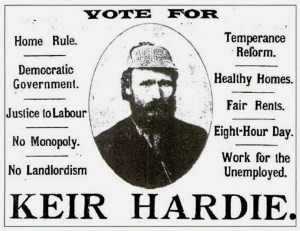
keir-hardie-labour-party

Support Semi-Partisan Politics with a one-time or recurring donation:

Agree with this article? Violently disagree? Scroll down to leave a comment.

Follow Semi-Partisan Politics on TwitterFacebook and Medium.

Submission, Part 2

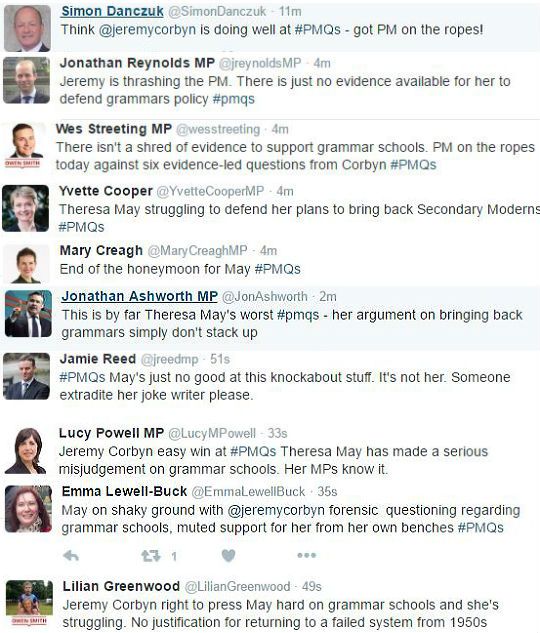
labour-plp-centrist-mps-praise-jeremy-corbyn-pmqs-guido-fawkes-twitter-compilation

More signs of the humiliating capitulation to come

After Jeremy Corbyn managed to surprise everyone and trounce Theresa May at yesterday’s Prime Minister’s Questions, it was interesting to note the fulsome praise he received, even from many of his staunchest critics.

Guido compiled some of the most striking olive branches as they flashed across Twitter, and it makes for interesting reading – see the image above.

And so we have yet more evidence of the PLP resigning itself to Owen Smith’s inevitable defeat and trying to make nice with the man they so opportunistically stabbed in the back in the panicked aftermath of the EU referendum. MPs who haven’t had a single kind word to say about Jeremy Corbyn in months are now keen to be seen cheering on their leader.

Is this just a collective expression of relief that Corbyn didn’t self-immolate at the dispatch box for once? No, clearly something more is at work here.

Why? Because many of these centrist Labour MPs realise that they have put themselves in an untenable position. In their fury at being sidelined, these MPs queued up to publicly declare that Jeremy Corbyn was awful and that there was simply no way that they could productively work together. Now Jeremy Corbyn is about to receive another stonking mandate from the party membership, which rather leaves the door open for the centrists, not Corbyn, to leave the party if they don’t like the direction the members have set. All the while, the ominous threat of deselection hangs over their heads, and so these MPs – many of whom have absolutely infuriated their local party branches with their disloyal behaviour – are understandably desperately seeking to shore up their positions.

As this blog recently pointed out:

The Parliamentary Labour Party called Jeremy Corbyn’s bluff and lost, badly. There is ample blame to go around – some for the remaining “big beasts” of the party who were too cowardly and self-serving to put their names forward as leadership contenders, leaving it to unloved support acts like Angela Eagle and the contemptible Owen Smith; some for misbehaving shadow ministers like Hilary Benn who took the job and then rebelled and briefed against their leader at every opportunity; and last but not least, a portion of the blame rests with every single one of the 172 Labour MPs who opportunistically calculated that the confused aftermath of the EU referendum provided a great “fog of war” in which they could go full Brutus on Jeremy Corbyn’s Caesar and get away with it.

Well, it didn’t work. Nobody viable stepped forward, the party membership was enraged at the parliamentary party challenging their pick for leader less than a year into the job, and Owen Smith’s damp squib of a campaign lurched from one unforced error to the next.

[..] And so the unhappy bedfellows will likely limp on together, Corbynites and centrists openly despising one another but remaining stuck with each other thanks to the British political system. The centrists will continue to moan to any journalist who will listen, Dan Hodges will have more material for his Mail on Sunday column than he knows what to do with, the PLP will do everything they can to make Jeremy Corbyn’s life a living hell, and Corbyn’s team will do all they can to set the stage for a purge of the centrists, either at the upcoming constituency boundary review or when it comes time to choose candidates for the 2020 general election.

But of course, if anyone is capable of seizing defeat from the jaws of victory (or at least taking 1.5 steps back for every 2 steps forward) it is Jeremy Corbyn. And so it is again today, with news that overzealous Corbynite aides have prepared another one of their infamous enemy lists, this time superciliously keeping note of those centrist MPs who have supposedly undermined Corbyn’s leadership in the past.

From the Guardian:

Jeremy Corbyn’s campaign team has issued a list singling out 14 Labour MPs, including deputy leader Tom Watson, who it claims have abused the leader and his allies, triggering a new row in the party.

Corbyn’s team said the list was sent out by mistake by a junior staff member, but the leader later appeared to stand by the substance of the allegations, saying all the remarks had been made on the record.

In the release, Owen Smith, the challenger for the Labour leadership, was accused of being the “real disunity candidate”, who has failed to tackle abuse meted out by his own supporters.

The list, obtained by Press Association, highlighted the behaviour of a number of Labour MPs, including Jess Phillips for telling Corbyn’s ally Diane Abbott to “fuck off”, John Woodcock for dismissing the party leader as a “fucking disaster” and Tristram Hunt for describing Labour as “in the shit”.

Watson was highlighted for calling the grassroots Corbyn campaign Momentum a “rabble”.

Cue lots of sanctimonious outrage from those MPs on the list – Jess Phillips is already parading her supposed vulnerability to crazed Corbynite violent attacks on social media.

This doesn’t make anyone look good. One of the most dispiriting things about the Labour Party in recent years, particularly since the departure of Ed Miliband, has been the continual games of competitive weaponised victimhood played by centrists and Corbynites alike. Both sides are clearly drinking deep from the well of social justice and identity politics, and have decided that the best way to win (or at least shut down) an argument they don’t like is to screech hysterically that the other side is somehow encouraging or tacitly accepting violence.

We are used to seeing this from the centrists, furious at their fall from power and lashing out at anyone and everyone who dares to suggest that their plight might just be self-inflicted. But it is depressing to see Corbynites now adopting the same behaviour, keeping finickity little lists of those MPs who have “abused” them or made them feel “unsafe”.

This, more than anything else, is why the British public views the Labour Party as an unelectable dumpster fire of a political party right now. Yes, Jeremy Corbyn’s outdated socialism is failing to win over centrists (in what is a broadly centre-right country, as recently reasserted by a new non-partisan report as well as by common sense), but far worse than that is the constant spectacle of briefing, counter-briefing and backbiting. These are the seething, petty politics of the student union, being practised by grown adults with prestigious jobs and £74,000 salaries. Frankly, it is pathetic.

But this is all just a flash in the pan. However much some Labour MPs may huff and puff about being placed on Corbyn’s enemy list, the majority of the PLP will fall into line. In fact, given the continual and widespread criticism that he has endured from his own back (and front) benches, the real miracle is that there are only fourteen names on the list.

And there are only fourteen names on the list because in this one key respect, Jeremy Corbyn acknowledges reality rather than struggling against it. Corbyn knows that most of the PLP, whatever histrionics they may have engaged in over the past year, will come trudging meekly back through the door of his tent the moment he finishes wiping Owen Smith’s blood off his sword. And like any smart vanquishing general trying to occupy hostile territory, Corbyn knows that the best thing to do is to make a very public example of those who were most disloyal to him while granting the majority a reprieve contingent on future behaviour.

Having utterly failed in their opportunistic and self-serving bid to rid Labour of Jeremy Corbyn, nearly all of his restive MPs – even the ones who pompously declared the impossibility of ever working with their leader – will shortly bend the knee in a humiliating show of submission.

This is Jeremy Corbyn’s party now, and the centrists are going to have to do a hell of a lot better than Twitter tantrums and Owen Smith if they are serious about changing that fact.


Jeremy Corbyn - PMQs

Support Semi-Partisan Politics with a one-time or recurring donation:

Agree with this article? Violently disagree? Scroll down to leave a comment.

Follow Semi-Partisan Politics on TwitterFacebook and Medium.

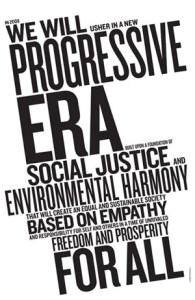
What Became Of The Great British Progressive Majority? It Never Existed

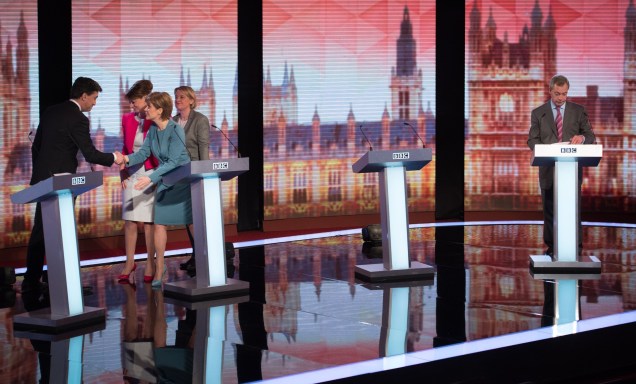
BBC Challengers Debate - Leaders Debate - General Election 2015 - Nigel Farage Stands Alone

Turns out that pooling their strength and holding hands beneath a big progressive rainbow will not help Britain’s left-wing parties get back into power after all. What a shame.

Remember the Great British Progressive Majority, that overwhelmingly large (yet always infuriatingly hidden) bloc of centre-leftish voters who together wielded the power to lock the Evil Tories out of 10 Downing Street and government forever, if only they could be organised and persuaded to vote tactically?

You know, that vast conclave of redistributionist, environmentalist, identity politics-wielding, Big Government-supporting luvvies who supposedly outweigh the 11.3 million British voters who re-elected the Conservative government last May?

Well, no worries if you don’t recall the fabled progressive majority. Because it turns out that it doesn’t exist after all, and never has.

Guido reports:

This morning the centrist, cross-party Social Market Foundation held a well attended seminar headlined by Chuka Umunna, Nicky Morgan and Nick Clegg. It felt like a wake for the Labour Party. SMF claims – on the back of research from Opinium – that there’s no progressive left-leaning majority in the country – the majority of voters hold “traditionally right-wing views” that will guarantee a “healthy majority” in the future for the right-wing parties.

The wonks categorised voters’ attitudes into eight political tribes/parties that share very distinctive political views. Despite the majority of voters self-describing as “centrist”, most voters actually identified with centre-right and right-wing political attitudes.

But…but…but Nicola Sturgeon promised us! One can hear the wailing from trendy lefty dinner tables from Brighton to Aberdeen. And so she did. So did they all – Sturgeon, Nick Clegg of the forgotten “Lib Dem” tribe, Plaid Cymru’s Leanne Wood, the Green Party’s underwhelming Natalie Bennett. In the tawdry hunt for votes, all of these party leaders told the electorate that between them, they carried the votes to “lock David Cameron out of Number 10 Downing Street“.

The only one to object, as all of this unfolded, was the hapless Ed Miliband, whose votes these other parties were ruthlessly cannibalising. Miliband, still entertaining sweetly pathetic hopes of becoming prime minister, had no great desire to share power in a leftist coalition, to have moralising Scottish and Welsh nationalists perched on either shoulder, scolding him for his insufficient fidelity to socialist principles.

But Miliband need not have worried about sharing power. Between them, the main parties of the Left – Labour, the LibDems, Plaid Cymru, the SNP and the Green Party – managed to accumulate just 13,102,483 votes in the 2015 general election. Meanwhile, the main parties of the Right – Conservative and UKIP – racked up 15,215,675 votes. This gave the parties of the Right an edge of well over 2 million votes, despite the fact that David Cameron’s lacklustre Coke Zero Conservatives hardly put a spring in people’s steps as they went to the polling station. Britain’s fabled progressive majority didn’t show up on polling day. And they didn’t show up because they don’t exist other than in the minds of starry-eyed leftists.

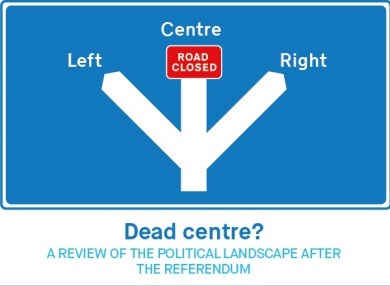
social-market-foundation-britain-progressive-majority

If you have the time, the whole report – entitled “Dead centre? A review of the political landscape after the referendum” – is worth a read. Yes, it contains the obligatory sprinkling of shellshocked establishment wailing about Brexit, and is published by a think tank which claims to represent something (the so-called “radical centre”) which by definition can not exist. But the report nonetheless highlights the key reason why the parties of the Left cannot unite in opposition to the Evil Tor-ees, as many of their activists clearly want to happen.

Money quote:

On the whole, our analysis makes more cheerful reading for those on the right, than on the centre or the left. The two largest tribes, making up around 50% of the population, hold a range of traditionally right wing views, offering a solid foundation on which to aim for the 40-42% of the vote which normally guarantees a healthy majority under our electoral system. These groups share a desire to see immigration reduced to below 100k a year and were both solidly pro-Leave in the EU referendum.

In fact, of the eight different voter tribes identified by the report, “none of the other groups approaches the size or homogeneity of these two”. These two groups alone account for more than half the electorate, and are inherently distrustful of more leftist policies. Throw in a third tribe, the “free liberals” (perhaps including this blog) and you are looking at 57% of the electorate likely to be hostile to collectivist, redistributionist thinking.

If splits within the Conservative Party and between the Tories and UKIP look bad, that is nothing compared to the fissures on the right, according to the report. As Guido notes:

The progressive tribes are fragmented, disagreeing on openness to the world and attitudes towards the welfare state and taxation. This is bad news for the current Labour Party as the think-tank finds massive differences between so-called“Democratic Socialists” and “Community” party voter blocs – traditionally known as Labour supporters – while both tribes agree on socialist policies towards capitalism, they diverge on supporting the EU or having an internationalist approach.

Well, really it is just Labour that is fractured. The LibDems, SNP, Plaid Cymru and Green party have all clearly decided to tread the internationalist, social democrat path, worshipping at the altar of the EU and scorning the nation state as a worthwhile agent for change or guarantor of core liberties. This leaves the Labour Party as the only home for those patriotic left-wingers who might fall into the “Community” tribe. And even there, they find themselves under continual assault by the sneering middle class clerisy which is loathe to give up its stranglehold on policymaking. Jeremy Corbyn answers some of this tribe’s concerns, but not all. In fact, one might consider him equally dissatisfactory to the “Democratic Socialists” as to the “Community” tribe, rubbing each up the wrong way.

Even if the parties of the Left could hammer out an uneasy truce and electoral alliance, why would they? Despite the overblown leftist rhetoric, Theresa May’s Conservative government hardly shows signs of being a radical right-wing government in the manner of Thatcher (more’s the pity), so why attempt a political merger which is almost certainly doomed to failure, just to thwart a very non-threatening centrist Tory government? Leftists’ hatred of the Evil Tor-ees is certainly irrational, but they are not that irrational.

Besides, whatever faultlines currently run through the British Left, the headline numbers don’t lie. And despite the fatuous claims of opportunistic smaller parties that greater Westminster representation would enable them to participate in a progressive majority government, the votes simply are not there. They never were.

Of course, none of this is surprising – except, apparently, to London-dwelling metro-left members of the political class who never actually get out and talk to normal people. Anyone who actually does so knows that Britain remains a vaguely conservative country, shot through with a fairly strong authoritarian streak and a deeply ingrained suspicion of success.

We Brits will happily sign petitions for Things That We Don’t Like to be banned and made illegal (the authoritarian bit), light ourselves on fire outside Downing Street in protest at The Great British Bake Off moving from the BBC to Channel Four (the conservative bit) before going on a long, satisfying rant about how evil it is that the inventors and producers of that television show want to receive market-rate compensation for their creation (the suspicion of success). That’s just who we are as a country. I certainly didn’t need the Social Market Foundation and their “eight tribes” report to know that Britain is a small-c conservative country.

That’s why David Cameron was able to guide his wishy-washy, Coke Zero Conservative government to one and a half general election victories – by appealing to these instincts in us. Lord knows it wasn’t because we were excited about his agenda for government (whatever that may have been).

Anyone who pays the remotest bit of attention to British politics ought to be able to sum up our national character fairly succinctly in a manner such as this. In fact, the only ones unable to do so – who laboured under the hilarious misapprehension that there was some great progressive majority yearning to break free and assert itself, installing a wind turbine on every roof – were the deluded metro-leftists.

Perhaps now they can disenthrall themselves of this sweet but futile notion.


Postscript: This review of the report in Conservative Home is also worth a read.


social-justice-progressive-majority-meaningless-waffle

Support Semi-Partisan Politics with a one-time or recurring donation:

Agree with this article? Violently disagree? Scroll down to leave a comment.

Follow Semi-Partisan Politics on TwitterFacebook and Medium.