Brexit Catastrophisation Watch, Part 2

Suffer and roar

The other day, while in an uncharacteristically high-minded mood, I wrote:

During the EU referendum, I genuinely wanted the Leave campaign to win more than I wanted to defeat the Remain campaign. Despite immense provocation from the political establishment and many on the Remain side, I was generally motivated more by a desire to secure a better and more democratic future for my country than to make Remainers sad or to wipe the smug smile off George Osborne’s face.

Well, today I take it all back.

Ordinarily I would feel bad about sharing what is basically an hour’s worthy of weepy young ignoramuses whose mourning for their lost “European identity” is matched only by their ignorance about what the European Union actually is and how it works – but many high-profile Remainers have been so insufferably tedious and ungracious in defeat that any reserves of goodwill I possessed on 24 June have long since been exhausted.

One can only take hearing one’s perfectly legitimate and non-extreme political views (i.e. believing that Britain should be like every country in the world outside the EU and not outsource swathes of our governance to an unaccountable supranational government) described as the first step toward the return of fascism before feeling tempted to hit back, hard.

So enjoy: sixty glorious minutes of morons who who think that painting the EU flag on their faces and singing hymns of praise to Brussels makes them Virtuous People and Enlightened Citizens, weeping bitter tears because the Evil Old People and their nasty racist views have set in motion our foolish secession from the greatest and most noble organisation in human history, the European Union.

Money quotes:

1.30 – pinch-faced, morally righteous young woman on the verge of tears

“I feel like we are watching the stirrings of fascism in Europe again, and I genuinely never thought it would by my country that did that”

Yep, vote for freedom from supranational political union one day and we’ll all be polishing our jackboots the next.

And:

2.17 – a hipster girl wearing an outfit seemingly made entirely of feathers:

“London is like a little bubble, and the outside world, especially like regional places, is quite right wing. And it’s really really scary for our generation?”

And yes, her statement does end with a question mark.

And:

2.26 – the pinch-faced, morally righteous young woman, again

“The majority of these people are over 75 – they don’t have a future in this country.”

Children, respect your elders.

And finally:

23.18 – MP / industrial vacuum cleaner salesman Keith Vaz, crying to the BBC

“This is a crushing, crushing decision. It’s a terrible day for Britain, and a terrible day for Europe with, you know, immense consequences [..] Frankly, in a thousand years I would never have believed that the British people would have voted in this way, and they have done so and I think they have voted emotionally rather than looking at the facts, and it’ll be catastrophic for our country, for the rest of Europe and indeed the world.”

Ah, the arrogant Remainer head vs heart explanation again. Sorry to let you down, Jim.

To be fair, though, I myself was a rabid euro-federalist from the beginning of my student days until my early twenties. Had the EU referendum happened back in the early 2000s, I could easily have been one of those people having a weepy nervous breakdown into any passing TV camera.

Hopefully, like me, some of these petulant voices will come to recant their pro-European views as they grow in age and wisdom – and as the realisation slowly dawns that Brexit, however badly managed by politicians, has not ushered in the apocalypse.


People hold banners during a demonstration against Britain's decision to leave the European Union, in central London

Bottom Image: Huffington Post, REUTERS/Neil Hall

Support Semi-Partisan Politics with a one-time or recurring donation:

Agree with this article? Violently disagree? Scroll down to leave a comment.

Follow Semi-Partisan Politics on TwitterFacebook and Medium.

Submission, Part 3

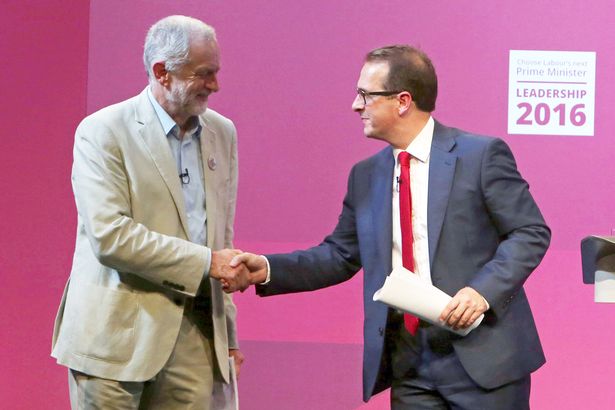
jeremy-corbyn-owen-smith-labour-leadership-coup-2

As they go down in flames for the second time in a year, Labour’s rootless and uninspiring centrists deserve neither respect for their “principles” nor sympathy for their plight

Quick, everybody reach for the tiny violins. The Telegraph’s Asa Bennett has penned a tremulous ode to Labour’s centrist MPs, encouraging these noble Men and Women of Principle (…) to never surrender in the face of Jeremy Corbyn’s imminent re-election as Labour leader.

Read the whole thing – entitled “Labour moderates have nothing to gain by kissing and making up with Jeremy Corbyn“. It is hilariously overwrought, and conjures much the same air as the Titanic’s band calmly playing “Nearer My God To Thee” as the doomed vessel slowly slipped beneath the icy waters of the Atlantic.

Money quotes:

Corbynistas know who their enemies are in the party. Don’t forget they have already divided up MPs by how loyal they are in secret lists. People like Mr Jarvis and Ms de Piero have made their disquiet known about Mr Corbyn, with the former believing he would lead the party to “electoral annihilation”. They have stuck their heads above the parapet to call for new leadership – a brave decision, but not one they can pretend never happened.

And Corbyn is not in a similar position? At least the centrists have one clear enemy and know exactly on who to focus their attempts at destabilisation. Jeremy Corbyn, despite being overwhelmingly popular among the party membership, is surrounded by disloyal MPs who have been working to undermine his leadership from Day 1. If the people who were supposed to work for you in your shadow cabinet were leaking damning quotes and incendiary opinions to the media like a broken tap, wouldn’t you try to implement some rudimentary system to remind yourself of who could be trusted and who would simply abuse any trust and autonomy to further their own aims rather than those of the party? I know I would.

Besides, that is the trouble with saying incendiary things to the media. There was always the risk that by attacking Corbyn in public, he would go on to triumph nonetheless, leaving his critics in an awkward position. But the answer is not to go on as an increasingly bitter heckler from the back benches. The answer is to either accept the overwhelming verdict of party members and try to cooperate constructively, or if this is impossible, to maintain a position of dignified silence on the backbenches. And then there is the nuclear option, which none of the centrist MPs will take out of overwhelming regard for their own political careers – if they really can no longer abide being in the Party of Corbyn they can always leave and join a different political party.

More:

Some MPs must be tempted to return in order to help Labour fight Theresa May’s government (even if their fellow moderates may think them scabs). This may help the Opposition put up a vaguely professional front, but it will be a gift to the Tories, who can relentlessly use these new shadow ministers’ past criticisms of their leader against them. Mr Corbyn is already struggling to convince voters that he could be a better Prime Minister than Mrs May, so how would that change by him bringing back a bunch of MPs who think he’s useless?

Again, this is shallow partisan thinking. As we are hopefully discovering in the aftermath of the EU referendum and the vote for Brexit, there is more to life than optics and how well things lend themselves to snappy soundbites. Might working alongside Jeremy Corbyn lead to some awkward questions from the media for those MPs who were vocally critical of him in the past? Sure. So power through the awkwardness. Reach out to Keith Vaz for tips on doing so, he has oceans of experience.

More:

Jeremy Corbyn’s former critics would be foolish to think that they can be welcomed back into the fold without any problem. Their return would be taken as sign of ultimate capitulation, and Corbynistas will not forget which side of the Labour leadership contest they fought on.

Asa Bennett is acting like Jeremy Corbyn is uniquely thin-skinned and petty, when in fact the opposite is the case. Corbyn has remained courteous even to MPs who have vented really quite unprofessional sentiments to the media. Will the insults be forgotten? No, probably not – that’s just human nature. But if any Labour leader in recent history is likely to work with his public critics, it would be Jeremy Corbyn.

Besides, in his overwhelming concern for the fate of centrist Labour MPs, Asa Bennett seems to be forgetting the pantheon of misfortunate MPs who were purged from the Courts of Tony Blair or Gordon Brown, their government careers abruptly terminated simply for showing too much favour to one or other of these egotistical megalomaniacs. Is Bennett really suggesting that Jeremy Corbyn being a bit frosty to MPs who openly called him “useless” on television is less acceptable than Prime Minister Gordon Brown throwing staplers and mobile phones at cowering aides who incurred his wrath?

And finally (my emphasis in bold):

This year’s Labour leadership election is drawing to a close, and Mr Corbyn’s survival is all but assured. Labour MPs have to decide whether to stay true to their beliefs and carry on the fight, or surrender and beg for a job. Moderates may seek a deal which means they can serve, but what is the point in carrying on such a charade?

WHAT BELIEFS?

Will somebody please tell me what high and noble principles these saintly centrist MPs consider so inviolate that they are honour-bound to refuse to serve alongside Jeremy Corbyn? Because for the life of me I cannot figure it out. Indeed, the very nature of being a centrist typically involves either a willingness to compromise on absolutely core and fundamental ideological principles, or the complete lack of any such principles in the first place. So what one Jeremy Corbyn policy is so offensive to the centrist rebels that they could not bring themselves to support it if focus groups suddenly showed it to be overwhelmingly popular?

Refusing to serve alongside Jeremy Corbyn because of deep and irreconcilable differences over policy matters would be understandable, even noble – but that is clearly not the case here. After all, Labour centrist MPs have enthusiastically thrown their support behind Owen Smith, who is campaigning on a nearly equally retro socialist programme as Corbyn. No, the Labour centrists are rebelling not because of unbridgeable differences but because they think Corbyn’s presence at the top of the ticket makes it harder for the party to get back into government and for their own pampered posteriors to get back into ministerial limousines. And that is contemptible.

That’s the rub. The only “belief” which unites the Labour centrist is the New Labour instinct to be all things to all people – to say anything and compromise on any belief in the pursuit of power for its own sake, while sanctimoniously pretending to be wiser than partisans on either side. The centrist creed, such as it is, would be “nothing is sacred, everything is negotiable”. Jeremy Corbyn disagrees, and for thus making Labour’s mountain back to power that much harder to climb they cannot forgive him.

If these centrists genuinely believe that the best policies for Britain would involve tacking just ever so slightly to the left of Theresa May’s centrist Conservative Party while warbling on about “compassion” and “equality” then they should say so – maybe not in so many words, as that would be political suicide, but they should make clear where they accept centrist Tory orthodoxy and where they would move to the Left. But they won’t do this.

The Labour centrists love to prance around in public as though there is some vast ideological gulf between the Evil Tor-ees and their noble selves, yet give them a leader who can actually put clear water between his own policy ideas and those of the Conservative government and they all scramble over one another to knife him in the back.

Asa Bennett could not be more wrong – the Labour centrist rebels of the PLP could not be less deserving of sympathy or respect. They had their opportunity to stand for something, anything clearly different, yet all of their remaining big beasts were too selfish and cowardly to run for the leadership, while the man who eventually became their champion – Owen Smith – spent the entire leadership contest asking members to vote for him because he was just as socialist as Jeremy Corbyn.

So when should we begin to feel sorry for the centrists, or give their incessant complaints another hearing? How about when one of them dares to stand up and articulate a positive, alternative vision for centre-leftist government which doesn’t just sound good on paper, but which actually generates the faintest amount of interest from the general public.

I suspect that we will be waiting a good, long while.


UPDATE: Read Submission Part 1 here, Part 2 here.


Jeremy Corbyn - PMQs

Top Image: Mirror

Support Semi-Partisan Politics with a one-time or recurring donation:

Agree with this article? Violently disagree? Scroll down to leave a comment.

Follow Semi-Partisan Politics on TwitterFacebook and Medium.

Brexit Catastrophisation Watch, Part 1

Since there seems to be no imminent end to the petulant, childish rage of disappointed Remain supporters at the prospect of being forcibly ripped away from their beloved European Union, we may as well start cataloguing some of the most hyperbolic and far-fetched tales of woe and prophesies of doom.

The inaugural submission comes, naturally, from the Guardian:

Social services for older and disabled people face crisis because post-Brexit migration restrictions could cause a massive shortage of care workers, leading care organisations have said.

The 1.4-million-strong UK care sector’s reliance on European migrant workers means it is vital they are given the right to remain in any future migration arrangements, the charities Independent Age and the International Longevity Centre UK (ILC-UK) said.

Currently about 84,000 care workers – equivalent to one in 20 of England’s growing care workforce – are from European Economic Area countries. About 90% do not have British citizenship and their future immigration status remains uncertain.

The charities said failure to tackle workforce shortages would mean thousands of older people would lose out on support, meaning they could be left housebound, struggle to recover properly from a stroke or fall, or fail to get assistance in getting up and dressed in the morning.

Translation: overturn the EU referendum result, or granny gets it.

(Note too the hyperbolic doomsday assumption of “a scenario which closed off all migration”, something which no serious person expects to happen).

The counterargument to this mini-tantrum, of course, is that cheap, young foreign labour from the EU and elsewhere has helped to ensure that care workers in Britain are paid an absolute pittance – often hovering around minimum wage – for performing a physically and mentally taxing job requiring skill, tact, empathy, good humour and great emotional intelligence in order to look after our loved ones in their final years.

The surly Guardianista charities moaning about the potential impact of Brexit on their sector clearly have no qualms or concerns that a worker can often make more money flipping burgers at a fast food restaurant than caring for our elderly and infirm senior citizens. This is just fine, apparently. But the mere possibility that free movement of labour restrictions might force employers to pay less desultory sums of money to frontline staff sends these “charities” into paroxysms of terror and rage. Whose side are they on? Not that of the patients or the care workers, that’s for sure.

Want to stop the endless drip-drip of care home abuse scandals? Try getting outraged that care is a borderline minimum wage occupation in this country, understand that people who might just as easily be flipping burgers for a living won’t always display the same dedication as Florence Nightingale – and be inordinately grateful for those care workers who do possess these criminally undervalued qualities. And in the meantime, forgive me for questioning the calibration of these charities’ moral compasses.

But why should we be surprised by their intervention? Everything about modern leftism and pro-Europeanism revolves around signalling virtue and ostentatiously displaying the “right” progressive beliefs to the right people.

And right now, it is far more important to be seen opposing those awful racist Brexiteers than it is to question the moral sustainability of an industry which hits its profit margin targets by providing our oldest and most vulnerable citizens with a Tesco Value standard of care.


nursing-care-home-abuse

Support Semi-Partisan Politics with a one-time or recurring donation:

Agree with this article? Violently disagree? Scroll down to leave a comment.

Follow Semi-Partisan Politics on TwitterFacebook and Medium.

Even Remainers Who Accept The EU Referendum Result Are In Denial As To Why People Voted For Brexit

rachel-reeves-brexit-eu-referendum

The EU referendum was not a question of “head vs heart”. When Remainers pretend that they occupied the intellectual high ground, they only delay their necessary and inevitable reckoning with the will of the British people

Remainers simply cannot help themselves. They cannot stop being arrogant and condescending toward Brexit voters, even when making otherwise admirable attempts to extend the olive branch and accept the nation’s verdict on leaving the EU.

Here’s Rachel Reeves MP, writing in the New Statesman:

Two days before the referendum, I visited the largest private sector employer in my constituency. I had spoken to many of the workers during the general election campaign a year earlier.

Although the chief executive works with a community centre to recruit local young people, like many businesses they also hire many Eastern European workers. It was a tough audience, as many blamed the EU for the squeeze on living standards and most felt immigration was out of control.

The people I met believed leaving the EU would mean less pressure on services and more money for them, because the downward pressure on wages would ease with fewer EU migrants.

[..] I knew in my heart at lunchtime on the day of that visit that we’d lost the referendum. My head had told me – the economist – that we would win because the consequences of leaving were a risk voters wouldn’t take. But, by Friday morning, we knew the Leave campaign’s emotional message was stronger than the rational arguments of the Remain campaign.

My emphasis in bold.

And there it is again – the infuriating “head vs heart” conceit, beloved by Remainers, that they unquestionably held the intellectual high ground when it came to arguing for Britain’s continued membership of the EU, and that the only reason for their defeat was that the base emotions and fears of Brexiteers somehow clouded their rational judgment and (to quote Lincoln, since Reeves tries and fails to do the same) shut out the “better angels of our nature”.

According to this cognitive dissonance-soothing rationalisation of defeat, Remainers were unquestionably right to warn of economic armageddon, and the economy was the sole worthwhile measure on which an existential question about national identity and democracy should be determined.

If this is the fruit of the Left’s attempt to understand Brexiteers (and we know it is, because the bottom of the article states that “This blog is based on a chapter Rachel Reeves MP wrote for the Fabian Society edited collection Facing the Unknown: Building a progressive response to Brexit“) then they have done an unspeakably lousy job.

The immediate post-referendum polling clearly showed that the strongest driver of the Leave vote was widespread concern about sovereignty and democracy:

The biggest issue, according to Lord Ashcroft’s post-referendum poll, was the overwhelming desire to preserve what remained of British sovereignty.

In “How the United Kingdom voted on Thursday … and why,” a survey of 12,369 voters in the United Kingdom conducted the day of the referendum, Lord Ashcroft found the No. 1 issue propelling people to vote “leave” was their belief that the U.K. should remain a self-governing entity not responsible to some supranational body writing rules and regulations about the economy and other matters.

Not hankering for a return to the 1950s.

Not an acute discomfort with dark-skinned people or eastern Europeans.

Not “Daily Mail lies” about curved bananas.

The people of Britain voted to leave the European Union because a majority of us quite rightly refused to accept the false claim that close and fruitful trade and cooperation with our European neighbours is somehow only possible by subsuming ourselves into the relentlessly integrating EU superstate. They were smart enough to realise that an organisation with a parliament, flag, anthem and ambitions for a combined military force has its sights set on something much grander than “friendship and cooperation”, and quite rightly wanted no further part of this doomed experiment in euro-federalism.

What’s more, the Brexit-voting people of this country were enlightened and dedicated citizens enough to see through the hysterical scaremongering propaganda of the Leave campaign, and accept that even if there were some short-term economic costs associated with Brexit, the Remain campaign clearly value our country and democracy too cheaply if they would remain part of a European political union through fear of a potential recession.

Were there oddballs, cranks and racists among the Leave campaign? Yes, of course we had our fair share. But the Remain campaign had Eddie Izzard, so let’s not tar an entire side based on its worst cheerleaders.

Look, I get it – daring to consider that one might have campaigned hard on the wrong side of history must be immensely difficult. The emotional investment of Remainers in their worldview, rhetoric and “identity” as super-progressive, tolerant and all-round awesome people is very strong and hard to see past. But if anyone should have the capacity to move beyond their own intellectual comfort zones it should be our elected MPs, people like Rachel Reeves. Sadly, there is little evidence that many are doing so. Nor will there be, probably, until a couple of decades’ time at which point warnings of economic cataclysm will have been taken over by events.

It is good that Rachel Reeves and some others at various points on the left-wing spectrum, Jeremy Corbyn included, recognise that the EU referendum result must be honoured and are reconciling themselves to the will of the people. But it is one thing to accept the country’s verdict while still sanctimoniously proclaiming that the people were manipulated and hoodwinked, and quite another to reach deep inside for some humility and admit that the people may actually have been right all along.

Nobody expects the Labour Party and other Remainers to make the transition overnight. But well-meaning articles like this from Rachel Reeves suggest that the majority have not even begun the urgently-needed process of reconciliation to the national will. And that is a real concern, for their own tenuous future political careers if nothing else.


European Union - United Kingdom - Britain - Flags

Top Image: Express

Support Semi-Partisan Politics with a one-time or recurring donation:

Agree with this article? Violently disagree? Scroll down to leave a comment.

Follow Semi-Partisan Politics on TwitterFacebook and Medium.

Jeremy Corbyn’s Labour Party – No Home For Centrists

jeremy-corbyn-rally

Jeremy Corbyn and his supporters vastly outnumber the Labour centrists. So whose party is it really?

Very slowly – journalist by journalist, publication by publication – the realisation is beginning to dawn that the unwelcome outsiders in the Labour Party are now the centrist members of the PLP, and not Jeremy Corbyn and his leftist support base.

From the Spectator (my emphasis in bold):

A few months ago, Watson and his fellow MPs thought Corbyn was the anomaly. That if he was dislodged, the natural balance of the Labour Party would be restored. Now it’s clear that there are tens of thousands of Corbynites who now hold party membership cards and are itching to use them. Labour MPs are starting to ask if they are the anomaly. And an anomaly that the new far-left members will seek to correct when Westminster boundaries are redrawn and MPs are selected.

Slow hand clap.

Yes, centrist MPs are indeed now the anomaly, just as centrists should always be the pitiable, wishy-washy anomaly in a political party. Finally, realisation dawns that maybe it is the centrist machine politicians who are the parasites in the so-called Labour Party, and not the socialists.

A political party is nothing if not the voice and champion of its members. Any other arrangement – such as the noxious idea that MPs, once selected, should have license to ignore their local party at will while being at no risk of ever losing their seat – makes the party membership little more than a fan club for some generally rather unremarkable career politicians. And under Jeremy Corbyn, the Labour Party is finally becoming less of a fan club and more a champion of its members.

Naturally, there are losers in this reconfiguration, namely the centrist MPs who have enjoyed utter dominance since the late 1990s, who suddenly find themselves out of favour and at theoretical risk of deselection. But what is the alternative? That Blairite and Brownite machine politicians, despised by the very constituency associations who will be tasked with pounding the pavements and handing out leaflets to get them elected, have the right to a “job for life”?

This is why we need to radically re-examine the way in which MPs are selected and removed from office. We need real powers of recall, so that constituents (on gathering a sufficient threshold of signatures in a petition) can recall from Westminster an MP who is underperforming, betraying their election pledges or dishonouring themselves and Parliament through scandal. But more than that, we need to move toward to mandatory re-selection and a competitive primary system.

As this blog recently pointed out:

This would bring Britain into line with other countries like the United States, where Representatives and Senators do not have “jobs for life” and must compete in party primaries if they wish to run for their seat at the next election. Such a move would put the wind up an often self-entitled political class, forcing MPs to justify their worthiness of a place on the ballot at regular intervals and forcing many of the older, less useful bench warmers off into retirement.

No constituency should be lumbered with a doddering old MP who doesn’t care any more, or a sharp-elbowed go-getter who ignores their constituency as they focus on climbing the greasy pole. Mandatory reselection goes a long way to solving those problems.

The current system, by contrast, is an abomination – incumbent MPs, often initially selected to stand for parliament in their constituencies through dubious, opaque or even downright corrupt means are then largely free from scrutiny by their own party for the rest of their career. As soon as they enter parliament they are enveloped in the Westminster self-protective cloak which serves to insulate parliamentarians from the consequences of their behaviour and political decisions.

If you know that nothing you can do will ever get you fired – if there is no political betrayal (like, say, pretending to be a eurosceptic during selection and then turning around and supporting the Remain campaign) for which you will ever be held to account – then there is every incentive to lie about your real political beliefs and motivations during selection, and then behave in as abominable and self-serving a way as you please as soon as your are elected to the Commons.

The Labour Party now has two choices if it wants to avoid a permanent schism:

  1. Rig the leadership election process (deceptively known as “restoring the electoral college”) to ensure that pesky party members and their awkward convictions never again elect an ideological leader, or
  2. Embrace a system of mandatory contested primaries, where sitting MPs have to win a party primary in order to stand as the Labour candidate for their constituency at each general election

Failure to adopt one of these two solutions (and this blog strongly favours the second) will ensure that the party remains permanently vulnerable to irreconcilable differences between the directly elected leader and the PLP, thus rendering Labour ungovernable.

Either it must be made harder for ordinary party members to choose the leader they want, or it must be made significantly easier for party members to remove MPs who prove themselves unwilling to work constructively with that elected leader.

The past year has been a viscerally painful case study in what happens when the can is endlessly kicked down the road and people pretend that some other magic solution will offer itself, saving them from having to pick one of these harsh medicines. And whatever harm Jeremy Corbyn’s left-wing positions may have done to Labour’s electoral fortunes pales in comparison to the harm inflicted by the centrist-led campaign to undermine and destabilise their leader.

Either the centrist Labour MPs must take a hike (at least resigning themselves to a few years of quiet irrelevance on the back benches) or the hundreds of thousands of new party members must take a hike, for they have proven themselves incapable of co-existing.

And while this blog disagrees with nearly the entire Corbynite platform, I side strongly with the ordinary Labour Party members who are about to overwhelmingly re-elect their man.


Jeremy Corbyn - PMQs

Top Image: Mirror

Support Semi-Partisan Politics with a one-time or recurring donation:

Agree with this article? Violently disagree? Scroll down to leave a comment.

Follow Semi-Partisan Politics on TwitterFacebook and Medium.