Jacob Rees-Mogg vs Leftist Thugs, And Another Depressing Weekend For British Conservatism

The Conservative Party would deserve more sympathy when their MPs are shouted down by leftist thugs if the prime minister herself were not such an enthusiastic suppressor of free speech

By now I assume everybody has seen footage of the impressively unflappable Conservative MP Jacob Rees-Mogg attempting to break up a physical altercation after an event in which he was speaking was stormed by leftist, Momentum-aligned protesters.

This is the kind of scene we have come to expect from American university campuses, where roving bands of masked Antifa-style goons, wearing their intolerance for diversity of thought like a perverse badge of honour, now routinely storm the meetings and public events of student organisations or external speakers they consider to be haram.

University campuses in Britain, by contrast, tend to be far more sedate places with much less visible security. Since we are fortunate enough in this country not to have to pause every couple of months to mourn another deadly mass shooting incident in an educational establishment, our university campuses do not have their own dedicated police forces as is sadly necessary in America. Neither is there some kind of private security guard for every three or four students.

This, however, may need to change if Members of Parliament and other speakers, people routinely invited onto university campuses to give talks or participate in student debates, find themselves pitched into the middle of violent confrontations with balaclava-clad goons whose devotion to the Cult of Social Justice and Identity Politics leads them to shut down the expression of any opposing thought.

On this occasion, the situation was defused before any real violence could take place, but Jacob Rees-Mogg has experience of standing up to aggressive leftist protesters and bravely stood his ground. Other MPs or public figures might understandably be less keen to put themselves in harm’s way while security guards or police are called to quell a developing problem.

And be assured, this will happen again – not because the speakers invited onto campus are becoming any more controversial or provocative, but because those opposed to their presence are becoming ever more sensitive to what they see as heresy – and too often are being indulged in their precious sensitivity by leftist academics, university administrators and politicians. The protesters cannot be reasoned with, and will not engage respectful debate when offered the chance, so the only way to preserve and protect freedom of expression on university campuses is to have a heavy security presence ready to haul out disruptive people who would censor events with their incessant yammering.

Unfortunately, what we saw from the Conservative Party in response to these events at the University of West England was not a muscular defence of free speech and a commitment to ensuring that universities which take public money also take seriously their responsibility to crack down hard on would-be student censors; rather, we saw a whinnying display of self-pitying victimhood:
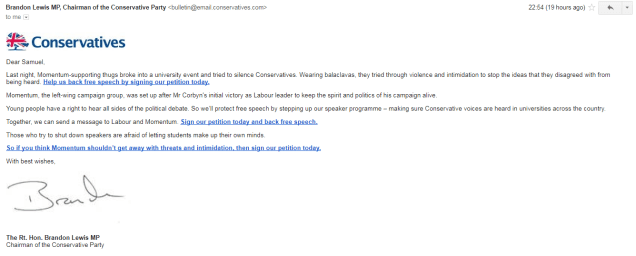
Brandon Lewis - Conservative Party email - free speech petition

In wheedling tones, the new Conservative Party chairman writes:

Last night, Momentum-supporting thugs broke into a university event and tried to silence Conservatives. Wearing balaclavas, they tried through violence and intimidation to stop the ideas that they disagreed with from being heard. Help us back free speech by signing our petition today.

Momentum, the left-wing campaign group, was set up after Mr Corbyn’s initial victory as Labour leader to keep the spirit and politics of his campaign alive.

Young people have a right to hear all sides of the political debate. So we’ll protect free speech by stepping up our speaker programme – making sure Conservative voices are heard in universities across the country.

Together, we can send a message to Labour and Momentum. Sign our petition today and back free speech.

To whom is this petition addressed? The Conservatives are in power, for pity’s sake. Are we to waste our time signing a petition at the request of the party of government, encouraging the party of government to do something which it could and should have been doing all along? A government which has to pass around tear-stained petitions encouraging their own ministers to do their jobs does not deserve to hold office.

The title of the email is “It’s not ok”, which is exactly the same scolding, infantilising kindergarten phrase used by the Social Justice Left in America to describe behaviours which they deem to be “harmful” or “oppressive”. And so rather than taking the fight to those who would shut down free speech in this country, the Tories instead prefer to flaunt their scars in an appeal for public pity and then ask us to sign a petition calling on them to do something about the very problem over which they have so ineptly presided.

This is untenable stupidity. As Home Secretary, Theresa May did as much as anyone else to suppress freedom of expression in numerous forms, using exactly the same arguments as the Social Justice Warriors – to protect the supposedly weak-minded citizenry from corruption or offence from undesirable sources.

As Brendan O’Neill noted in 2016, soon after Theresa May ascended to the office of prime minister:

May and the student Safe Spacers she’s railing against are one and the same in their belief that bad or eccentric ideas are best dealt with by censorship. May bans a pastor who has a problem with the Koran; students ban secularist critic of Islam Maryam Namazie. May bans Tyler, the Creator for being sexist; 30 students’ unions ban Robin Thicke’s ‘Blurred Lines’ for being sexist.

And both use the Stalinist language of ‘safety’ or ‘the public good’ to justify their speech-strangling antics. Students’ unions claim, with spectacular paternalism, to be protecting the ‘mental safety’ of their student charges; May says she bans people who say weird things because they aren’t ‘conducive to the public good’. It’s almost funny: student leaders fancy themselves as anti-Tory, yet ape Tory intolerance of difficult ideas; May positions herself as a critic of Safe Space nonsense, yet she’s Britain’s Safe-Spacer-in-chief, treating not only students but all of us as infants to be guarded from controversy.

You cannot busily construct a Safe Space at the national level – a dystopian society where people are woken up in the middle of the night and dragged off to jail for placards they create, songs they sing or words they publish on social media – and then be overly surprised or outraged when a gang of young college thugs, raised in a society where it is constantly preached that people have the divine right not to be offended, decides to take matters into their own hands.

As this blog has repeatedly pointed out, the battle for free speech is won or lost at the margins – it is only by defending the vile and unconscionable speech of extremists that a firewall is created to protect mainstream political discourse. Sadly for Britain, the battle for free speech was never even fought at the margins – the government instead chose to unilaterally surrender on all of our behalfs, and restrict speech considered offensive by nearly every designated victim group or professional offence-taker in the land.

Now the barbarians are at the gate, and it is not just “extreme” language or opinion under threat, or even loud-mouthed and controversial provocateurs like Katie Hopkins, but mild-mannered right-of-centre politicians like Jacob Rees-Mogg. And now that the Faith Militant of the Cult of Social Justice and Identity Politics threatens the physical safety of Conservative MPs as they address perfectly respectable student organisations, finally the government is stirring lazily to action, unjustifiably offended that anyone other than the police might seek to enforce the very cultural and linguistic taboos that in their incompetence they allowed to spread unchecked across the land.

Well sorry, but this is too little and too late. The idea that a government led by the same authoritarian zealot who waged war on civil liberties in this country for six years as Home Secretary is suddenly going to bravely fight for freedom of thought and expression on university campuses or elsewhere is utterly risible. Even if she were to totally flip-flop on the issue, devoid of any other ideological backbone as she is, the prime minister no longer has the political authority to take a serious stand on a domestic political issue.

The litany of political failures which can be chalked up to the Conservative Party since 2010 – failures of ambition, vision, intellect, principle and courage – is growing too long to recount in any one blog post or article. But ending up in the same ideological hemisphere as masked thugs who threaten the physical safety of their own MPs surely has to rank near the very top of the list.
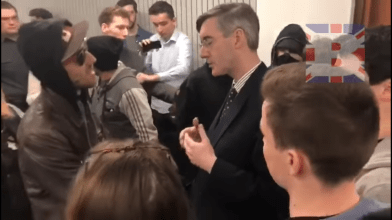
Jacob Rees-Mogg - University of West England - Momentum leftist protesters

Support Semi-Partisan Politics with a one-time or recurring donation:

Agree with this article? Violently disagree? Scroll down to leave a comment.

Follow Semi-Partisan Politics on TwitterFacebook and Medium.

The Two Brexits

Cultural Brexit - Culture Wars - Establishment

Not everything of value can be measured or counted, and Remainers opposing Brexit purely on economic or materialistic terms are doomed to forever misunderstand half the country when they refuse to view Brexit through any other prism

If we are to have any hope of knitting Britain back together after Brexit, Remainers must first acknowledge and seek to understand an entire aspect to Brexit which until now they have tended to ignore or crudely dismiss as xenophobia or nostalgia for Empire.

Brexit is two separate phenomena in one. First there is Economic Brexit, the world of quantifiable (if still largely speculative) prognostications and arguments over just how impoverished Britain will be after Hard Brexit versus the untold riches which will be ours once we have concluded that mega trade deal with New Zealand.

But there is another Brexit, too. I struggle to define it – some days I feel like it is “Constitutional Brexit”, the Brexit which concerns itself with high-minded questions of governance, statecraft and geopolitics. But on other days it feels more visceral, more inchoate, though no less important for that. This is “Cultural Brexit” – sneered at by the Economist but best understood as secession from the EU partly as a reaction against supranational European government, yes, but also an enormous cultural backlash against years of self-serving, centrist, technocratic government within the narrow boundaries of an incredibly restrictive Overton Window.

While many smug or outraged Remainers try to hang Vote Leave’s idiotic “£350 million for the NHS” bus slogan around my neck, I never believed any of that nonsense and did my best to dispel it while other Brexiteers who should have known better were still propagating the idiocy and sowing the seeds for our current impasse. Personally, I always pursued “Constitutional Brexit”. What mattered to me was not immigration numbers or trade deals per se, it was the fact that decisions like these – crucial to the development, prosperity and nature of any nation state – should be made at that national level, not set as an unsatisfactory 28-way supranational compromise in Brussels (at least until a tipping point is reached where majority of us feel more strongly European than British).

But the more I observe the furious establishment backlash against Brexit (and last year’s opportunistic centrist coup against Jeremy Corbyn’s leadership of the Labour Party) the more I find that Cultural Brexit also resonates quite strongly within me. Ultimately, I cannot separate the constitutional issues from the fact that for too long Britain has been run by cautious, unambitious identikit drones who nominally belong to Team Red or Team Blue but ultimately hold the same basic worldview and seek to inch us incrementally toward their shared vision of the future, without even thinking to meaningfully consult with the people or explain their actions.

Are the numbers important? Absolutely. To the extent that we can actually make meaningful forecasts (and note: nearly every self-professed or well-credentialed economic expert has been wide of the mark, from when they told us that staying outside of the euro would be economic suicide right up to the OECD’s continually shifting forecasts of Brexit doom) of course numbers and the impact of Brexit on the economy matters. An economically weakened Britain is a diminished Britain, even if only in the short term, and we cannot forget that government policy and spending decisions can be measured by their impact on real human lives.

But simultaneously, numbers are often very good at capturing nearly everything besides that which actually makes life worth living. That’s why I never warmed to the Tony Blair / Gordon Brown / Ed Miliband / Jeremy Corbyn view of the world. They all had their own emphases, but to listen to these leaders speak was to imagine a clinical and soulless Britain, impeccably multicultural, endlessly tolerant even as Western values were eroded, with punctual trains, benefits for everyone, a gleaming new NHS hospital on every other street corner filled with identically-uniformed staff – but very little else.

Public Services (and the taxpayer money which needed to be extorted to pay for them) are everything to this type of leftist. Civil society and the idea of individuals coming together to do anything besides consume public services or petition the government for More Stuff barely registers in their mind, because their conception of a Utopian society has little room for anything outside the public sector. Schools, hospitals and trains – absolutely. Churches, the Women’s Institute, innovative start-ups, world-beating corporations, the ambition to strive for anything besides total equality of outcome – not so much. There is (or at least there should be) more to our shared national life than the public services which we consume together.

People of this mindset simply cannot fathom why we might want to leave the European Union, because it represents risk, and to them risk doesn’t mean possibility or potential. It means the fear of less money for public services and a potential reduction in the kind of perks which middle class people like myself are supposed to be beguiled by – free movement, low roaming charges, the European Union Youth Orchestra. The idea of risking material comfort or stability for mere democracy or the chance of further constitutional change seems absurd to them – if it can’t be counted on an Excel spreadsheet and slapped onto a smug infographic to be shared on Twitter, it can’t possibly count as a valid argument about Brexit, goes their thinking.

Such people can only think in terms of Economic Brexit, and will not debate with you in good faith on any other topic – many refuse to even acknowledge the existence of constitutional or cultural concerns other than dismissing them as “xenophobia”, or angrily saying “of COURSE the EU needs further reform!” without ever specifying what this reform should look like. There is, in other words, a huge empathy gap between the two Britains, and since Remainers are often not shy in declaring themselves “better” than us unwashed Brexiteers I would submit that the duty is primarily theirs to close it.

Pete North has for a long time done a great job of dissecting both aspects of Brexit – the Economic Brexit with its need to get to grips with the minutiae of trade agreements and regulatory systems, and also the Constitutional/Cultural Brexit which gets too little attention from most commentators. But he really knocks it out of the park in his latest piece, writing:

I am often told that we Brexiters are pining for long lost glory – fighting for a better yesterday. But what if we are and what if we are not wrong? What if the relentless march of “prosperity” is eradicating the best part of us? No misty-eyed tales will be told of sitting in a Frankie and Benny’s while tapping one’s foot to the generic tones of Shania Twain.

[..] One thing one notes about modern British cultural history is that every recession is marked by a musical revolution. We had 70’s punk, 80’s metal, 90’s rave and ever since, especially since the smoking ban, culture has gone into hibernation. The place you would have booked for your face melting techno all nighter is now a Debenhams complex. If there is one defining quality of modern progressive Britain then it is the relentless commercialised tedium of it.

As we have gradually sanitised our living spaces we have also sanitised our culture and one cannot help thinking we are now sanitising thought. This is clear from the onslaught of safe space culture so that our delicate metrosexual hipster children are protected from ideas that that may lead them to stray from the path of bovine leftist conformity.

I can’t really speak to rave culture, so I’ll have to take Pete’s word for that. But there is much truth in what he says. Nobody can deny that we live in an age of technological miracles. People of my age, who experienced the early internet in our teenage years and just about remember a life before it, have to concede that much. And as a country – as the West – we are undoubtedly more prosperous. I am continually astonished walking through London, thinking back to how much scruffier and run down everything looked in the 1990s when I came on daytrips from Harlow as a boy, how dramatically the skyline has changed, how few restaurants there were compared to now, how much less variety and choice there was in all things only a decade ago.

By nearly every measurable metric we are better off and our prospects are brighter, and yet something intangible has been lost. The economic heart has been ripped out of my hometown of Harlow, Essex, with many of the prestigious large employers now gone and replaced with vast distribution centres offering only minimum wage work. The town centre is decayed and scruffy; a town of nearly 100,000 people that can no longer sustain a Marks & Spencer’s department store; charity shops and temporary seasonal stores occupying the places where more permanent, upmarket businesses once were.

Meanwhile, when my wife and I go shopping at the upmarket Westfield mall in White City everything is polished and perfect, but you could be anywhere – Houston, Paris, Dubai, Melbourne, Hong Kong. Globalisation and economic growth have brought gleaming homogeneity to the places frequented by globe-hoppers like me, but slow decay to towns like the one where I was raised.

By no means can all of this be laid at the foot of the European Union. But stories like these need to be repeated over and over again because there are still many people who fail to understand that the months and years prior to the EU referendum were in fact not Golden Years for many people.

And “Golden Years” brings me on to David Bowie, and back to the point Pete North was making. When Bowie died early in 2016, writer Neil Davenport lamented that our current youth culture could never create anything like him again:

It’s worth remembering that Bowie slogged on the margins for ages, in two-bit bands, recording very minor songs, before finally finding his voice. Back then, British society created a kind of free space in which young people who were willing to take the unpredictable route of cultural experimentation could do so.

This, too has been lost, which I think is what Pete means when he says that our culture has “gone into hibernation”. As I remarked at the time:

Who would have thought that calls to outlaw clapping and booing, tearful temper tantrums about dress codes, stifling ideas by labelling them ‘problematic’, the insistence on safe spaces and mandatory sexual consent workshops for students would have such a repressive, suffocating effect on our society?

That’s not to say that there is no great new talent emerging seven decades after the birth of David Bowie – clearly there is. But time and again, we see the biggest acts and pop stars of today are more eager to ostentatiously embrace prevailing social values as an act of public virtue-signalling rather than court controversy by cutting across today’s strictly policed social norms.

Lady Gaga took no risk when she sang “I’m on the right track baby, I was born this way” – indeed it opened the door to stadiums full of even more lucrative fans. That’s not to say that she was wrong to do so; but how often do you see an emerging pop star court real controversy or confound society’s expectations these days? You can blame some of this on commercialisation, sure, but not all of it. Something deeper is at work.

When emerging artists see ordinary people shamed and ostracised for saying the “wrong” thing or even just adopting the wrong tone on social media, how many will have the courage to incorporate anything truly daring or potentially “offensive” in their acts, or create spontaneously from the heart without first processing everything through the paranoid filter of societal acceptability?

The societal changes we have undergone in the last three decades are not insignificant, and they have not been to the benefit of all people. I think I feel this keenly and am able to empathise with Cultural Brexiteers because I have a foot in both worlds.

I have a pretty nice middle class life in North London surrounded by fellow “citizens of the world”, but I was born and raised in a Brexit town. To me, the inhabitants of Brexitland are not abstracts or nasty composite caricatures painted by the Guardian – they are fundamentally decent human beings, real people of flesh and blood who want the best for their families and children. They are friends and former work colleagues for whom voting Tory or Labour made very little difference over the past twenty years because both main parties represented the same basic consensus (of which support for the EU was emblematic).

Pete concludes with what passes for a message of hope:

In effect I see the natural consequence of Brexit being what Cameron imagined as the Big Society, where ideas like free schools and “CareBnB” can take root. In the absence of state provision people can and do fill the void. All these ideas have been tested but not allowed to take root because they are a threat to various blobs who are well served by ossified state structures.

I hope so. Aside from Brexit, David Cameron’s aborted Big Society was the last thing which passed for a significant political idea in this country, and it had merit.

The revitalisation of our civil society has a value, as does the revivification of our democracy (if only we can build on Brexit and demand that powers reclaimed from Brussels filter down further than Westminster). It may not be possible to count them up in a spreadsheet but their value is real, as is the positive impact of living in communities which are more than homogenised temporary landing pads for globe-hopping citizens of the world or run-down ghettos to house the people who serve them.

This is cultural Brexit. It’s not that the European Union is the source of every last one of these woes. It’s that many people who defend the EU and supported Remain are as deaf to the concerns of Constitutional Brexiteers as people who think globalisation is all benefit and no downside are deaf to the criticisms of those who oppose the centrist consensus. The deafness to both concerns is the same, because in both cases they are overwhelmingly the same people.

It is this failure of empathy and imagination which first gave the Labour Party Jeremy Corbyn, and then gave us Brexit. The anti-establishment backlash which powered Donald Trump to the White House was also similar, though Brexit is much more coherent than Trump’s grievance-fuelled manifesto.

Remainers can keep shouting about Brexiteers being wrong, stupid or evil. They can delude themselves that we were all hoodwinked by a red campaign bus or Russian propaganda. But if they want to tackle that pervasive feeling of divorce and estrangement from their own country which many of them painfully feel, they will simply have to consider that theirs is not the only valid or reason-based prism through which to view Brexit.

Remainers must be bold and confront rather than dismiss Cultural Brexit. And they must dare to imagine that regardless of how this government’s rather ham-fisted attempt at Brexit plays out, those who voted for Britain to leave the European Union may just be on the right side of history after all.

David Bowie - Beckenham Free Festival

Support Semi-Partisan Politics with a one-time or recurring donation:

Agree with this article? Violently disagree? Scroll down to leave a comment.

Follow Semi-Partisan Politics on TwitterFacebook and Medium.

The Conservative Party Has Lost The Pulse Of The Nation

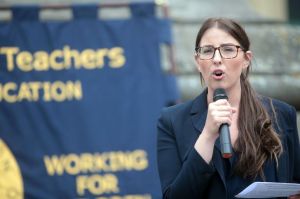
Laura Pidcock - Labour MP North West Durham - 2

Labour’s statist, redistributionist policies are as bad as ever, but unlike the Tories they increasingly have the pulse of the nation

Once again I find myself in the strange position of agreeing with a stridently left-wing MP in their criticism of this drifting Conservative government and the failing centrist consensus which it represents.

As Jon Trickett continues to curate LabourList for the week, North West Durham MP Laura Pidcock writes:

Those people who sit on the government benches, who speak very well and pronounce their excellence and their firm grasp of the system, probably do believe it was their hard work that got them there. I’m sure they believe that it was some unique brilliance that put them in a position of power, not their childhood classrooms with numbers in single figures; not their personal allowances whilst at university: not their ability to recover from failures, because of the large cushion they sit upon. Not everybody who is wealthy and privileged is like this, but it certainly – and evidently – it makes it harder for those that are to understand the reality of what is happening to ordinary people.

This is why you get a system like universal credit, like the bedroom tax, the rape clause, the sanction system, the work capability assessments and he hugely alienating disability benefits system. It is why there are fines and punishments associated with all aspect of working class life: parking, smoking, littering, debt payments, libraries, electricity meters. When I had a book that was overdue to return to the Commons Library, I did not receive a fine. Undoubtedly it was assumed that I was too busy, that I had better things to be doing. Do the same presumptions apply to 99 per cent of Britain? Of course, not. On the contrary, they seen are lazy, feckless and are perceived to be “cheating” the system for turning up minutes late to a benefits assessment. Then they are hit where they won’t recover: through their finances, and so the cycle continues.

Of course, Pidcock ultimately goes on to spoil it all with economically illiterate class envy and a programme based more on tearing down the privileged rather than giving greater opportunities to the underprivileged:

We must expose the absurdity of our current system, we should shine a light on the cosy, privileged networks which lock out our people, our communities and our class. We have to call out poverty pay for what it is: it is robbery from the real wealth creators.

This much at least is socialist piffle. Yes of course there are some exclusive, exclusionary networks that are unwelcoming to minorities and working class people, and this is reprehensible when it occurs. And yes, recruitment to the SpAdocracy and cadre of parliamentary researchers and advisers which acts as a recruitment pool of future MPs is often too narrowly targeted at people from the same homogeneous background. But as this blog discussed yesterday in the wake of the Oxford University diversity non-scandal, the real issue is a problem with the supply of qualified people from under-represented backgrounds, not a lack of demand for them.

Most institutions remotely connected with government are under huge pressure to improve their diversity ratios, and face constant political pressure and bad publicity when they fail to do so. The fact that insufficient progress has been made tells us that the pipeline of qualified (or interested) candidates remains restricted, not that willing and capable people are necessarily being turned away.

But strip away the leftist agenda and the rest of Pidcock’s criticism is spot-on. Of course there are honourable exceptions, but MPs sometimes manage to display a remarkable lack of empathy for the struggles of the squeezed middle. This manifests in a multitude of ways, and is by no means restricted to the Conservative Party.

The London-raised metro-left Labour MP parachuted into a safe Northern constituency but boasting a voting record more attuned to the priorities of Islington than Darlington is every bit as out of touch as the privately-educated Tory MP who cannot comprehend why a six-week gap between applying for Universal Credit and receiving a payment might be problematic. Or the Tory MP who is confused that a selfish housing policy which chronically restricts the supply of housing stock to benefit older homeowners simultaneously alienates younger voters. Or the rural Tory MP who devotes all their energy to supporting NIMBY causes and then wonders why each election leaves him with fewer and fewer colleagues from urban constituencies.

My concern is not that the Labour Party is suddenly coming up with compelling, inventive new solutions to the problems we face as a country. By and large, they are not. My concern is that Labour are at least correctly identifying some of those problems and speaking to them in a way which makes people think they care, while the Conservative Party steams on in the same dismal direction as before, bereft of vision or policy ideas and with an unfortunate tendency to loudly insist that everything is great when everybody can see otherwise.

My concern is that more than four months after a general election result which has seemingly prompted no change in strategy by Theresa May’s government, Labour MPs are starting to make more sense – and sound more like they live in the real world – than their Conservative counterparts.

And when that happens, it usually means that the out-of-touch party is heading for a spell on the Opposition benches.


Laura Pidcock - Speech

Support Semi-Partisan Politics with a one-time or recurring donation:

Agree with this article? Violently disagree? Scroll down to leave a comment.

Follow Semi-Partisan Politics on TwitterFacebook and Medium.


Laurie Penny, Gaslighter

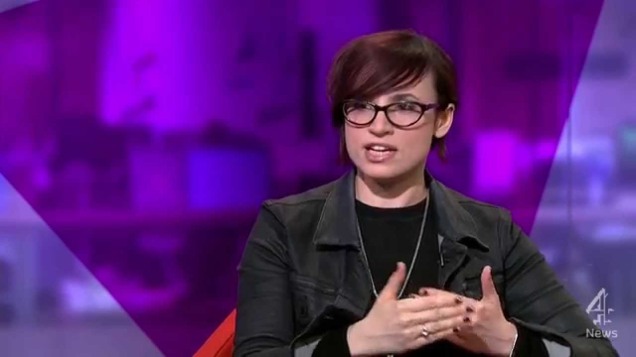
Laurie Penny

According to Laurie Penny, conservatives are the true enemies of free speech and the illiberal student activists who beat them up, ‘no platform’ their speakers and disrupt their events are merely questioning the establishment

As they stagger on under the “leadership” of Theresa May, this Conservative government continues to cast about aimlessly for some kind of raison d’être, a justification for showing up for work in the morning which sounds marginally more noble than “because daytime TV sucks”.

And so it came to pass that the unremarkable minister for universities, Jo Johnson, decided to jump on the increasingly popular right-wing bandwagon of bashing identity politics, demanding that universities uphold a commitment to free speech and promise not to use no-platforming or safe spaces to suppress the exchange of ideas on pain of being fined or even deregistered as an institution by the Office for Students.

This is all incredibly boring. Jo Johnson was head of the Downing Street Policy Unit from 2013-2015 under David Cameron, right at the time when illiberal identity politics zealots were cementing their power. If Johnson had a burning desire to protect free speech, he could have persuaded Cameron to take up the cause. He did not do so. It is also curious that he now wants to become a crusader for free speech when working for an authoritarian prime minister whose every instinct points the opposite way, toward more regulation and censorship. In short, this whole thing is a PR stunt by a rudderless Tory Party chasing headlines rather than following an ideological compass.

But all this is only to be expected. More noteworthy is the response to Johnson’s posturing by identity politics priestess Laurie Penny, who took to the New Statesman to claim not just that conservatives are exaggerating the threat to free speech but that it is entirely a figment of their imagination.

Penny’s article begins dishonestly, and then gets worse:

The nonsensical consensus amongst the centre-right that today’s students are a bunch of censorious cry-babies plays well with the base, so Johnson Minor has jumped on the rickety bandwagon barreling down the road to the palace of convenient fictions, where a delicate banquet of delusion will be served to those whose cash and status protect them from ever having to hear their opinions questioned by a bunch of rowdy kids.

Conservatives seeking protection from having their opinions questioned? This is an interesting inversion. Rather than trying to minimise the issue and argue that the threat to free speech on campus has perhaps been blown out of proportion and is perhaps not as bad as portrayed, Laurie Penny insists – rather shamelessly – that the problem does not exist at all, that it is all a figment of our imagination.

Penny must be a secret neo-conservative fan girl because this is a consummate Karl Rove strategy, whereby she shamelessly accuses her opponents of the identity politics Left’s own glaring flaws. Where is the lengthy list of prominent left-wing speakers who have been banned from college campuses by conservatives? Where are the left-wing professors who fear for their job security if they question conservative ideas? Where are the left-wing students expelled or suspended from college because they made conservatives feel “unsafe” and contributed to a hostile, non-inclusive atmosphere? They don’t exist.

The problem is not that crusty old establishment figures are upset that brave, radical students are questioning their judgment. The problem is that these illiberal students do not merely question ideas, they actively suppress them on the grounds that they amount to dangerous “hate speech” with the power to wound or even kill. Yet through immense self-deception, Penny is able to cast actions which deliberately prevent speech from taking place as mere protest:

This is a non-controversy, and it’s unbelievable that otherwise intelligent commentators are taking it seriously. “No-platforming” is just another word for student protest – the practice of opposing invited speakers with bigoted views is a time-honoured one. The cooked-up row over “student censorship” is led by the sort of trembly-whiskered outrage-merchants for whom “censorship” means “making me feel bad about holding certain views”.

But protesting an idea and infringing on the rights of another person to express that idea are two very different things. One could excuse any act of violent oppression using Penny’s logic. “But lynching is just another word for protest”, said the Klansman to the sheriff as he was caught red-handed tying a noose. “I believe that black men are a menacing sexual threat to white women. Doesn’t matter if it’s true or not, I sincerely believe that it is and on that basis you have no right to stop me stringing up DeShawn over here for making my wife stare at him lustfully”.

And so it is with the SJWs. They sincerely believe that words are violence (or at least some of them do – I can’t help but think the smarter ones know full well that words are not deadly, but pretend that they are as justification for censoring unwanted ideas) and on that basis they claim the right to “protest” by shutting down the offensive speech, preventing it from taking place or exacting severe physical, financial or bureaucratic consequences for the speaker who dares to persist.

Laurie Penny continues:

There is, I ought to say, a rhetorical difference here that causes some confusion. Today’s students are simply more likely to use the language of empathy and trauma in their politics. They’re more likely, initially, to say “this book about how women aren’t really human might make some of us feel unsafe” than they are to say “this book is bullshit”. They’re more likely to say “you’re doing harm” than they are to say “fuck you”.

This is partly because a lot of today’s young radicals come from demographics for whom it’s far more dangerous to say “fuck you”. They are young women, young queer people, young people of colour. Their way of questioning authority is simply less actively aggressive. Today’s angry young people are more likely to show you their scars than their fists. That might be passive-aggressive, but it’s not politically unsound.

This is nonsense. Today’s SJWs and Antifa (the movement’s Faith Militant) are equally happy inflicting scars as they are flaunting their own to garner sympathy. It doesn’t take long to dig up both high-profile and more obscure cases where the pseudo-victimhood of supposedly marginalised and oppressed groups morphed suddenly into violent aggression on campus.

Witness student Bonita Tindle pushing and shoving a white male student who had the temerity to wear his hair in dreadlocks. Witness the recent incident at University of California – Santa Cruz, in which protesters shut down a meeting of the College Republicans and one protester claimed that she literally felt unsafe meeting in a library which was previously used by college Republicans. Witness the aggression of Jerelyn Luther getting hysterical about Halloween costumes. Witness Black Lives Matter shutting down an ACLU free speech event at William and Mary College, holding up banners declaring that speech kills. Note, too, the rising trend of outraged leftists demanding that speakers and publishers of wrongthink retract their “harmful” ideas and articles rather than going to the effort of disproving them. The Cult of Social Justice and Identity Politics is causing many on the Left to forget how to argue at all.

Laurie Penny dismisses the current ideological focus on “harm” as a mere difference in rhetoric compared to previous generations, which is blatantly false. If you think a prominent idea is “bullshit” and evidently false then you generally relish the opportunity to publicly tear it down and discredit its proponents. But the SJWs do not do this. All too often, they don’t even attempt to engage with the substance because they claim that even hearing contrary thoughts expressed will do them physical and emotional harm.

There is hardly a shortage of literature and academic research on the rise of victimhood culture and learned fragility/unresilience. One thinks particularly of the paper “Microagression and Moral Cultures” by Bradley Campbell and Jason Manning, which discussed the difference between dignity, honour and victimhood cultures, or Jonathan Haidt’s development of these ideas.

Laurie Penny is doing a fantastic job of telling often well-meaning leftists exactly what they want to hear. She seeks to assuage any doubts that some wavering souls may feel about their movement’s snarling illiberalism by waving away any concerns as the desperate squeaking of a racist, misogynist old guard who are simply upset at the loss of their hegemony. After all, it is much easier to dismiss concern as the self-interest of oppressive powers rather than reflect on the ideological oppression they themselves are inflicting in the name of social justice.

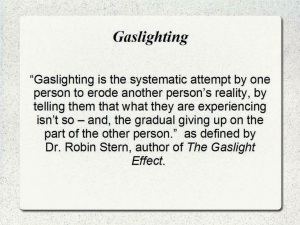
But in telling conservatives that persistent, concrete efforts by the Left to paint their ideas as intolerably extremist and forbid their expression on campus are merely imagined, Penny is actively gaslighting. She is engaging in that coercive, manipulative behaviour more common to spousal abusers by portraying her opponents as crazy and flat-out denying observable reality in order to delegitimise conservative concerns about free speech suppression.

That Laurie Penny feels able to lie and deceive so freely in the pages of the New Statesman shows just how strong the Cult of Social Justice and Identity Politics has become. Adherents to this illiberal, censorious cult no longer fear being discredited or held to account for their lies. So complete is their control over academia and so cowed and enslaved are the media and many politicians that people like Laurie Penny can now create their own reality and demand that others accept it as real.

If a conservative were to insist that capitalism was completely flawless or deny that poverty exists, they would be laughed out of town and rightly lose all credibility. Yet Laurie Penny can use her exalted perch in the New Statesman to deny that things we can all see taking place on Western university campuses are even happening at all, yet still be taken seriously the next time she spouts off on TV.

That’s the protective power of the Cult of Social Justice and Identity Politics at work.

That’s how close conservatives and defenders of free speech are to losing this war.


Gaslighting definition - Dr Robin Stern

Support Semi-Partisan Politics with a one-time or recurring donation:

Agree with this article? Violently disagree? Scroll down to leave a comment.

Follow Semi-Partisan Politics on TwitterFacebook and Medium.

Does Oxbridge Discriminate?

Brideshead Revisited - Oxbridge - Social Class - Discrimination

Oxbridge has every incentive to admit more students from disadvantaged and minority backgrounds. If diversity has failed to improve then it is our fault as individuals, families, communities and voters for failing to provide elite universities with a bigger, better talent pool

Another day, another tedious story about Oxbridge being a terrible bastion of privilege and discrimination where the few working class students who manage to evade the perimeter and matriculate find themselves mocked mercilessly by Bullingdon toffs while students of darker complexion are forced to drink from separate water fountains.

The trigger for this year’s rehashing of the predictable dirge was a freedom of information request submitted by Labour MP David Lammy, who selectively requested and interpreted data to paint the bleakest possible picture of barriers to elite higher education in Britain.

The Guardian reports on the “shocking” findings, and then have the temerity to criticise the Oxford University press office for daring to defend themselves rather than meekly accepting criticism and submitting to corrective punishment:

Oxford and Cambridge have been accused of failing to engage in serious debate over their lack of diversity by the former education minister David Lammy, who first highlighted the issue with data obtained by freedom of information requests.

The Labour MP said the universities had been “trying to make journalists change their stories” rather than address how little progress they were making in recruiting talented students by race, social class and location in England and Wales.

His accusation came after sparking national controversy over data – first published in the Guardian – that showed that as many as 16 Oxbridge colleges failed to offer any places to black British applicants in 2015, the most recent figures under the FOI request.

Note that when leftists call for a “serious debate” on something, in actual fact they do not want a debate at all. What they want is for you to flop over submissively on the ground and agree to whatever Utopian socialist pipe dream they have in mind. Back in the real world, Oxford and Cambridge do little else these days other than engage in never-ending symposia about diversity. The reason that these debates don’t satisfy the Left is because they do not end with Britain’s elite universities sacrificing their brands and academic standards by further lowering their entrance requirements to attract less qualified applicants who happen to tick the right diversity checkboxes.

David Lammy huffs in the Guardian that “seven years have changed nothing at Oxbridge”, but this is totally untrue. Elite universities are falling over themselves to admit minority and working class students to improve their admissions statistics. They face immense political and even financial pressure to do so. Seven years have indeed changed Oxbridge, but only in the direction of being even more amenable to considering applications from underrepresented groups. What has not changed, though, are the stubborn social and environmental factors which continue to restrict the pool of minority applicants in which Oxbridge and other elite universities must fish.

Of course, Labour were quick to pile on with predictable, cookie-cutter criticism:

Angela Rayner, Labour’s shadow education secretary, said: “This is the latest damning evidence on the government’s failure to widen access to our most selective universities.

“The proportion of comprehensive school pupils getting in to top universities under the Tories is lower than when Labour left office, and this data shows that the problem is especially serious at Oxford and Cambridge.

“Ministers claim their system is working, but these figures show that it isn’t.”

Because any imbalance simply must be the fault of institutions, and ultimately the government who wield absolute power over everything and everyone. The idea that poverty, social stability, family structure, engaged parenting or personal responsibility might play a part in the under-representation of certain groups at Oxbridge is unthinkable. Heavens, no. Successive British governments have created a perfectly egalitarian society, and the only reason that the enrolment at Oxford University does not perfectly match the makeup of the general population is because evil admissions officers in Oxford colleges harbour a seething, visceral hatred of poor, brown kids.

Lammy goes on to complain:

During this period [2010-2015], an average of 378 black students per year got 3 A grades or better at A-levels. With this degree of disproportionately against black students, it is time to ask the question of whether there is systematic bias.

Really? Now is the time? I’m so glad, because this conversation is indeed long overdue. Nobody has once raised the issue until this watershed moment, courageously midwifed into existence by David Lammy. At long last we can finally ask why, a time when every other institute of higher education in the country have conspicuously prostrated themselves before the Cult of Social Justice and Identity Politics, Oxford and Cambridge continue to openly revel in institutional racism.

This is asinine.

Getting angry at Oxbridge for not admitting more ethnic minority and working class applicants is putting all the blame for societal, cultural and family problems at the foot of higher education. I am technically a BAME individual (oh, how I hate that stupid, infantilising acronym) from a poor, single-parent family, yet I was admitted to Cambridge University and neither experienced discrimination while there nor witnessed anybody else facing discrimination. On the contrary, there was a rigorous, fiercely intellectual atmosphere (aside from all the drinking and punting) which cared only about what you think, not what you look or sound like.

If anything, given the incentives and political pressure faced by universities today, I would not be surprised if many elite institutions already do more than they should to correct for social and government policy failures by accepting students from under-represented backgrounds that would not stand a chance if they were white and middle class. I know that if I was a university administrator and my performance appraisal, reputation or funding were at stake then I would be very tempted to selectively lower standards.

To properly address this issue we need to have “honest conversations” not about institutional discrimination but about family structure, culture, parenting, wealth and both primary and secondary education. We need to ruthlessly eliminate influences which tell certain impressionable youngsters that academic achievement is uncool, that being a useless parent is socially acceptable, and which peddle myths about Oxbridge based on hazy recollections of Brideshead Revisited.

We also need to stop the media hand-wringing. Hysteria about the lack of BAME people at Oxbridge only feeds a false narrative that minorities are unwelcome at Britain’s elite universities. It is very hard to increase representation when you simultaneously tell a certain group that they probably won’t get in to Oxbridge and will likely have a very bad time there if they do manage to beat the odds.

What we cannot do is expect our best universities, the engine of Britain’s innovation and research, to expend scarce time and resources bringing some candidates up to the basic level they need to be starting at. Some remedial classes are already offered to students who arrive at universities without the required study skills. It would be unfortunate if this reactive solution were to bed down at Oxbridge.

It is very convenient for politicians such as David Lammy to point to an evil, imaginary bogeyman which is responsible for a lack of diversity rather than admitting the more complex and intertwined failures which contribute to the problem. But as a “BAME” person (ugh) from a relatively disadvantaged background who was accepted into Oxbridge, the narrative being spun by the Left smacks of cynicism and a lack of serious thought.

To be clear, I’m not suggesting that discrimination does not exist at the margins, or in the form of so-called microaggressions. I’m sure that it does. But I do not believe that it is systemic, particularly given that Oxbridge faces so many incentives and coercions to increase diversity.

Rather than badgering our elite universities to fix upstream issues and single-handedly correct disparities in the opportunities available to different demographic groups, we need to call individuals, families, communities and (yes) government to account for their failings and shortcomings. We need to foster a universal culture of ambition and respect for academic achievement which transcends lines of gender, ethnicity, wealth, culture or social background. This probably means making a thousand small and often inconvenient changes to the way that we behave as individuals, parents, teachers, students and policymakers, which is much harder work than joining the David Lammy Chorus and blaming everything on discrimination.

But the easy solutions are rarely the correct ones, and when it comes to increasing minority representation at our elite universities we must do what is hard rather than what feels good.

Formal Hall - Fitzwilliam College Cambridge University

Support Semi-Partisan Politics with a one-time or recurring donation:

Agree with this article? Violently disagree? Scroll down to leave a comment.

Follow Semi-Partisan Politics on TwitterFacebook and Medium.