Late Night TV Hosts vs Trumpland

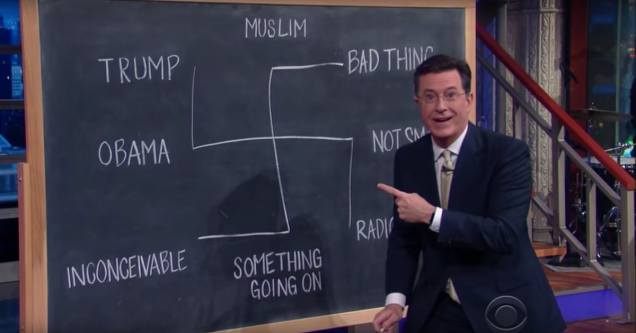
Stephen Colbert - Donald Trump - chalkboard swastika

When it becomes good business for left-wing late night comedy hosts to actively alienate and belittle half the country, it is clear that Donald Trump is not the only force stoking hatred and division in America

While in New York City last December, my wife and I were fortunate to get tickets to see The Late Show with Stephen Colbert being recorded at the Ed Sullivan Theatre.

It was a good show and ended up being a really fun experience, but as somebody who cannot reliably tick the “Yes, I agree” box next to every progressive cause under the sun, it was only fun because I knew what I was letting myself in for and readied myself in advance for an hour’s worth of dripping condescension, mockery and misrepresentation of conservatives and conservatism.

And increasingly that’s how it is for conservatives – and even some moderates – who want to consume the fruits of mainstream culture, be it network television, Hollywood movies, stand-up comedy or even classical music. Sure, you can watch – nobody barred me from entering the studio or administered an ideological test before I was allowed to sit and watch Stephen Colbert spit-roast Donald Trump in his monologue for the hundredth time. But in order to derive uninterrupted enjoyment from proceedings, those on the right increasingly have to perform a certain degree of mental disassociation from their political views before taking part. One has to fake laughter and perfect the wryly amused smile so as not to look out of place while everyone else clutches their sides and laughs at the Stupid Backward Conservatives.

During the warm-up act before Stephen Colbert came out, the warm-up comedian scoured the audience looking for interesting or odd people, and then made them stand up and engage him in conversation for the delectation of the audience. Pretty standard for a warm-up act, but one person in particular seemed to pique the warm-up comedian’s interest – a slightly patrician-looking, grey-haired and well-dressed man in his late fifties or early sixties. “A Republican in the audience!”, the comedian exclaimed.

The comedian got the man to stand up, confirmed that he was indeed a conservative and then went to town on him in a way which was superficially good-natured but as it dragged on (far longer than his other interactions) quickly became quite awkward both for the gentleman involved and a number of other audience members. This isn’t to resort to snowflakery – go to a comedy show and one should expect to get picked on by the person on stage, after all – but it was notable and entirely predictable that none of the conspicuously progressive stereotypes sitting in the audience received similar treatment. And of course this was but a foreshadowing of what would happen when Colbert himself took the stage (we in the audience were under strict instructions not to “spoil the fun” by booing at any point, though this rule was liberally disregarded when any mention was made of a conservative figure or policy).

Left-wing satire can be brilliant. I always felt that during his long tenure at The Daily Show, Jon Stewart did a fantastic job skewering the many foibles and failings of the George W. Bush administration without coming across as aggressively bitter or hostile to everyday conservative voters. He may not have been speaking to them for much of the time, but neither was Jon Stewart actively belittling those people who twice voted for Bush. Other late night hosts such as Bill Maher often make more pointed barbs directed at ordinary conservatives, but in Maher’s case his jokes are much funnier and are balanced with a frequent willingness to call out the excesses, failings and hypocrisies of his own side (such as the free pass given by much of the American Left to retrograde attitudes toward women in parts of the Islamic world).

Stephen Colbert, while often very funny, is less nuanced. As a non Trump-supporting conservative I personally fall down the awkward gap between agreeing with nearly all of Colbert’s criticisms of President Trump’s personal conduct and suitability for office while also wishing that not every single monologue had to be come a teachable moment about the supposed deficiencies of conservatism, the self-evident correctness of progressive positions and the supposedly inherent wisdom of even the dimmest people who happen to cheer for the progressive cause.

And this brings us to fellow late night talk show host Jimmy Kimmel, who took the opportunity (in front of an extremely friendly crowd of fellow progressives) to use a guest appearance on left-wing podcast Pod Save America to declare that progressive domination of late-night television was entirely right and proper, Darwinian natural selection at work within showbusiness.


From Ben Shapiro at The Daily Wire:

Following President Trump’s State of the Union address last week, CBS late night host Stephen Colbert had on the former Obama staffers of “Pod Save America” to bash Trump. Those same gentlemen welcomed ABC late night host Jimmy Kimmel to the stage for an event on Saturday night, where Kimmel proceeded to explain that all late night hosts are on the Left thanks to their vast intellect.

What a ridiculous and unnecessarily smug thing for Kimmel to say. One cannot rend one’s garments about hatred and division in America and then declare everyone on the winning side of a highly contentious election to be intellectually inferior. These are not the shocked and panicked moments immediately after election night in 2016 – by this point the American Left has had a long period of time to dwell on their missteps and shortcomings in that electoral cycle, but many Democrats and others on the left choose instead to marinade in their own anger, as though shouting at the other half of the country will win them around.

I have also been to a live recording of Pod Save America. It is actually a podcast to which I subscribe and listen frequently, and so when the hosts came on tour to London in January I went with a group of friends to Cadogan Hall to hear them do their thing. At its best, Pod Save America is entertaining and informative, albeit from an avowedly left-wing stance, and there is a real value to hearing how some of the most prominent alumni from the Obama administration view today’s politics. Being a left-wing podcast, nobody expects them to do anything other than preach to the choir in every episode, which is no worse than what many right-wing talk radio hosts do. But surely we should expect a little more from late-night network television?

Nothing good can come from the bitterness and rancour which currently seeps from the late-night talk shows. Network television comedy should bring people together, or at least not needlessly alienate them from one another. It may be good business for late night TV hosts to cater almost exclusively to staunchly Democratic voters – NBC’s Jimmy Fallon, who deliberately stays less political, is certainly suffering in the ratings for failing to bash conservatives on a nightly basis – but it is bad for our society as a whole.

A cohesive society requires that we maintain a public square where everyone is welcome, where people are not encouraged to self-segregate as progressives or conservatives, Christians or Muslims, whites or racial minorities. Where everybody can be American (or British) first and subordinate their various other identities and affiliations, albeit temporarily, to the one which we all hold in common. But time and again we see what should be common territory – places like  late night television or NFL football games – being tussled over by partisans until one side is forced to cede the field. When everything is political, everything becomes divisive and toxic.

In his latest show, Ben Shapiro makes a similar point with reference to last weekend’s Superbowl LII in Minnesota:

One of the things that football needs to understand – one of the things that the NFL needs to understand – is that the popularity of the sport is deeply entwined with the good feeling about the country. If you feel bad about the country it’s hard to enjoy sports, because you feel like sports are frivolous. If you feel good about the country then sports are a distraction from the mundane, sure, but they are also a reminder that all of our conflict is really play-acted.

And that’s not true in politics, you know, in politics there’s a lot of our conflict that’s not, that’s real, that’s about issues that matter and I care deeply about. But it’s good for Americans to recognise once in awhile – and I think that’s what the Superbowl is for – it’s good for us to recognise every once in awhile that there are these moments where we have more in common than we are separated by. So it’s amazing that in an evening that’s really about conflict between two teams is really more about the love for fans for one another. It’s really more about a love of country. It’s really more about what we are unified in favour of, and that’s why it was so entwined with the flag, with the military, and it’s why it alienated so many fans when the players started kneeling.

This is a time when we need to urgently be creating more shared, civic spaces where people of differing political views, backgrounds and identities can come together as fellow citizens first and foremost, not as victims, oppressors or activists. America actually fares better than Britain in this regard, since displays of patriotism and national pride are not yet considered quite so embarrassing or gauche as they are in Britain (though some on the American Left would doubtless love to change that fact), but neither country can afford to be complacent.

And here, late night television serves as a good barometer of just how polarised society has become. There are many excellent and respected comedians at the top of their field who do not feel it necessary to turn their acts into another campaigning wing of the Democratic Party. But many conservatives having already largely abandoned late night television, it does not make sense for ratings (and therefore for business) to do anything other than give the remaining progressive audiences exactly what they want – just ask Jimmy Fallon, who lags in the ratings precisely because he refuses to turn his show into a platform for progressive revivalism.

We see exactly the same situation in Britain, where new satirical news show The Mash Report (itself billed as hybrid of the Daily Show and British current affairs shows like Have I Got News For You) make endless fun of Brexit voters and conservatives as though being left-wing and pro-EU is the “natural” position, from which any departure should rightly trigger outrage and mockery. From a business and professional standpoint there may be every reason to continue along the current trajectory (including high ratings, monetary rewards and approval from fellow bubble-dwellers in the industry), but that doesn’t mean that the status quo is good for societal cohesion. It isn’t. There was a time (before Brexit) when people on the Left used to understand that not everything of value could be quantified, but apparently no more.

The best satirical comedy tends to punch upward, not down (though of course in a free society it should be free to punch wherever it likes). It should be possible to punch up at Donald Trump while reserving a few blows for other highly deserving fixtures of American political life, including the cadaverous and inept figures who make up the Democratic Party leadership. It should be possible to punch upward at ludicrous Tory Brexiteers like Boris Johnson while also using humour to point out the starry-eyed naivety of those on the Left who see the European Union as the fount of all good things.

But most importantly, it should be possible to punch up at the political class while avoiding punching down at entire groups of voters, let alone nearly half the country. Because when it becomes good business sense to deliberately alienate half the country to wring laughter and advertiser dollars from the other half, something has gone terribly wrong.
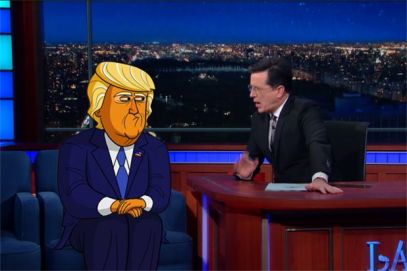
Stephen Colbert - Cartoon Donald Trump

Support Semi-Partisan Politics with a one-time or recurring donation:

Agree with this article? Violently disagree? Scroll down to leave a comment.

Follow Semi-Partisan Politics on TwitterFacebook and Medium.


Journalists Buying Fake Twitter Followers, Another Symptom Of Institutional Decay

Journalists buying fake Twitter followers - fraud

Some journalists and political pundits choose to buy artificial Twitter followers because being good at their job matters (and is incentivised) less than appearing like the Next Hot Thing.

I’ll admit it – in earlier years, in my weaker moments as a struggling political writer, I have idly thought about purchasing Twitter followers. But I have not and never will do so, and deplore those in journalism and politics who choose to sell out in this way.

The New York Times recently reported that a company called Devumi was offering dummy Twitter followers (either fabricated individuals or the fruits of identity theft) to those seeking to boost their social media stature for mere cents per follower. A whole swathe of celebrities were implicated (most of whom promptly rolled over and blamed their managers or PR people) but so too were a number of journalists at supposedly respectable outlets of the legacy media.

From the New York Times:

Genuine fame often translates into genuine social media influence, as fans follow and like their favorite movie stars, celebrity chefs and models. But shortcuts are also available: On sites like Social Envy and DIYLikes.com, it takes little more than a credit-card number to buy a huge following on almost any social media platform. Most of these sites offer what they describe as “active” or “organic” followers, never quite stating whether real people are behind them. Once purchased, the followers can be a powerful tool.

“You see a higher follower count, or a higher retweet count, and you assume this person is important, or this tweet was well received,” said Rand Fishkin, the founder of Moz, a company that makes search engine optimization software. “As a result, you might be more likely to amplify it, to share it or to follow that person.”

Twitter and Facebook can be similarly influenced. “Social platforms are trying to recommend stuff — and they say, ‘Is the stuff we are recommending popular?’” said Julian Tempelsman, the co-founder of Smyte, a security firm that helps companies combat online abuse, bots and fraud. “Follower counts are one of the factors social media platforms use.”

In some ways, this temptation is just one of many ways that using social media can warp our behaviours and motivations, as Jacob Brogan writes for Slate:

Twitter is a machine designed to generate ugly feelings. Here everything is subject to quantification: the number of people who like the things you tweet, the number who share your words with their own followers, and, perhaps most of all, the number who follow you. If you spend too much time on the platform, those numbers quickly become an index of your own self-worth, and no matter how high they get, they will always be too small.

Purchasing fake followers is thus rather grubby and slightly pathetic, but perhaps still fair game if you are a TV star looking to make a bit more money sending promotional tweets for haemorrhoid cream. But what if the person deceiving the public is somebody whose job it is to inform, educate and tell the truth? Surely then it becomes quite unambiguously wrong?

Well, lots of political journalists clearly don’t think so, according to NBC News:

Big media outlets have embraced Twitter as a distribution platform but still struggle with how reporters and editors use the social media service, particularly when they appear to be breaching journalism ethics.

This sizable gray area came into clearer focus this week, after a New York Times exposé revealed that more than a dozen news media figures had paid to artificially pump up the number of followers they have on Twitter.

Journalists and commentators, who presumably joined the platform to enhance their stature, instead found themselves grasping to explain why they had paid for counterfeit supporters. When contacted by NBC News, the journalists identified by The Times as having bought Twitter followers had a range of responses: Many ducked requests for comment, others blamed associates, while just one sounded chastened.

This practice doesn’t bother me so much when it takes place in other fields; if you’re a mediocre provincial stand-up comedian who wants to pretend you have an audience of half a million eager people hanging on your every word, so be it. Good luck to you. Same if you’re a B-list actress, a celebrity chef, an unremarkable footballer or a giver of lousy TED-style talks about personal development. I expect no realism from such people, and personalities from these fields who choose to over-inflate their popularity do no real harm.

Not so with journalists and political commentators, both those who parade around beneath the banner of the blue-tick Twitter verified logo and those scrambling for the Ultimate Recognition. Political Twitter is a nasty swamp of obnoxiousness at the best of times, but those of us who choose to lurk within it do so in the vague hope of coming across useful information or commentary once in awhile. And since nobody has time to vet every account that crosses one’s timeline to determine whether they deserve a follow or a clickthrough, a quick glance to see whether they have a decent (or at least a baseline) level of followers is a useful first line of due diligence.

Is this person for real? Well, their profile picture is the default egg icon and they have eleven followers. Hmm, probably not going to click that link or believe their sensational “report” about Theresa and Philip May using a ouija board in the Downing Street basement to seek inspiration and advice from Britain’s failed prime ministers of the past (plausible though that one actually sounds).

Buying Twitter followers makes a mockery of what the rest of us are trying to do, and undermines one of the few metrics left for gauging success (financial reward having long since ceased to be either a possibility or a useful indicator). I have a mere 2,500 followers on Twitter. However, unlike the cheaters, I earned my entire following by providing consistently useful or entertaining (intentionally or otherwise) content to my audience. Whether it is links to my blog, links to bloggers in my circle, flagging news articles of interest, engaging in feuds with trolls or writing in-depth threads on a particular topic, around two thousand people care enough about what I have to say to stay tuned on an ongoing basis (I imagine that many of the remaining 500 are either businesses or largely dormant accounts).

A study from 2016 suggested that of those people who had tweeted once within a six month period, their average number of followers was 707. This figure seems a little high to me, as I routinely interact with people whose following/follower figures are only in the double figures – but this may be a function of swimming almost exclusively in the political niche rather than venturing out into the deeper oceans of celebrity Twitter. Anyhow, the study would suggest that anything over 707 is then a pretty good sign, and in lieu of an affirmative action-gifted writing gig for The Spectator I am proud of my 2,500 followers as a sign that my hours in front of the keyboard are not entirely wasted.

Ultimately, all this predictable scandal tells us is what a fraud so much of journalism and political commentary has become. Portentously spewing words into the void of Twitter knowing that most of your audience is actually imaginary can’t bring positive feelings of journalistic pride, since one would be aware of the fraud. All that those followers can do is burnish one’s reputation and make one seem like an important person to get drinks with or be seen talking to at one of the many insufferable events that take place every day in Westminster or Washington, D.C.

And the problem is that for those journalists who buy Twitter followers, that’s just fine. They don’t want to organically build an engaged audience of followers who find what they say to be genuinely insightful. They may not object were it to happen, but actual professional accomplishment is clearly no longer the prize to these people. What they want is the aura of success, to be seen as uniquely knowledgeable, titillating or controversial without putting in the labour to do it themselves.

We see the same thing with many of our politicians. Twenty months on from the EU referendum and the number of MPs who have even a basic grasp of the technical issues relating to trade arising from Brexit can probably be counted on two hands. An even smaller number have paid much thought to the constitutional ramifications and the opportunities and threats to our future governance, if any at all. The most significant political development to happen in Britain in decades, and only a handful of our parliamentarians have bothered to stop spouting slogans from the referendum campaign to actually master the issues at hand.

Why is this? Because sitting down with books and consulting advisers in a spirit of humility and willingness to learn is boring and unsexy. The personal payoff just isn’t there, particularly when one can do so much more for one’s career by bleating an angsty speech about the Evil Tor-ees in the Commons chamber or going viral on social media with a well-timed quip on Question Time. And the only reason that our star journalists – the ones who pull in the big bucks and now get terribly worked up at the thought that their celebrity pay packets might not be “equal” – have not rumbled the politicians and revealed the extent of their ignorance is because much of the legacy media is in an equally benighted state.

The whole reason our politics are currently so dysfunctional is that being good at your actual job is no longer adequately incentivised. Looking good and frantically maintaining all the appropriate outward signs of success and positive momentum are what matters most, not solid work diligently performed in the spirit of self-improvement. That’s why people cut corners and do things like participate in Twitter follower-purchasing frauds – because they believe, often correctly, that the rewards which flow from mastering an issue or having an original idea are far less than those which flow from being on some insufferable “Westminster’s 100 people to watch in 2018” list.

You can write for months or years before establishment journalists (as I did) that the Tories were going on an ideology-free jaunt into political oblivion, or that Jeremy Corbyn ought to be taken seriously because the public responds to conviction and consistency, but it doesn’t matter. You won’t get the slightest credit, because nothing has officially been thought or written until it has come from certain approved sources within the Westminster Bubble. And even within the bubble exists a hierarchy, with all of the attendant temptations to level-up by artificially boosting one’s standing.

And that’s why I never have and never will buy Twitter followers. It represents everything that is rotten, sleazy and stupid about modern politics, and the alarming frequency with which people who shouldn’t be within ten promotions from the top of their respective fields end up prancing around at the pinnacle, lording it over the rest of us (be that the prime minister, whole swathes of Parliament, the editors of several newspapers, numerous television news personalities and various assorted celebrity columnists).

We will never live in a perfect meritocracy, and it is stupid to set unrealistic goals which ignore human nature. But one thing you ought to be able to trust in this day and age is that the Very Serious Journalist with the blue “verified” tick next to their Twitter account name is not perpetrating a fundamental fraud every time they broadcast their news, analysis and opinions.

I earned my Twitter audience, and my follower count rises and falls according to the value I deliver. Anything short of this basic standard of behaviour is akin to selling a used car having first tampered with the odometer. And while social media juicing may not be illegal, we should look upon those who engage in it with the same scorn and distrust one might reserve for a convicted fraudster.


Twitter for journalists

Support Semi-Partisan Politics with a one-time or recurring donation:

Agree with this article? Violently disagree? Scroll down to leave a comment.

Follow Semi-Partisan Politics on TwitterFacebook and Medium.

Over-Emoting Is A Growing Distraction In Live Music Performance

Overwrought emotional displays which detract from the music are not new to live performance, but are they becoming more pervasive and insufferable?

In an interesting segment from last night’s Ben Shapiro Show, Shapiro focuses on one stand-out act of celebrity leftist virtue signalling at the recent Grammy Awards in order to riff on performer over-emoting in more general terms.

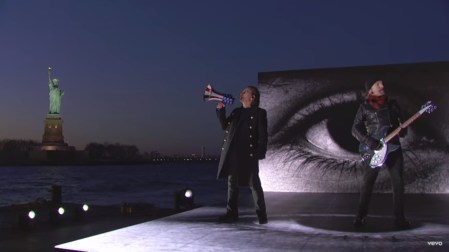
The specific performance that raised Ben’s ire featured U2’s Bono – an Irishman, it’s worth remembering, not a US citizen – singing in front of the Statue of Liberty, and praising the “shitholes of the world” as the source of America’s greatness, intended as a rebuttal to President Trump’s use of the vulgar phrase in a meeting with members of Congress about immigration.

While looking wistfully at the sky and prancing around in front of the Statue of Liberty, Bono portentously intones into a megaphone:

Blessed are the shithole countries, for they gave us the American Dream.

And to this nonsense, Shapiro responds:

As a musician for many many years, my favourite violinist – as is every violinist’s favourite violinist – is Jascha Heifetz. One of the things I love about Jascha Heifetz is that there is no histrionics. Jascha Heifetz, when he plays the violin – go look at a tape of him – is just stone faced. He just plays, and it’s great.

One of the things I hate the most about modern music is modern music is all based on energy and histrionics. It’s all based on you making faces while you sing, and looking up to the sky like Bono. Look at him, looking up to the sky with his red, white and blue loudspeaker.

This is something that I also find incredibly annoying and distracting. Of course this kind of preening and prancing has long been connected with music, and performers caring more about how they look and portray their socio-political opinions than how they sound on record is hardly a new phenomenon.

Nineteenth century Romantic pianist and composer Franz Liszt cultivated such a following that it coined a term – “Lizstomania” – where women would fight even over his coffee dregs and discarded cigars. And Lizst himself egged on this behaviour, being one of the first concert pianists to rotate the piano so that he would face the side of the stage at a right-angle to the audience, the better that they could appreciate his dashing profile.

Neither are all of the musicians I admire entirely innocent of this behaviour. Conductor-composer Leonard Bernstein also cut a dashing figure and was famous for the “Lenny leap” where he would sometimes clear a full foot from the podium. Glenn Gould, long my favourite pianist, is almost as well-known for his eccentricities – such as humming as he played, sitting on a battered folding chair when giving concerts and dressing for winter even in the height of summer – as he is for his revelatory interpretations of Bach, Beethoven or Brahms. But in the latter’s defence, many of his defining idiosyncrasies were clearly innate rather than studied, and in fact Glenn Gould had so little time for being a celebrity that he stopped giving concerts altogether at a young age to focus his energies on the recording studio.

British violinist Nigel Kennedy could likewise hardly be described as a staid, boring performer, yet his eccentricities somehow draw one into the performance rather than distracting or repelling the audience or listener. Watch Kennedy break normal concert protocol by addressing this BBC Proms audience immediately before launching into Elgar’s violin concerto and you’ll see what I mean:


But to me there is a definite order of magnitude between the baseline level of emoting that we see in classical music today and the more restrained (on average) approach of even thirty years ago. I confess that as technically brilliant as the likes of superstar pianists Lang Lang or Daniil Trifonov may be, I struggle to watch them because of the on-stage theatrics (in my opinion Yuja Wang does a far better job of being engaging and contemporary without appearing like a cholera patient on a storm-tossed sailboat).

I don’t care if you’re hamming up the rubato while playing some Chopin, there’s no need to lash your head around or make anguished faces as though someone is lurking under the piano pulling out your toenails as you play. But then maybe that’s just because I like my classical musicians the same way I like my journalists and TV news anchors – scruffy and unkempt, too dedicated to their craft to waste time worrying about being a walking shampoo commercial.

Now some of these behaviours and tics – maybe even a majority – can be put down to the understandable exuberance and vanity of youth. But I think a significant minority are inspired by a recognition that being brilliant is not enough unless one also looks and acts the part. And the look and act that audiences increasingly demand and reward is high on emoting, high on dazzling feats of technical brilliance (what Glenn Gould once derisively referred to as “piano-playing” in a self-critique of his earlier work) and lower on the kind of subtlety and introspection which is often needed to bring out the best in even some of the more bombastic repertoire.

And so might it be the case that the real problem with efforts to expand the market for classical music are not the things that usually get traditionalists so worked up – wearing jeans to the opera, mandatory white tie for orchestral musicians, informal lunchtime concerts and so on – but rather the fact that more and more classical performers are adapting to the Age of YouTube by attempting to groan and grimace their way to profundity just like every street busker who sings Lady Gaga’s “Poker Face” at a quarter speed, or Ke$ha’s overwrought performance at this year’s Grammys?

The point of classical music is, unsurprisingly, to convey ideas through the medium of music itself. Of course individual musicians will want to put their own stamp and interpretation on works, either in service of what they believe to be the composer’s original intent or to shed new light on what can sometimes be over-familiar works in the repertoire. But if you frequently find yourself pounding the piano keyboard like you’re playing Whack-A-Mole or sawing away at the violin while grimacing like your appendix just ruptured, you’re probably doing it wrong. The emotion should go through the music and not be lost in the gaudy, inefficient heat exchange of on-stage pantomime.

Performer eccentricities, when unintentional and/or in service of the music, are fine, and sometimes even a blessing. But Ben Shapiro is right; when they detract from the music itself then that can become a problem – in classical music as much as pop music with all the schmaltzy, simplistic political preening of Bono’s preachy Grammy performance.


Bono - US - 2018 Grammy Awards Performance - Virtue Signalling - Immigration - Blessed are the shithole countries

Support Semi-Partisan Politics with a one-time or recurring donation:

Agree with this article? Violently disagree? Scroll down to leave a comment.

Follow Semi-Partisan Politics on TwitterFacebook and Medium.


Are Technocrats To Blame For The Rise Of The Know-Nothing Celebrity Politician?

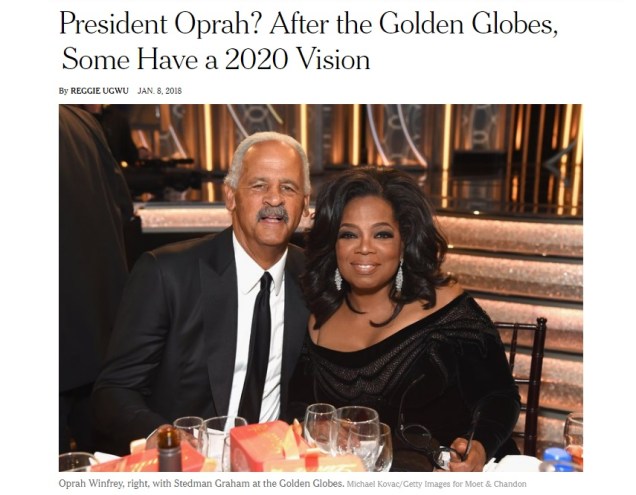
Oprah Winfrey - Golden Globes acceptance speech - MeToo - President Oprah

When unelected technocrats increasingly set policy and carry out the day-to-day business of governance we should not be surprised that electoral politics, castrated and less consequential than ever before, is becoming a circus freak show

Michael Brendan Dougherty has a new piece in the National Review which so succinctly captures the state of Western democratic politics that busy as I am this week, I feel the immediate need to blog a response/reaction to it.

Dougherty’s jumping off point is the sudden, feverish interest among assorted leftists and Democrats for television personality Oprah Winfrey (yes…) to run for president against Donald Trump in 2020, driven almost entirely by a speech Winfrey gave about the #MeToo movement while picking up an award at last night’s Golden Globes.

You might think it a little hypocritical for people who have spent the past two years bashing Donald Trump as an inexperienced dilettante in way over his head, a reality TV blowhard with no credentials and no right to occupy the office he holds, to immediately embrace a similar figure from their own side of the political divide – and you would be correct in thinking so. But the mere fact that voters are being drawn to these celebrity candidates is itself noteworthy, and crucially, Dougherty places the blame not with the voters but with the bland, interchangeable technocrats of the political class who offer those voters no compelling alternative.

Dougherty writes:

The average voter is going to be blamed for this. The great disdain of the educated class will fall on the Uhmurkans who have been hypnotized by their televisions. Maybe some of that’s right. But I blame the wonks. It was the wonks who, unawares, made the celebrity president not just desirable but logically necessary.

The wonk’s role is well-fitted to the centrist political ideal in the post–Cold War West. For them, government is most highly admirable when it is totally denuded of questions of value or morality (these having obvious and uncontroversial answers), and reduced to a purely technical exercise. The politician working with the wonk finds that his job is reconciling the public with what’s good for them. And this fits the machinery of the executive branch, which is filled with hundreds of thousands of civil servants, overseen by a much smaller retinue of political appointees almost all chosen from within the governing class of the country. Where this model of government is most advanced — in Europe — policy questions are routinely taken away from the passions of democratic peoples, and quarantined for expert management.

Taken together, these trends are more or less the abolition of traditional democratic politics. And so there is little use for the traditional politician, a person of judgment and charisma who represents the community from which he or she emerges, using his own wisdom in reconciling the diverse interests and needs of his nation and constituency.

You couldn’t write a better paragraph describing the impact of Westminster centrism and EU integration on our democracy, even though Dougherty is talking in his essay about American politics as much as European. On both sides of the Atlantic, political leaders have behaved as though we are living in the End of History even when Francis Fukuyama’s prediction has long since been disproven through bitter experience. Elections, while often bitter and hard fought, have generally offered little meaningful choice when it comes to big questions about how the nation can best order society and relate to the world. Even when political rhetoric has been heated and the candidates have seemed very different, the economic system and world order they ultimately support has tended to be the same, an embrace of the status quo.

Michael Lind also wrote at length in 2017 about the severing of the compact between the ruling class and the governed, with those in the political, professional and creative classes increasingly feeling no bond of kinship with or obligation to others in society, those they look down upon for holding “incorrect” or “oppressive views” (which can often be taken to mean “that which was mainstream twenty years ago”. And many politicians, nearly all drawn from this class (or inducted into it soon after election) do indeed spend their time explaining and defending the status quo to the citizens they nominally represent, rather than striving to change the status quo on their behalf.

I noted the same phenomenon only last month, in the context of Brexit:

Look at the big issues facing the West and the world in general in 2017 – global migration flows, Islamist terror, globalisation, outsourcing, automation and more – and there is not one of these complex problems which we as a country have failed to comprehensively sweep under the rug or otherwise avoid meeting the challenge.

Even on those occasions when the people have recognised burning problems and the need for bold new solutions, public opinion (such as on Brexit and immigration) has been repeatedly slapped down over the years by a cohort of politicians who think it is their job to explain and defend the current status quo to the citizenry rather than change the status quo according to the demands of the citizenry.

As I have also written, this managerialist technocratic approach to government, with the wonks in the driving seat and politicians as mere interlocutors to the public can potentially be justifiable when things are in steady-state, when times are good, society and the economy stable and when no large threats loom on the horizon. However, rather than a benevolent steady-state we instead live in interesting times, with numerous opportunities and threats ranged around us. This is the discontinuity about which I have been writing so much of late.

In such periods of discontinuity politicians must not remain in the back seat, because it then falls to unelected civil servants and powerful economic agents to dictate the nature and scope of change on their own terms and to their own advantage. For two decades now, globalisation, automation, outsourcing and immigration have changed the structure of our economies and the very meaning of work, and yet there has been no meaningful political debate about these topics until public dissatisfaction reached such a level that the debate could no longer be suppressed.

Nowhere has the debate been suppressed more effectively than on the subject of immigration, and nobody has done more to suppress that debate (thus pushing it toward the unpleasant fringes) than the Labour Party. On immigration, Labour and left-wing politicians very much see themselves as interlocutors rather than elected representatives. When people (including many of their own constituents) raise concerns about the dramatic levels of net migration since 2004, left-wing politicians and commentators see it as their job to explain why unprecedentedly high immigration is actually a good thing rather than seriously engage with voter concerns and amend policy based on that feedback.

When politicians refuse to take voters at their word and assume that their qualms about immigration are really about something else, this is not only patronising but ultimately counterproductive. One of Labour’s favourite fallbacks when it comes to immigration concerns is to pivot to worker exploitation. They think that by instituting new laws to crack down on hiring workers for less than minimum wage (as though it were not already illegal) the public will be placated because foreign workers will no longer be able to undercut local labour. Another favoured technique is to talk about infrastructure, a glib pseudo-concession to the reality that roads do not automatically widen nor hospitals acquire additional beds with every new migrant who lands at Heathrow. Of course, if they really cared about matching infrastructure to population increases caused by immigration they would have done so when they had the opportunity, so this is yet another evasion.

And even now that this tactic of ignoring voter sentiment and patronisingly explaining to voters why they are wrong to be concerned about mass immigration has spectacularly blown up in their faces, still the key voices of the Left can imagine no other way of functioning. Accepting that voters may have a point and amending their policies to reflect the democratic mood doesn’t occur to them. Instead we just see more earnest think pieces about how voters need to be better taught the benefits of immigration.

But immigration is only the most prominent policy area where we see this behaviour from politicians. The same haughty dismissal of public opinion occurs in nearly every sphere. As another example, both Labour and the Conservatives have long since coalesced around what is basically a social democratic economic worldview where profits were tolerated (though rarely celebrated) because the resulting taxes on those profits fund the massive, omnipresent public sector. This locked old-school socialists and more free-market conservatives out of the conversation until Ed Miliband’s failure to win the 2015 election saw Jeremy Corbyn bust open the consensus on the Left and take Labour in a more ideological direction. Theresa May still stubbornly refuses to come to an accommodation of her own with the libertarian right of her party, and this obstinacy and unwillingness to allow alternative views to influence policy is one of many reasons why the Conservative government is idling in neutral, doing nothing of value for the country and waiting for somebody to put it out of its misery.

So given the fact that our politicians (at least the ones who get ahead) tend to be dismal functionaries rather than inspired leaders with disruptive new ideas to meet the period of discontinuity in which we find ourselves, it is perhaps less surprising that many voters gravitate toward someone, anyone with charisma and a willingness to do something more than patiently explain to voters why all of the things they dislike are actually really good for them.

Dougherty writes:

Having eliminated the need for real probity in politicians, why shouldn’t the parties turn to celebrities as their political leaders? The celebrity will do the job of winning elections and riling up the public, but the machinery of government will go on, almost undisturbed.

This may be cathartic for some voters, but it has not taken long for the establishment blob to get the measure of most populist uprisings and swiftly tame them in all but rhetoric. In France for example, Emmanuel Macron discovered that by jumping around on stage and shouting a lot he could amass huge numbers of disillusioned voters and easily see off the threat from Marie Le Pen’s Front National, even though Macron is himself little more than a young face and a neat hairdo atop the same policies which so irritate the public and have increasingly proven inadequate to our present challenges.

And so it is too in America. Dougherty writes:

We can see how the permanent class of Republicans in government almost immediately tamed the Trump presidency. Instead of the populist presidency Trump promised, Trump is ushering in much of the pre-existing “moderate” Republican agenda of corporate tax cuts and economic deregulation. The political class and the media allied to it were able to expunge most of the populist figures from the administration. Soon, they might even succeed in expunging Trump, too.

We are thus heading toward a place where the theatre of democracy is almost entirely divorced from the process of governing. The connection between national elections and meaningful policy reform is becoming about as tenuous as the link between scripted reality TV and actual reality – in other words, almost nonexistent.

In this increasingly dystopian world, all our favourite celebrities can duke it out to become nominal presidents or prime ministers while the technocratic wonks pay no heed to the sideshow and quietly continue to go about implementing their preferred policies relatively unmolested.

But the blob may no more have the national interest at heart than the populist celebrity politician. Both are prone to self-interest, and while the celebrity politician’s interest likely lies in self-aggrandisement, the blob has often proven itself to be more interested in perpetuating policies which benefit its constituent classes in the short to medium term than strategically positioning the nation(s) they effectively govern to face the challenges and reap the rewards of the future.

And the blob is especially dangerous right now, having been moved to anger by unprecedented popular rejection in 2016. The disruptors may have thought that they could summon a good rage or indulge in a lavish pity party when they wanted, but their antics have proven to be nothing compared to the centrist persecution complex the displaced establishment has conjured up in response.

Neither side does their country any favours. The populists – whose figureheads are Donald Trump in America and the Hard Brexit Ultras in Britain – have by now proven their unseriousness and detachment from reality, but the blob still seems to be of the opinion that things can go back to the way they were once what they see as these temporary aberrations are over and the populist rebellions put down.

Patrick Deneen put it best in the Spectator this week, remarking that we now have “a liberal elite without a populace, and a populace without a moderating elite.” And so we are left to pick our poison – on the one hand an arrogant technocratic class which even now shows no humility or willingness to change its ways, and on the other a succession of telegenic performers who are great at channelling public anger but totally lacking the knowledge or leadership ability to turn anger into smart policy.

Not an enviable choice.

donald-trump-anxiety-therapy

Support Semi-Partisan Politics with a one-time or recurring donation:

Agree with this article? Violently disagree? Scroll down to leave a comment.

Follow Semi-Partisan Politics on TwitterFacebook and Medium.

The Age Of Perpetual Crisis

The Age of Anxiety - Ballet

When every single issue is falsely portrayed as a burning crisis, none of our national challenges will receive the considered attention they deserve

“We would rather be ruined than changed
We would rather die in our dread
Than climb the cross of the moment
And let our illusions die.” 
― W. H. Auden. The Age of Anxiety: A Baroque Eclogue

The housing crisis. The migrant crisis. The productivity crisis. The deficit crisis. The tedious, annual NHS winter crisis. Brexit. Nearly every important issue or event in our politics is portrayed as a pressing, existential crisis, despite few of them even remotely living up to the definition. If you are sceptical, just ask somebody who was alive and situationally aware in 1940 whether any of the issues which excite politicians and newspaper editors today amount to a real crisis, and see what they have to tell you.

And as it is in Britain, so it is across the Atlantic in America. Surveying the present scene, David French writes in the National Review:

In politics, when everything’s a crisis, it turns out that EVERYTHING’S A CRISIS!

We keep reading that Donald Trump is a unique danger to American democracy, a threat we should put aside partisan tribalism to defeat. Then, seconds later, we read that giving Americans the choice to buy health insurance will kill people by the thousands. Seconds after that, we learn that an entirely conventional Republican tax plan will not only kill people but also extinguish American democracy as we know it. Finally, we read that the end of net neutrality — a regulatory doctrine that only the smallest percentage of Americans even remotely understand — will extinguish American liberty.

[..] For the average American, who pays less attention to politics than to his professional and personal lives, all of this is exhausting. It’s numbing to the point where he can’t possibly determine what’s important and what’s not. So he checks out. He throws his hands in the air and gives up. But for the Americans who care the most about politics and drive our public debate, perpetual crisis is invigorating. It provides meaning and purpose.

A nation’s political culture is always defined by the people who care the most, and the people who care the most in our nation have lost all sense of proportion.

Charles Cooke makes a similar point, but at the more personal level, in the same publication:

Ours is a moment in which millions rush breathlessly to exclaim. In defense! In resistance! In bloody-minded persistence! “I will not back down!” we are told, by people who have not been asked to, and could not be compelled to. They won’t be “intimidated” either, nor “silenced,” nor “bullied” nor, it seems, pushed to any form of self-reflection. Indignation, not analysis, is the perennial order of the day, and the tone of our debates is ineluctably Twitteresque. Retweets are points on the board, and hyperbole gets you oodles of them. The worst. Ding! Insane. Ding! Crisis. Ding, ding, ding! Congratulations, you have been promoted to the next level.

I don’t think I have ever read a more perceptive or honest summary of how political Twitter works, and as a denizen of this world I see more than a few of these negative traits in my own work, some due to personal failures but more often because the difficult pathway to being heard and gaining an audience on social media incentivises some pretty negative behaviours.

It is in the nature of those involved in politics – either doing or writing about it – to imbue their work and their passions with an air of existential importance. In many ways, this is understandable – it is hard to get a hearing in the media, or from the People Who Matter, with a piece of sober, rational analysis addressing a long-running issue; harder still when the competition presents every new report or white paper as some kind of magical elixir to the nation’s woes.

Given the choice, most people want to be Neil Armstrong and not the dedicated but overlooked engineers and project managers who made the Apollo Program a reality. Or if politics is showbusiness for ugly people then most players want to walk the red carpet and be photographed, not lurk in obscurity editing screenplays or building sets. This is human nature, but it has the unfortunate side effect of warping our political process, bending it towards flashy but superficial quick fixes and wonder cures rather than holistic analysis and serious reform.

The word “crisis” in particular is used far too readily at present, by people who should know better. The nature of politics and public policy means that nearly every important decision will ultimately have some direct or indirect impact which can be measured in terms of human lives, thus making it existentially important to at least a few people. In fact, the Left in particular rely on this very phenomenon, since their conspicuous compassion policies front-load the emotional benefits of throwing resources at a problem while deferring or even denying the costs – after all, it is easy to win applause and positive headlines by opposing welfare or healthcare reform, but much harder to counsel delayed gratification or highlight the cumulative toll of welfare dependency on the quality and duration of human life.

But in actual fact there are very few actual full-blown crises facing us at the present time, despite the best efforts of opportunistic politicians and the media to suggest otherwise. Rather, there are a series of slow-burning, serious and often intractable problems which need to be tackled, few of which are likely to lead to sudden national ruin but many of which – if left unattended much longer – have the potential to chip away incessantly at our economic prosperity, national security, democratic health or the stability and cohesion of our society.

The appalling failure of successive governments to adopt a sensible housing policy and increase the housing stock will not lead to an explosion in homelessness or destitution overnight, but it will lead to a continuing sense of rage, disillusionment and alienation among younger voters, as it is already doing. Continuing to stand by an immigration system which proudly fails to make skills or likelihood of assimilation and popular consent the key drivers will not lead to riots in the street tomorrow, but it will continue to drive a wedge between the political class and much of the country. Continuing to enshrine the NHS as our national religion and abide by the strict political doctrine of NHS non tangere will not create an immediate spike in death rates, but it will ensure that UK health outcomes continue to further lag behind those countries with the best healthcare systems.

Labelling something a “crisis” suggests imminent peril requiring immediate remedy, even if the resulting damage control ultimately creates other problems or only succeeds in kicking the can down the road. It advocates for quick fixes, which is exactly what we don’t want at this time. In this period of discontinuity, where the old political settlement has broken down and traditional, familiar policy prescriptions neither work effectively nor command sufficient public confidence, what we need are carefully thought-out and mutually supporting policies rooted in an uncompromising, forensic analysis of the precise problems we face. What we absolutely do not need are a bunch of panicked gimmicks and pseudo-policies cooked up in silos by desperate politicians and leaders whose sole objective is to survive the day and avoid negative headlines.

The difficult truth is this: there is no one pressing crisis the resolution of which will solve all our problems and keep us safe and prosperous in a changing world, and there is no universal and comprehensive solution to any of the problems we deem to be crises. Housing cannot be addressed without revising planning rules, but it is also impossible to adequately plan future housing and infrastructure when there is no meaningful control over mass immigration. Low productivity cannot be addressed without looking at corporate governance, secondary and tertiary education, workers’ rights, union power and addressing the weak commitment to R&D. Indeed across the board there is no silver bullet, no quick fix, no political party with all the right answers, no system of government ideally equipped for the challenge. We must forge a new path.

Far from focusing attention and driving positive change, labelling everything a crisis merely creates apathy, causes many voters to check out and encourages many politicians to either view problems in a highly compartmentalised way or else simply consider them insurmountable, facts of life to be dealt with rather than challenges to be overcome – just as many in the British establishment seemed resigned to irreversible national decline in the 1970s, before Thatcherism finally equipped Britain with the tools to dig ourselves out from the last major period of discontinuity this country faced.

Britain emerged stronger from the late 1970s and 80s because after years of paralysing indecision and timid half-measures from Tory and Labour governments alike we finally made a calm, methodical and dispassionate analysis of the problems holding us back – excessive union power, flawed monetary policy, excessive state involvement in the economy – and set about tackling each of these issues in a coordinated way, as part of a comprehensive national turnaround strategy.

We need to adopt just such a process again today in order to overcome this new period of discontinuity and the specific challenges that it brings. And the first step is to stop viewing every last issue as a standalone, burning crisis.


Munch - The Scream

Support Semi-Partisan Politics with a one-time or recurring donation:

Agree with this article? Violently disagree? Scroll down to leave a comment.

Follow Semi-Partisan Politics on TwitterFacebook and Medium.