The Southern Poverty Law Center Is Enabling Islamist Extremism By Smearing Its Most Stalwart Opponents

maajid-nawaz-southern-poverty-law-centre-splc-extremism

By labelling dedicated anti-extremism campaigners like Ayaan Hirsi Ali and Majid Nawaz as anti-Muslim extremists themselves, the deluded and morally compromised Southern Poverty Law Centre is doing the Islamists’ work for them

There have been few sadder debasements of once-fine and noble institutions this year than the Southern Poverty Law Center’s decision to stop serving as a fearless searchlight highlighting violent extremism and instead become a trendy-lefty Islamism-denying propaganda outlet.

That might sound harsh, but there really is no other way to describe the SPLC’s fawning, slavish deference to leftist SJW dogma – a philosophy which furiously denies that there is any problem within the Islamic community or with a certain branch of the Muslim faith, and that anybody who disagrees and dares to draw attention to problems within Islam is effectively Hitler.

Last week, in a blaze of publicity, the Southern Poverty Law Center published a list of fifteen individuals singled out by that organisation as holding and disseminating false and extremist information and opinions about Islam.

In the preface to their report, the SPLC declares:

The anti-Muslim extremists profiled here have, between them, claimed that Islamic extremists have infiltrated the CIA, FBI, Pentagon and other agencies; asserted that there are “no-go zones” in Europe where non-Muslims including police are afraid to enter; suggested that there is a Muslim plot to impose Sharia religious law on U.S. courts; and claimed that President Obama is a secret Muslim. These claims, along with many others, have been shown conclusively to be false.

This misinformation and hateful rhetoric have consequences. When huge numbers of Americans believe that a majority of Muslims are terrorists or terrorist sympathizers, it can hardly be a surprise that some percentage of them engage in hate crime attacks. After all, they learned of the threat they believe Muslims pose from sources who were presented by the media as authoritative experts.

This country faces an array of complex and daunting problems, the threat of terrorism indisputably among them. Let’s not make them worse by allowing self-described “experts” to propagandize our fellow Americans with defamatory and frightening falsehoods. Our media, in particular, has the opportunity to present an objective picture that illuminates, rather than distorts, reality.

So far, so noble, you might think. There is certainty a lot of hyperbolic and often baseless scaremongering about Muslims and Islam in the media, and flagging particularly odious or disreputable sources for media attention is not in and of itself a bad thing. Until you realise who is on the list.

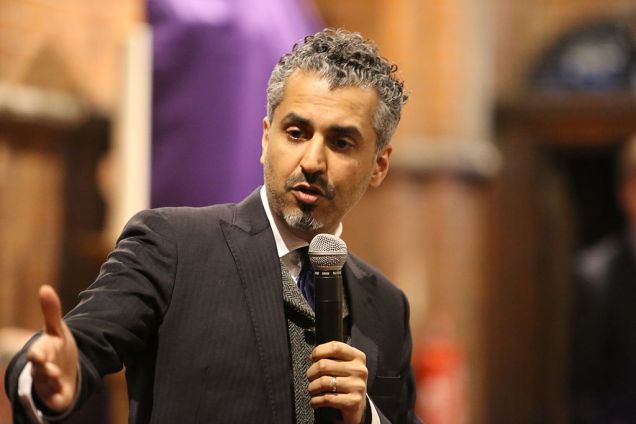
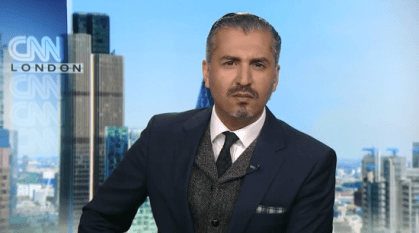
Some of the names are old suspects that one would expect to see. But in news which has provoked widespread outrage, the list also includes the names of entirely innocent and worthy activists fighting against Islamist extremism, like Ayaan Hirsi Ali and Maajid Nawaz.

And what is the SPLC’s charge sheet against Maajid Nawaz? What actions classify him as an “extremist”?

In the list sent to a top British security official in 2010, headlined “Preventing Terrorism: Where Next for Britain?” Quilliam [Nawaz’s anti-extremism think tank]  wrote, “The ideology of non-violent Islamists is broadly the same as that of violent Islamists; they disagree only on tactics.” An official with Scotland Yard’s Muslim Contact Unit told The Guardian that “[t]he list demonises a whole range of groups that in my experience have made valuable contributions to counter-terrorism.”

Well, what’s so shocking about that? It as an entirely logical statement on Nawaz’s part. Unless the people at the SPLC are truly dim and do not recognise a difference between Muslims and Islamists then there is no excuse for trying to turn a perfectly obvious point – that some people who support a fundamentalist ideology will choose violence while others do not – into some kind of “gotcha” smoking gun evidence of Nawaz’s secret Islamophobia.

And worse:

According to a Jan. 24, 2014, report in The Guardian, Nawaz tweeted out a cartoon of Jesus and Muhammad — despite the fact that many Muslims see it as blasphemous to draw Muhammad. He said that he wanted “to carve out a space to be heard without constantly fearing the blasphemy charge.”

Was this provocative? Perhaps. But again, Nawaz is himself a Muslim. Who better to judge what is or is not offensive to one’s religious moral code than the person tweeting the image? And even if doing so is “offensive”, are there not times when the offence is a price worth paying to make a broader argument in support of universal free speech? And if the Southern Poverty Law Center is so concerned about the emotional harm that may be inflicted by “blasphemous” acts like this, how do they explain their deafening silence when it comes to Christian beliefs and symbols being mocked in the popular culture?

The SPLC is not taking the side of ordinary Muslims here, some of whom may indeed be quietly offended by depicting Muhammad. They are taking the side of violent Islamists who seek to enforce blasphemy laws in the 21st century.

And then the SLPC really descends into the gutter:

Nawaz, who had described himself as a “feminist,” was “filmed repeatedly trying to touch a naked lap dancer,” according to an April 10, 2015, report in the Daily Mail. The paper apparently got the security film from the owner of a strip club who was incensed by Nawaz’s claims to be a religious Muslim.

And how we have the inevitable SJW identity politics hit job, seeking to ruin Nawaz’s reputation in the court of public opinion by repeating the shocking news that Nawaz has not at all times lived according to the letter of his faith. Well, so what? Sometimes, without thinking, I accidentally eat meat on a Friday during Lent. Does that make me virulently anti-Catholic and unable to fittingly discuss my faith in the media? Of course not. People’s actions diverge from their faith in a myriad of ways, small and large, and this applies just as much to those who got upset about Nawaz’s strip club visit (like the Muslim strip club owner) as to Nawaz himself. None are in a position to judge. Yet the SPLC feels that any divergence from Islamic teaching is sufficient to declare people that they don’t like to be somehow anti-Muslim.

This National Review editorial laments the SPLC’s corruption and decline:

The SPLC is an example of the way in which the Left corrupts and perverts the institutions it controls, from the IRS to the universities. While decrying “conspiracy theorists,” the SPLC itself is obsessed with “Terror from the Right” that is, pardon us for noticing, so rare as to be nearly insignificant. For all of the SPLC’s hysteria about neo-Confederates, skinheads, secret Nazi cabals, and the like, there is very little evidence that these organizations, to the extent that they exist as more than shared social-media fantasies, are actually up to much of anything. Even if we accept the tendentious characterization of SPLC favorite Timothy McVeigh as some kind of right-wing extremist (as with many such figures, his actual beliefs were confused, contradictory, and eccentric), the main organ of white-supremacist nuttery in the United States is prison gangs, which constitute a fairly constrained and peculiar phenomenon with relatively little effect on the outside world.

Not so violent Islamic radicalism, which is a factor in the United States and in practically every country in Europe, Africa, South Asia, and beyond. That is the great irony here: People like Ayaan Hirsi Ali are doing the work the SPLC is supposed to be doing — understanding and countering violent extremists — and the SPLC denounces them for it.

Very strange.

Some of those on the SPLC list are Muslims, former Muslims, and lifelong students of Islam. What they mostly have in common is that they are, broadly speaking, conservatives, people who are influential among conservatives, or writers and activists admired by conservatives. The SPLC is so drunk on its own poisonous ideological brew that it has simply come to conflate conservatism with violent or potentially violent extremism. One of these things is not like the others: A category of social tendencies that includes both Aryan Brotherhood felons in San Quentin and Somali-Dutch atheist women with celebrated literary careers is not an especially useful category.

While Nick Cohen provocatively (but accurately) declares in The Spectator that “the white left has issued its first fatwa” against Nawaz:

It is an organisation that ought to share Nawaz’s values, but because of the crisis in left-wing values does the dirty work of the misogynists, the racists, the homophobes, the censors, and the murderers it was founded to oppose. It does it with a straight face because, as I am sure you will have guessed, the fascism in question is not white but Islamic. And once that subject is raised all notions of universal human rights, and indeed basic moral and intellectual decency, are drowned in a sea of bad faith.

Nawaz is from Essex. He has fought and been beaten up by white British neo-Nazis. He fell in with Hizb ut-Tahrir while he was young. When he ended up in a torture chamber in an Egyptian jail, he abandoned Islamism for liberalism. Since then, he and his Quilliam Foundation have struggled against both the white far right and the Islamist far right. They have defended liberal Muslims and, indeed, all of us from lethal blasphemy taboos and the threat of terrorism. They respect freedom of speech, including the freedom of their enemies to speak.

A significant faction on the left hates them for upholding the values they have forgotten,  and will use any smear to denigrate them. As my secularist friend Faisal Saeed Al Mutar observed, when he, Nawaz and hundreds of others step forward and try to liberalise Muslim communities from within, they are attacked, ‘for being not Muslim enough, not Arab enough, not Pakistani enough, not filled with enough revenge and enough hatred’.

In the liberal orientalist world view the only ‘authentic’ Muslim is a barbarian. A battery of insults fires on any Muslim who says otherwise. They are ‘neo-conservatives,’ ‘native informants,’ and ‘Zionists’: they are as extreme as jihadists they oppose, or, let’s face it, worse.

This searing criticism could not be more accurate. For there is nothing so racist as the tyranny of low expectations in which the fashionable leftist intelligentsia holds the Muslim world, viewing them not as people with moral agency of their own but as little pets to be protected (or overgrown pets to be cowered from), people whose sometime decision to commit violence and murder cannot be condemned because it is supposedly “provoked” by forced beyond their control.

I have personally interviewed Maajid Nawaz, back when he was running as the Liberal Democrat candidate for the London constituency of Hampstead & Kilburn in the 2015 UK general election, and whatever one may think of his domestic political views, this is clearly not somebody who belongs on a list of violent, hateful extremists.

What is concerning is that the Southern Poverty Law Center would actually now prefer the old incarnation of Maajid Nawaz, back in the days when he was a member of a legitimate extremist group, Hizb ut-Tahrir. As such, he would be protected under the umbrella of leftist denial and fawning appeasement, so central to the SPLC’s new dogma, and they would bend over backwards to excuse his fundamentalist beliefs and violent actions.

By contrast, having long since rejected violence and an extremist fundamentalist interpretation of Islam, the SPLC would have us believe that Nawaz is somehow full of hatred and antipathy to normal Muslims, the equivalent of a knight of the Ku Klux Klan. It is absolute nonsense – pure, amoral leftist bilge.

This is also how Western civilisation destroys itself – by furiously denying the existence of opposing forces or in some cases openly bending the knee to them, while attacking those who actually recognise the danger and seek to confront it. In a world where precious few people have a remotely coherent strategy for tackling fundamentalist Islamism, Maajid Nawaz stands out as one of those with genuine understanding of the problem, and a plan for addressing it – and so the debased SPLC must now attack and undermine him at all costs, by pretending that he is an anti-Muslim extremist.

And one can only concur with Nick Cohen’s assessment that it is “heartbreaking” to witness an organisation so integral to the American Civil Rights movement, which bravely shone an unforgiving light on genuine violent extremism where it once existed, now creating McCarthyite lists of people who offend leftist/Islamist dogma and labelling them with the same term of “extremist”.

Ayaan Hirsi Ali makes the Southern Poverty Law Center’s list too. Why? Because she actively and gleefully foments prejudice and violence against ordinary innocent Muslims? Of course not. The SPLC include Ayaan Hirsi Ali in their leftist collaborationist fatwa because she had the temerity to renounce her faith and speak out passionately for the cause of secularism, thus gravely offending the real extremists to the point where she has to hire bodyguards to ward off assassination attempts.

It takes some twisted morality to come down on the side of those who seek to carry out an execution for the crime of apostasy over their intended victim, but somehow the SPLC has found a way.

Cohen concludes:

Do these jerks not think about the consequences of their rote-learned, pseudo-leftist bombast? Have they not heard that, across the world, lists circulate of ‘apostates’ along with invitations to the faithful to kill them when they can?

Maybe they have but do not care, and it will take drastic action to shake them out of their spiteful stupor.  A court action could do it. If Nawaz sues, SPLC’s work in fighting the white far right will suffer grievously. But, as it is so eager to be on the wrong side in the fight against the religious far right, I think we could call it evens.

It is hard to disagree. Gone, it seems, are the days when the Southern Poverty Law Center could be found seeking justice for the victims of real prejudice, oppression and extremist violence.

Where once the SPLC battled segregation and fought civil cases to ensure that racist lynchings and arson attacks were acknowledged at a time when the criminal justice system did not want to prosecute them, now they can be found patrolling the borders of our language, seeking to excommunicate decent and honest people from polite society for the high crime of having caused “offence” to certain protected groups.

And when an organisation has drifted so far from its founding ethos to the extent that a one-time civil liberties group is now in the business of making McCarthyite-style lists of people whose blasphemy offends Islamist extremists, then the time has probably come to wash our hands of that organisation, sad though it may be.
 

maajid-nawaz

southern-poverty-law-center

Top Image: Wikimedia Commons

Support Semi-Partisan Politics with a one-time or recurring donation:

Agree with this article? Violently disagree? Scroll down to leave a comment.

Follow Semi-Partisan Politics on TwitterFacebook and Medium.

Tales From The Safe Space, Part 45 – Puppy Therapy Session Arranged For Stressed Cambridge University Students

cambridge-union-puppy-therapy-therapets-mental-health-stress-infantilisation

Et tu, Cantabrigia?

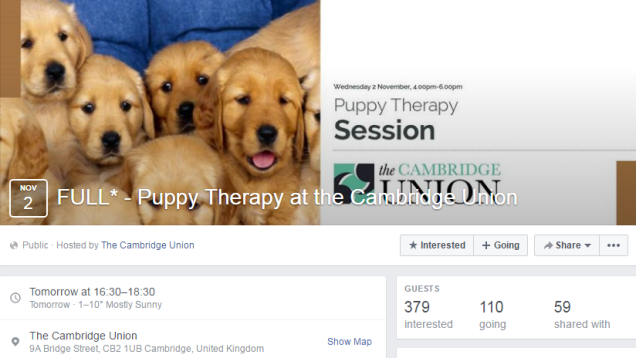
It is sad to see Cambridge University, my first alma mater, playing host to one of these infantilising “student puppy therapy” sessions. But after the Rhodes Must Fall nonsense at Oxford, it was only a matter of time before Cambridge started displaying more symptoms of the Adult Infantilisation Virus rapidly tearing through academia.

The advertisement reads:

Whether you have a deadline looming, are worried about your workload or are stressing over the number of societies’ you signed up to at the Freshers’ Fair, what better way to take a break than with a puppy therapy session, organised with the kind help of volunteers at Guide Dogs UK. The Union welcomes the volunteers and their canine counterparts for a relaxed afternoon of socialising which forms part of the puppies’ Guide Dog training. Donations for the Guide Dogs for the Blind Association welcomed.

Now, to be fair: this is a slightly more laudable event than some other puppy therapy sessions we have seen on other university campuses. In many cases, the puppy therapy has been presented entirely as a student service (like a dining plan or library facilities) but at least in this case there is a clear and worthy charitable connection. Any harm that attending students may do to their own future emotional resilience will at least be balanced by a well trained new generation of Guide Dogs for the visually impaired.

But this could have been sold to students just as effectively by calling it “puppy socialisation training”. This being Cambridge, they probably still would have had a line out the door had they named it “Canine-Human Familiarisation and Interaction Practice in a Social Setting.” But they didn’t, because puppy therapy is now all the rage on college campuses, and because the prevailing culture tells us that we are all only one unexpected bad grade or nasty personal remark away from a nervous breakdown, and so are in constant need of institutional hand-holding.

It is the same corrosive worldview which gave us “Inner Child Day” at Cardiff University earlier this year, and the introduction of “Therapets” sessions at Edinburgh University. Therapy animals have traditionally been used to help PTSD sufferers such as returning armed forces veterans, children with severe autism and hospice patients undergoing palliative care for terminal conditions. Are we really now including “two essays due on the same day” or “signed up to too many societies” in this list of severe mental stresses?

The danger of doing so is that we wrongly exceptionalise the normal stress of everyday life, putting relatively pedestrian problems on a pedestal and making it seem as though the sufferer is truly benighted and in need of external aid. This just about works so long as the student remains within the infantilising university setting and part of the noxious Cult of Social Justice and Identity Politics. But when these links are severed and the real world beckons, students who have been encouraged for years to celebrate and exaggerate their own fragility are opening themselves to incurring real trauma when they have their first less-than-pleasant contact with an indifferent world.

Most employers – excepting some of the large or wealthy technology companies, who were some of the first to be infected by the virus raging through academia – will not provide a puppy room for harried employees under tight deadlines. And while HR departments are scrambling as they (rightly) respond more positively and proactively to mental health issues among their employees, they will never be able to be the overbearing, protecting, auxiliary parent in the same way that universities are now becoming.

If universities are to have a pastoral role beyond pure academia, surely they should see the nurturing of anti-fragility (the quality of absorbing negative impacts and becoming stronger as a result of them) among their students as far more valuable in the long term than pandering to students’ largely imagined sense of vulnerability.

Throughout their storied histories, Cambridge University has provided Britain with 14 prime ministers while Oxford has supplied 27, including Theresa May. These illustrious records will likely soon begin to wither if future Oxbridge graduates are conditioned to reach for the puppy videos every time there is a crisis.

The Cambridge Union – of which I am a disappointed life member – should strongly look at rebranding their puppy therapy event, now and for any future events. The time has come for the university and its associated institutions to take a brave stand and become part of the solution to the rise in victimhood culture, rather than a collaborator in feeding the problem.


puppy

Safe Space Notice - 2

Top Image: Pixabay

Support Semi-Partisan Politics with a one-time or recurring donation:

Agree with this article? Violently disagree? Scroll down to leave a comment.

Follow Semi-Partisan Politics on TwitterFacebook and Medium.

Tales From The Safe Space, Part 44 – The Suffix “-phobic” Is Now Considered Oppressive Against People With Phobias

social-justice-word-cloud

The social justice movement, long ridiculous, has now disappeared so far up its own backside that it is quite simply beyond parody. These warped, self-righteous posers will weaponise anything and infantilise anyone to burnish their own right-on credentials

When faced with the latest example of SJW posturing and weaponised victimhood, one wonders just how much further these baby-faced tyrants can possibly go in policing our language and behaviour to make us conform with their ever-shifting conception of what is good and what is deplorable.

But in truth, they will never be satisfied. In SJW-land, the power and social standing of a Social Justice Warrior activist is derived entirely from “points” that they accrue defending their new orthodoxy and persecuting heretics simply trying to exercise their free speech. A diligent SJW can pick up points for riding to battle against something “offensive” written by a perfect stranger on social media, but they accrue even more kudos within their cult by accusing a fellow member(s) of heresy. We may be the usual targets, but the SJW cultists themselves must always look over their shoulders for fear of attack by an overzealous rival. The social justice / identity politics revolution loves to devour its own.

This manifests itself in all kinds of ways – witness the case of student union official Fran Cowling, who declared in a blaze of self-publicity that she would not share a stage with Peter Tatchell because he dared to take the side of free speech over SJW “no platform” policies designed to shut dissenting viewpoints out of university campuses. Never mind that Tatchell has done more for minority rights in a typical weekend than Cowling will likely manage her entire wretched life – Cowling cynically attempted to position herself as a better and purer cultist, and so leapfrog the many levels separating her own unscrutinised place in history and Tatchell’s far more tangible contribution.

But what if one enterprising SJW found a way to imply that nearly every other social justice cultist in the world is being inadvertently oppressive all the time, while they alone were enlightened enough to recognise the error of their ways? That SJW would then be able to claim the mantle of Most Compassionate Person, and accrue incredible kudos within that ridiculous community.

Well, it turns out that one such SJW – Denarii Monroe, writing at Everyday Feminism, the motherlode of idiotic social justice, victimhood culture nonsense – is attempting that very feat.

Monroe writes:

For years, through to today, we have named these oppressions as homophobia, biphobia, transphobia, or queerphobia. Other movements use phrases such as xenophobia, fatphobia, and Islamophobia.

It’s important to put a name to the systemic structures that marginalize us and have effects on our day-to-day living. This language is essential in the fight for liberation for all marginalized groups. I remember how empowering it was to have a name for the specific experiences and needs of the bi+ (plus) community.

Naming, well, just about anything in life – a spoon, a tree, a breed of dog – allows us to identify it. And in the case of oppression, being able to identify it allows us to tackle it head-on.

Unfortunately, in our quest to do so, we have chosen language that isn’t just problematic, but downright oppressive.

And I get it. Most of us were born into this language. Whether we belong to the communities who use this language or we’re just allies, it has informed much of our experiences – how we began to understand inequality, how we talk about the discrimination we experience, and how we relate to others with similar oppression.

But Islamophobia, transphobia, and other constructions that use “-phobia” as a suffix erase the fact that “phobias” are a real thing that happen to real people. Those of us who use these terms know all too well the damage that erasure can do in the fight to achieve liberation and social equity.

Regardless of good intentions, at the end of the day, it’s not okay to build our righteous movements on the backs of other marginalized people. Further, in choosing inaccurate, inadequate language, we harm ourselves as well.

Original emphasis in bold.

In other words, using the suffix “-phobia” when describing real or imagined acts of prejudice – as in Islamophobia, transphobia, homophobia – is itself “oppressive” because apparently it appropriates the language used to describe recognised phobias like claustrophobia, thus somehow erasing or denying the lived experience of claustrophobes, agoraphobes and assorted other phobics.

So according to the new draconian standard set by the Social Justice Warriors, this anti-Donald Trump meme (expressing a sentiment which they would otherwise doubtless support) is itself ableist and oppressive to those who suffer from traditional phobias:

phobias-are-oppressive

A year ago, this might have been regarded as an entirely legitimate form of anti-Trump protest. But so far have things moved in the space of twelve months that the cutting edge SJWs of Everyday Feminism would now regard references to “homophobia” as an unconscionable assault on the daily suffering and lived experience of people with medically recognised phobias.

Yes. To speak about Islamophobia or transphobia is now ableist – that is, oppressive towards those with disabilities – because it supposedly makes light of the “disability” of having a phobia. Denarii Monroe has essentially declared that nearly every other Social Justice Warrior, by virtue of still using the suffix “-phobia” as part of their daily activism, are in fact part of the oppressive, neo-colonialist masses. They are all part of the problem. She alone is part of the solution.

This is the social justice equivalent of the launch of HMS Dreadnought back in 1906. With the launch of the steam turbine-powered warship Dreadnought, every other battleship in every navy around the world was instantly rendered obsolete, giving the Royal Navy an immense strategic advantage and setting off a new arms race. And now, in a dismal pastiche of history over a century later, Denarii Monroe is essentially declaring that the language of every other Social Justice Warrior – people who spend their whole day festering in this fetid swamp of identity politics and weaponised victimhood – was oppressive all along, unbeknownst to them.

But why should we go to the effort of completely overturning the language that nearly all of us – not only SJWs – use to talk about prejudice and discrimination?

Phobias aren’t really something you hear much about, except as an exploitative tabloid episode on shows hosted by the likes of Maury Povich and Jerry Springer.

Like all marginalized groups, disabled folks have little representation in the media and in real-life institutions. This is reflected in how we are portrayed, talked about, and treated. Mental disabilities – from schizophrenia and obsessive compulsive disorder to bipolar disorder and generalized anxiety disorder – are particularly notorious for being misconstrued and inaccurately and harmfully portrayed, usually just for ratings (read: money).

[..] Phobias are virtually invisible in society outside of the aforementioned daytime talk show segments.  But the fact of the matter is that we are real.

We exist. We navigate this world, to the best of our abilities, every single day. We’re on disability. We work. We find love and sex, if we desire those things. We have dreams. We struggle.

And our lived experiences and truths deserve dignity and respect, not the further erasure and trivialization that phrases like “-phobia” actively perpetuate.

Good grief. Has any person suffering from a legitimate phobia ever been upset, outraged or “harmed” in any way by the fact that we also use the word for their condition to describe people who are prejudiced against certain groups? Of course not – just as if I were to say (as I believe) that the Cult of Social Justice and Identity Politics is a cancer on our society, people currently suffering from cancer will not suddenly wince in pain when I hit “publish”. It would be clear to any reasonable person (thus excluding the SJWs) that the cancer I speak of is metaphorical, and entirely different from the actual disease, just as it is clear to legitimate phobia sufferers that nobody is seeking to diminish their suffering when we speak of “xenophobia” or “homophobia”.

And mark this:

The use of “-phobia” as a suffix erodes the dictionary meaning of the word, but more importantly, it is one tool that helps society forget that phobias are real phenomena that affect real people every day, some of whom, like myself and my friends, are queer and trans.

It is as though the author is laying each one of her oppressed identities before us, to add weight to her specious argument.

Queer? Check.

Trans? Check.

Phobic (and thus disabled)? Check.

This is how you win an argument in Social Justice world. Not by appealing to facts, reason or evidence but rather by pointing to your identity in terms of race, gender and sexuality, and trying to claim the highest possible position on the Hierarchy of Oppression. Denarii Monroe knows that few people will be able to outdo the triumvirate of queer, trans, and phobic. And because the Cult of Social Justice and Identity Politics dictates that those lower on the hierarchy must defer to those who can claim greater victimhood, Monroe has carte blanche to change the terms of discussion and literally remove words from the permitted vocabulary of other SJWs.

Monroe does, however, eventually cut to the chase:

That is to say, while fear is behind much of the oppression we face, it’s not the whole story. It’s not even the primary story. The language we use should reflect that.

When we say what we’re actually talking about, it paints a more accurate picture for our movements and our allies of our needs. It makes our goal clearer, which makes it that much easier to accomplish.

Further, “-phobia” as a suffix ultimately centers the oppressor instead of the oppressed. The language becomes about their fear instead of our struggle.

And I don’t know about you, but I’m quite tired of privileged people being the center of attention.

Ah, there it is. All of this overwrought discussion of language and oppression, when in actual fact this whole article is borne of Monroe’s jealousy that using “-phobia” as a suffix puts the emphasis on the supposedly prejudiced person when in fact it should really be on her. Monroe doesn’t want “privileged people” to be the centre of attention because she doesn’t actually want us to focus on prejudice or do anything meaningful to tackle it – rather, she wants to revel in her own victimhood and be sure that we all acknowledge it so that she remains the centre of attention.

This is a sick, warped way of looking at the world. But it is also absolutely required behaviour among Social Justice Warriors and identity politics cultists the world over, who are intent on turning daily life into one great big collective group therapy session, in which those at the top of the Hierarchy of Oppression are free to unload on those further down, blaming them for their troubles all day, every day.

Denarii Monroe didn’t get so upset that she wrote an article in Everyday Feminism because she has legitimate, heartfelt concerns that saying words like “Islamophobia” or “transphobia” actually causes mental distress to people with real phobias. She wrote the article in triumph because she found yet another way to claim that other people – people on her own side! – were inadvertently transgressing one of the key tenets of social justice. Which, even though everybody was using this language a year ago without issue or complaint, is now a tremendous issue. And as a totally (ahem) unrelated bonus, it also just so happens to give Monroe heightened status and more power over her peers.

To slightly amend something I recently wrote on the same subject:

If all of this seems ludicrous and a million miles away from doing anything which might conceivably affect or help actual black disabled people in America, you would be right. Because at its dark, festering core the Social Justice movement is not about delivering justice, equality or doing any other kind of social good. Social wrongs are merely the fuel which power the machine to perform its true purpose – controlling the language and the thinking of society in order to establish beady-eyed little zealots like Party Island Denarii Monroe as the indispensable clerisy who tell everyone else what to say and do.

Social Justice is, above everything else, about the acquisition and exercising of power. Victimhood is actively sought and eagerly weaponised by members of this Social Justice clerisy in their scramble for status amongst their peers and contemporaries. The legitimate problems and grievances of minority communities become irritating background noise, a distraction from what really matters – this finickity, juvenile, university campus parlour game in which casting oneself as the most vulnerable, oppressed but simultaneously tolerant person imaginable confers tremendous power, while the slightest slip (such as accidentally using the wrong word) can lead to immediate excommunication from the group.

Monroe concludes by lecturing us that we should immediately replace the “-phobic” suffix with the much more clunky “-antagonistic”, as in “trans-antagonistic” or presumably “Islamo-antagonistic”:

From the queer and trans communities to Muslims and fat people, that is literally our experience. Our existence and identities cause the majority culture to be hostile toward us and, as a result, we struggle against them – for our humanity, our dignity, and our liberation.

But we can never be free until we’re all free – and this includes folks with disabilities. So it’s imperative that we begin to deliberately abandon “-phobia” once and for all.

The mind boggles. I would write that the social justice movement cannot possibly lose the plot any more than it presently has, but we all know that in a week’s time I will be back with another piece about some even more outrageous claim to victimhood or demand for censorship. The world record for Most Stupid Thing Said By An SJW is now being broken almost daily.

And this is because at its dark, sulphuric heart, the Cult of Social Justice and Identity Politics is an arms race, in which cultists have to continually invent new vulnerabilities and injuries just to maintain their position in the social hierarchy.

SJWs have perhaps marked what is happening in Britain, where the National Union of Students decreed that university LGBT societies should no longer allow “white cis gay men” to have their own representation on diversity committees because they are not sufficiently discriminated against. Being a gay man is apparently no longer enough to command even the lowliest of positions in the Hierarchy of Oppression. So all of those SJWs only slightly higher up on the hierarchy are desperately casting around for additional traumas and vulnerabilities that they can plausibly exaggerate just to keep themselves in the game.

Social Justice is about power, plain and simple. And while its cultists may preach rainbows and unicorns and solidarity, in practice it is a brutal club to suddenly find oneself excluded from. This is why the arms race has now decreed that saying “-phobic” is oppressive, and it is why next week we will be back here, marvelling that something even more vacuous and self-indulgent has occurred.


phobias-are-oppressive-2

Safe Space Notice - 2

Support Semi-Partisan Politics with a one-time or recurring donation:

Agree with this article? Violently disagree? Scroll down to leave a comment.

Follow Semi-Partisan Politics on TwitterFacebook and Medium.

Donald Trump, World’s Best Christian

donald-trump-bible

If you seriously believe that Donald Trump understands the Christian faith, has read the Bible or would choose the defence of religious values and freedom over some other passing whim while serving as president, then I have a bridge across the River Thames to sell you

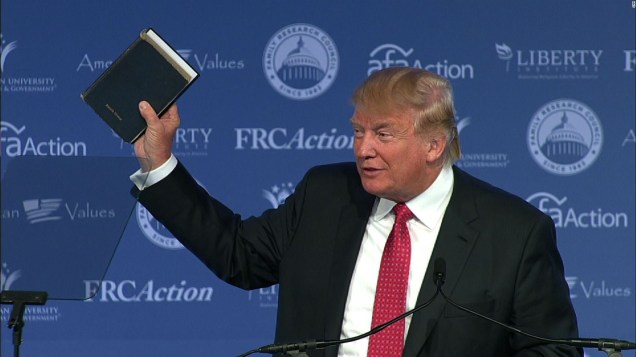
Eric Zorn has a great column in the Chicago Tribune in which he systematically takes apart Donald Trump’s pretence that he is a Serious Christian and the default choice for those voting with their Christian faith foremost in their minds.

Zorn writes:

Nothing illustrates what a flim-flam man Donald Trump is better than his frequent and oily allusions to the Bible.

It is his favorite book, he tells the credulous masses at his rallies. Nobody reads it more than he does.

But a review of the record suggests he may not have read it at all.

During a televised interview with John Heilemann and Mark Halperin of Bloomberg Politics in August 2015, Halperin noted Trump’s frequent professions of fondness for Judeo-Christian scripture and said, “I’m wondering what one or two of your most favorite Bible verses are and why.”

“I wouldn’t want to get into it,” Trump said, “because to me that’s very personal. You know, when I talk about the Bible it’s very personal so I don’t want to get into verses. The Bible means a lot to me but I don’t want to get into specifics.”

“Are you an Old Testament guy or a New Testament guy?” Heilemann asked.

“Probably equal,” Trump said. “I think it’s just incredible, the whole Bible is incredible.”

How utterly convincing. Zorn continues:

That unfamiliarity showed up again in April when host Bob Lonsberry of WHAM-AM in Rochester, N.Y., broached the subject in a phone interview: “Is there a favorite Bible verse or Bible story that has informed your thinking or your character through life, sir?”

“Well, I think many,” answered the would-be exegete-in-chief. “I mean, you know, when we get into the Bible, I think many, so many. And I tell people, look, ‘An eye for an eye,’ you can almost say that.”

You can, sure.

But not only is “An eye for an eye, a tooth for a tooth” an Old Testament verse that condones barbaric vengeance (“… hand for hand, foot for foot,” it goes on, “burn for burn, wound for wound, bruise for bruise”) it was also expressly repudiated by Jesus in the Sermon on the Mount: “You have heard that it was said, ‘Eye for eye, and tooth for tooth.’ But I tell you, do not resist an evil person. If anyone slaps you on the right cheek, turn to them the other cheek also” (Matthew 5:38-39).

I get it. Actually making time to sit down and read the Bible every day while trying to internalise parts of it is tough. Particularly, I imagine, when you are rich and famous and your free time is largely given over to grabbing women “by the pussy”. Personally, I have only read the entire Bible cover-to-cover once, when I was eighteen and preparing for my adult confirmation into the Roman Catholic church after converting from Anglicanism. More than a decade later I am now finally trying to do so again, with the help of a great online Bible app which comes with a manageable “Bible in a year” reading plan.

The point of which being that it is fairly easy to spot someone who has actually attempted the feat and possesses a genuine (if still somewhat patchy, like mine) familiarity with the Bible, and somebody who is just putting on an act, attempting to fake religious observance as a kind of cultural marker. And Trump clearly falls into the latter category.

Eric Zorn concludes:

Is Trump the first politician to exaggerate his piety in order to win favor with the American public, 70 percent of which identifies as Christian and 6 percent of which identifies as belonging to another faith tradition?

No, but he’s the worst at it — the most transparent — that we’ve ever seen on the national stage.

It’s not just that he’s a brazen Bible huckster, it’s that he’s really bad at it.

Those who put their faith in him should prepare to have it shattered.

This is depressing for all those Christians who have been taken in by Donald Trump’s false displays of piety, as well as those resigned Christians who recognise that Trump is a charlatan but feel that Trump represents a better bulwark against attacks on their values and way of life than Hillary Clinton.

But it is also darkly amusing. Because for eight years it has been the habit of more than a few Republican Party politicians to insinuate that President Barack Obama is somehow not a Christian, or even that he is a closet Muslim, despite endless evidence of the Obama family attending church and Obama himself being capable of speaking about his faith without getting completely tongue-tied or reporting to bland banalities. Some Republicans stood up to the “Obama is a Muslim” hysteria – notably John McCain at a town hall meeting during the 2008 presidential campaign. But many others remained cynically silent, allowing prejudice and misinformation to take hold, thinking that it would advantage them politically.

And now it is the GOP’s turn to field a presidential candidate who doesn’t merely “exaggerate his piety” but effectively invents it from thin air to get himself out of a tight spot in a TV interview. Of course, the Democrats are in absolutely no position to take advantage of this fact – Hillary Clinton is a Christian, like Obama, but has chosen to downplay her faith in this election because many of her supporters place more faith in the god of Social Justice and Identity Politics than the God of the Old and New Testaments.

As Ben Wolfgang notes in the Washington Times:

Hillary Clinton’s Christianity, which she wielded as a political weapon in her 2008 Democratic presidential primary campaign, largely has been missing in this year’s election.

She hasn’t hidden her Methodist upbringing, but scholars say it’s not front and center. And where in the past she used it as a window into her character, this year she’s deployed it as a debate tactic to push criminal justice reform and other policy goals.

Church attendance also has been all but absent from Mrs. Clinton’s schedule, except when she’s turned up behind a pulpit to stump for votes, particularly in predominantly black churches, where her appearances focus largely on how she intends to work with religious leaders to accomplish shared political objectives.

Since 2008 she’s also abandoned traditional Christian positions on issues such as same-sex marriage, coming in favor of the practice in 2013 after years of opposing it.

The reason for the shift, analysts say, is twofold. Mrs. Clinton is taking on an opponent, Republican Donald Trump, who is seen as one of the most nonreligious presidential candidates in modern history. Pew polling from earlier this year found that just 30 percent of American voters say they consider Mr. Trump religious, while 48 percent said the same about Mrs. Clinton.

Perhaps more importantly, she now leads a party that, among its white base, if not its core black and Hispanic members, has become an increasingly secular institution. Recent polling shows the Democratic Party includes in its ranks nearly four times as many atheists and agnostics as the GOP.

Ultimately, the “Donald Trump is a better Christian than Hillary Clinton” argument comes to the two candidates’ respective positions on abortion. And if abortion is a deal-breaker for you then yes, Trump’s currently stated position on abortion (which has certainly changed since his liberal days of a few years back, as well as during this campaign, both without satisfactory explanation) is more in line with Church teaching about the sanctity of life.

But as with all of Donald Trump’s other stated policy positions, there is absolutely nothing to give confidence that his current position either represents his true beliefs on the subject, or that he would not flip-flop on the issue without a second thought if he saw political value in doing so.

Christians – particularly Evangelicals – should really be used by now to cynical Republican politicians who have trained themselves to speak the language, say the right things and push all the right buttons on social issues in pursuit of the evangelical vote, only to sell out the movement once safely ensconced in power. George W. Bush won a tough 2004 re-election campaign against John Kerry in spite of his disastrous mismanagement of the Iraq invasion and its aftermath largely by switching the focus to social issues, namely gay marriage, in order to motivate his base. And in nearly every election before and since, evangelicals have been flattered, threatened and otherwise called upon to support the Republican candidate only to have their causes betrayed or ignored after election day once their usefulness was over.

Donald Trump is doing exactly the same thing all over again. But he is so inept and transparent in his attempt to feign Christian piety that a fool should be able to see through his cynical machinations. And yet many bright and decent people are taken in by Trump’s amateur act.

Don’t get me wrong – Hillary Clinton, largely beholden to the Cult of Social Justice and Identity Politics, will be no great defender of religious freedom or interests. But Donald Trump will be little better, as Christians should realise from bitter past experience and Trump’s unique untrustworthiness when it comes to holding true to his stated beliefs on fundamental issues.

Neither candidate, in office, would be a great friend of religion, though Donald Trump would likely continue to pay more lip service to Christian priorities thanks to the composition of the Republican Party. But both options are pretty bleak, and Christians seeking to vote based on their faith would actually be well advised to admit defeat and make their choice based on some other criteria.

Whoever wins this election, it looks quite safe to say that Christianity will lose.


bible-king-james-version

Bottom Image: Pixabay

Support Semi-Partisan Politics with a one-time or recurring donation:

Agree with this article? Violently disagree? Scroll down to leave a comment.

Follow Semi-Partisan Politics on TwitterFacebook and Medium.

FBI Reopens Investigation Into Hillary Clinton’s Emails As More Come To Light

hillary-clinton-hagiography

Hell hath no fury like a Clinton facing an existential political threat

And so with just eleven days until the presidential election, the week closes with the shock announcement that the FBI is reopening its investigation into Hillary Clinton’s use of a private unsecured email server now that new potentially significant emails have come to light through a separate, unrelated investigation into former congressman (and estranged husband of Clinton aide Huma Abedin) Anthony Weiner.

Cue the standard reactions you would expect from the major players. Donald Trump took to the stage at his next campaign rally and solemnly (well, with what passes for solemnity when delivered by Trump) told his supporters that there had been a critically important development in the campaign, relaying the news of the FBI’s reopened investigation to tumultuous cheers from the crowd. He went on to claim that the developing story was “bigger than Watergate“.

Meanwhile, the cable news channels, grateful for anything which disrupts the rather predictable “Clinton romping to near-certain victory” narrative which is so bad for ratings, eagerly talked up the “bombshell” development.

The only one we had yet to hear from was Hillary Clinton herself. She had precious little to say on the subject at her next campaign rally in Iowa, but we have now heard that the campaign is understandably furious at the timing of the announcement, and is pressing for immediate answers (and a swift second exoneration) from the FBI.

But what is the likely significance of this flurry of Friday activity? I think that Jonah Goldberg’s initial hot take is right on the money:

I think Comey has to have found something significant to have done this. Re-injecting himself into the presidential campaign eleven days before the election is not something he would do lightly or happily. But I have no idea what that something might be.

I agree. James Comey has a reputation to protect, one which will not be enhanced by making himself the sudden focus of the presidential election campaign this close to polling day if it turns out that there is nothing to the newly discovered email stash. Serious conversations would have gone on before Comey made the final decision to write that letter to congressional committee chairmen informing them of his decision to reopen the investigation, and that alone counts for something.

Goldberg continues:

I’m more confident, however, that if the Clinton campaign was holding back any opposition research in reserve, it is now very likely to get dropped like the payloads from a squadron of B-52 bombers. So far the Clinton camp has been very, very skillful in deploying its oppo. It doesn’t rush things and has been comfortable letting story lines develop. (Yes the Trump team is right that many of these sexual abuse stories are “orchestrated.” But “orchestrated” isn’t a synonym for “untrue”).

What would that oppo look like? I don’t know. But, unless there’s something much worse than the “groping” storyline we already know, the sexual-abuse charges are now baked in with most of the public (and among Republican apologists). Until today, that was probably fine with the Clinton camp because she’s been on course for a big win. If you’re in the clear lead, the incentive to drop more oppo is not there because there’s always the risk of blowback.

But the polls have tightened a little. More troubling for her is the fact that between the Doug Band story and now this, Clinton is likely to be in the spotlight for the next few days or longer. (By the way, how happy is Doug Band to be wiped out of the news cycle?) And the dilemma for Clinton is that whichever candidate is in the spotlight tends to suffer in the polls because the American people don’t like either of them.

And that’s why I think we can expect the Clintonites to do what they do best: change the subject from their wrongdoing to someone else’s, presumably Donald Trump’s. Maybe it won’t happen, but I wouldn’t be surprised if by the time the Sunday shows are on, or by Monday morning at the latest, we’ll have at least two “bombshells” to discuss.

Most people I have spoken to seem agreed that Hillary Clinton is holding something back in reserve – an additional Trump scandal (either real or confected) different in tone and nature to the others, which could be deployed as a kind of political doomsday device if Clinton found herself behind in the polls or facing serious political difficulties going into the home stretch. Anyone who knows how the Clintons operate would probably concur that this would be absolutely in character.

The only question, to my mind, is whether Hillary Clinton panics and deploys her doomsday device now, in an attempt to change the narrative and avoid losing a whole weekend’s worth of news cycles, or if she holds her nerve and waits to see any potential wobble in the tracking polls before deciding whether or not to take action.

As Jonah Goldberg rightly points out, there are disadvantages to unleashing an opposition research-generated political doomsday device this close to the end of the election. If the scandal is “good” enough, it could succeed in driving more moderate Trump supporters away or depressing his overall voter turnout. But if it is perceived as being little different to a restatement of Donald Trump’s personal flaws which have already been “priced in” by his supporters then it will make little positive difference, while potentially tarring Clinton with having used underhanded tactics in the home stretch.

There is no margin for error in this decision, so if we do see a big revelation from Hillary Clinton it will be a good sign that her campaign is seriously worried – and perhaps that they do not have full confidence in the many polls which have shown her maintaining a consistent lead over Donald Trump.

So while on face value this has been a rare good news day for the Trump campaign – probably the best since Hillary Clinton’s “medical episode” in New York on 9/11 – rather than rejoicing and taking a premature victory lap, now might actually be the time for the Donald Trump campaign and his supporters to hunker down and prepare for the worst.

Sticking their heads above the parapet to enjoy the spectacle of Hillary Clinton flailing in response to new questions about her improper use of email may be tempting and even cathartic, but it also increases the risk of being taken by surprise in the event of the deployment of Hillary’s Revenge.

If Hillary Clinton has something, anything else on Donald Trump, the temptation now comes hardest upon her to use it. This election campaign has either been blown wide open in Donald Trump’s favour, or is about to be slammed shut in his face.


hillary-clinton-email-scandal

Top Image: Pixabay

Support Semi-Partisan Politics with a one-time or recurring donation:

Agree with this article? Violently disagree? Scroll down to leave a comment.

Follow Semi-Partisan Politics on TwitterFacebook and Medium.