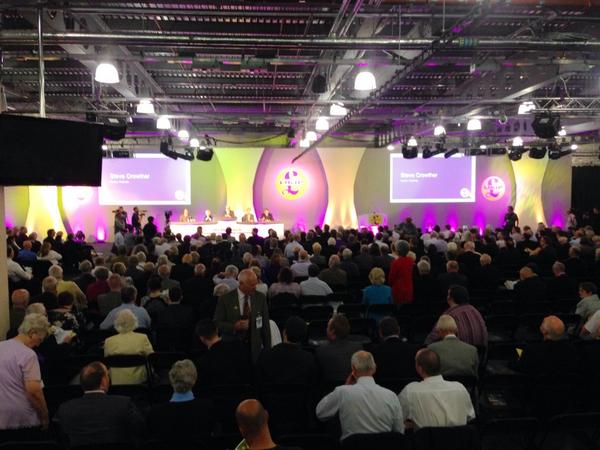
UKIP National Conference 2015: What To Expect

UKIP Doncaster 1

Last year’s party conference saw UKIP fresh from victory in the 2014 European elections, and boosted by the shock defection of former Conservative MP Mark Reckless. Twelve months and one agonisingly unfair general election result later, what surprises can UKIP offer this time around?

Twelve months ago, the current British political landscape would have been completely unrecognisable, the stuff of fantasy.

The Labour Party had not yet imploded in a shower of more-compassionate-than-thou moralising. The SNP’s Westminster surge was beyond even the Scottish nationalists’ wildest expectations following the “No” vote in the Scottish independence referendum. In fact, there was only one political party which could claim to have any real momentum and be making tangible progress of any kind.

That party was UKIP. Twelve months ago, when Nigel Farage teased the UKIP 2014 conference delegates by telling them that a Tory MP would be speaking to them in his place – that MP being Mark Reckless, who then defected to UKIP live on stage to enormous cheers – there was a very real possibility that the second defection of a serving Member of Parliament from the Conservatives to UKIP might unleash the floodgates. At that time, it was entirely possible that UKIP could have ended the summer with a small handful of motivated, eurosceptic ex-Tory MPs, and a real Westminster presence.


Continue reading

Are You A Populist Simpleton?

Populism - British Politics


Ukippers and Jeremy Corbyn supporters have often been steadfast in their political views for years, and as a result have languished in the political wilderness while those willing to bend, flatter and shapeshift their way toward sanitised focus group approval have been richly rewarded with power and success


Are you a populist simpleton?

I am, according to the Telegraph’s Janet Daley, because I am guilty of expecting more from politics than two shades of the same old drab consensus.

It’s a shame – I thought I had an ally in Daley, who is absolutely right in identifying the dull managerialism that now defines British politics, where dull technocrats reign supreme and general elections are fought over which party leader would make the best Comptroller of Public Services.

From Daley’s Telegraph piece, in which she attempts to compare the rise of Jeremy Corbyn with Donald Trump’s temporary ascendancy in the Republican Party’s presidential primary race:

There is no doubt that the politics of Western governing has become consensual and centrist. It is now a cliché – but no less important for that – to say that the arguments on which democratic choice revolve are puny and marginal. Parties and their leaders are reduced to debating the detail: a bit more of that, a bit less of this. No basic principles are at stake because they are all pretty much settled. The slogans are quite deliberately boring: recession is to be tackled with a “long-term economic plan”. It doesn’t quite have the ring of “Workers of the world unite! You have nothing to lose but your chains.” It often seems as if party strategists are having to thrash around desperately for some semblance of a compelling vision to distinguish themselves from their opponents.

Daley’s analysis of the problem is spot on, echoing what this blog has been saying for over a year. And yet Daley seems to hold in contempt those of us who have also identified the problem, but seek to redress it by supporting politicians who do not conform to the centrist mould.

Continue reading

Labour Leadership Candidates United By Arrogance On Europe


Anyone hoping that Labour Party’s haemorrhaging of northern votes to UKIP or the EU’s sacrifice of Greece to preserve the Euro might lead to a reconsideration of Labour’s reflexive, metropolitan pro-Europeanism must be sorely disappointed with the four candidates jostling for the honour of leading the party to defeat in 2020.

Although there is a groundswell of euroscepticism building across the country – and even though many prominent left-wingers are now calling for “Lexit”, including the ubiquitous Owen Jones – those who aspire to lead the Labour Party remain wedded to their desperate belief that the EU is somehow good for Britain.

Even as the contrary evidence mounts and public pressure for a left-wing eurosceptic political outlet grows, the Labour Leadership candidates prefer to stick to their increasingly hollow-sounding scripts, proclaiming the dubious virtues of political union and the supposed horrors that would befall Britain if we were to regain our independence.

This much became clear during the LBC radio Labour Leadership hustings, when a certain “Nigel from Kent” (yes, that one) phoned in with a question, asking the candidates whether there were any scenarios in which they could envisage campaigning for Britain to leave the EU and voting “no” in the Brexit referendum.

The responses were predictably depressing.

Continue reading

2015: A Good Time To Be Eurosceptic

Europe - EU Flag - Brexit - Eurosceptic - Fading Flag


First published at Conservatives for Liberty

It’s hard to remember the last time it felt this good to be a Eurosceptic, to love Europe but abhor the mid-century anachronism that is the European Union.

Since the dying days of the Major government we eurosceptics have been on the back foot, forced to watch Britain sign the agreements and ratify the treaties which lashed us ever more tightly to the post-war dream of ever-closer union, totally incapable of mounting an effective defence. And when we did speak up, we have consistently been portrayed as cranks, obsessives (and far worse) by left-wing politicians, Conservative sympathisers and the media.

Aside from the recent morale boost courtesy of Nigel Farage and UKIP, it has often felt as though we eurosceptics were waging a lonely and futile battle against progress itself – that the inevitable world of 2115 would be organised into huge, supranational, protectionist trading blocs, with nation states stripped of power and relevance, and representative democracy having long since slipped down the crack between the two.

But not now, not in 2015. Not after Greece.

It should not have taken the immolation of a small, southern European country – sacrificed for the “greater good” of monetary union – for so many people to finally wake up and realise that the European Union does not mean them well, that the Eurogroup’s treatment of one recalcitrant member is the rule, not the exception.

Continue reading

If Barack Obama Likes The EU So Much, America Can Take Britain’s Place

Barack Obama - EU - Britain - Brexit


The harshest critics of President Obama like to complain that the 44th president of the United States does not believe in American exceptionalism.

But today Barack Obama proved these fears to be unfounded – he does indeed believe that America is different and better than all the other countries of the world. And he did so by using an intervention at the G7 summit in Germany to pointedly suggest that a diplomatic settlement which the United States would never accept for itself (membership of a supernational body with sovereignty over the US government) is perfectly good enough for Britain, America’s closest ally.

From the Huffington Post:

Mr Obama’s comments came as he met Prime Minister David Cameron for talks in the margins of the G7 summit of world leaders in Schloss Elmau, Germany.

They are the strongest indication yet that Washington wants a Yes vote in the referendum which Mr Cameron has promised by the end of 2017 on whether Britain should stay in the EU.

Greeting Mr Cameron at the start of the bilateral talks, Mr Obama said the US-UK relationship remains strong, telling reporters: “We have no closer partner around the world on a whole host of issues.”

And he added: “I would note that one of the great values of having the United Kingdom in the European Union is its leadership and strength on a whole host of global challenges, so we very much are looking forward to the United Kingdom staying part of the European Union because we think its influence is positive not just for Europe, but also for the world.”

It should be noted that by making these pro-European interventions, President Obama is only repeating the longstanding American diplomatic position, which is that Britain should remain part of the European Union, come hell or high water.

Unfortunately, both hell and high water are now nearly upon us thanks to the suffocating economic and political embrace of the Old World, and it is high time we stopped giving any weight or consideration to American entreaties for us to do what is most convenient and beneficial for their own foreign policy over and above what is best for Britain. The United States would certainly like for Britain to remain in the European Union. But don’t take this as a sign of some overriding concern for the future of the UK’s economy or the health of our democracy – far from it.

Continue reading