The Inhabitants Of UKIP Country Are Our Friends And Compatriots, Not Members Of A Racist Freak Show

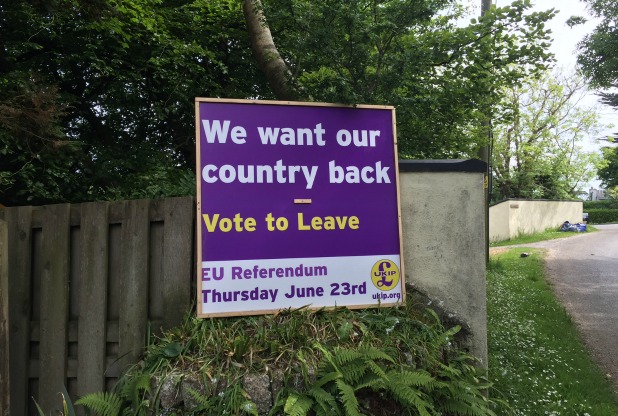
UKIP poster - yard sign - EU referendum

How is the fact that most Ukippers and Brexiteers are ordinary, decent people and not rabid skinhead racists such surprising news that it merits an article in The Spectator?

The metro-left have their fixed views of Brexiteers and Ukippers – basically ghastly, uncultured people with a blinkered, nationalistic worldview bordering on overt racism. Generally they hold these views not because of any personal experience meeting and talking with Brexit supporters, but rather because this caricature draws a neat contrast with the virtuous traits of openness, tolerance and progressivism that the Left love to claim as their own. This much is all well known.

But most of these views are formed at a great distance removed from the actual Brexiteers or Ukippers being judged. When Channel 4 filmmakers produce a dystopian documentary about what Britain would be like under a UKIP government led by Nigel Farage it is achingly obvious that nobody involved in the feature knows or has ever taken the time to get to know the type of people they so readily pastiche for the lazy consumption of their fellow metro-leftists.

But once in awhile someone from the metro-left bubble accidentally stumbles out of their hermetically sealed ideological environment, finding themselves deep in the heart of Brexit supporting suburbia, or – heaven forfend – UKIP country.

And when it turns out that the primitive, simple UKIP natives turn out to be perfectly decent people who just happen to hold different views on a few political issues, it is now apparently such shocking and revelatory news that it merits a whole article in The Spectator.

From standup comedian Ariane Sherine’s wide-eyed report on her accidental foray into UKIP land:

Most people would say UKIP lends itself to comedy better than Denis Healey’s eyebrows lent themselves to tweezers – but not the people of Walton-on-the-Naze, as they live in the party’s only constituency. I’m a stand-up comic, and I was booked to play the town’s first comedy night this month. I don’t know if the lovely promoter realised I was Asian when he booked me; for my part, I didn’t realise Douglas Carswell was Walton’s MP, and only discovered while Googling the town on the way to the gig, when it was too late to turn back.

When I arrived in Walton-on-the-Naze’s large ballroom with its cornicing and chandeliers (‘It looks like the inside of a prostitute’s wedding cake’ remarked one of the other comics), I was perturbed to see more skinheads than at your average EDL rally. Audiences in London are diverse both in terms of race and class; Walton’s audience was not. The first act quipped, ‘I know you’re all a bunch of racists’; whether he was joking or not wasn’t clear.

I was terrified before I went on. I generally sing a love song to Jeremy Corbyn; I thought ‘Oh no, they’re UKIP supporters – they’re going to hate it.’ I also sing about the time a beauty therapist waxed my bikini line into a Hitler moustache. Ridiculously, I thought ‘Maybe some of them are neo-Nazis and will object to this, too!’ Before our sets, the other new comic and I shared frightened glances. ‘Good luck,’ he said. ‘Thanks – I’ll need it,’ I replied. ‘Hopefully they’ll think I’ve just got a suntan and am not Asian at all?’. I was glad that my six foot six inch male friend had accompanied me to the gig.

Because we all know the seething hatred of Asian people in the heart of UKIP supporters and people who voted for Brexit? The condescension here is absolutely off the charts – first assuming that the people of Walton on the Naze are so stupid that Sherine’s clever little love ditty to Jeremy Corbyn might sail over their sloped foreheads, and second that the audience might start jumping around and flinging faeces when they realise that the person on stage is of Asian heritage.

Is there some little-reported history of Asian comics going missing after venturing too deep into small-town Essex that I am unaware of? Has Douglas Carswell quietly imported the defunct Jim Crow laws from the American South, entrenching racial segregation and discrimination in a small corner of eastern England?

This kind of foreboding and hysteria is only possible when one feels that the community in question are somehow fundamentally different to us, that they are “other”. But Ariane Sherine and her audience were both British, both English too, in fact. The idea of being afraid of one’s own countrymen because they happened to elect a mild-mannered MP like Douglas Carswell is absolutely absurd.

Sherine’s odyssey continues:

To my surprise and relief, they laughed, and went on to laugh throughout my set: at Corbyn, at the Hitler moustache, at my rude song about never having another boyfriend. They were friendly and good-natured. I tested the waters a bit, in case they hadn’t noticed my skin colour: ‘My little girl’s white and I’m brown, so I call her my secret Asian.’ They didn’t bat an eyelid. When I came off stage, the promoter’s wife said ‘They loved you! They came to life when you came on.’

In some ways, the crowd lived up to stereotypes: when the other comedian mentioned the referendum, he got heckled with ‘Brexit – out out out!’ And some of the crowd started to heckle the headline act when he maligned their hometown, with one man asking menacingly, ‘Are you taking the piss out of Walton-on-the-Naze?’ But whatever else the audience were, they weren’t racist. In fact, it occurred to me as we drove home, I was the prejudiced one, the one full of preconceived ideas about what other people were going to be like before getting to know them.

Slow hand clap.

Finally, the realisation dawns that perhaps it is the trendy lefty Londoner who holds prejudiced views – about her own countrymen, no less – rather than the much maligned white working class community which she was so alarmed to visit.

One is torn how to respond to this article. Obviously it is a very good thing that Ariane Sherine came to see the error of her ways in having prejudged Ukippers and people from Walton-on-the-Naze. One only wishes that Sherine’s epiphany could be shared with every other young, creative-industry-working, Guardian-reading, Corbyn-supporting hipster living in London and the other big cities – and that the good people living in pro-UKIP or pro-Brexit communities might eventually start to feel more understood and respected as a consequence.

But the fact that a comedian’s epiphany that people from a UKIP-voting town are not knuckle-dragging racists is such revelatory news that it merits a prominent article in The Spectator is depressing beyond belief. How is it possibly news that people in Walton-on-the-Naze didn’t racially abuse an Asian comedian and heckle her off the stage?

When so many of our fellow citizens hold other groups – the white working class, Ukippers, whoever – in such open disdain, even fearing them, then we are in trouble as a country. And when established media outlets like The Spectator feel the need to publish One Woman’s Voyage of Discovery Into UKIP Land with a straight face, just to make a point, then it is clear that our media has a long way to go in terms of understanding the country they cover.

This disconnect is why Britain voted for Brexit against the command and expectation of the country’s elite in the first place. Hasn’t the time come to give Britain’s silent, Brexit-supporting majority a little bit more respect?

 

UKIP Caravan

Top Image: Plymouth Herald

Support Semi-Partisan Politics with a one-time or recurring donation:

Agree with this article? Violently disagree? Scroll down to leave a comment.

Follow Semi-Partisan Politics on TwitterFacebook and Medium.

Many People In Britain Deserve Sympathy. Labour’s Centrist MPs Do Not.

The sycophantic Westminster media identify and empathise much more with Labour’s centrist MPs than the ordinary people who make up the party membership. And it shows.

In a rather nauseating review of Theresa May’s first outing in Prime Minister’s Questions, The Spectator’s Steerpike column gushes with sympathy for the rebellious Labour centrist MPs perched behind (and around) Jeremy Corbyn:

In recent weeks, Jeremy Corbyn’s popularity has hit a new low with the Parliamentary Labour Party. Things are so bad that he is unable to assemble a full Shadow Cabinet — instead having to assign some people with more than one position.

So, it was an interesting move of the Labour leader to bring up job insecurity and difficult bosses at today’s PMQs. Corbyn suggested that Theresa May had much work to do when it came to making employment rights fairer. Alas, the Prime Minister was unimpressed with Corbyn’s complaints. Channeling her inner Thatcher, May went on to suggest that it was he who was the guilty one when it came to inequality in the work place.

The Spectator goes on to quote the new prime minister’s (admittedly very effective) withering putdown of Corbyn:

‘I’m interested that he refers to the situation of some workers who might have some job insecurity and potentially unscrupulous bosses. I suspect that there are many members on the opposition benches who might be familiar with an unscrupulous boss.

A boss who doesn’t listen to his workers. A boss who requires some of his workers to double some of their workload. Maybe even a boss who exploits the rules to further his own career. Remind him of anybody?’

This is all part of a dismally familiar effort in the Westminster media to paint Labour’s rebellious centrist MPs as the wronged and oppressed group, and Corbyn as their unlikely tormentor in chief (when if anything it is clearly the other way around).

The Spectator – and they are far from alone – expect our hearts to brim over with sympathy for the poor Labour centrists whose ineptitude made Jeremy Corbyn’s rise possible in the first place, and who now stomp around Westminster mutinously, trying to destroy the mirror which Jeremy Corbyn holds up to their faces, showing them their own vacuity.

This is a fawning, sycophantic attitude which screams “screw the people and the Labour Party membership! What really matters are the hurt feelings and stymied career aspirations of 230 members of the Westminster political class, people who didn’t go to Oxbridge, secure prize political internships and shimmy their way up the greasy pole only to find their dreams of a Cabinet career dashed because their party is locked out of power for a generation.”

That’s not to say that Corbyn is some kind of faultless, saintly figure. Far from it. But while his ideology may have been plucked unreformed from the 1970s, it is at least coherent and sincerely felt. The same cannot be said for the restive cohort of centrists who are so busy trying to find an “electable” alternative that policy and passion and principle barely register at all.

Post-Brexit, it seems to be fashionable for well-connected journalists, commentators and intellectuals to publicly muse about the possible reasons for the anti-establishment rage simmering at the surface of British politics. Why oh why have the British people stopped listening to the expert opinion of their betters in the Establishment, goes the frequent cry. Why have the people lost faith in the political class?

Hint to the Spectator: journalists openly fretting about the mental welfare of supposedly poor, downtrodden centrist Labour MPs rather than the genuinely poor and downtrodden squeezed middle and working classes goes a long way toward explaining this impenetrable riddle.


Jeremy Corbyn - PMQs

Support Semi-Partisan Politics with a one-time or recurring donation:

Agree with this article? Violently disagree? Scroll down to leave a comment.

Follow Semi-Partisan Politics on TwitterFacebook and Medium.

This Nauseating Self-Pity From Disappointed Remainers Should Be Treated With The Scorn It Deserves

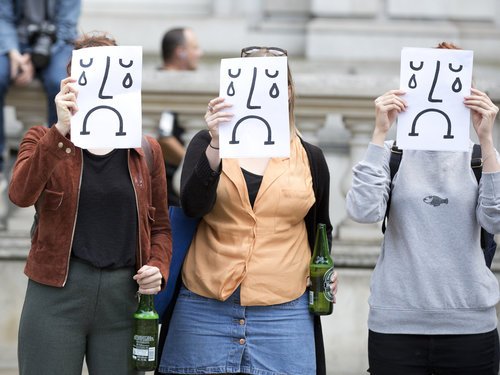
EU Referendum - Brexit - Despair

Disappointed Remainers may be anxious and upset at having their European identity “ripped away from them”, but Brexiteers have been voiceless and disenfranchised for their entire lives. The collective middle class hissy fit from sore loser Remain supporters is nothing more than their privileged reaction to not getting their own way for once

Melissa Kite tells an anecdote in The Spectator which will be immediately familiar to any Brexiteer stuck behind “enemy lines” with a social circle consisting primarily of disappointed Remain supporters:

‘Of course, there will be no air quality now,’ said a friend, shaking her head over my support for Brexit.

‘You what?’

‘Air quality,’ she said. ‘Or green belt. Or Sites of Special Scientific Interest, preserving the countryside and wildlife… All those really good EU regulations have all gone now.’

‘What on earth are you talking about?’ I started to feel exasperated, inwardly thinking, ‘Uh-oh, here goes another friendship…’

‘All those EU regulations safeguarding everything. All gone. No more air-quality rules. No more SSSIs.’

‘So you’re saying Brexiteers have ruined the air now, are you? That’s where we are up to with the scaremongering? No more air now we’re out of the EU.’

‘Well, I’m just saying…’

The air of surly resentment against Brexiteers – ranging from generalised “woe is me” laments to very specific lists of the many plagues of Egypt which will now befall them in an independent Britain – is getting tiresome in the extreme.

And it gets worse:

‘Oh my god! The scaremongering!’ I moaned. ‘I’ve had it up to here with it!’

‘Fine. We won’t talk about it,’ said my friend, who is a science teacher and ought to know her stuff when it comes to SSSIs and all that malarkey.‘I’m just saying, they’ll probably build all over the green belt now. And big business will take over the world…’

‘Stop it! I can’t take any more! There’s nothing you can say that will make me regret backing Brexit. Even if you tell me they’re going to build a million houses on every last inch of the green belt, and turn all the air into carbon monoxide, I still want to be able to elect the people who make the laws that govern me!’

‘Fine. We won’t talk about it. Although you could elect them if you bothered, but no one does…’

‘Not the MEPs! They don’t make the laws! The commissioners make the laws and they’re unelected… Oh my god, I’m turning back…’

‘Fine, let’s just not talk about it at all. My son just got a job and he’s bought two new suits…’

I assumed she was going to say, ‘…that were made out of toxic, poisonous wool because all the safety laws have been scrapped so he ended up in A&E…’ but she didn’t.

Of course Brexiteers would be equally grumpy if the result had gone the other way (as many of us expected it to), but it is hardly comparable. Remainers at least got to enjoy the European Union for all this time. Brexiteers had to suffer it.

But certainly, this blog would certainly have been apoplectic in the event of a Remain vote, and with good reason. Remainers love to whinge that the Leave campaign won based on lies and distortions, while conveniently overlooking the fact that the prime minister and chancellor debased their high offices by using the full machinery of government and Whitehall to work incessantly for a Remain vote.

Whether it’s the £9m government propaganda mailshot, the Obama intervention, Cameron’s violation of purdah rules or the way in which the Remain campaign shrank the debate to focus purely on the economy and then wheeled out expert after expert to suggest that the avoidance of short-term economic disruption should be our sole concern (while utterly ignoring the democratic question), the Remain campaign is just as guilty of lies and obfuscation as Vote Leave.

More to the point, Remain had a massive advantage in the status quo factor which makes it prohibitively difficult for the radical option to prevail in a referendum. Not only did they have the 24/7 support of the British government propelling them onward, they had a built-in advantage of thousands of wavering voters who would ultimately vote for continuity. And still they could not triumph. Without these aids, the margin of victory for Leave would likely have been even greater.

So while Remain supporters may be disappointed now, it is worth remembering that nothing will change for them until Britain actually leaves the EU (whenever that may be), and that many of the things which they treasure to the extent that they were willing to bargain away our democracy may still be available to them. Certainly if Britain pursues an interim EFTA/EEA access solution (as this blog advocates) then their economic nightmares will prove utterly unfounded while their precious freedom of movement is left largely untouched.

And while Remainers may be devastated at the prospect of soon no longer being EU citizens, Brexiteers have had to endure being in the EU against our will since 1973. And while I’m dreadfully sad that Remainers will not get precisely what they want handed to them on a silver plate for once in their lives, many Brexiteers have suffered what we see as an undemocratic, unjust status quo for our entire lives. Let’s not get so caught up in concern for the Brexit-inspired mental trauma of Phoebe and Rupert from Islington that we forget the fact that Jack and Gary from Sunderland have been losing out for decades, and only now are getting the opportunity to taste victory for the first time in their lives.

Of course, much of the commentariat struggles to wrap their heads around the fact that Brexit is not a calamity for everyone. They live among Phoebes and Ruperts, and rarely (if ever) meet Jacks or Garys, let alone identify with their lives, struggles and ambitions. That’s why the Guardian finds endless examples of delicate people whose anxiety has gone through the roof and have retreated to their safe spaces in terror, but then extends the same nauseating sympathy to celebrating Brexiteers, assuming that we uneducated rubes have been tricked to vote against our own interests and will soon regret our vote for democracy and self-governance.

What we are now witnessing, with these tearful examples of pampered middle class pseudo-trauma and calls to ignore the result of the EU referendum or to keep holding votes until the British public give the “right” answer, are nothing but a collective hissy fit from people who have had their way since 1973 and are furiously, childishly determined that nobody else should ever get to influence the future of their country and exercise control over their lives.

And while remaining magnanimous toward individuals and genuinely disappointed EU supporters in general, we should treat any further such selfish, self-pitying sentiments with the scorn they richly deserve.


Trigger Warning

Agree with this article? Violently disagree? Scroll down to leave a comment.

Follow Semi-Partisan Politics on TwitterFacebook and Medium.

The Daily Toast: Tony Blair On Labour’s Future In The Age of Corbyn

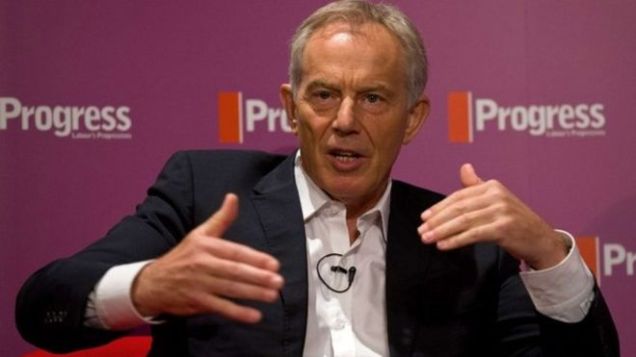
Tony Blair - Labour Leadership - Jeremy Corbyn - Annihilation

The Labour Left may dismiss him as a Red Tory war criminal, but Tony Blair raises some awkward questions about what Labour stands for in the Age of Corbyn

In the Christmas special edition of The Spectator, Tony Blair offers a typically self-aggrandising but (to the Corbynite Left) infuriatingly perceptive take on the challenges facing Labour, and why the emboldened hard Left are not equal to the task before them.

Defending New Labour’s record in government between 1997-2010, Tony Blair writes:

In a society in which fewer and fewer people thought of themselves as traditional working class, we needed to build a new coalition between the aspirant up and coming and the poorest and most disadvantaged. For the task of winning power, the emphasis on the values of community, society, family, compassion and social justice was highly effective.

But for the task of governing, we had to do more than proclaim our values, we had to have the courage and creativity to apply them anew to a changing world and make what counted what worked rather than defending interests or tradition.

That’s the rub: what does Labour stand for in a society where fewer and fewer people  think of themselves as being working class, or attach any real meaning or identity to that label? And specifically, what does the Corbynite Left of the party stand for in this new reality?

Blair points to an uncomfortable truth for Labour. Because few people, other than the Owen Jones romantic Left, still obsess about class. And though economic inequality is very much a real thing, many of us share common tastes in popular culture to an extent which was simply not the case in the 1920s or even the 1950s.

What does social class even mean when thousands of one-percenters listen to the same pop music and partake of traditionally working class interests such as football, and the technological revolution has given the masses the same access to entertainment, culture and travel destinations as the very wealthy? Does class mean anything at all in 2015, besides being a shorthand way to describe a person’s accent? Arguably not.

So what has replaced the issue of class in our public discourse? The answer, of course, is the new obsession with equality. Nebulous and never clearly defined, the Left harp on about equality without ever explaining whether they are referring to equality of opportunity or equality of outcome. But as a crude generalisation, one could say that centrist Labour strives (however badly) for equality of opportunity, while the Corbynite Left dream of a word of total, enforced equality of outcome.

What unites these two warring factions within Labour is the fact that neither side have the first clue about how to use public policy to translate their vision into reality. Centrist Labour is intellectually dead and hasn’t had an original idea since Tony Blair left office, but the rot became particularly bad during the Ed Miliband era. Miliband’s speeches were full of meaningless platitudes and waffle about creating a “fair” Britain, but shockingly free of specific policies or strategies to reshape the country accordingly.

And the emboldened Left are full of spittle-flecked condemnation of the Evil Tories, not to mention the endless, preening virtue-signalling which has become their hallmark. But they offer no solutions either, just a 24/7 Twitter stream of criticism of Tory policy. Want to know what the Corbynites want to do with taxes or welfare? Good luck finding out. Most of them don’t have a clue, and the few that do know won’t say because they know that their real vision for Britain would be hugely unpalatable to the general electorate.

The danger for Labour in failing to stand for an election-winning coalition of voters – as they did when they represented a cohesive working class in the twentieth century – is that others will define Labour to the electorate, and not in a flattering way.

Already, the Conservatives are pushing the message that Labour are the party of welfare, entitlement and anybody who is a net “taker” from society. And what can Labour possibly say to counter this claim, when they can always be found popping up on television to denounce spending cuts without announcing anything amounting to a cohesive plan of their own?

Blair closes his Spectator piece by warning:

Right now we’re in danger of not asking the right questions never mind failing to get the right answers. All of it is about applying values with an open mind; not boasting of our values as a way of avoiding the hard thinking the changing world insists upon.

Unfortunately, even the anti-Corbyn elements of the Labour Party seem utterly unable to grasp this fundamental truth. And too often, it seems that all Labour know how to do is hate the Tories and boast about their own values, rather than identifying solid policies to put them into practice.

Consider how the recent vote on military action in Syria descended into a mudslinging sideshow, with the Corbynite left accusing anyone who disagreed with their pacifist stance of being an Evil Tory warmonger. Or the way that the Labour Party rode to battle against the tax credit changes, the welfare cap and the NHS junior doctors pay dispute, enthusiastically taking up arms against the Conservatives without uttering a word about how they would address very real problems of concern to many British voters.

On these issues and more, Labour currently propose no solutions. While military intervention in Syria may well fail or lead to a worse outcome, no alternative has been clearly outlined – assuming that airy talk about negotiating with ISIS is not to be taken seriously. Ask ten Labour MPs (including the shadow cabinet) what the party proposes to do about welfare or the NHS and you are likely to get fifteen different answers.

In his article, Tony Blair repeatedly argues against focusing on ideology:

Infrastructure, housing, social exclusion – all these challenges require more modernising and less ideological thinking.

But this is misleading. Strong viable governments only come about when there is a coherency and consistency of ideology which informs the policies offered to the electorate. It’s no good just coming up with a basket of pragmatic policies – people rightly see this for what it is: electoral opportunism.

Labour need to pick an ideology, whether it is that of their leader, that of Tony Blair or that of the incoherent band of uncharismatic centrists who currently pass for party heavyweights. And then they need to show the public that real, tangible policies for government can flow through the party, shaped and informed by those ideals. Labour’s credibility is currently so low that opportunistic opposition to individual Conservative policies will deliver them nothing at the ballot box. An alternative platform for government is what’s needed.

And that takes us back to the opening question: who does Labour actually represent in the Age of Corbyn and his sulky centrist antagonists, when nearly everybody with an aspirational bone in their body is abandoning the party?

Jeremy Corbyn - Labour Party - Andrew Marr Show - BBC

Agree with this article? Violently disagree? Scroll down to leave a comment.

Follow Semi-Partisan Politics on TwitterFacebook and Medium.

All Hands To The Keyboards, To Save The United Kingdom


Stop talking about The Great British Bake Off for five minutes. Because in a couple of weeks time, there may no longer be a Great Britain at all.

If Scottish voters vote “yes” to independence in their coming referendum, that’s it – the end of the United Kingdom as we know it.

The Spectator magazine have taken the unprecedented step of announcing that this week’s cover story will be written not by journalists but by readers – it will be comprised of short letters from ordinary Britons, urging wavering Scots to vote to keep our country united.

Semi-Partisan Sam has already submitted a contribution, albeit a tortured piece that ran to 1,776 words, a number heavy with cultural and historic significance.

Though I feel unable to join in the opportunistic race to the left to compete with Alex Salmond, or the politicians’ desperate tactic of promising ever-more constitutional powers for Scotland alone rather than pledging to bring about the fully federal United Kingdom that I support, I wanted to say my piece and put on the record my love for my country in its unbroken, united form.

If you do nothing else political this year – and truly, the matter of our country’s ongoing survival transcends ordinary politics – take a moment to join in The Spectator’s campaign and say why the United Kingdom matters to you.