The EU’s Model Of Supranational Harmonisation Does Not Keep Us Safe

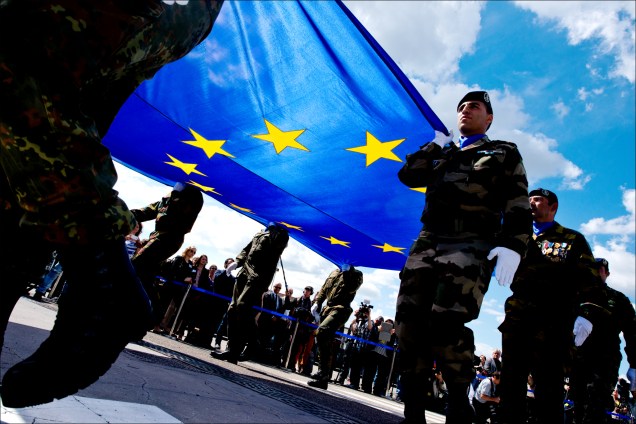
EU - European Union - Security Defence Policy

On national security as with trade and social affairs, the case for Brexit hinges on the conflict between intergovernmentalism and supranationalism

In his latest Telegraph column, Christopher Booker joins this blog in refuting the baseless, scaremongering claims by the Remain camp that being in the EU in any way protects Britain from the risk of terrorist attack.

Booker writes:

It was unfortunate timing for our not very convincing Defence Secretary Michael Fallon, when he used the Brussels terrorist attacks to claim that they only confirm how disastrous it would be for Britain to leave the EU. “The fact is,” he said, that “across Europe we do have these mechanisms now” for “sharing intelligence about terrorists’ movements” that enable “all intelligence services across Europe to pool their efforts”.

Do those “mechanisms” for sharing intelligence include the Parliament, Court of Justice, Commission, the supranational elements by which the European Union undermines nation states and seeks to usurp their role on the world stage? Of course not – these are all explicitly political institutions. All of the collaboration which actually helps to combat terrorism in Europe occurs on an intergovernmental, not a supranational basis, mostly outside of European Union structures.

When sovereign governments are free to co-operate on mutually important issues, they can often do so well. But when a busybody supranational regime seeks to take on ever more responsibilities from the nation state, vesting them in inappropriate and unproven institutions, that’s when things can easily fall through the cracks, as this blog explained yesterday.

Booker rightly goes on to argue:

In fact, there is here a much wider point, which highlights one of the most common misunderstandings about the EU, whose supporters try to persuade us that without it, international cooperation could not exist. In fact, over a whole range of issues, countries have long evolved extremely effective systems of inter‑governmental cooperation, such as on air-traffic control, Interpol, the international postal union, the European Space Agency and dozens more (not to mention Nato).

All these, negotiated between national governments, regardless of whether or not they are in the EU, work very well. And not the least absurd feature of the EU’s attempt to make itself a “supranational government of Europe” is how often it has tried to absorb these examples of effective cooperation into its own clumsy bureaucratic empire: as when it launched its “Single European Sky” programme, or set up “Europol”, or issued directives on postal arrangements with which it then expected non-EU states to comply, or tried to take over the European space programme for its crazy Galileo satellite project.

If only more people appreciated the crucial difference between “inter‑governmental”, which works, and “supranational”, which doesn’t, how much more enlightening our debate might become.

Inter-governmental versus supranational. It is very much in the interests of the EU’s apologists and closet federalists for the general public not to realise the difference between these two important terms.

The former describes the healthy co-operation between friendly allied countries, sometimes bilaterally and other times facilitated by an organising body (like Interpol). The latter describes weak nation states outsourcing key responsibilities to a higher third party, a reckless and unproven approach only ever attempted by national politicians seeking to escape accountability to their own electorates.

If the Remain camp succeed in their effort to lay a thick fog of war over the EU referendum debate so that important terminologies and ideas are confused and muddled, they automatically win. If they can persuade people that the EU equals warm, fuzzy co-operation with our friends while Brexit equals snarling isolationism and being an international pariah, the Remain camp need to nothing else. And so far, they are succeeding.

In order to turn this around, the Leave campaign absolutely must succeed in educating the public on the difference between laudable and (ideally) transparent and accountable co-operation between European countries on one hand, and the outsourcing of core government competencies to undemocratic, unwanted and untested unified European institutions on the other.

This applies not only to national security, but economic and social affairs too. When the Leave campaign are able to cut through the fog of confusion and make people realise that leaving the EU would actually represent an affirmation and strengthening of the only kind of co-operation which actually delivers positive results (the inter-governmental kind), they are far more likely to embrace Brexit and realise how the EU actively harms healthy intergovernmentalism in its rabid pursuit of ever-closer union.

Can the Leave campaign this message across in less than three months between now and the referendum? Perhaps. But enlightenment will not spring from the mouths of deliberately ignorant “leaders” like Boris Johnson.

Those who can actually distinguish between the real issues and the cosmetic ones – which sadly excludes much of the British press corps – urgently need to find a way to amplify their message.


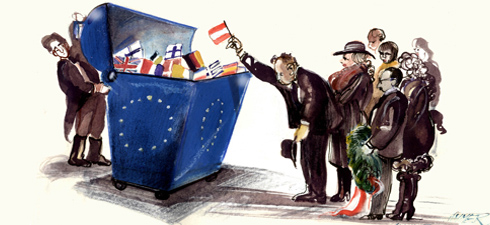
Intergovernmental vs Supranational - European Union - EU Referendum

Bottom Image: Cartoon by Wolfgang Ammer, published in Intergovernmentalism & Liberal Intergovernmentalism

Agree with this article? Violently disagree? Scroll down to leave a comment.

Follow Semi-Partisan Politics on TwitterFacebook and Medium.

Arrested For Thoughtcrime In Britain Following The Brussels Terror Attacks

Matthew Doyle - Facebook - Twitter - Brussels Attacks - Muslim Woman - Arrest - Free Speech - Police

Britain has become an authoritarian dystopia where the police prefer to waste scare resources scouring Twitter for instances of supposed thoughtcrime, rather than tackling real-world crime

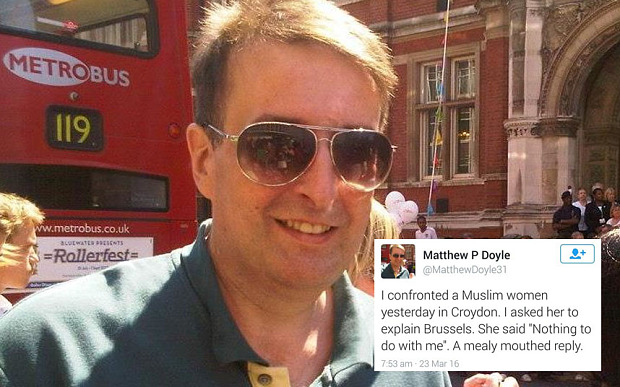
Matthew Doyle of Croydon, south London, was not the first person to say something stupid in the aftermath of the Islamist terror attacks in Brussels yesterday, and he will certainly not be the last. But Doyle does hold the dubious honour of being the first person in Britain to be arrested for thinking and saying – or in this case, tweeting – the wrong thing about the Brussels attacks, the latest victim of Britain’s dystopian hate speech laws.

As with most people whose free speech most urgently needs defending, Matthew Doyle does not come across as a remotely sympathetic character.

The Telegraph explains:

A man who tweeted about stopping a Muslim woman in the street yesterday, challenging her to “explain Brussels”, and lambasted on Twitter for his comments, has responded to the criticism today, insisting he is not some ‘far right merchant’.

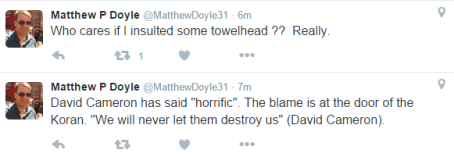
Matthew Doyle, partner at a south London-based talent & PR agency, posted a tweet on Wednesday morning saying: “I confronted a Muslim woman in Croydon yesterday. I asked her to explain Brussels. She said ‘nothing to do with me’. A mealy mouthed reply.”

He was later arrested.

His tweet referred to yesterday’s bomb attacks on the Belgian capital’s main airport and Metro system that left at least 34 people dead and 198 injured. His comment went viral, being retweeted hundreds of times before he eventually deleted it.

Mr Doyle told the Telegraph he had no idea his tweet would be the “hand grenade” it has proven to be – and that Twitter’s 140 character limit made the encounter sound vastly different to how he thought it went.

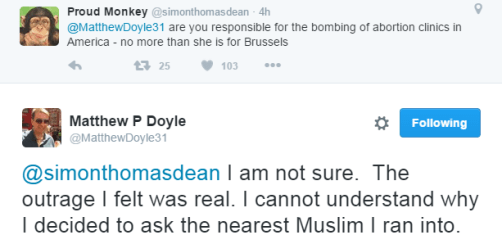
Now there is a good case to be made that Matthew Doyle is something of an idiot – in a follow up tweet, he later exclaimed “The outrage I felt was real. I cannot understand why I decided to ask the nearest Muslim I ran into”, which certainly suggests that perhaps we are not dealing with a world class mind here.

Matthew Doyle tweet

And his subsequent tweets veered firmly toward the knuckle-dragging bigot end of the spectrum, when he retorted “Who cares if I insulted some towelhead??”

Matthew Doyle tweet - 2

But let’s be clear – even if we apply the most unforgiving interpretation of Matthew Doyle’s tweet, and his subsequent account of the conversation, it should not be enough to land a citizen of a supposedly free democracy in trouble with the law.

Even if Doyle literally sought out the first Muslim-looking person he could see on the high street, approached them unbidden and asked them to account for the terrorist actions in Brussels yesterday, no country calling itself free should drag that man through the criminal justice system.

It may be incredibly ignorant and offensive to suggest that all Muslims share responsibility for the terrorist attacks in Brussels this week. It may be astonishingly stupid. But stupidity and lack of manners should not be enough to earn someone a knock on the door from the police.

In this case, the initial response of the Twitterverse was (for once) exactly what should happen – society’s self-righting mechanism kicking in against the actions of a conspicuous idiot. Doyle said something irretrievably stupid which was then widely retweeted, and he found himself on the end of thorough, fully deserved mockery from complete strangers online. Many of the subsequent parody tweets effectively (and wittily) exposed the total lack of logic behind Doyle’s sentiments and actions.

https://twitter.com/ThaKingSlayer/status/712613539366748160

So why is confrontation, rebuttal and mockery not enough in twenty first century Britain? Why can we not simply go to bed content that a self-declared idiot has had his idiocy widely exposed, refuted and mocked, without wanting to twist the knife further? Why is it now also necessary to compound his punishment by heaping an arrest, a trial and a possible criminal conviction on top of the self-inflicted public shaming?

As Alex Massie recently lamented when looking at the public’s response to Donald Trump’s comments about Britain, cases like these only prove his how snarlingly authoritarian and illiberal a place modern Britain can be once the sunny, progressive façade is peeled back:

It is always depressing to discover that there are vastly fewer liberals in this country than you might wish there to be. But that discovery should no longer surprise us.

This is the true attack on British and European values, and it comes from within. I am far less worried about the slim possibility that I will find myself standing next to a suicide bomber on my morning commute, and far more concerned that every single day I am apparently rubbing shoulders with people who smile and appear friendly at first glance, but who would not hesitate to bring the full weight of the criminal justice system crashing down upon my head if I happen to one day say the wrong thing (defined by British law as anything which gives them offence).

As a political blogger with sometimes forceful and controversial views, I am less worried that my writings may earn me a punch in the face from a stranger (I couldn’t be less famous, and my reflexes are quick – though I am probably playing with fire when I criticise our national religion, the NHS) and far more worried that someone will read something that I write, take massively overinflated exception to it, and – with a few clicks of a mouse or a quick telephone call – report me to the police, who would then be obliged to investigate me under Britain’s oppressive hate speech laws.

In the age of Islamo-fascist terror, my liberty and wellbeing is far more under threat from the Public Order Act 1986, the Communications Act 2003 and the Racial and Religious Hatred Act 2006 than it is from the terrorist’s bomb or the bullet. Not because I ever incite racial or religious hatred – indeed, I abhor those who do so – but because under the same laws that put Matthew Doyle in a jail cell, my “guilt” would depend entirely on the perception of the supposed “victim”. Anybody at any time can read anything that I write, claim to be alarmed and distressed by the ideas that I express, and have me carted off to prison.

They can do this to idiots like Matthew Doyle. They can do it to political bloggers like me. And they can do it to you. Sitting at your computer right now, you can get yourself arrested and cautioned, convicted and even sent to prison just by typing fewer than 140 characters on your keyboard. In Britain. In the year 2016.

In case the government actually cares, this is how the terrorists really win. They’ll never make Britain part of a radical Islamic Caliphate, but they can certainly help to ensure that we become such a snarlingly authoritarian, freedom-hating society that our country is changed irrevocably for the worse.

And as the freedoms and liberties which distinguish Britain from more benighted parts of the world – including primitive quasi-medieval regimes like the Islamic State – are shot to pieces, it is our own hand on the trigger. No one else’s. We do this to ourselves.


Postscript: What remains unclear at this time is whether Matthew Doyle was arrested for the content of his original tweet, his subsequent tweets (some of which were actually far more offensive) or the real-world act that his initial tweet described.

It may seem an arcane detail, but it will be interesting to discover whether the woman accosted by Doyle made the complaint, or whether it was a foot soldier in Britain’s growing army of professional online offence-seekers who took offence on her behalf. I would bet a very large sum of money that it is the latter, and that while the “victim” herself probably shrugged off the incident, Doyle’s prosecution is being urged most strongly by other people who are completely unconnected with the incident and who were not adversely affected in the slightest by his tweet.


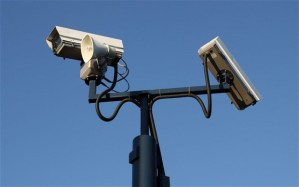
CCTV - Police State

Agree with this article? Violently disagree? Scroll down to leave a comment.

Follow Semi-Partisan Politics on TwitterFacebook and Medium.

Brussels Attacks: Solidarity With Belgium Today, But What About Tomorrow?

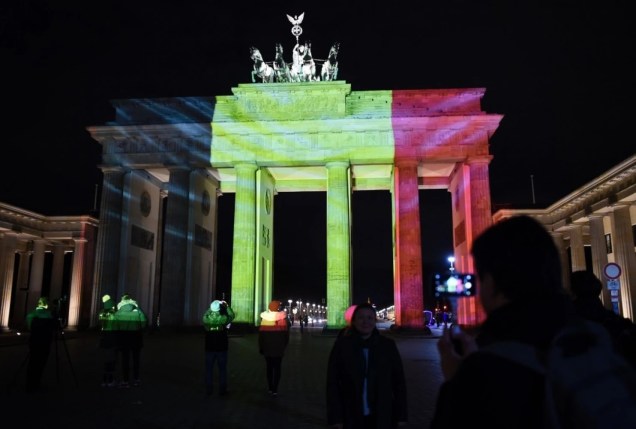
Bruxelles - Brussels - Terrorist Attack - Brandenburg Gate - 3

Solidarity is great. What’s next?

There is a very familiar pattern to all of this.

A bloody Islamist terrorist attack brings carnage and fear to the streets of a major Western city.

Everyone from heads of state to the man next door rush to publicly register their shock and solidarity on Twitter.

Someone inevitably pops up after a few hours to lecture us that there is nothing Islamic about Islamic State, and that we should really be calling them Daesh, or “so-called Islamic State”.

Someone else usually pops up to say something incredibly bigoted or ignorant about all Muslims.

Impromptu shrines appear in a major square of the afflicted city, with candles, chalk drawings and sometimes a bit of impromptu John Lennon.

And the day closes with Europe and America’s major landmarks illuminated to resemble the national flag of the afflicted nation. They’re getting really good at that part now.

Fast forward a day, and plans are well afoot to grant even more powers to the well-meaning but overstretched security services – who were unable to make use of their current extensive powers to thwart the attack – and generally at the expense of our civil liberties. Particularly our rights to privacy and free speech.

Fast forward a month, and we have all moved on. Domestic political concerns, celebrity scandals and daily life have reasserted themselves.

I think we can all agree that we’ve got the public grief, cathartic expressions of solidarity and stern faced authoritarianism down to a fine art at this point.

When are we going to start acknowledging – and maybe even tackling – the root causes?


Bruxelles - Brussels - Terrorist Attack - Le Monde - Cartoon

Agree with this article? Violently disagree? Scroll down to leave a comment.

Follow Semi-Partisan Politics on TwitterFacebook and Medium.

The Left Wing Case Against Mass Surveillance And The Investigatory Powers Bill

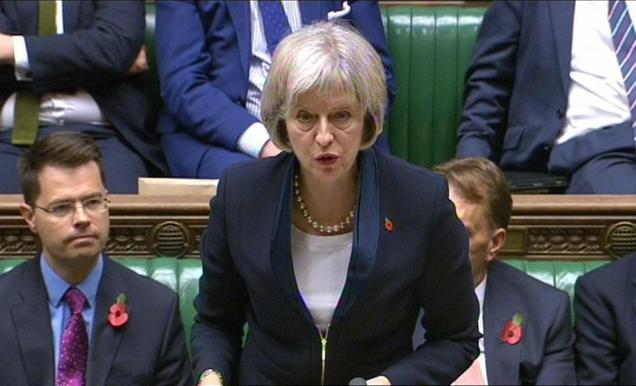
Theresa May - Investigatory Powers Bill - Mass Surveillance

The draft Investigatory Powers Bill will neither increase security nor effectively tackle extremism

Laura Westwood argues in Left Foot Forward that existing mass surveillance techniques have proved ineffective at stopping terror attacks, and that the new measures outlined in the government’s draft Investigatory Powers Bill would further undermine civil liberties with no commensurate reward:

Perhaps most unsettling is the potential harm caused by intruding on the lives of innocent people. Whatever the rationale, mass surveillance practices imperil our rights to privacy and freedom of expression. The UK’s Independent Reviewer of Terrorism Legislation himself warned that taking missteps could sow divisions in society and incubate the problem of ‘home-grown’ terrorists.

Why? Because extremists thrive on exploiting disenfranchisement and grievance. We are told so by former members of Islamist extremist groups. Taking blanket surveillance even further than it already goes is a calculated risk at best, and right now, the sums aren’t adding up.

Already, people languish in British prisons not for committing or inciting terrorist acts, but merely accessing articles and propaganda which praises terrorist acts, or expressing support for them on social media. Such actions may be reprehensible, but bringing the full weight of criminal law crashing down on people with odious foreign policy views and sharp tongues on social media is punishing thought, not words, and is incompatible with a free society.

Furthermore, locking up people like Runa Khan – imprisoned for “disseminating terrorist material”, which basically meant sharing pro-ISIS propaganda articles on Facebook – does nothing to confront and kill the noxious ideas in question, but rather elevates them to an unearned position of nobility, and makes a martyr of their speaker.

As Mick Hume argues in his book “Trigger Warning: Is The Fear Of Being Offensive Killing Free Speech?”:

If she had dressed her young children in suicide vests and sent them out to die in a bomb attack, that would be terrorism. But going online to argue that Muslim mothers should try to raise their sons to grow up as jihadis is something else entirely, more like perverse parenting advice than a military command. Words are not physical weapons and viewpoints are not violence, however ‘radical and extreme’ they might appear to most of us. The opinions expressed by the likes of Runa Khan need to be openly challenged. Trying to bury them instead in prison, on the ground that they are too dangerous to be let loose on Facebook, can only lend their radical message more credence.

At a time when almost all the serious business of governing has ground to a halt for the duration of the EU referendum campaign, mass surveillance is the one area where David Cameron’s ideologically rootless, authoritarian government seems determined to make progress. All other reforms and legislative activity have effectively been placed on hold, yet this most un-conservative government is formalising and expanding the powers of the state to indiscriminately collect and hold data on the private activity of citizens, with the kind of weak and unenforceable safeguards that you would expect from a country with no written constitution.

Why? Because while everything else is allowed to drift as David Cameron seeks to bully and scare the British people into fearfully voting to remain in the European Union, expanding the power and influence of the state over our lives knows no rest.

Those on the Left who oppose this are right to do so – not in pursuit of a political victory over the Evil Tories, but because the Investigatory Powers Bill is bad law and bad policy. And because it will be the poorest, most disadvantaged and least well-connected citizens who first fall prey to the surveillance state, as it always is.

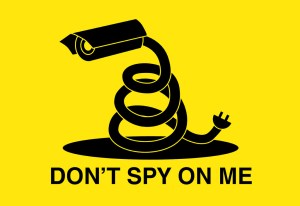
Don't Spy On Me - Mass Surveillance

Agree with this article? Violently disagree? Scroll down to leave a comment.

Follow Semi-Partisan Politics on TwitterFacebook and Medium.

One Year Later, Are We Still Charlie?

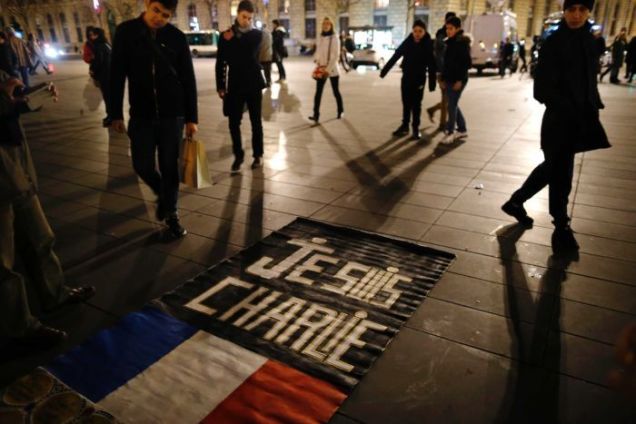
Paris - Charlie Hebdo Anniversary - Je Suis Charlie

As we pass the one year anniversary of the Charlie Hebdo attacks in Paris – the terrorist atrocity which prompted us to declare Je Suis Charlie in support of free speech – are we still Charlie, one year on? Were we ever?

This past week saw the first anniversary of the Charlie Hebdo attacks in Paris, a sickening assault on journalism and free speech, and the worst thing to happen to France until the Paris attacks of 13 November ensured that 2015 would end much as it started for Europe: in the shadow of Islamist terrorism.

At the time of the Charlie Hebdo shootings, many of us rallied to the cause of the small, satirical newspaper which found itself in the crosshairs of a primitive, totalitarian ideology, and we declared “Je Suis Charlie”.

It was a nice gesture, even if it wasn’t strictly true. Though David Cameron was eager to be seen marching arm-in-arm with other world leaders through the streets of Paris in support of free speech, those of us back in London knew that any British newspaper attempting to publish some of the satirical cartoons that Charlie Hebdo published would have been vilified, sued and shut down, and its editor would likely languishing in a British prison cell.

Things didn’t get much better as 2015 progressed, as Glenn Greenwald notes in his latest column for The Intercept:

It’s been almost one year since millions of people — led by the world’s most repressive tyrants — marched in Paris ostensibly in favor of free speech. Since then, the French government — which led the way trumpeting the vital importance of free speech in the wake of the Charlie Hebdo killings — has repeatedly prosecuted people for the political views they expressed, and otherwise exploited terrorism fears to crush civil liberties generally. It has done so with barely a peep of protest from most of those throughout the West who waved free speech flags in support of Charlie Hebdo cartoonists.

That’s because, as I argued at the time, many of these newfound free speech crusaders exploiting the Hebdo killings were not authentic, consistent believers in free speech. Instead, they invoke that principle only in the easiest and most self-serving instances: namely, defense of the ideas they support. But when people are punished for expressing ideas they hate, they are silent or supportive of that suppression: the very opposite of genuine free speech advocacy.

[..] In the weeks after the Free Speech march, dozens of people in France “were arrested for hate speech or other acts insulting religious faiths, or for cheering the men who carried out the attacks.” The government “ordered prosecutors around the country to crack down on hate speech, anti-Semitism and glorifying terrorism.” There were no marches in defense of their free speech rights.

Glenn Greenwald goes on to express his contempt for the fair-weather free speech advocates who are all to eager to shout their support for speech which offends people they happen to dislike, while simultaneously demanding that the authorities clamp down on speech which offends them or people with whom they sympathise.

Meanwhile, in Britain, the newly re-elected Conservative government was getting ready to “defend” free speech by expressing impatience with the fact that they did not have  more freedom to harass citizens acting in accordance with the law.

When David Cameron announced draconian new security measures, impatiently proclaiming “For too long, we have been a passively tolerant society, saying to our citizens ‘as long as you obey the law, we will leave you alone'”, this blog retorted:

These measures have the look and feel of a side which feels unable to win the argument in favour of British and western values through open debate, and so seeks to impose them by force of law instead.

A truly free and liberal society would not need to take such draconian steps as requiring “extremists” (never defined, and certainly not necessarily convicted) to submit advance copies of public remarks to the police for review and censoring, an astonishing proposal. But our society is becoming less and less free by the day, opting instead for security and a quiet life.

And at its depressing heart, this is what it comes down to – a desire for cloistered security above all else. On the economy, on foreign affairs and now on terrorism, our politicians have decided that we are too frightened and worn down by the dangers and threats of this world to face our challenges as a strong, independent nation.

But government has not been solely to blame. The desire to trade liberty for a chimerical sense of security has been coming from the bottom-up, with an increasing number of citizens – particularly those on the Left who ostentatiously proclaim their concern for issues of “social justice” – insisting that core liberties such as the right to free speech should be curtailed when they negatively infringe on the feelings of another person.

This corrosive new development has its roots in academia and the university environment, where a generation of liberal professors espousing political correctness as their religion are finally beginning to reap what they sowed – a new generation of coddled adult baby students who require trigger warnings, safe spaces and dawn-to-dusk parenting by their colleges just to make it through the day.

These New Age Censors and their petty authoritarianism are toxic to free speech, and their growing influence has already resulted in calls to outlaw clapping and booing, tearful temper tantrums about dress codes, stifling ideas by labelling them ‘problematic’, the insistence on safe spaces and mandatory sexual consent workshops.

As I recently explained, deep down this has nothing to do with “social justice”, but instead is all about gaining power by wrestling control over the language and laying verbal land mines with the intention of destroying opponents who – regardless of how they actually behave – happen simply to say the “wrong” thing:

That’s where the New Age Censors, the Stepford Students, the resurgent activist Left step in, always watching over your shoulder and always quick and eager to tell you when you have crossed one of the many invisible lines that they are busy drawing across our political and social discourse. Only the telling always seems to take the form of a social media lynching rather than a friendly pointer.

When the rules over precisely what can be said and how it must be phrased become so fiendishly complex that we are all liable to fall over them at some point, it grants enormous power to the gatekeepers, those swivel-eyed young activists at the forefront of modern identity politics. Not only do they get to write the rules, they and they alone get to sit in judgement as to whether those rules have been violated.

[..] Who knew that the petty tyrants of today would be cherubic-faced, smiley student activists, chanting mantras about keeping us safe as they imprison us in their closed-minded, ideological dystopia?

As far as 2015 Year In Reviews go, all of this makes for depressing reading. Indeed there are many reasons to be concerned for the future of free speech and civil liberties in general, particularly when many of our fellow citizens seem intent on destroying our freedoms from within.

And yet there have been some good news stories too, providing small glimmers of hope. One such case has been the exoneration of a Northern Irish pastor, James McConnell, who found himself on trial for sending “grossly offensive” communications following a sermon in which he described Islam as “a doctrine spawned in hell”.

This was a spiteful sting by the prosecution. McConnell’s sermon – in which the 78-year-old pastor said some highly unpleasant and inflammatory things about Islam – had been recorded and then later posted on the internet, allowing the authorities to accuse him of “causing a grossly offensive message to be sent by means of a public electronic communications network”.

Too often, such show trials have resulted in conviction and a prison sentence, which in this instance could have been six months. But in this case, Judge Liam McNally, threw the case out, saying “the courts need to be very careful not to criticise speech which, however contemptible, is no more than offensive”. If only this legal interpretation was more widely shared and disseminated throughout the English and Scottish legal systems, from the UK Supreme Court on downwards.

But the truly pleasing aspect of this case is the fact that one of the people who spoke outside the court in support of James McConnell was a Muslim academic, a senior research fellow in Islamic studies at the Westminster Institute named Muhammad al-Hussaini.

Taking a brave stance in support of speech which he himself must have found very distasteful, al-Hussaini nonetheless defended Pastor James McConnell’s right to say hateful things about the religion of Islam.

The Guardian reported at the time:

Speaking outside Belfast magistrates court to hundreds of McConnell’s supporters, Muhammad al-Hussaini, a senior research fellow in Islamic studies at the Westminster Institute, said he was in the city to back McConnell’s right to free speech.

Hussaini said: “This is possibly one of the most important things at our juncture in history; it could be the make or break for the continued survival of our planet actually.

“Against the flaming backdrop of torched Christian churches, bloody executions and massacres of faith minorities in the Middle East and elsewhere, it is therefore a matter of utmost concern that, in this country, we discharge our common duty steadfastly to defend the freedom of citizens to discuss, debate and critique religious ideas and beliefs – restricting only speech which incites to physical violence against others.

“Moreover, in a free and democratic society we enter into severe peril when we start to confuse what we perhaps ought or ought not to say, with what in law we are allowed to, or not allowed to say.”

At a time when freedom of speech is just as much under attack from safe space zealots and our own government as it is from radical Islamic terrorism, it is especially important that we stand in solidarity with those who defend free speech, and particularly those who have the moral courage to defend the speech that they personally hate.

In this regard, civil libertarians owe a debt of gratitude to Muhammad al-Hussaini and others like him. For in his defence of the rights of pastors – or anybody else – to say what they please, so long as they do not actively incite violence against another, this Muslim scholar is doing far more to defend the ancient British and enlightenment values of freedom and liberty than

In fact, one could quite easily say that al-Hussaini is more authentically British (in terms of extolling and living by the values which we supposedly hold dear) than our own government, the grunting anti-Muslim far-right and most of the academic safe space crowd put together.

This is the unusual situation in which we now find ourselves, with a British population and government cowed simultaneously by Islamic terrorism and by Islamophobia seriously discussing banning “hate preachers” like Donald Trump (of all people) from entering Britain, while it falls to a Muslim academic to stand up in defence of the free speech which the West supposedly holds so dear.

This landscape is not encouraging; few of us passed the Charlie Hebdo Test when those terrible shots rang out on 7 January 2015, and fewer still would do so now, based on their words and actions since that heinous attack.

But when a nation begins to forget its own values and once dearly-held principles, it is of some consolation on this first anniversary of the Charlie Hebdo shootings to see the flame of liberty being kept alive in some unexpected places, and by unexpected – but very welcome – custodians.
Freedom of Speech - Free Speech

Agree with this article? Violently disagree? Scroll down to leave a comment.

Follow Semi-Partisan Politics on TwitterFacebook and Medium.