Support David Cameron? I’d Rather Feel The Bern

Bernie Sanders For President

Bernie Sanders or David Cameron? There’s no contest

At a time when far too many conservatives on both sides of the Atlantic have revealed themselves to be either snarling authoritarians (Marco Rubio, Donald Trump) or patrician, vacuous hairdos (David Cameron), the search for authentic commitment to individual liberty can sometimes lead to unexpected places.

Spiked are now making the controversial argument that this search leads all the way to Vermont, and to US presidential candidate Bernie Sanders.

Todd Gillespie writes:

Despite being slammed by some as a big-government lefty, Sanders’ track record is more complicated — and arguably more libertarian than has been appreciated. Even libertarian stalwart Ron Paul has come out in support of Sanders’ small-government credentials, shortly after his son, Rand, left the Republican race.

Bernie has espoused positions similar to Rand’s, even joining with him to oppose government surveillance. Last year, Sanders wrote a blistering criticism of the ‘Orwellian’ practice of spying on citizens. He voted against the 2001 Patriot Act and its dreadfully named replacement, the Freedom Act, in 2015 — both of which Clinton supported. He is arguably the only candidate left who takes positions that can legitimately be described as libertarian.

He supports freedom of speech. He backs net neutrality and opposes attempts to censor the internet. In 2005, he introduced the Stamp Out Censorship Act, which sought to prohibit the government enforcing ‘indecency fines’ on non-public media (it failed to pass). Recently, addressing students at Liberty University (a Christian institution whose president has just endorsed Donald Trump), most of whom think very differently to Sanders, he said ‘it is vitally important for those of us who hold different views’ to engage in debate.

Anti-surveillance. Anti-censorship. Pro civil liberties. Pro free speech. All more than can be said of many American conservatives, who ostentatiously flaunt their love of the Constitution – by which they mean the Second Amendment, while conveniently overlooking the First and Fourth Amendments.

Gillespie continues:

Sanders’ right-wing critics write him off as a big-state socialist. But a better label might be ‘libertarian socialist’. Yes, he has a vision of centralised government spending funded mainly by tax hikes on big business, but Comrade Bernie also envisages having a private sector with greater employee ownership. He has introduced legislation several times to increase government funding for centres that would provide training and technical support for the promotion of worker ownership and participation. He introduced the Rebuild America Act 2015, proposing an extra $1 trillion investment to renew America’s crumbling infrastructure, increasing airport capacity, improving and expanding railways, roads, bridges and broadband connection. He also wants to end crippling student debt and drastically increase loans to fuel small-business innovation. You can’t accuse him of thinking small.

Of course there is also much in Bernie Sanders’ platform to abhor – the punishing effective tax rates which would be required to fund this social democratic revolution, the increase in the size of government and the stripping away of agency and responsibility from free citizens to make their own decisions and take their own risks, for a start.

But perhaps it is also a sign of the divergence between the American and British political spectrums that I quite often find myself nodding along in agreement when the ornery senator from Vermont opens his mouth to speak. Perhaps when you move far right enough in your British politics (many certainly seem to think I am Thatcher on steroids) you actually break through and register on the far left of the US political scale.

And one thing is certain – if Bernie Sanders were prime minister of the United Kingdom, we would have a far more ideologically conservative leader than we currently have in David Cameron.

Spot The Socialist - David Cameron vs Bernie Sanders - Semi Partisan Politics - Sam Hooper

Agree with this article? Violently disagree? Scroll down to leave a comment.

Follow Semi-Partisan Politics on TwitterFacebook and Medium.

National Religion Daily Penance: How Much Do YOU Cost Our NHS?

NHS - National Religion - How Much Have I Cost The NHS - Worship - Self Flagellation - Socialism

Don’t join in the Guardian’s fawning worship of the state – you don’t owe the NHS anything

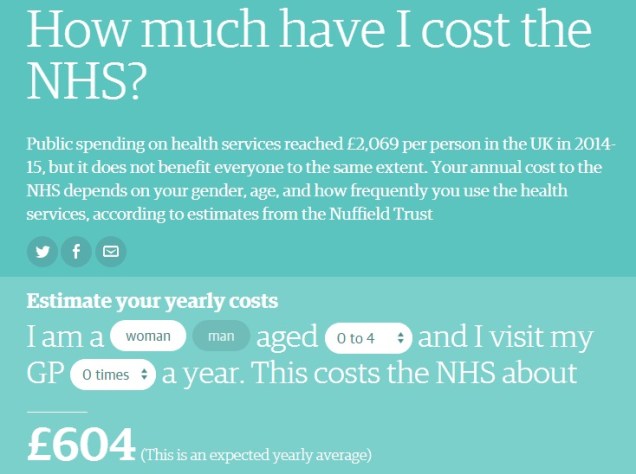
If any further proof were needed that conservatives and socialists think differently and see the world in a completely different way, you need only look at the latest feature in the Guardian’s nauseating, saccharine “This Is The NHS” series, a self-flagellating little feature asking “How much have I cost the NHS?”

In this post, the Guardian takes a break from exploiting real-life stories from doctors and patients to emotionally manipulate people into blindly supporting Britain’s unique but unexceptional healthcare system, and instead invites you to plug your personal details into their online calculator so that you can find out exactly how much money Our Blessed NHS lavishes on you every year. You ungrateful wretch.

The Guardian intones:

Public spending on health services reached £2,069 per person in the UK in 2014-15, but it does not benefit everyone to the same extent. Your annual cost to the NHS depends on your gender, age, and how frequently you use the health services, according to estimates from the Nuffield Trust.

So the total cost of your healthcare increases as you consume more healthcare services. Riveting stuff. Great investigative journalism.

The calculator does throw up some interesting numbers. Interestingly, if you sit stubbornly at home and never use a single NHS service or treatment of any kind, you somehow still manage to cost the health service hundreds of pounds a year.

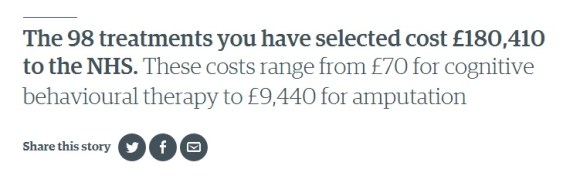
Meanwhile, at the other end of the spectrum, if you were really unfortunate and had every possible thing go wrong with you (once) in a given year, the NHS could be on the hook for as much as £180,410 – though I suspect that the calculator is holding back here, and that some patients may comfortably exceed this total without having to check every single box:

How Much Do You Cost The NHS - 3

How Much Do You Cost The NHS - 2

Also interesting is the fact that the only mention of mental health and associated problems from addiction to depression is buried deep in the “Other” section, and not given the prominence that a right-on publication like the Guardian might be expected to lavish. One can only speculate as to the reason for this sudden downplaying of mental health issues.

But the really interesting and revealing fact is that the Guardian published the article at all – and the conspicuous lack of a counterpoint piece asking how much we each contribute to the NHS (or indeed any of our other public services) every year through our taxes. Why the obsession with how much we are individually costing the state (or harming the environment with our carbon dioxide emissions, or doing any other Bad Thing) when there is no equal curiosity about how much we contribute? Looking at one side of the equation is meaningless until you also have visibility of the other.

This deliberate omission is especially galling at a time when some citizen-focused governments are now providing individual taxpayers with an itemised receipt every year, showing how much of their taxes have been spent on different areas of the budget like education, healthcare and defence. George Osborne even brought the practice to Britain, to the inevitable howls of protest (and accusations of disseminating propaganda) from the Left.

It may seem trivial, but this is a fundamental difference in mindset. Issuing a receipt showing how and where government is spending your money is an act of transparency and an acknowledgement that the government derives its legitimacy from – and can only function with the consent of – the citizenry.

Publishing a sanctimonious little online calculator so that your left-wing readership can calculate how much they cost society with every breath, on the other hand, elevates the state above all. It presupposes that we exist only at the pleasure of the government, that the state has a rightful claim on all of our possessions as well as the product of our labour, and that we should be grateful for any trivial sum that we are allowed to keep for ourselves after we have funded the Public Services behemoth.

Doing things the Guardian’s way – focusing on how much taxpayers “cost” their own government – inverts the proper power relationship between citizen and government, which should rightly be one of the state existing to serve and protect the people, not the other way around.

But of course we all know exactly why the Guardian is so eager to talk about how much we cost the state (and chide us for doing so) yet desperate to avoid talking about how much we contribute. Because to look at both sides of the equation simultaneously would be to encourage the public to ask whether they getting value for money. And it would reveal – as we now know – that the majority of us are net takers, or beneficiaries, from the system.

The Guardian’s whole anti-Tory, anti-austerity schtick is built entirely on the notion that we all contributed to our public services, and that the dastardly Evil Tories are cutting services to which we have all made substantial financial contributions. They seek to perpetuate the vague notion that we have a contributory welfare system, when in reality Britain’s welfare system is defiantly, depressingly non-contributory.

Some of us contribute vastly more to the exchequer than we will ever receive back in public services. Some of us struggle to break even. And others are on “take” mode for pretty much their entire lives – often for very justifiable reasons, but other times much less so. Most of us will fall into different categories at different stages of our lives.

But the Guardian doesn’t want people to know or think about any of this, or have access to this information. The prosperous middle-class couple on a joint six-figure income, blessed with good health and the lifestyle habits to maintain it, may well balk when they realise how much they are contributing to the NHS compared to what they receive back in a given year, or the equivalent projected lifetime figures. And they may balk again when they realise that their chain-smoking neighbour who trundles off to the doctor at the first sign of a cold contributes far less.

In short, real transparency about contributions made and benefits received would encourage a more consumer-like mindset among the people, forcing them to take responsibility and make the decisions which are best for them and for their families. And this goes against everything that the Guardian believes, because they want us to be a nation of state-dependent drones, flopping around helplessly, utterly reliant on services and/or alms disbursed by the government.

So, to recap: Itemised bills from the government for services provided to you by the state? Wonderful, brilliant idea, and a great way to remind us of everything that the beneficent nanny state does on our behalf.

Itemised receipts from the government showing the breakdown of how your tax payments are being spent? Evil propaganda designed to mislead the people and whip the lemmings up into a hysterical rage.

Glad we cleared that up.

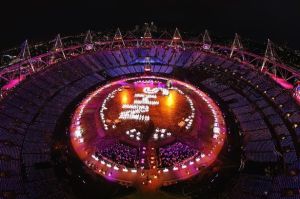
A scene from the Olympic opening ceremony celebrating the NHS

NHS Worship - London Olympic Games 1

Agree with this article? Violently disagree? Scroll down to leave a comment.

Follow Semi-Partisan Politics on TwitterFacebook and Medium.

Dreams Of The Rainbow Coalition

bbc-challengers-debate-leaders-debate-general-election-2015-nigel-farage-stands-alone

Left-wing collusion to lock the Conservatives out of power will not work, and would massively backfire were it even attempted

Remember Nicola Sturgeon’s dream of a rainbow coalition of left-wing political parties putting their differences aside and coming together to lock the Evil Tories out of government and usher in a new era of endless abundance for all, courtesy of the Magic Money Tree?

It hasn’t gone away. That insufferable, sanctimonious, morally superior dream has still not died. Here’s Brian Barder, writing in LabourList as though it were still May 6, 2015:

If the Tories, under a new leader enjoying a honeymoon, are to be dethroned, and if Labour alone can’t dethrone them, it’s simple logic that the job can be done only by an alliance of the progressive parties, led by Labour as the biggest of them. Such a multi-party association can take several forms: a loose alliance supporting a minority Labour government, or a slightly more formal ‘confidence and supply’ understanding with the other progressive parties, or a formal coalition of some or even all of them, each represented in a government of the broad left.

Similarly, the policies of a broad progressive alliance to replace the Tories in office can be agreed before an election (or even after it, as in 2010) in a detailed agreed document, or there can be a more general understanding in support of a progressive programme whose core elements all the progressive parties agree to support, or the other parties can be free to decide ad hoc which policies of a minority Labour government they will support as they go along.

This is all a response to the dawning realisation that whatever his arguable virtues (and this blog has been a cautious fan), Jeremy Corbyn is not currently positioning himself to sweep Labour back to power in 2020.

To his credit, Brian Barder is not panicking, and is instead trying to come up with a pragmatic way for the Left to make an impact without relying on overly sunny predictions about getting rid of Jeremy Corbyn any time soon. That much is good. But Barder’s solution and call for a left-wing coalition is no less silly than the calls for the Parliamentary Labour Party to split from the national party, pick their own leader and form a self-serving Westminster caucus without a local or national support base.

“So what if Labour can no longer enthuse enough people to march to their polling station to vote the party back into government”, goes this line of thinking. “There are enough other people out there vaguely like us that if we all band together in a cynical and self-serving coalition, we will be able to deny the British people the government that the electoral system should have produced and do the job ourselves, even though individually we are about as popular as a swarm of Brazilian mosquitoes”.

In other words, it’s complete nonsense. The general election we had just nine months ago proves that there is no great and silent left-wing majority in Britain. If there were, Labour would not have been decimated throughout south-east England, and the Greens and Liberal Democrats would have won enough seats between them to make ganging together to force Ed Miliband on a reluctant Britain politically viable. But they were decimated, and Ed Miliband is now making tedious speeches from the back benches.

Yet the denial is strong. In even proposing such a left-wing collaboration, Brian Barder reveals that he clearly spends his time percolating in the same confirmation bias-reinforcing ideological echo chambers as many others on the Labour left, and has mistaken a Twitter timeline full of David Cameron pig jokes and anti-Tory human rights hysteria for a representative sampling of the British public.

Or as blog said on 8 May, immediately after the election, which still holds true now:

Until the exit poll came in, it was simply inconceivable to many on the left that there could be any result other than a rainbow coalition of Britain’s left wing parties, coming together to lock the Evil Tories out of Downing Street and immediately get to work cancelling austerity and providing everyone with material abundance through the generosity of the magic money tree.

It is simply unthinkable to the like of Barder that the people of Britain might actually reject left-wing dogma and prefer David Cameron’s eminently pragmatic, reassuringly non-ideological form of watered down conservatism. Clearly the British people need saving from an Evil Tory government that they did not want, and therefore any electoral machination to achieve this end would be justified.

Except that it wouldn’t. The quietly patriotic, un-ostentatiously self-sufficient real majority in this country already believe that they are the victims of an establishment stitch-up when it comes to issues like Europe and immigration, where there was (rightly) perceived to be a false consensus among political parties, shutting down an important debate and denying millions of people the opportunity to have their voices heard and listened to.

How much worse, then, would the public’s reaction be if the next election sees an arrogant multi-party coalition of left-wing losers band together to lock the largest party out of power? How much rage would such a presumptive move cause?

Yet Barder (and others) are deadly serious in their daydreaming for a rainbow coalition of left-wing parties:

The first cautious step is for a group of the Labour leadership representing all its main strands of opinion to start private and non-committal talks with the leaders of the other progressive parties, to explore their attitudes to some form of possible progressive alliance. If these produce a positive response, the next step should be meetings to identify common policy ground which all concerned could agree to support.

We are not yet one year into the first term of the first all-Conservative government in eighteen years, and already fantasy plans are being drawn up for furtive meetings leading to grand summits between Jeremy Corbyn, Angus Robertson, Caroline Lucas and whoever now leads the Liberal Democrats.

The seductive dream of a united left-wing coalition against the Tories simply will not die. But that says far more about the Left’s unhinged and hysterical response to David Cameron’s bland, centrist government – and its relentless seizing of the middle ground – than it does about the possibility of such an odious coalition delivering a Labour prime minister in 2020.


Labour Party - General Election 2015 - Ed Miliband Resignation

Agree with this article? Violently disagree? Scroll down to leave a comment.

Follow Semi-Partisan Politics on TwitterFacebook and Medium.

Don’t Mock Bernie Sanders – David Cameron Is A Far Bigger Socialist

Spot The Socialist - David Cameron vs Bernie Sanders - Semi Partisan Politics - Sam Hooper

Agree with this article? Violently disagree? Scroll down to leave a comment.

Follow Semi-Partisan Politics on TwitterFacebook and Medium.

The Daily Toast: Peter Oborne, A Fellow Jeremy Corbyn Admirer

Peter Oborne is a journalist of uncommon principle; what he says should be taken seriously and treated with a measure of respect. But Peter Oborne has publicly stated his admiration for Jeremy Corbyn…

This blog has often felt like something of a voice in the conservative wilderness for not viewing Jeremy Corbyn as an unmitigated disaster for British politics.

One does not have to agree with Jeremy Corbyn’s sometimes loopy policies to admire the way his unexpected leadership of the Labour Party has shaken up a dull, lumpen, self-satisfied consensus among the Westminster elite, and put the fear of the voters back into a good many Members of Parliament who were more focused on the smooth progression of their own careers than the trifling concerns of the electorate.

That’s where this blog stands. I’m the first to criticise Jeremy Corbyn for his particularly crazy policies (like building a paper tiger nuclear deterrent with all the expensive submarines minus the all-important warheads) and his naive political operation (as embarrassingly revealed during the so-called Revenge Reshuffle). I’m also willing to give credit where credit is due, such as the holistic way Corbyn looked at education during the Labour leadership contest (and his proposed National Education Service).

What I don’t understand are conservatives who endlessly criticise Jeremy Corbyn because he doesn’t think or say all the same things as David Cameron or Tony Blair (and who could pick those two apart if blindfolded?)

Surely having two party leaders who think and say different things is the point of democracy. The fact that Britain has increasingly been afflicted with party leaders who say and think nearly identical things (once the rhetorical embellishment is stripped away) since Margaret Thatcher left office is the root of our current centrist malaise, and one of the primary reasons why a third of the electorate don’t show up to vote at general elections.

What’s the point in voting if the choice is between Prime Minister Bot A and Prime Minister Bot B, both of whom will automatically praise the NHS without looking more seriously at fixing healthcare, both of whom will tinker around the edges of welfare reform to get the Daily Mail off their backs but without doing anything substantive to fix our broken non-contributory system, both of whom are achingly politically correct at all times (“It’s Daesh, not ISIS! I can’t believe you called it Islamic State!“) and both of whom have so little faith in Britain’s ability to prosper as an independent, globally connected democracy that they strive (overtly or covertly) to keep us yoked to the European Union?

I’m a conservative libertarian. I have enough of a task on my hands trying to push the Conservative Party in a less authoritarian, more pro-liberty direction without worrying about what the Labour Party is doing every minute of the day. And I have enough confidence in my political worldview that I believe conservative principles will win the battle of ideas when promoted and implemented properly (hence my ongoing despair with the current Tories).

But many of my fellow conservatives, particularly those in the media, are in despair at the rise of Jeremy Corbyn and the return of real partisan politics. Why? Their professed concern that Britain have a “credible” opposition (meaning one almost identical to the governing party in all respects) stretches belief to breaking point and beyond. I can only think that their fear of Jeremy Corbyn reflects some personal doubt that their own political ideas and philosophies might not be superior after all – that Jeremy Corbyn might actually win people over in large numbers and have a shot at taking power.

I have no such fear. I believe that the principles of individual liberty and limited government beat discredited, statist dogma hands down, every day of the week. And I believe that the rise of Jeremy Corbyn might force conservatives to remember why they hold their views in the first place, and even refine and improve their own ideas through rigorous debate – if only they could get over their collective outrage that a socialist is in charge of the Labour Party.

In this spirit, I share the video of Owen Jones’ recent conversation with former Telegraph columnist Peter Oborne – see above. Oborne is an articulate writer, an unapologetic conservative and a thoughtful journalist of real integrity. That Peter Oborne also finds something to admire in Jeremy Corbyn (despite disagreeing with him politically) is helpful reassurance that I am not alone.

I don’t agree with everything that Oborne says in the video. But on the near-conspiracy of the political class and the media to undermine Corbyn (not to merely disagree with him but to portray his ideas as “unthinkable”) and on foreign policy (castigating our closeness with Saudi Arabia, an odious regime with whom we fawningly do business and lend our diplomatic legitimacy in exchange for oil and intelligence) he is spot on.

And I think that’s what makes Jeremy Corbyn’s detractors so angry. No man can be consistently wrong about everything all the time, and on rare occasions Jeremy Corbyn gets it conspicuously right – such as with his criticism of our closeness with the Saudi regime. People accustomed to either being in power or just one election away from power look at somebody who (whatever other baggage he may have) is unsullied by the continual act of compromise and ideological drift, and it makes them mad. It forces them to ask themselves how many of the compromises, reversals and deals from their own careers were strictly necessary, and how many resulted either from failures of courage or pursuing power for its own sake.

Sometimes, the haters were probably right to do what they did. Governing a diverse nation of 65 million people is not possible without the art of compromise, as Jeremy Corbyn would soon discover if the impossible happened and he became prime minister. But sometimes they were not. And the cumulative effect of all of these small compromises by Labour and the Conservatives over the years were two very slick but ideologically bankrupt political parties that looked and sounded nearly exactly the same on a whole host of issues. Issues (like the EU) which the political class had arrogantly deemed to be settled once and for all, though the voters had other ideas.

I understand this. I sense that Peter Oborne understands this. And if that means there are still only two non-Corbynites in Britain who don’t think that Jeremy Corbyn’s leadership of the Labour Party is an unmitigated disaster – well, at least I’m in good company.

Jeremy Corbyn - Labour Party - Andrew Marr Show - BBC

Agree with this article? Violently disagree? Scroll down to leave a comment.

Follow Semi-Partisan Politics on TwitterFacebook and Medium.