British Conservatives And The Youth Vote: The Failed Promise Of Activate

Activate - Tory Momentum campaign - conservatism - youth vote

It is easy to mock youthful conservative activists when their attempts at social media outreach go awry, but at least they are trying – none of the supposed adults in the Conservative Party seem remotely interested in salvaging conservatism’s toxic reputation among younger voters

The media has been having a lot of fun today at the expense of an organisation called Activate, a newly-launched independent conservative campaign group of young people, by young people and for young people.

Some of this criticism has been justified – the launch on social media was uncoordinated and the messaging…suboptimal, at best. One could certainly argue that Activate tried to run before it could walk, entering the political fray before the values and priorities of the group had been fully defined and agreed.

(Full disclosure: I was very tangentially involved in the pre-formation of this group earlier in the summer, participating in several group chats and offering occasional words of advice. This was in line with my strong belief – stated many, many, many, many times – that British conservatism will die out unless it urgently finds a way to reach and inspire younger voters with a positive message).

Inevitably, the reviews have not been kind, with outlets from the Independent, New Statesman, The SpectatorHuffington Post, Political ScrapbookRed Pepper and Esquire all forming an orderly queue to mock the group and question its grassroots bona fides.

The Guardian was actually one of the kindest:

A new Conservative grassroots campaign inspired by Labour’s Momentum movement will attempt to engage more young people in rightwing politics, though the group’s launch has been widely mocked on social media.

Activate, which aims to “engage young people with conservatism”, has close links with senior party activists, and is chaired by former Tory campaign manager Gary Markwell, a councillor in West Sussex. A Conservative spokesman said Activate was “not officially linked to the Conservatives and it receives no party funding”.

The group’s constitution says it will be independent from the party, though all members are expected to be members of the main party.

The campaigning group launched with a Twitter picture of the Labour leader, Jeremy Corbyn, followed by a picture of Star Wars character Admiral Ackbar, saying “It’s a trap”.

The group’s use of multiple hashtags and a meme that was last popular in the early 2000s led to widespread derision on the social network.

Somewhat cringeworthy? Of course. Not what I would have done or recommended. But you can look at this two ways.

On one hand, you can take the attitude of the scornful left-wing press (and even some of the right-wing blogs like Guido Fawkes) and make fun of Activate’s enthusiastic but undeniably amateurish initial foray into grassroots political campaigning. And indeed, many journalists and commentators have been only too happy to mock the sincere efforts of 17-year-old students who at least take the time to educate themselves about political issues and live up to their responsibility to be good engaged citizens. That is certainly one approach, albeit a rather cynical one.

But the other attitude – a far more constructive one – is to ask why the hell it is being left to a group of enthusiastic but inexperienced teenage and twenty-something activists to do what the Conservative Party should have been doing all along, namely trying to engage in meaningful outreach to sceptical younger voters.

Recall: Theresa May’s brilliantly inspired general election campaign saw the Tories lose the 18-19 year old first time voter demographic by a margin of 47 points. The Conservative Party is getting nowhere with young people and struggling with nearly everyone else because they cannot clearly articulate what they stand for and simply offer a bland, repetitive, uninspiring and entirely defensive message.

With no positive message to rally around, no formal conservative youth movement and national party leadership totally devoid of charisma, the combined forces of present-day young conservative activists could probably all fit comfortably within a League One football stadium, with room to spare. Unfortunately, people who unironically wear bow ties and read economics at Cambridge are pretty much all we have right now in terms of boots on the ground – would that it were otherwise. But at least Activate is trying to expand the appeal of conservatism.

Maybe rather than mocking the earnest sixth-former wearing a bow tie in his bio picture, the likes of Guido Fawkes should instead be asking why it has been left to young kids like this to take all the initiative of creating a grassroots youth conservative movement on their own, with almost no help from senior Tories, party grandees, external think tanks or anybody else with abundant time, money and influence.

Maybe they should ask what possible excuse party leader Theresa May and her CCHQ cronies can offer for falling down on the youth outreach job so spectacularly. Maybe they should try holding the prime minister to account for swanning off to Italy after having presided after this disaster of an election campaign rather than staying put to undo a small fraction of the damage that she has done to the Conservative brand.

Maybe the likes of the IEA, Adam Smith Institute and Centre for Policy Studies should be a little more concerned about where their pipeline of future fellows and supposed thinkers will possibly come from when nearly every young person in the country hates the Tories with the burning heat of a thousand suns, and retains that hatred well into middle age. Kate Andrews is great, and a breath of fresh air on Question Time, but there is a limit to the number of articulate young conservative thinkers we can import from the United States. At some point we will have to develop some more homegrown talent.

But no. Rather than engaging in the slightest bit of introspection, too many conservative voices seem content to continue writing their asinine hot takes about the daily developments in the Brexit negotiations, speculating pointlessly about the next Tory leadership contest or simply getting drunk on Pimms and having Jacob Rees-Mogg’s face tattooed on their chests. Because summer silly season nonsense is so much more fun than tending to the existential question of who will keep the flame of conservatism lit when its present custodians are no more.

Maybe Activate did make a really bad start to their campaign. Maybe their name lends itself too easily to mockery. Maybe their logo wasn’t produced by the best graphic designers that money can buy. Maybe their initial foray into social media was more worthy of a Jacob Rees-Mogg fanclub than a serious political entity. But everything they have done thus far, they accomplished without a scintilla of help from anybody else in the British conservative movement. Contra much of the leftist press, this really is an unaffiliated grassroots movement.

Faced with the immense tarnishing of the conservative brand and reputation among young voters inflicted by Theresa May, her Cabinet and all the other supposed adults in the room, a group of sincere and well-meaning young conservative activists stepped up at a time when our elected conservative politicians have effectively fled the field of battle. That counts for something, and deserves acknowledgement.

Activate received no help from from the increasingly unworthy political party that bears the conservative name, and certainly no help from the constellation of think tanks, institutions, media outlets or commentators who think themselves so well-connected and influential. Unlike Momentum on the political Left, Activate has no prominent champions in the wider conservative movement, no real mentors (so critical to getting a youth organisation off the ground) and no funding that I am aware of. If anything is embarrassing, it isn’t a dated Star Wars meme on Twitter – it’s the fact that besides these well-meaning if sometimes naive people, nobody else is even making an effort.

It is time to face a number of difficult truths. Conservatism as an ideology and a political movement is radioactive to the majority of today’s young people. We are in retreat in schools, on the university campus, in the world of the arts, in the laboratories, in popular culture and the media, not to mention the House of Commons. And our inability to connect with younger voters and inspire them with a positive message about how conservative values and policies will benefit them and benefit the country is arguably the biggest threat that we face.

Faced with this shameful lack of leadership from anybody in Westminster, Activate is at least trying to do something to face up to these threats and begin tackling conservatism’s huge deficit of trust and inspiration among young voters.

And that is vastly more than can be said of all those people who spent today laughing smugly at their struggle.


Conservative Party Logo - Torch Liberty - Tree

Support Semi-Partisan Politics with a one-time or recurring donation:

Agree with this article? Violently disagree? Scroll down to leave a comment.

Follow Semi-Partisan Politics on TwitterFacebook and Medium.

The British Left’s Cunning Plan To Reach Working Class Voters: Insult Them

Dont be a Nob - Dont vote Tory - Working Class - Leftist sanctimony arrogance

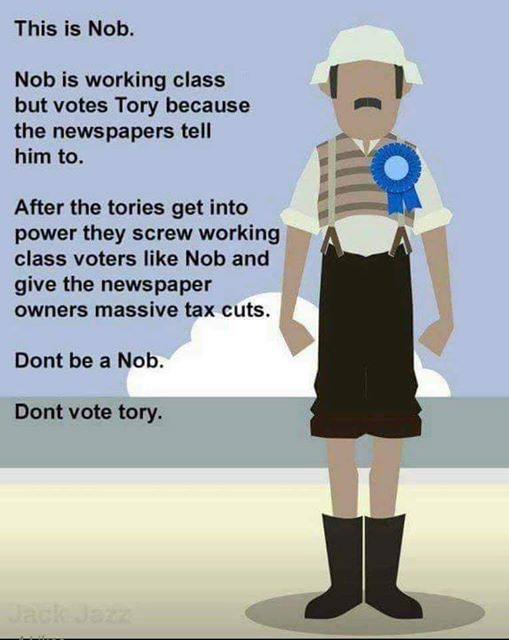
How can the British Left appeal to working class voters turned off by socialist paternalism and attracted by conservative messages of patriotism, freedom and self-sufficiency? Maybe a really sanctimonious internet meme will do the trick.

This internet meme – currently being widely circulated on Facebook and other social media by self-satisfied young lefties who think that twenty minutes spent reading HuffPost on the tube every day makes them a political guru – really does have it all.

First it has the crude pictorial stereotype of a “typical working class person” (but actually something far more akin to a Monty Python character), standing there in his workman’s garb all ready for an honest day’s labour ploughing the fields, making widgets in a factory or going down the mines – you know, the kind of jobs that people who work for creative agencies in Shoreditch think that people in Harlow or Stoke perform when they are not claiming their much-deserved benefits.

Then we have the arrogant, sanctimonious assertion that the poor fellow votes Tory only because the “newspapers tell him to”. This, of course, is in direct contrast to the enlightened sharers of the meme, who are naturally very highly intelligent, quizzical yet cynical souls who patiently weigh up every data source and review every policy position, judging every argument based on its merits before miraculously finding themselves in total agreement with whatever the Guardian, the Huffington Post or so-called comedian Marcus Brigstock happens to be telling them.

Next, we get the assertion that the Evil Tor-ees “screw working class voters” once they get into government, simply because they dare to treat the British public like autonomous human beings who might prefer it if the government got out of their way and treated them like capable adults rather than perpetual lifelong victims to be coddled and cared for by the state from cradle to grave.

And finally, of course, we get the culmination of the hilarious “word play” by which such working class voters who dare to shun their rightful masters and defenders (the parties of the Left) are labelled “Nobs”.

Honestly, it is hard to believe how a meme like this could possibly fail to deliver 100 percent of the working class vote to Jeremy Corbyn’s harmonious and very in-touch Labour Party, Tim Farron’s pinch-faced “Citizen of the World” LibDems, Caroline Lucas’s human progress-hating Greens and Nicola Sturgeon’s authoritarian, incompetent SNP.

But just for some fun, below is a more honest version of the meme, describing the kind of person who proudly shares it on their Facebook timeline – presumably in the hope of persuading the kind of working class person whose intellect they scorn, whose political viewpoints they despise and whose company they would never keep in a million years:


Jeremy Corbyn - Hipster - Middle Class Left Wing

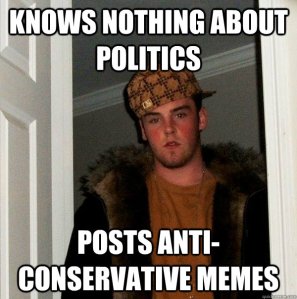
This is Pretentious, Virtue-Signalling Douchewad. Douchewad shares glib and overwrought anti-conservative memes on social media because their unquestioning discipleship of the Guardian and HuffPost has convinced them that anybody from the “working class” who doesn’t buy into the Left’s collectivist, non-contributory welfare supporting, NHS-worshipping, success-punishing agenda must have been brainwashed by the Evil Murdoch Press into voting against their own interests for the Evil Tor-ees.

It never occurs to Douchewad that said working classes might value self-sufficiency, personal resilience and individual opportunity (with a welfare state that acts as a safety net rather than a comfort blanket) over the chance to be the lifelong, helpless and perpetually dependent sympathy project for some Social Studies or PPE-educated leftist who prances around acting like the champion of the striving classes right up until until such people dare to offer political opinions of their own (cough, Brexit).

Don’t be a Douchewad.

Actually, go for it. Be a Douchewad. Vote Labour, Green, SNP or LibDem while broadcasting to the world about what an enlightened, compassionate, woke person you are, unlike those monstrous Tories. At this point you are literally doing Theresa May’s job for her.

Knows nothing about politics - posts anti conservative memes

Support Semi-Partisan Politics with a one-time or recurring donation:

Agree with this article? Violently disagree? Scroll down to leave a comment.

Follow Semi-Partisan Politics on TwitterFacebook and Medium.

The Left Compare Conservatives To ISIS, Warning Of The ‘Radicalisation Of Young White Men’

milo-yiannopoulos-alt-right-conservatism-online-radicalisation-of-young-white-men

This is the week when leftist cowards, unwilling or unable to counter opposing ideas with a compelling vision of their own, decided to smear conservatives by comparing the expression of conservative ideas to the radicalisation activities of ISIS

Update: See footnote at bottom for reaction to news that the anonymous Guardian article cited here was in fact a satirical piece designed to lampoon left-wing SJW attitudes

It all seems to be quite co-ordinated.

One anonymously-written article published in the pages of Britain’s leftist press, bashing conservative commentators and describing them as a “gateway drug” to full-blown racism, might be generously seen as an isolated if highly offensive smear. The existence of two such articles strains credulity. But with three such articles across two publications, I think it is safe to say we are looking at the British Left’s new official position on the rising popularity of conservative (or at least anti-statist) ideas.

First came this hysterical effort in the Guardian*, in which an anonymous pinch-faced, wobbly-lipped “white male” social justice warrior described how he had been temporarily led astray by the siren song of the online alt-right, only to realise that he was being indoctrinated into a “cult” and pull back from the brink at the last minute.

(* This article turned out to be a brilliant spoof by the excellent anti-SJW provocateur Godfrey Elfwick, something which was not known when I wrote this piece. The fact that the Guardian’ editorial team did not realise and published the article in earnest only goes to highlight that the establishment Left have swallowed the denialist myth that anybody who disagrees with their worldview must have been “radicalised” by the evil forces of conservatism – thus proving my point about the Left’s intellectual decline.)

The Guardian Man’s tremulous confession:

I am a happily married, young white man. I grew up in a happy, Conservative household. I’ve spent my entire life – save the last four months – as a progressive liberal. All of my friends are very liberal or left-leaning centrists. I have always voted Liberal Democrat or Green. I voted remain in the referendum. The thought of racism in any form has always been abhorrent to me. When leave won, I was devastated.

Because wanting Britain to leave a failing, antidemocratic, supranational political union can only be motivated by racism, naturally.

I was curious as to the motives of leave voters. Surely they were not all racist, bigoted or hateful? I watched some debates on YouTube. Obvious points of concern about terrorism were brought up. A leaver cited Sam Harris as a source. I looked him up: this “intellectual, free-thinker” was very critical of Islam. Naturally my liberal kneejerk reaction was to be shocked, but I listened to his concerns and some of his debates.

This, I think, is where YouTube’s “suggested videos” can lead you down a rabbit hole. Moving on from Harris, I unlocked the Pandora’s box of “It’s not racist to criticise Islam!” content. Eventually I was introduced, by YouTube algorithms, to Milo Yiannopoulos and various “anti-SJW” videos (SJW, or social justice warrior, is a pejorative directed at progressives). They were shocking at first, but always presented as innocuous criticism from people claiming to be liberals themselves, or centrists, sometimes “just a regular conservative” – but never, ever identifying as the dreaded “alt-right”.

So apparently it is a “rabbit hole” when watching one conservative-leaning YouTube video leads to the suggestion of others, but Guardian Man’s inevitable constant feed of prancing, left-wing virtue signallers is entirely healthy? Righty-ho. Left-wing ideological bubbles are good and virtuous, right-wing ones are dangerous and evil, got it.

Before long, Guardian Man had hit rock bottom:

At the same time, the anti-SJW stuff also moved on to anti-feminism, men’s rights activists – all that stuff. I followed a lot of these people on Twitter, but never shared any of it. I just passively consumed it, because, deep down, I knew I was ashamed of what I was doing. I’d started to roll my eyes when my friends talked about liberal, progressive things. What was wrong with them? Did they not understand what being a real liberal was? All my friends were just SJWs. They didn’t know that free speech was under threat and that politically correct culture and censorship were the true problem.

On one occasion I even, I am ashamed to admit, very diplomatically expressed negative sentiments on Islam to my wife. Nothing “overtly racist”, just some of the “innocuous” type of things the YouTubers had presented: “Islam isn’t compatible with western civilisation.”

She was taken aback: “Isn’t that a bit … rightwing?”

I justified it: “Well, I’m more a left-leaning centrist. PC culture has gone too far, we should be able to discuss these things without shutting down the conversation by calling people racist, or bigots.”

The indoctrination was complete.

At present, Guardian Man can be found tightening his cilice and loudly flagellating himself for having dared for even one moment to consider points of view which run contrary to the leftist One True Faith. With the tortured mind of an actual criminal, he is trying to find a way to apologise to his wife for having subjected her to such salty language and non-conforming ideas:

I haven’t yet told my wife that this happened, and I honestly don’t know how to. I need to apologise for what I said and tell her that I certainly don’t believe it. It is going to be a tough conversation and I’m not looking forward to it. I didn’t think this could happen to me. But it did and it will haunt me for a long time to come.

And offers his wise conclusion:

It hit me like a ton of bricks. Online radicalisation of young white men. It’s here, it’s serious, and I was lucky to be able to snap out of it when I did. And if it can get somebody like me to swallow it – a lifelong liberal – I can’t imagine the damage it is doing overall.

It seemed so subtle – at no point did I think my casual and growing Islamophobia was genuine racism. The good news for me is that my journey toward the alt-right was mercifully brief: I never wanted to harm or abuse anybody verbally, it was all very low level – a creeping fear and bigotry that I won’t let infest me again. But I suspect you could, if you don’t catch it quickly, be guided into a much more overt and sinister hatred.

And there it is – the official soft rollout of the term “radicalisation of young white men”. Expect every leftist commentator in the country to be using it multiple times in every piece by the end of next week, with Owen Jones, Paul Mason, Laurie Penny and Polly Toynbee all vying with one another to take primary ownership of the slur.

Writing in the Spectator, Douglas Murray – while outraged that his own name was not flagged as part of the “slippery sliding slope” to racism – calls out the Guardian for seeing radicalisation where it does not exist and denying it where it does:

At least at long last the Guardian has published something acknowledging the possibility of ‘online radicalisation’.  When they’re not busy running puff pieces for Muslim radicals or joint-letters defending Muslim radicals by other Muslim radicals, the Guardian tends to pretend no such thing exists.  Only now do they admit it does because – as their correspondent ‘Anonymous’ shows – ‘online radicalisation’ occurs among ‘young white men.’

This – it should be remembered – is a paper that complains solemnly about ‘post-truth politics’ as though they haven’t been practising it for years.  The Guardian has spent years denying the reality of Islamist terror.  The only mentions such terror does get is in the news pages, when Paris, London, Brussels or any other city suffers a major Islamist attack.  Of course the paper tries to demonstrate that these things only happened because the attackers were the victims of racism, sexism, homophobia, low self-esteem, government austerity or all of the above.  But the ‘I’ word does occasionally slip through because even the Guardian finds it has to report some of the news some of the time.  The comments pages, on the other hand, are filled with people who doggedly deny that any such terrorism or extremism exists.  Indeed its comment pages tend to be filled with people who, like ‘Anonymous’, stared at themselves in the mirror, realised they had become arseholes but chose to enjoy the view.

So here we are, with the Guardian pretending that Sam Harris – a man who has never called for anyone to be Jihad-ed, killed or oppressed and who is about the sanest, sweetest and most thoughtful person you could imagine (really a Buddhist, but with a bigger brain) is in fact a horrible hate preacher and gateway drug.

While Murray’s conclusion is bang on the money:

Let me tell you what is actually going on here.  Someone at the Guardian – perhaps everyone at the Guardian – has it in for Sam Harris.  So they have decided to publish an ‘Anonymous’ hit-job in order to try to smear him and damage him as much as possible.  That is all.  It tells us nothing, except that the state of the left is so incredibly poor that in 2016 Britain’s only remaining lefty newspaper is willing to publish an ‘Anonymous’ hit-job on an actual liberal to try to help save itself from going bust.

One marvels at the intellectual insecurity it must take  for leftist commentators to be so incapable of rebutting opposing arguments and so lacking in confidence in the persuasiveness of one’s own position that the best strategy now available to them is to warn the public not to listen to other points of view lest entertaining conservative ideas sets them on the path to becoming Hitler.

Guardian Man’s article was swiftly followed up by a piece in the New Statesman, in which a supposed Jeremy Corbyn supporter “confessed” to watching YouTube videos and media appearances by conservatives and alt-right stars and (pass the smelling salts) furtively enjoying them.

Alex Shattock writes:

As a Jeremy Corbyn supporter, former public sector worker and all-round lefty, I have a confession to make. I am a little bit in love with Milo Yiannopoulos, highly-paid internet troll and alt right poster boy.

Well, everyone has a guilty pleasure.

Out of context, it is difficult to see how anyone could enjoy listening to the person making these arguments, let alone be persuaded by them. But as Abi Wilkinson has pointed out,  alt right arguments like the ones above are gaining ground online, and contributing to the radicalization of young white men. How is this happening?

And there’s that phrase again, gradually being forced into our collective consciousness as though saying it often enough will make it a real thing.

A lot of the alt right’s appeal has to do with the delivery mechanism of their ideas: colourful entertainers who are a bit outrageous and disarmingly self-effacing. This is why, despite myself, I like listening to Yiannopoulos. He jokes, exaggerates, pushes the boundaries. It is all to provoke a reaction, get online attention, and rack up the view count. It works. One of his recent videos, “BBC tries to ambush Milo,” has over a million views.  Like his right-wing bedfellows, he is genuinely entertaining to watch.

Contrast the polished media performers of the right with left. When I get my daily fix of social-liberal political news, there is a deadly serious style of debate that turns people off straight away. Whenever Nigel Farage or Yiannopoulos appear on a Sky News debate with a dour-looking lefty academic, they’ve already won.

Really? As a holder of more right-wing (or at least classically liberal) opinions, I often chafe at the fact that the people they wheel out to defend “my side” of the argument on television are grotesque caricatures, while the people found to defend the centre-left status quo are inevitably the well-manicured picture of reasonableness.

And I’m not alone in this thinking. As a friend of Pete North’s memorably mimicked the BBC’s EU referendum coverage:

And now on BBC Radio 4, to talk to us about the EU, we have Professor Claus van der Reasoning, an expert on the European Union and a jolly good chap. Professor van der Reasoning is the Clegg Professor of Europe at the European Institute of Europe and has absolutely no axe to grind.

Here to give the anti-European perspective is Sir Henry Bigot MP, a foam-flecked lunatic who hates and little else, and was once reported by the Guardian to have felched David Duke while singing Horst Wessel Lied. He may experience technical issues.

Welcome both of you to this balanced programme that represents both sides of the argument.

That pretty much sums up every single Brexiteer vs Remainer clash on the broadcast news in the weeks and months leading up to referendum day. If Shattock thinks that the British political Right is brimming over with so many winning, articulate spokespeople that it constitutes an advantage over the Left then he is living in a parallel universe – one in which nobody from UKIP exists, for a start.

Not that Shattock is wrong about everything:

Boris Johnson, another master of the art, wrote in this magazine a couple of years ago that “lefties…are much more likely to think that right-wingers are genuinely evil.”  At times, we certainly give that impression. Now, I’m not saying there has never been a Tory activist who has, on a misty moonlit night in East Surrey, sacrificed a newborn to hasten the awakening of Azathoth. But if we stop assuming they all do that, the tone of our arguments will change accordingly, and Tory voters would feel less patronised.

A more self-effacing and less self-righteous approach can work wonders for public engagement, as Ed Balls seems to have discovered on the dance floor.  Whether or not this means giving Sunday Politics interviews in spandex is the way forward for Labour, I’m not sure. But our current Foreign Secretary is a prime example of how not taking yourself too seriously can go down well with the public.

Well, quite. It’s funny how people switch off and stop listening when you scream continually in their faces about how evil they are and how enlightened you are.

Shattock then indulges in some unbridled sanctimony:

But we also need to learn from the things the alt right commentators don’t say. At the heart of their appeal is the fact that, behind the jokes, their arguments are bracingly simple.

This is a huge advantage when it comes to persuading people. Instead of debating policy in detail in the national media, we should take a leaf from their book and go on the offence, attacking individual opponents and saying why they are unfit to govern as people, not flag-carriers. When Tony Blair called John Major “weak, weak, weak”, that was more effective than a hundred policy explanations. Where they are needed, our policy arguments need to be short, sharp and self-explanatory, or they are no good at all.

Admittedly, it is far easier for the right to make simple arguments than the left. On the left we are naturally more inclined to nuanced positions and complex explanations, and tend to look down on simple generalisations (try explaining to yourself why political correctness is important, in one sentence, with no commas). This intellectualism can too easily be used against us in debates. It was, quite literally, impossible for Ed Miliband to say that Labour overspent in government, because it would have been intellectually dishonest and a gross oversimplification.

What Shattock calls the “nuance” of left-wing arguments, many on the right might describe as woolly, hand-wringing moral relativism and a craven refusal to acknowledge basic truths and realities. But sure, if believing in a maximalist approach to free speech and civil liberties makes right-wingers “simplistic” then we shall wear the insult as a badge of honour. Rather that than sell out our freedoms one by one under the false guise of “tolerance”.

More:

This is, unfortunately, the world we live in now. Johnson, Farage, Yiannopoulos and, of course, Donald Trump, are all pioneers of post-truth politics. If we’re going to win, we have to fight them on their terms. If you think the strategy of “we go high when they go low” worked out well for Hillary Clinton, then you’ve been inhaling the same thing her husband didn’t. It is no longer good enough, if it ever was, to have sensible, rational economic arguments, and naïvely hope the truth will emerge from our public debates. That is just not where we are at in 2016.

Nowadays, if you want people to listen, you have to mock, exaggerate, cajole, put on a show. In our post-truth world, when it comes to persuading people you’re right, presentation is 90 per cent of what matters. The truth alone is no longer going to cut it.

Let’s ignore the free shot we could take at the ludicrous assertion that the British Left have at any point in their history “gone high” in terms of their political rhetoric, or that “post-truth politics” was somehow pioneered by Evil Brexiteers while those honourable, upstanding Remainers clung nobly to the trusty shield of truth. This blog and others have debunked that fatuous assertion more times than I care to remember.

And newsflash: better “presentation” by future witty young leftist YouTube stars will not solve the fundamental problem that the Left’s message is deeply unappealing to millions of decent people who are by no means racist, sexist or prejudiced, but who simply want to live their lives free from overbearing, hectoring, leftist moral guardians. Owen Jones has a YouTube channel with 82,000 subscribers. He might have many more, if only his output did not consist of finger-wagging screeds accusing his fellow citizens of being evil, heartless racists.

Look: this isn’t complicated. The reason that conservatives have increasingly fled to new media, starting with talk radio in 90s America all the way up to YouTube today (and yes, sometimes including fake news, though the Left are also guilty of consuming such propaganda) is because the mainstream media unapologetically persists with a left-leaning bias. Doubt it? Note the way that American newspapers and television networks all speak about “undocumented” rather than “illegal ” immigration now, under pressure from the social justice wing to avoid calling lawbreaking by its proper name. Or the way that British media peddle the idea that Brexiteers are anti-immigration (and therefore racist) as opposed to anti-uncontrolled immigration.

In a thousand small ways (and a few egregiously large ones), the mainstream media in Britain and America has taken a clear position, usually against those with conservative or classically liberal beliefs. And pumping out a one-sided product day after day is a surefire way to force your viewers and listeners to go elsewhere, often ending up in the arms of the likes of Milo Yiannopoulos, Mike Cernovich or even Alex Jones and the InfoWars crowd.

But left-wing versions of these shows do already exist. Look at The Young Turks in America, a very successful left-wing YouTube channel founded by Cenk Uygur, a former MSNBC host. There may be fewer such outlets on the Left than the Right, but that is largely because the Left can fall back on nearly all of the television news media to give them succour and reflect their views. When you control the mainstream media it is unreasonable to expect to dominate the counterculture, too.

Here in Britain, there is a dearth of good online commentary altogether because the mainstream media (including the Guardian, the New Statesman and the Spectator) all stubbornly refuse to engage with the blogosphere, jealously horde readers for themselves and throttle the limited independent political blogosphere in the crib. Want more fun, humorous political commentators? Well, maybe try acknowledging them when they publish things or try to make a name for themselves instead of studiously ignoring them and insisting on recruiting from the same old predictable, nepotistic “talent” pool.

And finally, here is Abi Wilkinson, peddling the same idea that white young men are being “radicalised” in the same manner as brainwashed ISIS recruits:

When we fret about young people leaving western countries and going to fight with Isis, it’s common to focus on the role of the internet in their political radicalisation. It’s time we discussed the radicalisation of angry, young white men in a similar way. The manosphere gave us Elliot Rodger. He was a regular on the forum “PUAhate” – populated by bitter men who had tried the techniques advocated by so-called “pick-up artists” to attract women and failed.

Reading through the posting history of individual aliases, it’s possible to chart their progress from vague dissatisfaction, and desire for social status and sexual success, to full-blown adherence to a cohesive ideology of white supremacy and misogyny. Neofascists treat these websites as recruitment grounds. They find angry, frustrated young men and groom them in their own image. Yet there’s no Prevent equivalent to try to stamp this out.

How many neo-nazi terror plots were thwarted in Britain this year, Abi? How many men’s rights massacres were narrowly averted by MI5? When young, disaffected and unassimilated Muslims radicalise, they have an unfortunate tendency of skulking away to Syria to join ISIS, plotting murderous attacks on the streets of Britain or at least turning a blind eye when others do so. When young white men watch too many YouTube videos from the “manosphere”, they become insufferable, obnoxious clowns. Where is the equivalence?

A counter-extremism strategy which aims to prevent the commissioning of terrorist attacks and physical violence is potentially justifiable. A “Prevent” scheme designed to stop young white males from thinking or expressing certain nonviolent thoughts on the internet is several steps further down the road to tyranny. Perhaps that’s why even Theresa May’s droolingly authoritarian government hasn’t suggested re-education camps for those who .

Whether these articles are anonymous or penned by star columnists, all of them reflect an insidious new effort by the British Left – which increasingly seems morally adrift and intellectually dead, utterly unable to counter conservatism with intelligent ideas of their own – to instead portray conservative thinking as a sign of intrinsic disorder, an unnatural and dangerous state of thinking which can only be brought around by foul play and manipulation.

That’s why we now see prominent left-wing publications like the Guardian and the New Statesman talking with a straight face about the “radicalisation” of young white men. Having spent much of the past decade fervently denying that radicalisation of young British Muslims is a problem, they are now screeching that the real danger is radicalised young white men. Somebody who marinates 24/7 in a stream of jihadist propaganda and lives as part of a community which exists in parallel to the rest of British society rather than fully assimilating is apparently A-OK. But beware the young white male gamer who watches one too many Milo videos and might one day be tempted – shock, horror – to say something triggering in a university lecture or public place.

This is offensive beyond measure, putting the legitimate (if sometimes juvenile) political views of young conservative media watchers – and in reality both the viewers and the media outlets span a wide spectrum, and should not be lumped together like this for the purposes of demonisation – on a par with the murderous ideology of fundamentalist Islamism. There is simply no comparison. While lone right-wing extremists have always existed and continue to lurk in the margins of society, the terrorist threat they pose is nothing compared to the threat currently posed by radical Islam. I see what the leftists are trying to do with this snide new comparison, and they need to stop.

The PC credo of many leftists may make them exquisitely uncomfortable criticising Islam without commensurate criticism of other, more “privileged” groups, so one can understand why left-wing commentators are starting to seize on this narrative of “white male radicalisation” because it allows them to defray criticism of one of their most favoured victim groups and suggest that radicalisation is problem throughout British society, and not just within Islam. Unfortunately, it is a massive overreach – the evidence simply does not back it up. If Abi Wilkinson has documentary proof of the “slippery slope” from watching alt-right YouTube stars to committing politically-inspired murder then I will hear her out. Until then, she should stop peddling misinformation.

But more than anything, the fact that we are now being peddled the myth that young white men are somehow being indoctrinated by flashy right-wing shock jocks reveals the extent of the Left’s intellectual decline. At this point it is utterly inconceivable to them that somebody might embrace patriotic, civic nationalist, anti-PC and pro-free speech positions held by the alt-right and popular right unless they were brainwashed or “radicalised” into doing so. They simply cannot understand why anybody would spurn their infantilising, identity politics-ridden world view unless a Big Bad Man is grooming them for an evil terrorist purpose.

That is how far the modern British (and American) Left have drifted from the people, and many of their own former voters. Furious with an electorate that does not respond warmly to their exacting Cult of Social Justice and Identity Politics, leftists are now lashing out, accusing anybody who refuses to support their dodgy candidates and tired old policies of not only being unreasonable, but actually having succumbed to Evil Tory radicalisation.

Back in the real world, ordinary people will sit back and watch the Left throwing this tantrum, accusing people who reject leftist orthodoxy of having been “radicalised”, and conclude that the Left, not the Right, represents the dangerous and intolerant cult in modern politics. And they would be absolutely right to do so.

In between their screaming tantrums, left-wing commentators in Britain and America might consider pausing to consider just how much reputational and intellectual harm this total war against conservatism is inflicting on their own movement.


Update: The first anonymous Guardian article cited in this blog post turned out to be a brilliant spoof by the excellent anti-SJW provocateur Godfrey Elfwick, something which was not known when I first wrote this piece. The fact that the Guardian’ editorial team did not realise and published the article in earnest only goes to highlight that the establishment Left have swallowed the denialist myth that anybody who disagrees with their worldview must have been “radicalised” by the evil forces of conservatism – thus proving my point about the Left’s intellectual decline.

 

harm-button-keyboard-online-radicalisaion

Top Image: Wikimedia Commons

Support Semi-Partisan Politics with a one-time or recurring donation:

Agree with this article? Violently disagree? Scroll down to leave a comment.

Follow Semi-Partisan Politics on TwitterFacebook and Medium.

Facebook And The Fake News Monster

facebook-news-feed

The mainstream media looks to Facebook and technology to solve the problem of “fake news”, while utterly ignoring their own starring role in driving readers into the arms of more disreputable news outlets

Jeff Chiu has an interesting rumination in Newsweek on the way that Facebook tacitly encouraged the monster of “fake news” which it is now being ordered to help slay.

Chiu writes:

Think back just a couple of years, before the 2016 election cycle and before Facebook set itself up as the world’s newswire. Facebook grew to a billion users by being a social network. It’s where you found old friends and kept up with family. I just looked back at my 2014 Facebook timeline. Almost zero politics! And that’s how most people liked it. Many users back then even beseeched friends to avoid political posts, or muted the violators if they persisted. In real life, most of us don’t want to argue politics with our friends and family, so why would we want to do it online?

Then, over the past two years, Facebook aggressively morphed into a media site. It set up deals with publishers to populate all our timelines with stories. It subtly encouraged users to post stories and to “like” and comment on them. Facebook, of course, did this with its own goals in mind. To maximize profit, Facebook needs to keep users engaged and on the site as long as possible, and to get those users to create or interact with all the content in their feeds. That thrum of activity helps Facebook’s algorithms more deftly target ads to more people, which makes Facebook even more attractive to advertisers.

Since politics is traditionally news, of course that topic started to slip into our feeds, and Facebook’s setup encouraged sinister practices. As users zip through their news feeds, scanning only the headlines, they are more likely to click on and share stories that are outrageous or stir emotions. In other words, Facebook—unwittingly, from what I hear—incentivized clickbait “news” over more serious news, and the success of clickbait opened the way for fake news. “We’re more likely to share inflammatory posts than non-inflammatory ones, which means that each Facebook session is a process by which we double down on the most radical beliefs in our feed,” writes Mike Caulfield, an expert in learning environments. “Marketers figured this out and realized that to get you to click, they had to up the ante. So they produced conspiracy sites that have carefully designed, fictional stories that are inflammatory enough that you will click.”

It’s hard to say whether Facebook is the chicken or the egg in this wave of political propaganda—whether it helped create the acidic and divided politics around the world or if the ugly political environment merely found an accommodating home on Facebook. No doubt it was some of both, and the result is that our feeds are now overwhelmed with wingnut political content that gets amplified even if it’s crazy. During the election, a lot of Facebook users just didn’t care if something was true, says Paul Mihailidis, a media literacy professor at Emerson College. “They saw it as a way to advocate,” he says. “They see a catchy headline, and the default is to share.” If you look globally—the U.S., the U.K., France, Colombia, the Philippines—politics are getting more caustic, not less. In this kind of environment, all the media outlets that now rely on Facebook’s audience are driven to flood us with click-worthy headlines that play to our fears and anger. Every trend line points to more of what we’re growing to hate on Facebook.

The perverse incentives created by Facebook’s dominance and algorithms cannot be overstated. At peak times, when I am actively promoting Semi-Partisan Politics during newsworthy events, up to 50 percent of total traffic can come from Facebook alone, some days even more. Other sites have an even greater dependency on Facebook as a source of traffic.

And for media professionals, with this dependency on Facebook comes the temptation to generate extra precious pageviews by pushing the boundaries of acceptable journalistic practice, whether as a ploy to increase web ad revenue or merely for the supposed prestige of more clicks. All other ways of generating extra traffic – like, say, producing better content – are far more arduous and time intensive than simply being a bit more provocative on Facebook. And the returns are nowhere near as good. It would take a media organisation of exceptional poise and integrity to withstand these temptations. And as we know, there are few publications where the words “poise” or “integrity” come naturally as descriptors.

Compounding the problem is the fact that this Facebook traffic is both fickle and disloyal. One can win the passing attention of their eyeballs for a few brief passing seconds with a catchy headline (and often a provocative picture), but the moment your articles stop appearing in the Facebook feed, the vast majority of users will not go seek you out independently as a publisher of content – as a publisher, you are utterly replaceable by the swarm of other sites churning out often superficially similar-looking stuff.

This leads to an arms race of hysteria in terms of online political coverage, with some of those outlets now shouting loudest about pro-Trump “fake news” being themselves the worst offenders. Many of the headlines or Facebook post descriptions published by left-leaning sites like Huffington Post or MotherJones sound like the breathless, hysterical reactions of a high school student as opposed to sober, reasoned analysis, and of course the same goes for the likes of Breitbart on the right. Every utterance by Donald Trump is “scary”, every pronouncement by Hillary Clinton a “threat to America” – and these people dare to accuse others of generating a toxic climate for political discourse.

Chiu goes on to ponder the implications for Facebook:

Despite recent statements by Facebook CEO Mark Zuckerberg about his efforts to rein in fake news, he won’t be able to do that easily. Zuckerberg hit on the reason when he said it would be problematic to set up Facebook editors or algorithms as “arbiters of truth.” Because—what’s truth? Centuries ago, it was true that the world was flat. When I was a kid, a mom would sit in a car’s front seat and put her baby on her lap and not wear a seat belt. If someone said that was insanely unsafe, you probably would’ve blinked quizzically and said, “That’s not true.”

Facebook apparently is working on software that would flag or block fake news. Last year, Google published research on a knowledge-based trust algorithm that would sort for truth. Some college kids recently got attention for creating a Google Chrome extension they called FiB that automatically labels allegedly iffy sources. British technologist Peter Cochrane recently talked to me about developing software he called a truth engine. These might succeed in banning certain sites or identifying stories likely to be fake because they come from a single source, and yet software solutions can probably never overcome the problem that truth to me might not be truth to you, and truth today won’t necessarily be truth tomorrow.

[..] One constant about the technology industry is that every seemingly bulletproof superpower at some point has a Waterloo. It happened to IBM, AOL, Microsoft, Intel; and it will happen to Apple, Amazon and Google. You might be witnessing Facebook’s moment of truth, in a very literal sense. If Facebook turns into a bottomless cesspool of competing political “truths,” a lot of us are going to soil ourselves and escape to something else.

Frankly, I am a lot less worried about the future of Facebook than I am about the future of political journalism. In Britain, the EU referendum and surprise Brexit vote exposed the mainstream media as horribly glib, superficial, biased and lacking in basic understanding of the topics that they were covering. While the shining ones in Westminster write their articles in prestige publications or pontificate in the TV news studios, one frequently has to turn to the independent political blogosphere – largely strangled in its crib by the big media companies over the course of a decade – for anything approaching serious, granular analysis.

Yet many of these writers are unpaid, doing what they do as a labour of love rather than as a viable career. Many of them could vastly increase their audiences by adopting the same clickbait tactics as practiced by the likes of Buzzfeed, HuffPo or InfoWars. From a medium term career perspective, the best thing that many of these writers and journalists could do for themselves would be to sell out, start trotting out establishment talking points wrapped up in the kind of hysterical catastrophisation which prospers under the Facebook algorithms.

The problem is partly one of human nature: there will always be a much bigger market for sensationalist partisan fluff than serious, sober analyis. But also important is the fact that there is not a neat dividing line between real news and “fake news”. Fake news can incorporate false facts, but also correct facts which have been deliberately misinterpreted or spun. And far more insidious than any one fake news story, no matter how egregious, is the way in which language is often used to subtly change public perceptions over time – note how we now speak about “undocumented” rather than “illegal ” immigrants, a change adopted by nearly all of the mainstream media in America, and now in Britain too.

When the media is secretly complicit in ideologically-driven agendas, trust in the more reputable media is rightly weakened. But this leaves people more vulnerable to peddlers of deliberately fake news, as they search for alternatives. The obvious answer is for mainstream prestige outlets to rediscover their integrity and stop forcing readers away with ideologically skewed coverage, but they will not desist, and so they fuel the exodus of readers away to the fringes of the internet, a place where the more outrageous a story sounds, the more people will read it.

We present this as a crisis of technology – or at least those who work for mainstream publications, unwilling to examine their own culpability, present it that way. If only Facebook could stop people falling prey to the great evil of fake news, they cry in anguish, utterly ignoring the role that they themselves play in driving people toward fake news.

But this is not a crisis of technology. It is a crisis of human integrity, and the prestige mainstream media need to examine their own consciences long and hard before finding fault in other people.


fake-news-newspaper-media-journalism

Top Image: Facebook

Support Semi-Partisan Politics with a one-time or recurring donation:

Agree with this article? Violently disagree? Scroll down to leave a comment.

Follow Semi-Partisan Politics on TwitterFacebook and Medium.


The Myth Of Post-Factual Politics

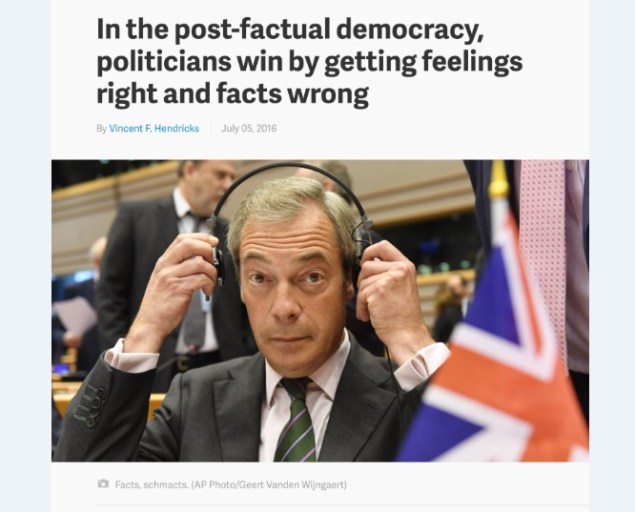
post-factual-post-truth-democracy

The term “post-truth politics” is starting to become an emotional comfort blanket for those people unwilling to examine the reason for legitimate electoral failure

In these interesting times, a lot is being made of the idea that we live in a supposedly “post-truth” or “post-factual” society, where political debates take place and elections are swung not on the basis of evidence and rationality but rather on the basis of bluster and superstition.

Even those of us who supported either Brexit or the election of Donald Trump (this blog was strongly in favour of the former but against the latter) should acknowledge that there is a degree of truth to this criticism of the modern media landscape. As this Buzzfeed article makes clear, when there is a whole industry comprised of people producing inflammatory, fake pro-Trump news articles to earn ad revenue from the clicks of credulous partisans eager to have their existing biases confirmed, something is clearly awry.

But it is also true that dismissing electoral losses as the result of dumb people being duped in a lamentably post-factual world – just as some Trump supporters prepared for defeat by insisting that losing to Hillary Clinton could only be the result of a shadowy conspiracy – is an emotional comfort blanket too easily seized by people who don’t want to do the hard work of understanding why their own ideas were rejected by the public.

I recently attended the debate marking the launch of the 2017 Orwell Prize in London, where the panel – including Polly Toynbee and the excellent Christopher Snowdon – debated the role of the media and of “experts” in the recent EU referendum. Snowdon gives an excellent summary of his own remarks here, and concluded his speech:

Lying may be more morally objectionable, but bullshit is more common and it is just as damaging to public understanding of the world we live in. My argument is not that we are living in a truthful age. On the contrary, there is bullshit everywhere but deliberate political lies make up a very small portion of it – and that portion is not growing.

As long as people have an appetite for having their biases confirmed, newspapers will continue printing bullshit. As long as people think they can get away with it, they’re going to mislead the public. I don’t think we live in the post-truth era because I don’t think there was ever an era of truth. We are still in the pre-truth era and probably always will be.

As the other panellists – Toynbee most forcefully, of course – lamented the way in which the Evil Murdoch Press had supposedly manipulated its uniquely gullible readership with lies and disinformation while Evil politicians like Michael Gove encouraged people to ignore the pro-Remain advice of self-described “experts”, thus causing Brexit, I felt the need to take a stand. So at the appropriate time I seized the microphone and pointed out that wheeling out expert after expert to repeat the establishment line that Brexit would ruin the British economy (as though none of these experts didn’t let their personal biases and preferences colour their opinions) made all other aspects of the decision secondary considerations.

Sky News and the BBC had an endless parade of self-described experts talking about the theoretical economic consequences of Brexit, yet hardly any time was given to experts on governance, democracy, history or constitutional matters. At some point a decision was made that this debate would be All About Economics, and nothing else. One can dispute the dismal predictions of the Remain campaign’s economic “experts” – this blog certainly did – but at least we discussed economics. There was barely a proper discussion about democracy or the constitutional implications of staying or leaving the EU.

This was unfortunately taken by the debate’s moderator to mean that “feelings matter too”, which is not what I was saying at all. My point was that qualitative facts are every bit as important as quantitative ones, and often even more so. I would have expected more sympathy for my viewpoint – among the trendy-lefty, pro-Corbyn crowd at the event were countless people who clearly spend much of their time railing against free markets and capitalism, yet who seem to unquestioningly believe that the slightest potential threat to future GDP growth would make seceding from the European Union in pursuit of democratic renewal a calamitous idea.

When it comes to British membership of the EU, the Remain campaign’s Project Fear spoke only about numbers (and skewed ones at that), with only the occasional bit of fluff about “friendship ‘n cooperation” thrown in as a rhetorical garnish. My point was that in voting for Brexit, it is not that the British people disregarded the numeric facts entirely, but rather that they cared more about other, qualitative facts. Facts to which the Remain campaign never sought to acknowledge, let alone tackle.

The facts vs emotion reduction which met my contribution to the Orwell debate and which now colours nearly all of the media coverage of our supposedly “post-truth society” is therefore a bit too simplistic. There are quantitative facts but there are also qualitative facts – truths which are not based on emotion or hunch or prejudice, but which nonetheless cannot be added up in an Excel spreadsheet, slapped on an infographic and shared on social media.

I voted for Brexit because I believe that the EU actively harms and undermines the democracies of its member states, by deliberate design. I marshalled many facts to back up this position during the campaign – from primary and secondary historical sources, the stated positions of current EU leaders and various other proofs. Just because they are not quantifiable and I could not declare (for example) that leaving the EU will make Britain 11.2% more democratic and give the people 8.4% more control over the decision makers does not make the facts on which I argued my case untrue. And reducing those qualitative facts about democratic control, accountability and the known history and trajectory of the EU as mere “emotion” unfairly diminishes those facts.

When Brexiteers present quotes from EU “founding fathers” speaking of their vision for a federal Europe and tie them to quotes and draft bills from contemporary EU politicians pushing towards the same goals, these are facts. They are not quantifiable, but they are solid facts, much more than mere emotion. And they deserved to be considered and engaged with, yet by and large they were not during the campaign.

Modern politics has become excessively numbers driven. But when the Overton Window is so narrow, the range of policy options so constrained and politics largely reduced to the technocratic management of our public services then that probably becomes inevitable. And we must counter this trend by giving more of a focus to narratives and general principles again. That will lead to greater political engagement.

At present there is far too much self-satisfied criticism of “post-factual politics” in which defeated pro-EU supporters express alarm that people supposedly ignored the only facts available to them and made irrational decisions against their own self interest, and this is not so. There were other, unquantifiable facts which moved people to vote for Brexit. And these pivotal criteria deserve to be acknowledged as legitimate facts, not dismissed as mere emotions.

It is easy and comforting to believe that one’s own side thinks and acts according to reason, logic and evidence while one’s opponents are moved by base emotion, superstition or prejudice. But the divide is very rarely so clear.

And if the “post-truth politics” crowd do not soon realise this and practice some humility, that emotional comfort blanket could all too quickly become a funeral shroud when they next face the electorate.


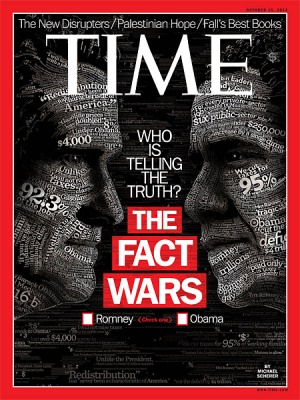
time-magazine-the-fact-wars

Support Semi-Partisan Politics with a one-time or recurring donation:

Agree with this article? Violently disagree? Scroll down to leave a comment.

Follow Semi-Partisan Politics on TwitterFacebook and Medium.