Brexit For Grown Ups

Eurosceptic but tempted to vote Remain because of the Boris Johnson / Faragist circus that is the official Leave campaign? There is a better Brexit campaign out there, and they have a comprehensive plan for safely leaving the European Union which does not rely on trumped up statistics or school playground insults

Are you a eurosceptic or undecided voter who is instinctively sceptical of the European Union, but put off by the bombast and rank amateurism of the official Leave campaign?

Perhaps you sense that there must be a better campaign out there somewhere, that the well worn record of Nigel Farage and the ranting of Boris Johnson – a man who had not even decided which side he was on until a couple of months ago – cannot possibly make then the best ambassadors for Brexit.

Perhaps you appreciate that most of us already know and understand the reasons why the EU is bad, and that what matters now is convincing a majority of our fellow citizens that there is a safe and non-disruptive way to leave the political construct of the EU while maintaining, even enhancing, our status as a global trading nation.

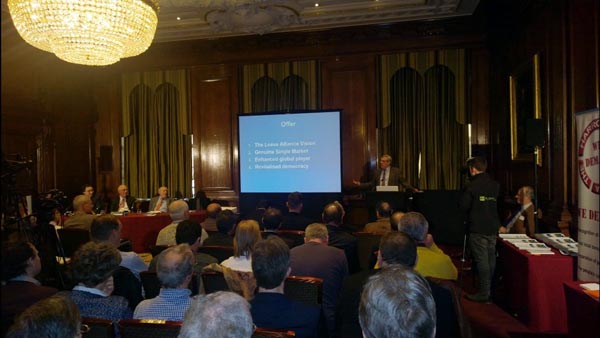
If this describes you, then you may get value out of this excellent TED-style talk by Dr. Richard North of the eureferendum.com blog. The video comes from a recent meeting of The Leave Alliance at the Royal Overseas League in London, and is a great visual exposition of the comprehensive plan for leaving the European Union known as Flexcit or the Market Solution.

Read The Market Solution pamphlet here.

Read Flexcit (the full-length plan) here.

It is vital for people to understand that the coming EU referendum is not like a general election, or even a by-election. We are not voting to elect the Vote Leave Party – thank heavens. That means that although Vote Leave often say some fantastical and frustrating things, and continue to spout statistics which don’t withstand the slightest scrutiny and end up helping the other side, fortunately it doesn’t matter because Vote Leave will not be in charge of the secession negotiations with the EU.

The idiots in Vote Leave do not speak for the whole Brexit movement, and their half baked plans for leaving (such as they exist) do not represent the political realities. In reality – when you take into account the inherent caution of the civil service and the composition of the Westminster parliament which would have to deal with a Brexit vote (more than 50% Remainers) – Britain would inevitably take the path of least resistance and exit to an off-the-shelf EFTA/EEA model (or a shadow version of the same) as a stepping stone, maintaining single market access but giving Britain the right of reservation, an emergency brake on immigration (like the one David Cameron failed to win) and a full seat on all world bodies once again.

This is why Remainers are desperate to falsely discount the EFTA/EEA model as something that Brexiteers either do not want or which would mysteriously be denied us – for it annihilates at a stroke every last one of their doom-laden warnings about economic apocalypse in the event of Brexit, while freeing us from the explicitly political union which they seem to love but dare not publicly say so. Adopting Flexcit (the Market Solution) leaves the Remain campaign with literally nothing besides their fear of change and love of having a supranational government increasingly do the hard work of governing.

For in truth, there is no cooperation between European countries which cannot flourish just as well – and often much better – outside the EU’s explicitly political, integrationist structure. Be it defence, international aid or the environment, inter-governmental cooperation can be far more effective than running everything through a set of institutions in Brussels which were designed not to foster effective governance, but to gradually sideline and undermine the various member states, creating immense resistance and resentment along the way.

If one reads the history of the EU, one quickly realises that the founding fathers never troubled to hide their intent, or the fact that two world wars made them see the nation state as the root of all evil, and the EU’s supranational government as the “cure”. This is not a conspiracy theory – you can read it in their own words. To think that Britain can stay in the club and not be swept along to the final destination is denialist fantasy.

As for staying “globally relevant”, this blog and my fellow writers in arms ceaselessly point out that most EU trade rules are actually set by global bodies like UNECE, Codex Alimentarius, the IMO and other organisations. The EU often does not come up with these rules and regulations, but merely passes them along to the member states, sometimes with unwelcome EU gold plating and tweaks which actually act as an impediment to global trade. The EU is certainly no longer the “top table,” as Remainers love to claim.

That is the future of trade and globalisation – global regulation. Being in the EU means that Britain surrenders our seat or vote on these bodies, must fight to be just one of 28 countries contributing to a common EU position, and has no right of reservation to say no to those regulations which could harm key industries or our national interest. Perversely, sometimes the EU, claiming competency and controlling the British vote, wields that vote against us in these global bodies. Brexit means we can rejoin the global regulatory environment as a full and active player, while remaining in the EU is quite literally giving up and conceding that Britain no longer has the ability or the will to govern ourselves.

But worst of all, voting to Remain because of understandable disillusionment with the mainstream Vote Leave campaign will doom us – quite unnecessarily – to a dismal future lived cowering behind the EU’s skirts while the opportunity to build a genuinely global trading and regulatory framework passes us by.

And for what? Nothing more than the pointless pursuit of a dusty, mid 20th century blueprint for a united Europe, dreamed up by old men scarred by the memory of two world wars and already out of date, long before it is fully realised.

Europe has moved on since VE day. And euroscepticism has moved on since the 1990s. Wanting Britain to leave the EU does not mean throwing your lot in with Nigel Farage, UKIP, Boris Johnson or anyone else, if you do not wish to do so. There is another way. There is a better Brexit campaign out there.

Take 30 minutes of your time to be an engaged citizen, and watch the video.

Then come join us.


The Leave Alliance - Flexcit

Support Semi-Partisan Politics with a one-time or recurring donation:

Agree with this article? Violently disagree? Scroll down to leave a comment.

Follow Semi-Partisan Politics on TwitterFacebook and Medium.

Flexcit For Newbies – A Comprehensive Plan For Safely Leaving The EU

The Leave Alliance - Flexcit Workshop - EU Referendum - Brexit

There now follows a message from The Leave Alliance…

Richard North announces:

We’re all set up for the big day at the ROSL. The programme is all organised, with an opening address by Christopher Booker, the TED-style talk on Flexcit from me, and then Question Time.

The question-time is one of the key elements of the afternoon. Unlike the typical “talking head” presentation, you the audience are the stars. We’re looking for at least ten volunteers, each to ask a focused question, in a similar format. The questioner makes a short statement from the floor to introduce the subject, and then directs the question at the panel, comprising myself and Booker.

[..] Once we’ve chewed over the answer, the questioner gets a come-back, if they want it, and then we close on that issue and move to the next.  After editing, each becomes a YouTube clip, giving us a steady flow of material to post on the web.

Some of the topics to be addressed by the panel are as follows:

  • What will be the effect of Brexit on farming?
  • How will fishermen benefit from Brexit?
  • In view of the controversy over savings on contributions, how much do you think the UK will save?
  • Why isn’t Flexcit getting more (any) attention from the media?
  • Will expats be forced to return to the UK?
  • What guarantee can you give that the Efta/EEA option would not end up as the final step instead of the first?
  • What would happen if the UK failed to reach a trade agreement before leaving the EU?
  • Would the UK need to re-negotiate all its trade deals after Brexit?
  • Would the UK lose out by not being part of TTIP?
  • Will UK defence and security be damaged by Brexit?

Throughout the afternoon, we’ll have roving cameras, recording for vox pop contributions, with people responding to the simple question: “why do you want to leave the EU?” We’ll edit and collate the responses, which will make for another, and truly historic film clip.

I will be in attendance, representing Semi-Partisan Politics, for what promises to be a great event – and one which will answer many common questions about Flexcit.

The event will be held at the following time and place – do come along if you are able, I understand that tickets will be on sale on the door for £15 which is a small price well worth paying for an afternoon of education on the most important and existential question facing Britain today.


Princess Alexandra Hall

Royal Overseas League

Overseas House, Park Place, St James’s Street

London, SW1A 1LR

Saturday 23 April, 2pm – 6pm


The Leave Alliance - Flexcit

Agree with this article? Violently disagree? Scroll down to leave a comment.

Follow Semi-Partisan Politics on TwitterFacebook and Medium.

Love Our NHS? Prove It With Your Vote In The EU Referendum, Part 3

Vote Leave campaign rally - Save Our NHS - 350 million - Brexit

The Remain campaign are going to tell lots of apocalyptic, scaremongering and false tales about how leaving the European Union would destroy the NHS. But that does not mean that Brexit campaigners should stoop to their level

Vote Leave are going all-in with their risible, childish lies about saving £350 million a week in the event of Brexit, and offering the money as a sacrifice to Our Blessed NHS instead.

This is – to use the nicest words possible – completely amateurish and stupid.

Conservatives – especially real ones who aren’t all that keen on the state being a monopolistic provider of healthcare – don’t make very plausible knights in shining armour when it comes to defending the NHS, especially in the minds of voters conditioned by years of hand-wringing left-wing rhetoric that the Evil Tories are perpetually one step away from turning poor people away from hospital.

Besides, the high figure of £350 million fails the common sense test even for the lowest of low information voters. The risible suggestion will do nothing to persuade those who already mindlessly worship the NHS like some kind of secular new age religion and fear that Brexit will hurt their idol, while it offends the more intelligent voter by treating them as though they are stupid.

Richard North, much like this blog, is not having it any more:

What is unlikely to impress, to any one who has the first idea of the issues, is the sort of slogan shown above – the £350 million claim. Vote Leave know it isn’t true. That makes it a lie. Why they go ahead with a deliberate lie, I don’t know. They must think there is some advantage to it.

I find the lie offensive. But then the other side is lying as well. I also find that offensive, but it doesn’t worry me. In fact, I welcome it – it shows weakness, reduces their credibility and gives us leverage. It does worry me when our own side lies – for exactly the same reasons: it shows weakness, reduces our credibility and it gives the other side leverage.

Throughout my campaigning career, I’ve made a point of seeking accuracy – as best I can. For the very opposite reasons that the lie is a bad idea. It shows strength, it increases our credibility and it denies the other side leverage.

In other words, accuracy is the embodiment of good campaigning. The lie is the opposite. That matters. We don’t. We need people to grow up and realise that. There is far too much at stake for us to be playing these silly games.

For libertarians and conservatarians, one of the most depressing aspects of nearly all the Leave campaigns is the idea that any money saved through Brexit (and the sums we are talking are likely to be so small in either direction as to be insignificant) should not be handed back to the taxpayer in the form of tax cuts, but merely re-allocated to some other area of the state which is crying out for more funding.

Apparently there is precisely zero demand in this country for a campaign, or politicians, who dare to suggest that we should aim to reduce government expenditure in one area not to free up cash for another, but rather to return the money to the people who earned it and who create value in the first place. Therefore it is unsurprising that the NHS proved too shiny and appealing a target for the dilettantes at Vote Leave to resist. They know we worship the NHS uncritically, and so they think that we will be highly susceptible to any messages which link Brexit with the idea of helping the NHS.

Unfortunately, they also lack the intelligence to realise that making this campaign about our socialised healthcare system means fighting the EU referendum campaign on ground which is uniquely favourable to the mostly Remain-supporting Left. And there is simply no way that a Brexit campaign supported mostly by those on the Right wins a “Who Loves The NHS Most?” contest against the arrayed forces of the Labour Party and every virtue-signalling keyboard warrior in the country.

As this blog recently pointed out:

Whether we vote to leave the European Union or remain in the burning building, the NHS will continue to exist. We can’t seem to shake it. And it will continue to churn out moderately priced but increasingly substandard levels of care while nearly the entire population gathers round to uncritically praise the holy creation of St. Aneurin Bevan of Tredegar from dawn to dusk. Nothing, absolutely nothing, will change.

Do you really believe Britain Stronger in Europe when they suggest that “medical innovation” will cease or be harmed if Britain leaves the political construct known as the European Union? Exactly what is it about forsaking a foreign flag, anthem and parliament which will slow down the cure for Alzheimer’s?

Or do you seriously buy this idea that Brexit means that we can throw up a brand new hospital in every major British city within a year, and keep on doing that until the NHS is not only our largest employer but our only employer?

Don’t be taken in by this execrable, manipulative, transparently idiotic nonsense from the major Leave and Remain campaigns, all of which seem to be managed by B-student politicos and all of which are operating on the hopeful assumption that you are a frightened, credulous simpleton.

In order to have a shot at winning the referendum on 23 June, Brexit supporters must stop getting sidetracked by glitzy distractions like promising to funnel non-existent money towards the NHS, and focus instead on neutralising many voters’ fear of the potential economic impact of Brexit.

As Dr. North correctly points out:

The least important people in the referendum campaign are those of us who have already made up their minds which way they are going to vote, and will not change their minds under any circumstances.

[..] Those who matter are the people who are undecided or who think they have a position but are genuinely open to persuasion. Those are the people who will decide the referendum.

The EU is by no means beloved. If the Brexit campaign could only negate all of the mostly baseless economic fears surrounding Brexit, they would win the referendum by a landslide. But to do so means communicating a Brexit plan which clearly de-risks the process and shows people that it is quite possible to leave the political construct known as the European Union while still participating fully in regional and global trade.

Every day that those with the biggest platforms and media profiles waste their time making implausible and unconvincing promises about the NHS – hostile ground where the fighting is hugely favourable to the pro-EU Left – is a day which is not spent promoting a clear Brexit plan and neutralising the one issue (economic concerns) which is preventing this decision from being a landslide 65-35 in favour of leaving the EU.

In other words, fighting this referendum with Vote Leave hogging the limelight on the Brexit side is like – well, Geoffrey Howe (of all people) said it best in his 1990 resignation speech in the House of Commons:

It is rather like sending your opening batsmen to the crease only for them to find, the moment the first balls are bowled, that their bats have been broken before the game by the team captain.

With a captain like Boris Johnson and the hotshots at Vote Leave, all bizarrely exhorting us to leave the European Union in order to Save Our NHS, who needs a Remain campaign anyway?


More on the attempts by both sides to weaponise the NHS for the coming EU referendum here and here.


European Union - United Kingdom - Britain - Flags

Agree with this article? Violently disagree? Scroll down to leave a comment.

Follow Semi-Partisan Politics on TwitterFacebook and Medium.

The Leave Alliance Campaign For Brexit: Citizen Democracy In Action

The Leave Alliance Launch - TLA - 2

This EU referendum is about the people, not the Westminster elite. Fortunately, there now exists a truly independent Brexit group – the only genuinely grassroots campaign fighting the referendum, and the only one with a credible plan for safely leaving the European Union

Last week – on Budget day, in fact – the Leave Alliance of individuals and groups campaigning for Britain to leave the European Union held its launch in Westminster.

Don’t worry, you’re not the only one who didn’t realise that anything had happened. The media is still having trouble wrapping their collective mind around the fact that in a referendum, the voices of politicians are no more important than those of ordinary citizens. That’s why every time Boris Johnson opens his mouth to utter his latest half-baked Brexit plan it is considered front page news, but when a group of private citizens and organisations form an independent campaign group to fight a national referendum it is deemed so un-newsworthy that it receives barely a ripple of attention.

Even when that launch takes place in the heart of Westminster, literally down the street from certain venerable news organisations (hello, Spectator), the idea of the Westminster media dispatching a journalist or two to see what was happening in their own back yard is apparently unthinkable. Every last resource simply had to be committed to this year’s Pulitzer Prize-winning coverage of George Osborne’s 2016 Budget, Omnishambles Revisited.

To be fair, The Leave Alliance – of which this blog is an enthusiastic supporterdid register a mention in Christopher Booker’s Telegraph column:

[Boris] Johnson’s empty-headed amateurishness only typifies the fatal failure of any of his allies in the “Leave” campaign to agree on a plausible, properly worked-out exit plan. One after another they come up with their own equally half-baked suggestions, which only demonstrate how none of them have done their homework. This is giving Cameron’s “Project Fear” an open goal, by failing to show how we could practically leave the EU while continuing to enjoy full access to the single market.

The only group that has done so, the Leave Alliance – launched last week with support from the Bruges Group, the Campaign for an Independent Britain and others – is too small to bid for the lead role in the campaign (although I am told on good authority that its expert and exhaustive analysis of all the options has been found very useful by civil servants).

But for a full account of the Leave Alliance launch you have to turn to the blogosphere. Lost Leonardo, writing at the Independent Britain blog, provides this summary:

The Leave Alliance (TLA) is a network of new and established political groups, bloggers and tweeters who are committed to winning the EU referendum for the “leave” side. What makes TLA unique among the declared leave groups is its support for a credible Brexit plan.

Flexcit: The Market Solution is a six-phase plan for recovering Britain’s national independence in stages, as part of a continuous process, rather than as a one-time event. That change of perspective shifts the Brexit debate firmly in the direction of pragmatic and practical politics. The exact form that our post-Brexit deal takes is less important than our vision for what we will do with our national independence. Self-governance means taking responsibility unto ourselves and, if our politicians are any indication, a long process of discovery and rediscovery lies ahead.

So as to short cut the economics- and trade-centred debate that has been allowed (some might say encouraged) to obscure the more important political question—who governs Britain?—the Flexcit plan advocates remaining in the Single Market and then working to create a genuine free trade area in Europe whilst also rebuilding the national policy-making framework and enhancing our democracy by means of The Harrogate Agenda.

This gravity of this referendum on Britain’s EU membership compels us all to think as fully engaged citizens, not merely as frightened consumers or “low information voters” easily manipulated by the cynical propaganda emanating from the major Remain and Leave campaigns. And in this campaign, it is the Remain campaign which benefits from our ignorance and the Leave campaign which is strengthened by knowledge.

When people educate themselves about the European Union, its history and its workings, they almost inevitably become more eurosceptic as the scales fall from their eyes and they realise that the EU is in fact not just a friendly club of like-minded countries who gather together to braid each other’s hair and have a good chat.

As I recently confessed:

Growing up, I was the most ardent European Union supporter and federalist imaginable. I firmly believed that the age of the nation state was over, that patriotism was silly and gauche, and that our only hope of a prosperous future lay in dissolving ourselves into a greater European collective. Adopting the euro, creating an EU army – you name it, I believed in it.

[..] Only when my appreciation for democracy and self-determination (and small-c conservatism) caught up with my authoritarian Utopianism did I realise that the accumulated wisdom of the British people might exceed my own, and that there may be good reasons to be sceptical of the European Union. And only when I came to realise the extent to which the EU is a creation of a small group of European intellectuals and political elites who thought that they knew best – and that the only way to bring about their creation was through stealth and subterfuge, never declaring the ultimate federal destination of travel – did I come to see how profoundly wrong it is.

[..] There is indeed an army of swivel-eyed ideologues in this EU referendum debate. And though they would hate to admit it, it is those on the Remain side who are most likely to be impermeable to facts, and who are least likely to have ever held a different view on the EU and been on an intellectual journey to arrive at their present position.

And as a rule of thumb, it is generally wisest to listen to those who can show evidence of having thought deeply about an issue and been persuaded by the steady accumulation of evidence to revise their thinking, rather than those who were born with their deeply-engrained love of the European Union pre-programmed in their brains.

One of the reasons I am proud of my association with The Leave Alliance is the fact that it is full of other people who, like me, have been on an intellectual journey. Sure, some of us saw through the EU from the beginning, but others – myself included – were won over to the side of Brexit by the steady accumulation of incontrovertible evidence.

We count Britain’s foremost authority on the European Union among our number, as well as several independent writers who possess more patiently acquired knowledge about the global regulatory environment than most of the Westminster media combined.

And if nothing else, the fact that the Westminster media failed to cover something as significant as the Leave Alliance launch – despite the fact that it was happening right in their midst – should be enough to convince anyone of the importance of doing one’s own research on Brexit, and not relying on any one single source or campaign when making this most important of decisions.


European Union - United Kingdom - Britain - Flags

Agree with this article? Violently disagree? Scroll down to leave a comment.

Follow Semi-Partisan Politics on TwitterFacebook and Medium.

Announcing The Leave Alliance

The Leave Alliance Launch

A campaign that Semi-Partisan Politics is proud to support

I have written a lot of uneducated bilge about the European Union in my time.

My natural instincts – supporting democracy, self-determination, the nation state and accountable government – were generally sound, but too often I lapsed into lazy confirmation bias and weak, borrowed rhetoric when arguing for Britain’s independence from Brussels.

I would still be churning out even more bilge today, were it not for the eureferendum.com site and the group of activist bloggers who are coalescing around Dr. Richard North and Flexcit, that rigorous, comprehensive plan for safely extracting Britain from European political union while minimising risk.

If this blog has gone somewhat quiet on the finer policy details of the Brexit question over the past year, sticking to the bigger picture, it is only because through slowly becoming familiar with this body of work, I have come to realise how much I have yet to learn and understand about the workings of the EU and the international regulatory environment – and how much I thought I understood that turned out to be completely wrong.

The upshot is this: this referendum should not be about David Cameron’s fraudulent “renegotiation” deal (even though it is yet more evidence of the EU’s inability to reform even under existential threat), any more than it should be about the arbitrary and misleading statistics about jobs saved or threatened, hospitals built or universities closed. All of these alarmist talking points can be fought to a draw on the 24-hour news channels by the SW1 talking head armies of the establishment Leave and Remain campaigns.

This referendum – this rare, great opportunity that we have been given – should be about our democracy. It should be about who governs Britain, how they govern Britain and how we exercise oversight over the people who make the key decisions affecting our lives. And one thing is certain: the more people learn about the true nature of the European Union – and the more they are encouraged to think like engaged citizens rather than fearful consumers – the more they come to realise that Brexit is an essential first step toward reclaiming our democracy.

That’s what The Leave Alliance is about. TLA is an alternative to the dumbed-down, uneducated major campaigns battling it out for lead designation in the referendum campaign, whose dismal and unforgivable failure to embrace a properly worked through plan for Brexit – and then promote it in the media – means that we are now fighting the referendum campaign with our hands tied behind our backs, David Cameron chuckling to himself all the while.

The Leave Alliance launches later today, in Westminster, and it will be a campaign that engaged citizens and thinking eurosceptics and Brexiteers across the country can actually be proud to support. It is a campaign which understands that Brexit is part of a process of much-needed democratic renewal, not a fixed destination in itself. And it is a campaign which will never condescend to the British people by reducing this great question of human governance and statecraft to a disingenuous war of competing statistics.

If you feel let down and embarrassed by the well-funded but utterly amateurish Leave campaigns, then The Leave Alliance offers you a home for this referendum campaign.

If you get angry when bumbling Johnny-Come-Latelys like Boris Johnson blunder onto the Brexit scene, stealing the limelight while making a complete hash of arguments which more intelligent eurosceptic voices have been making for years and even decades, then The Leave Alliance is for you.

And if you read Semi-Partisan Politics and generally find yourself agreeing with what is written here, then I ask you to follow my lead and abandon the mainstream Leave campaigns who are cheerfully leading us to defeat, and instead support The Leave Alliance, whose strong commitment to eurosceptic principles and intellectual rigour will campaign for Brexit – and to keep the flame of genuine democracy alive in Europe – for as long as it takes to achieve our cherished goal.

The Leave Alliance

Wednesday 16th March, 2.30PM

The Council Room

One Great George Street

London, SW1P 3AA

Donate here.


European Union - United Kingdom - Britain - Flags

Agree with this article? Violently disagree? Scroll down to leave a comment.

Follow Semi-Partisan Politics on TwitterFacebook and Medium.