One Month Until EU Referendum Day. Time To Break Out The Rudyard Kipling

The unforgiving minute approaches

At the conclusion of The Leave Alliance’s recent highly successful TED-style talk, in which Dr. Richard North walked through the Flexcit staged plan for leaving the EU, a number of the alliance’s Bloggers Army and other audience members stayed behind afterwards to explain their own reasons for voting Leave on 23 June.

Here are a selection of those reasons – including a contribution from yours truly.

The Leave Alliance is comprised of a diverse group of people from across the political spectrum, some who have been devoted to this cause for decades and others for whom it is a much more recent obsession.

I have the honour of fighting the EU referendum campaign alongside this excellent group of people – a group which comprises Dr. Richard North, surely the foremost authority on the European Union in Britain, Pete North, a writer of very rare ability, the Bloggers’ Army, whose various research and writing talents all far eclipse my own, and our very generous readers and supporters. It is a singular honour to be associated with them all, and to make even a small contribution toward our common goal.

Things are not looking good for the Brexit cause right now. The list of unforced errors, media howlers and general acts of incompetence committed by the oh so politically savvy leaders of the official Vote Leave campaign grows by the day. By clinging stubbornly to disproven statistics and flat-out false arguments, Vote Leave squander credibility faster than we can possibly hope to win it back. Indeed, fighting this EU referendum with the likes of Boris Johnson as a figurehead for the Brexit cause is like trying to swim the English Channel with a ball and chain clamped to one’s ankle – strive though we might, we are inevitably dragged down beneath the waves.

It should be noted that nearly every single one of the official Leave campaign’s missteps and key points of criticism could have been avoided by heeding the advice of The Leave Alliance – not least in terms of the importance of having a robust Brexit plan to lay before serious opinion-formers and influencers.

But we fight on, and we fight to win. Though the path to victory for the Leave side is now very narrow indeed – essentially resting on significant unforced errors from the Remain campaign or major external political shocks, as this blog now argues – we must continue to make the bold, globally-engaged case for Brexit, and stand ready to quickly capitalise on any good fortune which comes our way.

This blog will be working flat out for the next month to achieve the impossible and secure a vote for Brexit in the referendum on 23 June. David Cameron managed to say one true thing during his round of media appearances this weekend – that this referendum campaign is indeed more important than a general election. And so it is. It therefore demands the best of all our abilities.

In his famous poem, “If”, Rudyard Kipling wrote of filling the unforgiving minute with sixty seconds’ worth of distance run. Well, the final month ahead of us between now and Referendum Day will certainly be unforgiving. We are behind in the polls, we have nearly the entire political and cultural establishment ranged against us screaming hysterically that Brexit would somehow usher in the apocalypse, and the man generally recognised as the figurehead of our movement is, for all intents and purposes, a malevolent lunatic.

So – that should make eventual victory having overcome these challenges all the sweeter, no? We at least owe it to ourselves to try, to work tirelessly for victory but also pragmatically so that we are positioned to turn a bad result into the best possible starting point for our next attempt. And when we feel despondent, let’s remember that these are not ordinary political times. One year ago, who would have said that Jeremy Corbyn would be leader of the Labour Party, or that Donald Trump would be the presumptive Republican Party presidential nominee?

So let’s fill the unforgiving minute. Let’s leave it all on the field, as the Americans say – or on the pitch, if we’re being particularly British.

Who’s with me?


While normally it might be considered unbearably trite to quote Kipling, a close reading reveals that in fact there is barely a line which is not highly applicable to those of us struggling to voice a thinking person’s Brexit message in the hurricane of the national referendum debate. And so:


If —

IF you can keep your head when all about you
Are losing theirs and blaming it on you,
If you can trust yourself when all men doubt you,
But make allowance for their doubting too;
If you can wait and not be tired by waiting,
Or being lied about, don’t deal in lies,
Or being hated, don’t give way to hating,
And yet don’t look too good, nor talk too wise:

If you can dream – and not make dreams your master;
If you can think – and not make thoughts your aim;
If you can meet with Triumph and Disaster
And treat those two impostors just the same;
If you can bear to hear the truth you’ve spoken
Twisted by knaves to make a trap for fools,
Or watch the things you gave your life to, broken,
And stoop and build ’em up with worn-out tools:

If you can make one heap of all your winnings
And risk it on one turn of pitch-and-toss,
And lose, and start again at your beginnings
And never breathe a word about your loss;
If you can force your heart and nerve and sinew
To serve your turn long after they are gone,
And so hold on when there is nothing in you
Except the Will which says to them: ‘Hold on!’

If you can talk with crowds and keep your virtue,
Or walk with Kings – nor lose the common touch,
if neither foes nor loving friends can hurt you,
If all men count with you, but none too much;
If you can fill the unforgiving minute
With sixty seconds’ worth of distance run,
Yours is the Earth and everything that’s in it,
And – which is more – you’ll be a Man, my son!

 

European Union - United Kingdom - Britain - Flags

The Leave Alliance - Flexcit

Support Semi-Partisan Politics with a one-time or recurring donation:

Agree with this article? Violently disagree? Scroll down to leave a comment.

Follow Semi-Partisan Politics on TwitterFacebook and Medium.

Remain Supporters Are In Denial About The Nature And Purpose Of The EU

Owen Jones - EU Referendum

I’m voting Remain because Puppies For Everyone!!! The denialism and wishful thinking about the European Union’s true purpose and direction of travel exhibited by pro-EU left-wingers is off the charts

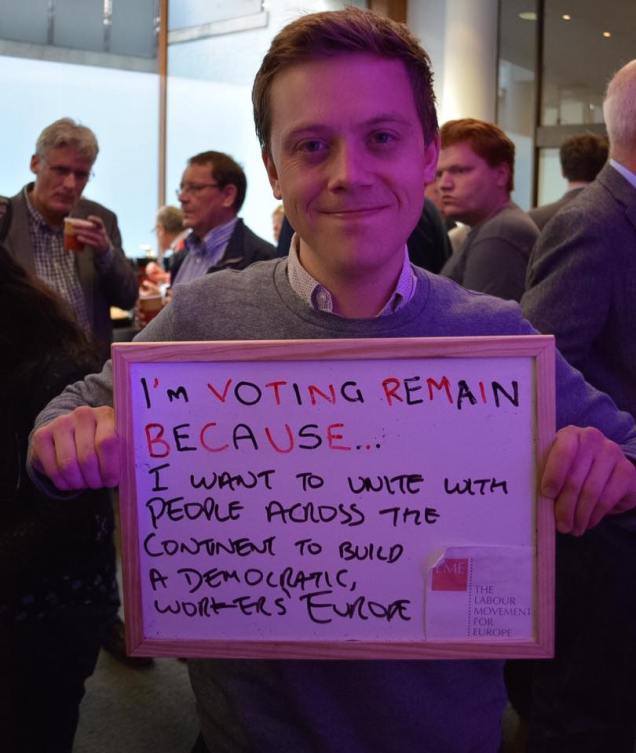
The Great Disappointment of the eurosceptic Left, Owen Jones, has popped up with a new contribution to the EU referendum debate in the form of the picture shown above, being widely shared on social media (albeit sometimes in cheekily photoshopped format with the message changed).

While this blog does not usually bother commenting on internet memes, this one is noteworthy because it simultaneously

  1. Sums up the entire basis of left-wing EU apologetics, and
  2. Reveals just how flimsy is that argument

The sign held up by Owen Jones proclaims:

“I’M VOTING REMAIN BECAUSE… I want to unite with people across the continent to build a democratic, workers Europe”

And I want to own a unicorn that shoots fruit based candy out of its ass and grants me three wishes a day, but sadly that is not on offer from the EU, just like the “workers’ paradise” lusted after by Owen Jones isn’t on the menu from Brussels either.

This referendum is serious business. So can Remainers please stop projecting whatever they desperately wish the EU to be onto an organisation which has never really been about friendly trade and cooperation, but is actually all about slowly and inexorably becoming a supranational government of Europe. And which is not going to abandon that long-held goal just because the British are now expressing a few doubts.

I’ve read the history of the EU. I strongly advise others to do the same. And if they still want to Remain, having understood the true nature of the grand projet, they should at least have the decency to admit out loud precisely what it is that they know they are committing us to.


For those interested in that history, here is a good starting point.


European Union - United Kingdom - Britain - Flags

Agree with this article? Violently disagree? Scroll down to leave a comment.

Follow Semi-Partisan Politics on TwitterFacebook and Medium.

The Official Leave Campaign’s Dismal Half Term Report Card

Report Card - Brexit Campaign - EU Referendum - Vote Leave

While many Brexiteers may be in line for a gold star for trying hard, the official Vote Leave campaign and its major spokespeople are coasting for a big fat F when it comes to execution

With little more than a month to go until voting in the EU referendum, it is worthwhile for Leavers and Brexiteers to pause, take stock of where we are and conduct a candid review of our strengths and weaknesses – what is working, and what is actively setting back the cause of independence from the European Union.

This blog post is not such a detailed report – though some other intrepid Brexiteer may well wish to create one, as a matter of historical record if nothing else. For in truth one does not need to dive deep into the poll numbers or aggregated political analysis to see that the Leave campaign is not only on course to lose the EU referendum, but is actively doubling down on those behaviours and activities which make defeat more likely.

For evidence, one has only to regard this crowing article in the New Statesman, in which Glenis Willmott gloats about the overly-emotional, rank amateurism of the country’s most prominent voices for Brexit.

One can almost hear the glee in her heart as Willmott writes:

They needed a new argument, a positive, forward-looking vision for what they see as the future of Britain… but they realised they didn’t have one so reverted to WWII and Hitler. Having lost all arguments on the economy, Vote Leave’s Boris Johnson raised the spectre of Hitler, talking about superstates and “historical parallels” between the EU and Nazi Germany. And they’re accusing the Remain campaign of being fearmongers?

They’ve complained about the terms of the debate. They’ve accused broadcasters of conspiring with the government. They’ve said journalists would be punished, and called for civil servants to be sacked. They’ve said they’ll disrupt pro-EU meetings and target pro-EU businesses. At every stage they’ve attacked individuals or organisations and not their arguments. And now they’ve invoked Godwin’s Law by comparing their opponents to Hitler.

Their tactics are the textbook definition of the increasingly desperate behaviour of the losing side in a debate.

Willmott concludes:

It’s what happens when you’ve given up on convincing the undecideds and care only about firing up die-hard Eurosceptics, praying for a low-turnout poll, which Vote Leave privately admits is their strategy. Having lost the argument on the economy, they’re now following step-by-step the UKIP guide to politics: attack foreigners, bash immigrants and peddle conspiracy theories of continental plots to take over Britain, likening Brussels of today to Berlin of yesteryear. It would be laughable if it wasn’t so serious.

And who can disagree with her? People expect some kind of positive message if they are to vote for a campaign – it can’t all be doom and gloom. And while the Remain campaign are certainly no strangers to scaremongering, they do at least take time to waffle on about their vague, fictionally pleasant European Union, a naive vision of a loose association of countries coming together on a super voluntary basis to fight crime, trade with one another and enshrine rights for working people.

Never mind that this idealised vision of the European Union is complete nonsense (and it is). People believe it because Vote Leave are too busy shouting about building a new hospital on every street corner with the money we supposedly save from leaving the EU that they almost totally neglect to pick apart Stronger In’s incredibly superficial and deceptive sales pitch.

It does, therefore, strongly appear as though Vote Leave have given up on winning the new support of anybody without a long-held antipathy toward the EU, choosing to focus instead on firing up the base and praying for a low turnout. Sadly, this almost never works. Brexiteers fired up on lashings of anti-immigration, “they need us more than we need them” rhetoric can still only vote once, just like everyone else. A fervent minority is still a referendum-losing minority.

Worse still, when they aren’t ranting about building hospitals on top of hospitals on top of hospitals in their utopian post-Brexit Britain, Vote Leave and other eurosceptic big beasts love nothing more than to prance around playing the role of the aggrieved victim. Despite having known for a long time that the prime minister is an unrepentant europhile and that the Cameron/Osborne “renegotiation” was nothing more than a deceptive piece of theatre, the brightest stars in the eurosceptic firmament somehow neglected to come up with a countervailing strategy besides running weeping to the media, sobbing about how unfair it all is.

Mary Ellen Synon puts it very well over at her excellent new Brexit blog:

This kind of complaint is worse than useless, it is embarrassing.

Anyone over the age of six who squeals, ‘He’s not playing fair!’ is absurd.

Of course Cameron is not playing fair. Of course he has been involved in secret dealings with big business. He is a politician who intends to win, and he has form for exactly this kind of behaviour.

I therefore have no time for Tories such as the MP Jacob Rees-Mogg who is reported today to be ‘furious’ over Cameron’s secret FTSE dealings.

Rees-Mogg told the Bruges Group in London that Cameron’s secret Remain dealings with the big corporations while he still worked to make people believe he might support Britain leaving the EU was ‘a scandal of the highest order.’ He said it appeared Parliament had been misled by Cameron.

Yet Rees-Mogg is a member of a party that was happy to go on backing Cameron even after he betrayed his ‘cast-iron guarantee’ to give the British people a referendum on the Lisbon Treaty.

That betrayal was in 2009. Cameron was a weasel then; he is a weasel now. It is no good for Leave campaigners such as Rees-Mogg to act as if they have only just realised it.

Quite. While it is not unreasonable to remark on the levels of deceit and lack of principle emanating from the Conservative Party leadership – pity the day when we come to accept it as unremarkable, or even virtuous – there is no point building a national referendum campaign around the fact. Besides the fact that momentum matters in elections and moping around weeping that you got a raw deal is like a big neon sign declaring that the momentum is with the other side, we are back to the fact that the Leave campaign does not have a compelling vision of an alternative Britain outside the EU.

And Vote Leave failed to come up with an alternative vision for Britain because that would mean having some kind of plan for Brexit. And they long ago decided that their unrepentant lack of a Brexit plan was somehow going to be their greatest selling point.

As Synon concludes:

The Leave campaign needs to stop whining that the campaign is ‘unfair,’ because of course it is.

However, Cameron is winning this referendum not because he is slippery, he is winning it because the official Leave campaign has described no clear, safe path out of the EU for the voters.

In other words, Cameron is not winning this campaign. The Leave campaign is losing it by being unthinking, uninformed, and unorganised.

This much is true: Cameron is not winning, but rather the Leave campaign is losing. And while the pro-EU side may have the advantage, at least this is not based on the great skill of the Remain campaign. David Cameron and his motley crew are coasting by using the advantage of their bully pulpit and the public’s natural hesitancy to depart from the status quo as their chief weapons. Even most Remainers would likely concede, under pressure, that Cameron achieved no meaningful concessions in his renegotiation, and that they cannot say with certainty what the EU will look like in five, ten or twenty years’ time, for example.

Right now this is enough, because Vote Leave have decided to fritter away their time and resources making ridiculous promises, playing the victim and invoking Godwin’s Law. Thus the Remain campaign is winning by default. But their numbers are potentially soft – people are sticking with Remain only because Boris Johnson doesn’t look like the type of man who can tie his shoes unaided, and because the avalanche of establishment opinion (organisations with no mandate to care about democracy but with strong interests in maintaining short term economic stability) coming down on the side of staying in the EU.

Realistically, there is no chance now that Vote Leave will significantly change their tactics, or suddenly embrace Flexcit and the EFTA/EEA model as a stepping stone out of political union. That ship has sailed. The only hope is that the Remain campaign’s principle strength – the overwhelming support of the establishment – may yet become its biggest weakness. And this could well happen.

Right now, Stronger In can point to a cast of thousands of the great and the good who have all lined up to tell the British people that the EU is wonderful, that Cameron negotiated a brilliant new deal and that exiting political union would lead to economic (and even military) armageddon. But what if this stops acting in their favour? These are febrile, uncertain times where little is certain except for the fact that those in positions of authority are distrusted and despised as almost never before. So what if the British political establishment, Barack ObamaChristine Lagarde, David Cameron and his CEO buddies all singing from the same hymn sheet begins to seem more like a stitch-up than wise counsel? What if their unanimity becomes more like a criticality accident of sanctimonious, self-interested elites clubbing together for their own gain rather than the sober, high-minded intervention they like to imagine?

Returning to the half term report card analogy, right now it is fair to say that the official Leave campaign has failed every single piece of coursework they have been set so far. This is not good. But fortunately, fifty percent of the total class grade is based on the end of term exam, and here we have an opportunity to make up some distance. We are never going to get an A and win by a landslide, but a concerted effort in the right direction and a hefty dose of luck* could yet bring us to 50% +1, which is all we need.

So do not despair, fellow Brexiteers. A pathway to victory still exists, albeit one which is heavily dependent on luck, or “events, my dear boy, events“. Fighting the EU referendum with Vote Leave in the driving seat is like being partnered with the class idiot for an important assignment – we are going to have to do all the leg work while they thrash around attention-seeking and disrupting everyone else. It will be difficult, but it can be done. Just buckle down, hope that the shining ones at Vote Leave towers manage to keep a lid on their worst excesses, and then pray for some kind of game-changing event to shake up the board.

This thing isn’t over until it’s over.


*mostly involving Vote Leave sitting out a few rounds and letting the adults take a turn.


European Union - United Kingdom - Britain - Flags

Agree with this article? Violently disagree? Scroll down to leave a comment.

Follow Semi-Partisan Politics on TwitterFacebook and Medium.

Who Should Be Able To Vote In The EU Referendum?

UK British EU Flags - Brexit - European Union - Secession Referendum


It goes without saying that the loudest voices on the pro-European side are desperate for the coming EU referendum to be open to EU nationals currently living in Britain, as well as British citizens. From their selfish perspective, subverting our democracy in this way is a price well worth paying in order to inflict their desired outcome on the rest of us.

But now the europhiles are reaching for another rhetorical weapon in the fight: the fact that Britain, through a number of bizarre constitutional quirks and the pernicious rules of the EU, already allows select groups of favoured non-citizens the right to participate in our democracy.

Mihir Bose, writing in the Guardian, is already taking a gleeful victory lap on the subject, suggesting that eurosceptics are somehow being craven or ideologically inconsistent for objecting to the idea of EU citizens voting to keep Britain chained to Europe while not speaking out against these other cases of non-citizens receiving the franchise:

What [eurosceptics] neglect to mention is that even now you do not necessarily need to be a UK passport holder to vote in a general election. Indeed, for decades the UK has allowed citizens from other countries the right to select members of parliament, a right that even extends to citizens of three EU countries. They are part of a much larger group of 72 countries that includes all Commonwealth territories, British overseas territories and British crown dependencies. Fiji and Zimbabwe may be suspended from the Commonwealth but their citizens resident here have not lost their right to vote in UK elections. The three special EU countries are Ireland, Cyprus and Malta. They enjoy this privilege because while they may now be part of the EU, they once had an older allegiance to a much greater union: the British empire. The sun set on the empire long ago, but its legacy lives on.

What makes all this fascinating is that while Eurosceptics are happy to raise all sorts of scare stories about the EU, these other voters are an issue they are reluctant to discuss. Indeed, as far as the UK electoral franchise is concerned, this is now the great elephant in the room, as I was made well aware during the recent election. At one husting, I had the chance to raise this issue with three panellists from the main parties: Michael Gove for the Tories, Ivan Lewis for Labour and Baroness Kramer for the Lib Dems. Lewis disapproved of my even raising the issue. Baroness Kramer, who did not seem to know that non-citizens could vote, justified it on the grounds that this was a wonderful example of British eccentricity. Gove just said that he did not want to see any change in the franchise.

More fascinating was how Ukip reacted. Some weeks before the election, at a British Future event, Douglas Carswell, now the only Ukip member of parliament, made a very reasoned speech to show that Ukip was not an anti-immigrant party. But when I raised this issue, he made it clear that this was not a question Ukip would touch, remarking that the British system was so complex that to lift the carpet would mean all sorts of things would crawl out. How strange to hear this from a party whose leader, Nigel Farage, makes so much of the fact that he is prepared to go where no other politician dares.

Continue reading

The United Kingdom’s Last Stand

Scotland UK Unity Rally Trafalgar Square London semipartisansam


In the darkest days of our nation’s history, when Britain confronted the Nazi menace alone and the United Kingdom was all that stood between the free world and fascism, a series of daily concerts were held at the mothballed National Gallery in London’s Trafalgar Square. These concerts, organised by the pianist Myra Hess, served to lift the spirits of war-weary Brits and demonstrate a positive public response in the face of the most trying circumstances.

Trafalgar Square has played host to many rallies, concerts and protests since those bleak days in the 1940s. But there have been none so important as the rally which is scheduled to take place later today, on Monday 15 September in support of the United Kingdom, and in opposition to a “Yes” vote in the upcoming referendum on Scottish independence.

The circumstances of the new existential threat we face may be quite different, but make no mistake: the survival of our country in its current form has not been at such great a risk since Hitler’s Luftwaffe threatened to clear the way for a German invasion.

A democratic, peacetime split may is clearly not the same as invasion by a foreign power, but it would be traumatic in its own way. No, there will not be an occupying army or columns of tanks on the street if the Scottish people decide to secede from the United Kingdom when they go to the polls on the 18th of September. As following a bereavement or divorce, life at its most banal will continue largely as usual. But something precious will have been lost, something irretrievable. The greatest, most successful country in modern history will have ceased to exist, fractured into a small, euro-centric social democracy to the north and a bewildered, diminished rump to the south.

Continue reading