The Age Of Perpetual Crisis

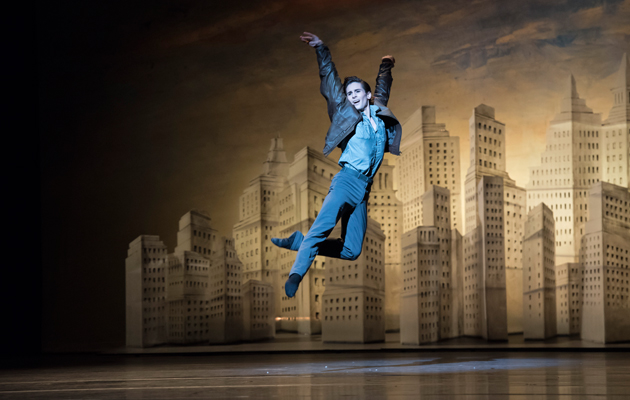
The Age of Anxiety - Ballet

When every single issue is falsely portrayed as a burning crisis, none of our national challenges will receive the considered attention they deserve

“We would rather be ruined than changed
We would rather die in our dread
Than climb the cross of the moment
And let our illusions die.” 
― W. H. Auden. The Age of Anxiety: A Baroque Eclogue

The housing crisis. The migrant crisis. The productivity crisis. The deficit crisis. The tedious, annual NHS winter crisis. Brexit. Nearly every important issue or event in our politics is portrayed as a pressing, existential crisis, despite few of them even remotely living up to the definition. If you are sceptical, just ask somebody who was alive and situationally aware in 1940 whether any of the issues which excite politicians and newspaper editors today amount to a real crisis, and see what they have to tell you.

And as it is in Britain, so it is across the Atlantic in America. Surveying the present scene, David French writes in the National Review:

In politics, when everything’s a crisis, it turns out that EVERYTHING’S A CRISIS!

We keep reading that Donald Trump is a unique danger to American democracy, a threat we should put aside partisan tribalism to defeat. Then, seconds later, we read that giving Americans the choice to buy health insurance will kill people by the thousands. Seconds after that, we learn that an entirely conventional Republican tax plan will not only kill people but also extinguish American democracy as we know it. Finally, we read that the end of net neutrality — a regulatory doctrine that only the smallest percentage of Americans even remotely understand — will extinguish American liberty.

[..] For the average American, who pays less attention to politics than to his professional and personal lives, all of this is exhausting. It’s numbing to the point where he can’t possibly determine what’s important and what’s not. So he checks out. He throws his hands in the air and gives up. But for the Americans who care the most about politics and drive our public debate, perpetual crisis is invigorating. It provides meaning and purpose.

A nation’s political culture is always defined by the people who care the most, and the people who care the most in our nation have lost all sense of proportion.

Charles Cooke makes a similar point, but at the more personal level, in the same publication:

Ours is a moment in which millions rush breathlessly to exclaim. In defense! In resistance! In bloody-minded persistence! “I will not back down!” we are told, by people who have not been asked to, and could not be compelled to. They won’t be “intimidated” either, nor “silenced,” nor “bullied” nor, it seems, pushed to any form of self-reflection. Indignation, not analysis, is the perennial order of the day, and the tone of our debates is ineluctably Twitteresque. Retweets are points on the board, and hyperbole gets you oodles of them. The worst. Ding! Insane. Ding! Crisis. Ding, ding, ding! Congratulations, you have been promoted to the next level.

I don’t think I have ever read a more perceptive or honest summary of how political Twitter works, and as a denizen of this world I see more than a few of these negative traits in my own work, some due to personal failures but more often because the difficult pathway to being heard and gaining an audience on social media incentivises some pretty negative behaviours.

It is in the nature of those involved in politics – either doing or writing about it – to imbue their work and their passions with an air of existential importance. In many ways, this is understandable – it is hard to get a hearing in the media, or from the People Who Matter, with a piece of sober, rational analysis addressing a long-running issue; harder still when the competition presents every new report or white paper as some kind of magical elixir to the nation’s woes.

Given the choice, most people want to be Neil Armstrong and not the dedicated but overlooked engineers and project managers who made the Apollo Program a reality. Or if politics is showbusiness for ugly people then most players want to walk the red carpet and be photographed, not lurk in obscurity editing screenplays or building sets. This is human nature, but it has the unfortunate side effect of warping our political process, bending it towards flashy but superficial quick fixes and wonder cures rather than holistic analysis and serious reform.

The word “crisis” in particular is used far too readily at present, by people who should know better. The nature of politics and public policy means that nearly every important decision will ultimately have some direct or indirect impact which can be measured in terms of human lives, thus making it existentially important to at least a few people. In fact, the Left in particular rely on this very phenomenon, since their conspicuous compassion policies front-load the emotional benefits of throwing resources at a problem while deferring or even denying the costs – after all, it is easy to win applause and positive headlines by opposing welfare or healthcare reform, but much harder to counsel delayed gratification or highlight the cumulative toll of welfare dependency on the quality and duration of human life.

But in actual fact there are very few actual full-blown crises facing us at the present time, despite the best efforts of opportunistic politicians and the media to suggest otherwise. Rather, there are a series of slow-burning, serious and often intractable problems which need to be tackled, few of which are likely to lead to sudden national ruin but many of which – if left unattended much longer – have the potential to chip away incessantly at our economic prosperity, national security, democratic health or the stability and cohesion of our society.

The appalling failure of successive governments to adopt a sensible housing policy and increase the housing stock will not lead to an explosion in homelessness or destitution overnight, but it will lead to a continuing sense of rage, disillusionment and alienation among younger voters, as it is already doing. Continuing to stand by an immigration system which proudly fails to make skills or likelihood of assimilation and popular consent the key drivers will not lead to riots in the street tomorrow, but it will continue to drive a wedge between the political class and much of the country. Continuing to enshrine the NHS as our national religion and abide by the strict political doctrine of NHS non tangere will not create an immediate spike in death rates, but it will ensure that UK health outcomes continue to further lag behind those countries with the best healthcare systems.

Labelling something a “crisis” suggests imminent peril requiring immediate remedy, even if the resulting damage control ultimately creates other problems or only succeeds in kicking the can down the road. It advocates for quick fixes, which is exactly what we don’t want at this time. In this period of discontinuity, where the old political settlement has broken down and traditional, familiar policy prescriptions neither work effectively nor command sufficient public confidence, what we need are carefully thought-out and mutually supporting policies rooted in an uncompromising, forensic analysis of the precise problems we face. What we absolutely do not need are a bunch of panicked gimmicks and pseudo-policies cooked up in silos by desperate politicians and leaders whose sole objective is to survive the day and avoid negative headlines.

The difficult truth is this: there is no one pressing crisis the resolution of which will solve all our problems and keep us safe and prosperous in a changing world, and there is no universal and comprehensive solution to any of the problems we deem to be crises. Housing cannot be addressed without revising planning rules, but it is also impossible to adequately plan future housing and infrastructure when there is no meaningful control over mass immigration. Low productivity cannot be addressed without looking at corporate governance, secondary and tertiary education, workers’ rights, union power and addressing the weak commitment to R&D. Indeed across the board there is no silver bullet, no quick fix, no political party with all the right answers, no system of government ideally equipped for the challenge. We must forge a new path.

Far from focusing attention and driving positive change, labelling everything a crisis merely creates apathy, causes many voters to check out and encourages many politicians to either view problems in a highly compartmentalised way or else simply consider them insurmountable, facts of life to be dealt with rather than challenges to be overcome – just as many in the British establishment seemed resigned to irreversible national decline in the 1970s, before Thatcherism finally equipped Britain with the tools to dig ourselves out from the last major period of discontinuity this country faced.

Britain emerged stronger from the late 1970s and 80s because after years of paralysing indecision and timid half-measures from Tory and Labour governments alike we finally made a calm, methodical and dispassionate analysis of the problems holding us back – excessive union power, flawed monetary policy, excessive state involvement in the economy – and set about tackling each of these issues in a coordinated way, as part of a comprehensive national turnaround strategy.

We need to adopt just such a process again today in order to overcome this new period of discontinuity and the specific challenges that it brings. And the first step is to stop viewing every last issue as a standalone, burning crisis.
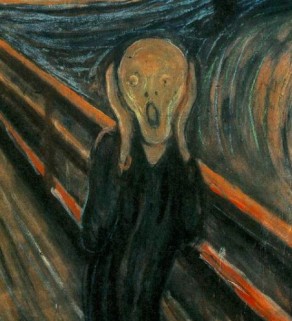
 

Munch - The Scream

Support Semi-Partisan Politics with a one-time or recurring donation:

Agree with this article? Violently disagree? Scroll down to leave a comment.

Follow Semi-Partisan Politics on TwitterFacebook and Medium.


The Battle For British Conservatism: Book Progress Update

Atlantis Books shop Oia Santorini Greece

A tedious race against time

As I mentioned last month, I am in the slow, tortuous process of writing a book on the challenges and future of British conservatism, based partly on my writings on this blog and augmented where appropriate with new material.

It turns out that writing a book is quite hard. Who knew? And yet a whole host of verifiable idiots seem to effortlessly churn the things out one after another; but then I suppose many of them have collaborators, researchers or ghostwriters. By contrast, my humble little book (much like this blog) remains very much a side-hustle, and one which necessarily takes third place to work and another significant ongoing project (details TBC) for the time being.

Right now I have a 30-page outline in Google Documents which is being sporadically worked on as I slowly transform terse bullet points, links to my past articles and stream-of-consciousness paragraphs into the final text. I hope to self-publish on Amazon and iBooks (or whatever else those young whippersnappers use, with their loud music and Pac-Man video games) by early in the new year, closer to Christmas if things progress smoothly. Maybe I’ll tweet it out in a 5000-tweet thread or broadcast it on SnapChat, who knows?

I can’t help but notice, as I set to work, that much of the UK political media has finally woken up to the fact that there might be something ideologically dysfunctional within the Tory Party, hence the sudden proliferation of “OMG the Tories have lost their way!” articles in all the prestige media and main political websites. Well done guys, it only took four years for you to catch up (ten years if we count Peter Hitchens as the pace-setter, which we probably should).

Joking aside, this is somewhat frustrating as I know full well that ideas first expounded on this blog (which I know is sometimes read by mainstream UK political journalists even if they almost never deign to link to me or re-tweet my stuff) will soon be appearing in rival books which have the backing of actual publishers and real distribution networks. And in a few short months, a bunch of self-satisfied hacks who only a few months ago could still be found praising the dismal, centrist Tory party to the rafters will be smugly sitting in television studios pontificating on how they were the first to recognise that something was wrong in Toryland. “Where did the Tories go wrong?” will likely be early 2018’s version of “So, Brexit happened” in terms of topical political book sub-genres ravenously pounced upon by the Westminster elite.

Therefore I find myself in a bit of a race to market against these guys, not because I will be remotely competing with them for critical acclaim or market share (I’ll celebrate if I end up selling fifty of the darn things and anybody outside my social circle pays the blindest bit of attention) but purely because I want the personal and intellectual satisfaction of getting my long-held ideas and warnings in print before the prestige media elite saunter along to claim insights first published on this blog as personal, original revelations of their own. Obviously there is a quality/speed trade-off at work, and I don’t want to release any old rubbish prematurely. But I also really, really don’t want to see Fraser Nelson’s Comprehensive Explanation Of The Conservative Dilemma staring down at me from a shelf in Waterstone’s before I have gone on the record myself. That would be significantly sub-optimal.

So I continue to work away on this project in the background. You may have noticed a new series on the blog called “The Battle For British Conservatism” (first article here), some of which will undoubtedly feed into the book (and which will hopefully feature some more interesting guest contributions), but other blog updates may be slightly more sparse for awhile as my energies are diverted.

In the meantime, it would be tremendously helpful to me if readers not already signed up for email updates could do so by signing up right underneath the Facebook sidebar on the right (if you’re reading on a smartphone or tablet then it may be waaaay at the bottom of the page). I will be using the blog’s hitherto-untapped mailing list to keep everyone updated on the book and offer a discount for readers – not that it will cost more than a London pint anyway.

In the meantime, if anyone sees Owen Bennett, Isabel Hardman or Tim Stanley hunched over a MacBook in Starbucks writing something vaguely similar, please give me a heads-up so I can stock up on Red Bull and pull the required all-nighters to beat them to the finish line.

Cheers!

img_7050

Support Semi-Partisan Politics with a one-time or recurring donation:

Agree with this article? Violently disagree? Scroll down to leave a comment.

Follow Semi-Partisan Politics on TwitterFacebook and Medium.


Harvey Weinstein Hypocrisy And The Westminster Cesspit

Westminster Big Ben Telephone Box

British journalists have reported and commented extensively on the Harvey Weinstein scandal, yet seem curiously unwilling to lift the lid on the seediness and sexual harassment which routinely takes place within their own industry

In the aftermath of the Harvey Weinstein scandal (were you as stunned as I was?!) we have seen a range of responses from genuinely shocking and awful first-hand accounts of serious harassment and abuse to the now-obligatory collective guilt lectures delivered condescendingly to All Men.

But I am particularly interested in the response of journalists and commentators in Britain who took the time to report on a sexual harassment scandal unfolding in Hollywood while remaining curiously silent about a similar culture at work in their own industry.

I make no pretence of being a Westminster insider, but in my life on the far, far outer periphery I have attended a number of political functions, meetings, party conferences, boozy book launches and parties where very high profile journalists and moderately high profile politicians were present, and I have seen behaviour with my own eyes which would shame some of those who lent their voices to the chorus of condemnation of Harvey Weinstein and other serial alleged harassers. I have also heard disturbing personal accounts of inappropriate and unwanted advances by married men in the media, though having been relayed to me in confidence, these are not my stories to tell.

The seediness of Westminster politics is reasonably well known, but while political journalists are generally now willing to report on politicians when they come a cropper, most are understandably much less eager to lift the lid on their own sub-clique. Yet ultimately, journalism is no different from many other professions where people work, travel, eat, rest and play with the same group of colleagues in a high-pressure environment. Throw in the fact that politics and political journalism falls squarely into the “showbusiness for ugly people” category and is dominated by big beasts who grew up in a very different Fleet Street era and young people desperate to get a break, and a pulsating atmosphere of illicit romances, scandals and unwanted advances is all but guaranteed.

I have been to events where wine-sodden journalists said eyebrow-raisingly inappropriate things which made others feel uncomfortable, or in some cases made fumbling physical advances which had to be repeatedly warded off by the unfortunate recipient. Most of these incidents amounted to little more than general slovenliness and lechery, the kind of thing which reflect badly on a person but should not necessarily end a career or put somebody in court. But other times the behaviour I witnessed and heard about fell distinctly into the dodgy end of the grey zone.

And yet so far the only people from the political media world to have faced any kind of scrutiny in Britain are the writers Rupert Myers and Sam Kriss – both of whose cases were summarily tried in the fiery crucible of the Twitter and Facebook Star Chamber with no due process. As happened for so long in Hollywood pre-Weinstein, a couple of relatively minor fish in British political journalism are being made scapegoats so that the Big Fish can swim on unsated, undaunted and unchecked.

Much is being written about the bravery (or lack thereof) exhibited by certain individuals in Hollywood in their dealings with Harvey Weinstein and other powerful men accused of sexual harassment. And many of us probably feel rightful admiration for the brave few who first came forward at considerable personal risk, and shake our heads at the powerful A-listers who didn’t once think to risk anything to warn or protect others.

But I am curious about the household name journalists who behave nearly as badly at SW1 events or party conference hotel ballrooms yet go unreported and unpunished year after year. And I am particularly interested in their media peers, who know exactly what is going on and whether or not it fits a pattern of behaviour, and find all the time in the world to excoriate Harvey Weinstein while saying nothing about the atrocious behaviour that occurs right under their noses.

Tom Bradby, former ITV News political editor and current anchor of News at Ten wrote quite a stirring call-to-arms about an unpleasant “lads culture” at his old rugby club and various stag parties he later attended. Yet after all his years at the top of British political journalism he couldn’t think of any relevant anecdotes about his own peers and colleagues of sufficient concern to make it into the article? Perhaps not; Bradby may very well have purposefully avoided many of the booze-fuelled, bacchanalian evening events which make up the Westminster social calendar, and saw nothing. But I suspect that many others of equal seniority and profile to Bradby know exactly what goes on but give their own industry a Get Out Of Jail Free card.

As anyone who works in politics and answers truthfully will attest, Westminster can be a very seedy place. I understand that the ascension of Jeremy Corbyn in 2015 saw some dispossessed Labour centrists indulge in behaviour which would have been considered scandalous at King Belshazzar’s feast. It seems likely that Theresa May’s bungled campaign and the trauma of election night this summer saw some similar desperation-fuelled behavioural lapses on the Right.

The two mini scandals du jour – Labour’s Clive Lewis getting a bit verbally carried away at a Momentum event in Brighton or Jared O’Mara having posted unsavoury comments on the internet fifteen years ago as a young man  – barely scratch the surface of what goes on. Indeed, these cases are almost decoys, relatively minor transgressions being seized upon so that the accused can be made scapegoats for the graver sins of a much larger group. One almost wonders whether the enthusiasm with which the UK political blogosphere, print and television media picked up these stories was a way of over-compensating for the profound silence about what takes place within their own camp.

But this seediness and sexual harassment within British politics and journalism will not be eradicated by offering up some scrawny, barely-known writer from Vice or a slightly bigger deal from GQ Magazine as a sacrifice to the Twitter gods. It will take a big fish to land a big fish – a heavyweight figure from a major publication or broadcaster must put their credibility on the line. The world of politics and journalism, like Hollywood, is a very hard industry to crack and those struggling to gain admittance from the outside risk everything by speaking out, even as they are the ones predominantly being preyed upon by grotesque, self-satisfied insiders.

One day – perhaps quite soon, given the rapidity with which Harvey Weinstein fell from grace – one of the big beasts of UK political journalism will be revealed for what they are. Somebody who everybody in the Westminster political/media world has been paying obsequious homage to for years will receive first one allegation of improper conduct, then another, and then a steady drip-drip of accusations until the sudden resignation, admission of “errors of judgment” and flight to celebrity rehab inevitably follow.

And when that happens, we will all be sitting here wondering how it was that so many people whose sole job it is to unearth and report stories of public interest – so many respected, well remunerated household names – somehow neglected to mention what was going on in their own back yard.

And what little scrap of credibility the Westminster media retains will be gone for good.


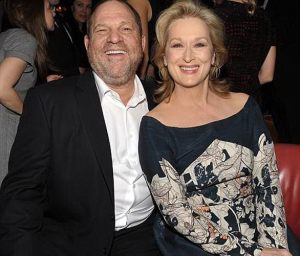
Harvey Weinstein - Meryl Streep

Support Semi-Partisan Politics with a one-time or recurring donation:

Agree with this article? Violently disagree? Scroll down to leave a comment.

Follow Semi-Partisan Politics on TwitterFacebook and Medium.

The Best One Percent

https://www.youtube.com/watch?v=Ps5ttDzWBaY

In his brief remarks to the media, General John Kelly, chief of staff to President Donald Trump, momentarily made everybody else in Washington D.C. look small

Good speeches do not always have to be painstakingly crafted well in advance and written down or beamed onto a teleprompter. Neither do good speeches always require a grand event as their backdrop. Sometimes the most stirring speeches can be extemporaneous, or at least appear relatively spontaneous when delivered.

And into this latter category fall the remarks made yesterday by former Marine Corps general John Kelly, chief of staff to President Donald Trump. Kelly was seeking to defend his boss from accusations that the president had been dismissive bordering on callous when making a telephone call of commiserations to the wife of a fallen US soldier killed in an ambush in Niger, a call which was overheard by a Democratic congresswoman and reported to the media.

I make no comment about the individual circumstances of the case here, though many other media organisations have seen fit to voyeuristically pick over what should be an intensely private moment in order to extract political advantage from it. For those interested, the two opposing sides are effectively summarised here and here.

Far more inspirational than this tawdry back-and-forth, however, were the words of Chief of Staff John Kelly, who sought to end the unseemly debate by describing to the press corps in detail the process which takes place when a US service member is killed in action overseas. These remarks range from the very detailed and practical (describing exactly what happens to the body and where it is taken) to the profound, and are worth quoting at length.

Kelly begins:

Most Americans don’t know what happens when we lose one of soldiers, sailors, airmen, Marines, our Coast Guardsmen in combat. So let me tell you what happens:

Their buddies wrap them up in whatever passes as a shroud, puts them on a helicopter as a routine, and sends them home. Their first stop along the way is when they’re packed in ice, typically at the airhead. And then they’re flown to, usually, Europe where they’re then packed in ice again and flown to Dover Air Force Base, where Dover takes care of the remains, embalms them, meticulously dresses them in their uniform with the medals that they’ve earned, the emblems of their service, and then puts them on another airplane linked up with a casualty officer escort that takes them home.

A very, very good movie to watch, if you haven’t ever seen it, is “Taking Chance,” where this is done in a movie — HBO setting. Chance Phelps was killed under my command right next to me, and it’s worth seeing that if you’ve never seen it.

So that’s the process. While that’s happening, a casualty officer typically goes to the home very early in the morning and waits for the first lights to come on. And then he knocks on the door; typically a mom and dad will answer, a wife. And if there is a wife, this is happening in two different places; if the parents are divorced, three different places. And the casualty officer proceeds to break the heart of a family member and stays with that family until — well, for a long, long time, even after the internment. So that’s what happens.

This is made all the more poignant by the fact that John Kelly suffered the loss of his son – First Lieutenant Robert Kelly – in Afghanistan, and presumably experienced this same heart wrenching process, something invisible to most civilians in the age of an all-volunteer professional army.

The brief core of Kelly’s remarks then focus on the fine qualities of the men and women who serve in the US military, before defending the actions of his boss. First, the praise:

Who are these young men and women? They are the best 1 percent this country produces. Most of you, as Americans, don’t know them. Many of you don’t know anyone who knows any one of them. But they are the very best this country produces, and they volunteer to protect our country when there’s nothing in our country anymore that seems to suggest that selfless service to the nation is not only appropriate, but required. But that’s all right.

Goodness me, that’s powerful. Remember, this is a former Marine Corps general and the serving chief of staff to President Trump, and he is saying that the state of the country is such that America is no longer worthy of the sacrifice made by its men and women in uniform. Think on that for a moment.

And then comes the necessary defence of President Trump, in which Kelly references his own painful loss:

So he called four people the other day and expressed his condolences in the best way that he could. And he said to me, what do I say? I said to him, sir, there’s nothing you can do to lighten the burden on these families.

Well, let me tell you what I told him. Let me tell you what my best friend, Joe Dunford, told me — because he was my casualty officer. He said, Kel, he was doing exactly what he wanted to do when he was killed. He knew what he was getting into by joining that 1 percent. He knew what the possibilities were because we’re at war. And when he died, in the four cases we’re talking about, Niger, and my son’s case in Afghanistan — when he died, he was surrounded by the best men on this Earth: his friends.

That’s what the President tried to say to four families the other day. I was stunned when I came to work yesterday morning, and broken-hearted at what I saw a member of Congress doing. A member of Congress who listened in on a phone call from the President of the United States to a young wife, and in his way tried to express that opinion — that he’s a brave man, a fallen hero, he knew what he was getting himself into because he enlisted. There’s no reason to enlist; he enlisted. And he was where he wanted to be, exactly where he wanted to be, with exactly the people he wanted to be with when his life was taken.

That was the message. That was the message that was transmitted.

This next section (which reminds one of Cicero’s exclamation O Tempora, O Mores!) is good too, because it is so obviously heartfelt coming from somebody from an older generation raised in a dignity culture:

It stuns me that a member of Congress would have listened in on that conversation. Absolutely stuns me. And I thought at least that was sacred. You know, when I was a kid growing up, a lot of things were sacred in our country. Women were sacred, looked upon with great honor. That’s obviously not the case anymore as we see from recent cases. Life — the dignity of life — is sacred. That’s gone. Religion, that seems to be gone as well.

Gold Star families, I think that left in the convention over the summer. But I just thought — the selfless devotion that brings a man or woman to die on the battlefield, I just thought that that might be sacred.

Kelly ends with this scathing criticism of politicians such as the congresswoman who saw fit to leak details of President Trump’s telephone call to one of the families:

I’ll end with this: In October — April, rather, of 2015, I was still on active duty, and I went to the dedication of the new FBI field office in Miami. And it was dedicated to two men who were killed in a firefight in Miami against drug traffickers in 1986 — a guy by the name of Grogan and Duke. Grogan almost retired, 53 years old; Duke, I think less than a year on the job. Anyways, they got in a gunfight and they were killed. Three other FBI agents were there, were wounded, and now retired. So we go down — Jim Comey gave an absolutely brilliant memorial speech to those fallen men and to all of the men and women of the FBI who serve our country so well, and law enforcement so well.

There were family members there. Some of the children that were there were three or four years old when their dads were killed on that street in Miami-Dade. Three of the men that survived the fight were there, and gave a rendition of how brave those men were and how they gave their lives.

And a congresswoman stood up, and in the long tradition of empty barrels making the most noise, stood up there and all of that and talked about how she was instrumental in getting the funding for that building, and how she took care of her constituents because she got the money, and she just called up President Obama, and on that phone call he gave the money — the $20 million — to build the building. And she sat down, and we were stunned. Stunned that she had done it. Even for someone that is that empty a barrel, we were stunned.

But, you know, none of us went to the press and criticized. None of us stood up and were appalled. We just said, okay, fine.

So I still hope, as you write your stories, and I appeal to America, that let’s not let this maybe last thing that’s held sacred in our society — a young man, young woman going out and giving his or her life for our country — let’s try to somehow keep that sacred. But it eroded a great deal yesterday by the selfish behavior of a member of Congress.

As a speech, this has pretty much everything. It might not have been the most stirring or poetic, but John Kelly is a blunt, military man and to have spoken in the cadence of John F Kennedy or Barack Obama would have been totally false and out of character. The authenticity of Kelly’s remarks derive from the seriousness of the subject, the dignified way in which a story of personal loss was mentioned (compared to the overt emotionalism of many contemporary speakers) and the workmanlike delivery.

What John Kelly did more than anything else was shame the people who had sought to cynically use a story based on the death of American soldiers for their own purposes – be it Democratic politicians looking for more character flaws in Trump, Republican politicians who sought to defend Trump or the media who saw a potentially juicy mini-scandal which would generate pageviews and ad revenue.

He shamed a group of neophytes and cynics, people who by and large did not serve in uniform themselves, but saw fit to pontificate on the protocol governing military rituals as though they were discussing any old arcane political dispute. Kelly effectively contrasts the quiet, selfless duty of American soldiers with the self-aggrandising behaviour of American politicians. And there can be few among the Washington DC political class, who measure their popularity by the number of their Twitter followers and see themselves as the centre of the universe, who did not come out of that press conference feeling at least slightly chastened.

This can also only be good for the career and reputation of John Kelly himself, who has faced scepticism that he would be able to rein in the excesses of the Trump administration and criticism for those occasions when that superhuman feat eluded him. By briefly lamenting that women are no longer honoured in today’s America (putting aside the fact that such 1950s-style honour was a double-edged sword), Kelly not-so-subtly denounced his own boss, whose record of behaviour towards women is not good. Criticising the politicisation of gold star families during the Democratic National Convention served the same purpose. Thus, Kelly successfully burnished his image as a man serving out of duty to his country and respect for the office of president rather than admiration for the individual who currently holds that office.

I struggle to think of a contemporary British political speech of similar power and worth. Does anybody recall any of the speeches given this party conference season, besides the slow-motion self-destruction of Theresa May? Has there been a British political speech in the last decade which made the heart beat a little faster or brought a lump to the throat?This is made even more depressing when one remembers that John Kelly is not even a politician – he is a retired general pressed into service to steady a wobbling first-year Trump administration.

Kelly’s remarks are a fine example of an effective speech, composed and well delivered under difficult circumstances, with a hostile media audience ready to throw hard-to-defend accusations against his equally hard-to-defend boss. Yet by the time he was done, John Kelly walked out of that briefing room ten feet taller while everyone else visibly shrank in moral stature.

That’s impressive. I would like to import just a fraction of that ability to Westminster.


UPDATE: 21 October

This report from the Washington Post suggests that John Kelly’s account of Representative Frederica Wilson’s speech at the newly-opened FBI building was not accurate. This in no way detracts from the power of the speech or even necessarily mean that Gen. Kelly’s righteous indignation was altogether misplaced, but the record should be corrected.


UPDATE: 22 October

Having sat back rather pleased with myself, thinking I might have written something vaguely original, I discovered today that Jonah Goldberg was simultaneously coming to the same conclusion in his G-file newsletter.

Goldberg sees in Kelly’s speech the same thing that I see – a dignified admonishment to President Trump as much as to the media or the Left:

The trends Kelly alludes to are real and lamentable, and they predate Donald Trump’s arrival on the national political scene. But it strikes me as indisputable that Trump personifies these trends, and if Kelly were not trying to do his job, he would acknowledge that.

Perhaps Kelly was criticizing the Gold Star Khan family in his remarks about the convention. But he could just as plausibly have had the president in mind. We need not rehearse all of the ways in which Donald Trump — who has bragged of his adultery and sexual assaults and who has insulted women’s looks — has less than an exemplary record of honoring the sanctity of women.

I understand that many Christian groups have convinced themselves that Trump is an instrument of God, but let us not delude ourselves that he is also a man of God.

It is also worth pointing out the media’s evident latent, automatic animosity toward any member of the Trump administration, merited or not. When it was shown that John Kelly misreported the content of Rep. Wilson’s speech at the opening of the FBI Academy, nearly all the media ran with a headline about Kelly being wrong, or even lying. They neglected to point out that the video evidence actually also underlined the truth of what Kelly was trying to say – that on the occasion of the dedication of a building to the memory of slain law enforcement officers, the politician present chose to make the occasion about herself.


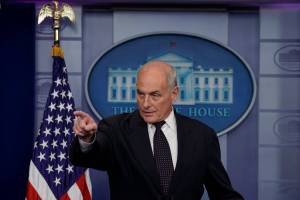
John Kelly - White House chief of staff - press briefing - Donald Trump call to military families

Support Semi-Partisan Politics with a one-time or recurring donation:

Agree with this article? Violently disagree? Scroll down to leave a comment.

Follow Semi-Partisan Politics on TwitterFacebook and Medium.

The Abnormalization Of President Trump

Abnormalization of Donald Trump

Donald Trump is not the first US president to ride roughshod over the Constitution or flout the checks and balances on executive power – and an honest media with any credibility would acknowledge as much

In highlighting the latest craven example of oversensitive American university students and administrations rescinding invitations to prominent conservative-leaning speakers, the Washington Post reports:

Once reserved for cheesy senior photos at campus landmarks, college commencement exercises have graduated into something different six months after Donald Trump was elected president: a battleground for protesting conservative policies and the people who promote them.

This is incredibly disingenuous. The trend of academic institutions and strident students refusing to tolerate the presence of anybody whose opinions diverge from the current leftist, social justice orthodoxy has been on the ascendance for well over a decade now, has accelerated rapidly in the last five years and has been widely commented on, written about and discussed – not least on this blog.

And yet here the Washington Post seeks to present the “student snowflake” syndrome as a new development which only now is rearing its head “six months after Donald Trump was elected president”. This comes perilously close to excusing the rising tide of illiberalism as merely a symptom or reaction against Trump’s unexpected victory, when in actual fact anybody with a functioning brain knows that Donald Trump’s victory was largely the symptom or reaction against the illiberal, intolerant Control Left.

But we are now witnessing a trend of articles and Op-Eds such as this, all seeking to portray every last one of Donald Trump’s actions as US president as being extreme and unprecedented in recent history. On foreign policy, domestic policy, constitutional matters and social issues, critics of Donald Trump (including the prestige Washington media) often seek to portray Trump as far more extreme than he has thus far shown himself to be, at least as far as policy initiatives and executive actions are concerned.

None of this is to support Donald Trump or excuse the atrocious start he has made to his presidency, which has been characterised by one largely self-inflicted political wound after another. Rather, the point is that by falsely pretending that every time Donald Trump breathes he is gravely wounding the Republic in ways unmatched by any previous president, Trump’s critics and the media inadvertently excuse serious failings in US policy and of past US administrations which deserve to be studied, criticised and rectified rather than merely glossed over.

Nicole Hemmer picked up on some of these areas as part of an article in Politico Magazine:

Many journalists covering the White House have lapsed into a practice of “Trump exceptionalism,” a tendency to assume each move the administration makes is new and nefarious. This assumption comes from a well-meaning place—a worry that they will be complicit in normalizing dangerous behavior in an American leader. But there are real risks, too.

First, it leads to quick-trigger panic over events that are normal. Take the reaction to the administration’s dismissal of 46 U.S. attorneys. Journalists framed it as a purge, and the panic escalated when one of those attorneys, Preet Bharara, refused to resign and was subsequently fired. But the dismissal of U.S. attorneys has been standard practice since the 1990s. The novel behavior here was Bharara’s. There’s a cost to getting this wrong: Cry wolf too many times, and readers are less likely to listen when the real dangers appear.

But perhaps the more important consequence of Trump exceptionalism is that it encourages journalists to overlook continuities. Trump is an abnormal president, unprecedented in many ways. But he is not sui generis. His anti-Muslim policies, hard-line anti-immigration stance, even his economic populism and free-trade skepticism all have long histories—even within mainstream conservatism. His nomination of Neil Gorsuch to the Supreme Court was as straightforwardly Republican as it gets.

One can quibble over the wording and focus of Hemmer’s argument – hysterically and disingenuously talking about Trump being “anti-immigration” when he has expressed no clear reservations whatsoever about legal immigration, for example. But her basic point is correct – inexperienced and superficial DC journalists have been too eager to cram every piece of news into their “Trump is unprecedented” narrative, whether each individual action happens to fit the mould or not.

When it comes to the Trump administration’s recent overtures to more authoritarian regimes (including Saudi Arabia and Turkey’s dictator-in-gestation Recep Tayyip Erdoğan), Glenn Greenwald does a far better job counting the ways that US support for morally questionable allies is far from unprecedented:

Since at least the end of World War II, supporting the world’s worst despots has been a central plank of U.S. foreign policy, arguably its defining attribute. The list of U.S.-supported tyrants is too long to count, but the strategic rationale has been consistent: In a world where anti-American sentiment is prevalent, democracy often produces leaders who impede rather than serve U.S. interests.

Imposing or propping up dictators subservient to the U.S. has long been, and continues to be, the preferred means for U.S. policymakers to ensure that those inconvenient popular beliefs are suppressed. None of this is remotely controversial or even debatable. U.S. support for tyrants has largely been conducted out in the open, and has been expressly defended and affirmed for decades by the most mainstream and influential U.S. policy experts and media outlets.

The foreign policy guru most beloved and respected in Washington, Henry Kissinger, built his career on embracing and propping up the most savage tyrants because of their obeisance to U.S. objectives. Among the statesman’s highlights, as Greg Grandin documented, he “pumped up Pakistan’s ISI, and encouraged it to use political Islam to destabilize Afghanistan”; “began the U.S.’s arms-for-petrodollars dependency with Saudi Arabia and pre-revolutionary Iran”; and “supported coups and death squads throughout Latin America.” Kissinger congratulated Argentina’s military junta for its mass killings and aggressively enabled the genocide carried out by one of the 20th century’s worst monsters, the Indonesian dictator and close U.S. ally Suharto.

Nor is Trump’s foreign policy behaviour a particular departure from more recent US administrations:

U.S. devotion to the world’s worst dictators did not end, or even recede, upon the end of the Cold War. Both the Bush and Obama administrations continually armed, funded, supported, and praised the world’s worst dictators.

In 2009, then-Secretary of State Hillary Clinton actually said of the murderous Egyptian dictator supported by the U.S.: “I really consider President and Mrs. Mubarak to be friends of my family.” When Egypt’s defense minister, Gen. Abdel-Fattah el-Sisi, overthrew that country’s first elected government, Clinton’s successor, John Kerry, hailed him for “restoring democracy,” and as Sisi became more brutal and repressive, the Obama administration lavished him with more weapons and money. The U.S. government did the same for the human-rights abusing dictators in Bahrain.

And of course this is to say nothing of Saudi Arabia.

It is bad enough having a US president who seems to suffer from self-delusions. That the Washington media and commentariat are engaging in fantastical delusions of their own is doubly dangerous for American democracy and policy.

To read the combined output of the American media, one would be forgiven for thinking that the George W. Bush administration never sanctioned the illegal torture of prisoners through dubious legal memos, and that the Obama administration never once decided to blast American citizens off the face of the earth with drone strikes, maintaining a “kill list” of US citizens who could be zapped without any due process.

No, apparently all of these sins are now forgiven – to the extent that the servile, sycophantic Washington media bothered to hold past administrations or senior officials accountable for their actions in the first place, generally preferring to party and intermarry with the political elite rather than be remotely adversarial.

In fact, the harsh truth is this: the only reason that Trump administration officials are being dragged over the coals for their own skirting of the Constitution and departures from US diplomatic and international norms are that Donald Trump has refused to cozy up to the Washington media class in the manner typical to all previous presidents, and so has failed to build up the traditional reserves of goodwill which would otherwise lead to effective immunity from scrutiny or criticism of himself and his administration.

This is a real and pressing problem, because every instance when the mainstream US media freaks out and acts as though Donald Trump is breaking new ground in authoritarianism by simply behaving in the same way as his predecessors only serves to drive a wedge between those media outlets and Trump-sympathising voters who already widely distrust the mainstream media – often with good reason.

Trump supporters need to be legitimately informed of occasions when the US president is acting in an unprecedentedly negative way, and examples of such behaviour – like the firing of FBI director James Comey for an ever-changing kaleidoscope of official reasons – are already rapidly mounting up. But their impact is massively diluted when Trump supporters have legitimate reason to believe that the media, angry at their rude treatment by the White House, is deliberately whipping every story into a major scandal, regardless of individual merit.

And the same goes for the rest of us, too. It does dissenting Republicans, Democrats and independents no favours when their every prejudice about Donald Trump is endlessly reconfirmed by an hysterical media which was only too happy to overlook some of the same faults, vices and mistakes in his predecessors of both parties. This behaviour by the media is not new, but the partisan debasement of political journalism has certainly sunk to new lows since Donald Trump took office.

A strong, almost irrefutable argument can be made that Donald Trump has brought the US presidency to an historical nadir through his personal coarseness, egotism, vengefulness and sheer inability to get to grips with public policy. The degree to which Trump’s political radar – so astute in helping him triumph over the establishment in the Republican primaries and general election – has now deserted him as he seeks to manipulate the levers of power in Washington D.C. is remarkable, if somewhat predictable.

Last week, a journalist was arrested in Washington D.C. for questioning Donald Trump’s Health & Human Services secretary, Tom Price, supposedly too aggressively. The alarming story was widely covered in American media at the time, but it has not driven the news cycle to nearly the same extent as other events which have ultimately proved to be little more than Donald Trump following the precedent set by previous administrations.

Why? Because too many in the media are ready and eager to go to DEFCON 1 every time that Trump opens his mouth, rather than cross-checking to see whether the latest presidential pronouncement or action is genuinely unprecedented or merely a more coarsely-worded rehash of something which would have gone unreported during the Clinton, Bush or Obama years.

Those of us with an active interest in the US media repairing and retaining its credibility in the wake of Donald Trump’s presidency should demand better from journalists, pundits and TV talking heads who currently paint every decision made by the Trump White House as an unprecedented step down the road to dictatorship.

The prestige media pretending to its audience that Donald Trump’s upcoming meetings with authoritarian dictators like Turkey’s Recep Tayyip Erdoğan are somehow unprecedented in American history is every bit as “fake news” as the ludicrous stories on the fringe Right about President Obama operating a paedophile ring out of the White House – only the prestige media’s lies and distortions are ultimately far more damaging, being read and believed by people with real power and influence in American society.

In short, Donald Trump is providing enough fresh new worrying material for us all. There is no need for the media to add to the drama by inventing more.


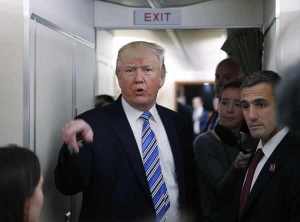
Donald Trump speaks to reporters

Support Semi-Partisan Politics with a one-time or recurring donation:

Agree with this article? Violently disagree? Scroll down to leave a comment.

Follow Semi-Partisan Politics on TwitterFacebook and Medium.