Brexit Catastrophisation Watch, Part 8 – A Song For Europe

When all else fails, sing a song for Europe

From a Remainer perspective, the drawbacks and perils of honouring the unexpected EU referendum result and actually leaving the European Union, as demanded by the British people, are endless.

Already we have heard that Brexit will leave elderly people housebound and uncared for (though perhaps the old gits deserve it, for not appreciating the EU enough), prevent artists from collaborating across borders, herald the triumph of “post-factual politics”, endanger the nation’s fluffy kittens and lead to people being lynched for speaking German in London.

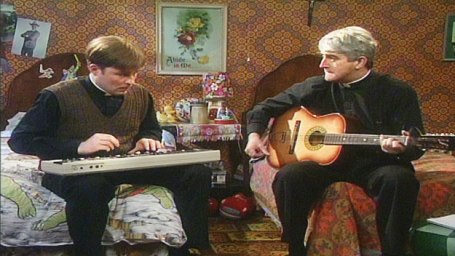
Given the harsh, fascistic dystopia in which EU supporters now find themselves, one might fully expect many of their number to feel depressed, hopeless, withdrawn and resigned to defeat. Not so, though. One woman is fighting back, through the medium of music. And her latest weapon is a cover of Mariah Carey’s classic, “All I Want For Christmas Is You”, reimagined as a wistful ode to the European Union.

The singer is one Madeleina Kay, an “an artist, writer, musician and social activist from Sheffield” who is “committed to using the arts to address important social and political issues and challenge destructive ingrained cultural attitudes”. Yes, she’s a Social Justice Warrior.

We’ll be generous and ignore the fact that the track Madeleina Kay hopes to make Christmas #1 sounds like a worn-out cassette recording of Zooey Deschanel’s inexplicably tone-deaf ghost playing on a battered Sony Walkman with dying batteries running at half speed deep underwater – let’s take a look at the lyrics:

I don’t want a lot for Christmas

There just one thing I need

I don’t care about the presents

In a country fuelled by greed

I just want for us to remain

Yeah, I want things to stay the same

Make my wish come true –

Baby all I want for Christmas is EU.

Because today’s generation of coddled, entitled millennials are actually profoundly conservative, inasmuch as they “want things to stay the same”, preserve and protect their own entitlements and value stability over opportunity.

A country fuelled by greed? Would that be the greed of young people brainwashed into believing that international travel and careers are possibly only through the munificence of the EU, and who then voted to Remain based purely on material concerns affecting them? The young people who claim to be citizens of the world but who make wretched citizens of their own country?

oooooh yeeeeah

I don’t want a lot for Christmas

Especially any new trade pacts, oh

I won’t be deceived by lies

I’m only concerned with the facts, oh

I don’t want my stocking filled with

A gift from Theresa May

Santa Claus won’t make me happy

With another border on Christmas Day

I just want for us to remain, etc.

And here is the customary allusion to the idea that Remainers voted in the EU referendum based on a high-minded, dispassionate review of the facts, basing their decision based on pure reason, while Brexiteers supposedly voted based on ignorant, racially-tinged superstition and emotion.

You and I may have blundered blindly into the voting booth, heads stuffed full of lies told by Boris Johnson and Nigel Farage, but Madeleina Kay and her Remainer friends painstakingly considered every piece of available evidence, every testimonial and every possible angle (economic, diplomatic, political, cultural and historical) before deciding that the European Union is just super, and that Britain should remain a member state forever.

And Kay clearly hates the Evil Tor-ees so much (more on that later) that she would refuse a gift from Theresa May if one were offered. We are clearly dealing with a young lady of great wisdom and principle here.

I won’t ask for much this Christmas

I won’t even ask Jeremy Corbyn to go

I just want to share the love so

I’ll wait beneath the mistletoe

I won’t make a list of demands

To send to Boris Johnson or Saint Nick

I won’t even try to chase away

Nigel Farage with a large stick, oh

For the sake of peace I will fight

Until we have seen the light

What more can I do?

Baby all I want for Christmas is you.

Okay, so Madeleina is a trendy lefty, but not of the Corbynista variety. Good to know. And it is also encouraging to know that the songstress intends to wage unrelenting war in the cause of “peace” – the peace that only the EU can give.

Oh the red bus driving

Spreading lies everywhere

And the sound of NHS patients’

Crying fills the air

And everyone is doubting

The lies they kept on shouting

Santa won’t you bring me the things I really need?

Like compassion, tolerance, multiculturalism

And a fair democracy?

Obligatory reference to Our Blessed NHS (genuflect)? Check.

Because of course every single patient in the NHS is lying in their hospital bed, their kidney transplant utterly dependent on the instant £350 million windfall that we all totally believed would land in our laps the moment we voted for Brexit, weeping at having been so cruelly betrayed by Vote Leave. And again, the only lies uttered in this campaign were those told by the official Leave campaign. Remainers possessed a virtuous monopoly on truth at all times.

And who can argue with Kay’s assertion that compassion and tolerance have been sucked out of Britain ever since the EU referendum? Personally, as a Brexiteer I delight in witnessing the suffering of others and adding to it wherever possible, and am incredibly intolerant of dissenting viewpoints, seeking to squash free speech, shame and intimidate people into fearful silence – quite the opposite of enlightened Remainers.

I don’t want a lot for Christmas

This is all I’m asking for

All my European friends singing

Stille Nacht outside my door

Oh I just want for us to remain

Yeah, I want things to stay the same

Make my wish come true

Baby all I want for Christmas is you.

Well, at least Madeleina correctly recognises that Germany is the dominant force within the European Union, that community of (ahem) equals based purely on “friendship” and “cooperation”.

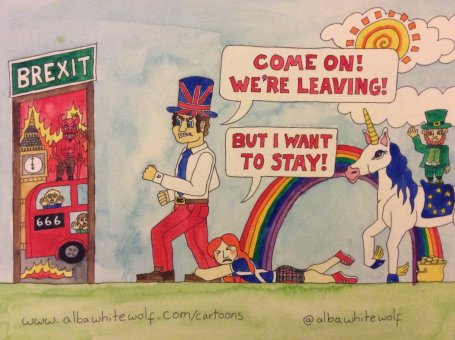
But it gets better. It turns out that Madeleina Kay is also a rather prolific cartoonist, expressing many of her stridently superficial pro-EU sentiments through numerous political cartoons. Much of her artwork seems to channel a bizarre Wizard of Oz obsession, in which EU supporters are portrayed as childlike innocents while any conservative or pro-independence politician is generally depicted as a snarling, fanged monster (Theresa May becomes the Wicked Witch of the West):

And no prizes for guessing who this X-Files monster is supposed to be:

I am strangely drawn to Madeleina Kay’s art because it represents very simply and honestly the simplistic thinking of leftists and Remainers alike. When she draws winged demons snatching the “Future Opportunity”, “Life Chance” and “Hope” from helpless children, she reveals how leftists genuinely see the British people – as feeble lemmings in need of constant nurturing and support from government, utterly adrift when faced with separation from the European Union which seeks to be an auxiliary parent to us all.

So this is much less a criticism of Kay, and more an attack on the stunted, juvenile thinking of those politicians and commentators who frequently express in words the same ideas and sentiments that Madeleina renders in crayon. Kay, after all, is young and naive.

I myself was a drooling europhile in my student days only a decade ago, a committed euro-federalist with an EU flag adoring my university dorm room. Wider reading and real life experience eventually disabused me of these dangerous notions, and Madeleina Kay may yet go through a similar conversion and learn to put down the guitar and the Crayolas in pursuit of something more worthwhile.

But until then, at least we can sing along to “All I Want For Christmas Is EU” – either wholeheartedly or ironically, according to our position. And to be fair, it’s no worse than that ghastly, sycophantic NHS worship song we bizarrely saw fit to make Christmas #1 last year.


Postscript: Now you can buy anti-Brexit Christmas cards designed by Madeleina Kay. An essential purchase for all virtue-signalling Remainers who don’t have the first clue what the EU is or how it works, but who need to show their friends that they are very much against leaving.


Hat tip: Pete North
madaleina-kay-european-union-brexit-cartoons-unicorns-and-leprachauns-2

father-ted-a-song-for-europe

Bottom Image 1: Madeleina Kay / Twitter

Bottom Image 2: Channel 4

Support Semi-Partisan Politics with a one-time or recurring donation:

Agree with this article? Violently disagree? Scroll down to leave a comment.

Follow Semi-Partisan Politics on TwitterFacebook and Medium.

This Generation Of Politicians Will Not Secure The Benefits Of Brexit

brexit-pixabay

Four months after the EU referendum, our leaders continue to shrink from the challenges (and opportunities) which lie ahead

As is nearly always the case, Pete North has the best analysis and summary of exactly where we are with our Brexit deliberations – and right now, the answer is rather depressing:

For several months we had the great and the good telling us how important the single market was and how valuable the EU was to the UK. Now that they are tasked with leaving the EU we see that they can barely define the EU and the single market let alone offer an adequate critique as to whether it is right for the UK.

Through successive treaties our parliament has idly signed away substantial areas of policy to be decided overseas with hardly any public scrutiny. It is therefore ironic that MPs now demand parliamentary sovereignty in scrutinising the terms of the exit arrangements when they showed so little interest in what they were signing away.

By voting to leave the EU we have caught the entire system of government off guard to show that is is totally ill-equipped to govern – and those claiming to represent us have failed in their duty to safeguard our democracy. Through forty years of negligence the UK’s trading relationship with Canada is decided not by Number Ten or Westminster. Instead it depends entirely on the Walloon assembly in Belgium.

And therein lies the inherent flaw in the EU design. The DNA is faulty. Introduce democracy and the whole thing grinds to a halt. Take it away and power ends up in the hands of the few. It cannot work and it cannot be reformed yet we have endured decades of politicians telling us otherwise.

One of the most depressing aspects of life post-EU referendum has been watching our national leaders shrink from the challenge of implementing Brexit. I don’t mean that they are all necessarily in denial, or that they wish to subvert the referendum result – but rather that their every public pronouncement suggests that many of them are simply not up to the task which lies ahead. Typically, this isn’t a question of intelligence, but rather a lack of imagination and ambition. And in truth, perhaps it is too much to expect the same politicians used to implementing EU decisions or operating within their constraints to suddenly step up and become adept drivers of a country suddenly without training wheels.

The debate has thus devolved into two rather tiresome strands – the one held by most Remainers, who have become intent on catastrophising Brexit at every turn and seizing upon every scrap of potentially troubling news as further evidence that the end is nigh, and the opposing, buccaneering view which loudly insists that everything can be wrapped up to Britain’s complete satisfaction by March 2019, and sees any questioning of this certainty as evidence of anti-Brexit treachery.

This blog falls down the gap between these two comically exaggerated positions, which is perhaps why I haven’t been writing about Brexit as much as I should have been lately. One can only slap down so much ridiculous establishment catastrophising of Brexit (now the nation’s fluffy kittens are in peril, apparently), while pointing out the need for a transitional arrangement and securing continuity of access to the single market still falls on deaf ears among those in charge, and only feeds the smug (but not entirely false) Remainer assertion that Brexiteers don’t know what they are doing.

And yet a transitional arrangement is exactly what we need, as Pete North explains:

What will become clear in due course is that Britain will need a continuity arrangement that sees little or no change to the labyrinth of customs procedures and regulations that make up the single market. Neither Britain nor the EU can afford to start tinkering under the hood of long established trade rules. The sudden collapse of CETA at the hands of a Belgian provincial assembly shows just how dysfunctional the system is.

If anything is inflicting damage on the UK it is not Brexit but the overall uncertainty over what Brexit looks like. This in part down to those media vessels determined to make Brexit look like a catastrophe and in part down to those politicians who have not bothered to plan for the eventuality. We are four months on from the referendum and key ministers are still struggling with basic terminology.

Brexit is by far the biggest and most ambitious thing that this country has attempted in decades – frankly, since the Second World War. It demands painstakingly extricating Britain from a web of agreements and schemes of a complexity befitting an organisation which still seeks to become the supranational government of a federal Europe. But to make it even more complicated, we will wish to maintain many avenues of cooperation after leaving the EU’s political union, meaning that a slash and burn of laws will not do – hence Theresa May’s much over-hyped Great Repeal Act.

As Pete points out, it is highly ironic that sulky Remainers are suddenly so interested in having Parliament examine every aspect of the secession deal (with the more juvenile characters, who clearly know nothing about negotiations, expecting to be briefed in advance) when over several decades they blithely signed away powers to the EU with barely a second thought, and certainly no real public debate.

It makes the Remain camp’s current favourite attack line – Brexiteers wanted to return decision-making power to Parliament, so why won’t they let Parliament have a say?! – especially cynical. But the argument is wrong anyway. “Returning powers to Parliament” is a handy catchphrase, but it is a glib one, always favoured more by eurosceptic MPs than the general public.

The current anti-establishment rage currently roiling Europe and America shows that political leaders have become too distant from (and unresponsive to) the people, no matter the level of power. Therefore, returning powers to the Westminster parliament is not enough – we need an end to British over-centralisation and the devolution of power back to the counties, cities, towns and individuals.

Sadly, the chance of meaningful constitutional reform taking place in Britain any time soon continues to hover around zero. And rather than Brexit being the catalyst for such change, as this blog once hoped, it now seems that an intellectually and imaginatively challenged political elite will hide behind the complexity of Brexit as an excuse to avoid doing anything else of substance. One can easily foresee a situation in a decade’s time where Britain is technically outside the EU but stuck in an increasingly permanent-looking halfway house, with acceptable access to the EEA but with none of the later work to move towards a global single market even started.

Would this be good enough? Well, Britain would be outside of the political structure known as the EU, which was always the base requirement – so if one is happy to shoot for the middle and accept the bare minimum then yes, it might have to do. But it would be an appalling failure of ambition, when there are real opportunities to improve the way that international trade and regulation works and to revitalise British democracy through wider constitutional reform.

But to realise great ambitions requires there to be half-decent leaders pointing the way. And looking at the Tory “Three Brexiteers” and the dumpster fire that is the Labour Party, one cannot help but conclude that great leaders – even just competent heavyweight politicians – are in short supply at present. Do you really see Boris Johnson’s name featuring in a future Wikipedia article about the great British constitutional convention of 2020? Or Theresa May’s? Jeremy Corbyn or Hillary Benn’s?

Do I regret my decision to campaign for Brexit? No, never. The European Union is offensive to any proper sense of democracy, or to the notion that the people of a sovereign nation state should decide and consent to the manner in which they are governed. Being rid of the EU (and hopefully helping to precipitate that hateful organisation’s eventual demise) is a solidly good thing on its own. But Brexit could be so much more than it is currently shaping up to become.

And perhaps this is the most damning thing of all about the European Union: the fact that 40 years of British EU membership has slowly turned the nation of Winston Churchill, Clement Attlee, Margaret Thatcher, Hugh Gaitskell, Tony Benn, Barbara Castle and Peter Shore – men and women of principle and substance – into the nation of Tony Blair, David Cameron, Nick Clegg, Chuka Umunna, Diane Abbott and Owen Smith.

A nation simply does not bounce back from that kind of decline in the space of a few years, and the more that our contemporary politicians carry on about Brexit the clearer this becomes.

Assuming that Brexit goes to plan, it may not be until the next generation of political leaders come of age (at the earliest) before we can finally take full advantage of our newfound freedom.


European Union - United Kingdom - Britain - Flags

Top Image: Stux, Pixabay

Support Semi-Partisan Politics with a one-time or recurring donation:

Agree with this article? Violently disagree? Scroll down to leave a comment.

Follow Semi-Partisan Politics on TwitterFacebook and Medium.

Brexit Catastrophisation Watch, Part 6 – Stay In The EU Or Kittens Will Die

kitten

Hysterical Remainiacs are now warning that Brexit will endanger the lives of the nation’s pets and farm animals

For the past four months, the British people have been subjected to some ridiculously childish hissy fits and the incessant catastrophisation of Brexit by self-regarding EU apologists in the media. But this latest tantrum by Ian Dunt, editor of politics.co.uk, is on another level.

Ian Dunt already has great form in portraying the slightest move to limit the growth of the state or safeguard national sovereignty as being part of a plot by the Evil Tor-ees to kill the poor and chuck out every last foreigner, but his increasingly bitter and alarmist Brexit coverage is starting to make him look particularly ridiculous. Because Dunt is now claiming that among the many other evils of Brexit, spurning the EU and demanding self-government will also put “people and animals at risk”.

Yes. Going ahead with Brexit means that kittens will die.

Dunt explains:

Look at any part of British society and you’ll see the damage Brexit is doing.

Take veterinary services. Yesterday afternoon, the Royal College of Veterinary Surgeons (RCVS) and the British Veterinary Association (BVA) wrote a letter to the prime minister. These are not radical organisations. They never really put out political statements of this sort. They stay in the background, concerning themselves mostly with relatively dry questions of policy detail. But they’ve been forced to issue a warning that Brexit – and Theresa May’s descent into anti-foreigner rhetoric – are putting people and animals at risk.

“Anti-foreigner”? Really? One can argue endlessly about the economic merits of Theresa May’s seeming determination to reduce net migration, but I challenge Ian Dunt to produce one example where the prime minister has actively sought to whip up anti-foreigner feeling in the population.

Wanting controls on immigration is not an extremist or unpalatable political viewpoint – many countries in the world (like Australia and the United States) don’t automatically accept anybody from their region or continent who wants to live and work. And at some point the British Left are going to have to take their collective finger off the nuclear button and stop screeching “racism” at anybody who dares to suggest that government should have control of who is allowed to come and settle in the country.

Regardless, Dunt continues:

Around half the veterinary surgeons registering to practise in the UK each year are from overseas – mostly the EU. Europeans are particularly prevalent in public health roles like the Government Veterinary Services. In the meat hygiene sector, some estimates put the number of veterinary surgeons who graduate overseas at 95%. And these people – the people who look after our pets, who check our food – are feeling increasingly uncomfortable in this country.

And this supposedly matters because:

The veterinary profession doesn’t just look after pets. It monitors and controls the spread of disease and assures the quality of the food we eat. If it goes into decline, the animals we love and share our homes with are in more danger. But there is also a very significant public health risk to go alongside the emotional one.

[..] while anti-immigrant newspapers and politicians whinged, immigrants were there: Treating your cat. Picking your fruit. Treating your condition. They are crucial to the running of this country and unless we start recognising that, it’ll be this country which suffers the consequences of their absence.

[..] The policy implications of Brexit are even more serious. In the future, the two organisations warn, “changes to the mutual recognition system or immigration restrictions could have a profound impact upon the veterinary workforce”. That means Britain may face a shortage of vets as it loses half its annual intake. It means a potentially catastrophic impact on TB testing and meat hygiene. It means abattoirs may be unable to export their products because the UK veterinary requirements are not recognised by European authorities.

So in other words, wanting to leave a deeply unpopular and dysfunctional continental supranational government is so terrible that it will kill our pets, causing us immense emotional harm, and also ensure that agricultural and food safety standards immediately fall off a cliff, leading to the immediate return of BSE and foot and mouth disease. Our democracy is hostage to the presumed fortunes of our household pets.

See? We warned you! Why didn’t you listen! Now Fluffy the Kitten is going to die, and it’s all your fault, you ignorant, hateful, xenophobic Brexiteer!

Will these histrionics from bitter, intellectually bankrupt Remainers never end?

The one valid point in this screaming tantrum of an article is that changes to (or severance of) the mutual recognition agreements governing veterinary standards or food safety – much of the latter of which actually falls under the purview of Codex Alimentarius – could cause real disruptions to trade. Too much of the political debate over Brexit has focused on buccaneering assumptions by government ministers and journalists that the avoidance of tariffs is the sole issue, when this is not at all true. The potential erection of non-tariff trade barriers by failing to extend mutual recognition of standards would have immensely more impact on British industry in terms of cost and complexity of doing business, and it is this which politicians need to wrap their heads around.

Dunt (inadvertently) raises an important issue here, and a timely warning. But his incessant, hysterical scaremongering (and pretence that there are no solutions or workarounds to the practical issue he flags) overshadows his argument. This is the polar opposite of constructive criticism – it is the kind of sulky fault-picking more worthy of a toddler than a grown man with a political website.

And yet I am coming to suspect that this is how it will always be. Never expecting victory in the EU referendum, I naturally didn’t devote much time to thinking about what it would actually feel like to be on the winning side, to finally overturn the 40-year pro-EU consensus. Now I’m starting to get an idea. And it is not pleasant.

Brexiteers had better get used to endless “won’t somebody please think of the kittens?!” caterwauling from aggrieved pro-Europeans, because it will probably last the rest of our lives. Even if Brexit ushers in the kind of democratic renewal that some of us hoped for – and even if we achieve secession from the EU on the most favourable terms possible – they will still criticise us and act as though we have ushered in an unprecedented calamity. And in the absence of counterfactuals, who can disprove Ian Dunt when in five years he whines that we would be enjoying hover cars and 200 year lifespans if only we had done the sensible thing, listened to him and voted to remain in the EU?

Brexiteers should settle in for the long haul. Yesterday it was Marmite, today it’s kittens and tomorrow it will be something else. And why? All because Ian Dunt and other pro-European can’t just bring themselves to say “I hate patriotism, I’m ashamed of my country, I feel more European than British and more than anything I hate the 52 percent of my fellow citizens for  defying my will and causing me not to get my own way for once in my life”?

Maybe therapy would help some of the Remainiacs-in-denial towards a necessary moment of catharsis. One can only hope so. Their endless hysterics and catastrophisation of Brexit makes them look far more stupid than it makes Brexit seem reckless.

European Union - United Kingdom - Britain - Flags

Top Image: Nanto, Pixabay

Support Semi-Partisan Politics with a one-time or recurring donation:

Agree with this article? Violently disagree? Scroll down to leave a comment.

Follow Semi-Partisan Politics on TwitterFacebook and Medium.

Brexit Catastrophisation Watch, Part 5 – Britain Stronger In Europe Tacitly Admit They Were Lying The Whole Time

open-britain-hard-brexit-soft-brexit-catastrophisation

While advocating a “soft Brexit” as their fallback position, Remainers contradict themselves and expose the tawdry lies they told during the EU referendum

Even Open Britain, the shrivelled husk of Will Straw’s failed Remain campaign group Britain Stronger in Europe, has now effectively admitted that leaving the European Union need not be intrinsically economically harmful – thus undermining the central pillar of their case for staying in the EU.

The harsh light which Remainers are now knowingly shining on their prior scaremongering and lies is quite hilarious. By drawing a distinction between “hard” and “soft” Brexit and campaigning fervently for continued membership of the EEA, campaigners are effectively admitting that their many economic apocalypse warnings applied only to leaving the single market, and not the EU’s political union.

From an Open Britain campaign email sent to supporters yesterday:

Open Britain is campaigning for Britain to stay in the Single Market, which brings increased investment, trade, jobs and growth.

It seems the public agree. A new poll we commissioned has found that 59% of voters want the UK to stay in the Single Market, so there is no mandate for a destructive Brexit.

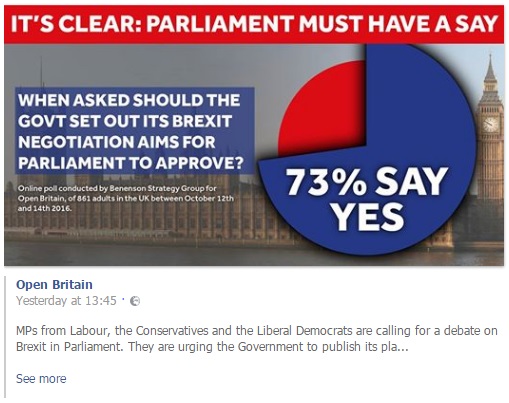
Now, MPs from Labour, the Conservatives and the Liberal Democrats are calling for a debate in Parliament. They are urging the Government to publish its plan for the forthcoming EU negotiations and to allow Parliament to approve it. A huge majority – 73% of people – support this.

Our future partnership with the EU should be not decided in secret but determined by democratic debate.

There is “no mandate for a destructive Brexit,” we are told. Well, that’s funny. Because not long ago, every Remainer in town – most certainly including Britain Stronger in Europe – was screeching about the automatic ruin which would befall Britain if we voted to leave the EU, regardless of how the Brexit process played out or whatever our eventual new trading and political relationship with the EU happened to be. For months we were told by sanctimonious Remainers that “destructive Brexit” was the only kind of Brexit available – yet now they acknowledge a benign version of Brexit and encourage us to adopt it.

Fast-forward four months and suddenly the story changes. Now, apparently, we need to fight tooth and nail to preserve our membership of and unimpeded access to the single market, because this is the lynchpin on which Britain’s economy rests. In other words, their entire economic scaremongering case was a giant lie.

Oh sure, they’ll come back and claim that most Brexiteers supposedly want a “hard Brexit” and that the major Leave campaigns envisioned Britain leaving the single market, which is why they felt justified in equating the European Union with the single market in their own campaign rhetoric. But this is the mealy-mouthed defence of someone who has been caught in a blatant lie. Remainers were desperate to bury the awkward fact that the EU and single market are not one and the same thing, and the fact that they did all they could to fudge the distinction (heck, they suggested that leaving the EU meant severing ourselves from the continent of Europe) shows that they were more obsessed with economic scaremongering than truth. It is Remainers, not Brexiteers, who dwell in a land of post-factual politics.

As this blog recently commented:

Funny. It’s almost as though [Remainers] are suggesting that leaving the EU needn’t necessarily mean “plung[ing] the UK into a period of recession and international decline”, and that Britain’s economic and diplomatic health is actually contingent on the kind of choices that Britain makes once we are free of the supranational political union.

Claiming that a mismanaged, uncontrolled or “hard” Brexit might cause serious economic harm is a perfectly respectable position. More than that, it is basic common sense. But that isn’t the argument that Remainers were making during the EU referendum campaign. No, they were claiming that any form of Brexit would be disastrous, that Britain leaving the European Union would be economically calamitous in and of itself, regardless of how Brexit unfolded or the model of our future trading relationship with the EU.

As it happens, this blog agrees with Open Britain’s revised position. Certainly as an interim measure Britain should remain in the EEA while working toward a longer-term solution which hopefully replaces the single market with a new framework which is more democratic and not part of a protectionist, beady-eyed, euro-federalist master plan. Given that the most skilled trade negotiators in the world (in which Britain is singularly lacking, despite generous help from our Commonwealth friends) take a decade or more to thrash out comprehensive bilateral agreements it is the height of idiocy to assume that a Brexit-inspired sense of urgency and the concerns of “German car makers” will get the job done in the initial two short years set out in Article 50 of the Lisbon Treaty.

But why couldn’t the Remainers just be honest from the beginning, level with the British people and tell them that it is Britain’s uninterrupted EEA access, not our membership of the supranational political union, on which our economic stability depends?

The answer, of course, is that for top Remainers the EU referendum was never about economics. It was about their craven desire to live in an amorphous internationalist blob where the nation state is fatally undermined and the strongest level of government and identity reforms at the European level. That’s what they wanted but couldn’t say in public. And so instead they falsely equated the EU with the single market in an attempt to scare low information voters and assorted unthinking lefties that voting for Brexit inherently meant economic doom.

Now that the decision to leave the EU has been made, these disingenuous people are having to regroup and come up with a new argument – that it is our future relationship with the single market, not the EU, which will have the greatest potential impact on our economy and future prosperity. And just as even a stopped clock tells the correct time twice a day, this time they happen to be correct.

Unfortunately, changing arguments mid-stream also reveals that nearly everything that the Remain campaign said prior to the EU referendum was a deliberate, filthy lie.


European Union - United Kingdom - Britain - Flags

Support Semi-Partisan Politics with a one-time or recurring donation:

Agree with this article? Violently disagree? Scroll down to leave a comment.

Follow Semi-Partisan Politics on TwitterFacebook and Medium.

A Third Runway At Heathrow Or Fixing Potholes In Roads? We Need To Be Bigger Than This In The Age Of Brexit

aviation-airplane-on-tarmac-at-airport

It is Westminster politicians and journalists, not Brexiteers, who have been short sighted and parochial

The Telegraph’s James Kirkup poses an interesting question about the expansion of Heathrow Airport and other national political priorities in the post-Brexit world:

Almost 70 per cent of commuting is done by car so roads are clearly of interest to voters, never mind the wider economics.   But it’s hard to avoid the conclusion that big shiny infrastructure projects like runways and high-speed railways are simply more glamorous and interesting to politicians and, yes journalists, who spend more time in London (where most people commute using public transport) than stuck at a roundabout trying to get onto a bypass.

Airport expansion is about international trade and competitiveness, our national self-image and our global role. All the important things that important people in London spend so much time talking about, in other words.  And rightly so. We should have another runway at Heathrow, and one at Gatwick, come to that: the more competition the better

But then our leaders really should start talking about things that are actually important to the people they work for: clogged roundabouts, congested junctions and potholes.

Earlier this year, the Treasury gave councils £50 million extra to fill holes in roads. Councils reckon they need £12 billion more to fill them all. That’s close to the £16 billion that might need to be spent on new roads around an expanded Heathrow. Which would voters choose in a referendum?

Read the whole thing – it is a thoughtful piece. And of course James Kirkup is right to point out that key national infrastructure projects and local community investment need not be mutually exclusive.

Personally, I make no apologies for firmly supporting the expansion of Heathrow Airport, as well as new runways for Gatwick Airport any any other airport which wants to expand to the benefit of our aviation sector.

As this blog previously ranted:

Air travel is great. It takes rich tourists from wealthy countries and brings them to poorer countries where they boost the local economy with their money. It keeps the wheels of business turning, from the CEO flying from New York to London for a meeting, the office worker commuting to Berlin every week for a project, to doctors and scientists gathering for international conferences.

Air travel bridges the distance between our towns and cities and helps knit the planet together through a web of far-flung family members, friendships and business relationships. And in doing so, the aviation industry helps to foster trust and understanding, bridging cultural divides and doing more to affirm our common humanity than any third-sector institution or political movement.

And yet we seem intent on attacking aviation, thwarting its growth and choking the life out of the industry with punishing airport taxes and insurmountable barriers to expansion. And for what? So that human beings can creep meekly across the surface of the planet, apologising for our very existence and ostentatiously offsetting the carbon dioxide we emit whenever we open our mouths?

But I must admit to bristling a bit at Kirkup’s analogy comparing Brexiteers to downtrodden locals worried only about potholes in their roads, while the Remain-supporting establishment are cast in the role of far-sighted metropolitan elites who alone acknowledge and face up to the long term problems facing our country.

If anything, it is actually the other way around. By continually divesting Westminster of more and more decision-making authority through successive EU treaties and agreements, it is the British political class who effectively dragged the level of our political discourse down to the level of squabbling about NHS waiting times, train delays and potholes in the roads. When all of the consequential decisions – like trade, and increasingly foreign relations – are taken at the European level, all that’s left for British politicians is to squabble about whether the BBC should be forced to up its bid for The Great British Bake-Off.

That’s why we now have a wishy-washy parliament and civil service which is having to rebuild atrophied trade negotiation competencies almost from scratch, while we look to our prime minister less as a world leader or person of real consequence, and more as a glorified Comptroller of Public Services, someone to moan about on social media when the local library closes or the street lights don’t get repaired quickly enough.

The British people instinctively realised this, too, when they voted in the EU referendum. They realised that they only way to even begin to regain control over the full range of domestic and foreign affairs which trickle down to impact their lives was by leaving the failing supranational, federalist experiment known as the European Union.

Kirkup suggests that our leaders “our leaders really should start talking about things that are actually important to the people they work for: clogged roundabouts, congested junctions and potholes”. Well excuse me, but I specifically do not want the prime minister of my country to be wasting her time fussing over potholes and traffic jams. I want the political leadership of this country to set its sights on higher matters for once. In fact, the rule of thumb should be that Westminster only takes an interest if a decision cannot be fairly and responsibly made at a lower level.

And as for Kirkup’s fact that £50 million was given by the Treasury to local authorities to fill in potholes, this is simply more evidence that all government in Britain is vastly overcentralised – that the work of constitutional and governance reform must continue well beyond Brexit. Why not vastly reduce the amount of personal income tax or VAT claimed by central government, and devolve increased tax-levying powers to the counties instead? That way, the people of Liverpool and Bristol can pursue policies which work for them, while the people of rural Essex or Cambridgeshire can do likewise – whether they choose to prioritise filling in more potholes or attracting new investment by slashing taxes or offering incentives to business.

The real danger of Brexit is that nothing much changes and we fail to rock the boat; that we fail to properly grab this once-in-a-lifetime chance to critically re-examine the way in which we govern ourselves and make important decisions at a personal, community and national level. Securing an economically stable secession from the European Union should be the minimum requirement, not the grand prize. Why go to the effort of leaving the EU simply to return to being governed by the same set of domestic institutions which orchestrated our national decline prior to joining the European Economic Community, and then gave away more and more power to EU institutions once we were inside?

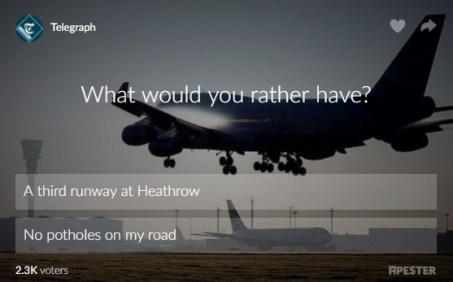
Ultimately, the media does us a disservice by framing idiotic questions and false choices like whether we would prefer a new runway at Heathrow Airport or for the potholes on our road to be fixed:

third-runway-at-heathrow-airport-or-no-potholes-on-my-road

Ask your average group of people whether they want to see enacted a policy which benefits them personally or one which has larger but more disparate benefits spread among a much larger population, and a majority will vote with their own immediate self interest – 67% to 33% as it currently stands on the Telegraph’s online poll.

Does that mean that this is the better policy? Absolutely not. There are times when we are one nation and must subordinate the narrow interests of certain interest groups in order to further the national interest, and there are many other times when we should be able to organise ourselves as communities and regions without the heavy-handed interference of Westminster. And while central government should absolutely be rolled back in many areas, subjecting new airport runway capacity decisions to a citizen’s pothole veto is precisely the wrong way to run a country or frame important strategic decisions.

We need to up our game. Politicians, journalists, ordinary citizens alike, all of us need to try harder to live up to the momentous times in which we find ourselves.

If we stop shooting for the middle and actually try to make the most of the historic opportunity afforded by Brexit then in a decade’s time we might witness a rebirth of local democracy and improve citizen participation in the democratic process at all levels. Better still, we might stop behaving like such dependent children, looking petulantly to Westminster for solutions to every issue we face. And if we stopped demanding that the same people who deal with matters of war and peace and the economic stewardship of the country also ensure that the Number 12 bus runs on time then maybe, just maybe we might improve both the quality and speed of critical decision making in this country.

And yes, maybe then there will finally be a gleaming new runway at Heathrow Airport, and at Gatwick too. Because voting for Brexit was the far-sighted, responsible act of enlightened citizens, not grumbling, parochial NIMBYs. And it should be the first of many such acts, not the last.


heathrow-airport-departure-lounge

Top Image: Michael Gaida, Pixabay

Bottom Image: LadyDisdain, Pixabay

Support Semi-Partisan Politics with a one-time or recurring donation:

Agree with this article? Violently disagree? Scroll down to leave a comment.

Follow Semi-Partisan Politics on TwitterFacebook and Medium.