Nick Clegg, Defiler Of Liberalism, Has Something To Say About Populism

Populism is bad, mmkaaay?

“I think it’s important to remember populism can be a very positive, can be – I mean, Gandhi was a kind of populist. If populism is about challenging a complacent elite, challenging an established order, speaking for people who are not spoken for, populism is a really really important antidote for complacency in politics” – Nick Clegg

The only way that one can hold this seemingly benign attitude toward populism while deploring Brexit and the vote to leave the European Union is either to misunderstand the true nature and purpose of the EU, or to be engaging in deliberate deception.

Nick Clegg is not an uneducated man. With his career, he knows better than most precisely what the EU is, how it operates and where it is heading. He knows that the European Union is more than the “friendship ‘n co-operation”, humble free trade club portrayed by deceitful Remainers during the referendum campaign. In other words, the ignorance excuse is not available to Nick Clegg.

That leaves only the conclusion that Nick Clegg is a liar. A very affable and eloquent liar, certainly, but a liar all the same, and a particularly dangerous one for his gifts.

Nick Clegg would seriously have us believe that the European Union has nothing to do with a “complacent elite”, an “established order” or “complacency in politics”, and that therefore Britain voting to liberate ourselves from the EU is therefore the “bad kind” of populism as opposed to the virtuous kind, which he happily supports. How anybody could sit and listen to him advance this view without either laughing or heckling is completely beyond me.

What nonsense; Nick Clegg has no time for populism of any kind, because it inevitably threatens the rule and routines of the elite in which he is so personally ensconced. Besides the archetypal High Tory, it is hard to imagine a senior British politician with less affinity for anyone who supports any populism movement. At his core, Nick Clegg believes that politics is something to be done to the people by enlightened, “liberal” elites like himself, not something for the masses to influence, with their base prejudices and uncomfortable opinions.

We know this because immediately prior to praising populism, Nick Clegg also said this:

“Populism is redolent with kind of uncontrollable rages and angers and passions, whereas liberalism – at least the liberalism I believe in – is about reason, rationality and evidence, and so on and so forth.”

No. The “liberalism” that Nick Clegg believes in consists of insulating oneself inside an hermetically sealed, epistemically closed information loop, listening only to those “experts” or paying heed to those “facts” which are conveniently in line with one’s own globalist, anti-nation state worldview to the complete exclusion of all other parameters, angles and viewpoints, before applying “reason” to that desperately narrow window on reality and pronouncing verdicts which always comfort and never challenge the metropolitan Regressive Left mindset.

Nick Clegg is perfectly entitled to hold and profess those seethingly anti-democratic, elitist positions. But he should not be allowed to get away with calling himself a liberal while he does so.

Watch this fascinating Intelligence Squared debate/discussion between the excellent social psychologist Jonathan Haidt and the sneering, unrepentantly euro-elitist Nick Clegg, on the subject of populism.


nick-clegg

Bottom Image: Chatham House / Wikimedia Commons

Support Semi-Partisan Politics with a one-time or recurring donation:

Agree with this article? Violently disagree? Scroll down to leave a comment.

Follow Semi-Partisan Politics on TwitterFacebook and Medium.

The Elites Are Fuelling A Backlash They Do Not Comprehend And May Not Withstand

david-cameron-resignation-statement

Accustomed to getting their own way and furious at being thwarted by mere democracy, the political elite are responding to recent setbacks by doubling down on behaviours which could soon see them swept away completely

One would be hard pressed to find a better charge sheet against the British political elite – and explanation for the populist backlash currently being felt by every well-manicured and over-rehearsed politician in the country – than the one recently laid out by Charles Moore in The Spectator.

Moore writes, in explaining why he is now “cheering for the populist right”:

It may sound Marxist to say this, but I do think the elites have constructed a world order which serves their interests, not those of their subject populations. You see it in little things, like the fact that European commissioners, when they leave their posts, receive enormous ‘transition’ payments (it was reported that Peter Mandelson got £1 million) on top of their salaries and pensions. You see it in big things, like the fact that nearly half the young people of Spain, Italy and Greece have to go without jobs in order to enforce Germanic theories about central banking and Brussels doctrines about European integration.

In the second half of the 20th century, the huge projects to which the western world bent its mind more or less worked — the Marshall Plan, Nato, the United Nations Security Council, even the European Community, when it had only six members. What are the equivalent achievements in the 21st century? A pseudo-virtuous climate change agreement reached only because its members know it won’t be observed. A banking crisis resolved in the interests of bankers. A threat from Islamist terrorism which the outgoing President of the most powerful nation on earth still cannot admit even exists.

It does sound a little Marxist to talk about the elites in this way, as Charles Moore fears, until one remembers that with our decaying institutions and system of crony capitalism, the best and most able to serve the marketplace of goods, services and ideas are no longer the ones rising to the top. Therefore, to criticise them is not to criticise capitalism or the free market, because if you were to strip away the privilege of those at the top of the political, legal and commercial worlds and force the inhabitants to fight their way back up to the top from a level playing field, most of them would be living on the streets within a year. This is the dismal calibre of people we now allow to rise to the top of our society; to criticise them is not Marxist, it is to yearn for some semblance of a meritocracy.

Moore continues:

The response of elites to their failures is too often to stigmatise the people who complain. Those who protest at immigration levels ten times higher than 30 years ago are treated as racists. Even the ballot box itself is seen as ‘populist’. Remainers argue that the referendum issues were ‘too complicated’ for voters. They seem actively to dislike the idea that our nation should once more be governed by its elected representatives. Having failed electorally, they turn to ‘lawfare’ — preferring a case before the Supreme Court to the direct implementation of what Parliament handed to the people to decide. Voters now believe that their rulers really do not like them very much, so the feeling becomes mutual.

Yes, a thousand times yes. And it is hilarious watching tone deaf politicians openly disparage the same parts of the electorate that they will be sucking up to in futility when the next general election rolls around. Most people possess a base level of social awareness. They know when they are being looked down upon, or worse, mocked. The experience shuts ears and hardens hearts against future persuasion. That so many MPs and commentators still do not realise this is a testament to the low calibre of people we have allowed to rise to the top of the political and journalism worlds.

Consider: Ed Miliband fought the 2015 general election on the premise that David Cameron and the Conservative Party were evil, far-right ideologues. Many respectable people who voted Tory in 2010 did not take kindly to the Labour Party suggesting that they were aiding and abetting evil, and now you can find Ed Miliband on the backbenches, giving forgettable speeches to a half empty Commons chamber. And yet the lesson has not been learned – many politicians now calling Brexit a calamity and deriding Brexiteers as either malevolent racists or useful idiots will be asking those same people for their vote in 2020 (or sooner). You don’t need to be Nostradamus to figure out how the electorate is likely to respond.

More from Moore:

In this respect, the culture war matters. You cannot go on saying that white straight males are brutes without eventually annoying them (and even a significant proportion of what John Prescott used to call their ‘womenfolk’). The cultural signals from the powerful are almost unthinkingly hostile to majority populations. This month, to take a minor example, a report into ‘diversity’ in the theatre commissioned by Andrew Lloyd Webber reported (reusing a phrase from Greg Dyke years ago) that it is ‘hideously white’. Why should the dominant racial characteristic of all western societies be considered ‘hideous’? If you said that anything was ‘hideously black’ you would (rightly) be shunned by polite society. Such asymmetry inspires revolt. The rise of Trumpery shows that the right has learnt a tactic of the left, which is to play up grievance to get power, money and attention. Grievance politics is extremely unattractive, but if western societies no longer deliver rising general prosperity and disrespect the people whom they are failing to serve, what do you expect?

And yet the Left continues to push aggressive multiculturalism and identity politics, even seeking to thwart Brexit so as to continue working towards their goal of undermining of the nation state.

This is dangerous. As Michael Lind once remarked, “the loyalties that succeed national solidarity are likely to be narrower, not broader”. Focus on individual racial identities, undermine the nation state, undermine Britain and any healthy sense of national identity and purpose we might otherwise have, and we very quickly descend into a jealously competing confederation of special interest groups, each one claiming some special victim status and viewing itself as oppressed by the others.

The Labour Party, which has long served the elites rather than the working man or woman, is currently in the process of falling down a chasm of their own making, between people who recognise and oppose this danger (their rapidly diminishing working class vote) and those who choose to remain blithely ignorant because they are not presently feeling many negative consequences (the virtue-signalling middle class clerisy). Both groups are coming to hate and scorn one another, yet Labour needs both to turn out in sufficient numbers if they are ever to win a general election again.

But indulge the populist side and the elitist side becomes enraged, and vice versa. Try to fudge the issue by making half-hearted gestures to each side (like Labour’s immigration coffee mug) and it alienates one side while failing to persuade the other.

In fact, populism vs elitism is rapidly becoming the new axis of our politics, which is a shame. There should be no question that when the interests and attitudes of the elite turn stridently against those of ordinary people, we should side with the ordinary people against the elites. That does not mean adopting every daft populist idea that comes along, but by actually taking into account the hopes, concerns and aspirations of ordinary people in regular policymaking we might hope to avoid finding ourselves in another situation where so many people see the likes of Donald Trump or Nigel Farage as their only salvation.

In other words, a certain amount of populism should be hardwired into our politics, so that it does not fester unseen and then break free to dominate proceedings and create destabilising uncertainty. The left vs right, authoritarian vs libertarian arguments remain far more interesting than the populism vs elitism shouting match, but it is currently being overshadowed as we debate idiotic questions like whether or not the wisdom of a powerful elite ought to cancel out the result of a national referendum. When we disagree about such fundamentals, worrying about what the government does and does not do for its citizens inevitably rather takes a back seat.

Moore concludes that “if, in a parliamentary democracy, the elites and the voters markedly diverge, one must surely bet that the elites are likelier to be wrong”. And the elites certainly have been short-sighted, self-serving and often outright wrong on a parade of key issues.

The political elite have perhaps one last chance to check their arrogant and selfish behaviour before they trigger an even bigger backlash, and things start to get really bad.

 

globalism-versus-culture

Support Semi-Partisan Politics with a one-time or recurring donation:

Agree with this article? Violently disagree? Scroll down to leave a comment.

Follow Semi-Partisan Politics on TwitterFacebook and Medium.

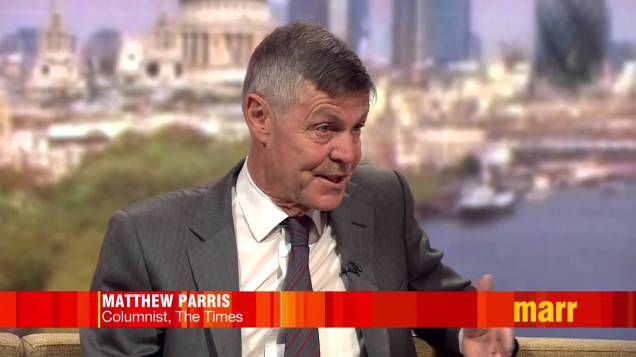
Donald Trump Victory Reaction: Matthew Parris Doesn’t Get It

matthew-parris-democracy-donald-trump-brexit-elitism-overton-window

Self-described elitists like Matthew Parris tolerate democracy only so long as they get to narrowly define the range of possible outcomes before the public are invited to have their say

The outcome of a democratic election in the greatest democracy on earth has caused Matthew Parris to lose faith in democracy itself. Go figure.

Self-confessed elitist Parris has a piece in The Spectator today in which he makes it clear just how very disappointed he is in We the People (now apparently downgraded in his estimation from being a “crowd” to a “mob”) following the EU referendum result in Britain and now the election of Donald Trump in America:

The election of Donald Trump as president of the United States may have signalled the death of the closest thing we have to a religion in politics. On both sides of the Atlantic, democracy risks being knocked from the high altar as an unmitigated and unquestioned good.

The man’s obviously a fool and a nasty fool too. The contest should have been a walkover for Hillary Clinton. But it wasn’t. What happened? Can we be sure any longer that democracy works? Is it really the reliable bulwark against political madness that we always supposed?

Without hesitation I plead guilty to the obvious charge: Trump supporters could level it at me, enthusiasts for Brexit do. Spanish enthusiasts for the left-wing populist party of protest, Podemos, and French supporters of Marine Le Pen would tell me the same and they’d be right. The reason I am beginning to question democracy is that it is producing results I profoundly dislike.

Already it should be clear that this is leading nowhere good. More:

But why now? When Richard Nixon was re-elected, did we who had preferred George McGovern despair of democracy? When British Conservative governments fell and socialist governments were elected, did Liberal or Tory democrats develop doubts about democracy itself? Why did we trust the people then, even though they had given the ‘wrong’ answer — but not now? What was it that people like me did believe, when we said we believed in democracy?

Someone urgently needs to introduce Matthew Parris to the concept of the Overton Window.

The reason nobody much cared when “conservative” British governments were voted out and replaced by “socialist” ones in the 50s, 60s and 70s is that they were actually all largely socialist anyway. Party labels at that time were more or less a nostalgic and almost entirely cosmetic sticker slapped on to differentiate two political parties which had both equally swallowed the dogmas of the post-war consensus and the supposed need for a planned, “mixed” economy (in reality an economy in which the government owned and ran vast swathes of industry, from mining, utilities, transport, telecoms and even restaurants and betting shops).

The reason that nobody in Britain “lost faith in democracy” when either shade of socialist Red got itself elected is because it hardly made a difference to their lives. The all-important (and foolish) decision to embrace rather than oppose socialism had been made in smoky back rooms by dusty, frightened old men (and some callow but zealous younger ones). Giving socialism the heave-ho was never on the ballot paper. The only question was whether one preferred Labour or the Conservatives to preside over our national decline.

overton-window-rachel-maddow-quote

When the Overton Window of a country’s politics – the range of political viewpoints considered mainstream, acceptable or permissible – is as desperately narrow as it was in Britain until Thatcher came and rescued us from self-inflicted socialist suicide, people like Matthew Parris would have no cause to lose faith in democracy because it continually serves up the kind of muddled, un-ambitious centre-leftism that they like (whether they admit it or not), and because elections therefore essentially do not matter.

The reason that Matthew Parris is now so upset, first with the Brexit vote in the EU referendum and now with Trump’s victory over Hillary Clinton in the US presidential election, is that both of these plebiscites actually mattered – because two markedly different potential outcomes were riding on the result. Or to put it even more bluntly: because the Overton Window has been expanded, and people like Matthew Parris are losing the ability to fix the policy outcome regardless of who wins an election.

The kind of “democracy” that Matthew Parris likes is one in which he and other people like him get together beforehand and decide the future direction of the country in advance, hashing out a deal between themselves before allowing the political parties to tinker around the edges and squabble over branding. Parris doesn’t trust the people to weigh up the important decisions themselves because he can barely tolerate most of the country, as he has himself previously admitted.

So spare a thought for poor Matthew Parris today. Soon Britain will be leaving the European Union, and the range of possible choices – on taxation, social matters, foreign policy, trade and more – over which the British government has greater or total autonomy will increase beyond the ideological guard rails currently imposed by our EU membership.

Worse, with the rise of Jeremy Corbyn, the British public have a real choice between Corbynite post-war consensus socialism and vaguely enthusiastic capitalism for the first time since 1983. And now, with the election of Donald Trump in America, the Overton Window of American politics has expanded so that the old (and often failed) consensus position on a whole range of issues is no longer the only choice available.

And Matthew Parris hates hates hates all of this. Because not-so-secretly, Matthew Parris hates most of us.


overton-window

pop-art-donald-trump-2

Support Semi-Partisan Politics with a one-time or recurring donation:

Agree with this article? Violently disagree? Scroll down to leave a comment.

Follow Semi-Partisan Politics on TwitterFacebook and Medium.

Expanding Heathrow Is A Start, But Now We Must End The War On Aviation By Cutting Air Passenger Duty

airplane-aeroplane-wheels-chocks-2

THIS ARTICLE WAS FIRST PUBLISHED AT CONSERVATIVES FOR LIBERTY


With the government’s announcement that Heathrow will finally get a third runway, it is time to end the decades-old war against aviation by slashing Air Passenger Duty too

About this time every year, my Texan wife and I glance at the calendar and realise, with dread, that the time has come to book plane tickets to the States for Christmas. To be clear, the dread has nothing to do with visiting my in-laws, whom I love very much – no, what ties my stomach in knots every autumn is the nagging question of how much money the British government intends to extort from me for the privilege of flying away from this rainy island for a couple of weeks of Texas sunshine.

Every year, Air Passenger Duty – that invidious, regressive, anti-business tax – creeps ever upward. And while the government may deign to excuse certain people from this extortion (children under sixteen were made exempt this year, in a blaze of self-congratulatory glory), for the rest of us APD keeps on inching upward. At a time when falling oil prices should mean that air fares reach historic lows, in Britain at least the cost of air travel is kept artificially high thanks to this ill-conceived tax – by far the highest in the developed world.

And why? Primarily as a sloppy wet governmental kiss to environmentalists, who some time ago decided that nothing poses a greater threat to the Earth than a working class person enjoying a holiday in Florida, or taking a cheap excursion to one of the sunnier parts of Europe. Air Passenger Duty is nothing so much as the collective howl of outrage from well-heeled leftist environmentalists that poor people are forgetting their place (i.e. receiving benefits and being thankful for them) and daring to travel the world as wealthy people did before them.

Remember the leftist credo, everybody: Fashionable celebrities flying private jets to Davos to moralise about carbon emissions made by the rest of us = good. Nasty working class folk flying Ryanair for a fortnight in Lanzarote or a stag weekend in Riga = bad.

Now that the government has taken the painful and very belated decision to proceed with the expansion of London’s Heathrow Airport (something which should have happened a long time ago) there will be inevitable calls for punishing new environmental levies to offset the terrible “damage” that is supposedly wrought when the state takes its jackboot off the throat of the aviation industry. There will likely be calls to raise Air Passenger Duty even further to help pay for this crucial national investment, even though the exorbitant tax already places Britain at a huge comparative disadvantage.

The government must resist any and all calls to raise APD. In fact, there could be few clearer signs that this government is committed to championing UK aviation and supporting the economy through the uncertainty of Brexit than a bold, dramatic cut in Air Passenger Duty from the current level of £13 short haul / £ 73 long haul / £146 premium cabin rates back down to the single digits. When my wife and I connect in Houston or Dallas Fort Worth on our way from London to the Rio Grande Valley, we pay the state of Texas no more than a few dollars for the privilege of transiting through DFW or George Bush Intercontinental airport – and both of those hubs put London’s Heathrow and Gatwick to shame.

At a time when the government is considering cutting Corporation Tax as low as 10% as an incentive to firms to invest, grow and remain in the United Kingdom, we should not be discouraging business executives and holidaymakers (72% of whom come to the UK by air) from choosing Britain by mugging them before they even step off the jet bridge. Cutting Corporation Tax is great, but the government should not forget individuals, who currently labour under all manner of punitive stealth taxes and would greatly welcome the relief. Neither should the government forget the aviation industry, which is every bit as vital as shipping to an island nation, and which for too long has been stymied and suppressed by cowardly politicians who refused to take critical decisions in the national interest.

With the long-overdue decision to build a third runway at Heathrow Airport, the government has finally called an end to years of dithering and inaction and made a necessary decision in support of the economy. But the benefits of this decision could yet be killed in the crib unless Britain also signals its intention to stop being the high-tax, anti-aviation country which prioritises impractical, virtue-signalling environmentalism over necessary infrastructure investment and tax reform.

There is no earthly reason why you or I should have to pay £73 for the privilege of taking off from Heathrow Airport, whether it has two runways or three. And if Theresa May and Philip Hammond are serious about signalling that Britain is open for business then slashing this one small but immensely harmful tax would be a great place to start.


THIS ARTICLE WAS FIRST PUBLISHED AT CONSERVATIVES FOR LIBERTY


aviation-airplane-on-tarmac-at-airport

Top and Bottom Images: Pixabay

Support Semi-Partisan Politics with a one-time or recurring donation:

Agree with this article? Violently disagree? Scroll down to leave a comment.

Follow Semi-Partisan Politics on TwitterFacebook and Medium.

Hacked Clinton Campaign Emails Reveal What The Political Class Really Think Of Ordinary Americans

podesta-clinton-emails-unaware-and-compliant-citizenry

Hacked emails from the Hillary Clinton campaign are unlikely to provide “smoking gun” evidence which might derail her candidacy, but they do paint a very depressing picture of exactly how the American political class view the people they supposedly serve

With each new release of hacked Clinton campaign emails released by Wikileaks, reporters have tended to swarm over the documents looking for a “smoking gun” of some kind – hard and fast evidence that Hillary Clinton may have engaged in illegal or clearly unethical acts. Such bombshell revelations are unlikely to emerge.

Why? Well, as Jonah Goldberg points out, we are dealing with an extraordinarily astute political operator here. Whether it is the work of the Clinton Foundation or her off-the-books correspondence as Secretary of State, shamefully kept on a bootleg server installed in her home, if Hillary Clinton wanted to commit any serious wrongdoing it would not have been committed to black and white in the first place, however well hidden and guarded.

Besides which, the definition of “smoking gun” has continuously evolved to ensure that Hillary Clinton remains on the safe side of it. Jonah Goldberg made this very point awhile ago:

But it’s really as if people don’t understand that a smoking gun is a very high evidentiary bar that most prosecutors — or journalists — never have to meet. Imagine a cop answers a call and comes to a bar where a guy named Jack Butler is caked in the blood of a dozen victims. One of the victims actually wrote, in his own blood, “Butler did it,” which was ironic because the victim was also a big fan of 1930s detective novels. A waitress who hid behind the juke box points at Butler and says, “He did it!” Butler himself says, “You got me.”

But the cop, going by the standards of Beltway clichés says, “Damn, there’s nothing I can do. I don’t see any smoke coming out of his gun.”

So quests to find smoking gun evidence in the hacked emails already released or those to come are likely to end in disappointment.

But far more interesting than any smoking gun evidence is the insight that these emails provide into the way that America’s ruling class thinks about the people. Typically, on election night, politicians and pundits alike pause hostilities to proclaim the beauty of democracy and laud the deep and abiding wisdom of the American people. You hear a hundred variations on this theme every election day as cable news anchors scramble to fill the unforgiving silence before the exit polls and results start to come in.

But the tone and content of these emails between Clinton staffers, discussing strategy and various ways to limit the damage from tawdry things that their candidate has done, reveals what the political elite really think of the people. And none more so than this email sent to John Podesta, chairman of the Hillary Clinton 2016 presidential campaign, by Bill Ivey, a longtime Clinton supporter and former Bill Clinton political appointee.

Some context: the two men are kicking back and forth ways that Hillary Clinton can cut through Donald Trump’s “entertainment” appeal to better get her message out to people who really don’t want to hear it.

Ivey writes to Podesta:

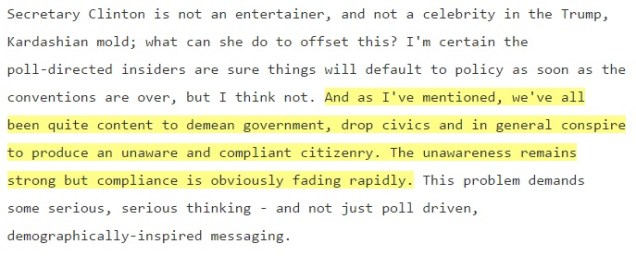
Well, we all thought the big problem for our US democracy was Citizens United/Koch Brothers big money in politics. Silly us; turns out that money isn’t all that important if you can conflate entertainment with the electoral process. Trump masters TV, TV so-called news picks up and repeats and repeats to death this opinionated blowhard and his hairbrained ideas, free-floating discontent attaches to a seeming strongman and we’re off and running. JFK, Jr would be delighted by all this as his “George” magazine saw celebrity politics coming. The magazine struggled as it was ahead of its time but now looks prescient. George, of course, played the development pretty lightly, basically for charm and gossip, like People, but what we are dealing with now is dead serious. How does this get handled in the general? Secretary Clinton is not an entertainer, and not a celebrity in the Trump, Kardashian mold; what can she do to offset this? I’m certain the poll-directed insiders are sure things will default to policy as soon as the conventions are over, but I think not. And as I’ve mentioned, we’ve all been quite content to demean government, drop civics and in general conspire to produce an unaware and compliant citizenry. The unawareness remains strong but compliance is obviously fading rapidly. This problem demands some serious, serious thinking – and not just poll driven, demographically-inspired messaging.

My emphasis in bold.

Now, it might not come as a surprise that senior politicians and their aides are complicit in deliberately trying to keep people ill-informed and docile. But in our more optimistic moments we might like to believe that this is merely an unfortunate side effect of politics rather than one of its central aims. Yet here we are, with two Clinton confidantes casually discussing that political operatives are fully aware and “quite content” to behave in this way.

What’s more, these people actively celebrate a docile and ignorant population, because when gerrymandered districts means that very few House and district races are actually competitive, it makes life easier for everyone if political parties can simply take for granted whole swathes of the population while focusing their efforts on a few narrowly defined demographics and swing states. In other words, it is to everyone’s advantage that Americans are neatly pigeonholed into ideological bubbles and prodded to action once every two years rather than becoming more thoughtful and genuinely engaged citizens. And these two Clinton operatives talk about this as though it is the most normal thing in the world.

Indeed, their only cause for alarm seems to be that while the ignorance remains strong, the people’s willingness to obey instructions is rapidly fading. And of course Clinton’s aides would be worried – their boss needed the underhand intervention of the Democratic National Committee simply to prevail over Bernie Sanders, an ornery old socialist, in her primary race. The Republican Party lost control of their uncompliant base completely, which is why they are now saddled with Donald Trump as their nominee rather than somebody who is, you know, an actual conservative.

But in neither case (for this is a problem of the political class in general, and not confined to one or other party) is there any sense of shame or introspection at having patronised and manipulated their party bases for so long that people rebelled in search of genuine authenticity. They don’t think they did anything wrong. They simply acknowledge that they now have a problem to solve, because the people’s “compliance is obviously fading rapidly”. They want to find a way to return their supporters to their rightful stupor as quickly as possible, so that they can go on governing as they see fit without having to respond to popular pressure to do things differently.

And in a way, that is more damning than any “smoking gun” email showing that Hillary Clinton broke the law or wielded inappropriate evidence ever could be. Because it shows that even when this election is over and one or other candidate fades to become a footnote in history, these parasitic  political operatives and bag carriers will still be there, waiting to serve their next master by keeping the population as dumb and compliant as possible.

And if that doesn’t depress you, you’re made of sterner stuff than I.


wikileaks-logo

Support Semi-Partisan Politics with a one-time or recurring donation:

Agree with this article? Violently disagree? Scroll down to leave a comment.

Follow Semi-Partisan Politics on TwitterFacebook and Medium.