Recognising Failure In Brexit

Brexit - young professionals

One of the greatest failings of Brexiteers since the referendum has been our inability to convince more wealthy, urban, Remain-voting younger professionals that the old pro-EU political consensus is broken, or that they benefit in any way from nation state democracy

I spend a lot of time on this blog telling various people and groups – the establishment, Remainers, Labour centrists, Tory wets – to engage in a bit of introspection and consider where their own actions and behaviours may have helped feed the very circumstances or phenomena which now upset them.

It is only fair that I go through the same process myself, as a way to maintain intellectual integrity. And there is one failure in particular that I keep coming back to – never finding a way to bridge the gulf of understanding between the two worlds that I myself straddle, Brexitland (where I was born) and the urban bastion of EU support (where I now live).

In the immediate aftermath of the referendum result, even before we knew the demographic breakdown of the vote, I wrote:

I extend to you the magnanimity and friendship that (I hope) you would be extending to me right now had the result gone the way we all expected. It is incumbent on all of us now to work together to achieve the best possible form of Brexit.

I think it is fair to say that I have not always lived up to that aspiration, though most of my lapses have only taken place in the context of extreme provocation in terms of the rhetoric or tactics adopted by what quickly became an extraordinarily energetic (and often venomous) continuity Remain campaign.

I have at least never knowingly initiated a hostile encounter with an EU supporter, online or in real life, because I still believe that whatever convulsions or purges our political class may need to go through as Brexit unfolds, the rest of us will need to knit back together as one country. As I have written only recently, we have many other pressing issues besides Brexit facing us as a country, none of which can be tackled successfully so long as we have our hands round one another’s throats.

It was therefore been incumbent on Brexiteers like myself – in addition to safeguarding the referendum verdict and working to achieve a better form of Brexit than the present government is on course to deliver – to attempt to persuade at least some Remain voters (particularly those who are not hardcore eurofederalists) that Brexit has the potential to be a good thing and a catalyst for further change if we demand it through our active participation.

This has not been a roaring success. I live in northwest London, in an overwhelmingly Remain-voting constituency (Hampstead & Kilburn) where EU flags flutter from the windows, I work in a professional job and have a social circle largely consisting of people like me, some of whom read this blog and all but one of whom voted Remain. Not only was I unable to sway any of the young professional people who know me during the referendum or in the aftermath (though I did have more success with other demographics), my efforts on social media were even more disastrous.

To understand the scale of the problem, one needs to understand just how hard this particular demographic took the Leave vote. When my wife went to work (at an American-owned international public relations company) the day after the referendum, her company’s German office had already sent the following email to their London colleagues:

Dear Friends,

On this truly disturbing day, we want to send you our greatest empathy and heartfelt solidarity to London and the whole UK [company] Team. Although troubling times maybe ahead of all of us here in Europe, the whole team of [company] Germany keeps on believing in the European idea and the future of peaceful and prosperous unity for Europe with the United Kingdom and all the wonderful people living there.

So for us this is not the end of the road. Our friendship with you will be stronger than ever and we will get through this together.

Big Hugs from Germany

Please share with the whole office

This text was followed by a picture of the entire German team making heart shapes with their hands as they hold aloft the German, EU and UK flags.

This is what we have to contend with as we try to navigate Brexit – whole offices full of undeniably smart people who legitimately view the events of the past seventeen months as a nearly unspeakable calamity with no possible redeeming features.

The author of this email (and the senior person who authorised it) clearly had absolutely no doubt that their sentiments would be shared by every single one of their colleagues in London. There was simply no recognition that smart, professional people might come down on different sides of the Brexit debate, only the arrogant but genuine assumption that everybody working for the company (both in Germany and the UK) shared the pro-EU worldview.

Imagine working at such a place: certainly no Brexit-supporting employee would dare to openly admit their own political views in such a one-sided, hostile climate. If senior management think your political views are “truly disturbing” one is not likely to torpedo one’s own career by dissenting from the email. We saw the same intolerance of ideological dissent at Google earlier this year, when engineer James Damore was fired for what was portrayed by the media as an “anti-diversity screed” but which in reality was a thoughtful (if partially flawed) memo on Google’s specific diversity policies.

I was stunned when my wife showed me the anti-Brexit email circulated within her firm. But what struck me most was the way that the author described Brexit – the prospect of Britain regaining the kind of democratic control over its own affairs enjoyed by every other developed country in the world outside Europe – as “truly disturbing”. It simply should not be the case that the entire staff of any organisation (save perhaps the EU itself) view Brexit as an unmitigated calamity. That such uniformity of opinion still exists is a failure on the part of Brexiteers – despite the unwavering effort of many of us to present the progressive, internationalist case for leaving the EU.

We currently live in a country where many people are consumers first and conscientious citizens a distant second; where the elimination of the smallest short-term risk is seen as more important than safeguarding the long term democratic health of Britain. But it is not enough to rail at pro-EU professionals for voting for their own short-term economic self interest, just as it is not enough for disappointed Remainers to berate Brexiteers for supposedly voting against their own. Just as the rise of identity politics has stoked bitter divisions in society on both sides of the Atlantic, so in addressing Brexit here we must somehow find a new common language which unites all of us (or enough of us to establish a workable new consensus).

As of yet, I don’t have an answer to any of this. I just know that what I and other Brexiteers tried during the EU referendum and in the months following the Leave vote has not worked, and that something new must be attempted. The danger is that unless this key demographic of young urban professionals can be made to see Brexit in less catastrophic terms, they will reject any new conservative ideas out of hand and effectively hand the country to Jeremy Corbyn.

We have entered a new period of discontinuity in British politics, where the old consensus has broken down and new policies are required to solve new problems. Without a radically new approach we will be doomed to more of the same – weak, short-term governments reacting to events in isolation rather than proactively addressing them according to any kind of master plan.

It is impossible to build anything likely to stand the test of time – such as a new model for an independent, open country which is adaptive rather than defensive to globalisation, automation, migration and other issues – without the enthusiastic backing of enough people to elect a strong government with a clear mandate to deliver.

And it will be impossible for any Conservative government, at least, to secure such a mandate without better outreach to this truculent demographic of young urban professionals who currently believe that the Big Bad Brexiteers have stolen their future.


Remainer paints EU flag on her face - European Union - Brexit

Support Semi-Partisan Politics with a one-time or recurring donation:

Agree with this article? Violently disagree? Scroll down to leave a comment.

Follow Semi-Partisan Politics on TwitterFacebook and Medium.


The Big Brexit Guilt Trip By Ageing Political Grandees Will Not Work

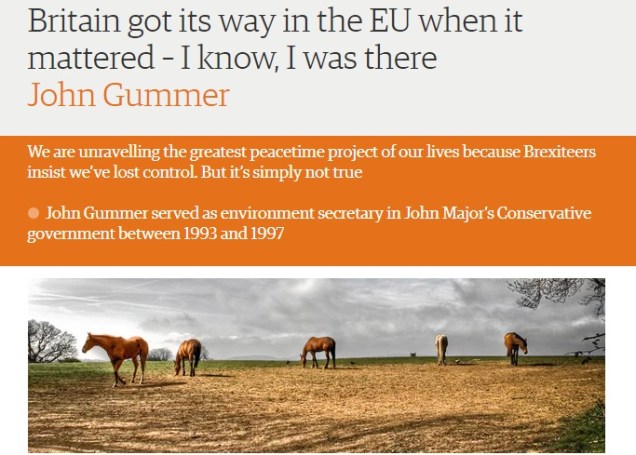
John Gummer - Environment Secretary - Brexit - Live horse export - Remainer

Efforts by pro-EU political grandees to guilt the country into feeling bad about Brexit by elevating trivial British victories in ancient, minor trade disputes as proof of our great influence in Brussels only reveal the poverty of their ambition for Britain

Another day, another ageing political grandee is wheeled out to lecture us about how selfish and ungrateful we were to turn our backs on so benevolent and non-threatening an institution as their beloved European Union.

This time it is the turn of former Tory Environment Secretary John Gummer, who takes to the Guardian with a particularly tedious and deceitful lament that “we are unravelling the greatest peacetime project of our lives because Brexiteers insist we’ve lost control. But it’s simply not true”.

The premise of Gummer’s argument is that because he once had a good relationship with his environment and agriculture ministerial counterparts in Europe and ensured that Britain won key trade and regulatory battles when our national interest was at stake, this somehow proves that we had unparalleled and decisive influence in Brussels.

From the Guardian:

In fact, the UK has led Europe in a remarkable way, and has rarely failed to gain its major objectives. However the process is one of debate and argument, proof and counter-argument, rather than demanding that the rest of EU should immediately see the sense in our position and give way without question. It is this assumption of always being right that has bedevilled our relationships with our neighbours.

Immediately Gummer frames the question of whether Britain could influence the EU as one of whether we could win individual arguments within the EU institutions rather than whether we could meaningfully influence the course of the EU itself.

Gummer then presents the crown jewel of his argument:

One example suffices. In a single market, the UK’s refusal to allow the export of live horses for food was clearly illegal but politically essential. All the odds were stacked against us, Belgium was becoming increasingly insistent, and a vote was looming. We had one strong card: our relationships. We had helped others in parallel positions, helping to find ways for the EU to meet its common objectives while recognising national differences.

My very effective minister of state, David Curry, and I had formed friendships and we took trouble to maintain them. Many of our fellow ministers had come to Britain and stayed at our homes. Above all, we had never pretended. They all knew that if we said something was really important to the UK, we weren’t bluffing.

We were always communautaire – but in the national interest. When the relatively new French minister, a socialist, in a very restricted session, without his key advisers, had agreed to something that would have been very difficult for France, I slipped round the table and pointed the problem out. He was able to retrieve the situation, the council was saved interminable recriminations, and Britain had a firm friend. Working as a team, clearly putting our national interest first but ensuring we got the best out of the EU, meant that when it mattered we won. I don’t suggest that my counterparts ever really understood the peculiar British view that it’s all right to eat beef but not horse, but they accepted it was a political reality and knew the UK would help when they had to explain their own national singularities.

Oh gosh, this riveting act of high-stakes international diplomacy will be recorded in the history books for all time. Schoolchildren two hundred years hence will still be learning about how John Gummer heroically managed to stop the UK from having to export live horses for slaughter in continental Europe, all because he was best pals with the French undersecretary for agriculture. Consequential feats of statecraft like this put one in mind of Yalta.

In fact, it only shows the extreme paucity of Gummer’s thinking and the worldview he represents. These old grandees – and you can throw in the likes of Michael Heseltine and Kenneth Clarke here, too – sincerely believe (or have somehow convinced themselves) that British disquiet with membership of the European Union was based on trivialities like how many battles we won over live horse exports. They think that if only they can provide enough examples of the UK having successfully defended the interests of Cheshire cheesemakers or Welsh textile makers then we will have an epiphany, see the error of our ways and beg to be allowed back into the club.

It simply does not occur to these EU-loving grandees that the British problem with the European Union might originate at a deeper level than who is seen to win a plurality of disputes over trade or regulation. Having marinated for so long within a political elite which accepted supranational government and the gradual deconstruction of the nation state as a self-evidently good thing, they are now shocked to discover that not everybody agrees with the basic premise on which their entire worldview rests.

The Lord Ashcroft poll taken in the immediate aftermath of the EU referendum showed perfectly clearly the key drivers of the Leave vote, and the number one issue was sovereignty (decisions about the UK being taken in the UK, as per the specific poll question). The British people voted to extricate ourselves from the supranational government in Brussels and reclaim our right to make policy and law for ourselves without having to either haggle with 27 other member states or otherwise operate within the narrow tramlines set by a set of remote Brussels institutions towards which many of us feel no love or affinity.

Unfortunately, almost since the beginning of the referendum campaign, most prominent Remainers refused to deal with the big picture. Yes we got a lot of tired old soundbites about the importance of “friendship ‘n cooperation” or overwrought tales about how the EU alone had kept the post-war peace, but the official Remain campaign, Britain Stronger in Europe, desperately shied away from the big picture at every turn.

Why? Because the big picture has always been toxic or concerning to far more Britons than actually voted Leave in the referendum. Most people don’t want the supranational government and its ambition/necessity to transform into a federal Europe, and knowing this, the Remain campaign never dared to try persuading them otherwise. This left Britain Stronger in Europe (and most Remainers) with little option but to drag the fight to a lower level, where it became all about money, economic risk and the kind of low-level goodies that people like John Gummer think dictate our sentiments towards the EU.

Perhaps this is understandable. From Gummer’s very narrow perspective we probably did indeed “win” in Europe a lot. But Gummer is thinking about issues of farm animal exports and agricultural regulations, not matters of geopolitics or statecraft. And the truth is that Britain had almost zero influence on the ultimate direction of the European Union as a political entity. Yes, we could sometimes slow things down or carve out occasional opt-outs for ourselves (at a diplomatic cost). But Britain could never realistically propose that a large supranational government in Brussels with strong federalist ambitions transform itself into a looser federation of closely economically integrated nation states. That simply would never have happened, even if Britain played the long game and aggressively sought support from other countries.

If one was a passenger on a cruise ship it would be nice to be sufficiently influential to sometimes suggest menu ideas to the chef or offshore excursions to the cruise director and have those suggestions adopted. But even then, at no point could that passenger reasonably imagine himself an officer of the ship, let alone the captain. Winning battles within the framework created for us to argue is not the same as having meaningful influence over the design of the framework itself. So no, we did not “win” in Europe, because we could not persuade those on the bridge to set a course which we were willing to follow.

Once again, this debate has proven that the British people have always had a more expansive view of the EU question – and higher ambitions for our country – than the majority of our political class. Many Remainer grandees still see things in terms of petty fights won and lost in the Brussels crèche where they were allowed to play, and simply can’t understand that our problem was not that they failed to smack the other kids around to our satisfaction but rather that they were content to play the role of children in the first place.

By voting to leave the European Union, the British people are demanding that our politicians and leaders become adults again, not rambunctious toddlers and surly teens supervised by their parents in Brussels. We want government without training wheels again, even if this means that we wobble a bit or even fall and scrape our knees.

This was never about petty little trade disputes here and there. Brexit was far more fundamental than that, but even now many EU apologists fail to see it.


Brexit - EU - European Union Flag - Missing Star - Britain - UK

Support Semi-Partisan Politics with a one-time or recurring donation:

Agree with this article? Violently disagree? Scroll down to leave a comment.

Follow Semi-Partisan Politics on TwitterFacebook and Medium.

Catalonia Independence And Brexit – Not The Same Thing

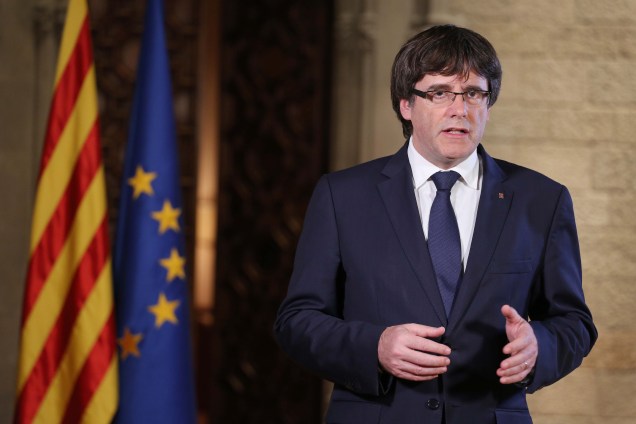
Catalan Catalunya president Carles Puigdemont speech - declaration of independence

The Catalan declaration of independence does not prove your point, whether you are for or against Brexit

There has been an inevitable tendency among many people to co-opt the events surrounding the recent Catalan independence referendum and resulting declaration of independence from Spain for their own distinct purposes. This is unhelpful. Recent events in Spain illuminate Brexit little more than the election of Donald Trump explains Brexit – in other words, a few headline similarities obscure a wealth of differences.

First, we can all acknowledge that Spain hugely mishandled the entire affair. Whether this is partly due to weaker institutions and the less embedded traditions of democracy in Spain or just sheer incompetence on the part of Prime Minister Mariano Rajoy’s government is not fully clear to me, but the actions of the Spanish government clearly fuelled rather than defused the situation.

Rajoy should have learned from the UK’s experience with the Scottish independence referendum of 2014. Faced with Scottish separatists with similar delusions of statehood, David Cameron called the bluff of the Scottish National Party. The referendum was held on fair terms and the nationalists lost – despite an awfully dreary and uninspiring “No” campaign which pushed an entirely negative message and had little positive to say about the value of the United Kingdom. And though this led to the rise of Nicola Sturgeon and the arrival of the Tartan Tea Party of SNP MPs in Westminster after the 2015 general election, the nationalist tide has since receded.

Madrid took a different approach, opposing the referendum at every turn. I can’t speak to the legality of the constitutional court’s decision to ban the referendum, but the violent way in which it was put down by the police and Guardia Civil handed the separatists a huge and unnecessary propaganda victory. I can fully believe that the Catalan regional government has behaved reprehensibly and childishly throughout, but a mature national government in Madrid would have handled this in a way which took the sting out of the Catalan independence movement, putting it to bed for a generation. Mariano Rajoy achieved the exact opposite.

The decision of former Catalan president Carles Puigdemont to proceed with a declaration of independence, as ratified by the Catalan parliament, was opportunistic, antidemocratic and immature. Yes, the referendum was violently put down by the Spanish authorities. But the referendum was also deemed illegal  in the first place by the proper Spanish courts, and many of those who would have voted against independence did not go to the polls. To take this botched referendum as a mandate for independence is a huge overstepping of Puigdemont’s authority, and is fundamentally antidemocratic.

Simultaneously, Spain has been far too laid back in dealing with this threat. It was shocking enough that it took until the days before the Scottish independence referendum for anti-independence campaigners to hold a mass rally in London in support of the United Kingdom – but at least it happened. Spain waited until days after the unilateral declaration of Catalonian independence to hold a similar rally in Barcelona. Where was this public outrage and shows of loyalty to Madrid when Carles Puigdemont was prancing around acting like the living embodiment of all Catalan public opinion? It is hard to attribute this to anything but laziness on the part of the citizenry. As he left the US constitutional convention in 1787, Benjamin Franklin told an enquirer that he had bequeathed the American people “a Republic, if you can keep it“. At times, the Spanish seemed too lazy to make much of an effort to keep theirs.

How does all of this tangentially relate to Brexit? In one sense, Brexiteers can draw some basic parallels to Catalan independence. Both are primarily cultural movements consisting of people who do not accept the legitimacy of the larger political entity which they seek to leave. But the British EU referendum was conducted under the rule of law and its outcome was legitimate. One can raise valid points about the precise mode of Brexit being unstated and the lack of a plan on the part of the official Leave campaign – all true. But the instruction from voters to the UK government to commence secession from the political entity known as European Union was clear. In the case of Catalonian independence, not so. In many cases, the Catalan government behaved provocatively and with great immaturity. These are not smart, measured people whom anybody should seek to drape their arms around.

But there is also a contradiction at the heart of the Catalonian separatist movement. Both in Catalonia and Scotland, advocates for independence seek to leave the political purview of Madrid and Westminster respectively, but remain very much part of the European Union. In doing so they engage in a feat of denial and political fancy which exceeds that of the most ignorant of Hard Brexiteers. Leaving Spain means Catalonia leaving the EU, just as leaving the United Kingdom inevitably meant Scotland leaving the EU when Scotland voted back in 2014. In both cases, separatists sought to downplay or even deny this truth. Carles Puigdemont and his followers need to accept this difficult fact if they are to be remotely taken seriously. But they do not accept reality, just as the SNP refused to accept reality.

It is also curious that the separatists are so desperate to escape the clutches of Madrid (one protester today said that Catalonians were currently “oppressed” by Spain) but are entirely comfortably – even eager – to remain under the authority of Brussels, and inevitably as a much smaller and less influential member state were they to be readmitted. I would very much like to read an argument explaining how modern Spain suppresses Catalonian culture and freedom in a way that the EU would not. As an independent country and small EU member state, Catalonia would be much less able to influence EU policymaking than Spain is currently able to do. They would be in an infinitely weaker position to defend and advance Catalonian national interest.

And yet if this is still the choice of the Catalonian people they should be free to make it – through a lawful, democratic and legitimate referendum. If they do so, it will be a clearly cultural and constitutional decision, just as Brexit was. This doesn’t automatically mean that it is the “wrong” decision – it would simply mean that as with Brexit, some things matter more than short term political and economic stability. This is an argument which I have strongly made about Brexit, and which could hold true for Catalonian independence too. If the people of Catalonia genuinely feel that Madrid is hostile to their own interests then they should have the right to secede from Spain and take the consequences and potential benefits upon themselves. I supported Brexit because I do not feel that our cultural affinity to Europe – our sense of ourselves as part of a cohesive European demos – warrants as powerful and extensive a government as we currently have in Brussels. If Catalonians feel the same about Spain then so be it.

But if nothing else good comes from this turmoil in Spain, hopefully it will disabuse separatists throughout Europe of the childlike, naive notion that Brussels is their friend, and that the European Union in any way cares about their freedom or right to self-determination. It most assuredly does not. The European Union has its own journey – toward greater political integration and centralisation – to pursue. Brexit is enough of a bump in the road for EU leaders; they have no desire to see Europe fragmenting further at a time when they are trying to busily absorb everyone into the grand project, even as their undermining of established member states fuels these separatist movements.

Besides that, this is an internal matter for Spain to deal with. One might plausibly consider taking sides from a personal perspective had the referendum been conducted legally under terms agreed by both sides, or if the Catalan government could make an irrefutable case that no further dialogue with Spain was possible for the redress of their grievances. But in the absence of these mitigating factors we ought to refrain from jumping into a foreign debate purely to score cheap political points about matters in our own country.

The Catalan independence movement is not like Brexit, as anybody who supported the continuation of the United Kingdom in 2014 and Brexit in 2017 should have the humility to accept. No matter how low your opinion of Nigel Farage, Aaron Banks and Dominic Cummings may be, they did not press ahead with an unlawful referendum and claim (quite) such an implausible mandate from it. And whatever constitutional vandalism the UK government is currently engaged in as it seeks to implement Brexit is nothing to the constitutional vandalism currently being perpetrated in Spain.

At its core, Brexit is about securing the continued relevance and autonomy of the nation state (at least until such time as public opinion shifts more definitively in favour of the kind of supranational government offered by the European Union). And that means keeping our personal opinions about Catalan opinions quite distinct from any other political agenda.


Catalonia is not Spain - declaration of independence flag

Support Semi-Partisan Politics with a one-time or recurring donation:

Agree with this article? Violently disagree? Scroll down to leave a comment.

Follow Semi-Partisan Politics on TwitterFacebook and Medium.

The Conservative Party Has Lost The Pulse Of The Nation

Laura Pidcock - Labour MP North West Durham - 2

Labour’s statist, redistributionist policies are as bad as ever, but unlike the Tories they increasingly have the pulse of the nation

Once again I find myself in the strange position of agreeing with a stridently left-wing MP in their criticism of this drifting Conservative government and the failing centrist consensus which it represents.

As Jon Trickett continues to curate LabourList for the week, North West Durham MP Laura Pidcock writes:

Those people who sit on the government benches, who speak very well and pronounce their excellence and their firm grasp of the system, probably do believe it was their hard work that got them there. I’m sure they believe that it was some unique brilliance that put them in a position of power, not their childhood classrooms with numbers in single figures; not their personal allowances whilst at university: not their ability to recover from failures, because of the large cushion they sit upon. Not everybody who is wealthy and privileged is like this, but it certainly – and evidently – it makes it harder for those that are to understand the reality of what is happening to ordinary people.

This is why you get a system like universal credit, like the bedroom tax, the rape clause, the sanction system, the work capability assessments and he hugely alienating disability benefits system. It is why there are fines and punishments associated with all aspect of working class life: parking, smoking, littering, debt payments, libraries, electricity meters. When I had a book that was overdue to return to the Commons Library, I did not receive a fine. Undoubtedly it was assumed that I was too busy, that I had better things to be doing. Do the same presumptions apply to 99 per cent of Britain? Of course, not. On the contrary, they seen are lazy, feckless and are perceived to be “cheating” the system for turning up minutes late to a benefits assessment. Then they are hit where they won’t recover: through their finances, and so the cycle continues.

Of course, Pidcock ultimately goes on to spoil it all with economically illiterate class envy and a programme based more on tearing down the privileged rather than giving greater opportunities to the underprivileged:

We must expose the absurdity of our current system, we should shine a light on the cosy, privileged networks which lock out our people, our communities and our class. We have to call out poverty pay for what it is: it is robbery from the real wealth creators.

This much at least is socialist piffle. Yes of course there are some exclusive, exclusionary networks that are unwelcoming to minorities and working class people, and this is reprehensible when it occurs. And yes, recruitment to the SpAdocracy and cadre of parliamentary researchers and advisers which acts as a recruitment pool of future MPs is often too narrowly targeted at people from the same homogeneous background. But as this blog discussed yesterday in the wake of the Oxford University diversity non-scandal, the real issue is a problem with the supply of qualified people from under-represented backgrounds, not a lack of demand for them.

Most institutions remotely connected with government are under huge pressure to improve their diversity ratios, and face constant political pressure and bad publicity when they fail to do so. The fact that insufficient progress has been made tells us that the pipeline of qualified (or interested) candidates remains restricted, not that willing and capable people are necessarily being turned away.

But strip away the leftist agenda and the rest of Pidcock’s criticism is spot-on. Of course there are honourable exceptions, but MPs sometimes manage to display a remarkable lack of empathy for the struggles of the squeezed middle. This manifests in a multitude of ways, and is by no means restricted to the Conservative Party.

The London-raised metro-left Labour MP parachuted into a safe Northern constituency but boasting a voting record more attuned to the priorities of Islington than Darlington is every bit as out of touch as the privately-educated Tory MP who cannot comprehend why a six-week gap between applying for Universal Credit and receiving a payment might be problematic. Or the Tory MP who is confused that a selfish housing policy which chronically restricts the supply of housing stock to benefit older homeowners simultaneously alienates younger voters. Or the rural Tory MP who devotes all their energy to supporting NIMBY causes and then wonders why each election leaves him with fewer and fewer colleagues from urban constituencies.

My concern is not that the Labour Party is suddenly coming up with compelling, inventive new solutions to the problems we face as a country. By and large, they are not. My concern is that Labour are at least correctly identifying some of those problems and speaking to them in a way which makes people think they care, while the Conservative Party steams on in the same dismal direction as before, bereft of vision or policy ideas and with an unfortunate tendency to loudly insist that everything is great when everybody can see otherwise.

My concern is that more than four months after a general election result which has seemingly prompted no change in strategy by Theresa May’s government, Labour MPs are starting to make more sense – and sound more like they live in the real world – than their Conservative counterparts.

And when that happens, it usually means that the out-of-touch party is heading for a spell on the Opposition benches.


Laura Pidcock - Speech

Support Semi-Partisan Politics with a one-time or recurring donation:

Agree with this article? Violently disagree? Scroll down to leave a comment.

Follow Semi-Partisan Politics on TwitterFacebook and Medium.


Resurrecting The Citizen Politician

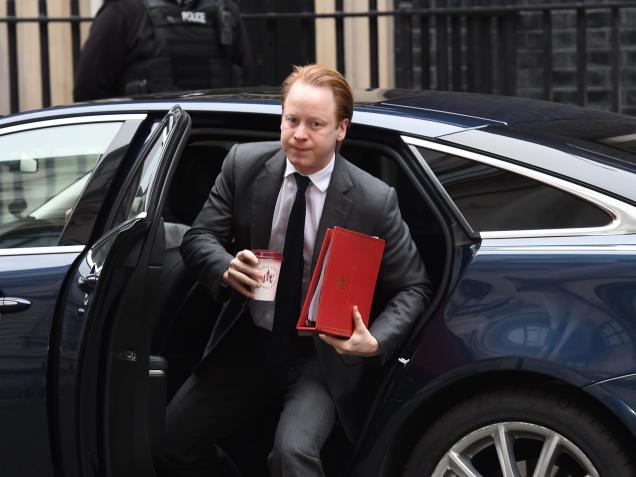
Ben Gummer MP

After Brexit, attracting more exceptional citizen politicians and fewer mediocre career politicians is the next crucial step towards democratic renewal in Britain

A worthwhile article by new Labour MP Laura Smith for LabourList underlines the urgent need for more politicians who look and sound like contemporary human beings rather than cautious clones who have been training to become MPs their whole life.

Laura Smith writes:

I’m new to politics. I’ve never been in local government; I was an activist, a member of the union and came from a long-standing Labour Party family. I haven’t come from a background of jargon and empty words, and I know what it’s like when life throws you a curve ball that takes the wind from your sails and the plans that you had made lay shattered in a million pieces. I can say with integrity that I will try my best to fight against the injustice that members in my constituency feel, and I’ll do it with vigour and sincerity.

Entering Westminster has been an eye opener without a doubt. Never have I been more sure that the ambitions of many there come from a place of self-indulging hypocrisy, and the decisions that they make are sheer games rather than coming from a place of care.

I don’t know the parliamentary protocol nor do I care much for it, I speak with a northern accent, I came to the door with an overdraft, no savings and a limited wardrobe purchased on a credit card to try and look smart.

I am what I am and that is representative of millions of women in Britain. My class has been with me my whole life, forged from the experiences of my Scottish mining grandfather, and I’ve ridden on the rollercoaster of the ups and downs of life. I’m proud to be working class, I’m proud of my people and for as long as my constituency wish to keep me in Westminster I will fight for the working people of this country.

How refreshing it is to hear a politician – especially a Labour politician – speak passionately about the politics of class rather than the politics of identity. Both are divisive, to be sure, but the former is at least reassuringly familiar and relatively harmless these days, while the latter is doing more than anything else right now to tear apart the fabric of British society.

I would probably disagree strongly with about eighty percent of what Laura Smith stands for, but there can be no denying that this is exactly the kind of decent, committed person we should want to attract to Westminster – somebody with strong convictions, a record of community service but also, crucially, a life outside politics (Smith held real jobs and ran her own business).

It cannot hurt to have more MPs of all parties who know what it is to live on a budget as Smith has done, or to have struggled with debt, unemployment or work-life balance issues, to complement those who know how to be an ambitious party functionary but little else. Being an MP is a calling and not a career, but certain accommodations can and should be made which would make serving in Westminster more appealing while still demanding sufficient dedication to public service.

Smith’s dismissal of parliamentary protocol will also chime with many people, including all those SNP MPs who didn’t understand why clapping after a speech was verboten while braying like a donkey at Prime Minister’s Questions is positively encouraged. While there will always be an important place for tradition and rituals which remind us of our heritage and the small part we play in our larger shared history, it is also undeniable that certain habits and protocols are hopelessly outdated and serve no useful purpose. There is no reason why Parliament should not adopt electronic voting, for instance, rather than wasting time while MPs physically traipse in and out of the Commons chamber to record their vote.

But most impressive in Laura Smith’s article is the fact that she clearly went to Westminster with a purpose greater than her own political advancement. Not every MP can or should be a statesman, a philosopher or a leader, though MPs of all backgrounds and ideologies have fulfilled these roles. We also need MPs who care deeply about their constituents and about particular issues, campaigning MPs who want to use their term(s) in office to make a specific difference. Indeed, such MPs can often be far more valuable and effective than those who merely spout reheated rhetoric from four decades ago, be it Michael Foot-style socialism or unreconstructed Thatcherite dogma.

Yet too often we let motivated MPs of this calibre languish for a term or two on the backbenches before they either become disillusioned and stand down, or else lose their inner fire and slowly transform into unremarkable, uninspired time-servers.

One of the best recent citizen politicians in Parliament was former Conservative MP Dan Byles, a man who was the first in his family to attend university, received a prestigious Army scholarship, served on active duty in Bosnia, rowed across the Atlantic, climbed mountains and served on the board of several charities before serving a single term in Parliament from 2010-2015.

This is exactly the kind of person who should now have a senior Cabinet role, and whose charisma and leadership skills might presently be leading the Conservative Party in a more inspiring, less suicidal direction. Yet despite becoming one of relatively few first-term backbench MPs to rack up some real accomplishments to his name (including constitutional reform of the House of Lords via a private member’s bill), Byles stood down in 2015 to “pursue new challenges”. Some of our most exceptional people no longer feel that they can make a meaningful difference by serving in Parliament.

Westminster attracts the power-hungry, the ambitious but also – thanks to elitism and nepotism – the mediocre and the self-serving. And too often, the genuinely talented are overlooked in favour of the well-connected. Witness Theresa May’s government, which managed to find a place for the utterly unremarkable Ben Gummer (son of former Tory minister John Gummer) in Cabinet while leaving thoughtful and intelligent conservative voices like Kwasi Kwarteng or James Cleverly to languish on the backbenches. Note also how Harlow MP Rob Halfon, who could actually articulate a positive (if controversial) vision for conservatism, was sacked as a minister while Theresa May kept faith in Home Secretary Amber Rudd, who entered politics not to advance any deeply-felt political agenda but to “get a grip on her life” and add another accomplishment to her CV.

As if the chaotic Brexit negotiations did not already make it abundantly clear, the calibre of leadership we manage to attract at the national level does not serve us well. This is in significant part due over-centralisation at Westminster and the neutering of local government in Britain, where at present there is probably only one executive role outside of Cabinet – the mayoralty of London – which might remotely prepare a politician to plausibly step into the role of prime minister. But it is also because we expect too little from the people we choose to represent us.

To take the next step in renewing British democracy, we must break the stranglehold that national political party headquarters wields over candidate selection. We must do away with affirmative action shortlists and central casting candidate lists alike, empower constituency party organisations and allow them to nominate candidates who they feel best represent their values and their concerns. We must devolve and decentralise significant powers away from Westminster to the counties and the regions, so that local government can transform from being adult daycare to a useful incubator of future national leadership talent.

And we must re-embrace the idea of the citizen politician, valuing the contributions of those candidates with different backgrounds.We must identify and advance talent wherever it is found rather than demanding that passionate and inspired MPs with executive experience outside politics first spend years acting as bag-carrier for other ministers before being trusted with any real responsibility.

Only if we embrace this radical decentralisation and ideological renewal – here it is particularly important that committed small-C conservatives seize back control of the Tory Party from the dead hand of Theresa May, just as the Corbynite Left deposed the centrists within Labour – can we take the next step after Brexit and finally begin the democratic renewal of Britain.

The alternative is more of the same uninspiring, grinding disappointment with which Britain has sadly become so familiar.


Theresa May - Conservative campaign bus - photo op campaign phony

Support Semi-Partisan Politics with a one-time or recurring donation:

Agree with this article? Violently disagree? Scroll down to leave a comment.

Follow Semi-Partisan Politics on TwitterFacebook and Medium.