The Big Tent Ideas Festival

Stepping Stones Report - Goals and Risks - Brexit - EU Referendum

Searching for the missing conservative soul in a Berkshire field

Various people have been raving about an event which took place last week in Twyford, Berkshire, where Conservative MP George Freeman set up a few yurts in a field and held an impromptu late-summer symposium on how to renew British conservatism.

The Big Tent Ideas Festival is a laudable ongoing effort to refresh and reset British conservatism while the Tory party is still in government, as opposed to waiting until they languish in opposition. This is easier said than done – as anybody can plainly see, Theresa May’s listless and fratricidal government has run out of what little ideological steam it inherited from David Cameron’s equally muddled tenure. Now they sit, idling in neutral, on the cusp of making an almighty mess of Brexit and being kicked out of office without a single lasting achievement to their name.

Mark Wallace of Conservative Home was in attendance, and describes the extent of the challenge:

The Right’s challenge is that time in government saps the energy, and increases the centralisation, of any movement. The never-ending trials of running the country drag in, and burn through, many of the policies and people. Indeed, we produce our best ideas and develop our greatest new talents when the variety of interests that exist across the centre right movement have room to breathe and freedom to operate. Often that happens in Opposition – the Party’s apparatus, authority and powers of patronage are more limited, and there’s a clear objective to pursue.

That’s as true for Labour as it is for the Conservatives – consider the contrast in energy between the respective camps of Major and Blair, or Brown and Cameron. The task for our movement today is to break that cycle: to renew and innovate now, while the Conservative Party is still in power. To do so requires us to recapture that freedom and urgency enjoyed in the years between 2004 and 2010, which saw such fertile growth of new thinking and campaigning organisations, the development of new outlets to communicate our ideas (not least ConservativeHome), the development of a raft of strong, new policies and the emergence of a generation of talented campaigners, thinkers and communicators.

The Big Tent is currently focusing on three main strands of renewal: Social Renewal, Political Renewal and Economic Renewal. Fair enough – these designations seem to make sense. And some of the questions being debated across all three areas resonate very strongly with topics that this blog cares deeply about, namely:

  • What are the causes of the deepening crisis of disconnection between government and the citizens it is supposed to serve?
  • How do we define a meaningful notion of citizenship with reciprocal responsibilities with the state, which works for us all?
  • How do we better support our third sector and encourage volunteering?
  • How do we reform our benefits system?
  • How do we build lifelong learning, from antenatal, through the early years, school and adulthood, and incorporating resilience, emotional and social learning, as well as key skills? How do we get parents and communities to support this in the poorest areas?
  • Is the rise of extremism – to left and right – a function of failure in the mainstream centre or simple liberation of the radical fringes?
  • Given the public’s rejection of mass low wage migration, how can we achieve the transformational skills and training revolution of the UK workforce which has defied policymakers for 150 years?

And particularly:

  • How do we embed lifelong learning to increase workforce resilience for the coming tech change tsunami so we do not make the same terrible mistakes as happened in 1980s mining areas (and from which we have still not recovered)?

Remarkably, though, the housing crisis was not called out as a separate issue for discussion, even though it is the pre-eminent challenge driving a wedge between the Tory party and otherwise potentially sympathetic voters. This is a very curious feat of omission, to the extent one wonders whether it can have been accidental. As with Conservative policy since 2010 there seems to be a deliberate refusal to acknowledge the need to do anything which might annoy the current rural, home-owning, NIMBYish Tory base by threatening the continual upward trajectory in the value of their houses.

This is short-sighted, and needs to be addressed urgently. Housing should be one of the absolute key issues being debated by the Big Tent, not something whispered about on the margins or tangentially as part of another discussion. In the 2017 general election, the Tories did not win a majority of any demographic until the average age ticked over fifty. Fifty! Conservatives no longer merely have a problem with youth voters, though we are certainly more radioactive than ever among this crowd. We are now almost equally unpopular among young professionals and people in early middle age.

At least the Tories of Margaret Thatcher’s day had some slick city Yuppies with stripy shirts and enormous cellphones in their corner. I have lived and worked in a professional capacity in London for a decade now, and can count the number of fellow “out of the closet” conservatives in my social circle on two hands, with fingers to spare. That CCHQ does not presently view this deficit among young, educated voters as an existential crisis speaks volumes about their complacency and sheer incompetence.

This is a demographic time bomb waiting to explode in the Conservative Party’s face. The metaphorical conveyor belt carrying young idealists from left-wingery to conservatism as they age cannot be taken for granted – it has only worked in recent decades because as people get older, government policy has allowed them to acquire a greater stake in society, primarily through home and equity ownership. People do not just magically start voting Conservative when they get their first grey hair, and people who have been consistently screwed over by selfish, short-termist policies which pander to the Tory base at the expense of the wider national interest will develop a lasting antipathy to the Conservative Party and to conservatism in general.

Dodging the housing issue is not an option. It must be tackled head-on, and (unlike Theresa May’s “dementia tax” debacle) it must be done with care and sensitivity. So long as Jeremy Corbyn or somebody like him leads the Labour Party, the Tories will have a bit of political cover to do something radical on housing – even if it enrages a section of their base, few of these people will defect to a Labour Party eager to tax them to death. Failing to act before Labour falls back into centrist hands means that the Conservatives’ scope for manoeuvre will be greatly reduced.

Additionally, while the tripartite focus on social issues is laudable at first glance, this area should not be allowed to dominate the discussion as it dominated much of Cameronism and now Theresa May and Nick Timothy’s very statist, paternalistic brand of conservatism.

Yet Toby Guise at The American Conservative reports that the “society” tent was by far the most popular:

The mainly young delegates heard speakers in tents marked “politics,” “economics,” and “society.” Tellingly, the last of these was the largest—with a program that opened with pitches from the founders of two significant charities focused on social exclusion. This theme reflected the fact that accusations of a compassion-deficit are at the heart of Labour’s attack on the Conservatives.

This reflects the current priorities and incentives for success in conservative Westminster politics. Being seen as a beardy Nick Timothy acolyte seeking to extend government influence into every home and mind is viewed as trendy and forward-thinking, while sitting at a desk thinking about how to encourage entrepreneurship and decrease reliance on the state is seen as excessively “ideological”.

It may sound harsh, but conservative renewal will not come about by focusing relentlessly on social issues, as though the state can and should provide an answer to every single social ill in Britain. It is tempting to believe that government must fill this expansive role these days, especially since the Tories are pounded day after day by Labour’s wobbly-lipped moralisers about how they are supposedly so callous and unfeeling. It is only natural in these circumstances to want to begin offering scattergun policy prescriptions to address every last issue which happens to excite the Joseph Rowntree Foundation.

Indeed, the phrase “compassionate conservatism” only plays into the Left’s hands by wrongly conceding that ordinary vanilla conservatism is somehow cruel and uncompassionate, and that we can only redeem ourselves by accepting statist, left-wing talking points and policies. This is a dangerous nonsense.

People say that they are interested in social justice and equality, particularly at dinner parties, when talking to pollsters or otherwise needing to make themselves look good. But when they are in the privacy of the voting booth they actually care about the economy and the general direction of the country. That means that to make a measurable difference in the fortunes of the Conservative Party, the Big Tent should focus primarily on the Economic and Political renewal branches, trusting that improving the overall health of the nation and spurring the reinvigoration of civil society will improve conditions for all. Rather than more government intervention, we need to create the conditions for a rapid growth of charitable (real charities, not 90% government-funded money laundering outfits) and private solutions to entrenched social problems rather than the clunky, failed attempts at social engineering preferred by New Labour and their successor Tory governments.

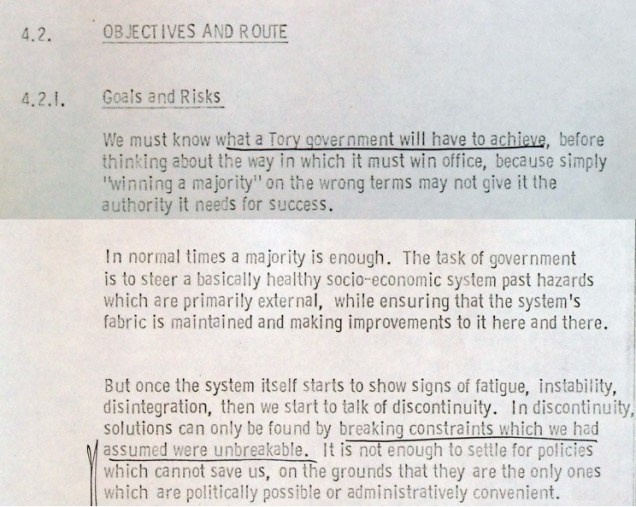
The good news is that there is precedent for all of this. In 1977, the “Stepping Stones” report was published by the late John Hoskyns and Norman Strauss, two businessmen (at IBM and Unilever respectively) who took it upon themselves to diagnose the “British disease” which threatened to doom us to long-term national decline, and propose radical solutions. Crucially, the treatment prescribed by Stepping Stones was not a mixed basket of scattergun solutions to individual problems, but rather a coherent package of reforms which sought to simultaneously treat all of the symptoms of the British disease while also identifying and destroying the root cause (the grip of statist socialism and the unions).

The Britain of the 1970s, wallowing deep in the failing post-war consensus, can hardly be described as being highly receptive to radical right-wing thinking at the time Stepping Stones was published. But that didn’t matter – Hoskyns and Strauss managed to get the ear of aides to Margaret Thatcher back when she was still Leader of the Opposition, and when she walked into Downing Street in 1979 she did so with Stepping Stones in her handbag and on her mind. Then, as now, the important thing to begin with was not that the country understands the entire plan or knows that the Tories view the current status quo as a disease to be cured, but just that the government seems to have energy and purpose again. The plan will reveal itself in good time, just as Stepping Stones did.

That doesn’t mean that the Tories can avoid coming up with a better narrative than “Strong and Stable” or “Brexit means Brexit”. These were appalling battle cries with which to fight the 2017 general election, and deserved to be mercilessly picked apart and ridiculed by the media and a newly-confident Labour Party. A new narrative is certainly needed, but this must be both authentically conservative and it must avoid clashing with policies that the government intends to adopt. For instance, it is no good for the Tories to publicly wring their hands about such-and-such social issue when they have little intention of directly tackling it through the levers of government. That’s why I am hesitant to support the Big Tent’s heavy focus on social renewal – it opens up endless opportunities for the sanctimonious parties of the Left to attack us for weasel words or hypocrisy, while at the very best all we can hope to do is fight the socialists to a draw.

But of course, back in 1977-79 all of this ideological and rhetorical renewal was done from the relative comfort and obscurity of opposition. Now, an intellectually exhausted Tory Party must effectively perform the same feat while in government and seeing their worldview held accountable for every little thing that goes wrong up and down the land. This is a much harder task, bordering on the impossible.

Yet that is exactly what we need. We need a new Stepping Stones report for the Britain of 2017, recognising that the challenges we face today – globalisation, automation, mass migration, Islamist terror and Brexit – are very different to those faced by the incoming Thatcher government in 1979, but that these contemporary problems must be tackled with exactly the same spirit and according to the same conservative values.

Hopefully the Big Tent can play an important role in this process. If nothing else, it is hugely encouraging to see somebody, anybody else finally acknowledge that the Conservative Party does actually need to renew itself and come up with a compelling conservative vision for Britain rather than arrogantly waiting for Jeremy Corbyn to fail. This blog has been something of a voice in the wilderness on this topic since mid way through the coalition government – hammering home the point here, here, here, here, here, here, here, here, here, here, here, here, here, here, here, here, here, here, here, here, here, here, here, here, here, here, here, here, here, here, here, here, herehere and here – but it is good to be belatedly joined by a chorus of establishment journalists and conservative commentators who have finally woken up to the fact that the Tories need an explicitly ideological answer to Jeremy Corbyn and Labour’s resurgent socialism.

Toby Guise is broadly hopeful that the Big Tent has potential:

Disheartened conservatives should remember that cultural Marxism was born out of weakness not strength—specifically, the failure of Western proletariats to obey Marxist doctrine by revolting during World War One. Since the fall of Communism, the strategy has been pursued with ever-greater vigour as a displacement activity from discussing discredited economic ideas. When British Labour politicians are put on the spot about policy, they often flounder spectacularly. Yet the overall direction of travel in Jeremy Corbyn’s speech today at the Labour national convention was clear: towards a Venezuelan-style command economy based on nationalization and authoritarianism. Equipped with this tried-and-failed policy program, it’s no surprise that the party machine diverts as much attention away from economics and onto kulturkampf. By refusing to engage this strategy—and instead directing attention firmly onto clear-minded political solutions that make markets work for all—the Big Tent Ideas Festival is precisely the right type of response.

Mark Wallace was also pleasantly surprised:

I’m pretty sure I saw some Hunter wellies, and some conversations did occasionally threaten to induce a minor wince. But, if we’re honest, there was probably less of each of those phenomena to be seen in the beautiful Berkshire sun than there will be in Manchester next week.

Crucially, they did not outweigh the value of the event, which grew on me as the day went on. Here were Conservatives, entrepreneurs, inventors, charity founders, policy experts, young people, older people and a mix of journalists and politicians talking about ideas for a whole day. That shouldn’t be unusual, but it is. The election, and the problems suffered by the Conservative Party among certain key demographics, was the inevitable backdrop to the discussion, but the Big Tent encouraged people to exchange views openly, to hear experiences alien to their own, and to consider how their principles might be applied to real world issues.

With about 220 people in attendance, it wasn’t a lobbying-fest, or a jockeying arena for glad-handing and card-swapping. It felt more like what I’d imagine to be Steve Hilton’s ideal wedding reception (except with more shoes): tents and bunting, a good buffet, and a bar of sustainably-produced beverages, along with speeches about the environment, prison reform and the impact of technology on democratic culture.

This wasn’t a representative sample of the Conservative Party, still less of the electorate, either socially or ideologically, but I found it refreshing to see people applying their minds and experiences to pressing problems.

I have also now volunteered my time and effort to the cause. And in a way, I will regard whether my offer of help is taken up as a sign of whether the Big Tent has the potential to be a useful vehicle for conservative renewal. Not because I am so amazing, talented and inspired that I can single-handedly save British conservatism, but because if they start listening to independent bloggers and other voices (besides the usual MPs, journalists, Westminster types, charity representatives and community organisers) then it will be a clear sign that British conservatism is willing to entertain ideas from outside the bubble. That having hit intellectual rock bottom they are finally willing to take a dispassionate look at their failings and make some vital changes.

Stepping Stones, which literally formed the blueprint for saving Britain from 1970s-style national decline, was not borne of a cosy conversation between people inside the Westminster political elite. It took outsiders – from the world of business, in this instance – to hold a mirror up to the country and to the establishment, showing them that the old path was unsustainable and that new ideas, previously dismissed as unworkable or politically unpalatable, were required to get Britain back on track.

We need a new Stepping Stones report for the Britain of 2017, and a Conservative Party with the ambition, courage and clarity of thinking to get on and carry out its recommendations, effectively executing a dramatic mid-term course change rather than waiting fearfully for Jeremy Corbyn’s Labour Party to cast them back into opposition.

God speed to the Big Tent and the work they are doing; Lord knows that it is desperately needed.


Stepping Stones Report - Wiring Diagram

Support Semi-Partisan Politics with a one-time or recurring donation:

Agree with this article? Violently disagree? Scroll down to leave a comment.

Follow Semi-Partisan Politics on TwitterFacebook and Medium.

Back To The Grindstone

Oia - Santorini - Greece - Sam Hooper vacation

Back to work for party conference season – and announcing a new side hustle

Apologies for the lack of new blog posts in the second half of September (save one to be published shortly over at Leave HQ). For the past week-and-a-bit my wife and I have been on a much-needed holiday in Greece, visiting the islands of Paros and Santorini, our old favourite.

Fortunately it doesn’t seem as though I missed a whole lot, other than Theresa May wasting taxpayer money travelling to Florence to give people the same vague, woolly pseudo-aspirational fluff that she normally transmits from London, and of course Donald Trump’s new War on Football and the NFL.

I like to make use of these short breaks in blogging to pause and reflect on how I can best proceed going forward, and I have decided to write a short book over the next few months. I shall self-publish (most likely on Amazon) and the subject shall be the future of British conservatism – assuming that some kind of future for right-wing politics is even possible in contemporary Britain. I will be drawing largely from past articles on this blog, but also adding in new material, contemporary developments and daring to venture a few predictions and pieces of advice (all of which will no doubt be proven hilariously wide of the mark very soon thereafter).

Assuming that I publish around Christmastime or early in the new year I can also be reasonably confident that various hacks from the Telegraph and Spectator will be making eerily similar points and claiming them as their own (or at least to be self-evident truths) within a few short months, to great acclaim from the Westminster media bubble. Unless, of course, Jeremy Corbyn has already become Prime Minister by that point and/or the Brexit talks have collapsed, in which case all of this will have come too late and we will have far bigger things to worry about than the establishment media’s freezing out of the independent political blogosphere.

My forthcoming e-book will not be available in all good bookstores – or even in very bad ones, for that matter. A copy will not be kept at the British Library, or any other copyright library. Or the bargain bin at your local charity shop. But it will be insultingly cheap and hopefully not too boring.

But who knows, my verbosity does often tend to get the better of me, I’ve never written a book before and I don’t have an editor or any experience of working with one. So if the whole thing turns out to be unfathomably awful you have my advance permission to protect my fragile ego by telling me how great it is while not reading beyond the Contents page.

Deal?

writing a book - authorship

Support Semi-Partisan Politics with a one-time or recurring donation:

Agree with this article? Violently disagree? Scroll down to leave a comment.

Follow Semi-Partisan Politics on TwitterFacebook and Medium.

Theresa May’s One Chance For Redemption: Sacrificing Her Leadership For A Sane Brexit

Theresa May - Brexit - Article 50 declaration signing

Theresa May will never be remembered as a great prime minister because she is timid, calculating and lacks any positive vision for the country. But she can still redeem her failed premiership by sacrificing it in order to achieve a sane Brexit

The fate of Brexit hangs in the balance, primarily because two equal and opposing forces are selfishly attempting to hijack Britain’s negotiating stance for their own purposes.

One one hand there are the Brexit Ultras (or the Brexit Taliban, to use the less charitable but evocative phrase) who insist, like religious fundamentalists, that theirs is the One True Brexit, the only route to heaven, while all other interpretations are dangerous heresy. These people – your Steve Bakers, John Redwoods, Jacob Rees-Moggs and Suella Fernandeses – do not see Brexit as meaning departure from the political entity known as the European Union. To them, Brexit means severing virtually all ties and treaties with the EU while retaining nearly all of the current perks, while making up for any economic shortfall by effortlessly completing a series of swashbuckling free trade deals with countries often far less important to the UK economy than our nearest neighbours.

But on the other hand, there are forces who are arguing passionately for a “soft Brexit” with strong and enduring ties to the Single Market, not because they believe in Brexit or have accepted it, but because they see this as the first step to reversing the result of the EU referendum and keeping Britain in the European Union (generally by means of a second referendum, which they believe – erroneously, I think – that they could win). These people are not to be trusted. During the referendum campaign they could be found loudly insisting that any change in Britain’s relationship with the EU would result in political isolation and economic Armageddon, yet now they claim (somewhat more plausibly) that it is only separation from the Single Market which will cause harm. Their old argument was therefore a lie, a fig leaf to justify their determination for Britain to remain part of European political union at any cost.

And sandwiched between these two fanatical, opposing forces, are the saner Brexiteers – such as those connected to the Leave Alliance – who have been arguing all along that Brexit is not a sudden event but a process of unpicking 40 years of political and regulatory integration, and that the best way to achieve our political ends without causing undue economic damage is by means of a transition that involves rejoining EFTA and trading with EU member states on the terms of the EFTA-EEA agreement.

At the moment, however, Theresa May’s inability to exert control over her own party means that the government’s negotiating stance is effectively held hostage by the Brexit Ultras, who see the slightest moderation on trade as a “betrayal” of Brexit, despite laws relating to the EEA accounting for just 20 percent of the total EU acquis. Despite having languished in the political wilderness for decades, getting 80 percent of what they want on the back of a tight referendum result is somehow not good enough for the Brexit Taliban – and their selfish greed for the full 100 percent needlessly imperils the whole endeavour, and our economy with it.

But it need not be like this. As Stephen Bush points out in the New Statesman, there is no shortage of MPs willing to work with Theresa May to achieve a softer, saner Brexit (at least for a transitional period) if only she was willing to work in a bipartisan way rather than remaining a hostage to her own backbenchers.

Bush writes:

As Parliament has ratified Article 50, passed May’s Queen Speech and thus lost control of its ability to directly influence the government’s negotiations, when the final Brexit deal comes before the House of Commons, the option they will be voting on will be “Theresa May’s Brexit deal or no deal”. As I’ve written on several occasions, no deal is a great deal worse than a bad deal. No deal means, at best, exit on World Trade Organisation terms, no deal to allow British airplanes to fly to the European Union or the United States, chaos at borders and an immediate and hard border between Northern Ireland and the Republic.

This all has one massive upside for May: while there are many Conservative MPs who don’t accept this to be true, the opposition parties all know it to be the case. May will always be able to count on enough MPs from the parties of the centre and left being unwilling to make their own constituents’ lives drastically worse.

But the snag remains:

But that would require her to pursue a Brexit deal that wasn’t focused on keeping her government on the road –  one that saw getting the best deal as more important than preventing May being removed by her own backbenchers. The difficulty is that Theresa May displayed precious little desire to pick a fight with her own party before she threw away their first parliamentary majority in 23 years and she has even less of one now.

This is one of those times when a presidential-style system of government would actually aid Britain enormously. With a separately-elected head of government, more autonomous and less beholden to the rank and file of their political party, it would be easier to forge a winning coalition in Parliament to pass a more sensible, measured Brexit bill. Unfortunately, with the British parliamentary system, any attempt by Theresa May to make overtures to pragmatists across the political aisle would immediately put her premiership in grave peril. A leadership challenge would all but certainly be triggered immediately, and it would then be a race against time to pass the bill before the self-destructive forces at work within the Tory Party concluded their ghastly business and replaced May with a One True Brexit fanatic.

But at this point, there is precious little to lose – not for the country, anyway (though Tories with medium-term hopes for future political careers may feel somewhat differently). And there is precious little for principled conservatives to lose either, given that Theresa May’s government has given every indication from Day 1 that it intends to fight a rearguard retreating battle against encroaching statism rather than take it on with a bold, alternative vision.

The prime minister and her Conservative Party have had all summer to dwell on the reasons for their disastrous election campaign and their their growing unpopularity among people with their original hair colour, and to come up with at least a sketched outline of a new approach. And what was the best scheme they managed to cook up between themselves in all that time? A puny, derisory pitch to reduce interest rates on student loan debt, in the risible hope that doing so might win the affections of young voters currently seduced by Jeremy Corbyn.

The ambition has gone from this Conservative government, together with any semblance of intellectual rigour in their policymaking. Rather five years of Jeremy Corbyn, constrained by his own centrist MPs and a Tory party in opposition, than any more of this decay and damage to our reputation. At least the government’s approach to Brexit might be somewhat more pragmatic if led by people who do not expect the European Union to freely offer all of the benefits of the Single Market for none of the costs or commitments. And then, when Corbyn’s Labour Party have proven themselves to be a shambles in every other respect, the Conservative Party might bounce back into government under the direction of a leader more worthy of respect.

What great development are Theresa May’s supporters hanging on for? What great new policies or achievements do they imagine her accomplishing with her puny non-majority in the time before she is inevitably toppled by one of her Cabinet members? There is nothing. So better to bring the suffering to a close and stop deferring the inevitable.

If the prime minister were better advised, she might also see the advantages of this option. Theresa May is a weakened leader, barely in control of her directionless party which itself is unpopular with voters after seven wasted years in government. At present, her premiership is set to come to an ignominious close with no significant accomplishments to her name. But this need not be so.

In a final act of defiance – and as an extravagant and substantial gesture to help bring the country together after the EU referendum and its fallout – Theresa May should stand up to her backbenchers and to the Brexit Taliban, and work with willing MPs from the opposite benches to ensure that a more considered Brexit Bill is passed by Parliament. This need not and should not be a formal arrangement with the Leader of the Opposition, who will have his own motives. Jeremy Corbyn’s support remains shallow within the Parliamentary Labour Party, and willing supporters could be found by going round the Labour whips.

At present, the very future of Brexit is being imperilled by zealots who foolishly insist that forty years of political and economic integration with the EU be unpicked in the space of just two years. These people need to be sidelined, and if the price of doing so is the end of an otherwise hopeless premiership and the provoking of a long-overdue existential crisis within the Tory party then it is a price very much worth paying.

There is nothing else that Theresa May can do which would impact so positively on her legacy at this point. The prime minister should consider her options.


Britain - UK - European Union - Referendum - Brexit - Punishment Beating

Support Semi-Partisan Politics with a one-time or recurring donation:

Agree with this article? Violently disagree? Scroll down to leave a comment.

Follow Semi-Partisan Politics on TwitterFacebook and Medium.

British Conservatives And The Youth Vote: The Failed Promise Of Activate

Activate - Tory Momentum campaign - conservatism - youth vote

It is easy to mock youthful conservative activists when their attempts at social media outreach go awry, but at least they are trying – none of the supposed adults in the Conservative Party seem remotely interested in salvaging conservatism’s toxic reputation among younger voters

The media has been having a lot of fun today at the expense of an organisation called Activate, a newly-launched independent conservative campaign group of young people, by young people and for young people.

Some of this criticism has been justified – the launch on social media was uncoordinated and the messaging…suboptimal, at best. One could certainly argue that Activate tried to run before it could walk, entering the political fray before the values and priorities of the group had been fully defined and agreed.

(Full disclosure: I was very tangentially involved in the pre-formation of this group earlier in the summer, participating in several group chats and offering occasional words of advice. This was in line with my strong belief – stated many, many, many, many times – that British conservatism will die out unless it urgently finds a way to reach and inspire younger voters with a positive message).

Inevitably, the reviews have not been kind, with outlets from the Independent, New Statesman, The SpectatorHuffington Post, Political ScrapbookRed Pepper and Esquire all forming an orderly queue to mock the group and question its grassroots bona fides.

The Guardian was actually one of the kindest:

A new Conservative grassroots campaign inspired by Labour’s Momentum movement will attempt to engage more young people in rightwing politics, though the group’s launch has been widely mocked on social media.

Activate, which aims to “engage young people with conservatism”, has close links with senior party activists, and is chaired by former Tory campaign manager Gary Markwell, a councillor in West Sussex. A Conservative spokesman said Activate was “not officially linked to the Conservatives and it receives no party funding”.

The group’s constitution says it will be independent from the party, though all members are expected to be members of the main party.

The campaigning group launched with a Twitter picture of the Labour leader, Jeremy Corbyn, followed by a picture of Star Wars character Admiral Ackbar, saying “It’s a trap”.

The group’s use of multiple hashtags and a meme that was last popular in the early 2000s led to widespread derision on the social network.

Somewhat cringeworthy? Of course. Not what I would have done or recommended. But you can look at this two ways.

On one hand, you can take the attitude of the scornful left-wing press (and even some of the right-wing blogs like Guido Fawkes) and make fun of Activate’s enthusiastic but undeniably amateurish initial foray into grassroots political campaigning. And indeed, many journalists and commentators have been only too happy to mock the sincere efforts of 17-year-old students who at least take the time to educate themselves about political issues and live up to their responsibility to be good engaged citizens. That is certainly one approach, albeit a rather cynical one.

But the other attitude – a far more constructive one – is to ask why the hell it is being left to a group of enthusiastic but inexperienced teenage and twenty-something activists to do what the Conservative Party should have been doing all along, namely trying to engage in meaningful outreach to sceptical younger voters.

Recall: Theresa May’s brilliantly inspired general election campaign saw the Tories lose the 18-19 year old first time voter demographic by a margin of 47 points. The Conservative Party is getting nowhere with young people and struggling with nearly everyone else because they cannot clearly articulate what they stand for and simply offer a bland, repetitive, uninspiring and entirely defensive message.

With no positive message to rally around, no formal conservative youth movement and national party leadership totally devoid of charisma, the combined forces of present-day young conservative activists could probably all fit comfortably within a League One football stadium, with room to spare. Unfortunately, people who unironically wear bow ties and read economics at Cambridge are pretty much all we have right now in terms of boots on the ground – would that it were otherwise. But at least Activate is trying to expand the appeal of conservatism.

Maybe rather than mocking the earnest sixth-former wearing a bow tie in his bio picture, the likes of Guido Fawkes should instead be asking why it has been left to young kids like this to take all the initiative of creating a grassroots youth conservative movement on their own, with almost no help from senior Tories, party grandees, external think tanks or anybody else with abundant time, money and influence.

Maybe they should ask what possible excuse party leader Theresa May and her CCHQ cronies can offer for falling down on the youth outreach job so spectacularly. Maybe they should try holding the prime minister to account for swanning off to Italy after having presided after this disaster of an election campaign rather than staying put to undo a small fraction of the damage that she has done to the Conservative brand.

Maybe the likes of the IEA, Adam Smith Institute and Centre for Policy Studies should be a little more concerned about where their pipeline of future fellows and supposed thinkers will possibly come from when nearly every young person in the country hates the Tories with the burning heat of a thousand suns, and retains that hatred well into middle age. Kate Andrews is great, and a breath of fresh air on Question Time, but there is a limit to the number of articulate young conservative thinkers we can import from the United States. At some point we will have to develop some more homegrown talent.

But no. Rather than engaging in the slightest bit of introspection, too many conservative voices seem content to continue writing their asinine hot takes about the daily developments in the Brexit negotiations, speculating pointlessly about the next Tory leadership contest or simply getting drunk on Pimms and having Jacob Rees-Mogg’s face tattooed on their chests. Because summer silly season nonsense is so much more fun than tending to the existential question of who will keep the flame of conservatism lit when its present custodians are no more.

Maybe Activate did make a really bad start to their campaign. Maybe their name lends itself too easily to mockery. Maybe their logo wasn’t produced by the best graphic designers that money can buy. Maybe their initial foray into social media was more worthy of a Jacob Rees-Mogg fanclub than a serious political entity. But everything they have done thus far, they accomplished without a scintilla of help from anybody else in the British conservative movement. Contra much of the leftist press, this really is an unaffiliated grassroots movement.

Faced with the immense tarnishing of the conservative brand and reputation among young voters inflicted by Theresa May, her Cabinet and all the other supposed adults in the room, a group of sincere and well-meaning young conservative activists stepped up at a time when our elected conservative politicians have effectively fled the field of battle. That counts for something, and deserves acknowledgement.

Activate received no help from from the increasingly unworthy political party that bears the conservative name, and certainly no help from the constellation of think tanks, institutions, media outlets or commentators who think themselves so well-connected and influential. Unlike Momentum on the political Left, Activate has no prominent champions in the wider conservative movement, no real mentors (so critical to getting a youth organisation off the ground) and no funding that I am aware of. If anything is embarrassing, it isn’t a dated Star Wars meme on Twitter – it’s the fact that besides these well-meaning if sometimes naive people, nobody else is even making an effort.

It is time to face a number of difficult truths. Conservatism as an ideology and a political movement is radioactive to the majority of today’s young people. We are in retreat in schools, on the university campus, in the world of the arts, in the laboratories, in popular culture and the media, not to mention the House of Commons. And our inability to connect with younger voters and inspire them with a positive message about how conservative values and policies will benefit them and benefit the country is arguably the biggest threat that we face.

Faced with this shameful lack of leadership from anybody in Westminster, Activate is at least trying to do something to face up to these threats and begin tackling conservatism’s huge deficit of trust and inspiration among young voters.

And that is vastly more than can be said of all those people who spent today laughing smugly at their struggle.


Conservative Party Logo - Torch Liberty - Tree

Support Semi-Partisan Politics with a one-time or recurring donation:

Agree with this article? Violently disagree? Scroll down to leave a comment.

Follow Semi-Partisan Politics on TwitterFacebook and Medium.

Winter Is Coming For Conservatives Unless We Wake Up To The Socialist Threat

Momentum - socialist - online campaigning - videos social media

The hard Left is on the march, and all the anti-Corbyn negative ads in the world will not save an ideologically bankrupt Conservative Party which cannot clearly articulate an appealing and realistic vision for Britain

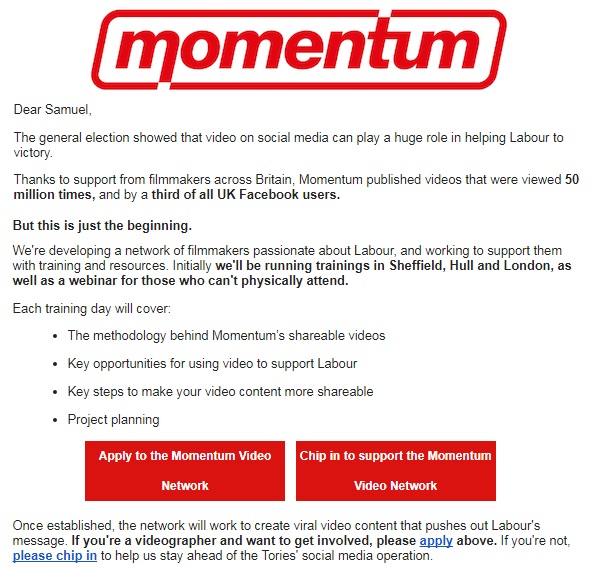
Look at this email, which pinged into the inboxes of Momentum members and supporters today.

The socialists are on manoeuvres. They haven’t wasted their summer sipping limoncello on the Amalfi Coast or plotting Oxford Union-style leadership coups with their Cabinet chums. No, having drawn blood from the Conservative Party and reduced the British prime minister to a laughing stock in the June general election, Momentum and other hard-left elements of the Labour Party sense that their long-awaited victory is nearly at hand. And they are training for the battle to come.

I wrote the other day about how the Conservative Party is fiddling while the country burns and Momentum creeps up behind them. This isn’t a laughing matter. Momentum are organising, deploying the latest in voter outreach strategies imported from the Bernie Sanders presidential campaign in America, and – shock, horror – daring to have conversations with traditionally Tory voters rather than engaging in fruitless navel-gazing introspection as the Conservative Party is currently doing.

Much was written during the election campaign about how much slicker and better financed the Tory online campaign was than its Labour counterpart. The Conservatives spent over £1 million on negative ads on Facebook alone. But it was not an effective campaign. It was soulless, clinical and relentlessly negative. All of which might have been forgivable if it had been properly targeted. But it wasn’t. Instead, CCHQ-produced messages designed to energise the existing Tory base were thrown relentlessly in the faces of swing voters, who did not respond to shrill warnings about Corbyn’s impending socialist takeover.

As with literally everything else about the Conservative Party, the online and voter outreach campaigns were hideously overcentralised and clearly managed by some of the same gormless nepotism beneficiaries who infested Theresa May’s pre-election Cabinet.

And still this might have been survivable if the Labour Party was as terminally dysfunctional as nearly every Westminster-based journalist was confidently reporting prior to the release of the exit poll. But it wasn’t, and still isn’t. Centrist doubters sat on much of their criticism for the duration of the campaign, and following the stronger-than-expected result came crawling meekly back to the leader they once openly undermined.

A vindicated Jeremy Corbyn is bolstered in his position. And the socialist hard-left of the Labour Party has benefited from this injection of confidence, immediately pivoting toward the next general election, where they believe they can dislodge this tired and pointless Tory government and turn the clock back to 1979.

I wrote the other day about how Momentum, Jeremy Corbyn’s praetorian guard, are holding group training sessions to teach their activists the latest in voter engagement techniques, with even doddery old folk less familiar with the latest technology being inducted into the organisation’s Slack group so that they can communicate in real-time on their smartphones. And now, today’s Momentum bulletin shows that the organisation also intends to revolutionise its social media campaign activities, potentially turning each of their members into a YouTuber capable of creating viral internet videos in support of the Labour Party.

Bear in mind: while the Tories vastly outspent Labour in the online campaign war, their dismal content failed to articulate any positive vision of conservatism and probably alienated half the people who viewed it. Meanwhile, Momentum’s videos were viewed 50 million times, and by a third of all the Facebook users in Britain. That level of penetration and engagement, on a shoestring budget, is incredible.

But you can’t just put it down to a superior grasp of online campaigning by the hard Left. People watched Momentum videos and kept coming back for more because they liked what they were seeing and hearing, or were at least open to the message. They did not respond warmly to the Conservatives, who engaged nearly exclusively in fearmongering and robotic negative messaging about their opponents, but many of them did respond to the side who took enough pride in their political values and had sufficient confidence and faith in those values to make a bold public case for More Socialism. And still Momentum is not satisfied. Still they seek to improve their messaging and hone their campaigning ability.

Meanwhile, what are we conservatives doing to retool ourselves to better fight the next general election? We are creating juvenile Jacob Rees-Mogg fanclubs on Facebook, engaging in pointless speculation about a cast of future leadership contenders all alike in blandness, and spending more time trying to ingratiate ourselves with the Tory party machine in constituency and at conference than figuring out what we should actually stand for, and how we can persuade others to stand with us.

Fellow conservatives, you need to wake up and hear this message while there is still time:

The hard, Corbynite Left are gunning for us. Hard.

Unlike conservatives, they have worked out exactly what their values are.

They are not ashamed of those values, and do not apologise for them.

They are hard at work translating those values into policy.

They are proud to proclaim those values and policies in messaging which appeals to the electorate, while we sound defensive and almost ashamed of our own policies and record.

They are convinced that they are on the right side of history, while we seem to have lost faith in the principles of free market capitalism and individual liberty.

They make an unashamedly moral case for their worldview while we seem content to sit at the back and pick holes in their sums, looking like soulless technocratic bean-counters.

They have a thriving youth movement. Ours was disbanded because of a bullying scandal, and because it was basically a giant Ponzi scheme with risible promises of future candidacies dangled in front of naive young activists.

Their activists dominate university campuses, their leftist dogma reigning supreme in the lecture hall and students’ union alike, while conservatives are an endangered minority who often face ostracisation or even official censure for speaking out.

They have a national party with strong and growing constituency branches, while we have a decaying national party with withering constituency branches, ruled from Westminster by proven mediocrities.

They have a party leader who can pack a 3000-seat theatre with excited and motivated activists, while we have a party leader who was too cowardly to even debate during the election campaign, and who is so robotic that she short-circuits if she goes out in the rain without an umbrella.

But here’s the good news – this is a fight that we can win.

Regressive leftist policies of redistribution and nationalisation have brought poverty and misery in their wake everywhere that they have been tried, while the free market that we support has lifted more people out of poverty, subsistence and despair than any other economic system devised by man. There is a reason that the Left has gone very quiet about Venezuela, once their favourite case study of socialism in action.

The traditional Left/Right political divide is being augmented (if not replaced) by the Anywheres vs Somewheres dichotomy (or “open vs closed”, to use the more patronising terms). The Labour Party is marching away from its working class base of Somewheres because their self-serving parliamentary caucus is in thrall to the self-entitled demands of other Anywheres like themselves. This gives us conservatives a huge opportunity to steal their votes – after all, we stand for country, community and patriotism, the very values that the metro-left openly despises.

But we will only win this fight if we get our heads out of the sand, stop manoeuvring for status or creating stupid memes on Facebook and learn instead to boldly and unapologetically articulate conservative principles in the public sphere, without apology. Not the craven, Labour-copying principles of Theresa May’s authoritarian government. Not the paternalistic statism of Nick Timothy and the Joseph Chamberlain afficionados. Rather, we need to re-embrace the timeless principles of individual liberty, patriotism, respect for institutions, strong national defence and flourishing civic society over paternalist statism, which always come through for us when we actually have the confidence to articulate them.

And we don’t have much time. In this unpredictable age, with no majority and a number of difficult things to push through Parliament, Theresa May’s government could conceivably be toppled at any moment. Momentum and the hard Left is ready for the fight. We are not.

To use a topical Game of Thrones analogy, when the White Walkers are massing and threatening to breach the wall, it’s no good squabbling over which lacklustre, uncharismatic Cabinet minister should next occupy the Iron Throne. Now is the time to find some ideological dragonglass and fashion it into a viable electoral weapon before we are swept away by the Army of the Socialist Undead and Britain succumbs to another long winter of discontent.

Momentum have given us fair warning. They are not being secretive about their strategy and tactics. So we conservatives will have only ourselves to blame if we find ourselves undone by them.


White Walkers - Game of Thrones

Support Semi-Partisan Politics with a one-time or recurring donation:

Agree with this article? Violently disagree? Scroll down to leave a comment.

Follow Semi-Partisan Politics on TwitterFacebook and Medium.