The Big Tent Ideas Festival

Stepping Stones Report - Goals and Risks - Brexit - EU Referendum

Searching for the missing conservative soul in a Berkshire field

Various people have been raving about an event which took place last week in Twyford, Berkshire, where Conservative MP George Freeman set up a few yurts in a field and held an impromptu late-summer symposium on how to renew British conservatism.

The Big Tent Ideas Festival is a laudable ongoing effort to refresh and reset British conservatism while the Tory party is still in government, as opposed to waiting until they languish in opposition. This is easier said than done – as anybody can plainly see, Theresa May’s listless and fratricidal government has run out of what little ideological steam it inherited from David Cameron’s equally muddled tenure. Now they sit, idling in neutral, on the cusp of making an almighty mess of Brexit and being kicked out of office without a single lasting achievement to their name.

Mark Wallace of Conservative Home was in attendance, and describes the extent of the challenge:

The Right’s challenge is that time in government saps the energy, and increases the centralisation, of any movement. The never-ending trials of running the country drag in, and burn through, many of the policies and people. Indeed, we produce our best ideas and develop our greatest new talents when the variety of interests that exist across the centre right movement have room to breathe and freedom to operate. Often that happens in Opposition – the Party’s apparatus, authority and powers of patronage are more limited, and there’s a clear objective to pursue.

That’s as true for Labour as it is for the Conservatives – consider the contrast in energy between the respective camps of Major and Blair, or Brown and Cameron. The task for our movement today is to break that cycle: to renew and innovate now, while the Conservative Party is still in power. To do so requires us to recapture that freedom and urgency enjoyed in the years between 2004 and 2010, which saw such fertile growth of new thinking and campaigning organisations, the development of new outlets to communicate our ideas (not least ConservativeHome), the development of a raft of strong, new policies and the emergence of a generation of talented campaigners, thinkers and communicators.

The Big Tent is currently focusing on three main strands of renewal: Social Renewal, Political Renewal and Economic Renewal. Fair enough – these designations seem to make sense. And some of the questions being debated across all three areas resonate very strongly with topics that this blog cares deeply about, namely:

  • What are the causes of the deepening crisis of disconnection between government and the citizens it is supposed to serve?
  • How do we define a meaningful notion of citizenship with reciprocal responsibilities with the state, which works for us all?
  • How do we better support our third sector and encourage volunteering?
  • How do we reform our benefits system?
  • How do we build lifelong learning, from antenatal, through the early years, school and adulthood, and incorporating resilience, emotional and social learning, as well as key skills? How do we get parents and communities to support this in the poorest areas?
  • Is the rise of extremism – to left and right – a function of failure in the mainstream centre or simple liberation of the radical fringes?
  • Given the public’s rejection of mass low wage migration, how can we achieve the transformational skills and training revolution of the UK workforce which has defied policymakers for 150 years?

And particularly:

  • How do we embed lifelong learning to increase workforce resilience for the coming tech change tsunami so we do not make the same terrible mistakes as happened in 1980s mining areas (and from which we have still not recovered)?

Remarkably, though, the housing crisis was not called out as a separate issue for discussion, even though it is the pre-eminent challenge driving a wedge between the Tory party and otherwise potentially sympathetic voters. This is a very curious feat of omission, to the extent one wonders whether it can have been accidental. As with Conservative policy since 2010 there seems to be a deliberate refusal to acknowledge the need to do anything which might annoy the current rural, home-owning, NIMBYish Tory base by threatening the continual upward trajectory in the value of their houses.

This is short-sighted, and needs to be addressed urgently. Housing should be one of the absolute key issues being debated by the Big Tent, not something whispered about on the margins or tangentially as part of another discussion. In the 2017 general election, the Tories did not win a majority of any demographic until the average age ticked over fifty. Fifty! Conservatives no longer merely have a problem with youth voters, though we are certainly more radioactive than ever among this crowd. We are now almost equally unpopular among young professionals and people in early middle age.

At least the Tories of Margaret Thatcher’s day had some slick city Yuppies with stripy shirts and enormous cellphones in their corner. I have lived and worked in a professional capacity in London for a decade now, and can count the number of fellow “out of the closet” conservatives in my social circle on two hands, with fingers to spare. That CCHQ does not presently view this deficit among young, educated voters as an existential crisis speaks volumes about their complacency and sheer incompetence.

This is a demographic time bomb waiting to explode in the Conservative Party’s face. The metaphorical conveyor belt carrying young idealists from left-wingery to conservatism as they age cannot be taken for granted – it has only worked in recent decades because as people get older, government policy has allowed them to acquire a greater stake in society, primarily through home and equity ownership. People do not just magically start voting Conservative when they get their first grey hair, and people who have been consistently screwed over by selfish, short-termist policies which pander to the Tory base at the expense of the wider national interest will develop a lasting antipathy to the Conservative Party and to conservatism in general.

Dodging the housing issue is not an option. It must be tackled head-on, and (unlike Theresa May’s “dementia tax” debacle) it must be done with care and sensitivity. So long as Jeremy Corbyn or somebody like him leads the Labour Party, the Tories will have a bit of political cover to do something radical on housing – even if it enrages a section of their base, few of these people will defect to a Labour Party eager to tax them to death. Failing to act before Labour falls back into centrist hands means that the Conservatives’ scope for manoeuvre will be greatly reduced.

Additionally, while the tripartite focus on social issues is laudable at first glance, this area should not be allowed to dominate the discussion as it dominated much of Cameronism and now Theresa May and Nick Timothy’s very statist, paternalistic brand of conservatism.

Yet Toby Guise at The American Conservative reports that the “society” tent was by far the most popular:

The mainly young delegates heard speakers in tents marked “politics,” “economics,” and “society.” Tellingly, the last of these was the largest—with a program that opened with pitches from the founders of two significant charities focused on social exclusion. This theme reflected the fact that accusations of a compassion-deficit are at the heart of Labour’s attack on the Conservatives.

This reflects the current priorities and incentives for success in conservative Westminster politics. Being seen as a beardy Nick Timothy acolyte seeking to extend government influence into every home and mind is viewed as trendy and forward-thinking, while sitting at a desk thinking about how to encourage entrepreneurship and decrease reliance on the state is seen as excessively “ideological”.

It may sound harsh, but conservative renewal will not come about by focusing relentlessly on social issues, as though the state can and should provide an answer to every single social ill in Britain. It is tempting to believe that government must fill this expansive role these days, especially since the Tories are pounded day after day by Labour’s wobbly-lipped moralisers about how they are supposedly so callous and unfeeling. It is only natural in these circumstances to want to begin offering scattergun policy prescriptions to address every last issue which happens to excite the Joseph Rowntree Foundation.

Indeed, the phrase “compassionate conservatism” only plays into the Left’s hands by wrongly conceding that ordinary vanilla conservatism is somehow cruel and uncompassionate, and that we can only redeem ourselves by accepting statist, left-wing talking points and policies. This is a dangerous nonsense.

People say that they are interested in social justice and equality, particularly at dinner parties, when talking to pollsters or otherwise needing to make themselves look good. But when they are in the privacy of the voting booth they actually care about the economy and the general direction of the country. That means that to make a measurable difference in the fortunes of the Conservative Party, the Big Tent should focus primarily on the Economic and Political renewal branches, trusting that improving the overall health of the nation and spurring the reinvigoration of civil society will improve conditions for all. Rather than more government intervention, we need to create the conditions for a rapid growth of charitable (real charities, not 90% government-funded money laundering outfits) and private solutions to entrenched social problems rather than the clunky, failed attempts at social engineering preferred by New Labour and their successor Tory governments.

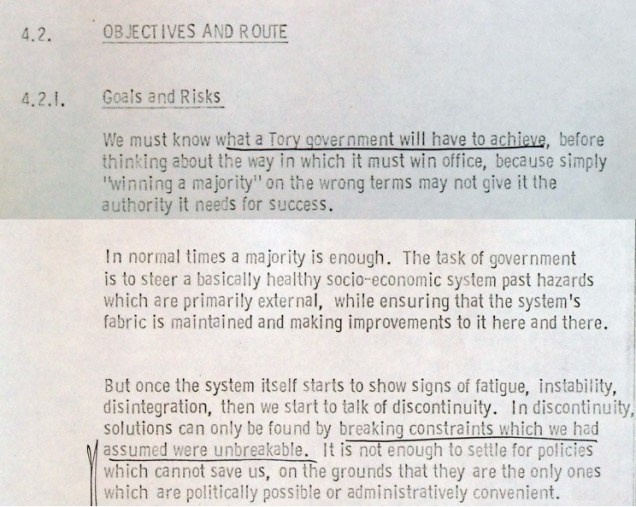
The good news is that there is precedent for all of this. In 1977, the “Stepping Stones” report was published by the late John Hoskyns and Norman Strauss, two businessmen (at IBM and Unilever respectively) who took it upon themselves to diagnose the “British disease” which threatened to doom us to long-term national decline, and propose radical solutions. Crucially, the treatment prescribed by Stepping Stones was not a mixed basket of scattergun solutions to individual problems, but rather a coherent package of reforms which sought to simultaneously treat all of the symptoms of the British disease while also identifying and destroying the root cause (the grip of statist socialism and the unions).

The Britain of the 1970s, wallowing deep in the failing post-war consensus, can hardly be described as being highly receptive to radical right-wing thinking at the time Stepping Stones was published. But that didn’t matter – Hoskyns and Strauss managed to get the ear of aides to Margaret Thatcher back when she was still Leader of the Opposition, and when she walked into Downing Street in 1979 she did so with Stepping Stones in her handbag and on her mind. Then, as now, the important thing to begin with was not that the country understands the entire plan or knows that the Tories view the current status quo as a disease to be cured, but just that the government seems to have energy and purpose again. The plan will reveal itself in good time, just as Stepping Stones did.

That doesn’t mean that the Tories can avoid coming up with a better narrative than “Strong and Stable” or “Brexit means Brexit”. These were appalling battle cries with which to fight the 2017 general election, and deserved to be mercilessly picked apart and ridiculed by the media and a newly-confident Labour Party. A new narrative is certainly needed, but this must be both authentically conservative and it must avoid clashing with policies that the government intends to adopt. For instance, it is no good for the Tories to publicly wring their hands about such-and-such social issue when they have little intention of directly tackling it through the levers of government. That’s why I am hesitant to support the Big Tent’s heavy focus on social renewal – it opens up endless opportunities for the sanctimonious parties of the Left to attack us for weasel words or hypocrisy, while at the very best all we can hope to do is fight the socialists to a draw.

But of course, back in 1977-79 all of this ideological and rhetorical renewal was done from the relative comfort and obscurity of opposition. Now, an intellectually exhausted Tory Party must effectively perform the same feat while in government and seeing their worldview held accountable for every little thing that goes wrong up and down the land. This is a much harder task, bordering on the impossible.

Yet that is exactly what we need. We need a new Stepping Stones report for the Britain of 2017, recognising that the challenges we face today – globalisation, automation, mass migration, Islamist terror and Brexit – are very different to those faced by the incoming Thatcher government in 1979, but that these contemporary problems must be tackled with exactly the same spirit and according to the same conservative values.

Hopefully the Big Tent can play an important role in this process. If nothing else, it is hugely encouraging to see somebody, anybody else finally acknowledge that the Conservative Party does actually need to renew itself and come up with a compelling conservative vision for Britain rather than arrogantly waiting for Jeremy Corbyn to fail. This blog has been something of a voice in the wilderness on this topic since mid way through the coalition government – hammering home the point here, here, here, here, here, here, here, here, here, here, here, here, here, here, here, here, here, here, here, here, here, here, here, here, here, here, here, here, here, here, here, here, herehere and here – but it is good to be belatedly joined by a chorus of establishment journalists and conservative commentators who have finally woken up to the fact that the Tories need an explicitly ideological answer to Jeremy Corbyn and Labour’s resurgent socialism.

Toby Guise is broadly hopeful that the Big Tent has potential:

Disheartened conservatives should remember that cultural Marxism was born out of weakness not strength—specifically, the failure of Western proletariats to obey Marxist doctrine by revolting during World War One. Since the fall of Communism, the strategy has been pursued with ever-greater vigour as a displacement activity from discussing discredited economic ideas. When British Labour politicians are put on the spot about policy, they often flounder spectacularly. Yet the overall direction of travel in Jeremy Corbyn’s speech today at the Labour national convention was clear: towards a Venezuelan-style command economy based on nationalization and authoritarianism. Equipped with this tried-and-failed policy program, it’s no surprise that the party machine diverts as much attention away from economics and onto kulturkampf. By refusing to engage this strategy—and instead directing attention firmly onto clear-minded political solutions that make markets work for all—the Big Tent Ideas Festival is precisely the right type of response.

Mark Wallace was also pleasantly surprised:

I’m pretty sure I saw some Hunter wellies, and some conversations did occasionally threaten to induce a minor wince. But, if we’re honest, there was probably less of each of those phenomena to be seen in the beautiful Berkshire sun than there will be in Manchester next week.

Crucially, they did not outweigh the value of the event, which grew on me as the day went on. Here were Conservatives, entrepreneurs, inventors, charity founders, policy experts, young people, older people and a mix of journalists and politicians talking about ideas for a whole day. That shouldn’t be unusual, but it is. The election, and the problems suffered by the Conservative Party among certain key demographics, was the inevitable backdrop to the discussion, but the Big Tent encouraged people to exchange views openly, to hear experiences alien to their own, and to consider how their principles might be applied to real world issues.

With about 220 people in attendance, it wasn’t a lobbying-fest, or a jockeying arena for glad-handing and card-swapping. It felt more like what I’d imagine to be Steve Hilton’s ideal wedding reception (except with more shoes): tents and bunting, a good buffet, and a bar of sustainably-produced beverages, along with speeches about the environment, prison reform and the impact of technology on democratic culture.

This wasn’t a representative sample of the Conservative Party, still less of the electorate, either socially or ideologically, but I found it refreshing to see people applying their minds and experiences to pressing problems.

I have also now volunteered my time and effort to the cause. And in a way, I will regard whether my offer of help is taken up as a sign of whether the Big Tent has the potential to be a useful vehicle for conservative renewal. Not because I am so amazing, talented and inspired that I can single-handedly save British conservatism, but because if they start listening to independent bloggers and other voices (besides the usual MPs, journalists, Westminster types, charity representatives and community organisers) then it will be a clear sign that British conservatism is willing to entertain ideas from outside the bubble. That having hit intellectual rock bottom they are finally willing to take a dispassionate look at their failings and make some vital changes.

Stepping Stones, which literally formed the blueprint for saving Britain from 1970s-style national decline, was not borne of a cosy conversation between people inside the Westminster political elite. It took outsiders – from the world of business, in this instance – to hold a mirror up to the country and to the establishment, showing them that the old path was unsustainable and that new ideas, previously dismissed as unworkable or politically unpalatable, were required to get Britain back on track.

We need a new Stepping Stones report for the Britain of 2017, and a Conservative Party with the ambition, courage and clarity of thinking to get on and carry out its recommendations, effectively executing a dramatic mid-term course change rather than waiting fearfully for Jeremy Corbyn’s Labour Party to cast them back into opposition.

God speed to the Big Tent and the work they are doing; Lord knows that it is desperately needed.


Stepping Stones Report - Wiring Diagram

Support Semi-Partisan Politics with a one-time or recurring donation:

Agree with this article? Violently disagree? Scroll down to leave a comment.

Follow Semi-Partisan Politics on TwitterFacebook and Medium.

Back To The Grindstone

Oia - Santorini - Greece - Sam Hooper vacation

Back to work for party conference season – and announcing a new side hustle

Apologies for the lack of new blog posts in the second half of September (save one to be published shortly over at Leave HQ). For the past week-and-a-bit my wife and I have been on a much-needed holiday in Greece, visiting the islands of Paros and Santorini, our old favourite.

Fortunately it doesn’t seem as though I missed a whole lot, other than Theresa May wasting taxpayer money travelling to Florence to give people the same vague, woolly pseudo-aspirational fluff that she normally transmits from London, and of course Donald Trump’s new War on Football and the NFL.

I like to make use of these short breaks in blogging to pause and reflect on how I can best proceed going forward, and I have decided to write a short book over the next few months. I shall self-publish (most likely on Amazon) and the subject shall be the future of British conservatism – assuming that some kind of future for right-wing politics is even possible in contemporary Britain. I will be drawing largely from past articles on this blog, but also adding in new material, contemporary developments and daring to venture a few predictions and pieces of advice (all of which will no doubt be proven hilariously wide of the mark very soon thereafter).

Assuming that I publish around Christmastime or early in the new year I can also be reasonably confident that various hacks from the Telegraph and Spectator will be making eerily similar points and claiming them as their own (or at least to be self-evident truths) within a few short months, to great acclaim from the Westminster media bubble. Unless, of course, Jeremy Corbyn has already become Prime Minister by that point and/or the Brexit talks have collapsed, in which case all of this will have come too late and we will have far bigger things to worry about than the establishment media’s freezing out of the independent political blogosphere.

My forthcoming e-book will not be available in all good bookstores – or even in very bad ones, for that matter. A copy will not be kept at the British Library, or any other copyright library. Or the bargain bin at your local charity shop. But it will be insultingly cheap and hopefully not too boring.

But who knows, my verbosity does often tend to get the better of me, I’ve never written a book before and I don’t have an editor or any experience of working with one. So if the whole thing turns out to be unfathomably awful you have my advance permission to protect my fragile ego by telling me how great it is while not reading beyond the Contents page.

Deal?

writing a book - authorship

Support Semi-Partisan Politics with a one-time or recurring donation:

Agree with this article? Violently disagree? Scroll down to leave a comment.

Follow Semi-Partisan Politics on TwitterFacebook and Medium.

British Conservatives And The Youth Vote: The Failed Promise Of Activate

Activate - Tory Momentum campaign - conservatism - youth vote

It is easy to mock youthful conservative activists when their attempts at social media outreach go awry, but at least they are trying – none of the supposed adults in the Conservative Party seem remotely interested in salvaging conservatism’s toxic reputation among younger voters

The media has been having a lot of fun today at the expense of an organisation called Activate, a newly-launched independent conservative campaign group of young people, by young people and for young people.

Some of this criticism has been justified – the launch on social media was uncoordinated and the messaging…suboptimal, at best. One could certainly argue that Activate tried to run before it could walk, entering the political fray before the values and priorities of the group had been fully defined and agreed.

(Full disclosure: I was very tangentially involved in the pre-formation of this group earlier in the summer, participating in several group chats and offering occasional words of advice. This was in line with my strong belief – stated many, many, many, many times – that British conservatism will die out unless it urgently finds a way to reach and inspire younger voters with a positive message).

Inevitably, the reviews have not been kind, with outlets from the Independent, New Statesman, The SpectatorHuffington Post, Political ScrapbookRed Pepper and Esquire all forming an orderly queue to mock the group and question its grassroots bona fides.

The Guardian was actually one of the kindest:

A new Conservative grassroots campaign inspired by Labour’s Momentum movement will attempt to engage more young people in rightwing politics, though the group’s launch has been widely mocked on social media.

Activate, which aims to “engage young people with conservatism”, has close links with senior party activists, and is chaired by former Tory campaign manager Gary Markwell, a councillor in West Sussex. A Conservative spokesman said Activate was “not officially linked to the Conservatives and it receives no party funding”.

The group’s constitution says it will be independent from the party, though all members are expected to be members of the main party.

The campaigning group launched with a Twitter picture of the Labour leader, Jeremy Corbyn, followed by a picture of Star Wars character Admiral Ackbar, saying “It’s a trap”.

The group’s use of multiple hashtags and a meme that was last popular in the early 2000s led to widespread derision on the social network.

Somewhat cringeworthy? Of course. Not what I would have done or recommended. But you can look at this two ways.

On one hand, you can take the attitude of the scornful left-wing press (and even some of the right-wing blogs like Guido Fawkes) and make fun of Activate’s enthusiastic but undeniably amateurish initial foray into grassroots political campaigning. And indeed, many journalists and commentators have been only too happy to mock the sincere efforts of 17-year-old students who at least take the time to educate themselves about political issues and live up to their responsibility to be good engaged citizens. That is certainly one approach, albeit a rather cynical one.

But the other attitude – a far more constructive one – is to ask why the hell it is being left to a group of enthusiastic but inexperienced teenage and twenty-something activists to do what the Conservative Party should have been doing all along, namely trying to engage in meaningful outreach to sceptical younger voters.

Recall: Theresa May’s brilliantly inspired general election campaign saw the Tories lose the 18-19 year old first time voter demographic by a margin of 47 points. The Conservative Party is getting nowhere with young people and struggling with nearly everyone else because they cannot clearly articulate what they stand for and simply offer a bland, repetitive, uninspiring and entirely defensive message.

With no positive message to rally around, no formal conservative youth movement and national party leadership totally devoid of charisma, the combined forces of present-day young conservative activists could probably all fit comfortably within a League One football stadium, with room to spare. Unfortunately, people who unironically wear bow ties and read economics at Cambridge are pretty much all we have right now in terms of boots on the ground – would that it were otherwise. But at least Activate is trying to expand the appeal of conservatism.

Maybe rather than mocking the earnest sixth-former wearing a bow tie in his bio picture, the likes of Guido Fawkes should instead be asking why it has been left to young kids like this to take all the initiative of creating a grassroots youth conservative movement on their own, with almost no help from senior Tories, party grandees, external think tanks or anybody else with abundant time, money and influence.

Maybe they should ask what possible excuse party leader Theresa May and her CCHQ cronies can offer for falling down on the youth outreach job so spectacularly. Maybe they should try holding the prime minister to account for swanning off to Italy after having presided after this disaster of an election campaign rather than staying put to undo a small fraction of the damage that she has done to the Conservative brand.

Maybe the likes of the IEA, Adam Smith Institute and Centre for Policy Studies should be a little more concerned about where their pipeline of future fellows and supposed thinkers will possibly come from when nearly every young person in the country hates the Tories with the burning heat of a thousand suns, and retains that hatred well into middle age. Kate Andrews is great, and a breath of fresh air on Question Time, but there is a limit to the number of articulate young conservative thinkers we can import from the United States. At some point we will have to develop some more homegrown talent.

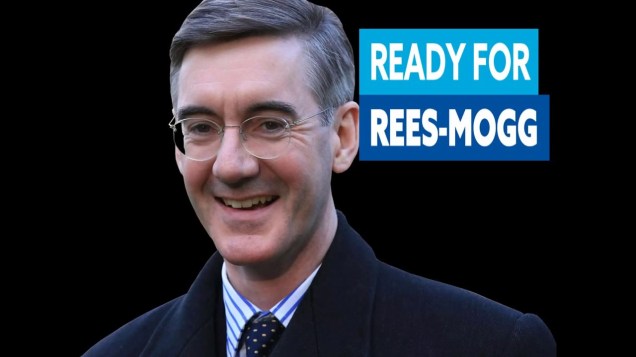
But no. Rather than engaging in the slightest bit of introspection, too many conservative voices seem content to continue writing their asinine hot takes about the daily developments in the Brexit negotiations, speculating pointlessly about the next Tory leadership contest or simply getting drunk on Pimms and having Jacob Rees-Mogg’s face tattooed on their chests. Because summer silly season nonsense is so much more fun than tending to the existential question of who will keep the flame of conservatism lit when its present custodians are no more.

Maybe Activate did make a really bad start to their campaign. Maybe their name lends itself too easily to mockery. Maybe their logo wasn’t produced by the best graphic designers that money can buy. Maybe their initial foray into social media was more worthy of a Jacob Rees-Mogg fanclub than a serious political entity. But everything they have done thus far, they accomplished without a scintilla of help from anybody else in the British conservative movement. Contra much of the leftist press, this really is an unaffiliated grassroots movement.

Faced with the immense tarnishing of the conservative brand and reputation among young voters inflicted by Theresa May, her Cabinet and all the other supposed adults in the room, a group of sincere and well-meaning young conservative activists stepped up at a time when our elected conservative politicians have effectively fled the field of battle. That counts for something, and deserves acknowledgement.

Activate received no help from from the increasingly unworthy political party that bears the conservative name, and certainly no help from the constellation of think tanks, institutions, media outlets or commentators who think themselves so well-connected and influential. Unlike Momentum on the political Left, Activate has no prominent champions in the wider conservative movement, no real mentors (so critical to getting a youth organisation off the ground) and no funding that I am aware of. If anything is embarrassing, it isn’t a dated Star Wars meme on Twitter – it’s the fact that besides these well-meaning if sometimes naive people, nobody else is even making an effort.

It is time to face a number of difficult truths. Conservatism as an ideology and a political movement is radioactive to the majority of today’s young people. We are in retreat in schools, on the university campus, in the world of the arts, in the laboratories, in popular culture and the media, not to mention the House of Commons. And our inability to connect with younger voters and inspire them with a positive message about how conservative values and policies will benefit them and benefit the country is arguably the biggest threat that we face.

Faced with this shameful lack of leadership from anybody in Westminster, Activate is at least trying to do something to face up to these threats and begin tackling conservatism’s huge deficit of trust and inspiration among young voters.

And that is vastly more than can be said of all those people who spent today laughing smugly at their struggle.


Conservative Party Logo - Torch Liberty - Tree

Support Semi-Partisan Politics with a one-time or recurring donation:

Agree with this article? Violently disagree? Scroll down to leave a comment.

Follow Semi-Partisan Politics on TwitterFacebook and Medium.

The Conservative Party Fiddles While Momentum Aggressively Courts Tory Voters

Jacob Rees-Mogg - Moggmentum - Conservative Party - Tory Leadership

Momentum and other leftist groups supportive of Jeremy Corbyn are using new tactics to aggressively court Tory voters. Meanwhile, lacking a compelling vision of its own, the rootless and enfeebled Conservative Party has no response

We may be in the depths of summer silly season, but it is rapidly becoming evident that the forces of the Left are using their time productively while complacent Conservatives sun themselves on generally undeserved vacations.

This week in particular there has been a flurry of activity from the Corbynite wing of the Labour Party, with Owen Jones launching a “decapitation strategy” targeted at vulnerable (and in some cases very high profile) Tory ministers and MPs defending greatly reduced majorities. At the same time, the grassroots campaign group Momentum is trialling new voter outreach tactics lifted from the Bernie Sanders campaign, aimed at getting dissatisfied voters unimpressed with the performance of Theresa May’s government to give socialism a second look.

Emma Bean at LabourList crows:

Owen Jones is joining forces with pro-Corbyn campaigning group Momentum in a push to seize the seats of several current and former Tory cabinet ministers.

The new Unseat campaign will target Boris Johnson, Amber Rudd, Justine Greening and Phillip Davies, all of whom saw their majorities slashed in the general election. Another MP, Stephen Crabb, who has been linked to an organisation which claims that homosexuality and bisexuality can be “cured”, will also face Momentum’s efforts on the doorstep.

The group seeks to create a series of “Portillo moments”, a reference to the unseating of the Tory defence secretary in the 1997 Labour landslide victory.

The Hastings seat of Rudd, the home secretary, was held by Labour as recently as 2010.

While Momentum are currently so swaggeringly confident in their shiny new US-style voter outreach strategy that they bragged about it to the New Statesman:

Momentum’s approach to canvassing, inspired by the Bernie Sanders campaign in the US, attempts to create a deeper engagement between the activists and the members of the public they are speaking to. The message at the training session was ambitious – even the staunchest Tory can be convinced to vote for Labour.

Momentum’s approach to canvassing, inspired by the Bernie Sanders campaign in the US, attempts to create a deeper engagement between the activists and the members of the public they are speaking to. The message at the training session was ambitious – even the staunchest Tory can be convinced to vote for Labour.

Canterbury’s swing to Labour this summer is a case in point. A previous Tory stronghold, the constituency swung to Labour by more than nine percentage points, and was won by Labour’s Rosie Duffield with 45 per cent of the vote.

One workshop attendee who canvassed in Canterbury believes this swing was because Momentum “went to every house” and that even those who seemed hostile to Momentum “still wanted to talk politics with them”.

After the result of the snap election, with Theresa May’s plans for Tory domination in tatters, Momentum announced plans to continue to campaign as though there was another snap election on the horizon. Activists and canvassers have descended on  Boris Johnson’s Uxbridge and South Ruislip seat as recently as three weeks after the snap election, supported by notable Labour party figures such as Sir Keir Starmer MP and Shadow Foreign Secretary Emily Thornberry. While May has clung onto power over the summer break, the continued political turbulence adds a sense of urgency to the training session.

Ambition. A sense of urgency. Most Conservatives have probably forgotten how those sensations feel. Apparently at the end of one Momentum activist training session in Euston, all of the attendees were added to a Slack group so that they could better coordinate through the instant messaging app – even the older Momentum members who were a bit dubious about technology. What we have here is a hard left socialist group given strategic rocket boosters through the accumulated lessons of the Howard Dean and Barack Obama campaigns.

Meanwhile, what do the Tories have to show for themselves? How has the party which carries the torch (or should that be the tree) for conservative politics been spending its downtime this summer?

One might have thought that having guided her party to such catastrophic near-defeat, Theresa May would be keen to make amends by cancelling any holiday plans and visibly knuckling down, devoting every spare moment to damage control, overseeing Brexit negotiations and coming up with a conservative strategy that doesn’t involve cross-dressing in Labour’s hand-me-down clothes.

But no – the prime minister has been off hiking in Italy, where the only headline she generated in the domestic press occurred when she led guests at her five-star hotel in a rousing rendition of the British national anthem.

Disaster is staring the Conservatives in the face, but they are either too busy sipping limoncello in Italy (the prime minister), plotting their pathetic and utterly indistinguishable future leadership bids (the MPs) or having Jacob Rees-Mogg’s face tattooed onto their left buttocks (the activists) to notice the peril. The shock general election result in June should have been a wake-up call, but instead the Tories have immediately lapsed back into complacency, apparently content to be in a minority government propped up by the DUP with Jeremy Corbyn’s hard-Left Labour Party breathing down their necks.

If British conservatism (and the UK’s political system) were healthy right now, as opposed to being on life support, then this summer would have seen a wellspring of new ideas bubbling up from all quarters – promising backbench MPs, radical think tanks, grassroots conservative movements unwilling to allow the captain who already crashed the ship once to continue to set the course. But conservatism, like our political system as a whole, is not healthy, and we have seen no such ideas, no such developments.

The Conservative Party still cannot decide what it wants to be. “But wait for the party conference!”, I hear you shout. Don’t get your hopes up. Do you really think that anything positive, anything remotely useful in the small government conservative mould is going to emerge out of the Tory autumn conference in Manchester? This conference will be devoted to two things: trying to shore up Theresa May’s failed premiership, and providing a platform for a lot of chest-thumping idiocy about Brexit. There will be no bold new vision for British conservatism in the 21st century because there are no bold new thinkers. There are barely any thinkers at all, and what few there are remain consigned to the backbenches (Kwasi Kwarteng, James Cleverly) while mediocrities continue to hog the limelight.

And what of the Conservative Party’s hopeless performance with the youth vote? Has any action been taken to learn the lessons from the 2016 general election, or counter-strategies developed to rebut Jeremy Corbyn’s ludicrous false promises? Does any action look likely to be taken?

Immediately after the general election disaster I wrote:

In some ways, Jeremy Corbyn seems like a most implausible politician to court the youth vote – an old, grey haired career politician with absolutely zero interest in doing anything fashionable, sartorially or politically. But my god, he is an authentic conviction politician. And if your average voter hates overgroomed, telegenic bland politico-bots then young people clearly hate them even more. Canned soundbites don’t work on social media-savvy young people, if they work on anyone. And yet the Conservatives went into battle – largely thanks to the “genius” Lynton Crosby – with an arsenal made up almost exclusively of glib, canned soundbites in place of anything remotely authentic.

Not that authenticity alone is enough. Right wing politics are clearly hugely toxic to many young people, who would sooner die than consider voting Conservative, let alone admitting any conservative leanings to their social circle. The Tories are too closely associated with grey, uninspiring “austerity”, even though austerity is largely a myth. The Tory brand, fair or unfair, is still toxic to many people. And the parties of the left have perfectly tapped into the consumerist politics of Me Me Me by promising to firehose endless sums of money into the gaping, insatiable mouth of Britain’s public services.

It seems painfully apparent to me that we need a prominent, national vessel for the development and promotion conservative policies (and personalities) separate from the Conservative Party, which simply can no longer be trusted to make the case for its own worldview.

And as I emphasised in another piece, the same point applies to policy:

Theresa May’s team seemingly forgot that people don’t become more conservative as they get older automatically or without some prompting, and that if the Tories continually screw somebody over through their formative years, young adulthood and early middle age then they won’t magically become Tory voters when they get their first grey hair. People become more conservative as they get older because historically, sensible government policy has allowed them to become greater and greater stakeholders in society, largely through property and equity ownership. Cut off millions of young people from this ladder to prosperity and security, and the conveyor belt which gradually moves people from political Left to Right as they age will come grinding to a halt.

And on strategy:

We particularly need to work closely with conservative organisations in the United States, which face a similar uphill struggle in overcoming a historic disinterest in the youth vote but which are now starting to have some success, generated in part by their opposition to the illiberal Cult of Social Justice and Identity Politics sweeping American university campuses, with its disregard for freedom of speech and toxic obsession with the politics of victimhood.

We should be sharing best practice back and forth with American conservative organisations as to how to build strong redoubts for conservatism in overwhelmingly leftist places, so that conservatism isn’t washed away altogether. Frankly, British conservatism is in such a parlous state that we need their help. And then, once things have stabilised, we can look to reclaim some of the ground we have lost among young voters.

It looks like Momentum and the Left took this idea and ran with it, and are already benefiting from adopting their new strategy. What a pity that the message has been so roundly ignored by its actual intended audience.

Conservatism decline and a slide toward irrelevance is not inevitable, but preventing it will take hard work and a capacity for self-criticism. We all dropped the ball in 2016; we all need to do better. But it is no good pushing harder in precisely the same direction, or shouting the same slogans even louder than before. “Strong and stable” doesn’t work when much of the population is dissatisfied and wants change. And at a time when many voters responded warmly to Jeremy Corbyn’s conviction politics of the Left, confounding all expectations, the Conservatives must regrow some convictions of their own.

Yet a plurality of Tories either don’t care about the crisis we face, or are simply deny its existence. They think that slapping a new coat of paint on the same rusty old banger will convince voters already tiring of seven years of Conservative government that they are buying a shiny new Tesla rather than a wobbly old Reliant Robbin. They bizarrely think that Moggmentum is the cure, or simply sticking with a failed prime minister who should never have ascended to the top job in the first place.

No, no, no. The Conservative Party needs to stop squabbling about personalities and which interchangeable Cabinet nonentity is best placed to succeed Theresa May, and decide what it actually stands for. And any conservative groups, think tanks and private individuals with an ounce of vision and charisma need to step up and push the party in the right direction, just as John Hoskyns and Norman Strauss did with their Stepping Stones Report in 1977, planting the seed of the Thatcherite recovery.

The Tories cannot make an informed decision about who should be their next leader without first deciding what kind of party they want to be – a limp and apologetic outfit which grovels and apologises for its limited principles, trying to make itself look as much like the Labour Party as possible, or a virile and ambitious party with transformative instincts, belief in individual liberty and the zeal to roll back the administrative state.

The Conservative Party conference opens in Manchester on Sunday 1st October. And rather than painting a false picture of unity, let’s actually have it out once and for all. And if a few unremarkable political careers end up getting caught up in the crossfire, so much the better. We need to clean house in terms of leadership, but more importantly in terms of ideology and basic principles.

At present, Theresa May and her rootless Tories are effectively in office but not in power. And if they do not take swift and dramatic action in the face of a resurgent leftist movement, the office could also slip away, sooner than they think.


Conservative Party Logo - Torch Liberty - Tree

Momentum Logo - Labour Party - Jeremy Corbyn

Support Semi-Partisan Politics with a one-time or recurring donation:

Agree with this article? Violently disagree? Scroll down to leave a comment.

Follow Semi-Partisan Politics on TwitterFacebook and Medium.

When The Devil Is In Your House: Charlottesville, The Alt Right And Conservatism

There is nothing conservative about the resurgent white identitarian movement taking root in America, and all decent conservatives must vehemently reject this toxic ideology – and its adherents – before we are further tarred by association

There seem to be two main responses from conservatives to the awful violence which took place in Charlottesville, Virginia last weekend.

One approach – and the correct one – is to forcefully condemn the rise in white nationalism and the specific act of domestic terror which one individual from that movement perpetrated on society, pointing out that no matter what these people call themselves (Alt Right, Far Right or anything else) there is no place for them in the conservative movement.

The other approach is to point angrily at the leftist counterprotesters, particularly the militant Antifa contingent, and point out that these thugs were also violent, punching people, wielding clubs and attacking journalists with very little intervention from the police. This is the “whataboutism” approach – pointing out the speck in your brother’s eye while ignoring the beam in your own.

Sadly, we have seen too much of the second approach and not enough of the first in the days since violence came to Charlottesville.

The video above is a segment of the Andrew Klavan show. Klavan is a podcast host on Ben Shapiro’s conservative website The Daily Wire, and in this segment he demonstrates by example the way that conservatives should respond when racist, far right fanatics try to hijack our movement and sabotage our policy agenda in service of their own warped agenda.

Beginning at 6 minutes into the video, Klavan says:

Let us start among ourselves, because we’re all good conservatives here. Let us gather together and just remind ourselves – these clowns are in our house, okay? These evil, satanic clowns are in our house.

And it’s no good saying “well, they don’t believe what we believe”, of course they don’t believe what we believe. Of course they don’t. They don’t believe in the Constitution, they don’t believe in E Pluribus Unum, they don’t believe in the great American tradition of bringing people in, transforming them into America through our creed that we conservatives are fighting so hard to defend, they don’t believe in low taxes, they don’t believe in any of this stuff. They don’t believe in America, they don’t believe in the whole thing that makes America what it is.

But they’re in our house. They identify themselves as right wing, they vote for the people we vote for, they have their slogans “Unite the Right” and all this stuff. It’s no good – when the devil is in your house you gotta take care of that, it’s no good saying “well, the devil is in the other guy’s house too” – of course he is. But let’s not mince words about it.

Absolutely. And conservatives cannot afford to be hypocrites here. Whenever a terrorist atrocity is committed by a radical Islamist, many of us on the political Right correctly demand that the Muslim community do more to confront and defeat extremist Islamist ideology wherever it manifests in their mosques, their workplaces, their social circles or even their own homes. The state can not be fully responsible for making radical or violent interpretations of Islam unacceptable to susceptible people, and its attempts to do so (through the PREVENT programme in Britain, for example) will only ever be partially acceptable. The ultimate solution to Islamist extremism cannot be enforced from outside, it must be midwifed by responsible people within the community.

But if we make this demand of our Muslim compatriots, friends and neighbours, we conservatives must also be honest when a violent and extremist ideology is lurking in the fringes of our own movement. The domestic terrorist who killed one person and injured many more in Charlottesville, Virginia last Saturday is no more representative of the conservative movement than the depraved Islamist terrorists who kill innocent people in London, Paris or Brussels is representative of all Muslims – possibly even less so. But still we have an obligation to stand up and vociferously object when our movement is hijacked by those who would seek to appropriate our language, policies and even our political parties for their own warped purposes. It is only fair to be morally consistent in this way.

In the face of resurgent (or at least emboldened) white nationalism it is not enough to do what some stalwarts of the American Right did, and loudly proclaim that Nazism is actually a far-left ideology, trying to pretend that the white nationalist identitarian resurgence is not a problem primarily of the Right:

This is just supremely unhelpful, not because Dinesh D’Souza doesn’t have a point but because this “whataboutism” makes it look – quite reasonably – as though conservatives are deflecting. Yet D’Souza seemed to spend most of the weekend labouring this angle of attack, which while technically true does nothing to purge conservatism of the parasites in our midst, or convince sceptical people that we have our house in order.

Right now I don’t think Republicans or many American conservatives realise just what a severe reputational issue they are facing at the hands of this president. Is the media always fair with its coverage? Of course not. Does the media lazily try to fit every story into their “conservatives are racist” framework much of the time? Yes. But that only makes it more important for us to be whiter than white at all times (if you’ll pardon the unintentional pun).

Conservatives know that they will be attacked for racism if there is even the slightest possibility of malice, while leftists will be given a free pass. We know this, so there is absolutely no excuse for acts like Donald Trump’s latest press conference where he opened himself up to valid accusations by the media that he was drawing a moral equivalence between the violence of the neo-Nazi thugs and the actions of the counterprotesters (yes of course violence took place on both sides, but the ideologies in question are not morally equivalent, and only one side committed an act of domestic terrorism).

And yes, sometimes the Republican Party has been too willing to make a home for racists in their house, a fact which is not expunged by the fact that Democrats did the same in the 1960s. Engaging in whataboutism does not shift the spotlight away from conservatives, it merely makes it look to ordinary people as though we have something to hide.

At this point we are rapidly running out of excuses and mitigating factors for Trump’s behaviour. No, scratch that – the reserve of excuses has long since been exhausted, and the barrel is now bare. And if this presidential behaviour continues largely unchallenged by mainstream conservatives then only one of two things can happen – either conservative and Republican elected officials face deserved electoral annihilation in the midterms and the next presidential election cycle, or they are propped up and kept in office not by genuine conservatives but by uber-motivated Alt Right types – at which point small-government, constitutional conservatives will have been definitively pushed out of their own party.

This is untenable. The white nationalist and white supremacist Alt Right is a cancer on conservatism because they choose to align themselves with conservatism and live in our house, and rather than administering a welcome dose of chemotherapy the President of the United States is allowing the tumour to grow unchecked – either for cynical political ends, or else for a much darker purpose.

Meanwhile, every hysterical criticism and slander of conservatism ever made by leftists becomes slightly more plausible when Donald Trump, face of the Republican Party, cannot bring himself to disavow gushing words of praise from white supremacists like David Duke.

Abraham Lincoln once said:

Fellow-citizens, we cannot escape history. We of this Congress and this administration, will be remembered in spite of ourselves. No personal significance, or insignificance, can spare one or another of us. The fiery trial through which we pass, will light us down, in honor or dishonor, to the latest generation [..] We — even we here — hold the power, and bear the responsibility.

We are rapidly reaching the point where all conservatives of conscience who have not already done so – including elected officials at all levels – must take a public stand and declare whether they accept the White House’s inexplicable Entente Cordiale with the Alt Right, or whether they repudiate it as a matter of conscience.

Those people who choose the wrong side of this existential debate, or who shamefully sit on the fence, will be remembered in spite of themselves.  And one day they will have to answer for their cowardice.


White Supremacists March with Torches in Charlottesville

Support Semi-Partisan Politics with a one-time or recurring donation:

Agree with this article? Violently disagree? Scroll down to leave a comment.

Follow Semi-Partisan Politics on TwitterFacebook and Medium.