The Battle For British Conservatism: Are The Tories The Enemy Within?

Theresa May - Downing Street - Conservative Party - Tories

What if the current Tory Party represents a dangerous, long-ascendant fifth column within British conservatism?

In a blistering attack on the party of Theresa May, Philip Hammond, David Cameron and George Osborne, Laura Perrins of The Conservative Woman declares that the Tories are now the “enemy within” and the single greatest threat to what remains of British conservatism.

Perrins’ dissatisfaction with the Conservative Party – like that of this blog and other malcontents of much longer pedigree such as Peter Hitchens – has clearly been building for some time, but finally reached boiling point when the Conservatives cooked up their  “presumed consent” scheme for organ donation, yet another policy which sounds fluffy and caring at first glance but which would effectively make one’s body the property of the state, merely on loan to you not from God or nature but from Her Majesty’s Government, to which it must be returned upon death unless one specifically requests an exemption.

Perrins thunders:

The last straw for me was the proposed ‘presumed consent’ organ donation scheme, more accurately described as the State organ appropriation scheme. This is small fry in the scheme of things but it sums up the whole rotten party. The concept that your body is yours, and remains yours and then under the control of your family after death, is so fundamental, so obvious, so visceral and so conservative that it should not need explaining.

Now Theresa May tells us that in fact your body belongs to the State, unless you have taken the time and trouble to tell the State otherwise. This is wrong in principle and in practice. I was on a radio show with a chap who was waiting for a kidney and he said that his surgeons told him there were not even the beds or doctors to take advantage of this scheme. So, the Conservatives are grabbing organs just, as usual, to look nice. See, neo-Statists.

I had a very similar reaction at the time, not because I am any less keen to see organ donation rates improve and waiting lists decrease, but because this way of going about it represents about as big a power grab by the state as it is possible to make:

https://twitter.com/SamHooper/status/915636056732655616

But this is just one of the many ways which the impostor party which bears the name “Conservative” has made a mockery of the principles they supposedly stand for, and Perrins goes on to recount the full litany at length.

Let’s face it, the Conservative party are neo-Statists and have done more damage to conservatism in this country than Labour ever could. The current leader of the party believes actual conservatism – small government, strong families and the free market – is nasty. She actually said this, yet we are all to go merrily along backing this wretched party no matter what, as we did in the last election – much to my regret.

This is the party that believes an energy gap is a good idea, and that continued government guarantee of tuition fees is sensible. The Tories are as ideologically wedded to the socialised health system that is the NHS as the Labour party is, all because they think they will look mean if they point out that in fact the Emperor has no clothes.

The Tories have interfered with the childcare market, causing the costs to rise year in, year out. They want more mothers in work, whether they want to be there or not. They lecture us on what to eat and drink; no detail of our life is beyond government note-taking. Now they have instructed GPs to ask what your sexuality is. This is Nanny turned Nurse Ratched.

The Conservatives love big government. There has been no reduction in quangos – they have quangos lobbying their own government, for goodness’ sake. They use the school system to try to solve every social problem: FGM, toothbrushing, sex education, pornography, drugs, healthy eating, on and on it goes. The national debt could hit £2trillion in the next ten years.

And so it goes on – Perrins inevitably touches on the march of the Cult of Social Justice and Identity Politics, noting that the Tories have bent over backwards at every turn to accommodate increasingly avant-garde and unproven leftist orthodoxies around gender and family life. And to each accusation there is little which can be said in defence.

Of course, there are exceptions, and I do not agree with all the charges laid by Perrins at the foot of the Conservative Party. I would certainly argue that some of the concessions to modernity made by the Tories are good and entirely necessary, particularly the opening up of the stabilising, enriching influence of civil marriage to same-sex couples. But even where one agrees with the thrust of Tory policymaking on social issues there can be little denying that the fears, objections and liberties of dissenting individuals and religious organisations have been trampled in the process.

So what to do, given that the present-day Tory Party is at best ambivalent and at worst hostile to many conservative values and priorities? Must we really shrug our shoulders, be grateful that we don’t have Prime Minister Jeremy Corbyn and put up with the dismal, directionless leadership we currently have?

Laura Perrins hints that maybe we do not have to put up with this Coke Zero Conservative government after all:

A Labour government would be grim, don’t get me wrong. But I wager that they won’t last long, they will split, and they will not get to do half the things they say they will do. They have already ditched the tuition fee promise and they are not even in power. In sum, they are not the long-term threat to this country.

I am inclined to agree. As I have written numerous times before, at present small-C conservatives have the worst of all worlds. We are nominally in power, yet virtually none of our values and priorities are being addressed by the government. We are continually assailed by the Left for supposedly being heartless, callous and cruel towards the generically “vulnerable”, yet the budget deficit persists, the national debt grows and the idea of real fiscal conservatism remains as remote as ever. We are accused of seeking to destroy the “beloved” socialist edifices of post-war Britain like the welfare state and Our Blessed NHS, yet Universal Credit rollout by 2022 is apparently the best we can do.

As I once wrote:

If I’m going to be accused of callously taking a jackhammer to the welfare state I at least want to see a little bit of rubble as my reward. But there is no rubble, only the stench of craven capitulation to the leftist forces of perpetual dependency.

So given the near-futile hope of meaningful conservative ideological renewal while in power, how much worse could a Corbyn premiership actually be? Here, I again agree with Perrins. While Jeremy Corbyn himself would probably love to take the country galloping off to a hard leftist destination, in practice he is constrained by the centrists within his party. And as we are all currently witnessing with the Brexit debate, establishment centrists have a way of grinding down objections and diluting any idealism in order to get the self-serving stability which they want for themselves.

While at present this centrist handbrake serves to stymie Brexit and torpedo any possibility of real small-government conservative reform, in the event of a Jeremy Corbyn premiership the same centrist blob would also serve as a drogue parachute, arresting any sudden leftist moves attempted by Labour and limiting the damage that such a government could inflict. Therefore, revoking all support for the current Tory government need not be calamitous. After all, when we already have a government which is willing to decimate the armed forces, firehose foreign aid at countries in a manner totally unaligned with our foreign policy goals, trample civil liberties and spend taxpayer money like a sailor on shore leave then how much worse could it possibly be?

What Perrins’ article does not do, however, is spend much time looking at what kind of party the Conservatives should become if only they can be retaken. And here there is a genuine tension, not between the kind of social conservatism presumably favourable to The Conservative Woman and craven submission to the identity politics cult, but between social conservatism and free markets.

This is a battle for the soul of British conservatism which has been suppressed for far too long. A new balance must be struck between social conservatism and free markets which addresses the key challenges of our time – globalisation, automation, migration, national identity, defending Western values and defeating Islamist terror – in a way which attracts and inspires voters. The Conservative Party’s current policy mix isn’t turning any heads, and is actively alienating most people under fifty years of age. Our sole saving grace is that Labour haven’t yet come up with a compelling solution either.

There remains an opportunity for conservatives to answer these critical questions and arrive at a new balancing of priorities which works for the country, though doing so while still in office is a tall order. But if we are to have any chance of success we must begin by acknowledging that the contemporary Conservative Party is not and has not been a friend of small-C conservatism for many years.


Conservative Party Logo - Torch Liberty - Tree

Support Semi-Partisan Politics with a one-time or recurring donation:

Agree with this article? Violently disagree? Scroll down to leave a comment.

Follow Semi-Partisan Politics on TwitterFacebook and Medium.

Conservatives Are Conceding The Battle Of Ideas Without A Fight

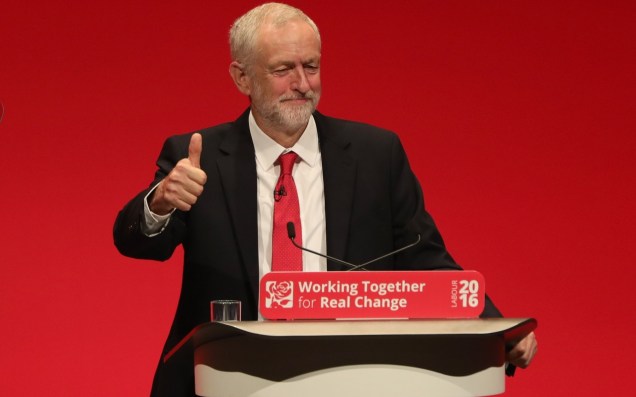
Jeremy Corbyn thumbs up

Jeremy Corbyn’s Labour Party is hard at work promoting their beguiling new left-wing vision for Britain while the Tories offer nothing but drudgery and incompetence

Every day now brings more ominous warning signs for the squabbling, directionless Tory government that the only people in Britain offering a clear, articulable vision for the country are those on the Corbynite hard-left wing of the Labour Party.

Four months after the general election, and all of the political energy and momentum is still on the Left. Jeremy Corbyn is more wily than he was in 2015, less prone to gaffes or accidentally handing his enemies the initiative. His centrist rivals have fallen into line, discredited and with no strong candidate to unite behind. Moreover, while most conservatives spent the summer licking their wounds far from the ideological field of battle, Momentum continued to organise and prepare for what they believe is one final push required topple the Tories and seize power.

And this newfound confidence is starting to creep into the rhetoric used by Labour politicians. Jon Trickett, Shadow Minister for the Cabinet Office, writes this week in LabourList:

There was a time after the second world war when government saw its central role as creating a socially just Britain where full employment, adequate housing for all and free education was the right of the many.

In that time, there was always more to achieve but the national sense of purpose was clear.

It was a time when jobs were secure and for the long term. Policy was designed to make communities feel secure, when the past was a bad place of mass unemployment, slum housing and no hope. But the future was full of promise, where strangers were welcomed into communities because no one felt their jobs were under threat.

And in the time, it was not acceptable that the growing wealth of the country was only distributed to the wealthiest.

A coherent set of progressive values aimed at building a social contract in which we had a sense of duty to the community, and the country agreed to stand behind those who could not care for themselves.

Note what Trickett is doing here. He is building a narrative, talking about the kind of country we once were and citing the great endeavours from our past in order to build a link with the present and generate enthusiasm for future Labour policies.

President Lyndon B. Johnson did something very similar (albeit at a much more sophisticated level) when introducing the Great Society initiative in 1964, not merely proposing a raft of random new socialist programmes but making them collectively seem almost inevitable by deliberately linking them with the American founding, history and national destiny:

The purpose of protecting the life of our Nation and preserving the liberty of our citizens is to pursue the happiness of our people. Our success in that pursuit is the test of our success as a Nation.

For a century we labored to settle and to subdue a continent. For half a century we called upon unbounded invention and untiring industry to create an order of plenty for all of our people.

The challenge of the next half century is whether we have the wisdom to use that wealth to enrich and elevate our national life, and to advance the quality of our American civilization.

Your imagination, your initiative, and your indignation will determine whether we build a society where progress is the servant of our needs, or a society where old values and new visions are buried under unbridled growth. For in your time we have the opportunity to move not only toward the rich society and the powerful society, but upward to the Great Society.

In fact, this is a simple device which even mediocre politicians and rhetoricians were once capable of using before technocratic centrism sucked the soul and energy out of politics. It is the exact opposite of anything written or spoken by a Conservative minister in Theresa May’s administration, because great political rhetoric can only exist when there are great ideas to be expressed or arguments to be won.

Trickett goes on to give a perfunctory but devastating indictment of the state of Britain under the Conservatives:

But now you would struggle to discover a shared sense of national purpose. You could describe a sense of anomie in Britain where a sense of common values, duty to others and co-operation for shared ends are, to one extent or another, lacking.

Too often: post-industrial communities have been abandoned; young people have less hope than ever before of acquiring a home at reasonable cost; education has become a commodity rather than a public good; where that which was common is frequently private or suffering from severe spending cuts; and, where the wealth of the most privileged is growing exponentially at the expense of the rest.

How do we explain this shift in the national culture?  Or rather, how do we account its disintegration and fracturing? Is this a uniquely British problem? And can we begin to rebuild a renewed socialist project based on 21st century.

At this point a five-alarm fire warning should be sounding in CCHQ and inside the head of every single Tory or small-C conservative in Britain, because Jon Trickett has just eloquently and concisely diagnosed the ailments of modern Britain – the fact that we are effectively drifting as a nation with no core unifying purpose or attachment to one another and a diminishing sense of obligation to our fellow citizens. In other words, Trickett has created an itch, a burning discomfort with the status quo, and now stands ready to offer voters the calamine lotion of Jeremy Corbyn’s socialist policies.

One does not have to agree that building “a renewed socialist project” is the answer. The point is that Trickett has clearly defined a problem and proposed a solution, all in the space of three short paragraphs. The Tories, meanwhile, are stuck defending a mediocre record with the huge distraction of Brexit, and seem to be loudly insisting that everything is great despite mounting evidence to the contrary (see Universal Credit). They have chosen to be cheerleaders for the status quo rather than agitators for change, even though the Conservative leadership election-that-wasn’t last year presented the perfect opportunity for unflinching self-assessment followed by an ideological reset.

That opportunity was squandered. And it has really come to something quite appalling when a Labour politician is responding to the priorities of this blog before the Tories pay proper attention. Jon Trickett is hardly known as Labour’s greatest thinker, but at least he understands that mandate-bestowing electoral victories are won on the back of selling the electorate an inspiring vision for the future.

Having a narrative is important. Good leaders and successful political movements understand this. The Attlee government alluded to by Jon Trickett certainly had a clear vision of the New Jerusalem they wanted to build out of the rubble of war. Margaret Thatcher had her urgent mission to save Britain from a failing post-war consensus and terminal national decline. Even David Cameron had his “Big Society”, an idea which might have been genuinely transformative if only it was bolstered with more thought and political courage.

In America, Franklin Delano Roosevelt had his “New Deal”. LBJ championed the “Great Society”. Ronald Reagan beguiled the nation with his promise of “Morning in America” after years of perceived stagnation under presidents Ford and Carter. And while President Obama’s soaring rhetoric often exceeded his relatively pedestrian governing agenda, his 2008 message of “hope and change” also strongly resonated with many Americans (including millions who deserted the Democrats to vote for Donald Trump in 2016 after no positive change appeared in their lives).

British politics has been stuck in such a dismal slump because for two decades an incredibly narrow, self-serving consensus was allowed to crowd out all other perspectives. And while this consensus served many people fairly well, its policy outcomes focused almost exclusively on funnelling material benefits (either wealth and career opportunities or literal welfare benefits) to certain specified groups of people rather than calling all of us together as a society united by a common bond, culture and purpose.

That approach has been found wanting. When the bipartisan political consensus (favouring EU membership, social liberalisation, globalism and corporatism) goes unchallenged it feels no need to respond to the concerns of those who do not benefit from existing policy. That is why for all the material progress seen in Britain we are still blighted by low productivity, family breakdown, divisions over immigration and a lack of any meaningful government response to the negative side-effects of automation, outsourcing and globalisation.

By electing Jeremy Corbyn as leader, some within the Labour Party recognised that continuing to stand up for a failing political consensus was no way to address these problems or win a decisive mandate for left-wing government. As incumbents, the Tories were left as the only major party championing the status quo, and rather than develop a radical, inspirational right-wing message of their own they continued to double down on bland, uninspiring centrism under Theresa May.

What makes it especially galling that the Left rather than the Right have recognised the need for a positive, bold new narrative is that it is the Left who are most in thrall to the Cult of Identity Politics which does so much to atomise society and make people see themselves as members of persecuted identity groups first and foremost rather than fellow citizens of a united country. Somehow, despite this increasingly prevalent mindset within their ranks, some on the Left still managed to recognise the need for a coherent, inspiring national message, a message with the potential to unite a broad swathe of society behind it (though whether it succeeds is another matter).

As John Prescott boasted earlier this year:

Finally, we’re talking about ideas and policies – not splits and personalities. Twenty years ago next month, Labour won an ­election landslide because we were united, trusted and had policies people could understand. When we lost in 2010, I felt we lost our way. We didn’t want to defend our record in government and by 2015 we accepted Tory austerity.

At least Labour is now ­developing clear red water between us and May. Not with soundbites and brickbats, but with popular policies.

Ideas and policies over splits and personalities.

Meanwhile, what do the Tories offer? False promises of being “strong and stable”, a moronic slogan which described an unattainable state of being rather than a clear direction for the country. More dull, technocratic drudgery in which eliminating the budget deficit (painstakingly slowly) is considered an aspiration worth putting in neon lights and making the focus of their government. Division and incompetence on Brexit, with the only optimistic Tory voices now belonging to free trade fantasists who want Britain to unilaterally lower barriers to trade and who think that crashing out of the EU and defaulting to WTO trade terms is a smart decision. Barely concealed leadership rivalries between a cast of identikit Cabinet ministers who seem to be competing with one another based on personality rather than different visions for the country.

Yet even now, the Conservative Party has no idea of the terminal danger it is in. Despite a few plucky efforts to re-inject some proper thinking and ideas into the party, the prime minister and her Cabinet offer no real ideological leadership whatsoever. Consumed by Brexit (and doing a pretty poor job at that) they seem to have abdicated any responsibility for using government to lead the country to a better place. Everything they do is reactive and cynical, like Theresa May’s university tuition fee freeze and Chancellor Philip Hammond’s age-based tax proposals, transparently cynical attempts to court the youth vote which are laughable in their inadequacy.

A couple of days ago I mused about whether the Conservatives can renew themselves ideologically and spiritually while still in office. This already slim prospect looks less and less likely by the day, both because senior people within the Tory Party seem to be too busy lurching from crisis to crisis to see the bigger picture and because all of the ideological energy and political momentum is on the Left right now.

And where there is new conservative thinking, it tends to counsel more, not less, accommodation with the Left. Some MPs, like Sam Gyimah, talk the right language of purpose and ambition but then disappointingly default to predictable, Left-leaning “compassionate conservative” solutions. And even these efforts at conservative renewal tend to focus more on what the government could and should do for us rather than what we collectively might accomplish together as a people. Time and again, the present Conservative Party capitulates to the Left and apologises for its own principles.

This is frustrating because conservatives should be able to come up with a far more inspirational, compelling message than the one they have been peddling. The Left’s entire focus is fixed firmly on inequality. Yet even die-hard Social Justice warriors would surely admit that equality is a hygiene factor, the absolute baseline for which society should aim (though they might then go on to disagree about whether equality or opportunity or outcome should be the goal).

Therefore, as eloquent as Jon Trickett’s words are – and as much as they should scare conservatives who are yet to join the ideological battle – equality remains insufficient as an organising principle for society or a shared national ambition. We need more concrete goals toward which we can all strive and move together, while in the background we are working hard to achieve a just society (however we choose to define it).

And luckily for conservatives, this is what the Left still does not get. Though they have woken up to the need to talk in terms of vision and ambition while the Tories are still lost at sea, the Left still sees achieving equality as the ultimate goal. One gets the distinct impression that many on the hard Left would not much care if we never really accomplished anything great as a country and even regressed somewhat in terms of material comfort and economic development, so long as society was flattened and the gap between rich and poor reduced. To listen to many a Labour speech, one almost pictures a country with a state-of-the-art NHS hospital on every street corner but a population so busy marvelling at their wonderful state of equality that they forget to go out and change the world.

So there remains an opportunity for conservatives to sneak in with an improved narrative and national ambition, one which aspires to something more than mere equality. Something which actually seeks to organise and harness the best of our energies and skills as we strive to make our country and the world better, not just more equal. Such a vision, carefully crafted and persuasively argued, would beat the Left’s narrow-minded focus on equality any day of the week.

So who will step up to the challenge and help develop a worthy conservative response to the re-energised Left? Because right now they are the ones fizzing with energy and ideas, while conservatism seems content to trudge wearily to its grave, quite possibly dragging the country along with it.


UPDATE – 17 October

Evgeny Pudovkin makes some good points over at Comment Central, specifically around how the Tories can potentially keep Theresa May in place as a “bad bank” repository for public dissatisfaction with the status quo while developing new ideas and new talent in parallel:

Some argue for replacing May with a fresh candidate who could offer the Tories a new vision. Yet May is still at Number 10 due to the very reason of her being a fulfiller and not a prophet. Her main role entails overseeing already introduced reforms – Iain Duncan Smith’s Universal Credit, George Osborne’s Northern Powerhouse, the house building programme and, indeed, Brexit. That doesn’t leave much time for blue-sky thinking, at least not until future relations with the EU are at least broadly defined. Just what exactly will toppling May achieve, apart from spawning new rivalries?

Any vision for post-Brexit Britain must be cultivated in parallel with May’s premiership. First of all, prospective candidates should establish a stronger presence on social media. The time when David Cameron could simply dismiss digital communication with his “Britain is not Twitter” jibe is over. As historian Niall Ferguson explained (here and here), the successes of both Donald Trump and the Leave campaign can be explained at least partially by their presence on social media. Secondly, the next leadership candidate might want to spend more time with the grassroots. Finally, a prospective challenger could create a new platform for developing policy. The Centre for Policy Studies served an important vehicle for Thatcher’s revolution, while Policy Exchange helped to inject a more coherent vision into Cameron’s project.

The dichotomy between May’s stable rule and the need to reinvigorate the Tory party is false. You can do both at the same time.

I agree in principle. Of course, this approach depends entirely on the public retaining patience with the Tories long enough for them to come through the other side of Brexit with an attractive new philosophy of government ready to go and an equally attractive leadership candidate to pick up the torch.

Right now, I struggle to see where the seeds of a new 21st century conservatism are germinating. Certainly the think tanks are nothing like the humming centres of creative energy that they were back when they propelled Margaret Thatcher to power with a copy of the Stepping Stones report in her pocket.

On paper, what Evgeny Pudovkin proposes makes perfect sense. In practice, I don’t see where the new ideas or the leadership talent are going to come from. I sincerely hope that this is due to my political myopia rather than a genuine dearth of new ideas within the British conservative movement, but I do not think it likely.


British Ambition - underground tube sign

Support Semi-Partisan Politics with a one-time or recurring donation:

Agree with this article? Violently disagree? Scroll down to leave a comment.

Follow Semi-Partisan Politics on TwitterFacebook and Medium.

British Conservatives And The Youth Vote: The Failed Promise Of Activate

Activate - Tory Momentum campaign - conservatism - youth vote

It is easy to mock youthful conservative activists when their attempts at social media outreach go awry, but at least they are trying – none of the supposed adults in the Conservative Party seem remotely interested in salvaging conservatism’s toxic reputation among younger voters

The media has been having a lot of fun today at the expense of an organisation called Activate, a newly-launched independent conservative campaign group of young people, by young people and for young people.

Some of this criticism has been justified – the launch on social media was uncoordinated and the messaging…suboptimal, at best. One could certainly argue that Activate tried to run before it could walk, entering the political fray before the values and priorities of the group had been fully defined and agreed.

(Full disclosure: I was very tangentially involved in the pre-formation of this group earlier in the summer, participating in several group chats and offering occasional words of advice. This was in line with my strong belief – stated many, many, many, many times – that British conservatism will die out unless it urgently finds a way to reach and inspire younger voters with a positive message).

Inevitably, the reviews have not been kind, with outlets from the Independent, New Statesman, The SpectatorHuffington Post, Political ScrapbookRed Pepper and Esquire all forming an orderly queue to mock the group and question its grassroots bona fides.

The Guardian was actually one of the kindest:

A new Conservative grassroots campaign inspired by Labour’s Momentum movement will attempt to engage more young people in rightwing politics, though the group’s launch has been widely mocked on social media.

Activate, which aims to “engage young people with conservatism”, has close links with senior party activists, and is chaired by former Tory campaign manager Gary Markwell, a councillor in West Sussex. A Conservative spokesman said Activate was “not officially linked to the Conservatives and it receives no party funding”.

The group’s constitution says it will be independent from the party, though all members are expected to be members of the main party.

The campaigning group launched with a Twitter picture of the Labour leader, Jeremy Corbyn, followed by a picture of Star Wars character Admiral Ackbar, saying “It’s a trap”.

The group’s use of multiple hashtags and a meme that was last popular in the early 2000s led to widespread derision on the social network.

Somewhat cringeworthy? Of course. Not what I would have done or recommended. But you can look at this two ways.

On one hand, you can take the attitude of the scornful left-wing press (and even some of the right-wing blogs like Guido Fawkes) and make fun of Activate’s enthusiastic but undeniably amateurish initial foray into grassroots political campaigning. And indeed, many journalists and commentators have been only too happy to mock the sincere efforts of 17-year-old students who at least take the time to educate themselves about political issues and live up to their responsibility to be good engaged citizens. That is certainly one approach, albeit a rather cynical one.

But the other attitude – a far more constructive one – is to ask why the hell it is being left to a group of enthusiastic but inexperienced teenage and twenty-something activists to do what the Conservative Party should have been doing all along, namely trying to engage in meaningful outreach to sceptical younger voters.

Recall: Theresa May’s brilliantly inspired general election campaign saw the Tories lose the 18-19 year old first time voter demographic by a margin of 47 points. The Conservative Party is getting nowhere with young people and struggling with nearly everyone else because they cannot clearly articulate what they stand for and simply offer a bland, repetitive, uninspiring and entirely defensive message.

With no positive message to rally around, no formal conservative youth movement and national party leadership totally devoid of charisma, the combined forces of present-day young conservative activists could probably all fit comfortably within a League One football stadium, with room to spare. Unfortunately, people who unironically wear bow ties and read economics at Cambridge are pretty much all we have right now in terms of boots on the ground – would that it were otherwise. But at least Activate is trying to expand the appeal of conservatism.

Maybe rather than mocking the earnest sixth-former wearing a bow tie in his bio picture, the likes of Guido Fawkes should instead be asking why it has been left to young kids like this to take all the initiative of creating a grassroots youth conservative movement on their own, with almost no help from senior Tories, party grandees, external think tanks or anybody else with abundant time, money and influence.

Maybe they should ask what possible excuse party leader Theresa May and her CCHQ cronies can offer for falling down on the youth outreach job so spectacularly. Maybe they should try holding the prime minister to account for swanning off to Italy after having presided after this disaster of an election campaign rather than staying put to undo a small fraction of the damage that she has done to the Conservative brand.

Maybe the likes of the IEA, Adam Smith Institute and Centre for Policy Studies should be a little more concerned about where their pipeline of future fellows and supposed thinkers will possibly come from when nearly every young person in the country hates the Tories with the burning heat of a thousand suns, and retains that hatred well into middle age. Kate Andrews is great, and a breath of fresh air on Question Time, but there is a limit to the number of articulate young conservative thinkers we can import from the United States. At some point we will have to develop some more homegrown talent.

But no. Rather than engaging in the slightest bit of introspection, too many conservative voices seem content to continue writing their asinine hot takes about the daily developments in the Brexit negotiations, speculating pointlessly about the next Tory leadership contest or simply getting drunk on Pimms and having Jacob Rees-Mogg’s face tattooed on their chests. Because summer silly season nonsense is so much more fun than tending to the existential question of who will keep the flame of conservatism lit when its present custodians are no more.

Maybe Activate did make a really bad start to their campaign. Maybe their name lends itself too easily to mockery. Maybe their logo wasn’t produced by the best graphic designers that money can buy. Maybe their initial foray into social media was more worthy of a Jacob Rees-Mogg fanclub than a serious political entity. But everything they have done thus far, they accomplished without a scintilla of help from anybody else in the British conservative movement. Contra much of the leftist press, this really is an unaffiliated grassroots movement.

Faced with the immense tarnishing of the conservative brand and reputation among young voters inflicted by Theresa May, her Cabinet and all the other supposed adults in the room, a group of sincere and well-meaning young conservative activists stepped up at a time when our elected conservative politicians have effectively fled the field of battle. That counts for something, and deserves acknowledgement.

Activate received no help from from the increasingly unworthy political party that bears the conservative name, and certainly no help from the constellation of think tanks, institutions, media outlets or commentators who think themselves so well-connected and influential. Unlike Momentum on the political Left, Activate has no prominent champions in the wider conservative movement, no real mentors (so critical to getting a youth organisation off the ground) and no funding that I am aware of. If anything is embarrassing, it isn’t a dated Star Wars meme on Twitter – it’s the fact that besides these well-meaning if sometimes naive people, nobody else is even making an effort.

It is time to face a number of difficult truths. Conservatism as an ideology and a political movement is radioactive to the majority of today’s young people. We are in retreat in schools, on the university campus, in the world of the arts, in the laboratories, in popular culture and the media, not to mention the House of Commons. And our inability to connect with younger voters and inspire them with a positive message about how conservative values and policies will benefit them and benefit the country is arguably the biggest threat that we face.

Faced with this shameful lack of leadership from anybody in Westminster, Activate is at least trying to do something to face up to these threats and begin tackling conservatism’s huge deficit of trust and inspiration among young voters.

And that is vastly more than can be said of all those people who spent today laughing smugly at their struggle.


Conservative Party Logo - Torch Liberty - Tree

Support Semi-Partisan Politics with a one-time or recurring donation:

Agree with this article? Violently disagree? Scroll down to leave a comment.

Follow Semi-Partisan Politics on TwitterFacebook and Medium.

Winter Is Coming For Conservatives Unless We Wake Up To The Socialist Threat

Momentum - socialist - online campaigning - videos social media

The hard Left is on the march, and all the anti-Corbyn negative ads in the world will not save an ideologically bankrupt Conservative Party which cannot clearly articulate an appealing and realistic vision for Britain

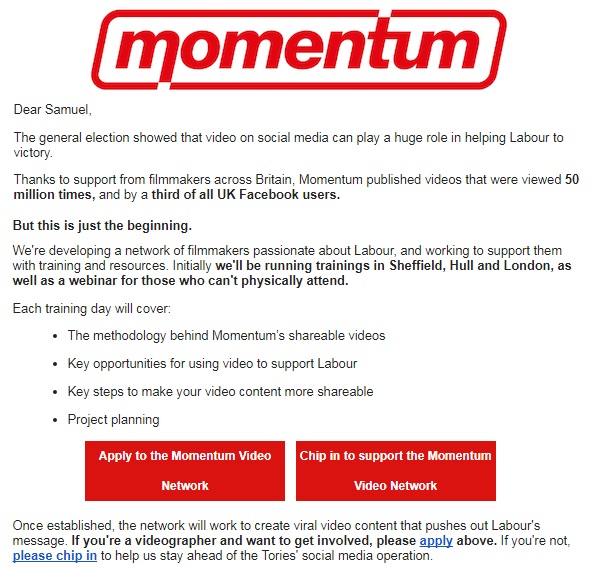
Look at this email, which pinged into the inboxes of Momentum members and supporters today.

The socialists are on manoeuvres. They haven’t wasted their summer sipping limoncello on the Amalfi Coast or plotting Oxford Union-style leadership coups with their Cabinet chums. No, having drawn blood from the Conservative Party and reduced the British prime minister to a laughing stock in the June general election, Momentum and other hard-left elements of the Labour Party sense that their long-awaited victory is nearly at hand. And they are training for the battle to come.

I wrote the other day about how the Conservative Party is fiddling while the country burns and Momentum creeps up behind them. This isn’t a laughing matter. Momentum are organising, deploying the latest in voter outreach strategies imported from the Bernie Sanders presidential campaign in America, and – shock, horror – daring to have conversations with traditionally Tory voters rather than engaging in fruitless navel-gazing introspection as the Conservative Party is currently doing.

Much was written during the election campaign about how much slicker and better financed the Tory online campaign was than its Labour counterpart. The Conservatives spent over £1 million on negative ads on Facebook alone. But it was not an effective campaign. It was soulless, clinical and relentlessly negative. All of which might have been forgivable if it had been properly targeted. But it wasn’t. Instead, CCHQ-produced messages designed to energise the existing Tory base were thrown relentlessly in the faces of swing voters, who did not respond to shrill warnings about Corbyn’s impending socialist takeover.

As with literally everything else about the Conservative Party, the online and voter outreach campaigns were hideously overcentralised and clearly managed by some of the same gormless nepotism beneficiaries who infested Theresa May’s pre-election Cabinet.

And still this might have been survivable if the Labour Party was as terminally dysfunctional as nearly every Westminster-based journalist was confidently reporting prior to the release of the exit poll. But it wasn’t, and still isn’t. Centrist doubters sat on much of their criticism for the duration of the campaign, and following the stronger-than-expected result came crawling meekly back to the leader they once openly undermined.

A vindicated Jeremy Corbyn is bolstered in his position. And the socialist hard-left of the Labour Party has benefited from this injection of confidence, immediately pivoting toward the next general election, where they believe they can dislodge this tired and pointless Tory government and turn the clock back to 1979.

I wrote the other day about how Momentum, Jeremy Corbyn’s praetorian guard, are holding group training sessions to teach their activists the latest in voter engagement techniques, with even doddery old folk less familiar with the latest technology being inducted into the organisation’s Slack group so that they can communicate in real-time on their smartphones. And now, today’s Momentum bulletin shows that the organisation also intends to revolutionise its social media campaign activities, potentially turning each of their members into a YouTuber capable of creating viral internet videos in support of the Labour Party.

Bear in mind: while the Tories vastly outspent Labour in the online campaign war, their dismal content failed to articulate any positive vision of conservatism and probably alienated half the people who viewed it. Meanwhile, Momentum’s videos were viewed 50 million times, and by a third of all the Facebook users in Britain. That level of penetration and engagement, on a shoestring budget, is incredible.

But you can’t just put it down to a superior grasp of online campaigning by the hard Left. People watched Momentum videos and kept coming back for more because they liked what they were seeing and hearing, or were at least open to the message. They did not respond warmly to the Conservatives, who engaged nearly exclusively in fearmongering and robotic negative messaging about their opponents, but many of them did respond to the side who took enough pride in their political values and had sufficient confidence and faith in those values to make a bold public case for More Socialism. And still Momentum is not satisfied. Still they seek to improve their messaging and hone their campaigning ability.

Meanwhile, what are we conservatives doing to retool ourselves to better fight the next general election? We are creating juvenile Jacob Rees-Mogg fanclubs on Facebook, engaging in pointless speculation about a cast of future leadership contenders all alike in blandness, and spending more time trying to ingratiate ourselves with the Tory party machine in constituency and at conference than figuring out what we should actually stand for, and how we can persuade others to stand with us.

Fellow conservatives, you need to wake up and hear this message while there is still time:

The hard, Corbynite Left are gunning for us. Hard.

Unlike conservatives, they have worked out exactly what their values are.

They are not ashamed of those values, and do not apologise for them.

They are hard at work translating those values into policy.

They are proud to proclaim those values and policies in messaging which appeals to the electorate, while we sound defensive and almost ashamed of our own policies and record.

They are convinced that they are on the right side of history, while we seem to have lost faith in the principles of free market capitalism and individual liberty.

They make an unashamedly moral case for their worldview while we seem content to sit at the back and pick holes in their sums, looking like soulless technocratic bean-counters.

They have a thriving youth movement. Ours was disbanded because of a bullying scandal, and because it was basically a giant Ponzi scheme with risible promises of future candidacies dangled in front of naive young activists.

Their activists dominate university campuses, their leftist dogma reigning supreme in the lecture hall and students’ union alike, while conservatives are an endangered minority who often face ostracisation or even official censure for speaking out.

They have a national party with strong and growing constituency branches, while we have a decaying national party with withering constituency branches, ruled from Westminster by proven mediocrities.

They have a party leader who can pack a 3000-seat theatre with excited and motivated activists, while we have a party leader who was too cowardly to even debate during the election campaign, and who is so robotic that she short-circuits if she goes out in the rain without an umbrella.

But here’s the good news – this is a fight that we can win.

Regressive leftist policies of redistribution and nationalisation have brought poverty and misery in their wake everywhere that they have been tried, while the free market that we support has lifted more people out of poverty, subsistence and despair than any other economic system devised by man. There is a reason that the Left has gone very quiet about Venezuela, once their favourite case study of socialism in action.

The traditional Left/Right political divide is being augmented (if not replaced) by the Anywheres vs Somewheres dichotomy (or “open vs closed”, to use the more patronising terms). The Labour Party is marching away from its working class base of Somewheres because their self-serving parliamentary caucus is in thrall to the self-entitled demands of other Anywheres like themselves. This gives us conservatives a huge opportunity to steal their votes – after all, we stand for country, community and patriotism, the very values that the metro-left openly despises.

But we will only win this fight if we get our heads out of the sand, stop manoeuvring for status or creating stupid memes on Facebook and learn instead to boldly and unapologetically articulate conservative principles in the public sphere, without apology. Not the craven, Labour-copying principles of Theresa May’s authoritarian government. Not the paternalistic statism of Nick Timothy and the Joseph Chamberlain afficionados. Rather, we need to re-embrace the timeless principles of individual liberty, patriotism, respect for institutions, strong national defence and flourishing civic society over paternalist statism, which always come through for us when we actually have the confidence to articulate them.

And we don’t have much time. In this unpredictable age, with no majority and a number of difficult things to push through Parliament, Theresa May’s government could conceivably be toppled at any moment. Momentum and the hard Left is ready for the fight. We are not.

To use a topical Game of Thrones analogy, when the White Walkers are massing and threatening to breach the wall, it’s no good squabbling over which lacklustre, uncharismatic Cabinet minister should next occupy the Iron Throne. Now is the time to find some ideological dragonglass and fashion it into a viable electoral weapon before we are swept away by the Army of the Socialist Undead and Britain succumbs to another long winter of discontent.

Momentum have given us fair warning. They are not being secretive about their strategy and tactics. So we conservatives will have only ourselves to blame if we find ourselves undone by them.


White Walkers - Game of Thrones

Support Semi-Partisan Politics with a one-time or recurring donation:

Agree with this article? Violently disagree? Scroll down to leave a comment.

Follow Semi-Partisan Politics on TwitterFacebook and Medium.

The Conservative Party Fiddles While Momentum Aggressively Courts Tory Voters

Jacob Rees-Mogg - Moggmentum - Conservative Party - Tory Leadership

Momentum and other leftist groups supportive of Jeremy Corbyn are using new tactics to aggressively court Tory voters. Meanwhile, lacking a compelling vision of its own, the rootless and enfeebled Conservative Party has no response

We may be in the depths of summer silly season, but it is rapidly becoming evident that the forces of the Left are using their time productively while complacent Conservatives sun themselves on generally undeserved vacations.

This week in particular there has been a flurry of activity from the Corbynite wing of the Labour Party, with Owen Jones launching a “decapitation strategy” targeted at vulnerable (and in some cases very high profile) Tory ministers and MPs defending greatly reduced majorities. At the same time, the grassroots campaign group Momentum is trialling new voter outreach tactics lifted from the Bernie Sanders campaign, aimed at getting dissatisfied voters unimpressed with the performance of Theresa May’s government to give socialism a second look.

Emma Bean at LabourList crows:

Owen Jones is joining forces with pro-Corbyn campaigning group Momentum in a push to seize the seats of several current and former Tory cabinet ministers.

The new Unseat campaign will target Boris Johnson, Amber Rudd, Justine Greening and Phillip Davies, all of whom saw their majorities slashed in the general election. Another MP, Stephen Crabb, who has been linked to an organisation which claims that homosexuality and bisexuality can be “cured”, will also face Momentum’s efforts on the doorstep.

The group seeks to create a series of “Portillo moments”, a reference to the unseating of the Tory defence secretary in the 1997 Labour landslide victory.

The Hastings seat of Rudd, the home secretary, was held by Labour as recently as 2010.

While Momentum are currently so swaggeringly confident in their shiny new US-style voter outreach strategy that they bragged about it to the New Statesman:

Momentum’s approach to canvassing, inspired by the Bernie Sanders campaign in the US, attempts to create a deeper engagement between the activists and the members of the public they are speaking to. The message at the training session was ambitious – even the staunchest Tory can be convinced to vote for Labour.

Momentum’s approach to canvassing, inspired by the Bernie Sanders campaign in the US, attempts to create a deeper engagement between the activists and the members of the public they are speaking to. The message at the training session was ambitious – even the staunchest Tory can be convinced to vote for Labour.

Canterbury’s swing to Labour this summer is a case in point. A previous Tory stronghold, the constituency swung to Labour by more than nine percentage points, and was won by Labour’s Rosie Duffield with 45 per cent of the vote.

One workshop attendee who canvassed in Canterbury believes this swing was because Momentum “went to every house” and that even those who seemed hostile to Momentum “still wanted to talk politics with them”.

After the result of the snap election, with Theresa May’s plans for Tory domination in tatters, Momentum announced plans to continue to campaign as though there was another snap election on the horizon. Activists and canvassers have descended on  Boris Johnson’s Uxbridge and South Ruislip seat as recently as three weeks after the snap election, supported by notable Labour party figures such as Sir Keir Starmer MP and Shadow Foreign Secretary Emily Thornberry. While May has clung onto power over the summer break, the continued political turbulence adds a sense of urgency to the training session.

Ambition. A sense of urgency. Most Conservatives have probably forgotten how those sensations feel. Apparently at the end of one Momentum activist training session in Euston, all of the attendees were added to a Slack group so that they could better coordinate through the instant messaging app – even the older Momentum members who were a bit dubious about technology. What we have here is a hard left socialist group given strategic rocket boosters through the accumulated lessons of the Howard Dean and Barack Obama campaigns.

Meanwhile, what do the Tories have to show for themselves? How has the party which carries the torch (or should that be the tree) for conservative politics been spending its downtime this summer?

One might have thought that having guided her party to such catastrophic near-defeat, Theresa May would be keen to make amends by cancelling any holiday plans and visibly knuckling down, devoting every spare moment to damage control, overseeing Brexit negotiations and coming up with a conservative strategy that doesn’t involve cross-dressing in Labour’s hand-me-down clothes.

But no – the prime minister has been off hiking in Italy, where the only headline she generated in the domestic press occurred when she led guests at her five-star hotel in a rousing rendition of the British national anthem.

Disaster is staring the Conservatives in the face, but they are either too busy sipping limoncello in Italy (the prime minister), plotting their pathetic and utterly indistinguishable future leadership bids (the MPs) or having Jacob Rees-Mogg’s face tattooed onto their left buttocks (the activists) to notice the peril. The shock general election result in June should have been a wake-up call, but instead the Tories have immediately lapsed back into complacency, apparently content to be in a minority government propped up by the DUP with Jeremy Corbyn’s hard-Left Labour Party breathing down their necks.

If British conservatism (and the UK’s political system) were healthy right now, as opposed to being on life support, then this summer would have seen a wellspring of new ideas bubbling up from all quarters – promising backbench MPs, radical think tanks, grassroots conservative movements unwilling to allow the captain who already crashed the ship once to continue to set the course. But conservatism, like our political system as a whole, is not healthy, and we have seen no such ideas, no such developments.

The Conservative Party still cannot decide what it wants to be. “But wait for the party conference!”, I hear you shout. Don’t get your hopes up. Do you really think that anything positive, anything remotely useful in the small government conservative mould is going to emerge out of the Tory autumn conference in Manchester? This conference will be devoted to two things: trying to shore up Theresa May’s failed premiership, and providing a platform for a lot of chest-thumping idiocy about Brexit. There will be no bold new vision for British conservatism in the 21st century because there are no bold new thinkers. There are barely any thinkers at all, and what few there are remain consigned to the backbenches (Kwasi Kwarteng, James Cleverly) while mediocrities continue to hog the limelight.

And what of the Conservative Party’s hopeless performance with the youth vote? Has any action been taken to learn the lessons from the 2016 general election, or counter-strategies developed to rebut Jeremy Corbyn’s ludicrous false promises? Does any action look likely to be taken?

Immediately after the general election disaster I wrote:

In some ways, Jeremy Corbyn seems like a most implausible politician to court the youth vote – an old, grey haired career politician with absolutely zero interest in doing anything fashionable, sartorially or politically. But my god, he is an authentic conviction politician. And if your average voter hates overgroomed, telegenic bland politico-bots then young people clearly hate them even more. Canned soundbites don’t work on social media-savvy young people, if they work on anyone. And yet the Conservatives went into battle – largely thanks to the “genius” Lynton Crosby – with an arsenal made up almost exclusively of glib, canned soundbites in place of anything remotely authentic.

Not that authenticity alone is enough. Right wing politics are clearly hugely toxic to many young people, who would sooner die than consider voting Conservative, let alone admitting any conservative leanings to their social circle. The Tories are too closely associated with grey, uninspiring “austerity”, even though austerity is largely a myth. The Tory brand, fair or unfair, is still toxic to many people. And the parties of the left have perfectly tapped into the consumerist politics of Me Me Me by promising to firehose endless sums of money into the gaping, insatiable mouth of Britain’s public services.

It seems painfully apparent to me that we need a prominent, national vessel for the development and promotion conservative policies (and personalities) separate from the Conservative Party, which simply can no longer be trusted to make the case for its own worldview.

And as I emphasised in another piece, the same point applies to policy:

Theresa May’s team seemingly forgot that people don’t become more conservative as they get older automatically or without some prompting, and that if the Tories continually screw somebody over through their formative years, young adulthood and early middle age then they won’t magically become Tory voters when they get their first grey hair. People become more conservative as they get older because historically, sensible government policy has allowed them to become greater and greater stakeholders in society, largely through property and equity ownership. Cut off millions of young people from this ladder to prosperity and security, and the conveyor belt which gradually moves people from political Left to Right as they age will come grinding to a halt.

And on strategy:

We particularly need to work closely with conservative organisations in the United States, which face a similar uphill struggle in overcoming a historic disinterest in the youth vote but which are now starting to have some success, generated in part by their opposition to the illiberal Cult of Social Justice and Identity Politics sweeping American university campuses, with its disregard for freedom of speech and toxic obsession with the politics of victimhood.

We should be sharing best practice back and forth with American conservative organisations as to how to build strong redoubts for conservatism in overwhelmingly leftist places, so that conservatism isn’t washed away altogether. Frankly, British conservatism is in such a parlous state that we need their help. And then, once things have stabilised, we can look to reclaim some of the ground we have lost among young voters.

It looks like Momentum and the Left took this idea and ran with it, and are already benefiting from adopting their new strategy. What a pity that the message has been so roundly ignored by its actual intended audience.

Conservatism decline and a slide toward irrelevance is not inevitable, but preventing it will take hard work and a capacity for self-criticism. We all dropped the ball in 2016; we all need to do better. But it is no good pushing harder in precisely the same direction, or shouting the same slogans even louder than before. “Strong and stable” doesn’t work when much of the population is dissatisfied and wants change. And at a time when many voters responded warmly to Jeremy Corbyn’s conviction politics of the Left, confounding all expectations, the Conservatives must regrow some convictions of their own.

Yet a plurality of Tories either don’t care about the crisis we face, or are simply deny its existence. They think that slapping a new coat of paint on the same rusty old banger will convince voters already tiring of seven years of Conservative government that they are buying a shiny new Tesla rather than a wobbly old Reliant Robbin. They bizarrely think that Moggmentum is the cure, or simply sticking with a failed prime minister who should never have ascended to the top job in the first place.

No, no, no. The Conservative Party needs to stop squabbling about personalities and which interchangeable Cabinet nonentity is best placed to succeed Theresa May, and decide what it actually stands for. And any conservative groups, think tanks and private individuals with an ounce of vision and charisma need to step up and push the party in the right direction, just as John Hoskyns and Norman Strauss did with their Stepping Stones Report in 1977, planting the seed of the Thatcherite recovery.

The Tories cannot make an informed decision about who should be their next leader without first deciding what kind of party they want to be – a limp and apologetic outfit which grovels and apologises for its limited principles, trying to make itself look as much like the Labour Party as possible, or a virile and ambitious party with transformative instincts, belief in individual liberty and the zeal to roll back the administrative state.

The Conservative Party conference opens in Manchester on Sunday 1st October. And rather than painting a false picture of unity, let’s actually have it out once and for all. And if a few unremarkable political careers end up getting caught up in the crossfire, so much the better. We need to clean house in terms of leadership, but more importantly in terms of ideology and basic principles.

At present, Theresa May and her rootless Tories are effectively in office but not in power. And if they do not take swift and dramatic action in the face of a resurgent leftist movement, the office could also slip away, sooner than they think.


Conservative Party Logo - Torch Liberty - Tree

Momentum Logo - Labour Party - Jeremy Corbyn

Support Semi-Partisan Politics with a one-time or recurring donation:

Agree with this article? Violently disagree? Scroll down to leave a comment.

Follow Semi-Partisan Politics on TwitterFacebook and Medium.