Theresa May’s One Chance For Redemption: Sacrificing Her Leadership For A Sane Brexit

Theresa May - Brexit - Article 50 declaration signing

Theresa May will never be remembered as a great prime minister because she is timid, calculating and lacks any positive vision for the country. But she can still redeem her failed premiership by sacrificing it in order to achieve a sane Brexit

The fate of Brexit hangs in the balance, primarily because two equal and opposing forces are selfishly attempting to hijack Britain’s negotiating stance for their own purposes.

One one hand there are the Brexit Ultras (or the Brexit Taliban, to use the less charitable but evocative phrase) who insist, like religious fundamentalists, that theirs is the One True Brexit, the only route to heaven, while all other interpretations are dangerous heresy. These people – your Steve Bakers, John Redwoods, Jacob Rees-Moggs and Suella Fernandeses – do not see Brexit as meaning departure from the political entity known as the European Union. To them, Brexit means severing virtually all ties and treaties with the EU while retaining nearly all of the current perks, while making up for any economic shortfall by effortlessly completing a series of swashbuckling free trade deals with countries often far less important to the UK economy than our nearest neighbours.

But on the other hand, there are forces who are arguing passionately for a “soft Brexit” with strong and enduring ties to the Single Market, not because they believe in Brexit or have accepted it, but because they see this as the first step to reversing the result of the EU referendum and keeping Britain in the European Union (generally by means of a second referendum, which they believe – erroneously, I think – that they could win). These people are not to be trusted. During the referendum campaign they could be found loudly insisting that any change in Britain’s relationship with the EU would result in political isolation and economic Armageddon, yet now they claim (somewhat more plausibly) that it is only separation from the Single Market which will cause harm. Their old argument was therefore a lie, a fig leaf to justify their determination for Britain to remain part of European political union at any cost.

And sandwiched between these two fanatical, opposing forces, are the saner Brexiteers – such as those connected to the Leave Alliance – who have been arguing all along that Brexit is not a sudden event but a process of unpicking 40 years of political and regulatory integration, and that the best way to achieve our political ends without causing undue economic damage is by means of a transition that involves rejoining EFTA and trading with EU member states on the terms of the EFTA-EEA agreement.

At the moment, however, Theresa May’s inability to exert control over her own party means that the government’s negotiating stance is effectively held hostage by the Brexit Ultras, who see the slightest moderation on trade as a “betrayal” of Brexit, despite laws relating to the EEA accounting for just 20 percent of the total EU acquis. Despite having languished in the political wilderness for decades, getting 80 percent of what they want on the back of a tight referendum result is somehow not good enough for the Brexit Taliban – and their selfish greed for the full 100 percent needlessly imperils the whole endeavour, and our economy with it.

But it need not be like this. As Stephen Bush points out in the New Statesman, there is no shortage of MPs willing to work with Theresa May to achieve a softer, saner Brexit (at least for a transitional period) if only she was willing to work in a bipartisan way rather than remaining a hostage to her own backbenchers.

Bush writes:

As Parliament has ratified Article 50, passed May’s Queen Speech and thus lost control of its ability to directly influence the government’s negotiations, when the final Brexit deal comes before the House of Commons, the option they will be voting on will be “Theresa May’s Brexit deal or no deal”. As I’ve written on several occasions, no deal is a great deal worse than a bad deal. No deal means, at best, exit on World Trade Organisation terms, no deal to allow British airplanes to fly to the European Union or the United States, chaos at borders and an immediate and hard border between Northern Ireland and the Republic.

This all has one massive upside for May: while there are many Conservative MPs who don’t accept this to be true, the opposition parties all know it to be the case. May will always be able to count on enough MPs from the parties of the centre and left being unwilling to make their own constituents’ lives drastically worse.

But the snag remains:

But that would require her to pursue a Brexit deal that wasn’t focused on keeping her government on the road –  one that saw getting the best deal as more important than preventing May being removed by her own backbenchers. The difficulty is that Theresa May displayed precious little desire to pick a fight with her own party before she threw away their first parliamentary majority in 23 years and she has even less of one now.

This is one of those times when a presidential-style system of government would actually aid Britain enormously. With a separately-elected head of government, more autonomous and less beholden to the rank and file of their political party, it would be easier to forge a winning coalition in Parliament to pass a more sensible, measured Brexit bill. Unfortunately, with the British parliamentary system, any attempt by Theresa May to make overtures to pragmatists across the political aisle would immediately put her premiership in grave peril. A leadership challenge would all but certainly be triggered immediately, and it would then be a race against time to pass the bill before the self-destructive forces at work within the Tory Party concluded their ghastly business and replaced May with a One True Brexit fanatic.

But at this point, there is precious little to lose – not for the country, anyway (though Tories with medium-term hopes for future political careers may feel somewhat differently). And there is precious little for principled conservatives to lose either, given that Theresa May’s government has given every indication from Day 1 that it intends to fight a rearguard retreating battle against encroaching statism rather than take it on with a bold, alternative vision.

The prime minister and her Conservative Party have had all summer to dwell on the reasons for their disastrous election campaign and their their growing unpopularity among people with their original hair colour, and to come up with at least a sketched outline of a new approach. And what was the best scheme they managed to cook up between themselves in all that time? A puny, derisory pitch to reduce interest rates on student loan debt, in the risible hope that doing so might win the affections of young voters currently seduced by Jeremy Corbyn.

The ambition has gone from this Conservative government, together with any semblance of intellectual rigour in their policymaking. Rather five years of Jeremy Corbyn, constrained by his own centrist MPs and a Tory party in opposition, than any more of this decay and damage to our reputation. At least the government’s approach to Brexit might be somewhat more pragmatic if led by people who do not expect the European Union to freely offer all of the benefits of the Single Market for none of the costs or commitments. And then, when Corbyn’s Labour Party have proven themselves to be a shambles in every other respect, the Conservative Party might bounce back into government under the direction of a leader more worthy of respect.

What great development are Theresa May’s supporters hanging on for? What great new policies or achievements do they imagine her accomplishing with her puny non-majority in the time before she is inevitably toppled by one of her Cabinet members? There is nothing. So better to bring the suffering to a close and stop deferring the inevitable.

If the prime minister were better advised, she might also see the advantages of this option. Theresa May is a weakened leader, barely in control of her directionless party which itself is unpopular with voters after seven wasted years in government. At present, her premiership is set to come to an ignominious close with no significant accomplishments to her name. But this need not be so.

In a final act of defiance – and as an extravagant and substantial gesture to help bring the country together after the EU referendum and its fallout – Theresa May should stand up to her backbenchers and to the Brexit Taliban, and work with willing MPs from the opposite benches to ensure that a more considered Brexit Bill is passed by Parliament. This need not and should not be a formal arrangement with the Leader of the Opposition, who will have his own motives. Jeremy Corbyn’s support remains shallow within the Parliamentary Labour Party, and willing supporters could be found by going round the Labour whips.

At present, the very future of Brexit is being imperilled by zealots who foolishly insist that forty years of political and economic integration with the EU be unpicked in the space of just two years. These people need to be sidelined, and if the price of doing so is the end of an otherwise hopeless premiership and the provoking of a long-overdue existential crisis within the Tory party then it is a price very much worth paying.

There is nothing else that Theresa May can do which would impact so positively on her legacy at this point. The prime minister should consider her options.
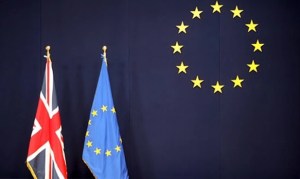
 

Britain - UK - European Union - Referendum - Brexit - Punishment Beating

Support Semi-Partisan Politics with a one-time or recurring donation:

Agree with this article? Violently disagree? Scroll down to leave a comment.

Follow Semi-Partisan Politics on TwitterFacebook and Medium.

Sixteen Years

Violin Concerto, 2nd movement, by Samuel Barber (1939)

911 memorial

Follow Semi-Partisan Politics on TwitterFacebook and Medium.

Where Is The American Left’s Outreach To Trump Voters?

Donald Trump supporters

Too many leftist and liberal voices would rather bask in their own righteousness and moral virtue than engage in the only kind of outreach which stands a chance of defeating Trumpism at its source

As is often the case, a satirical news article in The Onion makes a political point better than 100 earnest Op-Eds on the same subject (including those of this blog).

In a piece entitled “Former conservative recalls belittling tirade from college student that brought him over to the Left”, The Onion reports:

Explaining how the string of personal insults and sharply worded accusations caused him to reevaluate every one of his political leanings, former conservative Vincent Welsh recalled for reporters Friday the belittling tirade from a college student that brought him over to the left. “It was last October and I’d just mentioned my support for a Republican congressional candidate on Twitter when this 19-year-old responded by telling me I was an ignorant asshole who hated the poor and that I was everything that was wrong with the world, and it just completely opened my eyes to how incorrect my whole worldview was,” said Welsh, fondly recounting how the sophomore sociology major converted him to liberalism on the spot by calling him a hateful bigot and saying he was too much of a “brainwashed puppet” of corporate interests to know what was best for him, instantaneously invalidating the 56 years of individual thought and life experience that had led him to his previous political beliefs.

This is what the Laura Pidcocks and Abi Wilkinsons of the world simply fail to understand; publicly declaring that those with differing political views are amoral or at best complicit in evil behaviour does not open hearts and minds, it closes them. Furthermore it only prompts those on the Right, tired of being falsely portrayed as callous oppressors, to hit back against leftist positions using the same divisive language of morality.

I’m sometimes guilty of this myself, having finally snapped after being called out and unfriended by a sanctimonious leftist former acquaintance, and subsequently resolving to fight fire with fire rather than patiently argue that left wing policies are well-intentioned but flawed. Is this the best approach I could take, in terms of helping to bridge political divides and promote understanding? Of course not. But it is incredibly cathartic and gets this blog much more traffic.

The Onion makes a point which may be (and often is) lost on ordinary grassroots left-wing activists, particularly those patrolling social media. And that is only to be expected; right-wing activists are often equally strident in their denunciation of leftists and liberals as communist antipatriots determined to undermine the country from within. Obstinate partisanship is not the preserve of any one political ideology.

But one would hope and expect the adults in the room to take a different approach. Those holding elected office or exercising influence over millions of people on television or in their written commentary ought to be able to tell the difference between playing to the gallery (which is easy) and engaging in genuine persuasion (which can be extraordinarily difficult). Yet too often they choose the former rather than the latter path.

Witness this recent feature by Stephanie McCrummen in the Washington Post. Entitled “The Homecoming”, the feature follows a young female university student returning from her liberal arts college back to visit her home in rural Missouri and help out at the county fair, finding it difficult to relate to her conservative, Trump-supporting family and friends.

In a piece which broke the needle on my overwrought sanctimony detector, McCrummen begins:

It was the first full day of the Clark County Fair, and over at the concession stand Emily Reyes was reading the novel “Ulysses,” raising her head every few paragraphs to look out through the window.

Meet our protagonist, Emily Reyes, child of rural Missouri but reborn as an urban sophisticate following a couple of semesters at college in Kansas City. Already the alarm bells should be sounding – few people read “Ulysses” for pleasure, and one wonders whether Reyes brought the book home with her in part to signal the intellectual leap she has made from her backward hometown. That I could certainly understand, having read numerous books merely to be seen reading them back in my more insufferable youth.

It goes on:

She put down the novel about a young Irish man searching for meaning on an ordinary day in Dublin and began making some jalapeño poppers. A white-haired farmer in denim overalls arrived at the window.

“Small cup of coffee,” he said.

“It’s Starbucks!” Emily began, realizing as soon as the words came out that “Starbucks” was of course a symbol of the urban elite liberal, which was exactly what she did not want to seem to be. She poured him a large cup of coffee and slid it across the counter.

Jesus. Rural Missourians are familiar with Starbucks, and most of them do not see it as a symbol of the urban elite – how can it be when even smaller towns often have a drive-thru Starbucks on their main strip? Newsflash, Washington Post: small town America also has electricity and running water.

More:

Emily had been going since she was a girl, and had always looked forward to the feeling of ease, the lull while the corn was rising, the unhurried conversations. But nothing felt easy to her since the election, especially conversations of the sort that she had learned could arise here.

She had tried talking to her parents during other visits home, telling them that a vote for Trump was a vote “to deport your future son-in-law.” She had tried with Cyrus, and their relationship had only suffered. She and her best friend Hannah had decided not to talk about Trump at all because of the strain the subject had put on their friendship. A sister-in-law had told Emily that she had become difficult to talk to lately, self-righteous and angry.

At this point you should be starting to question whether Emily Reyes might just be a little bit dim. And to be fair, at her age of 22 and early into my political awakening I was not unlike her in terms of my outlook. A more curious person, though, having noted her hometown’s strong proclivity for Donald Trump and then experiencing an entirely different culture at a left-leaning urban college campus, might start asking what faults and failings among the supposedly superior political and cultural elite prompted so many decent people to drift away from establishment candidates and end up wearing MAGA hats. But all Reyes can seeminly do is see the faults and failings of her own family and friends.

And why on earth was their vote for Trump a vote to deport her then-fiancé, how husband? Is her husband an illegal immigrant? There is no indication given in the piece that her Guatemalan partner is “undocumented”. One can reasonably object to Donald Trump’s stance on border security, amnesty for existing illegal immigrants and the foul, racially charged rhetoric he used during the campaign. But to imagine that Trump plans to begin deporting legally settled immigrants is leftist hysteria of the first order, a wild extrapolation from anything that Trump has ever said or that his administration has ever proposed. But again, the Washington Post is not interested in highlighting or deconstructing the flaws in Reyes’ own thinking – for the purposes of their feature, Reyes is unquestionably right about everything, and the residents of Clark County, Missouri are unquestionably wrong.

So far, the only line in the piece which rings true is the observation that Reyes “had become difficult to talk to lately, self-righteous and angry”. That much I can totally believe, based on numerous conversations with people exactly like her.

More:

She turned on some Bob Dylan at a low volume, opened “Ulysses” and settled into a folding chair, advancing 10 pages before Hannah arrived to help. Hannah Trump was her maiden name. Her uncle ran Trump Trucks. An aunt ran a bed-and-breakfast called Trump Haus. Her brother played football and was booed at an out-of-state game recently because of the name Trump on his jersey.

They began making biscuits and gravy, talking about an old high school classmate studying at the University of Missouri.

“She was asking me to help her work on a project about diversity in small towns — she wants to know about any racial targeting,” Emily began.

Again, did the fact that her friend’s brother was booed at an out-of-state football game for sharing a surname with the 45th president of the United States prompt Emily Reyes to dwell for a moment on leftist intolerance? Apparently not.

And of course their mutual friend at the University of Missouri was working on a project about diversity in small towns. American academia in general has become little more than the clergy of the social justice movement, and Mizzou in particular is notable for having capitulated totally to the Cult of Social Justice and Identity Politics. The only astonishing thing here is the speed at which Reyes discarded her old values and sense of empathy with her hometown friends and neighbours in order to side completely and unequivocally with the leftist politics pumped out by her college.

There then follows a particularly egregious segment where McCrummen and the Washington Post seem almost to take enjoyment from the fact that the hopes that the people of Clark County had invested in Donald Trump were not being met:

At a moment when Trump was making news almost every day, when the Trump campaign was under investigation for possible ties to Russia, when some Americans were still rooting for his agenda and others were convinced that his presidency amounted to a national crisis of historic dimensions — no one seemed to be talking about Trump at all.

In the very heart of Trump country, no Make America Great Again hats were in sight. No Trump T-shirts. No Trump bumper stickers or placards.

When asked, people said the standard things Trump voters have been saying, that the president should “stop tweeting so much,” or Congress should “give him a chance,” or that he was always “the lesser of two evils.” Then they went back to talking about how good the corn was looking, or the car crash yesterday, or which garden photo won the open art show.

Sitting in the shade of the grandstand, Marvis Trump, a member of the fair board and owner of Trump Haus, had her theory. She had supported Trump, she said, and for a while, she even had a Trump sign up at her house because it irritated her liberal daughter-in-law. It was a lot of fun, she said, but sometime around Easter, she said, that feeling faded.

“Probably the fun’s over now,” she said.

Perhaps I am being oversensitive, but I almost detect an air of mockery here – a perverse enjoyment by the writer and newspaper that the hopes of these people that Trump might actually “Make America Great Again” were being slowly dashed, that they were being made to look foolish for having previously supported his candidacy so sincerely.

And this gets to the heart of the problem with leftist and liberal resistance to Donald Trump. It’s not that leftists do not have many critiques of Trump which are entirely valid – of course they do. It’s that too many of them seem to enjoy being proved right more than they see the need to make meaningful outreach to those who were wrong.

Yes, the Emily Reyes’s of this world were absolutely right about all of Donald Trump’s character flaws, his inability to govern effectively and his disinterest in even trying to do so. They correctly identified his moral flaws, and picked apart the non sequiturs and logical fallacies in his various arguments with ease. But astonishingly, even now – 227 days into this presidency – they remain utterly unwilling to look at the flaws and failings of their own politics which drove so many people into the arms of Donald Trump in the first place. This does not bode well for the defeat of Trumpism.

I’m currently reading an excellent book, “The Once and Future Liberal” by Mark Lilla, which explores some of these failings in leftist dogma, particularly as they relate to the Left’s obsession with identity politics.

In the introduction, Lilla notes:

“The main result has been to turn young people back onto themselves, rather than turning them outward toward the wider world. It has left them unprepared to think about the common good and what must be done practically to secure it – especially the hard and unglamorous task of persuading people very different from themselves to join a common effort.”

This seems to perfectly capture the seemingly unbridgeable divide between college-educated child and rural-dwelling parent described in the Washington Post piece. In one sense, Reyes is extraordinarily open, having seen the wider world, worked with Syrian refugees in Greece and married someone of Guatemalan heritage. But in another way, her newfound political ideology is so insular that it has left her struggling to look past the different politics of her immediate family and friends to see their innate goodness, and also unable to discuss these issues without becoming angry.

None of this is particularly the fault of Emily Reyes, who seems to be a generous and upstanding individual, despite the fact that she is clearly being used as a tool by the Washington Post to advance their particular ideological agenda. Rather, it is the fault of a political dogma which equates moral virtue with the unquestioning acceptance of its strictures – hence the cognitive dissonance experienced by some identity politics leftists when beloved family members hold the “wrong” views, effectively making them “bad” people.

Obviously the Left’s problems go far beyond this, and include a failure to grapple with the impact of globalisation and automation on the people of small-town America, who tend not to be the kind of ultra-mobile knowledge workers found in the city (and to whom so much of the Democratic Party policy platform is geared). But besides Mark Lilla, few other people on the American Left presently seem willing to engage in any kind of introspection.

Abraham Lincoln once noted that “with public sentiment, nothing can fail; without it nothing can succeed”. Sullenly waiting for Donald Trump supporters to realise the error of their ways – and come crawling back to the same political parties and the same policies which so repulsed them in the first place – is not a recipe for success. On their current trajectory, the Left and assorted anti-Trump forces can at best hope to silence Trump voters, returning many of them to a state of sullen political disengagement and despair – hardly a recipe for improved social cohesion.

Far better to win them over with a new and improved vision for America, one which is better than Donald Trump’s bleak and superficial promises on the one hand, and the Left’s dystopian, censorious identity politics on the other.


Divided States of America - modified US flag

Support Semi-Partisan Politics with a one-time or recurring donation:

Agree with this article? Violently disagree? Scroll down to leave a comment.

Follow Semi-Partisan Politics on TwitterFacebook and Medium.

Citizenship And The Nation State Remain Relevant, Despite The Efforts Of Their Detractors

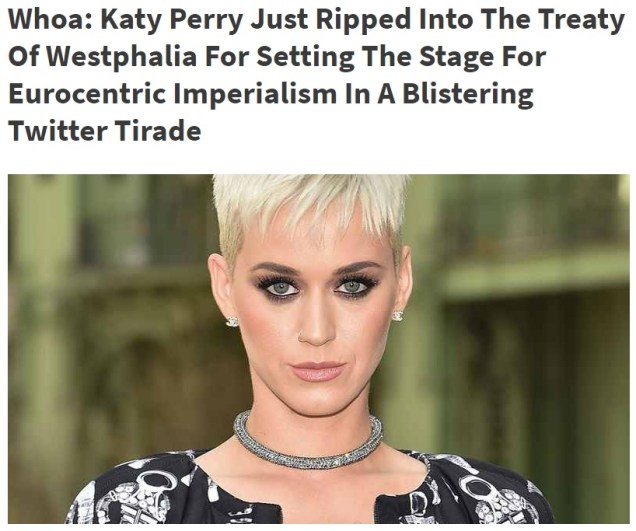
Katy Perry - Treaty of Westphalia - Nation States

There’s life in the humble nation state yet

As the backlash against Brexit grows ever stronger and the Cult of Social Justice and Identity Politics eats away at our national fabric from within, there are many legitimate reasons to fear for the future of patriotism, citizenship and even the nation state itself.

However, there are also a few reasons for optimism, and Rebecca Lowe Coulson sets some of them out in Conservative Home. But first she paraphrases the question that many people are now asking about the continued relevance of the concept of citizenship:

In an increasingly globalised world, however — in which the Westphalian order of nation states is regularly criticised as inward-looking — citizenship is repeatedly denounced as an outdated representation of division and exclusion. It hardly seems necessary to comment that such denouncements typically come from the privileged, within the most economically and politically secure nations. And that, like those Britons angered at the imminent loss of their EU citizenship after Brexit, few “global citizens” seem keen to give up the privileges of their current national citizenships.

Of course, what many of those citizenship-snubbers truly want (like most of the rest of us) is for their own privileges to be extended to those living in less secure places. It is undeniable that great global imbalances remain, even though living standards continue to rise across the world. But then, the question should not be whether the concept of citizenship precludes opportunities in the sense that being a member of one state can be highly preferable to being a member of another, but whether it is still the case that one’s rights and opportunities are best protected and afforded through membership of an individuated state. In a world in which secure states increasingly offer extensive rights to non-citizen inhabitants, aCitind less secure states need more substantial upheaval and help than an improved understanding of the intricacies of membership rules, is the concept of citizenship relevant?

Coulson Lowe then goes on to explain exactly why the concept of citizenship remains relevant, and will not be undermined despite the best efforts of those who see the nation state as an obstacle to be overcome rather than a crucial guarantor of rights:

We all remember how, in her 2016 Conservative Party conference speech, Theresa May said that “citizens of the world” were “citizens of nowhere”. The comment has become symbolic of an approach for which she has been widely criticised: an approach seen both as arrogant, and as attempting to appeal to those on the further right of her party.

At the time, I felt her tone mistaken, in that I would have preferred a use of language implying greater keenness to heal, or at least address pressing divisions within the country. General criticisms of the comment often overlook the argument May was setting out, however. The words came within a section about the “spirit of citizenship”, and read, in full: “But if you believe you’re a citizen of the world, you’re a citizen of nowhere. You don’t understand what the very word ‘citizen’ means”. Surely, it is that forgotten second sentence that is key, here. And that the point May was in the midst of making was about the importance of “respecting the bonds and obligations that make our society work”.

The state, and the society that exists within it, still matters profoundly to those people who aren’t happy with the countries they call home .. Official membership of such societies is conferred in different ways: from the automatic rights of familial lineage to the successful passing of a test. But the standard way of gaining the citizenship of a state is by being born and growing up in it. For those of us fortunate to count somewhere like Britain or Australia as that place, it can be easy to take for granted the relative privileges this affords us.

Yet most of us see that the uncertainties and risks of life make it expedient for us to live together in societies, and that, as social creatures, it is natural for us to want to do so, over and above that expediency. The advancements of the past centuries — in communication, travel, science, military capabilities, commerce, and on — have made it impractical for societies to remain limited to the family groups, villages, or cities they once were. The continuation of that advancement does not mean that our embrace of the nation state must also become outdated, however. For simple reasons of functionality — not to mention the more complex, such as those related to culture or national identity — it is hard to see how bigger blocs or idealist internationalist approaches could work.

This is what many on the Left fail (or are unwilling) to grasp. The Westphalian concept of statehood and sovereignty (combined with 19th century concepts of nationalism) survive the test of time because they work with the grain of human nature rather than against it. Rather than pretending against all available evidence that somebody from country A has as much in common with someone from country Z as their next door neighbour, the system of nation states is a tacit admission that the human instinct to be part of a social communities mean that harmony is best achieved when systems of government are aligned with societal boundaries. And indeed, when there is a mismatch between government and society, nation states have often split and reformed in response.

But the bigger blocs and non-state actors championed by the nation state’s detractors will not become a viable replacement in the foreseeable future, precisely because an entity’s democratic legitimacy and popular support are derived from having a demos which identifies as a cohesive whole and consents to being governed at that level.

The United States works as a country because US citizens see themselves as American first and foremost, and not Californian, Texan, Iowan, Alaskan or North Carolinian. The United Kingdom survived the 2014 Scottish Independence referendum because a majority of Scots (just about) considered themselves British as well as Scottish, if not more so.

Supranational blocs do not command this sense of loyalty or commonality among the people they nominally represent, as the European Union discovered with Brexit and will continue to discover as member states chafe against one-size-fits-all dictation from Brussels. Brexit occurred because the European Union’s drive for ever-closer union and a grander role on the world stage was plain for all to see, and the majority of voters who consider themselves more British than European wanted no part of it.

The “if you build it they will come” approach – where ideological zealots construct all the trappings of a supranational state in the hope or arrogant expectation that a common demos and sense of shared purpose will follow on automatically – has been proven to be nothing more than wishful thinking.

And this is a good thing, because as Rebecca Lowe Coulson correctly observes, supranational and non-state actors have generally proven themselves far less able to effect change than unilateral, bilateral or multilateral efforts by nation states with common purpose. The very nature of trying to shoehorn the competing national interests and priorities of multiple countries into a “common” foreign, fiscal or defence policy gives rise to resentment, suboptimal outcomes (such as stratospheric youth unemployment in Southern Europe) and inevitable net losers.

And yet the myth persists – amplified by bitter Remainers and much of the corrupted civil liberties lobby – that cooperation between countries is only possible under the umbrella of supranational government, and that these non-state actors are somehow a better guarantor of individual liberties than nation states themselves.

Take this hysterical email recently sent out by “civil liberties” organisation Liberty:

Yesterday we took another huge step towards our withdrawal from the European Union as the Government published the Repeal Bill.

If the Bill passes in its current state, people in the UK will lose rights after we leave the EU. It’s that simple and the stakes are that high.

The vote to leave the European Union was not a vote to abandon our human rights.

Yet the Repeal Bill includes worryingly broad powers for ministers to alter laws without parliamentary scrutiny and contains no guaranteed protections for human rights. Worse, it takes away the protections of the Charter of Fundamental Rights without ensuring that we will continue to protect all of those rights in the UK after Brexit.

Every single right we have now needs to stay on our statute books – from those contained in the EU Charter of Fundamental Rights, to equality protections we’ve gained from our membership.

Liberty – and other groups who are content for British citizens to have “rights” imposed on them from above rather than argue for and win them at a domestic level – see supranational organisations as a convenient bypass for national democracy. If the stupid British people are too dumb to vote for more employment protections and other government treats, this line of thinking goes, then advocacy groups who know better should just go over their heads to the EU. This is profoundly undemocratic, but more than that it only affirms the dangerous idea that our rights should be granted by government (at any level) rather than being innate and inalienable.

This is utterly wrong, as I explained back in 2015:

The new, emerging institutions which will replace them are being designed behind closed doors by small groups of mostly unelected people, as well as the most influential agents of all – wealthy corporations and their lobbyists. We have almost no idea, let alone influence, over what they are building together because instead of scrutinising them we spend our time arguing over the mansion tax or the NHS or high speed railways, which are mere distractions in the long run.

The liberties and freedoms we hold dear today can very easily slip away if we do not jealously guard them. By contrast, power is generally won back by the people from elites and powerful interests at a very heavy price – just consider Britain’s own history, or the American fight for independence from our Crown.

The yawning gap in the argument of those who would do away with the nation state is how they intend to preserve democracy in its absence (assuming they even care to do so). Even many of the EU’s loudest cheerleaders concede that the current institutions are profoundly undemocratic and unresponsive to popular priorities or concerns – this tends to be expressed through an exasperated “of course the EU needs reform!”, sandwiched between odes of love and loyalty to the very same entity, as we witnessed countless times during the EU referendum.

But what that reform actually looks like, nobody can say. Or at least, those few tangible visions for a future EU which do exist are so unmoored from reality as to be little more than idle curiosities – see former Greek finance minister Yanis Varoufakis’ DiEM25, which contends both that the European Union can be persuaded to undertake meaningful reforms (ha!), and that this reformed EU should then amplify left-wing priorities to the exclusion of all others (how very democratic).

If you want to do away with the concept of the nation state or actively agitate for its demise then I think you have a responsibility to state clearly and unambiguously what you would have in its place before pushing us all into the undiscovered country. Yet the assorted citizens of the world, so anguished by Brexit, refuse to come up with an answer – at least not one which they are willing to utter in public.

The European Union is not a static entity – it is an explicitly and unapologetically political project moving relentlessly (if erratically) toward the clear goal of ever-closer union. If this is not their preferred outcome for Britain and all other nation states (and few pro-EU types will admit that this is what they want) then it is incumbent on them to offer an alternative goal with a politically viable means of achieving it.

And until they do so, the assorted enemies of the nation state do not really deserve a hearing.

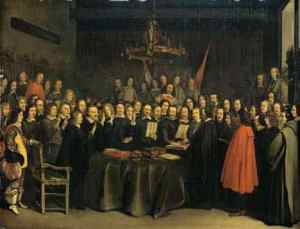
Treaty of Westphalia

Support Semi-Partisan Politics with a one-time or recurring donation:

Agree with this article? Violently disagree? Scroll down to leave a comment.

Follow Semi-Partisan Politics on TwitterFacebook and Medium.

Like, Why Can’t British Politicians Talk Fancy No More?

Great political speeches are only possible when there are great ideas to be expressed, and great leaders to express them

After watching the semi-famous video of former Labour minister Peter Shore arguing passionately against Britain’s membership of the EEC during a 1970s Oxford Union debate, Mark Wallace of Conservative Home has realised that the quality of contemporary British political oratory is perhaps not what it once was.

Wallace observes:

What’s striking is to try to list the modern speeches by Parliamentarians which have achieved the same quality. I’ve wracked my brains and, frankly, I can’t think of any. To be quite honest, while there are many excellent MPs in today’s House of Commons, I can’t think of a single one who speaks so well. Probably the most famous good speech of recent years was delivered by Hilary Benn, in the Syria debate – but watch it back, and you’ll see that while it was effective, it was done with notes and is still seen as exceptional rather than normal.

Depressingly, most of our Parliamentarians do not seem to prize public speaking. Indeed it’s a fairly regular occurrence to see some of them apparently struggling to convincingly read out loud from a bit of paper. Many are perfectly serviceable speakers, but compare modern performances to those from 40 or 50 years ago and it seems that today’s greats are not as great, the average is somewhat worse than it was, and the worst are now really quite dire.

Indeed. In actual fact, Hilary Benn’s speech on Syria wasn’t particularly good at all – it is memorable mostly because of the dramatic circumstances of its delivery during a period of unrest over Jeremy Corbyn’s leadership of the Labour Party, not the rhetorical exhortations of a man with all the charisma of a Quentin Blake illustration.

People also frequently praise the speeches of leftist politicians such as Mhairi Black (whose maiden speech in the House of Commons went drearily viral all over social media), but these speeches are also not particularly well-constructed or persuasive – they are simply very emotive, which makes them seem good in an age when feelings trump reason and reality TV has diminished our collective capacity to think.

Wallace continues:

Somewhere along the way, we ceased to value oratorical skill in our politicians. Perhaps it was the decline of the public meeting and the rise of soundbite-dominated TV campaigning that did it. Or maybe the decision not to teach school pupils how to debate left millions unduly intimidated by the idea of even trying to speak in front of an audience. There’s also a suspicion in some quarters that public speaking is somehow inherently elitist – a fallacy, given the many great orators who once arose, largely self-taught, from the union movement in particular, but a self-fulfilling belief, in that if you tell the majority of kids that only the rich and posh do speeches then you run the risk that they will believe you.

This is a clear loss to the character and effectiveness of our politics. How often do we hear people lament that politics is boring, that its main characters are bland, or that they don’t understand what it’s all about? It cannot have helped to have reduced the art and feeling in how we communicate about politics, and abandoned a means to compellingly communicate often complex concepts to mass audiences.

I am very glad that Mark Wallace and Conservative Home have woken up to the crisis in British political rhetoric. This blog has been lamenting the abysmal quality of British political speechwriting (and delivery) for years, not least here, here, here, here, here and here. Hopefully with the “bigger guns” of ConHome now trained on the problem we might force the discussion into the mainstream.

But good political rhetoric does not exist in a vacuum. Contra Mark Wallace and Peggy Noonan, the internet and social media are not a guaranteed friend of good political speechwriting, heralding a coming renaissance in speechifying. While it is true that some political YouTubers are able to gather massive numbers of followers with their witty or acerbic rants, I can’t think of any high profile social media activists who communicate in a genuinely persuasive way.

Case in point: if one looks at the likes of Owen Jones on the hard left or Paul Joseph Watson on the conspiratorial/alt-right (nobody outside the extremes has much of a following), these people are good only at preaching to the converted in order to generate clicks and likes. They will hardly ever cause somebody to reconsider their own deeply held convictions unless a process of personal political transition is already underway. This also applies to the likes of The Young Turks, Steven Crowder, Ben Shapiro and other voices in American politics, some of whom are good, but who tend not to do bipartisan outreach.

No, the art of British political speechwriting can only be revived if there is a simultaneous renaissance in British political thinking. And there are precious few signs of such a revival taking place any time soon. Right now both main parties are pretty much intellectually dead. The Labour centrists, utterly exhausted and discredited after the Blair/Brown years, are finished – and in their place is a holdover from the 1970s in the form of Jeremy Corbyn. Meanwhile, the soft and non-threatening quasi-conservatism of Cameron/Osborne gave way to the statist paternalism of Theresa May, another throwback to the 1970s which can hardly be considered progress.

Nowhere was this dearth of visionary thinking mirrored by equally uninspired rhetoric reflected more clearly than in the EU referendum campaign. This was a highly consequential, even existential political decision for the people of Britain, and yet rather than bold speeches and compelling narratives on either side we were offered little more than glib soundbites and canned catchphrases.

As I wrote at the time:

When the history of Britain’s 2016 EU referendum comes to be written, what will we remember? Of all the particularly dramatic moments in the campaign to date, none of them have been speeches. Sure, sometimes the fact of a speech has been newsworthy, such as when an unexpected establishment figure has been wheeled out to say that Brexit will usher in the apocalypse, but the content – the oratory itself – has rarely raised hairs or stiffened spines.

In fact, proving Eleanor Roosevelt’s famous assertion that great minds discuss ideas, average minds discuss events and small minds discuss people, the media has determinedly reported almost exclusively on the latter two. Of course that is always the temptation for journalists, but our politicians have hardly given the media much to work with on the ideas front, even if they were minded to cover them.

This is a depressing state of affairs. This most important debate should be bringing out the best in our politicians and our media. We should be witnessing a straight-up fight between advocates of the democratic, independent nation state and those who ardently believe in the euro-federalist dream, adjudicated by a press corps  beholden to neither side and always willing to challenge baseless assertions rather than merely provide a “fair and balanced” platform for two partisan idiots to yell at each other for an equal amount of time.

We will not see a revival in political speechmaking in this country until British politicians actually start having ideas and advocating policies worthy of grander rhetoric. So long as there remains in place a technocratic, managerialist consensus between centre-left and centre-right (which very much remains the case and has only been partially broken by Brexit), there will be no bold new ideas in British politics, and in turn there will be no speeches worth listening to.

When even the prime minister of our country sees her role as more of a glorified Comptroller of Public Services than a world leader representing a great and consequential nation, why would we expect her speeches to be any more memorable than the platform announcements at Waterloo station? And if the prime minister’s words are so utterly uninspiring and inconsequential then why bother listening to the words of those who are not even at her level, but merely vying to replace her in that diminished role?

Our current political debates are often petty and parochial, and so are the words we use to fight them. And those issues which might potentially generate bold ideas matched by bold words tend to be furiously ignored by political leaders – look at their refusal to properly confront the Islamist threat, or the staggeringly superficial debate about Brexit.

Great political rhetoric only occurs when there are great issues at stake and great minds willing and able to tackle them. Think of Franklin Delano Roosevelt’s “The only thing we have to fear is fear itself“, delivered as the American economy buckled under the Great Depression. John F. Kennedy’s “We choose to go to the moon” speech at Rice University, setting the United States the ambitious goal of landing a man on the moon and returning him safely to earth. Winston Churchill’s “We shall fight on the beaches“, given after Britain’s deliverance at Dunkirk. Ronald Reagan’s “Tear down this wall“, made at the Brandenburg Gate in Berlin (and ironically helping to usher in the post-Cold War world which for all its wonders also sucked much of the vitality from Western politics, together with our raison d’être).

And maybe part of the reason that there are no great contemporary British political speeches reflects our diminished status in the world, no longer a superpower or the pre-eminent actor in world affairs. Lofty words are easier to reach for when one reasonably expects that they might reshape the world. Perhaps this is why American political oratory has undergone a similar decline in the post-Reagan era, now that Pax Americana is drawing to an end and the uncertain new multipolar world emerges.

But one thing is certain: without conviction politics, there can be no speeches of great conviction. At best, a centrist or technocratic politician might be able to mimic the grandeur and cadences of famous speeches – as President Obama did so effectively, talking loftily of hope and change while a very different reality played out on the ground – but they will never truly achieve that perfect synergy of subject, argument and tone that is the hallmark of a great speech.

Why are there no great contemporary British political speeches? Well, try picturing one in your head, given the kind of issues we typically argue about and the politicians who represent us.

Imagine future historians studying the impact of rousing speeches about lowering corporation tax by a few percentage points or abolishing the so-called “bedroom tax”.

Imagine schoolchildren memorising the words to that famous speech opposing HS2 or supporting the renationalisation of Southern Rail.

Picture a crowd of thousands of people brought to its feet in genuine excitement by a pledge to reduce NHS waiting times by 15 percent in the next parliament, hire a few hundred more nurses or increase the minimum wage to an astronomic £8 an hour by the year 2020.

And there’s your answer.

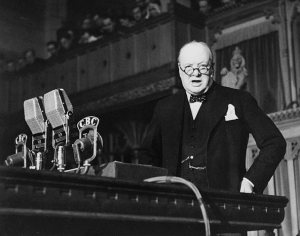
Winston Churchill speech to Canadian Parliament - 1941

Support Semi-Partisan Politics with a one-time or recurring donation:

Agree with this article? Violently disagree? Scroll down to leave a comment.

Follow Semi-Partisan Politics on TwitterFacebook and Medium.