Ed Miliband Talks About The Deficit, Says Absolutely Nothing

Ed Miliband Speech Deficit Austerity Economic Policy Media SPS


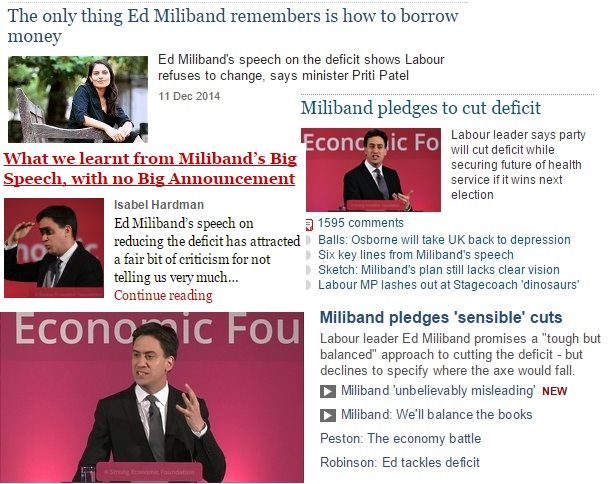
How many times have we been told to expect a “big speech” from Labour’s ex-Leader in waiting, Ed Miliband?

Today is the day when Ed Miliband finally gets serious and fires the starting gun for the 2015 general election campaign, we were told. This is the day when the Labour party will stop being scared of its own shadow or apologetic for its past, and tackle the issue of Britain’s persistent budget deficit head-on. In fact, the latest oration by Miliband was so heavily trailed by Labour’s press team that even seasoned and cynical Westminster reporters were teased into expecting some kind of new policy proposal or big announcement. And what did we get? The same lack of specifics and anticlimactic sense of time wasted that Ed Miliband always manages to evoke.

This blog has long pointed out that Ed Miliband wouldn’t know a great political speech if one jumped off the teleprompter and hit him square in the face – a typical Miliband speech is a more or less random assortment of short, standalone platitudes, focus group-tested to ensure their bland inoffensiveness, and none of which exceed ten words so as not to tax the brain of the listener, whose intelligence is so rudely and continually insulted. This being so, it was a pity to see much of the mainstream press, starved of inspiring political oratory for so long, lazily repeating back the assertion that this was indeed a Big Speech by Miliband, just because the Labour press office labelled it so.

Continue reading

The Obscenity Of Middle-Class Giveaways During Austerity

Middle Class Benefits


Are we all in this together, as George Osborne insists, or are we not?

The Labour Party and their sympathisers in the media have been asking this question non-stop since the coalition government came to power in 2010, shrieking with outrage every time a new policy was announced which failed to forcibly grab enough from the rich and scatter the proceeds over the heads of the deserving poor. And throughout this time we have been treated to some wildly over-the-top rhetoric and mischaracterisations, such as Polly Toynbee’s insistence that “people feel in their pockets … that the middle and lower half are deliberately made to pay the price, while Osborne gifts the richest the most.”

(How could it be otherwise, one might well ask. Labour spent thirteen years in government making even middle-class families reliant on benefits, tax credits and public services, so there was no way that government spending could then be cut in times of austerity without causing more pain and human suffering than should otherwise have been the case. And yet still we look wistfully at Gordon Brown as he saunters off into the sunset, and glare sullenly at David Cameron and George Osborne as they deal with Brown’s toxic legacy).

We may still be stumbling out of the crater left by the Great Recession and the dubious economic recovery, but that doesn’t mean that every tax rise or spending decision has to be, or even can be, progressive. To behave in such a way would be foolish – we would end up in a situation where we forcibly “spread the wealth around” in good times because there is more cash to be expropriated from the successful in an economic boom, and then spread the wealth around some more in lean times because that’s the “compassionate” thing to do. Meanwhile, we would have created such a universal disincentive to work hard, invest and succeed that anyone with wealth to expropriate will have dialled back their efforts or fled the country altogether.

Continue reading

We Can’t Have An Honest Discussion About Immigration Unless We Actually Listen To Each Other

Immigration Debate UKIP Cover Ears Dan Hodges Samuel Hooper SPS


It has become fashionable of late to say that it’s high time  we had a frank, open and honest discussion about immigration.

Never mind that this empty platitude is primarily uttered by the same demagogues who owe their political or media careers to either whipping up excessive fears on the subject, or  sweeping it under the rug while smearing dissenters with the toxic charge of racism; that particular irony, though amusing, is beside the point. Zealots on both sides have come to realise that there is political capital to be made in positioning oneself as the straight-talking voice of reason, and pulling off that particular deception in the eyes of the voters requires going on the record saying how terribly important it is that we talk honestly about immigration.

Even casual followers of the news cycle will notice that the most strident calls for this long-awaited symposium on immigration funnily enough happen to coincide with each advance in the polls made by UKIP, or with every time that Nigel Farage contrives to leave the legacy party leaders looking impotent, or worse still, in active collusion with one another. This has led to accusations of cynicism – they’re only calling for a discussion about immigration now because UKIP are breathing down their necks, comes the predictable refrain. But in fact we have been holding a reasonably thorough and robust conversation about immigration for some time now – or, to be more precise, we have all been talking a lot about the subject. Where we have consistently fallen short, though, is the listening part, without which a truly meaningful conversation can never take place.

Continue reading

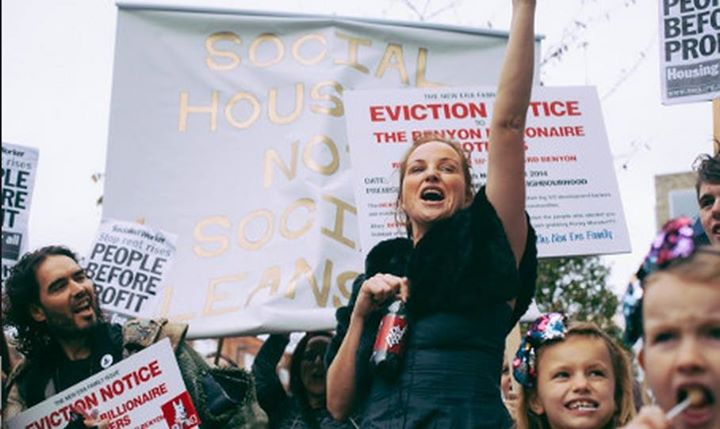
A Very Modern Exodus: The New Era Housing Estate Saga

New Era campaign


This article was originally published on the In My Shoes blog, and subsequently at Guerilla Policy.

It took Hitler’s Luftwaffe to provoke the last great exodus of people from London. First went the children, evacuated en masse to the care of strangers in the countryside, and then after the war whole families were relocated from the rubble of the Blitz to the post-modern New Towns of Britain’s brave new world.

Fast-forward seventy years, and a new displacement is underway. But in 2014, people are being driven from their homes and communities not by bombs from the air but by the process of gentrification and the callous indifference of London’s housing market.

Today’s high-profile case is that of the New Era housing estate in Hoxton, which houses over 90 families at below-market rate rents. Earlier this year, the estate was bought by American property management company Westbrook Partners, who announced their intention to serve notice to the tenants, refurbish the flats and let them at market prices.

The Guardian contrasts the philanthropic spirit that conceived the New Era estate with the vulture capitalism that now threatens to tear it down:

[The estate was] built by a charitable trust in the 1930s in order to offer working-class residents affordable private rented accommodation. Even when the blocks were sold this spring, residents say they were assured that the old tenets would apply. Within weeks, new owners told them that rents would rise to market values: spiralling from £600 a month for a two-bed flat to something closer to £2,400. That was meant to happen by summer 2016. After [Conservative MP Richard] Benyon’s firm pulled out of the deal last week, residents were told that Westbrook would accelerate the process.

Continue reading

The New Era Housing Estate Saga, And The Price Of Gentrification


Back in August I was on London Live TV alongside politics.co.uk editor Ian Dunt, debating the contentious issue of gentrification, and whether it is something to be welcomed or a shameful exercise in social cleansing. Never one to duck a challenge, I argued in cautious defence of the principle of gentrification and the seemingly interminable dereliction-hipsterisation-bankertown cycle, and said that the benefits of gentrification would outweigh the costs – if only Britain would start building new housing supply at the rate and volume we need.

Three months later and I stand by my argument. But as successive governments have failed to stand by their pledges to tackle the housing crisis, gentrification rightly remains a hot-button issue; we should all be concerned that increasing numbers of people are not just being priced out of their neighbourhoods into slightly cheaper adjacent areas, but are having to contemplate moving half way across the country, far from families and support networks, in order to be able to afford to keep a roof over their heads.

This blog has always been an enthusiastic proponent of free markets and maximal personal freedom, and will continue to fight that corner. But when housing supply is artificially restricted through NIMBYism, political cowardice and simple bureaucratic ineptitude, interventions in the market become not only plausible but even desirable. Since the government is in effect already picking winners – choosing to bless existing homeowners with rapidly increasing house prices at the expense of those trying to get on the property ladder or live anywhere in the south east of England – any possible reticence about siding firmly with the underprivileged, the vulnerable and the low paid goes out the window.

Continue reading