Jeremy Corbyn’s restive but cowardly shadow cabinet members have refused to put up or shut up with their concerns about his leadership. Therefore, he should fire them. Now.
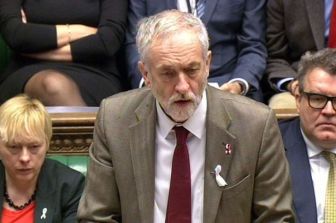
Rumour has it that Jeremy Corbyn had finally had enough of spineless Labour shadow cabinet members who choose to serve under him by day but run to the newspapers with sensationalist quotes attacking him by night.
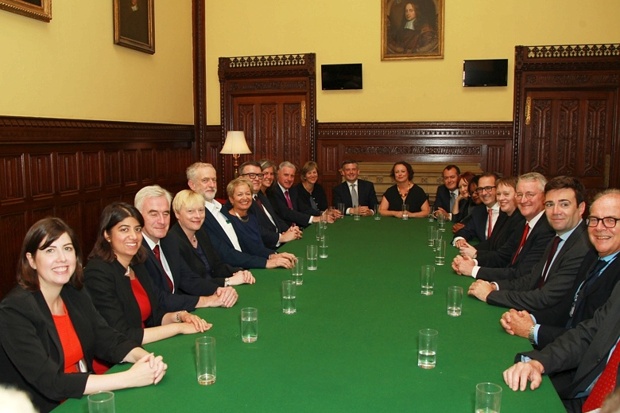
Jeremy Corbyn will spend the Christmas break planning a reshuffle to oust his most prominent shadow cabinet critics that is due to be announced within weeks of the New Year, The Telegraph understands.
The Labour leader and his aides will spend the next fortnight working out how to replace leading internal critics with allies in major a departure from his initial conciliatory top team.
Hilary Benn, the shadow foreign secretary, and Maria Eagle, the shadow defence secretary, are high on the target list after their public opposition to Mr Corbyn over Syrian air strikes.
Good. A reshuffle is long overdue.
Let us not forget that it is the restive Labour centrists currently murmuring and plotting within Jeremy Corbyn’s shadow cabinet who are responsible for his rise – and the rise of the hard left in general – in the first place.
Hopelessly pathetic Labour leadership candidates like Andy Burnham and Yvette Cooper inspired such little inspiration among the party grassroots with their centrist non-vision that Corbyn, an unreconstructed socialist, won the leadership contest by a landslide.
And for the past five years of Conservative coalition rule, the Labour centrists – working under Ed Miliband – engaged in a hysterical, sanctimoniously moralising form of opposition which tolerated the most ridiculous anti-Tory hyperbole in the pursuit of power. This approach – incorporating such tactics as ranting about the supposed “human rights” abuses of the Evil Tories – gave a green light to the crazies and far-left types who have now taken control. The centrists tried to ride the far-left tiger, but were eaten by it.
And yet these losers – these Labour centrists who could barely motivate their own families to vote for them – have the temerity to mutter their discontent to the national newspapers, even while serving in Jeremy Corbyn’s shadow cabinet and being loyal to his face.
These are some of the anti-Corbyn quotations briefed to just one sympathetic journalist, Dan Hodges, by those dull, craven shadow cabinet featherweights who sanctimoniously claim to have the best interests of the Labour Party at heart:
If even one of these quotes had been made by a restive shadow cabinet member about Ed Miliband, such brazen disrespect for the office of Leader would have been front page news, and news channels would have led with stories about an imminent resignation from the Labour front bench.
But under Corbyn’s leadership, the normal rules of behaviour have been suspended – Corbyn’s shadow cabinet feel free to brief against him every day without doing the decent thing and resigning, and the spectacle has become so unremarkable that each instance serves only to add colour to other news stories, rather than making headlines on their own.
Mass shadow cabinet resignations. A dramatic stalking-horse challenge. Poor-health. An act of God. The bulk of the PLP yearns for anything that will bring an end to their Corbyn nightmare. Anything, that is, that does not require an act of courage or defiance from themselves.
And these people actually aspire to govern us. They have the nerve to represent themselves as our future leaders. Ask us to place in their trembling, fumbling hands decisions of life and death, health and happiness, war and peace.
They will not get their wish. There is no 100,000 strong army of “moderates” riding to their rescue. Good. Labour’s spineless parliamentarians no longer deserve salvation.
The current situation is quite simply untenable. The Labour centrists lost the general election, the Labour leadership election and the argument. They lost. They utterly failed to present a compelling political vision of their own, and so they were turfed out in favour of the Corbynites, who do actually stand for something (however unappealing that vision may be).
Jeremy Corbyn’s shadow cabinet are duty bound to serve the man who won their party’s leadership election. That’s how it works. If they have irreconcilable differences with Corbyn on fundamental matters of policy or leadership style, they should air their dissent from the backbenches after having resigned on principle, and not continue to moan and whimper while clinging on to their thoroughly unremarkable front bench careers.
So I say bring on the Corbyn cabinet reshuffle. Those who brief anonymously to the newspapers but lack the courage to air their grievances directly do not deserve their positions of seniority.
May many cowardly heads roll this Christmas.
–
Agree with this article? Violently disagree? Scroll down to leave a comment.
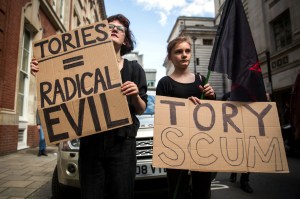
The hysterical left will always call conservatives “Tory scum” and hate us with a blind, unthinking rage. It’s time to stop cowering at their attacks and apologising for our values
As 2015 draws to an end, we still have four and a half more years of David Cameron’s wishy-washy, ideologically rootless, Conservative In Name Only government to look forward to, followed by a general election which will almost certainly deliver another five years of blandness.
For small government conservatives and libertarians, this continual betrayal of principle is bad enough. But as an added insult, it also means four more years of being spat on and called “Tory scum” by demented far-left types who view David Cameron and George Osborne’s half-hearted attempts to pare back the state as the modern-day equivalent of Nazi war crimes, and who have no reservations in publicly saying so. Not very appealing.
That’s why the time has come for conservatives of all stripes to finally seize back the word “Tory” from the haters and reclaim it with pride, rather than meekly and apologetically crawling around and apologising for our values – values which saved this country from decline and irrelevance three decades ago, and can do so again if only we fully unleash them.
In his article, entitled “Why I’ve Become Tory Scum”, Tony Parsons calls out the Labour Party and other forces on the Left for the sanctimonious nature of their campaigning during the general election, and their utter inability to empathise with their opponents – or even entertain the thought that those who oppose them might be doing so from a position of legitimate, morally valid disagreement.
Parsons points out:
The general election was decided not by shy Tories but by us reluctant Conservatives. The millions like me who saw nothing but catastrophe in Labour’s addiction to high taxes and big spending, their loathing of success, the way they could use a word like “mansion” with a straight face and, above all, that endless pious prattle about the NHS – as though the British have no other identity but as a sickly, enfeebled, diseased people in need of having our bottoms wiped by the state from dawn till dusk.
But the truth is that David Cameron’s government is very much an unremarkable continuation of New Labour. Far from being a son of Thatcher, Cameron and his leadership team are very much the heirs to Blair, and would bear comparison with many centre-left governments around the world. The Conservative Party, even under Thatcher, has in many respects always been to the left of even the Democratic Party in the United States, and certainly is so now.
Of course, you would not think that the Conservatives were in any way moderate, judging by the hysteria among many vocal parts of the Left, who present David Cameron’s steady-as-she-goes paternalism and tentative deficit reduction as some kind of outrageous economic shock treatment combined with “human rights” abuses worthy of the Nazis.
Tony Parsons ponders why this is so:
Why are those of us who believe in a different economic model – one where aspiration is encouraged, where the state gets out of your way and doesn’t spend money it doesn’t have – morally reprehensible? Exactly why are we scum? History suggests that, when presented with the chance to vote for socialism the British people always run as fast as we can in the opposite direction. It doesn’t make us bad people. But the left have lost the argument and are reduced to shrieking abuse.
But then the hysterical far left have always talked about conservatives thus, and they always will. Parsons recognises this as he writes:
The loud left are as pertinent to modern Britain as blacksmiths. No wonder their protests are increasingly ugly. They react with furious disbelief at the result of a democratic election. They rave about balancing the nation’s books as if it was like drowning kittens in a sack. They scream in our faces about their own compassion while bandying around epithets like “scum” and “filth” with the vicious abandon of Nazis talking about Jews.
Since the abuse will never end, clearly there is nothing to be gained from running from it any longer. Nor is there anything to be gained by continually apologising for core conservative principles – free individuals and strong families, fiscal conservatism and a prohibitive national defence – as the current Conservative leadership sadly continues to do.
What British conservatism and libertarianism really need is their own version of Jeremy Corbyn – someone who unapologetically sticks to their principles, refusing to water them down for political expediency, and who seeks to lead and persuade rather than conform to the results of the latest opinion poll or focus group.
Or to use a West Wing analogy, British conservatism needs a Matthew Santos-like figure, someone willing to proudly wear the “Tory” label just like Santos refused to apologise for being a liberal in the famous presidential debate episode:
Speaking up for American liberalism in a way that one can only wish David Cameron or George Osborne would do for small government conservatism, Santos says to his Republican opponent:
What did liberals do that was so offensive to the liberal party? I’ll tell you what they did. Liberals got women the right to vote. Liberals got African-Americans the right to vote. Liberals created social security and lifted millions of elderly people out of poverty. Liberals ended segregation. Liberals passed the Civil Rights Act, Voting Rights Act. Liberals created Medicare. Liberals passed the Clean Air Act, Clean Water Act. What did conservatives do? They opposed every single one of those things. Every one.
So when you try to hurl that label at my feet – liberal – as if it were something to be ashamed of, something dirty, something to run away from, it won’t work, Senator. Because I will pick up that label and I will wear it as a badge of honour.
Of course it is almost unimaginable for a conservative to ever talk this way, with such passion, partly because we tend not to make such grand claims for ourselves in reshaping the world or forcibly changing human nature in pursuance of our goals. It is not in our nature to brag about our accomplishments, because the biggest accomplishment a conservative can aim for in government is to get out of the way and help remove obstacles from others so that they might reach their full potential.
But more than this, British conservatives since Margaret Thatcher have had precious little to brag about. Locked out of office under thirteen years of New Labour, the Conservative Party which emerged under David Cameron has made so many compromises with triangulating, Blairite centrism that there are almost no genuinely conservative policy victories or changes in the country which we can claim.
What are we supposed to brag about? Remember when the Tories stood up to the growing climate of intolerance toward freedom of expression, and formally codified a British citizen’s right to free speech? We can’t say that because it didn’t happen. Indeed, under Theresa May Britain is becoming an even more authoritarian police state than it was before, with human beings languishing in our prisons simply for saying, singing, or tweeting the “wrong” thing.
Remember when George Osborne struck a blow for fiscal conservatism, rallied the country with his argument that it was morally obscene for government to spend more on debt repayments than education or the military, and achieved a real budget surplus in order to finally begin paying down the national debt? We can’t say that either, because although Osborne is happy for the public and lazy journalists to believe that the Tories are “paying down Britain’s debts”, in reality the government is doing no such thing.
Conservative supporters truly have the worst of both worlds at present. We are attacked by the furious Left for an ideologically-motivated attack on the state and its poorest dependants, while in reality almost zero real conservative reform is being enacted. We are stuck with the leftist abuse, but have absolutely nothing positive to show for it.
If David Cameron’s Conservative Party was voted out of office today, what will future historians and political commentators say about this government fifty years from now? What will be the Cameron / Osborne legacy? What edifices of stone, statute and policy will remain standing as testament to their time in office? Try to picture it clearly.
Are you happy with what you see?
No real conservative should be happy with what they see right now. Assuming that the political pendulum will at some point swing back in favour of the Labour Party, we conservatives have almost nothing to show after five years of David Cameron other than a half-finished job clearing the budget deficit. We have a reanimated Ted Heath sitting in Downing Street, not a worthy heir to Margaret Thatcher.
But just as the American Tea Party lay conspicuously dormant for the many years of fiscal profligacy and budget-busting spending under the George W. Bush administration only to miraculously awaken when a man named Barack Hussein Obama won the presidency, so the hysterical British Left are now shrieking bloody murder over a set of very pedestrian, middle-of-the-road centrist policies being enacted by the Conservative Party after having airily ignored the very same governing philosophy when the now-hated Blairites were in charge.
As conservatives, we realise there is no point in launching a futile battle against human nature or the instinct of many on the Left to demonise that which they do not or cannot understand. They will continue to call us “Tory Scum” and we have no control over that.
But we do have the power to take back ownership of the label “Tory” and refuse to see it as an insult.
We do have the power to point out that there is nothing virtuous or compassionate about throwing more money at unreformed healthcare and welfare systems, or spreading the wealth around so much that wealth creation is destroyed or driven overseas.
We do have the power to proclaim the importance of fiscal conservatism, not out of some wonkish obsession with balancing the books but because running up further government debt today is a blatant act of intergenerational theft, living at the expense of our children and grandchildren. And because as we have seen with other countries, excessive national debt can become a foreign policy and national security issue too.
We do have the power to point out to anyone who will listen that the modern Left love to parade their virtue and ideological purity but have apparently given up on coming up with alternative policies of their own, and to demand that Labour produce some costed tax and spending plans rather than simply railing against the inhumanity of the Evil Tories.
We do have the power to point out the many ways in which David Cameron’s pitiful excuse for a Conservative government ignores or betrays real conservative values, and to declare “not in my name”.
The Left are not going to change, so we had better get used to the spitting, the vandalism, and the overwrought, emotional and short-termist way in which they discuss public policy.
But we can change. We can stop lying down and taking it every time a virtue-signalling lefty pontificates on welfare without offering a plan of their own, or seeks to win an argument on healthcare by stoking the public’s idolatry of the NHS.
We can stop fighting on the Left’s terms.
And who knows, if small government conservatives and libertarians actually succeed in getting off the back foot for the first time since Margaret Thatcher left 10 Downing Street, we might even manage to salvage something from David Cameron’s woeful premiership.
–
Agree with this article? Violently disagree? Scroll down to leave a comment.
I’m currently back in the United States to celebrate Christmas in Texas. These short “Postcards from America” will document a few of my thoughts as I escape the political whirlwind of Westminster and look back at Britain from the vantage point of our closest ally
–
In America, not everyone waits passively for government to improve their life circumstances. Aided by a thriving community college sector, people take their futures into their own hands
While sitting in the cinema waiting for Star Wars: The Force Awakens to begin, I was struck by the number of local advertisements for regional schools, community colleges and universities which were shown.
By my reckoning, at least 40% of the commercials screened over a fifteen minute period were promoting some kind of educational service. Contrast this with the United Kingdom, where local commercials of any kind are a rarity, and most national commercials these days tend to be for banks, fast-moving consumer goods, the EE mobile phone network (featuring Kevin Bacon) or one of the limited number of other companies able to afford a national cinema campaign.
An example of the type of commercial screened at the south Texas cinema I attended is shown above. Typically, they feature personal testimonials from ordinary people who explain simply and positively how going back into education has helped them in their careers, how the various modes of study fitted in around their existing home and work commitments, and how easy/affordable it turned out to be.
These degrees and diplomas provide a springboard into skilled, middle class jobs, many of which are well paid and non-outsourceable. Dental nurses, IT engineers, electricians, car mechanics and many other such career opportunities. Recognising that not everybody can be – or wants to be – an elite lawyer or doctor, these institutions equip people with tangible skills which actively help them in the labour market, ensuring that their career options are far greater than the prospect of 40 years working at the 7-eleven, or some other minimum wage drudgery.
This emphasis on adult education is one sign of a more active and engaged citizenry, of a people who understand that their self advancement and personal destiny is in their own hands, not those of the government.
To be fair, some British politicians are also coming to realise the importance of adult education to keep our own workforce skilled, adaptable and capable of commanding high wages rather than minimum wages. During the Labour leadership campaign, Jeremy Corbyn floated his plan for a National Education Service to do for lifelong learning what the NHS did for healthcare.
Banging on about apprenticeships is all very well, but what of adults over 25 who cannot take an apprenticeship under the current schemes, or who want to work in a field where none exist? What of the 55-year-old steelworker made redundant with few other transferable skills?
A conservative government worth its salt would look at Jeremy Corbyn’s proposal for a National Education Service, balk at the more nakedly socialist aspects, but then consider how a smaller and leaner government might be able to promote the education of the adult workforce in pursuance of the national interest. But of course our current Coke Zero Conservative government is not worth its salt.
If Britain is to prosper in this globalised age – and if our poorest, most disadvantaged fellow citizens are to be spared from a harsh life of minimum wage drudgery – we need a learning revolution in the United Kingdom, a British Apollo Program for education.
What party, what future leader will rise to the occasion and propose a solution equal to the task at hand?
–
Agree with this article? Violently disagree? Scroll down to leave a comment.
If you buy the NHS Choir’s mediocre Christmas ditty you are part of the problem, not the solution
Imagine that a large, critical government department was gradually but incessantly becoming less and less fit for purpose.
Suppose that (say) HM Revenue & Customs suffered from major failures of management and leadership, an outdated structure, a confused remit and an ever-increasing list of responsibilities coupled with constantly changing priorities. What should be done?
Was your first thought the idea that a group of HMRC employees should get together and release a song with the hope of reaching the Christmas No. 1 slot in the charts? Did you think – in a moment of epiphany – that recording a Christmas song would in any way address the issues with that organisation, or that any public goodwill generated by the song would somehow make the various deep-rooted organisational problems and resource constraints melt away?
Probably not. You would most likely want to see some kind of hard-headed, evidence-based action plan to turn things around, not a cheesy song that pretended everything was great. But this “sing your problems away” approach is exactly what is happening today, not with HMRC but rather with the NHS. And now we are all being asked to allow ourselves to be swept up in the self-deception, mindlessly tweeting our support for an organisation – and model of healthcare delivery – which becomes more out of its depth and more inadequate to our needs with every passing day.
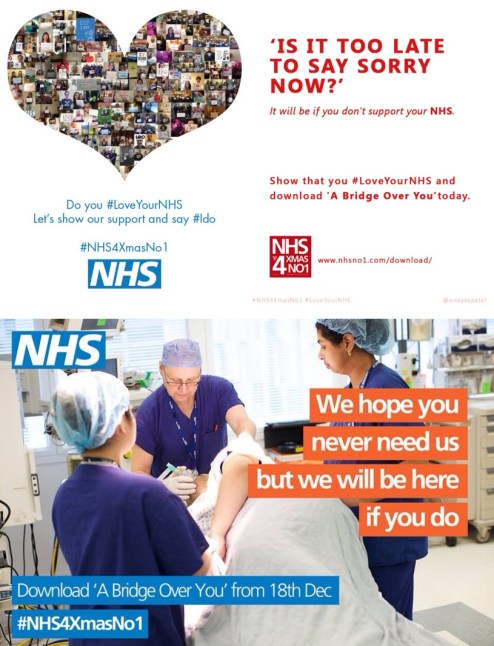
The Lewisham and Greenwich NHS Choir are leading the in way in the race for the 2015 Christmas Number one, as the battle to secure the top spot heats up.
According to initial reports from the Official Charts Company, the choir’s track A Bridge Over You – a mash-up of Simon and Garfunkel’s Bridge Over Troubled Water and Coldplay’s Fix You – is currently ahead of rivals Justin Bieber and Louisa Johnson.
But with the track leading the way by just under 5,000 sales, it’s still looking likely to be a three way race for the top spot.
The NHS choir could also receive a boost following the release of the accompanying video earlier this week.
That video is the one shown at the top of this piece.
But this piece of lazy, self-congratulatory, virtue-signalling NHS worship is nothing to be proud of and certainly not something which any engaged and informed citizen should support.
Why? A couple of reasons:
1. First of all, it’s a poor piece of music making. It’s a bad mashup, even by the low standards of most mashups. It takes one timeless classic (the Simon & Garfunkel) and one decent contemporary song (the Coldplay) and unimaginitively smooshes them together in a way which somehow manages to destroy or obfuscate the best of both pieces.
But of course, we can’t possibly acknowledge this fact, because:
2. Second, the video is emotionally manipulative twaddle, yet more unthinking pro-NHS propaganda of the kind that will ensure Britain’s healthcare system continues to lurch, unreformed, from crisis to crisis for another seventy years. And the fact that the propaganda is produced not by government diktat but by zealous citizens who believe they are working for the Greater Good only makes it all the more insidious.
“Aren’t NHS workers wonderful?”, the video asks us to ponder. Yes, I suppose so, but no more so than those who work for HM Revenue & Customs. Both perform a vital service, and both draw a government paycheque at cost to the taxpayer. And yet we all know that if George Osborne’s Treasury barbershop ensemble released an album of Christmas classics it would already be festering in bargain bins and languishing at the very bottom of the charts.
Thus, over five tedious minutes of this particular pseudo-inspirational dirge, we are treated to scenes of saintly NHS workers helping wobbly old people stand up from chairs, therapists teaching amputees how to walk again, premature babies being nursed to health, and other everyday scenes of hospital life. Are these heartwarming scenes? Sure they are. Are they unique to the NHS? Hell no.
“What other organisation but the NHS could possibly do any these things?”, screams the message from the video. After all, we all know that old people, premature babies and the disabled are simply thrown into woodchipping machines and disposed of in other advanced countries without an NHS. Only in Britain with “our NHS” (genuflect) do people receive healthcare free at the point of use.
Except that none of that is true. Britain is not an island of enlightened compassion in a sea of cruelty and denied cancer treatments. And precisely zero countries are knocking on our front door and sending in their experts to learn about how we organise healthcare in this country so that they can replicate our system back at home. Shouldn’t that maybe tell us something, and cause us to take a pause from the incessant, self-satisfied boasting?
Emotional blackmail / NHS propaganda
This isn’t an attack on NHS workers. It’s not even an attack on the Lewisham and Greenwich NHS Choir, even though their unremarkable song no more deserves to be Christmas No. 1 than will the next inevitable re-release of “Feed the World”.
This is an attack on our unthinking, embarrassing commitment to the NHS model, our apparent desire as a nation to worship what is in fact an immensely powerful government department, and the sanctimonious belief that by propelling this mediocre song to the top of the charts in time for Christmas we are making any positive contribution toward the future of British healthcare (beyond the admittedly welcome charitable donation).
We can sing songs about the NHS until we are blue in the face (and the number of songs is growing – how long until they coin an official anthem?), but it will do nothing to change the fact that a centralised model of state-funded and state-delivered healthcare designed in the post-war 1940s is highly unlikely to be the optimal solution in the year 2015.
Singing songs in praise of Aneurin Bevan’s rusting creation will do nothing to address the cold, hard truth that rising life expectancies and the continual developments of new, expensive treatments can only be tackled by an unreformed NHS if there are immediate, dramatic increases in personal taxation. For everyone, not just the Evil Bankers, of whom there are sadly not enough.
But sure, let’s make the NHS Choir song the number 1 Christmas single. Then let’s all sit back and smugly reflect on what right-on, progressive people we are for spurning Simon Cowell’s latest manufactured hit-by-numbers offering in favour of doctors and nurses who sing in their spare time. Let’s keep pretending that we alone, of all nations, stumbled upon the optimal way to deliver top quality healthcare to a growing, ageing population, back when we were still digging ourselves out of the rubble of World War 2.
It’s ironic. The NHS Choir is warbling away about “trying to fix” us this Christmas, when it is hagiographic stunts like this which mean we may never summon the political will required to fix (or replace) the NHS.
–
Agree with this article? Violently disagree? Scroll down to leave a comment.
Who will condemn the bishops for exploiting our fear of terrorism in their grubby bid to preserve taxpayer funding of the BBC’s religious output?
The Church of England is very upset that the BBC is considering cutting the amount of taxpayer money it spends on (predominantly) Christian television output.
A spokeswoman confirmed that the BBC was planning to “look at ways we can reduce costs” as it faced “huge financial challenges” but added that cuts would come from across the corporation.
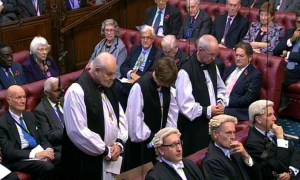
The Bishop of Norwich, the Rt Rev Graham James, the Church of England’s lead spokesman on media issues, said the move could threaten something which was “fundamental to our public life”.
“It seems to me that religion has already taken a hit,” he said.
“It has already been reduced certainly in terms of its scope as an independent part of the BBC, at a time when we already need – as everyone acknowledges – more religious literacy in the nation.”
Nothing unusual there. The Church of England is a well oiled lobbying machine, and any private organisation lucky enough to have a bloc of 26 unelected representatives sitting in parliament to influence our laws in their favour would be foolish not to make good use of them. Thus it is no surprise that the unelected theocrats of our state church have been hard at work speaking out against the BBC’s planned actions.
But the fact that the Church of England’s behaviour is understandable does not make it any less reprehensible. Firstly, because it makes a total mockery of the idea of the BBC as an independent broadcaster. Nobody seriously believes that an organisation whose budget is nearly totally dependent on taxpayer money can be truly independent, but the fact that the Lords Spiritual are now actually speaking in parliament about the internal decisions and strategy of the BBC makes any pretence of the BBC’s impartiality or the government’s non-involvement utterly ridiculous.
Worse than this, though, is the flimsy rationale now offered by the bishops as a pathetic excuse for more taxpayer funded religious programming:
Bishops have warned the BBC it risks turnings its back on efforts to tackle extremism and aid integration by slashing spending on religious programming.
[..] The first female cleric in the House of Lords, the Bishop of Gloucester, the Rt Rev Rachel Treweek, remarked that the decision had presumably been taken “to reduce the possibility of offending people with too much God stuff over the holiday”.
It is good to see the newly enobled Rachel Treweek, my Lord Bishop of Gloucester, is wasting no time in rolling up her sleeves and interfering in our national democracy as generations of theocrats have done before her. She will be making the home team very proud. But unfortunately, she and her fellow Lords Spiritual are talking nonsense.
The argument that cutting the amount of taxpayer money devoted to religious television and radio programming on the state broadcaster is somehow a threat to anti-extremism efforts is as ridiculous as it is unfounded.
More moderate Christianity on TV will not result in less Islamic extremism on the margins of British society. And pontificating, busybody bishops who abuse their parliamentary platform to suggest otherwise should provide evidence for the supposed link, or else retract the claim and admit that they are simply exploiting serious issues of national security in a cheap ploy to gain more taxpayer-funded airtime.
The real issue is not so much the pull factor of extremism as the push factor of the alienation of too many young Muslims from British society. It’s the fact that we have living among us too many self-segregated societies comprised of people who hold the same passports as us, but look upon us – and the enlightenment values of reason, education, liberty and democracy to which we try to adhere – as alien and unwelcome. By failing to inculcate a strong and inclusive sense of Britishness, out of craven fear of causing offence, we provide the Islamist recruiters with easy fodder.
Do my Lord Bishops of Gloucester and Norwich (flowery titles for a bygone age) seriously believe that the kind of alienated youths and their families who are now quietly slipping away to ISIS in Syria or seeking out radicalising materials online are the same type of people who tune in to BBC Two at six o’clock in the evening, ready to be reached out to and placated with a documentary about public spirited imams, rabbis and priests working together to open a new community centre? What nonsense.
The people most in need of the BBC’s moderate religious programming and generally liberal worldview are those whose eyes are glued to YouTube videos of anti-American 9/11 conspiracy theories or seditious social media conversations on their smartphone screens. More government intervention – be it through Prevent or the BBC – is not going to make meaningful inroads to these people. The only lasting solution must come from the bottom up, a revitalisation of patriotism and pride in Britain, and the promotion of a common British identity which transcends racial divides (rather than revelling in a multicultural dystopia which sees groups living side by side but separately in parallel, alienated lives.
This is in no way intended as an attack on religion, or on the Church of England (so long as it stays within its own boundaries and stops trying to play an undue role in our public life). I grew up watching Songs of Praise on a Sunday, and have happy memories of doing so. But it is not right for general taxpayers of an increasingly secular country to continue funding religious programming using a model that invites some appointed bureaucrat or another to choose which religions or denominations are to be favoured above others.
Perhaps the Lords Spiritual begin to grasp this. Perhaps they are grasping at these increasingly ludicrous excuses for their continued influence because deep down, they realise that they have no place in the government of a twenty-first century democracy.
But if these are the death throes of theocracy in Britain, they are still very offensive indeed. Claiming that the BBC should continue to spend taxpayer money on religious output favouring the established church because failing to do so will unleash more extremism – and note how the bishops cannot bring themselves to utter the name of the religion from which that extremism currently emanates – is cynical and manipulative, playing on the fears of British people just to win more free promotion.