Social Justice Commandments: Being A Good Parent Perpetuates Unfair Privilege

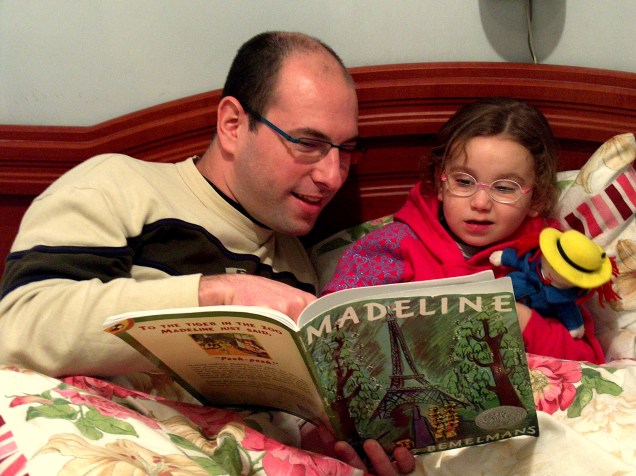
Bedtime Story

The warped philosophy of social justice decrees that good parents are part of the problem, not the solution

For more evidence of the sickness at the heart of our universities, I present the professor from Warwick University – my alma mater – who thinks that parents who read to their children are gifting them with unfair privilege over other kids whose parents are too busy watching Britain’s Celebrity Animals Bake-Off On Ice to lavish their own children with similar attention.

From the ABC summary of the segment on Australian radio:

[Professor Adam] Swift in particular has been conflicted for some time over the curious situation that arises when a parent wants to do the best for her child but in the process makes the playing field for others even more lopsided.

‘I got interested in this question because I was interested in equality of opportunity,’ he says.

‘I had done some work on social mobility and the evidence is overwhelmingly that the reason why children born to different families have very different chances in life is because of what happens in those families.’

Once he got thinking, Swift could see that the issue stretches well beyond the fact that some families can afford private schooling, nannies, tutors, and houses in good suburbs. Functional family interactions—from going to the cricket to reading bedtime stories—form a largely unseen but palpable fault line between families. The consequence is a gap in social mobility and equality that can last for generations.

Already this sounds ominous. And though Swift gets his mention of “equality of opportunity” in nice and early, the draconian means by which he wants to achieve this equality are quite something to behold:

‘What we realised we needed was a way of thinking about what it was we wanted to allow parents to do for their children, and what it was that we didn’t need to allow parents to do for their children, if allowing those activities would create unfairnesses for other people’s children’.

The test they devised was based on what they term ‘familial relationship goods’; those unique and identifiable things that arise within the family unit and contribute to the flourishing of family members.

For Swift, there’s one particular choice that fails the test.

‘Private schooling cannot be justified by appeal to these familial relationship goods,’ he says. ‘It’s just not the case that in order for a family to realise these intimate, loving, authoritative, affectionate, love-based relationships you need to be able to send your child to an elite private school.’

Note what Swift has done here. First of all, he posits a dystopian world where “we” have any right to “allow” parents to do certain things or raise their children in certain ways, the corollary to which is that these mystical external authority figures also have the power to prohibit parents from engaging in certain everyday activities.

But worse, he has made an arbitrary judgement with relationship to these “familial relationship goods”. You might think that it is up to individual parents and families to decide what is good for their young ones, or what is most needed to ensure that they thrive and become well-rounded, successful people. But you would be wrong. Because Adam Swift has a definitive list of all the things needed to create a well-behaved, social justice loving adult, and private schooling ain’t on the list.

And that’s when it gets really crazy:

In contrast, reading stories at bedtime, argues Swift, gives rise to acceptable familial relationship goods, even though this also bestows advantage.

‘The evidence shows that the difference between those who get bedtime stories and those who don’t—the difference in their life chances—is bigger than the difference between those who get elite private schooling and those that don’t,’ he says.

This devilish twist of evidence surely leads to a further conclusion—that perhaps in the interests of levelling the playing field, bedtime stories should also be restricted. In Swift’s mind this is where the evaluation of familial relationship goods goes up a notch.

‘You have to allow parents to engage in bedtime stories activities, in fact we encourage them because those are the kinds of interactions between parents and children that do indeed foster and produce these [desired] familial relationship goods.’

How gracious of Swift, allowing parents to continue to read to their children at bedtime, even though the unfair privilege they bestow by doing so eats away at his enlightened, equality-loving soul.

Swift continues:

‘We could prevent elite private schooling without any real hit to healthy family relationships, whereas if we say that you can’t read bedtime stories to your kids because it’s not fair that some kids get them and others don’t, then that would be too big a hit at the core of family life.’

So should parents snuggling up for one last story before lights out be even a little concerned about the advantage they might be conferring?

‘I don’t think parents reading their children bedtime stories should constantly have in their minds the way that they are unfairly disadvantaging other people’s children, but I think they should have that thought occasionally,’ quips Swift.

So by all means continue to read to your children, if you must. But you should feel very guilty while you do so, and chastise yourself once little Timmy has fallen asleep, while meditating on the various ways he will grow up to oppress those unfortunate children whose parents did not read to them.

Which, of course, is the one thing missing from Adam Swift’s “analysis” – any thought or mention of the parents who do not read to their children. As with everything else in the victimhood-soaked world of social justice, where everything must be viewed through a lens of privilege and oppression, only those who work hard and do the right thing are subject to criticism. Those who do the wrong thing, by contrast, are continually excused and stripped of any agency for their own actions – a condescending behaviour which actually does more to dehumanise them than any “harm” they incur from the privileged.

In the entire segment, Swift has no words of reproach for those parents who do not read to their children at bedtime. He neither suggests that this might be through their own fault, or that they need to anything to rectify the situation. It is simply taken as a given that they will continue to be bad parents, helpless to modify their behaviour, and that the only thing society can do in response is to worsen the overall standard of parenting in order to prevent the worst parents from feeling bad or experiencing the consequences of their own actions.

And this, right here, is at the root of our society’s decay. We now simply accept and nod our heads while academics airily consider how best to bring everyone down to the same, lower level of attainment rather than striving to confer as many of the benefits currently enjoyed by the rich (or those with good parents) on all. The insidious Cult of Social Justice and Identity Politics has done its work well, because many of us now look at inequality and feel the instinct to tear the successful down (or at least actively thwart their rise) rather than building others up.

Fortunately, Adam Swift is not about to be given wide-ranging power over how people raise their children. But it is worth noting the type of outcomes which one might get when beady-eyed authoritarianism (where external authority figures “allow” graciously parents to do things) meets the warped Social Justice view of inequality.

For so long as these ideas remain abstract discussions between philosophers, there is limited real-world harm. But when more young people who have percolated in this environment all through university start entering the job market and getting themselves elected to local and national government, we will have a real problem on our hands.

In Britain, the Labour Party is already very hostile to the idea of private schools, while many in the Conservative Party are themselves quite paternalistic and keen for the state to regulate behaviour. And while neither party has not yet succeeded in shoehorning government fully into the parent-child relationship (except for Scotland, where the SNP is making a game attempt at taking over from parents), it may well be only a matter of time.


Bedtime Stories

Safe Space Notice - 2

Top Image: Wikipedia

Bottom Image: Guardian

Agree with this article? Violently disagree? Scroll down to leave a comment.

Follow Semi-Partisan Politics on TwitterFacebook and Medium.

The British Media’s Shameful Coverage Of The EU Referendum

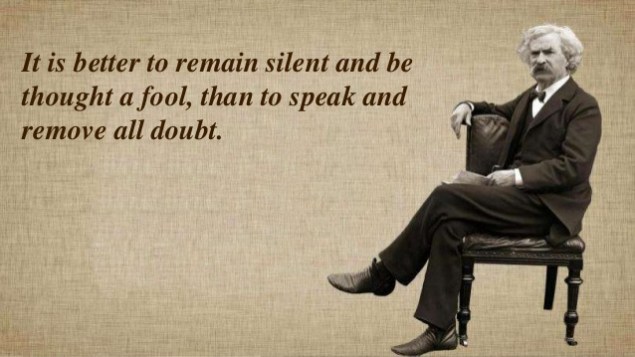
Mark Twain - It is better to remain silent and be thought a fool, than to speak and remove all doubt

Of the many disappointments in this EU referendum campaign, the utter failure of the British press to discharge its basic professional duty stings worst of all

A well-functioning, free press is essential to the health of a democracy.

Rigorous journalism, conducted with integrity, is the lifeblood of a vigilant, engaged citizenry – without it, the people cannot make informed decisions and corruption, incompetence and decay quickly begin to corrode good government.

The current EU referendum should therefore be a great test for our nation’s media elite, and reveal whether or not the British press are fulfilling their essential function. After all, here is an absolutely existential question facing the nation – do we stay in the European Union or do we leave? There are many interweaving areas to consider – trade, foreign policy, defence, national security, trade, immigration, the economy. And there is the temporal aspect – what is awkward or uncertain in the short term may have huge benefits in the long run, and vice versa. In every respect, this is a big, meaty issue for Britain’s finest journalistic minds to wrap their heads around.

Of course, no one journalist or publication can perfectly embody all of the great journalistic characteristics of fearlessness, impartiality, scepticism and rational enquiry all the time. That much is not possible, nor expected. We are all human beings and we all have motivations and core beliefs which give us blind spots or encourage us to take mental shortcuts. That’s normal. But at the macro level, if our democracy were in good shape, by now we should see an accumulation of evidence of rigorous enquiry by the media class. Even in a media market where newspapers and websites make no claim of impartiality we should still see evidence of lies being exposed, truth being searched out and upheld, and assertions constantly questioned.

This holds true even when the quality of the discourse itself – in this case driven by the two official campaigns on each side of the EU referendum – is poor, as is very much the case with the fearmongering establishment Remain campaign and the unhinged, loose cannon Vote Leave. Bad ideas are bad ideas and false statements are false statements, whether they come from the shouty man on Twitter or an oleaginous SW1 spokesperson. Therefore, bearing the imprimatur of establishment authority should make one more open to questioning, not less, and there should always be a healthy scepticism of authority and social status.

So are we currently passing the test? On this most important of issues, has the British media been doing its job properly?

It hardly needs stating that the answer is a resounding “no”. In fact, the quality of coverage has fallen incredibly short of the standard we should expect from a healthy democracy – but then, our democracy is hardly healthy. Or particularly democratic. Tthis is not a criticism of any one journalist or publication – though there are several whose deserve full and individual criticism for their groupthink, confirmation bias and craven deference to power. But for the purposes of this blog post we will focus our attention on the overall national media output.

And the best way to see how the media have fallen short in their EU referendum coverage is through their utter lack of curiosity about a plan for Brexit. This is particularly odd given the fact that the SNP government’s weighty tome outlining a plan for Scottish independence provided such rich pickings for journalists during the 2014 referendum. As time dragged on and on, one might have reasonably expected calls in the press for the release of a Brexit plan to have reached a loud crescendo, eventually forcing the hand of the official campaign.

But no – when it was high handedly decided that having an actual plan for what to do after the referendum would be stupid because it would (shock horror) invite scrutiny, there was barely a peep from the media. Vote Leave were allowed to get away with fighting this most rare and consequential campaign without so much as a list of bullet points scribbled on the back of a napkin. Yet you will struggle to find one television or newspaper interview where senior Vote Leave figures (or Leave.EU figures prior to the designation decision) were put on the spot about their lack of an agreed plan.

And yet a Brexit plan exists, and has done for several years. It’s called Flexcit and is hosted at the eureferendum.com blog authored by Dr. Richard North, one of Britain’s foremost authorities on the history and workings of the European Union. Now, it may not bear the stamp of the Westminster bubble, but it was at one point being considered for adoption by Leave.EU (who shamefully decided not to do so because it detracted from the simplistic anti-immigration, economically illiterate message which is working such wonders for the Leave campaign at the moment).

And yet does this warrant the slightest attention from the Westminster media? Apparently not. Besides a vaguely disparaging article in the Herald Scotland, you won’t find a single mention of it by name in a major UK newspaper, let alone on television. Those columnists and pundits who know of Flexcit (and thanks to many ordinary supporters and a large web footprint it is hard to miss in a Google search) and support the plan are forced to make murky allusions to it, because openly mentioning the one citizen-authored plan for leaving the European Union would mean the torpedoing of that article before it ever saw the light of day.

This is a plan which was originally drawn up as an entry to an official competition organised by the IEA, and which has now been downloaded nearly 100,000 times. It isn’t some child’s finger-painting stuck lovingly to the fridge door with a magnet – it is a serious piece of work. And yet even as Britain debates the merits of leaving or staying in the EU and the process by which Brexit might occur, apparently no “household name” Westminster journalist has considered it worthwhile to write about the only comprehensive Brexit plan in existence.

Why the media blackout of Flexcit? One can only speculate – but none of those speculations lead to a very pleasing conclusion. Some journalists and publications overlooking Flexcit might be accepted as a very odd act of omission. The entire Westminster media stubbornly refusing to to mention Flexcit while hanging on every word uttered by Boris Johnson begins to look like a conspiracy of silence. Particularly since The Leave Alliance – the network of Brexit campaigners united under the Flexcit banner (this blog is a member) – has twice met right under their noses in prestigious central London locations.

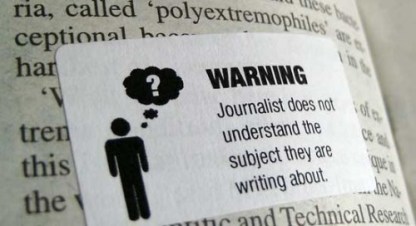
Warning - Journalist does not understand the subject they are writing about

In fact, if you want to see a serious mention of Flexcit and the staged withdrawal from the EU advocated by the Flexcit plan, one has to look in the American media – Andrew Stuttaford has twice written about Flexcit while covering the EU referendum for the prestigious conservative journal National Review, meaning that American readers are perversely better informed about the most comprehensive (and likely to be adopted) plan for leaving the European Union than most British people.

Take a moment to let that sink in. Britain is having a great national debate about whether and how to leave the European Union. There exists a comprehensive plan for doing so, which is particularly relevant now because one of the Remain campaign’s chief attack lines is that Leave supporters don’t know what Brexit looks like. But if you want to read about this plan, you will have to rely either on the American media or the small but dedicated army of citizen journalists and bloggers who promote it, because nobody in the British media cares to report on something of material significance to the campaign.

You don’t need to be a fully paid-up Brexiteer to realise that there is something profoundly wrong with this picture. Surely, if there exists a properly thought-out plan for how Brexit might work, it would be in the public interest to mention this plan? Maybe a couple of SW1’s finest journalists might take a few hours out of their busy day to skim the 400 pages and form an opinion, heck, even contact the author with a few questions. But apparently not. If it wasn’t dribbled into a microphone by Boris Johnson – a man who had not even decided that he wanted Britain to leave the European Union a few short months ago – the British media don’t seem to think it is worth covering.

Stuttaford’s latest National Review piece says what the British media will not:

David Cameron’s predictably dishonest ‘Project Fear’ is working predictably well.

The best way to counter it is to show that Brexit is, economically speaking, manageable, and the best way to manage it (there are alternatives) is by joining the European Economic Area—doing a Norway, to use the shorthand. It’s dull, and that’s the point: Dull is reassuring. Signing up for the EEA also recognizes the reality that, after decades of British entanglement with Brussels, leaving the EU is a process, not one bold break, however much romantics might wish otherwise.

Over at EU Referendum, Richard North has, as I have mentioned before in this Corner, been making this point for years (his EEA-based ‘Flexcit’ plan remains—for anyone who wants to get into the details—an essential read).

Before concluding:

I have always thought that Brexiteers would be the underdogs in this referendum. That’s how it has turned out to be, but if those who want out of the EU want to have a shot of winning this thing, they have to show that they have come to grips with the ‘how’ as well as the ‘why’ of Brexit. Their version of ‘how’ will not necessarily be definitive, but the fact that it is being articulated will go quite some way to reassuring an understandably nervous electorate that its concerns are being thought through.

[..] Like it or not, Johnson is the most prominent ‘face’ in the Leave camp.  He needs to start talking about a Brexit route with enough substance to it to reassure the anxious. Arguing that the UK has the economic and political clout to cut a good economic deal with its future former EU partners is not crazy, but it is not enough to convince nervous voters to take the Brexit ramp.  It looks too much like wishful thinking.  And what voters want to hear is evidence of serious thinking.

We can talk until we are blue in the face about the many failings of Vote Leave. And when the history of this campaign is written, they will rightly come in for much criticism for failing to embrace a comprehensive, risk-minimising Brexit plan like Flexcit. But a rigorous press should and would have discovered Flexcit without needing it to be trumpeted by Boris Johnson or slapped onto the side of Nigel Farage’s battle bus. Professional rigour should have seen to that much, or even (one would have hoped) natural curiosity.

The fact that the one rigorous Brexit plan in existence has played almost no role in the national referendum discussion to date is damning evidence of the British media’s lack of interest in rigorous reporting, and strong preference for covering the personality-based, tit-for-tat human drama. And one can understand the temptation. Reading through a 400-word tome about how to withdraw from the European Union while maintaining economic stability is soooo boring, especially when one could be writing breathless gossip pieces about how Michael Gove’s wife and Samantha Cameron have fallen out over their husbands’ divergent views on Brexit. Why do the serious research and analysis when it’s far easier – and generates far more precious web traffic – to report on the latest incendiary nugget to fall from the… mouth of Boris Johnson?

Here, Pete North says it best:

As present, we are only superficially aware that we don’t have democracy because we are missing an essential component of a healthy democracy – a free and inquisitive press. It is not that the state censors our media, rather it censors itself largely to appease advertisers and corporate cronies. In that regard the government does not need to censor the British press.

But as much as anything it has lost its essential inquisitiveness. It is concerned only with the entertainment aspect of politics rather than the dreary business of policy. It is for that reason I look forward to the day when our newspapers go the way of the dinosaur. A fate well deserved.

But in having such a dismally inept media, decisions that affect our lives go unnoticed. We are often taken by the idea that government takes sweeping decisions behind closed doors but the ultimate joke is that they are held in the open, transcribed and published on the web. These days the best way to ensure nobody will read something is to put it on the EU website.

Regardless of which side they happen to occupy in this referendum, most thinking people agree that the level of debate has been shockingly bad. Whether it is David Cameron suggesting that it is “immoral” to vote for Brexit (despite having “ruled nothing out” himself during the renegotiation) or Vote Leave insisting that Brexit would free up £350 million every week which they would prefer to spend building a brand new NHS hospital on every street corner, both sides are spewing out misinformation and hysteria, and talking down to the general public in an immensely grating fashion.

If the Westminster media were doing their job, they would not only fact-check the obvious untruths and misrepresentations emanating from both sides, they would also search out and report on the best of Brexit and Remain thinking from outside of the SW1 bubble. Yet it does not seem to occur to them that people who are not currently MPs, journalists, celebrities or the spouses of MPs, journalists and celebrities also have ideas and opinions about the EU referendum. Sometimes, those ideas and opinions are actually quite good. Sometimes – gasp – they are a lot better than what the professional politicians and pundits are saying.

As things stand, Britain is probably on course to vote to Remain in the European Union, based on a campaign in which both sides were reduced to screaming “but the NHS!” at each other until exasperated voters stopped paying attention. Very few of us will go into the polling booth with an understanding of the EU’s history, its strategic impetus and its future direction of travel. Very few of us will cast our vote with so much as a basic understanding of the global regulatory environment and the EU’s (diminishing) role in setting standards. And as the results start to come in, few of us will have voted purely according to the specific question on the ballot paper, which merely asks us whether we want to leave or remain in the European Union.

And to some extent that’s normal. Not everybody can be an expert. Most people have lives, and do not live and breathe this stuff 24/7. But conversely, just as not everybody can be an expert, nobody has to be totally ignorant, either. There is no reason why the British people, at this late stage in the campaign, could not have a better base level of knowledge than we do. There is no good reason why (for example) important terms like the EEA, Single Market and Schengen Area are routinely confused or conflated with one another. There is no good reason why, in a referendum about deciding whether or not to leave the European Union, so few people know about the one comprehensive plan to deliver precisely that outcome. No good reason at all. Yet here we are.

And for this dismal state of affairs you can thank the Great British Media.

You’re doing a heckuva job, Fleet Street.


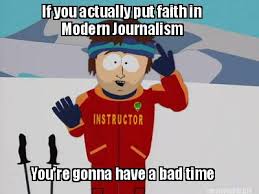
If you actually put faith in modern journalism youre gonna have a bad time

European Union - United Kingdom - Britain - Flags

Agree with this article? Violently disagree? Scroll down to leave a comment.

Follow Semi-Partisan Politics on TwitterFacebook and Medium.

Vote Leave: An Unhinged Fifth Column, Leading Brexiteers To Ruin

It’s time to declare open warfare on the malevolent idiots in charge of Vote Leave, if we are to minimise the further harm that they can yet inflict on the Brexit cause

Apparently the super-intelligent, well-connected, savvy people running the Vote Leave campaign think that this political broadcast, which aired today on national television, is a key part of some winning strategy to deliver 50%+1 votes on 23 June.

It certainly has a lot going on. There’s the slavish idolatry of “Our NHS” for a start, which actually might not be a bad tactic in NHS-obsessed Britain but for the fact that the Vote Leave campaign is mostly full of Tory types who didn’t exactly make a name for themselves by protesting their local A&E unit closure or otherwise worshipping at the altar of St. Aneurin Bevan of Tredegar. In other words, it strains credibility to think that Boris Johnson & co are fighting for Brexit because they are desperate to shower the health service with more money.

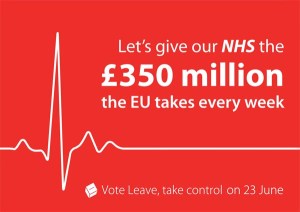
Ah yes, money. Then we see the flagrant, unapologetic repetition of the false £350 million claim, a number which does not take into account the UK rebate or EU funds disbursed back to Britain. Quite why the more accurate figure of £161 million could not be used is a mystery – perhaps because £350 sounded like a nice round number, and because it conveniently tallied with the cost of building a new hospital. And so the official Leave campaign goes charging into the last month of the referendum waving a headline figure which can be instantly disproved and mocked by any Remain campaigner with a functional brain, tarring the entire Brexit movement with their shameful idiocy.

I cannot stress this firmly enough – at this point, Vote Leave may just as well be part of the Remain campaign. They are essentially operating as a fifth column, actively doing more harm than good. They are wasting precious time and resources simply to ensure that their heavily eurosceptic base vote for Brexit even more emphatically than they already planned on doing, while appearing so shifty and unserious to undecided voters that they destroy our credibility – and with it, our chance of winning.

Therefore, the next month must be spent firing over, around and through Vote Leave. They are not our allies. They may as well be working for David Cameron and George Osborne. In fact, some of them quite possibly are doing just that.

At this late stage, Vote Leave will do nothing other than continue to burble unbelievable nonsense about building a brand new hospital on every street corner in Britain in their fantasy Brexit world; there is nothing we can do about that. But we are not powerless.

We need to go out there and talk about sovereignty and democracy.

We need to talk about the unappealing, authoritarian future of the EU.

We need to talk about the revolution in regulation and the emerging global single market, in which a free Britain can play a leading role.

But most of all, we need to get out there and do something, anything, to distract from the utter FREAK SHOW of an official Leave campaign being orchestrated by BoJo the Clown and his trusty sidekicks.

Glad as I am that they all seem to be having a roaringly fun time on the campaign trail, allowing the children to take the wheel unfortunately means that they are now running over the life’s work and dreams of many a committed eurosceptic and Brexiteer.

And they can not, must not be allowed to continue unchecked.


Postscript: This ad is even more idiotic. The cretin who put it together failed even to draw a link between the subject (possible future Turkish membership of the EU) and the conclusion (vote Leave to Save Our NHS), ensuring that the spot ends with that grating non sequitur. It’s almost as though the entire operation is staffed by not-very-bright nepotism beneficiaries and Westminster hangers-on…


Apparently the only reason now for wanting Brexit is to “Save Our NHS”. When did that happen? And when will the person who signed off on this strategy be made accountable for their utter incompetence?


Vote Leave - NHS 350 Million - Brexit

European Union - United Kingdom - Britain - Flags

Agree with this article? Violently disagree? Scroll down to leave a comment.

Follow Semi-Partisan Politics on TwitterFacebook and Medium.

Nonexistent Shared Christian Values Are No Justification For The EU’s Existence

Francis Campbell - Reimagining Europe

The latest feeble Christian case for remaining in the EU: “Let’s forge a meaningful common European identity based on the fluffiest and least well defined parts of our faith!”

More hand-wringing waffle from the Reimagining Europe blog, this time from regular contributor and former British diplomat Francis Campbell:

Whatever the outcome of the UK referendum in June, there will be equally important questions for EU leaders in the years ahead. The process of Britain’s renegotiation has led many to consider their own national identity and how it fits within the identity of the European Union. With a rising tide of Euroscepticism in countries across the continent, the challenge for Europe’s leaders is to instil a sense of European values which enhance rather than threaten national and regional identities.

Right-o. The challenge apparently is not to question whether the decision to unite the countries of Europe under a single supra-national government was a smart idea in the first place. No, the challenge is simply to do a quick PR job, to “instil a sense of European values” and force the restive people of Europe to come to terms with this government that has been designed for them, without their input or their permission.

Campbell at no point questions the wisdom of the project to establish a supranational government of Europe in the first place, taking its existence and benefits as a given despite the current referendum offering a once-in-a-generation opportunity to question old assumptions and break out of stale ways of thinking.

But Campbell has no interest in doing any of this – he is concerned that the EU try to “build bridges” with its citizens, even though the EU project was largely created behind their backs and without their permission. Saying that the EU needs to build bridges with those it has the nerve to call its citizens is like saying that a robber should be polite and avoid leaving a mess while they ransack your house – when the real issue, of course, is that they have no business walking off with your DVD player in the first place.

We are then treated to more of the same woolly, vague and undefined hand-wringing ecumenism which sadly typifies too much of the church’s response to the EU referendum debate. Campbell writes:

In such a context the EU’s task of building bridges between citizens is a daunting one. But perhaps there is an opportunity in the current crisis for EU member states to identify common interests and shared values in among the obvious cultural differences across Europe.

One powerful shared value that is missing from the negotiation tables in Brussels is religion. Faith plays a huge part in the lives of many millions of EU citizens, yet it has been all but barred from the political arena. Whether they profess to have a faith or not, political leaders should look to religion for inspiration when forging the future identity of the EU.

Christianity is arguably something that is common to all European member states and a potential value or source of identity around which they could unite. But how do we reconcile that sense of shared identity and history with those of other faiths or none?

Catholicism, and indeed all major faiths, teaches us to believe in the intrinsic dignity of every human person. If we can look beyond our differences and guard our national interests less jealously, every EU citizen has shared values and a common identity and a commitment to live within and promote a shared pluralist space.

Okay, but how does that translate into the necessity for a powerful and activist supra-national government to sit above the nation states, claiming exclusive competency in a wide array of areas to speak and act on behalf of a group of people as diverse as Brits, Germans, Poles and Greeks?

The answer, of course, is that it doesn’t. Campbell’s background is in the Foreign Office – including a number of postings to the European Union – so he of all people should understand at least the basic history of how and why the EU came to be and took its present form. Is such a complex and inherently antidemocratic structure in any way necessary to express whatever limited sense of European-ness which may exist in our hearts and minds? Of course not, and Campbell knows it. The only reason you create an organisation with institutions mirroring those of a nation state and staffed with people who constantly agitate for more power and competencies is because you ultimately want the new organisation to be an independent actor on the world stage, replacing the nation states from which it was built.

Of course we all share a common humanity, that much is self-evident. But the sheer disingenuousness required to make the huge leap between all of us believing in the dignity of human life and all of us wanting or needing to be governed by the same common set of institutions in Brussels is simply staggering. And hardly Christian.

Trying to shoehorn Christianity in to fill the spiritual and democratic void at the heart of the European Union also brazenly overlooks the rapid growth of secularism, particularly in Western Europe. If Campbell is seriously suggesting that the EU base its social law on the values of the Roman Catholic Church, as would no doubt be popular in much of Poland, how does he think it will go down in France, Germany and Britain?

And if we attempt to base European values partly on other assertively growing faiths (i.e. Islam), what will then be the consequences for fundamental rights such as freedom of speech? And if this isn’t what Campbell means, then what exactly is his suggestion, than more hand-wringing, morally relativist waffle from the Christian Left?

Pete North hammers this point home in a recent blog post on European disunion:

We are persistently told that Eastern European countries are just chomping at the bit for Western liberalism and that is the justification for root and branch social reforms at the behest of the EU. Anyone who objects is clearly regressive in their eyes. Except the problem with EU foreign policy is that EU elites speak only to other political elites who tell them what they want to hear.

But as with the UK the metropolitan view is somewhat different to the provincial view which is seldom ever heard. It’s all very well demanding sweeping reforms but this rather forgets the lessons we learned in the UK. All economic and social reform has casualties and too much too soon creates resentment that lasts generations. That is why the Tories still can’t win seats in parts of Yorkshire and the North East.

Now apply that same revolutionary industrial reform to Poland and Ukraine while demanding social reforms that do not sit well with the catholic population. Attitudes are nearly thirty years behind in some regions. Try being an unmarried mum in rural Poland. Even today there are still objections in Ireland to reforms to abortion laws. That goes double for Eastern Europe.

So Francis Campbell’s bright idea to base our perpetually missing common European identity on Christianity or religion is clearly a dud. As the Anglican church has discovered, there is such wide and irreconcilable difference between its own traditionalist and progressive wings that some people find themselves unable to remain part of the same congregation or communion. And that’s just one branch of Christianity! How, then, is forming the kind of robust, multi-layered identity required to legitimise a powerful supranational government going to be possible merely by reeling off a few bland pronouncements about Christian “values” and the dignity of human life?

In short, this is exactly the kind of desperately small, unimaginative thinking which is responsible for so much of Britain’s current democratic malaise. When presented with an historic opportunity to look again at European and global systems of governance and regulation, all that Francis Campbell can do is propose minor tweaks to the status quo – tweaks which in his heart of hearts he must realise are empty words which will make no discernible impact in bridging the gap between an increasingly powerful, unloved European Union and the citizens of its member states.

And this is why Brexit must be more than an event – it must be just part of a larger process of democratic renewal and reform of our governance. There is precisely zero point in reclaiming powers and competencies from Brussels through Brexit if we are only to give them back to a government and Foreign Office staffed by rent-a-bureaucrats, who have the “vision” only to ploddingly execute the instructions placed in front of them, and will probably end up giving power away again to someone else in exchange for a few magic beans.

Francis Campbell, like too many other prominent Christian EU apologists, begins from the lazy and unsupported starting point that the European Union is inherently good, virtuous and necessary, without so much as examining its history or asking why similar structures have not developed in other part of the world. The brain then only truly engages when considering how the people might be better made to realise all of the wonderful good being done on their behalf, at which point we get lots of flowery language about shared Christian values but no intellectual meat on the bones. And the analysis is worthless anyway, because the initial assumptions were flawed from the start – the EU is not inherently good, virtuous or necessary.

So still we wait for that most elusive of things – a structured, intellectual Christian case for the European Union, and for Britain remaining in the EU. Many have stepped forward to try, but none (to my knowledge) have yet succeeded. Some have made themselves look quite silly in the process.

And time is running out.


Christianity - Europe - EU - Brexit

Top Image: Times Higher Education

Agree with this article? Violently disagree? Scroll down to leave a comment.

Follow Semi-Partisan Politics on TwitterFacebook and Medium.

One Month Until EU Referendum Day. Time To Break Out The Rudyard Kipling

The unforgiving minute approaches

At the conclusion of The Leave Alliance’s recent highly successful TED-style talk, in which Dr. Richard North walked through the Flexcit staged plan for leaving the EU, a number of the alliance’s Bloggers Army and other audience members stayed behind afterwards to explain their own reasons for voting Leave on 23 June.

Here are a selection of those reasons – including a contribution from yours truly.

The Leave Alliance is comprised of a diverse group of people from across the political spectrum, some who have been devoted to this cause for decades and others for whom it is a much more recent obsession.

I have the honour of fighting the EU referendum campaign alongside this excellent group of people – a group which comprises Dr. Richard North, surely the foremost authority on the European Union in Britain, Pete North, a writer of very rare ability, the Bloggers’ Army, whose various research and writing talents all far eclipse my own, and our very generous readers and supporters. It is a singular honour to be associated with them all, and to make even a small contribution toward our common goal.

Things are not looking good for the Brexit cause right now. The list of unforced errors, media howlers and general acts of incompetence committed by the oh so politically savvy leaders of the official Vote Leave campaign grows by the day. By clinging stubbornly to disproven statistics and flat-out false arguments, Vote Leave squander credibility faster than we can possibly hope to win it back. Indeed, fighting this EU referendum with the likes of Boris Johnson as a figurehead for the Brexit cause is like trying to swim the English Channel with a ball and chain clamped to one’s ankle – strive though we might, we are inevitably dragged down beneath the waves.

It should be noted that nearly every single one of the official Leave campaign’s missteps and key points of criticism could have been avoided by heeding the advice of The Leave Alliance – not least in terms of the importance of having a robust Brexit plan to lay before serious opinion-formers and influencers.

But we fight on, and we fight to win. Though the path to victory for the Leave side is now very narrow indeed – essentially resting on significant unforced errors from the Remain campaign or major external political shocks, as this blog now argues – we must continue to make the bold, globally-engaged case for Brexit, and stand ready to quickly capitalise on any good fortune which comes our way.

This blog will be working flat out for the next month to achieve the impossible and secure a vote for Brexit in the referendum on 23 June. David Cameron managed to say one true thing during his round of media appearances this weekend – that this referendum campaign is indeed more important than a general election. And so it is. It therefore demands the best of all our abilities.

In his famous poem, “If”, Rudyard Kipling wrote of filling the unforgiving minute with sixty seconds’ worth of distance run. Well, the final month ahead of us between now and Referendum Day will certainly be unforgiving. We are behind in the polls, we have nearly the entire political and cultural establishment ranged against us screaming hysterically that Brexit would somehow usher in the apocalypse, and the man generally recognised as the figurehead of our movement is, for all intents and purposes, a malevolent lunatic.

So – that should make eventual victory having overcome these challenges all the sweeter, no? We at least owe it to ourselves to try, to work tirelessly for victory but also pragmatically so that we are positioned to turn a bad result into the best possible starting point for our next attempt. And when we feel despondent, let’s remember that these are not ordinary political times. One year ago, who would have said that Jeremy Corbyn would be leader of the Labour Party, or that Donald Trump would be the presumptive Republican Party presidential nominee?

So let’s fill the unforgiving minute. Let’s leave it all on the field, as the Americans say – or on the pitch, if we’re being particularly British.

Who’s with me?


While normally it might be considered unbearably trite to quote Kipling, a close reading reveals that in fact there is barely a line which is not highly applicable to those of us struggling to voice a thinking person’s Brexit message in the hurricane of the national referendum debate. And so:


If —

IF you can keep your head when all about you
Are losing theirs and blaming it on you,
If you can trust yourself when all men doubt you,
But make allowance for their doubting too;
If you can wait and not be tired by waiting,
Or being lied about, don’t deal in lies,
Or being hated, don’t give way to hating,
And yet don’t look too good, nor talk too wise:

If you can dream – and not make dreams your master;
If you can think – and not make thoughts your aim;
If you can meet with Triumph and Disaster
And treat those two impostors just the same;
If you can bear to hear the truth you’ve spoken
Twisted by knaves to make a trap for fools,
Or watch the things you gave your life to, broken,
And stoop and build ’em up with worn-out tools:

If you can make one heap of all your winnings
And risk it on one turn of pitch-and-toss,
And lose, and start again at your beginnings
And never breathe a word about your loss;
If you can force your heart and nerve and sinew
To serve your turn long after they are gone,
And so hold on when there is nothing in you
Except the Will which says to them: ‘Hold on!’

If you can talk with crowds and keep your virtue,
Or walk with Kings – nor lose the common touch,
if neither foes nor loving friends can hurt you,
If all men count with you, but none too much;
If you can fill the unforgiving minute
With sixty seconds’ worth of distance run,
Yours is the Earth and everything that’s in it,
And – which is more – you’ll be a Man, my son!


European Union - United Kingdom - Britain - Flags

The Leave Alliance - Flexcit

Support Semi-Partisan Politics with a one-time or recurring donation:

Agree with this article? Violently disagree? Scroll down to leave a comment.

Follow Semi-Partisan Politics on TwitterFacebook and Medium.