Love Our NHS? Prove It With Your Vote In The EU Referendum

Brexit - NHS - European Union - EU Referendum - Brexit

The EU referendum meets our national religion

The major campaigns on both sides of the EU referendum are currently slugging it out in a tawdry contest for the affections of fearful, NHS-idolosing simpletons.

No British political campaign is complete without eye-rolling attempts by those without ideas or vision to trawl for votes by pretending that Our Blessed NHS (genuflect) is mere moments away from being abolished.

From Vote Leave’s latest mailshot, entitled “Save Our NHS”:

Lord Owen, the former Labour Foreign Secretary and Health Minister, today launches the Vote Leave ‘Save our NHS’ campaign with an important speech: ‘Protecting our NHS from the EU’.

He argues that the our National Health Service should not be under the control of the EU and cites serious flaws in The Transatlantic Trade and Investment Partnership (TTIP), which is a major new deal being negotiated behind closed doors between the EU and the USA.  This he says, disregards the purpose of social health care and undermines the responsibility each member state has for its own healthcare policy.  This is highly detrimental to our NHS.

And from Britain Stronger in Europe, the charmingly personalised “Love the NHS Samuel? You need to read this”:

When it comes to the NHS, you can’t listen to the people campaigning to leave Europe.

They describe the NHS as a “60-year mistake” (Vote Leave’s Dan Hannan), say there’s “plenty of room for cuts” (Nigel Farage), and think people should have to pay for services so they “value them more” (Boris Johnson).

No – instead, we should listen to the doctors and NHS workers who make our health service so special.

This week, 200 medics wrote a letter stressing that “the NHS, medical innovation and UK public health” are stronger in Europe.

They warned “Brexit should carry a health warning” – because the economic damage caused by leaving Europe would “jeopardise an already cash-strapped NHS.”

Samuel, those who work in the NHS couldn’t be clearer – we need to stay in Europe to protect investment in our health service. Volunteer for our campaign today, and help secure the NHS for future generations:

Well, that’s that then. Your friendly local NHS urologist is clearly such an expert on statecraft, diplomacy and constitutional matters that they are ideally positioned to tell you how to vote on a matter of existential importance to Britain.

The obvious, simple-minded manipulation being attempted by both campaigns would be offensive were it not so amateurish. And to think that political consultants and strategists are actually being paid money to come up with this stuff.

Vote Leave and you’ll get cancer, because Brexit is so dreadfully scary that it should come with a health warning!

Vote Leave and we’ll save so much money that we can build a brand new hospital every week. Just think of it! That’s fifty two massive new hospitals every year. In a decade, we’ll have 520 new hospitals! By the year 2036 we could have 1040 new hospitals! Enormous ones! Your descendants could live in a Britain with a humongous, fully staffed new hospital for every single person living on this island! Oh, what a paradise it will be.

What pathetic, manipulative nonsense.

Whether we vote to leave the European Union or remain in the burning building, the NHS will continue to exist. We can’t seem to shake it. And it will continue to churn out moderately priced but increasingly substandard levels of care while nearly the entire population gathers round to uncritically praise the holy creation of St. Aneurin Bevan of Tredegar from dawn to dusk. Nothing, absolutely nothing, will change.

Do you really believe Britain Stronger in Europe when they suggest that “medical innovation” will cease or be harmed if Britain leaves the political construct known as the European Union? Exactly what is it about forsaking a foreign flag, anthem and parliament which will slow down the cure for Alzheimer’s?

Or do you seriously buy this idea that Brexit means that we can throw up a brand new hospital in every major British city within a year, and keep on doing that until the NHS is not only our largest employer but our only employer?

Don’t be taken in by this execrable, manipulative, transparently idiotic nonsense from the major Leave and Remain campaigns, all of which seem to be managed by B-student politicos and all of which are operating on the hopeful assumption that you are a frightened, credulous simpleton.

Recognise that this referendum is about sovereignty, sovereignty and sovereignty. Do your own research, and then make the right decision. And whatever you decide, don’t waste your vote virtue-signalling your love for Our Blessed NHS.


Save Our NHS

Top Image: Daily Express

Agree with this article? Violently disagree? Scroll down to leave a comment.

Follow Semi-Partisan Politics on TwitterFacebook and Medium.

Yanis Varoufakis: The Remain Campaign’s Best Spokesman For Brexit

Wolfgang Schaeuble - Yanis Varoufakis - 3

Think that the EU is a hopelessly outdated, cumbersome, anti-democratic tyranny of the technocrats and unaccountable elites? So does Yanis Varoufakis. But he would very much like for you to vote Remain.

If you were searching for a passionate, eloquent case against the EU and the increasingly discredited idea of European political union from a non-Briton, you could do little better than the first 80% of Yanis Varoufakis’ latest Op-Ed in the Guardian.

In his article, Varoufakis uses anecdotes from his brief and tumultuous period as Greek finance minister to give the reader an illuminating and deeply unpleasant close-up view of exactly what it is like for a national government minister to face off against the EU’s leaders and technocrats in defence of their sovereign national interest (spoiler alert: advocating for national interest, like sovereignty, is verboten).

If you stop reading the Op-Ed before the final six paragraphs, you would come away thinking that this is a man who has stared into the cold, dead eyes of supranational European governance, seen its soul and come away understanding just how misguided and dangerous is the anachronistic, mid-century experiment known as the EU.

But then Varoufakis executes one of the sharpest journalistic handbrake turns you will ever see, wilfully ignoring his own bitter experience at the hands of supranational governance for the “common good”, and somehow arriving at the conclusion that everything will be better if we simply double down on our commitment to European political union.

His response upon being burned by the flame of unaccountable, supranationalist technocracy is apparently not to recoil his hand, but rather to go marching briskly on into the inferno.

Thus Varoufakis goes from this, when describing the nature of his negotiations with the Eurogroup (and German finance minister Wolfgang Schäuble in particular) at the height of the Greek Euro crisis in 2015:

An alliance of states, which is what the EU is, can of course come to mutually beneficial arrangements, such as a defensive military alliance against a common aggressor, coordination between police forces, open borders, an agreement to common industry standards, or the creation of a free-trade zone. But it can never legitimately strike down or overrule the sovereignty of one of its member states on the basis of the limited power it has been granted by the sovereign states that have agreed to participate in the alliance. There is no collective European sovereignty from which Brussels could draw the legitimate political authority to do so.

One may retort that the European Union’s democratic credentials are beyond reproach. The European Council comprises heads of governments, while Ecofin and the Eurogroup are the councils of finance ministers (of the whole EU and of the eurozone respectively). All these representatives are, of course, democratically elected. Moreover, there is the European parliament, elected by the citizens of the member states, which has the power to send proposed legislation back to the Brussels bureaucracy. But these arguments demonstrate how badly European appreciation of the founding principles of liberal democracy has been degraded. The critical error of such a defence is once more to confuse political authority with power.

A parliament is sovereign, even if its country is not particularly powerful, when it can dismiss the executive for having failed to fulfil the tasks assigned to it within the constraints of whatever power the executive and the parliament possess. Nothing like this exists in the EU today.

For while the members of the European Council and the Eurogroup of finance ministers are elected politicians, answerable, theoretically, to their respective national parliaments, the Council and the Eurogroup are themselves not answerable to any parliament, nor indeed to any voting citizens whatsoever.

Moreover, the Eurogroup, where most of Europe’s important economic decisions are taken, is a body that does not even exist in European law, that keeps no minutes of its procedures and insists its deliberations are confidential – that is, not to be shared with the citizens of Europe. It operates on the basis – in the words of Thucydides – that “strong do as they please while the weak suffer what they must”. It is a set-up designed to preclude any sovereignty derived from the people of Europe.

While opposing Schäuble’s logic on Greece in the Eurogroup and elsewhere, at the back of my mind there were two thoughts. First, as the finance minister of a bankrupt state, whose citizens demanded an end to a great depression that had been caused by a denial of our bankruptcy – the imposition of new unpayable loans, so payments could be made on old unpayable loans – I had a political and moral duty to say no to more “extend-and-pretend” loan agreements. My second thought was the lesson of Sophocles’s Antigone, who taught us that good women and men have a duty to contradict rules lacking political and moral legitimacy.

Political authority is the cement that keeps legislation together, and the sovereignty of the body politic that engenders the legislation is its foundation. Saying no to Schäuble and the troika was an essential defence of our right to sovereignty. Not just as Greeks but as Europeans.

To this, in his pivot towards advocating a Remain vote:

Our European Union is disintegrating. Should we accelerate the disintegration of a failed confederacy? If one insists that even small countries can retain their sovereignty, as I have done, does this mean Brexit is the obvious course? My answer is an emphatic “No!”

Here is why: if Britain and Greece were not already in the EU, they should most certainly stay out. But, once inside, it is crucial to consider the consequences of a decision to leave. Whether we like it or not, the European Union is our environment – and it has become a terribly unstable environment, which will disintegrate even if a small, depressed country like Greece leaves, let alone a major economy like Britain. Should the Greeks or the Brits care about the disintegration of an infuriating EU? Yes, of course we should care. And we should care very much because the disintegration of this frustrating alliance will create a vortex that will consume us all – a postmodern replay of the 1930s.

It is a major error to assume, whether you are a remain or a leave supporter, that the EU is something constant “out there” that you may or may not want to be part of. The EU’s very existence depends on Britain staying in. Greece and Britain are facing the same three options. The first two are represented aptly by the two warring factions within the Tory party: deference to Brussels and exit. They are equally calamitous options. Both lead to the same dystopian future: a Europe fit only for those who flourish in times of a great Depression – the xenophobes, the ultra-nationalists, the enemies of democratic sovereignty. The third option is the only one worth going for: staying in the EU to form a cross-border alliance of democrats, which Europeans failed to manage in the 1930s, but which our generation must now attempt to prevent history repeating itself.

This is precisely what some of us are working towards in creating DiEM25 – the Democracy in Europe Movement, with a view to conjuring up a democratic surge across Europe, a common European identity, an authentic European sovereignty, an internationalist bulwark against both submission to Brussels and hyper-nationalist reaction.

Is this not utopian? Of course it is! But not more so than the notion that the current EU can survive its anti-democratic hubris, and the gross incompetence fuelled by its unaccountability. Or the idea that British or Greek democracy can be revived in the bosom of a nation-state whose sovereignty will never be restored within a single market controlled by Brussels.

Just like in the early 1930s, Britain and Greece cannot escape Europe by building a mental or legislative wall behind which to hide. Either we band together to democratise – or we suffer the consequences of a pan-European nightmare that no border can keep out.

In other words, the European Union as it is presently constituted and governed is a colossal, anti-democratic behemoth, but trying to leave this decaying mid-century relic to embrace the kind of inter-governmental and multilateral cooperation which befits a modern, confident Britain in a globalised world would “create a vortex that will consume us all”. Britain is stuck with the decision it made in 1975.

This is the Sajid Javid school of thought – the heart feels eurosceptic and yearns for Brexit, but the head worries that the world is too dangerous and uncertain right now for us to risk a small outbreak of democratic sovereignty by voting Leave. Incidentally, it is also the same mental cowardice that would have seen the thirteen American colonies never declare their independence from an overbearing, undemocratic British Crown with which they increasingly felt little affinity.

Or is it?

Much like the battered spouse convinces themselves that they are the ones at fault, or that their abusive partner can change, Yanis Varoufakis seems to have convinced himself that with enough “grassroots support” a pan-European democratic movement (his own DiEM25) can spring up and accomplish the following lofty goals at the drop of a hat:

  1. Willing a true European demos and sense of European identity into being, and
  2. Wresting the true levers of power within the EU away from political and economic elites, and vesting them in the newly-invigorated common European institutions created in Step 1

But it is pure wishful thinking. The EU’s architects (those who bought into the original vision of a process leading to a single European state) and current beneficiaries (political elites who enjoy the lack of full accountability to their own electorates) will not take such a brazen power grab lying down. Varoufakis, if he recalls, was finance minister of Greece until the powers that be froze him out, forcing his resignation.

And were they to succeed, DiEM25 would only be yet another entirely elitist group seeking to impose their own top-down vision of supranational governance on the peoples of Europe. Two of its founder members (Noam Chomsky and JK Galbraith) are Americans who have no damn right to decide how we choose to govern ourselves in the first place.

(Look beyond the flashy website and the picture of a smiling Caroline Lucas and read the manifesto, and you’ll see that the talk of democracy is just a window dressing for the same integrationist dogma, only bolted on to a bunch of miserablist, left-wing nonsense)

Apparently Varoufakis’ idea of an alternative to the current hegemony of the Brussels elite is to replace them with a new academic elite instead – to cram the European Union’s institutions with tweed-jacketed professors in place of sharp-suited lobbyists and bureaucrats.

One can understand why Yanis Varoufakis might want to agitate for a mini-revolution within the European Union to displace his many recently-acquired enemies and install more people like him (cerebral, academic types) in their place.

One can even admire his chutzpah for trying to engineer such a coup in broad daylight, and his shamelessness at exploiting the very real suffering of his Greek compatriots in an attempt to bring about another elitist vision of European political union (which will fail ordinary citizens just as the current model fails Europe’s citizens).

But what Varoufakis utterly fails to do – having devoted the majority of his Guardian Op-Ed to correctly explaining why the EU is a democratic black hole – is advance the slightest argument as to why Britain should aid and abet him in his grubby scheming by voting to remain in the European Union this June.
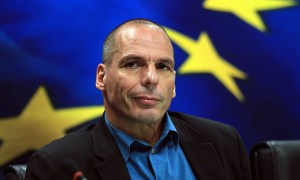
 

Yanis Varoufakis

Top Image: City AM

Bottom Image: Guardian

Agree with this article? Violently disagree? Scroll down to leave a comment.

Follow Semi-Partisan Politics on TwitterFacebook and Medium.

Black And Pro-Brexit

Dreda Say Mitchell - Brexit- Eurosceptic - European Union - EU Referendum

Could the Remain campaign’s arrogant assumption that they have the support of ethnic minority voters be their downfall?

While the Remain campaign may arrogantly assume that it has the support of all ethnic minority Britons in the coming EU referendum, this is absolutely not the case.

Author Dreda Say Mitchell “comes out” as a Brexiteer in the Guardian:

I share the view of leftwing politicians like my former MP, the late Peter Shore. The EU debate isn’t about bent bananas or migrants on the take; it’s about democracy. There doesn’t seem much point in electing MPs if their votes can be overridden by supranational institutions like the EU or tax-dodging corporations. Much of the apathy and cynicism towards politics is a result of people feeling that real power is somewhere else and not in the ballot box. I’ve seen the EU described as “post-democratic”. Some of us would prefer the real thing back.

Meanwhile, if it’s true that there are growing numbers of BAME voters down the golf club worrying about all these Polish plumbers, I’m taking the positives from that. It proves integration works – we’re becoming just like our white counterparts.

Mitchell makes exactly the same case for Brexit as many other principled eurosceptics – because whatever the cynical Remain camp may say, this referendum has absolutely nothing to do with race or identity politics, and everything to do with democracy.

Something to remember next time the rootless Remain campaign attempts to smear eurosceptics by latching on to the pitiful rantings of Brexit’s worst ambassadors.

Belatedly, some on the Remain side (particularly those on the Left) are starting to wake up to the fact that they take ethnic minority voters for granted at their peril in this referendum, and are scrambling to prepare exactly the kind of divisive, identity politics-based overtures to such voters that one has come to expect from the Left.

In February, Left Foot Forward noted:

The ‘in’ camp cannot stick its head in the sand while [UKIP immigration spokesman Steven] Woolfe and Nigel Farage talk about the Commonwealth at every available opportunity, in a direct appeal to BAME voters.

EU supporters need to engage directly instead of sticking rigidly to arguments about the benefits of the EU more generally.

[..] Aligning issues which resonate more with ethnically-diverse communities alongside the standard pro-Europe arguments makes common sense and will help remain campaigns to feature more in places like The Voice.

The fact that a whole side of the EU debate is being outfoxed by a single UKIP member with no track record of working in BAME communities is embarrassing to watch. It’s not like the ‘remain’ campaign weren’t alerted to the ethnic gap in their strategy before.

While Labour continue to digest the need to raise their game on racial diversity, having marginally slipped further back against the Tories on BAME votes at the last election, it is disappointing that a pro-EU campaign driven largely by progressives has not absorbed these lessons. There is still time.

Meanwhile, the Independent squeals indignantly about UKIP having the nerve to appeal to black voters (who of course should blindly and gratefully do whatever they are told by sanctimonious lefties who have “their best interests” at heart):

Putting the Brexit debate aside, Woolfe’s comments are problematic for a number of reasons. Ukip is not a party known for its concern for the wellbeing of Black people living in Britain, but rather its concern about Black people living in Britain. Indeed, to consider Ukip and racial progress in the same breath often feels like something of an oxymoron.

So to suddenly feign concern for the lives of Black Britons in an attempt to gain Black British support for the EU Out campaign seems both disingenuous and offensive.

[..] Absurdly, Ukip now expect Black Britain to be complicit in the stirring of such a climate of hate through simplistic scaremongering. However, while Woolfe continues to refer to ‘evidence’ that supposedly suggests Black Britons are opposed to EU membership, substantive research from the Runnymede trust finds that Black Britons are divided and largely ambivalent on the issue.

[..] Shifting xenophobic arguments from one oppressed group to another, however, isn’t exactly the inspiring narrative that Black communities are looking for when deciding which way to vote on a possible Brexit.

How dreadfully problematic.


European Union - United Kingdom - Britain - Flags

Top Image: BBC

Agree with this article? Violently disagree? Scroll down to leave a comment.

Follow Semi-Partisan Politics on TwitterFacebook and Medium.

By Failing To Back Brexit, Millennial Voters Are Failing Their Generation’s First Great Test Of Character

Students for Europe

Millennial voters who lazily but instinctively support Britain remaining in the European Union are letting down their country and their entire generation

Lately, this blog has been focusing on the younger, millennial generation and our unfortunate propensity to think as scared consumers rather than engaged citizens, and so overwhelmingly support Britain remaining in the European Union (even if many of us are too lazy to carry our opinions as far as the ballot box).

In taking this stance, I have encountered some pushback from readers, who have (rightly) pointed to the fact that older generations can be equally greedy and self-interested, but (wrongly) drawn a false equivalence between the two.

While not all young Remainers hold their position because of perceived material self-interest, those who completely ignore the democratic question to focus exclusively on their own material (typically career and travel) prospects – which would almost certainly be completely unaffected in the event of Brexit – are fully deserving of the criticism levelled at them by this blog and others.

The Guardian breaks down the latest polling data:

Government strategists and pollsters privately admit that the central problem for the Remain side is that its support for staying in the EU is strongest among young people, the group least likely to vote. Opinium found that in the 18-34 age group, 53% said they backed staying in, against 29% who wanted to leave. But only just over half (52%) in this age group said they were certain to actually go out and vote.

Among voters in the 55-and-over category, support for leaving was far stronger, as was their certainty to vote, offering a huge advantage to the Leave side.

Some 54% of voters aged 55 and over said they wanted to leave against 30% who wanted the UK to remain in the EU. But in stark contrast to younger voters, 81% of this group were certain to vote.

Perhaps our generation is in need of a wake-up call. This particular tirade (quoted below) is addressed to American millennials flirting with the presidential candidacy of Bernie Sanders, but parts of it apply equally to younger British voters indignant that the Leave campaign’s quest to restore democracy is interfering with their perceived career options springing from the munificent European Union.

Courtney Kirchoff writes over at Steve Crowder’s website:

Adulthood isn’t what we thought it would be. No, the economy these past several years hasn’t exactly been stellar, either. Okay? Okay.

My fellow millennials, for sure we have our challenges. Many of you were raised in broken homes. Many of you were exposed to divorce. It’s possible a lot of you didn’t live with your father or may not have known him at all. Combine home life with the rise of political correctness in school, taking its dangerous form of “self-esteem above all,” and no wonder you think life is unfair but you should have it all.

Look, I’m sorry life screwed you over in the early years. I’m sorry if you were shuffled to daycare day in and day out. I’m sorry if you don’t have memories of playing with your parents. But most of all, I’m sorry you were not instilled with the grand idea of personal responsibility. I’m sorry you were not empowered with the notion that YOU are the commander of your own life. If you take nothing else from this post, believe that no matter who you are, you can succeed. Without government.

Because guess what, my friends? You’re abject loyalty to socialism is going to tank our country. Your insistence on getting what you want and making other people pay for it, all under the guise of “fairness,” will lead to ruin. For everyone. Including you.

Switch out “socialism” and “government” and replace it with “the EU” and you have a perfect response to the EU’s millennial cheerleaders.

Yes, of course this is an age of anxiety. Just as the boomer generation seriously worried about imminent nuclear annihilation, so we worry about job security and career prospects. But we are hardly a uniquely benighted generation, though there are indeed many ways which our politics currently favours older voters – the government’s lack of a coherent housing policy being an obvious example.

But I’m sorry: growing up in economically uncertain times in an age where there is no guaranteed job for life does not absolve millennials – my generation – from thinking not only as self-interested consumers but also as engaged citizens who care about the country and democracy that they will bequeath to their own descendants.

The generation who spent their prime years fighting fascism – and who saw their contemporary Britain largely reduced to rubble and ruin in the process – could have abstained en masse from fighting the Nazi threat in order to buy a few more years of economic security and job stability through appeasement. But they were willing to go to war and risk what they had for principles which transcended material concerns.

By contrast, our generation is not called to risk or sacrifice nearly as much as our grandparents and great grandparents were to defend democracy and national self-determination – and in fact could have much to gain from British secession from the European Union, materially and otherwise. But by an overwhelming majority we are unwilling to take even that far smaller risk.

And history will long note this colossal failure of courage and character from Generation Me Me Me.


Hello I'm A Millennial

Agree with this article? Violently disagree? Scroll down to leave a comment.

Follow Semi-Partisan Politics on TwitterFacebook and Medium.

Virtue Signalling Celebrities – Silly. Virtue Signalling Government – Dangerous

Benedict Cumberbatch - Virtue Signalling - Syria - Refugees

When celebrities indulge in open virtue-signalling and Something Must Be Done-ery, it is irritating but ultimately harmless. But now political leaders and governments are doing the same thing, and it is deadly serious

Tony Parsons – who only last year bravely admitted to being “Tory Scum” – has a great new piece in GQ magazine, blasting the prevalence of virtue-signalling behaviour among the celebrity and political class.

After ridiculing certain actors and celebrities, whose Something Must Be Done-ery and hand-wringing at the existence of the Evil Tories is misguided but ultimately harmless, Parsons goes on to warn that it is much less funny when political leaders and entire governments are engaging in the same virtue signalling exercise.

His conclusion is worth quoting at length:

All this smug, self-satisfied, shockingly empty posturing would be merely laughable if it was confined to a few pompous luvvies who make clods of themselves every time they say a line that isn’t written by someone far smarter than them. But the desire to demonstrate moral purity now extends its cloying reach all the way to Downing Street, where even pink-faced Tory boys strain to prove their liberal credentials.

Many civilised nations such as Australia, Canada, France, Japan and Ireland have vastly reduced their foreign aid budgets after reaching the conclusion that shovelling billions to the developing world does nothing but encourage corruption, erode democracy and throw away taxpayers’ hard-earned money like a sailor on shore leave.

But in our own country the commitment to spend 0.7% of gross national income on foreign aid has been enshrined in law. The UK spent more than £12 billion on foreign aid last year, at a time when almost every other area of public spending was being slashed. Only the NHS and foreign aid were spared George Osborne’s cuts.

How can this be? How can a new private plane for a developing world despot be more important than the police, or the armed forces, or benefits for the disabled? How can it be rational, or even sane, for a country to care more about flood defences in Congo than it does about flood defences in Carlisle?

Because it doesn’t really matter if that £12bn a year in foreign aid itself is effective. It is not about feeding hungry mouths. Foreign aid is purely about demonstrating impeccable liberal goodness. Cameron’s Conservatives need to demonstrate that they are kind, decent and virtuous, need to show that they bought “Do They Know It’s Christmas” when they were at Eton and Westminster. Our foreign aid budget – millions of it shipped to nations where the British are despised – is meant to be conclusive evidence that the Tories care.

Virtue signalling begins and ends in the developing world. So Benedict Cumberbatch can’t give a thought to a small German town like Sumte (population 102) that finds its infrastructure collapsing under the burden of giving a home to 750 migrants. Sherlock can only prove his liberal goodness by fretting about Syrian refugees.

There is a debate to be had – and it is the debate of our age – about how we manage our moral obligation to our own people with our humanitarian impulse to help the world. But you will never hear that difficult subject broached among the virtue signallers who scream their pious certainties and wag their censorious fingers at the wicked Tories – which is bitterly ironic as David Cameron is the biggest virtue signaller of them all.

This blog dissents from the suggestion that the bulk of the foreign aid budget should not have been returned to taxpayers but merely reallocated to an unreformed NHS and welfare state, but the main thrust of Parsons’ argument – that we are essentially spending nearly one percent of our GDP not to do good but rather to look good – is devastatingly accurate.

And since those who disagree with the Conservative government are already determined not to see it as merely politically misguided but as a sociopathic millionaire’s club actively seeking to hurt the poor, there is little point in continuing to ringfence international aid spending as part of a PR exercise which has already failed.

Virtue signalling when practised by lame comedians and other assorted commentators angling for a cheap laugh is tiresome but essentially harmless. But when our elected government signals its virtue with taxpayer money and national policy, it can be the difference between life and death.

Which is why David Cameron and George Osborne should focus on sound policymaking and (just for a change) conservative principle, leaving the compassionate handwringing to the more-than-capable Sherlock Holmes and Dr. Watson.


Postscript: None of this is to say that this blog does not sometimes agree with the causes fleetingly taken up by celebrities, even Benedict Cumberbatch.


Benedict Cumberbatch - This Is What A Feminist Looks Like - Virtue Signalling

Top Image: ITV

Agree with this article? Violently disagree? Scroll down to leave a comment.

Follow Semi-Partisan Politics on TwitterFacebook and Medium.