Who Is To Blame For The NHS Junior Doctors’ Strike? Look In The Mirror

NHS Junior Doctors Contract Strike

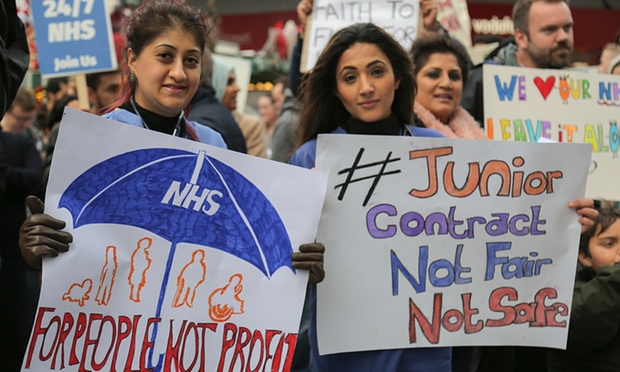
By reflexively worshipping the NHS, vilifying people who don’t and rewarding politicians who tell us only what we want to hear, the junior doctors’ strike – and everything else wrong with the health service – is our fault, and ours alone

Who is to blame for the NHS junior doctors’ strike?

Is it heartless Jeremy Hunt, that doctor-hating, treatment-denying Conservative villain at the Department of Health? Is it the Evil Tories in general, with their single-minded obsession (mysteriously never realised despite all their accumulated years in power) with privatising and destroying Our Precious NHS? And if not them, who could it be? The capitalists? The bankers? Katie Hopkins?

Surely anyone and everyone is to blame, apart from ourselves.We love Our NHS. We are good people who believe that healthcare free at the point of use is one of the fundamental rights of citizenship. We stick up for the NHS at every turn, demanding that politicians pay obsequious lip service to the organisation every time they run for office. We’ll happily slap the NHS logo on our Facebook profile picture, paint it on our faces, wear it on a badge, lapel pin or t-shirt. You name it, we’ll do it to virtue-signal the love we have for Our NHS.

And that, right there, is the problem. Not Jeremy Hunt, not the Evil Tories, not Katie Hopkins. Us.

We don’t want elected officials who take a hard, uncompromising look at changes in medical treatments, life expectancies, the public finances and best practice from overseas to continually assess whether the NHS – that uniquely British solution to healthcare coverage – is still fit for purpose in the twenty-first century, and what changes may be beneficial or necessary.

We don’t want elected officials who tell us that difficult decisions might have to be made – that providing the latest treatments to an ageing, fattening population will cost all of us more in taxes, require radical overhaul of the NHS model, or both. We want our politicians to find the money to provide a world-class health service without disrupting other areas of public spending, or the fatness of our own wallets.

And we certainly don’t want elected officials who do anything to upset the NHS-Industrial Complex – that vast network of people, organisations and vested interests who are first to squeal and protest (always in the name of “public safety”) when their own livelihoods or ways of working are threatened. Like children listening to a trusted school teacher, we innocently take the words of such people as gospel.

Of course, this situation is quite unsustainable. And when any one element of this vast human bureaucracy reaches breaking point – whether that is manifested in industrial action, hospital death scandals or longer waiting lists – we will look for anyone to blame and attack for the fact that these problems have gone unaddressed. Anyone other than ourselves.

The Economist reaches the same conclusion in a very welcome “plague on all their houses” review of the context behind the first junior doctors’ strike:

[..] there is a more serious way in which the public is to blame for the sickness of the health service. The electorate that notionally adores “our NHS” and propels a saccharine song by health workers to the top of the Christmas charts shows remarkably little willingness to pay more in tax towards what remains a relatively cheap system. Without extra money and facing ever wider and wrinklier patients, the NHS must tighten its belt by £30 billion ($43 billion), or about one-fifth, by 2020. It is in this context that Mr Hunt is trying to expand services to evenings and weekends. Pity the well meaning health secretary, pity the hardworking doctors—and blame the sentimental but hypocritical British public.

The famous maxim says that people get the politicians and leaders that they deserve. Well, the same can be said for healthcare, too. We refuse to look difficult truths in the eye, preferring to ignore them in the risible hope that a healthcare system built in 1948 can still be fit for purpose in 2016, if only we pump a bit more money into it. And a bit more. And a bit more again.

We deserve the NHS we currently have, with its air of permanent crisis, in all its faded glory. It is the sum total of all our misplaced pride, boastfulness, smugness, ignorance, fear of change, intellectual laziness and lack of vision.

We have become self-entitled public service consumers rather than thinking citizens, demanding easy answers and instant results from our elected leaders, while rewarding all of the wrong behaviours when it comes to healthcare policymaking.

We have become the kind of intellectually dull society that will happily produce a cheesy Christmas hymn to the NHS and then propel it to Number 1 in the charts, but prefers to sit and vegetate in front of Britain’s Strictly Come Bake-off On Ice rather than question whether the organisation we were just singing about is fundamentally fit for purpose.

On this rare occasion, the Economist’s editorial line is quite correct. When it comes to the failings and shortcomings of the NHS, the government, the health secretary of the day and individual NHS staff are comparatively blameless.

It is we, the British people, who are most at fault for singing worshipful hymns of praise to a healthcare system we will neither properly fund, nor meaningfully reform.

NHS Choir - Harriet Nerva - 2

Agree with this article? Violently disagree? Scroll down to leave a comment.

Follow Semi-Partisan Politics on TwitterFacebook and Medium.

Why I Write

Political Blogging

At the risk of sounding like a PBS telethon…

Why isn’t there more good journalism out there? Gawker paints a depressing picture for those of us who toil away in the often thankless business of writing.

Hamilton Nolan writes:

Many writers believe that our brilliant writing will naturally create its own audience. The moving power of our words, the clarity and meaning of our reporting, the brilliance of our wit, the counterintuitive nature of our insights, the elegance with which we sum up the world’s problems; these things, we imagine, will leave the universe no choice but to conjure up an audience for us each day.

Time and experience have long since disabused me of any such idea. Fortunately, writing about politics and public policy – if immensely frustrating at times – is also its own form of reward.

Nolan concludes:

Maybe there is a talented young writer out there with a dream of starting the very best, smartest magazine or website that has ever existed, and building it into their very own historic legacy. I am here to tell you that it will not work. The business of media has very little, if anything, to do with quality journalism. If you aspire to be a Writer of Legitimately Good Things, the best you can hope for is to get the prestige spot that is paid for by the garbage. To hope for a prestige spot that is not paid for by garbage, or by a lone rich wacko, or by a new advertising technology, but instead by the mass audience that will flock to your brilliance is to ask for too much. If you are able to get a job writing good stuff, you are one of the lucky ones in the big Exercycle of Mindless Entertainment that is “the media.”

Now, political writing certainly shouldn’t be an easy career option. After all, it takes a certain arrogance to expect to be remunerated for sitting at a keyboard ranting about the state of the world and pontificating on the “obvious” solutions to society’s ills, particularly when there are people out there doing real work like serving in the armed forces, providing healthcare, creating world-class art, working out how to get to Mars or producing amazing, unthought-of new consumer products.

There are certainly times when my own efforts at political writing seem depressingly far from the high ideal set out by George Orwell, and much closer to the ranting of the pub bore or the slick keyword focus of the SEO marketer – though having done this (with varying levels of commitment) for four years now, I hope that I am somewhat better than when I started out.

Earlier this week I was at a talk given by Dan Hodges about his general election book “One Minute To Ten”, and got chatting to a senior journalist from the Sunday Times. I put to him that while political blogging may have been ripe with promise ten years ago, the format seems to have dried up today, and readers left with the choice between established legacy media outlets or the latest viral clickbait funnelled through social media.

He didn’t disagree, and hammered home the fact that many readers currently have almost zero loyalty to any specific news outlet, and instead get their news according to what happens to be trending on social media or appear in their (often bias-reinforcing) news feeds. This trend is reflected in the traffic stats for Semi-Partisan Politics. A sizeable minority of traffic now comes through Facebook in particular, and there is always the temptation to devote time and effort to promoting pieces on Facebook to get more eyeballs on the latest piece, even if it brings in few potential long-term readers with whom one can develop a relationship.

The one positive trend at present is the growing and thriving community of Brexit bloggers and campaigners coalescing around eureferendum.com and the work of Dr. Richard North to promote Flexcit – by far the best (and only) properly thought-through plan for how Britain might best leave the European Union and re-emerge as a globally engaged, prosperous sovereign democracy.

If only the same collegial, rigorous and dedicated spirit could be found elsewhere in the political blogosphere as exists among many of my fellow Brexiteers (see links in the sidebar on the right), journalism in this country – particularly citizen journalism and the concept of the campaigning blog – might not be in quite such a parlous state.

Regardless: whatever the people at Gawker say, Semi-Partisan Politics will continue to grow and flourish as we enter 2016, and will campaign – loudly and unapologetically – for the following goals and ideals:


Brexit: freedom from the European Union

Democracy and national sovereignty

Constitutional reform and a federal UK

Separation of church and state

Healthcare reform, not NHS worship

Smaller, smarter government

Free speech, without restriction

Fighting timid centrism on the Right

Fighting empty virtue-signalling on the Left


If you agree with these objectives and enjoy this blog’s coverage of UK politics and current affairs, please do consider using the PayPal tip jar to make a small regular contribution or a one-time donation:


Any reader donations will 1) be a personal ego boost to myself, 2) help me to do more original reporting, like the successful live blog of last year’s UKIP annual conference, and 3) help me promote this site and the work of other like-minded writers – particularly in the crucial effort to win a “Leave” vote in the coming Brexit referendum – so that we can actually make a difference.

Small donations from individual contributors are not only greatly appreciated by me, but also help to preserve independent journalism and commentary in general – so that nobody has to rely exclusively on the BBC, the Guardian or the Telegraph to understand what’s going on in our country and around the world.

But it’s not all about the money. What matters even more than that (for me) is spreading the word and sharing the message – and these days, like it or not, that means social media. So if you read something you like here, don’t just sit on it. Share it on Twitter or Reddit. Email it to a friend. Be that person on Facebook who posts provocative political articles on their timeline.

2016 is already off to a good start – pageviews and comments are at their highest ever, and an appearance on a certain major national political TV show (to be announced soon) is in the works. Onwards and upwards!

Many thanks to all my readers for your continued generous support.

Follow Semi-Partisan Politics on TwitterFacebook and Medium.

Time For An English National Anthem?

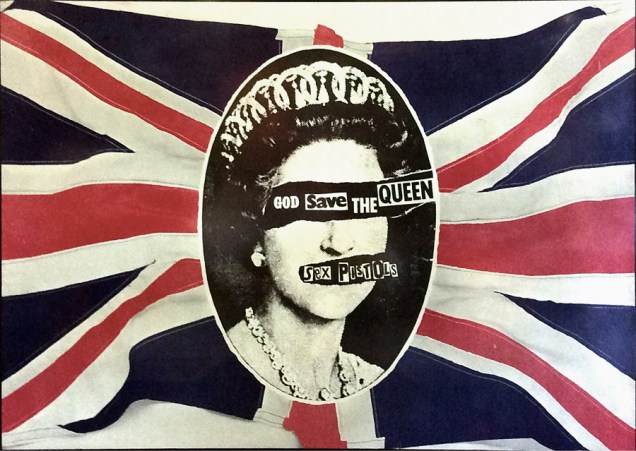
God Save The Queen - Sex Pistols - 2

We don’t need to change our national anthem, or create a separate one for England. We just need to make much better use of the one we already have

Is it time that England asserted herself by choosing a new national anthem of her own, separate and distinct from “God Save The Queen”, which supposedly represents our whole United Kingdom?

MPs seem to think so – the House of Commons has just voted in favour of an English national anthem, with a strong movement emerging to make Jerusalem England’s new anthem. But was Chesterfield MP Toby Perkins right to table the motion in the first place, and would we be right to ultimately adopt his idea?

In short, no. Much as this blog is generally in favour of full parity between the four home nations – best expressed through a federal structure brought about as the result of a full constitutional convention – calls for a separate English national anthem are particularly unhelpful at this time.

Our United Kingdom is already fraying at the seams. Having narrowly avoided dissolution as a result of the Scottish independence referendum last year, now is hardly the time for further measures which emphasise the relatively slight differences between England, Wales, Scotland and Northern Ireland. And no matter the temptation to poke swivel-eyed Scottish nationalists by meeting their quasi-religious fervour with a matching level of English nationalism, any step in this direction is likely to do more harm than good.

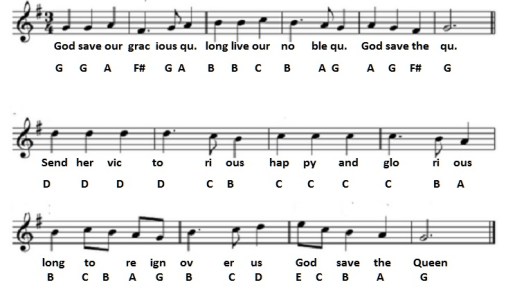
Is “God Save The Queen” a great anthem? Sadly not. Though as one commenter said on the BBC Daily Politics last night, it would have sounded less turgid sung lustily and at twice the speed, as apparently it once was. But there is no escaping the fact that Britain’s national anthem is a dusty and somewhat dull affair, especially set against the rousing, martial Marseillaise, the strutting, operatic Italian anthem or the ever-inspirational Star-Spangled Banner.

But much that is “wrong” or unsatisfactory with “God Save The Queen” can be remedied by performing it better. That means much less Lesley Garrett warbling away in a high soprano, and more beautiful arrangements like the heart-stopping Benjamin Britten version which has been given a new lease of life in recent years at the Last Night of the Proms:


The hushed opening, stately and noble tempo and beautiful harmonies, slowly building to an impassioned climax in the (too rarely heard) second verse, “Thy choicest gifts in store…”, actually make those who have only ever heard bad recordings of our national anthem stop and reconsider its merit.

And this sense of a fresh look is possible with contemporary performances too. We all know how the Americans pinched the tune to our national anthem and rebranded it as a patriotic song entitled “My Country, ‘Tis Of Thee“. Well, in the right hands it can sound incredibly moving – again showing that we British fail to make the best use of the source material at our disposal.

Consider Kelly Clarkson’s beautiful performance of “My Country, ‘Tis Of Thee” at President Obama’s second inauguration in 2013:


It is quite possible to listen to this beautiful arrangement – with Clarkson accompanied by the US Marine Corps band – and get quite emotional, before thinking “wait – I recognise that tune!”

Yes, that amazing performance which had you on your feet was none other than “God Save The Queen”, re-branded and given a glitzy makeover by a people who are a bit less hesitant to wear their emotions on their sleeves. Once again, we could learn a thing or two from our American cousins.

But of course, there is no escaping the fact that the words of Britain’s national anthem are written to glorify one person – the monarch – rather than our country itself, or her people. For some with republican leanings, it is impossible to get past this obstacle, whatever their other feelings on the subject. I can sympathise with this position. But as someone who greatly admires the Queen, has enormous respect for our country’s history and heritage but who increasingly thinks that the monarchy should be gently separated from our constitution once the second Elizabethan age is over, I still sing our national anthem with pride, thinking of my country rather than just my Queen.

The temptation to meddle – to change things, supplant or supplement them – is always going to be present, because nothing we do or create will ever be perfect. But “God Save the Queen” has been with us since 1745. It is very much a part of our history. In the past year alone it has seen us through two world wars, a cold war, as well as technological and social revolutions which have utterly transformed Britain – nearly always for the better.

Could we adopt Parry’s “Jerusalem” instead? Yes, of course. Nobody doubts that it is a fine composition, with a century of its own history and lyrics – it is a setting of a poem by William Blake – in its favour. It also has the advantage of glorifying a country, or at least an idea of a country, which is what national anthems are if anything supposed to do.

But is the satisfaction we might feel by doing so worth adding to the factors which are undermining our United Kingdom from within and without? Is taking what would be a very bold step toward the reassertion of separate English identity worth potentially destroying our union. I do not think so.

Should we change our national anthem, or create a new anthem specifically for England? Absolutely not. Not now. We should just make much better – and more musical – use of the anthem we already have.

God Save The Queen - Musical Score

Agree with this article? Violently disagree? Scroll down to leave a comment.

Follow Semi-Partisan Politics on TwitterFacebook and Medium.

Modern Safe Space Culture Will Never Produce Anyone Like David Bowie

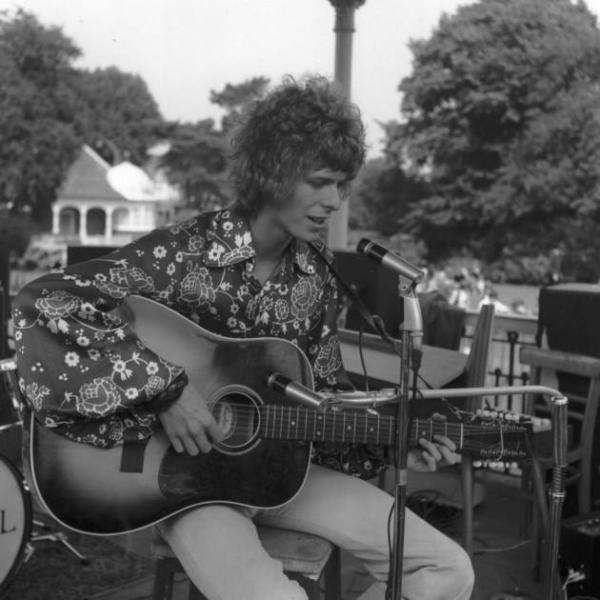
David Bowie - Beckenham Free Festival

Something more than David Bowie died this week

Why has David Bowie’s death affected so many people so deeply?

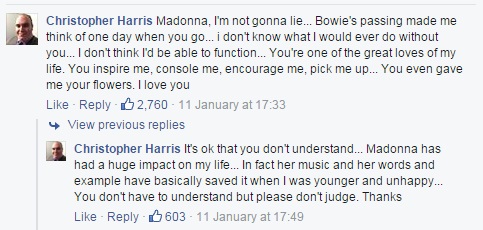
It goes much deeper than the pro-forma grief athleticism which the internet does so much to encourage. Yes, we can easily find examples of people going too far in their vicarious grief – often with extremely awkward effect:

David Bowie Death - Madonna Reaction - Facebook


But there is also something more than just anonymous people assuming a hysterical degree of mourning more appropriate for the passing of family members and close friends.

Neil Davenport attempts to draw out this undefined sense of loss in a piece in Spiked magazine entitled “Bowie and the shrinking sense of possibility”.

The piece begins by pointing out that while Bowie’s success was far from assured in the early years, it was made more likely by the greater sense of freedom and possibility which reigned in the early post-war decades, from the 1960s to the 1980s.

Davenport points out:

It’s worth remembering that Bowie slogged on the margins for ages, in two-bit bands, recording very minor songs, before finally finding his voice. Back then, British society created a kind of free space in which young people who were willing to take the unpredictable route of cultural experimentation could do so.

This should give some small measure of hope and a reminder to many of us toiling away in relative obscurity – be it in the arts or elsewhere – that success is rarely instant, and the lasting success we savour the most almost always requires a supreme degree of effort to be ploughed in to our endeavours before any results are seen.

But unfortunately, many aspects of our contemporary society conspire against encouraging this personal risk-taking and reinvention, as Davenport goes on to explain:

Today, in obsessively trying to ‘support’ and mollycoddle young people, society unwittingly robs them of the independence, resilience and drive that Bowie showed in his graft and in his shift from being a nobody to a zeitgeist-changing genius.

Where Bowie encapsulated a genuine sense of freedom and possibility, of total and frequent reinvention, today’s young people find themselves living in an era that discourages risk-taking, puts off adulthood, and erects official scaffolding around their lives. Young people have internalised a culture of anti-freedom.

We can see this in its most extreme form in the desire of some Western-born youths to join the death cult of ISIS, who seem to think that a repressive Caliphate which does all their thinking for them is a really great idea. We see it on university campuses, where student leaders make hectoring demands for Safe Spaces and ban controversial speakers, songs, newspapers or comedians. We see it with the daily emergence of yet another moronic petition calling for someone or something to be banned or punished for daring to ‘offend’ others. For all the celebrations of Bowie’s achievements, what he represented is actually in very short supply today. His death should serve as a reminder, or rather a wake-up call, of some of the backward social changes of the past 20 years.

Who would have thought that calls to outlaw clapping and booingtearful temper tantrums about dress codes, stifling ideas by labelling them ‘problematic’the insistence on safe spaces and mandatory sexual consent workshops for students would have such a repressive, suffocating effect on our society?

That’s not to say that there is no great new talent emerging seven decades after the birth of David Bowie – clearly there is. But time and again, we see the biggest acts and pop stars of today are more eager to ostentatiously embrace prevailing social values as an act of public virtue-signalling rather than court controversy by cutting across today’s strictly policed social norms.

Lady Gaga took no risk when she sang “I’m on the right track baby, I was born this way” – indeed it opened the door to stadiums full of even more lucrative fans. That’s not to say that she was wrong to do so; Lady Gaga’s advocacy of gay rights is laudable. But how often do you see an emerging pop star court real controversy or confound society’s expectations these days? You can blame some of this on commercialisation, sure, but not all of it. Something deeper is at work.

When emerging artists see ordinary people shamed and ostracised for saying the “wrong” thing or even just adopting the wrong tone on social media, how many will have the courage to incorporate anything truly daring or potentially “offensive” in their acts, or create spontaneously from the heart without first processing everything through the paranoid filter of societal acceptability?

No, trigger warnings and safe spaces are not directly to blame for the X Factor or One Direction. But all of these unsavoury phenomena – and the societal trends which create them – are indelibly linked.

Why, then, has this particular death hit many of us so hard? Perhaps because deep down, we realise that we have lost something more rare and precious even than David Bowie – the possibility of ever producing another like him.

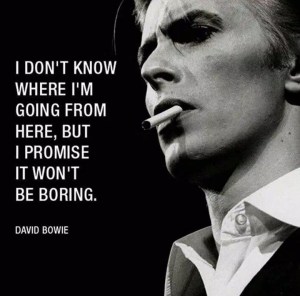
David Bowie Quote 1

Agree with this article? Violently disagree? Scroll down to leave a comment.

Follow Semi-Partisan Politics on TwitterFacebook and Medium.

One Year Later, Are We Still Charlie?

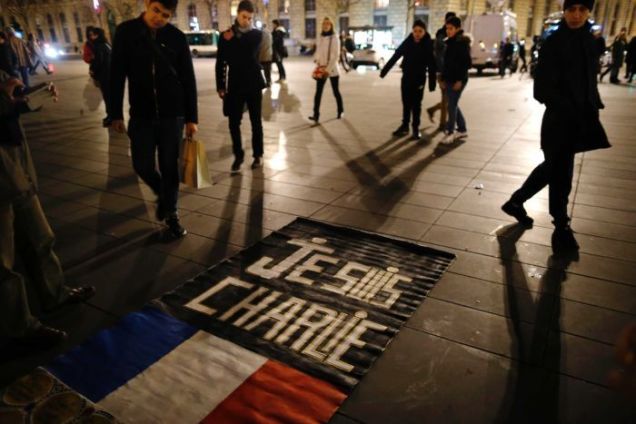
Paris - Charlie Hebdo Anniversary - Je Suis Charlie

As we pass the one year anniversary of the Charlie Hebdo attacks in Paris – the terrorist atrocity which prompted us to declare Je Suis Charlie in support of free speech – are we still Charlie, one year on? Were we ever?

This past week saw the first anniversary of the Charlie Hebdo attacks in Paris, a sickening assault on journalism and free speech, and the worst thing to happen to France until the Paris attacks of 13 November ensured that 2015 would end much as it started for Europe: in the shadow of Islamist terrorism.

At the time of the Charlie Hebdo shootings, many of us rallied to the cause of the small, satirical newspaper which found itself in the crosshairs of a primitive, totalitarian ideology, and we declared “Je Suis Charlie”.

It was a nice gesture, even if it wasn’t strictly true. Though David Cameron was eager to be seen marching arm-in-arm with other world leaders through the streets of Paris in support of free speech, those of us back in London knew that any British newspaper attempting to publish some of the satirical cartoons that Charlie Hebdo published would have been vilified, sued and shut down, and its editor would likely languishing in a British prison cell.

Things didn’t get much better as 2015 progressed, as Glenn Greenwald notes in his latest column for The Intercept:

It’s been almost one year since millions of people — led by the world’s most repressive tyrants — marched in Paris ostensibly in favor of free speech. Since then, the French government — which led the way trumpeting the vital importance of free speech in the wake of the Charlie Hebdo killings — has repeatedly prosecuted people for the political views they expressed, and otherwise exploited terrorism fears to crush civil liberties generally. It has done so with barely a peep of protest from most of those throughout the West who waved free speech flags in support of Charlie Hebdo cartoonists.

That’s because, as I argued at the time, many of these newfound free speech crusaders exploiting the Hebdo killings were not authentic, consistent believers in free speech. Instead, they invoke that principle only in the easiest and most self-serving instances: namely, defense of the ideas they support. But when people are punished for expressing ideas they hate, they are silent or supportive of that suppression: the very opposite of genuine free speech advocacy.

[..] In the weeks after the Free Speech march, dozens of people in France “were arrested for hate speech or other acts insulting religious faiths, or for cheering the men who carried out the attacks.” The government “ordered prosecutors around the country to crack down on hate speech, anti-Semitism and glorifying terrorism.” There were no marches in defense of their free speech rights.

Glenn Greenwald goes on to express his contempt for the fair-weather free speech advocates who are all to eager to shout their support for speech which offends people they happen to dislike, while simultaneously demanding that the authorities clamp down on speech which offends them or people with whom they sympathise.

Meanwhile, in Britain, the newly re-elected Conservative government was getting ready to “defend” free speech by expressing impatience with the fact that they did not have  more freedom to harass citizens acting in accordance with the law.

When David Cameron announced draconian new security measures, impatiently proclaiming “For too long, we have been a passively tolerant society, saying to our citizens ‘as long as you obey the law, we will leave you alone'”, this blog retorted:

These measures have the look and feel of a side which feels unable to win the argument in favour of British and western values through open debate, and so seeks to impose them by force of law instead.

A truly free and liberal society would not need to take such draconian steps as requiring “extremists” (never defined, and certainly not necessarily convicted) to submit advance copies of public remarks to the police for review and censoring, an astonishing proposal. But our society is becoming less and less free by the day, opting instead for security and a quiet life.

And at its depressing heart, this is what it comes down to – a desire for cloistered security above all else. On the economy, on foreign affairs and now on terrorism, our politicians have decided that we are too frightened and worn down by the dangers and threats of this world to face our challenges as a strong, independent nation.

But government has not been solely to blame. The desire to trade liberty for a chimerical sense of security has been coming from the bottom-up, with an increasing number of citizens – particularly those on the Left who ostentatiously proclaim their concern for issues of “social justice” – insisting that core liberties such as the right to free speech should be curtailed when they negatively infringe on the feelings of another person.

This corrosive new development has its roots in academia and the university environment, where a generation of liberal professors espousing political correctness as their religion are finally beginning to reap what they sowed – a new generation of coddled adult baby students who require trigger warnings, safe spaces and dawn-to-dusk parenting by their colleges just to make it through the day.

These New Age Censors and their petty authoritarianism are toxic to free speech, and their growing influence has already resulted in calls to outlaw clapping and booing, tearful temper tantrums about dress codes, stifling ideas by labelling them ‘problematic’, the insistence on safe spaces and mandatory sexual consent workshops.

As I recently explained, deep down this has nothing to do with “social justice”, but instead is all about gaining power by wrestling control over the language and laying verbal land mines with the intention of destroying opponents who – regardless of how they actually behave – happen simply to say the “wrong” thing:

That’s where the New Age Censors, the Stepford Students, the resurgent activist Left step in, always watching over your shoulder and always quick and eager to tell you when you have crossed one of the many invisible lines that they are busy drawing across our political and social discourse. Only the telling always seems to take the form of a social media lynching rather than a friendly pointer.

When the rules over precisely what can be said and how it must be phrased become so fiendishly complex that we are all liable to fall over them at some point, it grants enormous power to the gatekeepers, those swivel-eyed young activists at the forefront of modern identity politics. Not only do they get to write the rules, they and they alone get to sit in judgement as to whether those rules have been violated.

[..] Who knew that the petty tyrants of today would be cherubic-faced, smiley student activists, chanting mantras about keeping us safe as they imprison us in their closed-minded, ideological dystopia?

As far as 2015 Year In Reviews go, all of this makes for depressing reading. Indeed there are many reasons to be concerned for the future of free speech and civil liberties in general, particularly when many of our fellow citizens seem intent on destroying our freedoms from within.

And yet there have been some good news stories too, providing small glimmers of hope. One such case has been the exoneration of a Northern Irish pastor, James McConnell, who found himself on trial for sending “grossly offensive” communications following a sermon in which he described Islam as “a doctrine spawned in hell”.

This was a spiteful sting by the prosecution. McConnell’s sermon – in which the 78-year-old pastor said some highly unpleasant and inflammatory things about Islam – had been recorded and then later posted on the internet, allowing the authorities to accuse him of “causing a grossly offensive message to be sent by means of a public electronic communications network”.

Too often, such show trials have resulted in conviction and a prison sentence, which in this instance could have been six months. But in this case, Judge Liam McNally, threw the case out, saying “the courts need to be very careful not to criticise speech which, however contemptible, is no more than offensive”. If only this legal interpretation was more widely shared and disseminated throughout the English and Scottish legal systems, from the UK Supreme Court on downwards.

But the truly pleasing aspect of this case is the fact that one of the people who spoke outside the court in support of James McConnell was a Muslim academic, a senior research fellow in Islamic studies at the Westminster Institute named Muhammad al-Hussaini.

Taking a brave stance in support of speech which he himself must have found very distasteful, al-Hussaini nonetheless defended Pastor James McConnell’s right to say hateful things about the religion of Islam.

The Guardian reported at the time:

Speaking outside Belfast magistrates court to hundreds of McConnell’s supporters, Muhammad al-Hussaini, a senior research fellow in Islamic studies at the Westminster Institute, said he was in the city to back McConnell’s right to free speech.

Hussaini said: “This is possibly one of the most important things at our juncture in history; it could be the make or break for the continued survival of our planet actually.

“Against the flaming backdrop of torched Christian churches, bloody executions and massacres of faith minorities in the Middle East and elsewhere, it is therefore a matter of utmost concern that, in this country, we discharge our common duty steadfastly to defend the freedom of citizens to discuss, debate and critique religious ideas and beliefs – restricting only speech which incites to physical violence against others.

“Moreover, in a free and democratic society we enter into severe peril when we start to confuse what we perhaps ought or ought not to say, with what in law we are allowed to, or not allowed to say.”

At a time when freedom of speech is just as much under attack from safe space zealots and our own government as it is from radical Islamic terrorism, it is especially important that we stand in solidarity with those who defend free speech, and particularly those who have the moral courage to defend the speech that they personally hate.

In this regard, civil libertarians owe a debt of gratitude to Muhammad al-Hussaini and others like him. For in his defence of the rights of pastors – or anybody else – to say what they please, so long as they do not actively incite violence against another, this Muslim scholar is doing far more to defend the ancient British and enlightenment values of freedom and liberty than

In fact, one could quite easily say that al-Hussaini is more authentically British (in terms of extolling and living by the values which we supposedly hold dear) than our own government, the grunting anti-Muslim far-right and most of the academic safe space crowd put together.

This is the unusual situation in which we now find ourselves, with a British population and government cowed simultaneously by Islamic terrorism and by Islamophobia seriously discussing banning “hate preachers” like Donald Trump (of all people) from entering Britain, while it falls to a Muslim academic to stand up in defence of the free speech which the West supposedly holds so dear.

This landscape is not encouraging; few of us passed the Charlie Hebdo Test when those terrible shots rang out on 7 January 2015, and fewer still would do so now, based on their words and actions since that heinous attack.

But when a nation begins to forget its own values and once dearly-held principles, it is of some consolation on this first anniversary of the Charlie Hebdo shootings to see the flame of liberty being kept alive in some unexpected places, and by unexpected – but very welcome – custodians.
Freedom of Speech - Free Speech

Agree with this article? Violently disagree? Scroll down to leave a comment.

Follow Semi-Partisan Politics on TwitterFacebook and Medium.