Bilbo Baggins Dials Back The Anti-Conservative ‘Tory Scum’ Rhetoric

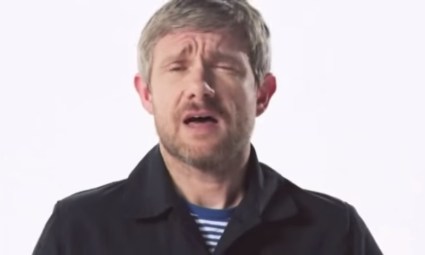
Martin Freeman – the artist best known as Bilbo Baggins / Dr. Watson – now says that it is wrong to call conservatives ‘evil’. But that’s not what he was hinting before the general election…

Now that he is no longer shilling for Ed Miliband and the Labour Party, actor Martin Freeman has come over all thoughtful and introspective.

Well, everything’s relative. But in a new interview given to the pretentious Rake magazine, Freeman pontificates that it is wrong and unfair to call Tories and those with conservative political opinions “evil”.

The Spectator notes:

In an interview with The Rake, Martin Freeman — who starred in Labour’s election broadcast when Ed Miliband was leader — says it’s unfair to call all Tories ‘evil’, as the left has been responsible for more deaths in recent years.

While Rake quotes Freeman as saying:

My team — the left, generally — has been responsible for more deaths in the last century than the other team if you count Stalin, Mao, the Khmer Rouge, the Shining Path… that’s not a good team.

The left is quite at home with evil bastards, actually. Religion doesn’t have a downpayment on genocide: there are atheists, materialists and socialists who have gone on quite happily with rape and murder.

How magnanimous of Martin Freeman, placing us all (conservatives, left-wingers and genocidal maniacs alike) on the same end of the sliding scale of evil – as though there were no difference between government making an honest and sometimes flawed effort to help and work for citizens on the one hand, and deliberately terrorising and oppressing them on the other.

But Bilbo Baggins was not always so well disposed to people on the political Right. Only a few short months ago, Martin Freeman’s face was barking at us from our television screens with his Labour-supporting party political broadcast, part hagiography of Milibandism and part bully pulpit from which to bash the Evil Tories.

Just for fun, let’s remind ourselves of what Martin Freeman was saying about anybody who failed to appreciate the wonders of Ed Miliband before the general election. I’ll interject with some observations of my own every now and then.

It’s a choice between two completely different sets of values. A choice about what kind of country we want to live in.

Well, if by “completely different” you mean New Labour with a red rosette and New Labour with a blue rosette, then yes. The colours under which the two main parties are fighting the campaign, blue and red, are indeed very different.

Now I don’t know about you, but my values are about community, compassion, decency, that’s how I was brought up.

Won’t somebody give that saint a halo already? The man cares about decency and compassion, didn’t you hear him? And as we all know, the basic human tenets of compassion and decency can now only be found in those who espouse left-wing politics.

So yeah, I could tell you the Tories would take us on a rollercoaster of cuts while Labour will make sure the economy works for all of us, not just the privileged few – like me. But it’s not just about that.

He could tell you that the Evil Tories are the barbarians at the gate, chomping at the bit to sink their fangs into our Precious Public Services and rip them to shreds. Martin Freeman could tell you that. He could wax eloquent on the subject for days. But he’s just a humble guy like you and me; he isn’t the kind of person to sully himself with party politics. So he’ll just let you know what he would say, were he inclined to mention the Tories.

I could tell you it seems like the Tories don’t believe in the NHS, while Labour is passionate about protecting it.

Martin Freeman could tell us that the Tories hate Our Blessed NHS, but since it would be based on absolutely no evidence whatsoever – neither the declared intentions of the Conservative Party or a reasonable inference from observing their behaviour in government over the past five years – instead he will just leave the vague accusation hanging ominously in the air. Because that’s what humble, regular guys like Martin Freeman do all the time. It certainly isn’t a long-practised political smear.

I could tell you that the Tories have got sod all to offer the young, whereas Labour will invest in the next generation’s education and guarantee – that word again – apprenticeships for them.

If Martin Freeman were so uncouth as to talk politics with us, he could mention how the Evil Tories absolutely loathe the young, and yearn for a future where a failed generation of ill educated and uninspired young people sit around getting pregnant, committing crimes and claiming endless benefits. As we all know, the Tories simply love it when people fail to reach their potential as human beings and live stunted lives of despair, deprivation and grinding poverty. What can I say – it gives us a warm glow inside. And Martin Freeman could tell us all about that, if only his speech were some kind of political message.

I could tell you that Labour will put the minimum wage up to £8, and ban those ‘orrible zero hours contracts, while the Tories would presumably do more of their tax cutting for millionaires.

Bilbo could tell us this, but he doesn’t know for sure. As the inclusion of the word “presumably” indicates, Martin Freeman didn’t actually bother to do any research before standing in front of the camera to pitch for Ed Miliband. Maybe the Tories would undo some more of Gordon Brown’s spiteful and counterproductive tax hikes on the rich (tax cuts for millionaires!), or maybe they might – oh, I don’t know – introduce a national living wage of £9 per hour, even higher than Labour propose. But since he couldn’t say for certain before the election, it was probably right to assume that those Nasty Tories will keep turning the screws on the poor.

But real though all that stuff is, and important though it is if you’re young in this country or broke in this country or if you’re unwell in this country – and let’s face it, we all need the NHS at some point – or if you are just plain working hard and finding life tough, there is a choice of two paths. The bottom line is what values are we choosing. Because in the end this choice we make really does matter.

Labour: they start from the right place. Community, compassion, fairness – I think all the best things about this country. I love this country so much and I love the people in it, and I think you do too. But really, for me, there’s only one choice. And I choose Labour.

Martin Freeman loves this country and everyone in it. Everyone, that is, apart from those people who disagree with him and think that a Labour government and a prime minister Ed Miliband would have been an unmitigated disaster and an utter failure of national aspiration. Those people, Bilbo Baggins somehow isn’t quite so keen on.

So to paraphrase Martin Freeman’s sanctimonious, moralising, self-aggrandising attitude toward the nearly 50% of his fellow British citizens who voted for a more right-leaning party in 2015: “I’m not saying that all Tories are Evil Nazi Scum. They may hate the sick and yearn to destroy Our NHS. They may have no compassion, unlike we Virtuous People of the Left. They may not care about the future of our children. But they’re not evil. Heavens, no. I certainly never intended to give that impression. The Tories aren’t scum, they’re just ethically challenged.”

Conservatives should rejoice, to thus receive the benediction of Martin Freeman. They aren’t evil after all. They just hold evil values. Not proper, wholesome Labour values.

What pious, self-regarding, moralising nonsense Bilbo Baggins talks. In fact, Martin Freeman represents everything that is wrong with left-wing politics today – captivated by its own supposed virtue, yet utterly bereft of ideas for improving or transforming the country besides the same old, tired schemes to bash the rich, punish success and reward mediocrity.

And now here comes Martin Freeman once again – a diminished and discredited figure after his beloved Ed Miliband barely persuaded his own friends and family to vote Labour at the general election – attempting to worm his way back into the good graces of the public by smugly pontificating against those who took him at his word back in May, and who now hysterically accuse conservatives of being “evil”. Suddenly, calling conservatives “evil” is a terribly gauche and inappropriate thing to do.

But that’s not what you were saying back in April and May 2015, is it, Mr. Freeman? When the general election campaign was raging, you lent your voice, image and public profile to a party political broadcast designed to benefit the Labour Party and in which you made highly speculative and slanderous statements about the priorities and the very character of conservative-minded voters.

Well, Martin Freeman can keep his values, and he can stick them. The hobbit’s newfound realisation that it is wrong to demonise half the population as being greedy, avaricious and soulless monsters is tired, belated and hypocritical in the extreme – especially considering the fact that Bilbo Baggins was leading the charge against the Evil Tory Scum on national television only a few months ago.

Martin Freeman: your half-hearted, obscure non-apology is most sincerely not accepted.
 

Martin Freeman - Labour Party - Tory Scum - Left Wing Hate Watch

Agree with this article? Violently disagree? Scroll down to leave a comment.

Follow Semi-Partisan Politics on TwitterFacebook and Medium.

What Conservative Government? – Part 2

Housing Crisis

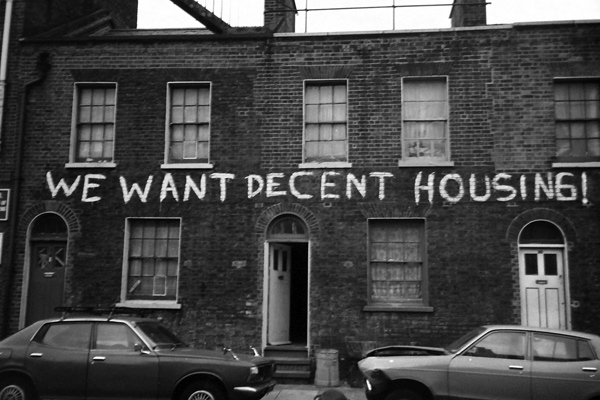
Rather than do any of the things which might actually ease the housing crisis, David Cameron’s Coke Zero Conservative government wants the state to enter the housebuilding business

When faced with the inescapable truth of the housing crisis – the fact that demand for housing is increasing faster than supply – David Cameron’s Conservative government has typically preferred to faff around with headline-chasing proposals to boost demand for the same inadequate housing stock rather than upset any of their vested interests by unleashing a real, consumer-focused supply side revolution.

But doing nothing at all in the face of a pressing national problem doesn’t look very good, and so the government has simultaneously been grasping around for eye-catching policies which give the illusion of taking serious action, while doing almost nothing to tackle the root causes.

And since this government is clearly content to pick freely from any policies ranging anywhere from the authoritarian left to the bland centre, they have come up with a doozy of a socialist idea: being unwilling to deregulate the market or meaningfully ease burdensome planning restrictions, the state will simply start commissioning new housing itself. What could possibly go wrong?

The breathless government press release informs us:

The Prime Minister will today announce that the government is to step in and directly commission thousands of new affordable homes.

In a radical new policy shift, not used on this scale since Thatcher and Heseltine started the Docklands, the government will directly commission the building of homes on publicly owned land. This will lead to quality homes built at a faster rate with smaller building firms – currently unable to take on big projects – able to get building on government sites where planning permission is already in place. The first wave of up to 13,000 will start on 4 sites outside of London in 2016 – up to 40% of which will be affordable ‘starter’ homes. This approach will also be used in at the Old Oak Common site in north west London.

A plan for every stage of your life, indeed.

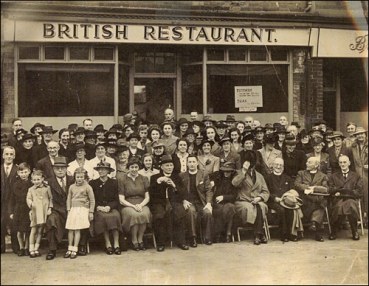
This amounts to nothing so much as a nationalised British Housing corporation – on a small scale for now, but who knows where or how far this statist adventure could lead us? Where once we had British Coal, British Steel, British Rail and even British Restaurants, now we are about to have British Housing foisted upon us – and by a supposedly conservative government, no less.

But just as nationalised, centrally planned companies like British Leyland churned out low quality, uncompetitive products that nobody wanted back in the last century, so British Housing will inevitably see the construction of more cookie-cutter, non-high-rise, low density “developments” that barely keep pace with rising demand and do nothing to tackle house prices or put the dream of home ownership within reach of more people.

But who cares? George Osborne will have another excuse to don his high-vis jacket, strap on his hard hat, and prance around a building site with his sleeves rolled up like a man of action and plausible Future Prime Minister. And that’s all that matters. Not solving real problems. Not applying the best of contemporary conservative thinking to transform Britain for the better. Just another good photo opportunity and more of the same endless, vacuous triangulation and electioneering.

Rigorous conservative thought and policymaking is capable of producing compelling answers to nearly all of the problems facing modern Britain – unemployment, housing, welfare, competitiveness and the democratic deficit. But we do not have a prime minister or a government who have any respect for conservative thought, or the principles of small government, free individuals and the free market as a force for good.

We have David Cameron, George Osborne and the bricks-and-mortar equivalent of British Rail sandwiches.


British Restaurants - Nationalisation

Agree with this article? Violently disagree? Scroll down to leave a comment.

Follow Semi-Partisan Politics on TwitterFacebook and Medium.

What Conservative Government? – Part 1

David Cameron - Conservative Party - Tree Logo - Coke Zero Conservatism

The Left may love to rail against the Evil Tory government inflicting untold harm on the defenceless people of Britain in service to their extreme, worse-than-Thatcher ideology. Of course, it’s all just hysterical, hyperbolic nonsense. This “What Conservative Government?” series will highlight multitudinous examples showing that David Cameron’s rootless, centrist Conservative Party is an authoritarian, Big Government carbon copy of Tony Blair’s New Labour.

Last week, I had the opportunity to debate the Conservative Culture Minister, Ed Vaizey, on the infantilisation of today’s students and their ludicrous demands for trigger warnings, safe spaces and the suppression of free speech.

This week, Vaizey pops up in Conservative Home, defending the government’s record on public libraries from left-wing attack (my emphasis added):

When I first became a Minister, we abolished the libraries quango and moved responsibility to the Arts Council.  We wanted to join up our cultural strategy with libraries.  This decision has been thoroughly vindicated.  The Arts Council has made £6 million of new Lottery funding available to libraries to host cultural events and realise their role as important community spaces.  Yesterday, they announced a further investment of more than £1.5 pounds, which will help library authorities work better together, and will support a range of national initiatives covering reading, digital literacy and health.

[..] Councils have a legal obligation to provide comprehensive and efficient library services, and must consult with the local population on plans. We are the first Government to review every closure. Central government can and will intervene if a council is planning dramatic cuts.

There is a serious point here, which is that the Labour Party are utterly disingenuous to attack the Conservatives for library closures, when only 11 of 79 library closures in the past five years have been ordered by Conservative councils. And there is probably merit to the implied suggestion that left-wing Labour councils are publicly rending their garments and spitefully shutting down high profile services as a kind of self-immolating protest against the Evil Tories in Westminster.

But what kind of conservative government obsesses about the “national initiatives” feeding into their “cultural strategy”, and watches over the shoulder of every local authority in the country, demanding the right to sign off on every single building closure? Certainly not any government that truly believes in smaller, leaner government or a renewed emphasis on localism and individual liberty.

Now, this centralise-first instinct in British politics is not new. And ironically, it is partly the legacy of the Thatcher government, which faced implacable resistance from rabidly left-wing local councils and believed that the only way to implement its agenda was to circumvent and/or neuter local authorities. But the New Labour governments of Tony Blair and Gordon Brown did nothing to reverse this process, and David Cameron’s Coke Zero Conservatives are in no hurry to undo the process.

But the over-centralisation of government is one of the biggest problems in British politics and civil life. It kills any attempt at radical experimentation or bold new policy initiatives in the crib, since everything must conform to the same national standards, either by legal requirement or the fear of endless angry “postcode lottery!” headlines in the press.

Why should the four home nations of the UK not have the ability to vary tax rates and bands as they see fit, according to local priorities, so long as all four pay the correct proportional share of their revenue to Westminster for UK-wide shared obligations such as foreign policy and defence?

Why should local authorities not be able to raise (or lower) sales taxes autonomously, in place of a fixed (and brutally high) VAT rate of 20%, returning funds to taxpayers or spending the revenues as local communities see fit?

Why should city councils not be permitted to implement hotel room taxes, as in nearly every major city around the world outside the UK, and use the revenue to promote local tourism in the provinces and regions?

(The one policy standing in David Cameron’s favour is the creation of local Police and Crime Commissioners – though it has been hard to generate any real enthusiasm for this form local control when it is not replicated in other areas of our lives).

A truly radical, campaigning conservative government would be asking these questions, developing policies to answer them, and then boldly implementing them across the nation. And now, after five years of Conservative government, Britain might be starting to feel the benefit of re-embracing liberty, individualism, localism and regional variation.

But of course, all of this would require the Conservative Party to actually govern like a conservative party.


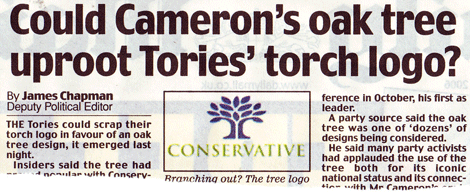
Conservative Party Logo - Cameron - Oak Tree

Agree with this article? Violently disagree? Scroll down to leave a comment.

Follow Semi-Partisan Politics on TwitterFacebook and Medium.

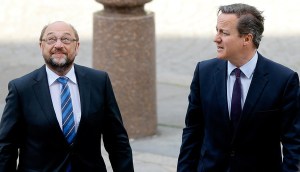
David Cameron And Martin Schulz – Bad Cop / Bad Cop Anti-Brexit Strategy

Martin SCHULZ - EP President , David Cameron - British Prime minister

After David Cameron and Donald Tusk’s arrogant two-finger salute to the British public comes Martin Schulz’s risible Bad Cop routine

It has been a couple of days now, and the anger about the government’s unchanging approach to the EU has started to dissipate – only to be replaced by a dull sense of abandonment and cynicism.

Of course David Cameron was not going to announce any kind of meaningful deal with the European Union – expecting Dave to represent our interests in a negotiation with Brussels is like being on trial, spilling your guts to the chief prosecutor and still expecting him to bend over backward to get you acquitted. That is, it’s implausible because of a flawed assumption about whose side they are on.

This was not a renegotiation between Britain and the other member states of the European Union; rather, it was a game of wits with the prime minister and his fellow EU leaders on one side, and the British people on the other side. The objective was not to present British demands to Brussels and seek to win as many concessions as possible; on the contrary, the aim from Day One was to identify how little the British people could be persuaded to accept as crumbs from the EU’s table while still doing what they were told.

When you realise that democracy and the restoration of national sovereignty were never on the table, everything makes a lot more sense. And yet David Cameron is clearly stretching his luck. The few meagre statements of intent in Donald Tusks’s formal response to the British letter are completely irrelevant, and certainly will do nothing to address the concerns of most people. And the press has realised, and duly given the prime minister a roasting for his feeble negotiating skills.

Thus there is still a possibility – however slight – that if the referendum goes ahead on the accelerated timescale in June this year, the Leave side may be able to squeak a victory by painting David Cameron’s half-hearted renegotiation as part of a bipartisan establishment conspiracy of the political elites against the British people, to keep us in the European Union come hell or high water.

Or as this blog noted yesterday:

With nearly every authoritative voice in Britain about to begin earnestly intoning the many benefits of Brussels, our most potent weapon may be the British people’s strong sense of fair play, and their likely discomfort at seeing the Leave campaign being outspent, outmanoeuvred, outgunned and shouted down. We have been weak and ineffectual enough thus far – so we may as well ham it up for the cameras and work to build the narrative that this referendum is in fact The Establishment vs The People.

Bearing all this in mind, what the Remain campaign could really do with to twist the knife would be for a senior EU politician to come out swinging and playing Bad Cop to David Cameron’s Useless Cop. What they really need is for one of the EU’s big beasts – preferably someone with a suitably scary Teutonic name – to barge onto the scene and warn Britain that we are testing his patience with our pesky demands for sovereignty and self-determination, and that unless we soon shut up and accept what we are being offered, he and his chums can make no guarantees for our safety.

Step forward president of the EU Parliament Martin Schulz, who used a speech in London today to do just that. Schulz said:

Europe needs the UK with its foreign policy experience and clout, its open market policies and its trade track record if we want to have hope of solving any of these crises – and even more so, if we want to maintain the global security architecture and shape the future world order.

This is why personally I am a strong supporter of the UK remaining in EU. And this, despite the fact – and I admit this quite frankly – that the British often test our patience and good will with their continuous demands.

They are demanding. They push hard. They insist. They just don’t let go. Many of my colleagues say behind closed doors: ‘Don’t stop a rolling stone. If the Brits want to leave, let them leave.’

I do not support this line that just because the UK can be frustrating it would be in our interest to let it go. I believe we need the UK to make the EU stronger and better. And to make something stronger and better sometimes it’s necessary to push hard and be critical.

In other words: “Hey, you know I love you, Britain. You’re great, I would do anything for you. But some of my friends have had enough; they think you are getting ideas above your station. In fact, they think that you are itching to be taught a lesson in humility. Not me, of course. I think you’re just swell. But what say we put this whole silly euroscepticism business behind us and carry on as normal? I think that would be much better that way. And I wouldn’t want anything bad to happen to you…”

Basically, this is a threat dressed up as friendly concern.

My first thought on reading this was: is Martin Schulz confusing the UK with another country – one which is actually assertive in standing up for its national interest and kicking up a fuss when it doesn’t get its way? Because this description doesn’t sound anything like the Britain I recognise.

What “continual demands” has Britain been making of the European Union? And which demands have been conceded by a reluctant Brussels which supposedly feels bullied and taken advantage of by our selfish stance? You would think that if Britain had such a notable track record of standing in the way of EU goals and projects, that a nominally eurosceptic government like David Cameron’s would be busy talking up all of these filibustering victories to buy some credibility from a sceptical public. You would think that David Cameron’s stump speech would be littered with Brussels pet projects which he thwarted for the good of the taxpayer and in defence of Britain’s national interest.

So where are those success stories? Where are the examples of Britain “pushing”, “insisting” and “not letting go”? Does Martin Schulz mean the time that Britain was presented with a £1.7 billion supplementary bill from the EU as a penalty for economically outperforming the Eurozone? Because if my recollection serves me correctly, our prime minister gave a red-faced, foot-stamping press conference in which he insisted that Britain would not pay a further penny, before quietly authorising George Osborne to pay the entire sum as soon as the general election is out of the way. Is this the kind of obstructionism that Martin Schulz means? The totally illusory kind?

But what of France and its angry insistence on violating the EU stability and growth pact, for reasons both real and confected? If the rules were put in place for the benefit of all, what does it say about France that they rage against the European Commission for daring to point out their lack of compliance? Is this not being “demanding” and “pushing hard” to get their own way?

And what about Germany’s constant, selfish running of a current account surplus in excess of the maximum 6 per cent allowed under the Macroeconomic Imbalance Procedure (MIP)? Where is the European solidarity there? And what might Martin Schulz have to say about the stubborn behaviour of his own compatriots? Don’t expect an answer any time soon.

The truth is that by most measures, you could not find a more pliable, easy-going and constructive member of the European Union than Britain. We pay our dues, enforce and abide by the rules and laws a lot more rigorously than many other countries, and while the public may complain a lot, our elected representatives hardly ever filter that dissatisfaction upward to disturb the smooth running of EU summits.

The only way that your average EU leader or bureaucrat could possibly be troubled by British euroscepticism is if they were to spend their days clicking through the comments sections of the Daily Mail website – which presumably they have no time to do, what with being such busy and efficient people. They certainly have not encountered any euroscepticism from Downing Street for thirteen years of New Labour or five subsequent years of rootless Cameronism.

But how well it aids the Remain campaign for a prominent EU leader to come to London with the message that Brussels is getting sick and tired of our irritating demands for national sovereignty, that the world is a scary and unpredictable place, and that we wouldn’t want to find ourselves in their bad books just in time for a big Chinese economic slowdown. What absolutely marvellous timing. Really, you couldn’t have co-ordinated it any better if you wanted to orchestrate an event to distract attention from the fact that Cameron and the EU are standing before the British electorate absolutely stark naked.

But we should see this for what it is – a cheap and tawdry act of scaremongering from a political establishment (and assorted allies such as Schulz) who are utterly incapable of making a bold, unabashed and unambiguous argument in favour of the EU as a good model for future human governance and the preservation of democracy.

In place of any attempt (however foolhardy) at real, tangible reform of the European Union, taking into account some of the actual concerns of the British people, instead we have David Cameron’s big bag of nothing followed by Martin Schulz issuing sinister threats wrapped in faint praise.

Having the prime minister announce a renegotiation “outcome” so pitifully short of addressing even his own original and desperately unambitious areas for discussion is bad enough. But to then be on the receiving end of passive-aggressive threats from the EU aristocracy, chiding us for being “demanding” – really the pot calling the kettle black with this supranational group of obstinate prima donnas – is an insult too far.

As always, we are denied the big picture and forced to operate in the blind because the leader of our country does not view us as fellow citizens with a right to have a say on Britain’s future based on full and complete information, but rather as a potentially dangerous mob whose every thought and sentiment must be carefully curated by our betters, to guide us toward the “correct” decision.

We never had any reason to believe that it would be otherwise. But it is still galling to experience this intellectual, emotional and psychological manipulation strategy unfolding in real time.


David Cameron - Martin Schulz - 2

Agree with this article? Violently disagree? Scroll down to leave a comment.

Follow Semi-Partisan Politics on TwitterFacebook and Medium.

Dreams Of The Rainbow Coalition

bbc-challengers-debate-leaders-debate-general-election-2015-nigel-farage-stands-alone

Left-wing collusion to lock the Conservatives out of power will not work, and would massively backfire were it even attempted

Remember Nicola Sturgeon’s dream of a rainbow coalition of left-wing political parties putting their differences aside and coming together to lock the Evil Tories out of government and usher in a new era of endless abundance for all, courtesy of the Magic Money Tree?

It hasn’t gone away. That insufferable, sanctimonious, morally superior dream has still not died. Here’s Brian Barder, writing in LabourList as though it were still May 6, 2015:

If the Tories, under a new leader enjoying a honeymoon, are to be dethroned, and if Labour alone can’t dethrone them, it’s simple logic that the job can be done only by an alliance of the progressive parties, led by Labour as the biggest of them. Such a multi-party association can take several forms: a loose alliance supporting a minority Labour government, or a slightly more formal ‘confidence and supply’ understanding with the other progressive parties, or a formal coalition of some or even all of them, each represented in a government of the broad left.

Similarly, the policies of a broad progressive alliance to replace the Tories in office can be agreed before an election (or even after it, as in 2010) in a detailed agreed document, or there can be a more general understanding in support of a progressive programme whose core elements all the progressive parties agree to support, or the other parties can be free to decide ad hoc which policies of a minority Labour government they will support as they go along.

This is all a response to the dawning realisation that whatever his arguable virtues (and this blog has been a cautious fan), Jeremy Corbyn is not currently positioning himself to sweep Labour back to power in 2020.

To his credit, Brian Barder is not panicking, and is instead trying to come up with a pragmatic way for the Left to make an impact without relying on overly sunny predictions about getting rid of Jeremy Corbyn any time soon. That much is good. But Barder’s solution and call for a left-wing coalition is no less silly than the calls for the Parliamentary Labour Party to split from the national party, pick their own leader and form a self-serving Westminster caucus without a local or national support base.

“So what if Labour can no longer enthuse enough people to march to their polling station to vote the party back into government”, goes this line of thinking. “There are enough other people out there vaguely like us that if we all band together in a cynical and self-serving coalition, we will be able to deny the British people the government that the electoral system should have produced and do the job ourselves, even though individually we are about as popular as a swarm of Brazilian mosquitoes”.

In other words, it’s complete nonsense. The general election we had just nine months ago proves that there is no great and silent left-wing majority in Britain. If there were, Labour would not have been decimated throughout south-east England, and the Greens and Liberal Democrats would have won enough seats between them to make ganging together to force Ed Miliband on a reluctant Britain politically viable. But they were decimated, and Ed Miliband is now making tedious speeches from the back benches.

Yet the denial is strong. In even proposing such a left-wing collaboration, Brian Barder reveals that he clearly spends his time percolating in the same confirmation bias-reinforcing ideological echo chambers as many others on the Labour left, and has mistaken a Twitter timeline full of David Cameron pig jokes and anti-Tory human rights hysteria for a representative sampling of the British public.

Or as blog said on 8 May, immediately after the election, which still holds true now:

Until the exit poll came in, it was simply inconceivable to many on the left that there could be any result other than a rainbow coalition of Britain’s left wing parties, coming together to lock the Evil Tories out of Downing Street and immediately get to work cancelling austerity and providing everyone with material abundance through the generosity of the magic money tree.

It is simply unthinkable to the like of Barder that the people of Britain might actually reject left-wing dogma and prefer David Cameron’s eminently pragmatic, reassuringly non-ideological form of watered down conservatism. Clearly the British people need saving from an Evil Tory government that they did not want, and therefore any electoral machination to achieve this end would be justified.

Except that it wouldn’t. The quietly patriotic, un-ostentatiously self-sufficient real majority in this country already believe that they are the victims of an establishment stitch-up when it comes to issues like Europe and immigration, where there was (rightly) perceived to be a false consensus among political parties, shutting down an important debate and denying millions of people the opportunity to have their voices heard and listened to.

How much worse, then, would the public’s reaction be if the next election sees an arrogant multi-party coalition of left-wing losers band together to lock the largest party out of power? How much rage would such a presumptive move cause?

Yet Barder (and others) are deadly serious in their daydreaming for a rainbow coalition of left-wing parties:

The first cautious step is for a group of the Labour leadership representing all its main strands of opinion to start private and non-committal talks with the leaders of the other progressive parties, to explore their attitudes to some form of possible progressive alliance. If these produce a positive response, the next step should be meetings to identify common policy ground which all concerned could agree to support.

We are not yet one year into the first term of the first all-Conservative government in eighteen years, and already fantasy plans are being drawn up for furtive meetings leading to grand summits between Jeremy Corbyn, Angus Robertson, Caroline Lucas and whoever now leads the Liberal Democrats.

The seductive dream of a united left-wing coalition against the Tories simply will not die. But that says far more about the Left’s unhinged and hysterical response to David Cameron’s bland, centrist government – and its relentless seizing of the middle ground – than it does about the possibility of such an odious coalition delivering a Labour prime minister in 2020.


Labour Party - General Election 2015 - Ed Miliband Resignation

Agree with this article? Violently disagree? Scroll down to leave a comment.

Follow Semi-Partisan Politics on TwitterFacebook and Medium.