I’m voting Remain because Puppies For Everyone!!! The denialism and wishful thinking about the European Union’s true purpose and direction of travel exhibited by pro-EU left-wingers is off the charts
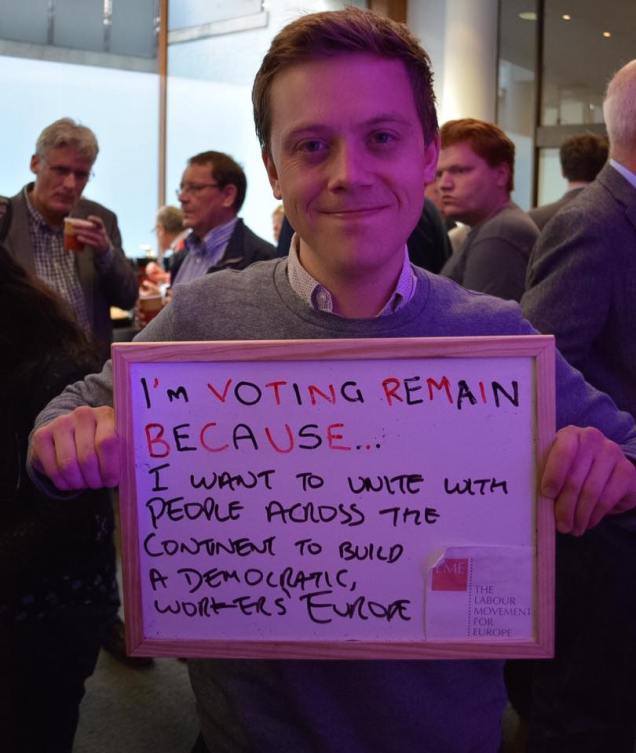
The Great Disappointment of the eurosceptic Left, Owen Jones, has popped up with a new contribution to the EU referendum debate in the form of the picture shown above, being widely shared on social media (albeit sometimes in cheekily photoshopped format with the message changed).
While this blog does not usually bother commenting on internet memes, this one is noteworthy because it simultaneously
Sums up the entire basis of left-wing EU apologetics, and
Reveals just how flimsy is that argument
The sign held up by Owen Jones proclaims:
“I’M VOTING REMAIN BECAUSE… I want to unite with people across the continent to build a democratic, workers Europe”
And I want to own a unicorn that shoots fruit based candy out of its ass and grants me three wishes a day, but sadly that is not on offer from the EU, just like the “workers’ paradise” lusted after by Owen Jones isn’t on the menu from Brussels either.
This referendum is serious business. So can Remainers please stop projecting whatever they desperately wish the EU to be onto an organisation which has never really been about friendly trade and cooperation, but is actually all about slowly and inexorably becoming a supranational government of Europe. And which is not going to abandon that long-held goal just because the British are now expressing a few doubts.
I’ve read the history of the EU. I strongly advise others to do the same. And if they still want to Remain, having understood the true nature of the grand projet, they should at least have the decency to admit out loud precisely what it is that they know they are committing us to.
Nobody has yet made a convincing Christian case for the EU. That should tell us something.
If nothing else, the Church of England’s Reimagining Europe blog has served to highlight – with a few very worthy exceptions – the exceedingly low quality of Christian thinking when it comes to the EU referendum question, and Britain’s place in the world more broadly.
Although there are certainly problems with the European Union (no one is seeking to gloss over these), the Dutch are at least able to see some of the positive benefits that belonging to a bigger whole has brought. It seems that they hoped that the debate in the UK would be more positive, more constructive than it has been. A number of people have said ‘Surely they can talk about the benefits of belonging, rather than just saying we are not sure what is going to happen, so let’s stay where we are!’
I think there is a real hope that the vote to Remain will actually be a positive statement of intent, rather than a negative one of fear and uncertainty. We will have to wait and see!
Newsflash, Gready – Britain is and will always remain part of a “bigger whole” whether we remain in the European Union or not. The European Union is a political construct, and a very recent and unproven one at that. It is not interchangeable with the continent of Europe, and it has no democratic legitimacy when it arrogantly claims to speak and act on behalf of the many diverse European peoples. There is a positive case for Brexit based on leaving euro-parochialism behind and engaging more fully in the world, and pro-EU Christians participating in the debate should at least acknowledge this fact rather than arguing against the two-dimensional cartoon Ukipper they hold in their minds.
But this is the very low standard of debate we have sadly come to see from those who claim to represent the Christian perspective. At its core, their argument amounts to little more than “the EU is about friendship and peace and cooperation, and Jesus was in favour of all those things, so what’s not to like?”
Or as the founder of Christians for the EU, the Very Revd Michael Sadgrove, puts it:
“I think life is meant to be lived together in partnerships and collaboration. To walk away from an institution that was set up to pursue those ideals is a big mistake.
“Link that with the Genesis principle that it is not good for a man or a woman to be alone. The EU is very much not perfect, but the essential ideal and aim is still valuable. The world needs nation states to be grouped together in alliances that will be good for the human race.”
Because partnership and collaboration is only possible through political union, of course. The sheer superficiality of this thinking is mind-boggling.
Seriously – boil down most of the pro EU articles over at Reimagining Europe and they amount to little more than that. You’ll hear endless variations on the theme that because we are all brothers and sisters in Christ, somehow it naturally follows that we should be united under the same supranational political umbrella – though curiously the Church of England never wastes its time clamouring for Asian countries to merge together, or for Canada, Mexico and the United States to institute a shared parliament.
Yes, Europe is a Christian continent. But it’s not only a Christian continent, and that’s important to note. It’s a Christian continent, but it is also a ‘Greek’ continent, it is also a democratic continent; which is to say that the space that we call ‘Europe’ is not really a geographical thing. There is no border of Europe, geographically speaking. There are islands off the coast, there is no clear Eastern border.
Instead, what defines the border of the space that we call Europe is a cultural and intellectual thing. It is a space which is defined by what has come before; it is defined by Christianity, and by Greek philosophy, and by a number of other cultural and intellectual movements. So, it’s a mistake to think we are actually a real continent. There is no such thing as a ‘geographical Europe’, it can only really be seen as an intellectual space.
Sadly, many within the Church deliberately ignore these awkward facts, and have convinced themselves that pressing ahead with a uniquely 20th century vision of uniting the diverse under a single supranational government is a wise and moral thing to do – democracy be damned. And they do damn democracy through their actions, because what little organic desire and impetus for European political union there is always comes from the political elites, and not the ordinary people.
As a Catholic eurosceptic, it is frustrating to witness so many fellow Christians accepting the pro-EU, pro-Remain position almost by default, without actually engaging their brains or making considered reference to their faith. I’m no theologian myself, but I’ve read my Bible and I know that the New Testament offers little by way of clear instruction or even guidance as to how any entities larger than individuals and faith groups should organise or govern themselves, while much of the Old Testament reads as a “how not to do statecraft” manual.
If we restrict ourselves then to the teachings of Jesus, from where do Christian EU apologists draw their inspiration? The EU is not a democratic entity, nor is it likely to become one any time soon. What is so Christian about defending an organisation which insulates a continent’s leaders from the practical and political consequences of their rule? What is so Christian about sticking one’s fingers in one’s ears and loudly repeating the mantra “the EU is about peace and cooperation, the EU is about peace and cooperation”, while ignoring the known history of European political union and disregarding the fact that fruitful inter-governmental cooperation could take place just as well outside the EU’s supra-national structure?
Canon Giles Fraser, founder of Christians for Britain, gets it:
“If the Tower of Babel teaches us anything, it is, when man tries to control too much and usurp the power of God then God disperses them,” he said. “Government that is centralised tends towards corruption: that is the history of human nature.
“The biblical pattern is not always for agglomeration of power. God also divides in order that powers would be controlled.”
As I say, I’m no theologian. But I’ve been on the lookout for a more substantial Christian case for the European Union which is not based on wilful ignorance or wishful thinking about the EU’s true nature, and so far I have come up short. Meanwhile, Brexit offers at least the chance of democratic renewal in Britain, potentially giving people (including the faithful) greater control over their lives and communities.
Regrettably, I have come to the conclusion that much of the Christian case for Remain rests either on a lazy “agree with the Left by default” mindset, or the desire to virtue-signal generally “progressive” values across the board. I will be happy to be proven wrong, and to be presented with a serious Christian case for the EU based on the argument that staying part of a supranational political union unreplicated in any other part of the world is 1) what Jesus would do, or 2) what is best for Christians in Europe. But I’m not holding out much hope.
And if that’s what this is really about – cheering on the EU because it signals that one holds the “correct” progressive opinions in other areas – then they picked a really lousy time to do it. Our politics is suffering a crisis of legitimacy, and yet many in the Church have taken the decision to cheer on the one entity which best represents the interests of a narrow European elite overriding the interests of ordinary people.
For the Church as a whole, the consequences of coming down on the wrong side of this issue – or at least failing to come down convincingly on the right side – could be profound. One way or another, now or twenty years down the line, Brexit is coming. And when it does, many leading authority figures within the church will have placed themselves firmly on the side of governing elites rather than the people who fill their emptying pews.
This should be provoking a great degree introspection and self-reflection from Britain’s most high profile Christian leaders. So far, one gets the distinct impression that it is not.
–
Agree with this article? Violently disagree? Scroll down to leave a comment.
Finally, a glimmer of self-awareness from within the perennially self-satisfied Labour Party. But there is a long, difficult road ahead if Labour are serious about reaching out to their legions of disaffected former voters, and it is far from certain that senior party figures have either the stamina or the humility to make the journey
“What makes us great as a country is not our culture, it’s not our wealth, and it’s definitely not currently our footballing abilities.” – Suzy Stride, Labour Parliamentary Candidate for Harlow, 2014
Apparently Tristram Hunt has been filling the time freed up through refusing to serve in Jeremy Corbyn’s shadow cabinet by having a good, long think about why the Labour Party imploded quite so badly under the hapless leadership of Ed Miliband.
Hunt’s principle contribution to this process of soul-searching has been to assemble and edit a book of essays by various people within the party, each one ruminating on the cause of their defeat. The common thread which emerges, unsurprisingly, is the profound extent to which the increasingly metropolitan, middle-class core of the modern Labour Party has diverged from the “white working class”, to the extent that the Labour leadership (and many activists) had almost nothing to say to Britain’s strivers going in to the 2015 general election.
Hunt previews this new book – “Labour’s Identity Crisis” – in an article for the Guardian, and it makes fascinating reading, though probably not for the reasons that its author would like. For it reveals the absolute mountain which Labour has to climb just in order to appear relevant to those voters who have deserted the party for UKIP or the Tories.
“I’m a white working-class Englishman who isn’t on benefits, Labour isn’t for people like me.” That was the brutal message that confronted the Labour party candidate Suzy Stride on a doorstep in Harlow, Essex, during last year’s general election.
It was a sentiment repeated across the country: Labour didn’t speak for England. Worse, in that remarkable tweet from the Islington MP Emily Thornberry – picturing St George’s crosses adorning a semi in Rochester – we seemed to mock it.
It’s very interesting that Tristram Hunt should kick off his article with a quote from failed 2015 Labour parliamentary candidate for Harlow (my hometown), Suzy Stride. Because this is what Stride had to say about the country which gives her life and liberty back during the 2014 Labour Party Conference:
“What makes us great as a country is not our culture, is not our wealth, and it’s definitely not currently our footballing abilities. What makes us great is that we have the dignity to care for those who are most vulnerable. So when did it become acceptable to make parents queue for food at foodbanks?”
This is someone who stood before the electorate asking for their vote only months after boasting on television that she believes there is nothing special about her country, its culture, history or achievements, and that the only thing which we on this rainy island have to be proud of is the fact that we confiscate ever more money from the most productive people in society and blast it indiscriminately at anybody declared by the Labour Party to be “vulnerable” (currently hovering at around 50% of the population, in terms of net welfare recipients).
And yet up pops Suzy Stride in Tristram Hunt’s book, acting as though the seeds of her defeat were sown not by her own contemptuous attitude toward her country, but rather by the mistaken priorities and poor leadership of the national party. The man who went on to beat Stride by 8,350 votes, incumbent Conservative MP Robert Halfon, understands that in fact our culture is great, as is our history, our wealth and global power. And while he is far from being a Thatcherite right-winger, Halfon at least appreciates that the greatness of our country is more than the sum of our public services. Faced with a choice between the two candidates, it was no contest for the voters of the bellwether constituency of Harlow.
Tristram Hunt quotes Stride again, at the end of a long passage on immigration:
For too many voters, we were still the party that had once dismissed Gillian Duffy as “bigoted” for raising the question of mass migration and cultural change. Labour still has a long way to go to acknowledge the post-2004 influx as one of the most dramatic demographic surges in the history of England. As a result, England has changed in cultural and ethnic composition with an intensity many voters understandably find deeply unsettling.
For at the same time as new migrants found work, manufacturing was laying off workers in the face of increased global competition. There was no direct link between the jobs gained and those lost, but the conjunction of immigration, globalisation and job losses left a toxic political legacy: industrial communities in England saw their way of life change under a Labour policy for which democratic consent was never sought, let alone given. Even worse was an unwillingness by Labour activists to acknowledge the problem. According to Tim Bale, professor of politics at Queen Mary, University of London, eight out of 10 Labour party members think that immigration is good for the country. This is not the case on most doorsteps in Labour areas. And when, in 2015, English voters raised cultural concerns about changes in language, dress and social norms, we answered with crass, material responses. “Many middle-class Labourites scoffed at such views,” according to Suzy Stride in Harlow. “Where would the NHS be without immigrants?” was a common response from canvassers, she said.
This is actually a very good passage, and is the closest we have yet come to anything approaching contrition for the way that the New Labour government of Tony Blair waved through an unprecedented influx of immigrants without so much as mentioning it to the British electorate, let alone seeking their permission. Whether one is generally pro or anti-immigration (and this blog is very much pro), we should all be able to agree as democrats that such a significant national change, brought about by stealth, was an unconscionable act of arrogance by the Blair government. The fact that many Labour activists still have to be coaxed ever so gently toward this realisation is itself a sign of how much atoning the party still has to do.
Tristram Hunt then gets to the core of it:
A failure to appreciate the value of Englishness played an important role in our 2015 defeat and nothing Corbyn has done as leader has changed this. Indeed, his cosmopolitan views on immigration, benefits, the monarchy and armed forces are likely to have exacerbated the disconnect.
As George Orwell put it: “In leftwing circles it is always felt there is something slightly disgraceful in being an Englishman and that it is a duty to snigger at every English institution, from horse racing to suet puddings.” He was right: in no other progressive European tradition – from the French Socialist party to Spain’s Podemos – do you find a similar reluctance to fly the flag.
So there are obvious reforms for Labour to pursue: an English Labour party; a referendum on an English parliament; radical devolution to cities and counties. Alongside that, we have to be careful during the EU referendum campaign not to alienate those millions of Labour voters opting for Brexit. But more than that, what these tales from the 2015 campaign expose is Labour’s need to shed its metropolitan squeamishness about England. It needs to express its admiration and love for the people and culture of this great country.
An admirable sentiment, but at present a futile hope. As Hunt himself admits, the election of Jeremy Corbyn to the leadership of the Labour Party has done nothing to change the core of the party’s disdain for that bulk of people lumped together under the umbrella term “white working class”. While this blog hailed Corbyn’s leadership bid not because of his odious foreign policy opinions but because of the opportunity he represents to inject some real partisan choice back into our domestic political debate, there is sadly little evidence that the army of new members Corbyn helped attract to the party hail from outside the urban, middle class clerisy first identified by Brendan O’Neill as the Labour Party’s new de facto rulers.
You see the effect in Jeremy Corbyn’s immediate U-turn on the European Union the moment he became Labour leader. Corbyn had always held a principled eurosceptic stance and had voted to leave back in the 1975 referendum, and yet here he is in 2016, chanting the praises of Brussels. Why? Because while the Labour party membership will forgive many things (including supporting the IRA, as Alex Massie reminds us), the one thing they cannot abide is a failure to support the mindless, anti-democratic pseudo-internationalism of the EU, or the failure to take a firm, unapologetic stance in favour of unlimited immigration. Those things are simply non-negotiable for Labour activists, most of whom can scarcely conceal their disdain for anybody who fails to hold the “correct” view on immigration in particular.
And that’s the problem. Too many Labour activists actually hate the people of this country – or at best they view those not already convinced of Labour’s righteousness as dangerously ignorant, as Tristram Hunt goes on to explain:
Jamie Reed, MP for Copeland, in Cumbria, takes the analogy further by suggesting that, if Labour fails to embrace Englishness, it will face in northern towns and villages the same fate as the Democrats in the US south: a failure to connect “culturally” with a socially conservative working-class electorate, increasingly willing to vote against their own material interests.
Jamie Reed presumptuously declares that it is the cultural issues surrounding English identity which make natural Labour supporters spurn the party and vote against their own material self interest. But this lazy “what’s the matter with Kansas?” attitude is itself part of the problem – the arrogant assumption that people are voting Tory or UKIP despite rather than because of their right wing economic policies, and that of course they would see that good old fashioned socialist policies would be much better for them, if only they were a little more educated.
The headline of Hunt’s piece in the Guardian is “There’ll always be an England – and Labour must learn to love it”. But from all the evidence currently on display, aspiring for love is setting the goal far too high. First, Labour must learn simply to tolerate the country again – to look upon the white working class and others of their former supporters not as godless infidels who spurned the One True Faith and threw their lot in with the genocidal Tories and racist Ukippers, but as decent and rational human beings who simply don’t like what the Labour Party is currently selling.
Meanwhile, Labour shadow ministers and the army of activists who knock on doors and deliver leaflets need to dial down the moral sanctimony from 100 to about 50, and accept that maybe they, rather than the electorate, made the mistake on May 7 (and the days leading up to it) last year.
If these extracts from “Labour’s Identity Crisis” – and the behaviour of Labour supporters in the year since that fateful general election – are anything to go by, the party has a lot of unresolved anger toward the British electorate. If this were a marriage, couples therapy would most definitely be in order. All of which is quite ridiculous, because it is Britain which has every right to be angry at the Labour Party, and not vice versa.
The white working class and many others spurned the Labour Party in 2015 not because they are morally defective, but because the centre-left, urban, woolly Fabianism of the Miliband era had absolutely nothing to offer them.
And what remains uncertain, despite a radical change in leadership and a plucky first attempt at introspection from Tristram Hunt, is just how the Labour Party ever expects to win a future majority when they continue to hold such a large segment of the population in open contempt?
–
Support Semi-Partisan Politics with a one-time or recurring donation:
–
Agree with this article? Violently disagree? Scroll down to leave a comment.
While many Brexiteers may be in line for a gold star for trying hard, the official Vote Leave campaign and its major spokespeople are coasting for a big fat F when it comes to execution
With little more than a month to go until voting in the EU referendum, it is worthwhile for Leavers and Brexiteers to pause, take stock of where we are and conduct a candid review of our strengths and weaknesses – what is working, and what is actively setting back the cause of independence from the European Union.
This blog post is not such a detailed report – though some other intrepid Brexiteer may well wish to create one, as a matter of historical record if nothing else. For in truth one does not need to dive deep into the poll numbers or aggregated political analysis to see that the Leave campaign is not only on course to lose the EU referendum, but is actively doubling down on those behaviours and activities which make defeat more likely.
For evidence, one has only to regard this crowing article in the New Statesman, in which Glenis Willmott gloats about the overly-emotional, rank amateurism of the country’s most prominent voices for Brexit.
One can almost hear the glee in her heart as Willmott writes:
They needed a new argument, a positive, forward-looking vision for what they see as the future of Britain… but they realised they didn’t have one so reverted to WWII and Hitler. Having lost all arguments on the economy, Vote Leave’s Boris Johnson raised the spectre of Hitler, talking about superstates and “historical parallels” between the EU and Nazi Germany. And they’re accusing the Remain campaign of being fearmongers?
They’ve complained about the terms of the debate. They’ve accused broadcasters of conspiring with the government. They’ve said journalists would be punished, and called for civil servants to be sacked. They’ve said they’ll disrupt pro-EU meetings and target pro-EU businesses. At every stage they’ve attacked individuals or organisations and not their arguments. And now they’ve invoked Godwin’s Law by comparing their opponents to Hitler.
Their tactics are the textbook definition of the increasingly desperate behaviour of the losing side in a debate.
Willmott concludes:
It’s what happens when you’ve given up on convincing the undecideds and care only about firing up die-hard Eurosceptics, praying for a low-turnout poll, which Vote Leave privately admits is their strategy. Having lost the argument on the economy, they’re now following step-by-step the UKIP guide to politics: attack foreigners, bash immigrants and peddle conspiracy theories of continental plots to take over Britain, likening Brussels of today to Berlin of yesteryear. It would be laughable if it wasn’t so serious.
And who can disagree with her? People expect some kind of positive message if they are to vote for a campaign – it can’t all be doom and gloom. And while the Remain campaign are certainly no strangers to scaremongering, they do at least take time to waffle on about their vague, fictionally pleasant European Union, a naive vision of a loose association of countries coming together on a super voluntary basis to fight crime, trade with one another and enshrine rights for working people.
Never mind that this idealised vision of the European Union is complete nonsense (and it is). People believe it because Vote Leave are too busy shouting about building a new hospital on every street corner with the money we supposedly save from leaving the EU that they almost totally neglect to pick apart Stronger In’s incredibly superficial and deceptive sales pitch.
It does, therefore, strongly appear as though Vote Leave have given up on winning the new support of anybody without a long-held antipathy toward the EU, choosing to focus instead on firing up the base and praying for a low turnout. Sadly, this almost never works. Brexiteers fired up on lashings of anti-immigration, “they need us more than we need them” rhetoric can still only vote once, just like everyone else. A fervent minority is still a referendum-losing minority.
Worse still, when they aren’t ranting about building hospitals on top of hospitals on top of hospitals in their utopian post-Brexit Britain, Vote Leave and other eurosceptic big beasts love nothing more than to prance around playing the role of the aggrieved victim. Despite having known for a long time that the prime minister is an unrepentant europhile and that the Cameron/Osborne “renegotiation” was nothing more than a deceptive piece of theatre, the brightest stars in the eurosceptic firmament somehow neglected to come up with a countervailing strategy besides running weeping to the media, sobbing about how unfair it all is.
This kind of complaint is worse than useless, it is embarrassing.
Anyone over the age of six who squeals, ‘He’s not playing fair!’ is absurd.
Of course Cameron is not playing fair. Of course he has been involved in secret dealings with big business. He is a politician who intends to win, and he has form for exactly this kind of behaviour.
I therefore have no time for Tories such as the MP Jacob Rees-Mogg who is reported today to be ‘furious’ over Cameron’s secret FTSE dealings.
Rees-Mogg told the Bruges Group in London that Cameron’s secret Remain dealings with the big corporations while he still worked to make people believe he might support Britain leaving the EU was ‘a scandal of the highest order.’ He said it appeared Parliament had been misled by Cameron.
Yet Rees-Mogg is a member of a party that was happy to go on backing Cameron even after he betrayed his ‘cast-iron guarantee’ to give the British people a referendum on the Lisbon Treaty.
That betrayal was in 2009. Cameron was a weasel then; he is a weasel now. It is no good for Leave campaigners such as Rees-Mogg to act as if they have only just realised it.
Quite. While it is not unreasonable to remark on the levels of deceit and lack of principle emanating from the Conservative Party leadership – pity the day when we come to accept it as unremarkable, or even virtuous – there is no point building a national referendum campaign around the fact. Besides the fact that momentum matters in elections and moping around weeping that you got a raw deal is like a big neon sign declaring that the momentum is with the other side, we are back to the fact that the Leave campaign does not have a compelling vision of an alternative Britain outside the EU.
And Vote Leave failed to come up with an alternative vision for Britain because that would mean having some kind of plan for Brexit. And they long ago decided that their unrepentant lack of a Brexit plan was somehow going to be their greatest selling point.
As Synon concludes:
The Leave campaign needs to stop whining that the campaign is ‘unfair,’ because of course it is.
However, Cameron is winning this referendum not because he is slippery, he is winning it because the official Leave campaign has described no clear, safe path out of the EU for the voters.
In other words, Cameron is not winning this campaign. The Leave campaign is losing it by being unthinking, uninformed, and unorganised.
This much is true: Cameron is not winning, but rather the Leave campaign is losing. And while the pro-EU side may have the advantage, at least this is not based on the great skill of the Remain campaign. David Cameron and his motley crew are coasting by using the advantage of their bully pulpit and the public’s natural hesitancy to depart from the status quo as their chief weapons. Even most Remainers would likely concede, under pressure, that Cameron achieved no meaningful concessions in his renegotiation, and that they cannot say with certainty what the EU will look like in five, ten or twenty years’ time, for example.
Right now this is enough, because Vote Leave have decided to fritter away their time and resources making ridiculous promises, playing the victim and invoking Godwin’s Law. Thus the Remain campaign is winning by default. But their numbers are potentially soft – people are sticking with Remain only because Boris Johnson doesn’t look like the type of man who can tie his shoes unaided, and because the avalanche of establishment opinion (organisations with no mandate to care about democracy but with strong interests in maintaining short term economic stability) coming down on the side of staying in the EU.
Realistically, there is no chance now that Vote Leave will significantly change their tactics, or suddenly embrace Flexcit and the EFTA/EEA model as a stepping stone out of political union. That ship has sailed. The only hope is that the Remain campaign’s principle strength – the overwhelming support of the establishment – may yet become its biggest weakness. And this could well happen.
Right now, Stronger In can point to a cast of thousands of the great and the good who have all lined up to tell the British people that the EU is wonderful, that Cameron negotiated a brilliant new deal and that exiting political union would lead to economic (and even military) armageddon. But what if this stops acting in their favour? These are febrile, uncertain times where little is certain except for the fact that those in positions of authority are distrusted and despised as almost never before. So what if the British political establishment, Barack Obama, Christine Lagarde, David Cameron and his CEO buddies all singing from the same hymn sheet begins to seem more like a stitch-up than wise counsel? What if their unanimity becomes more like a criticality accident of sanctimonious, self-interested elites clubbing together for their own gain rather than the sober, high-minded intervention they like to imagine?
Returning to the half term report card analogy, right now it is fair to say that the official Leave campaign has failed every single piece of coursework they have been set so far. This is not good. But fortunately, fifty percent of the total class grade is based on the end of term exam, and here we have an opportunity to make up some distance. We are never going to get an A and win by a landslide, but a concerted effort in the right direction and a hefty dose of luck* could yet bring us to 50% +1, which is all we need.
So do not despair, fellow Brexiteers. A pathway to victory still exists, albeit one which is heavily dependent on luck, or “events, my dear boy, events“. Fighting the EU referendum with Vote Leave in the driving seat is like being partnered with the class idiot for an important assignment – we are going to have to do all the leg work while they thrash around attention-seeking and disrupting everyone else. It will be difficult, but it can be done. Just buckle down, hope that the shining ones at Vote Leave towers manage to keep a lid on their worst excesses, and then pray for some kind of game-changing event to shake up the board.
This thing isn’t over until it’s over.
*mostly involving Vote Leave sitting out a few rounds and letting the adults take a turn.
–
Agree with this article? Violently disagree? Scroll down to leave a comment.
“Postcapitalism” author and former Channel 4 economics editor Paul Mason is a truly nasty piece of work. For proof, one need only look at his latest sickening column in the Guardian, in which he diligently catalogues all of the European Union’s faults and inherent anti-democratic tendencies before going on to say that he can’t possibly support Brexit when the Tories are in charge, because doing so might mean that some awful right-wing people get to implement policies democratically chosen by the British electorate.
The leftwing case for Brexit is strategic and clear. The EU is not – and cannot become – a democracy. Instead, it provides the most hospitable ecosystem in the developed world for rentier monopoly corporations, tax-dodging elites and organised crime. It has an executive so powerful it could crush the leftwing government of Greece; a legislature so weak that it cannot effectively determine laws or control its own civil service. A judiciary that, in the Laval and Viking judgments, subordinated workers’ right to strike to an employer’s right do business freely.
Its central bank is committed, by treaty, to favour deflation and stagnation over growth. State aid to stricken industries is prohibited. The austerity we deride in Britain as a political choice is, in fact, written into the EU treaty as a non-negotiable obligation. So are the economic principles of the Thatcher era. A Corbyn-led Labour government would have to implement its manifesto in defiance of EU law.
And the situation is getting worse. Europe’s leaders still do not know whether they will let Greece go bankrupt in June; they still have no workable plan to distribute the refugees Germany accepted last summer, and having signed a morally bankrupt deal with Turkey to return the refugees, there is now the prospect of that deal’s collapse. That means, if the reported demand by an unnamed Belgian minister to “push back or sink” migrant boats in the Aegean is activated, the hands of every citizen of the EU will be metaphorically on the tiller of the ship that does it. You may argue that Britain treats migrants just as badly. The difference is that in Britain I can replace the government, whereas in the EU, I cannot.
This is fair and accurate criticism of the EU. Mason rightly senses the unaccountable nature of the supranational government in Brussels, and hones in on the key point – that the EU is antidemocratic because we have absolutely no way of removing its leaders if we wish to do so.
Unfortunately, it then quickly begins to go off the rails, as Mason’s snarling anti-democratic authoritarian streak surges to the foreground:
Now here’s the practical reason to ignore it. In two words: Boris Johnson. The conservative right could have conducted the leave campaign on the issues of democracy, rule of law and UK sovereignty, leaving the economics to the outcome of a subsequent election. Instead, Johnson and the Tory right are seeking a mandate via the referendum for a return to full-blown Thatcherism: less employment regulation, lower wages, fewer constraints on business. If Britain votes Brexit, then Johnson and Gove stand ready to seize control of the Tory party and turn Britain into a neoliberal fantasy island.
They will have two years in which to shape the post-Brexit economy. Worse, the Tories will be free to use the sudden disappearance of our rights as EU citizens to reshape the UK’s de facto constitution. The man who destroyed state control of education and the man who shovelled acres of free land into the hands of London developers will get to determine the new balance of power between the citizen and the state. So even for those who support the leftwing case for Brexit, it is sensible to argue: not now. The time to confront Europe over a leftwing agenda is when you have a Labour government, and the EU is resisting it.
Waah, waah, waah. In other words, Paul Mason fully appreciates that the European Union is hopelessly undemocratic and utterly unreformable, but he refuses to either campaign or vote for Brexit because reclaiming democracy for Britain might mean that we then go on to do the “wrong” thing with our new-found freedom.
Britain’s parliamentary system of government is not a shocking new reality. Our present system of mini “elected dictatorships” spanning the length of a parliamentary term is how Britain has always been governed in living memory. And unfortunately for Paul Mason, our electoral system produced a Conservative majority government one year ago. You can argue that most people did not vote for the Conservative Party. True. But if we don’t like the system by which our governments are chosen, it is within our power to change it. Indeed we had just such an opportunity back in 2011, and decided to stick with the status quo.
So when Paul Mason frets that a Brexit under the Tories might lead to two years of “neoliberal fantasy” government, what he actually means is that Britain might be led by the government which we only recently elected together. He is fretting that an anti-democratic impediment to Conservative rule in the form of Brussels might be removed, and that the government might then seek to fulfil its manifesto outside the constraint of the EU’s political union. He is effectively presenting democracy as the scary thing to be avoided, and the European Union as the “least worst option”, one step better than democratically chosen conservative government.
Mason then goes on to make it worse:
All this suggests that those of us who want Brexit in order to reimpose democracy, promote social justice and subordinate companies to the rule of law should bide our time.
And there’s the problem, right there. Paul Mason doesn’t support an eventual Brexit because he believes in democracy or the importance of British sovereignty. He wants Brexit only as a means to imposing his own radical left-wing policies and “social justice” values on the country. When the people look likely to support these concepts at the ballot box, he chafes at the democratic impediments thrown up by the European Union barring their implementation. But when the people spurn his left wing fantasyland and choose a conservative government, suddenly Brussels becomes his best friend, his bulwark against the people he views as “closet Nazis”.
Behold the face of the Mason/Corbynite Left. This is a movement which, to their credit, has no natural love for the European Union, often seeing it for what it is, but who have shamefully taught themselves to accept Britain’s EU membership as the price which must be paid in order to successfully “lock out” conservative viewpoints and policies.
This is a movement chock full of people who love nothing more than to prance around screeching about how wonderfully tolerant and accepting they are, right up until the moment they encounter somebody with a different political philosophy, at which point any previous lip service paid to the importance of democracy or even free speech goes straight out the window.
It’s hard to say which is worse – the fact that Paul Mason harbours these seething anti-democratic sentiments in the first place, or the fact that he is so shameless that he openly admits his desire to thwart the general election result by forming a temporary alliance with the hated European Union, swinging around to support Brexit only when the prospect of giving democracy back to Britain seems likely to deliver the kind of government he wants.
One thing is for certain, though – Paul Mason is no man of the people, and no friend at all of democracy.