Brexit Catastrophisation Watch, Part 5 – Britain Stronger In Europe Tacitly Admit They Were Lying The Whole Time

open-britain-hard-brexit-soft-brexit-catastrophisation

While advocating a “soft Brexit” as their fallback position, Remainers contradict themselves and expose the tawdry lies they told during the EU referendum

Even Open Britain, the shrivelled husk of Will Straw’s failed Remain campaign group Britain Stronger in Europe, has now effectively admitted that leaving the European Union need not be intrinsically economically harmful – thus undermining the central pillar of their case for staying in the EU.

The harsh light which Remainers are now knowingly shining on their prior scaremongering and lies is quite hilarious. By drawing a distinction between “hard” and “soft” Brexit and campaigning fervently for continued membership of the EEA, campaigners are effectively admitting that their many economic apocalypse warnings applied only to leaving the single market, and not the EU’s political union.

From an Open Britain campaign email sent to supporters yesterday:

Open Britain is campaigning for Britain to stay in the Single Market, which brings increased investment, trade, jobs and growth.

It seems the public agree. A new poll we commissioned has found that 59% of voters want the UK to stay in the Single Market, so there is no mandate for a destructive Brexit.

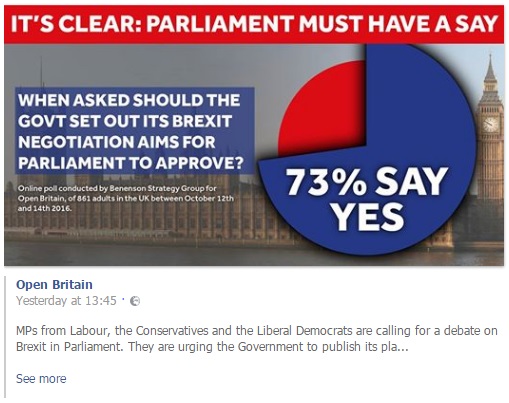
Now, MPs from Labour, the Conservatives and the Liberal Democrats are calling for a debate in Parliament. They are urging the Government to publish its plan for the forthcoming EU negotiations and to allow Parliament to approve it. A huge majority – 73% of people – support this.

Our future partnership with the EU should be not decided in secret but determined by democratic debate.

There is “no mandate for a destructive Brexit,” we are told. Well, that’s funny. Because not long ago, every Remainer in town – most certainly including Britain Stronger in Europe – was screeching about the automatic ruin which would befall Britain if we voted to leave the EU, regardless of how the Brexit process played out or whatever our eventual new trading and political relationship with the EU happened to be. For months we were told by sanctimonious Remainers that “destructive Brexit” was the only kind of Brexit available – yet now they acknowledge a benign version of Brexit and encourage us to adopt it.

Fast-forward four months and suddenly the story changes. Now, apparently, we need to fight tooth and nail to preserve our membership of and unimpeded access to the single market, because this is the lynchpin on which Britain’s economy rests. In other words, their entire economic scaremongering case was a giant lie.

Oh sure, they’ll come back and claim that most Brexiteers supposedly want a “hard Brexit” and that the major Leave campaigns envisioned Britain leaving the single market, which is why they felt justified in equating the European Union with the single market in their own campaign rhetoric. But this is the mealy-mouthed defence of someone who has been caught in a blatant lie. Remainers were desperate to bury the awkward fact that the EU and single market are not one and the same thing, and the fact that they did all they could to fudge the distinction (heck, they suggested that leaving the EU meant severing ourselves from the continent of Europe) shows that they were more obsessed with economic scaremongering than truth. It is Remainers, not Brexiteers, who dwell in a land of post-factual politics.

As this blog recently commented:

Funny. It’s almost as though [Remainers] are suggesting that leaving the EU needn’t necessarily mean “plung[ing] the UK into a period of recession and international decline”, and that Britain’s economic and diplomatic health is actually contingent on the kind of choices that Britain makes once we are free of the supranational political union.

Claiming that a mismanaged, uncontrolled or “hard” Brexit might cause serious economic harm is a perfectly respectable position. More than that, it is basic common sense. But that isn’t the argument that Remainers were making during the EU referendum campaign. No, they were claiming that any form of Brexit would be disastrous, that Britain leaving the European Union would be economically calamitous in and of itself, regardless of how Brexit unfolded or the model of our future trading relationship with the EU.

As it happens, this blog agrees with Open Britain’s revised position. Certainly as an interim measure Britain should remain in the EEA while working toward a longer-term solution which hopefully replaces the single market with a new framework which is more democratic and not part of a protectionist, beady-eyed, euro-federalist master plan. Given that the most skilled trade negotiators in the world (in which Britain is singularly lacking, despite generous help from our Commonwealth friends) take a decade or more to thrash out comprehensive bilateral agreements it is the height of idiocy to assume that a Brexit-inspired sense of urgency and the concerns of “German car makers” will get the job done in the initial two short years set out in Article 50 of the Lisbon Treaty.

But why couldn’t the Remainers just be honest from the beginning, level with the British people and tell them that it is Britain’s uninterrupted EEA access, not our membership of the supranational political union, on which our economic stability depends?

The answer, of course, is that for top Remainers the EU referendum was never about economics. It was about their craven desire to live in an amorphous internationalist blob where the nation state is fatally undermined and the strongest level of government and identity reforms at the European level. That’s what they wanted but couldn’t say in public. And so instead they falsely equated the EU with the single market in an attempt to scare low information voters and assorted unthinking lefties that voting for Brexit inherently meant economic doom.

Now that the decision to leave the EU has been made, these disingenuous people are having to regroup and come up with a new argument – that it is our future relationship with the single market, not the EU, which will have the greatest potential impact on our economy and future prosperity. And just as even a stopped clock tells the correct time twice a day, this time they happen to be correct.

Unfortunately, changing arguments mid-stream also reveals that nearly everything that the Remain campaign said prior to the EU referendum was a deliberate, filthy lie.
 

European Union - United Kingdom - Britain - Flags

Support Semi-Partisan Politics with a one-time or recurring donation:

Agree with this article? Violently disagree? Scroll down to leave a comment.

Follow Semi-Partisan Politics on TwitterFacebook and Medium.

A Third Runway At Heathrow Or Fixing Potholes In Roads? We Need To Be Bigger Than This In The Age Of Brexit

aviation-airplane-on-tarmac-at-airport

It is Westminster politicians and journalists, not Brexiteers, who have been short sighted and parochial

The Telegraph’s James Kirkup poses an interesting question about the expansion of Heathrow Airport and other national political priorities in the post-Brexit world:

Almost 70 per cent of commuting is done by car so roads are clearly of interest to voters, never mind the wider economics.   But it’s hard to avoid the conclusion that big shiny infrastructure projects like runways and high-speed railways are simply more glamorous and interesting to politicians and, yes journalists, who spend more time in London (where most people commute using public transport) than stuck at a roundabout trying to get onto a bypass.

Airport expansion is about international trade and competitiveness, our national self-image and our global role. All the important things that important people in London spend so much time talking about, in other words.  And rightly so. We should have another runway at Heathrow, and one at Gatwick, come to that: the more competition the better

But then our leaders really should start talking about things that are actually important to the people they work for: clogged roundabouts, congested junctions and potholes.

Earlier this year, the Treasury gave councils £50 million extra to fill holes in roads. Councils reckon they need £12 billion more to fill them all. That’s close to the £16 billion that might need to be spent on new roads around an expanded Heathrow. Which would voters choose in a referendum?

Read the whole thing – it is a thoughtful piece. And of course James Kirkup is right to point out that key national infrastructure projects and local community investment need not be mutually exclusive.

Personally, I make no apologies for firmly supporting the expansion of Heathrow Airport, as well as new runways for Gatwick Airport any any other airport which wants to expand to the benefit of our aviation sector.

As this blog previously ranted:

Air travel is great. It takes rich tourists from wealthy countries and brings them to poorer countries where they boost the local economy with their money. It keeps the wheels of business turning, from the CEO flying from New York to London for a meeting, the office worker commuting to Berlin every week for a project, to doctors and scientists gathering for international conferences.

Air travel bridges the distance between our towns and cities and helps knit the planet together through a web of far-flung family members, friendships and business relationships. And in doing so, the aviation industry helps to foster trust and understanding, bridging cultural divides and doing more to affirm our common humanity than any third-sector institution or political movement.

And yet we seem intent on attacking aviation, thwarting its growth and choking the life out of the industry with punishing airport taxes and insurmountable barriers to expansion. And for what? So that human beings can creep meekly across the surface of the planet, apologising for our very existence and ostentatiously offsetting the carbon dioxide we emit whenever we open our mouths?

But I must admit to bristling a bit at Kirkup’s analogy comparing Brexiteers to downtrodden locals worried only about potholes in their roads, while the Remain-supporting establishment are cast in the role of far-sighted metropolitan elites who alone acknowledge and face up to the long term problems facing our country.

If anything, it is actually the other way around. By continually divesting Westminster of more and more decision-making authority through successive EU treaties and agreements, it is the British political class who effectively dragged the level of our political discourse down to the level of squabbling about NHS waiting times, train delays and potholes in the roads. When all of the consequential decisions – like trade, and increasingly foreign relations – are taken at the European level, all that’s left for British politicians is to squabble about whether the BBC should be forced to up its bid for The Great British Bake-Off.

That’s why we now have a wishy-washy parliament and civil service which is having to rebuild atrophied trade negotiation competencies almost from scratch, while we look to our prime minister less as a world leader or person of real consequence, and more as a glorified Comptroller of Public Services, someone to moan about on social media when the local library closes or the street lights don’t get repaired quickly enough.

The British people instinctively realised this, too, when they voted in the EU referendum. They realised that they only way to even begin to regain control over the full range of domestic and foreign affairs which trickle down to impact their lives was by leaving the failing supranational, federalist experiment known as the European Union.

Kirkup suggests that our leaders “our leaders really should start talking about things that are actually important to the people they work for: clogged roundabouts, congested junctions and potholes”. Well excuse me, but I specifically do not want the prime minister of my country to be wasting her time fussing over potholes and traffic jams. I want the political leadership of this country to set its sights on higher matters for once. In fact, the rule of thumb should be that Westminster only takes an interest if a decision cannot be fairly and responsibly made at a lower level.

And as for Kirkup’s fact that £50 million was given by the Treasury to local authorities to fill in potholes, this is simply more evidence that all government in Britain is vastly overcentralised – that the work of constitutional and governance reform must continue well beyond Brexit. Why not vastly reduce the amount of personal income tax or VAT claimed by central government, and devolve increased tax-levying powers to the counties instead? That way, the people of Liverpool and Bristol can pursue policies which work for them, while the people of rural Essex or Cambridgeshire can do likewise – whether they choose to prioritise filling in more potholes or attracting new investment by slashing taxes or offering incentives to business.

The real danger of Brexit is that nothing much changes and we fail to rock the boat; that we fail to properly grab this once-in-a-lifetime chance to critically re-examine the way in which we govern ourselves and make important decisions at a personal, community and national level. Securing an economically stable secession from the European Union should be the minimum requirement, not the grand prize. Why go to the effort of leaving the EU simply to return to being governed by the same set of domestic institutions which orchestrated our national decline prior to joining the European Economic Community, and then gave away more and more power to EU institutions once we were inside?

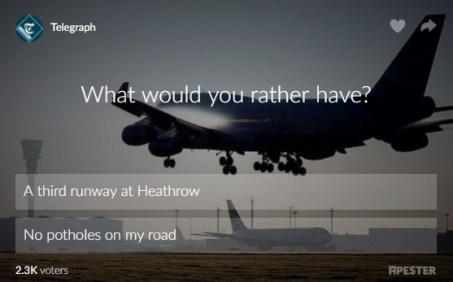
Ultimately, the media does us a disservice by framing idiotic questions and false choices like whether we would prefer a new runway at Heathrow Airport or for the potholes on our road to be fixed:

third-runway-at-heathrow-airport-or-no-potholes-on-my-road

Ask your average group of people whether they want to see enacted a policy which benefits them personally or one which has larger but more disparate benefits spread among a much larger population, and a majority will vote with their own immediate self interest – 67% to 33% as it currently stands on the Telegraph’s online poll.

Does that mean that this is the better policy? Absolutely not. There are times when we are one nation and must subordinate the narrow interests of certain interest groups in order to further the national interest, and there are many other times when we should be able to organise ourselves as communities and regions without the heavy-handed interference of Westminster. And while central government should absolutely be rolled back in many areas, subjecting new airport runway capacity decisions to a citizen’s pothole veto is precisely the wrong way to run a country or frame important strategic decisions.

We need to up our game. Politicians, journalists, ordinary citizens alike, all of us need to try harder to live up to the momentous times in which we find ourselves.

If we stop shooting for the middle and actually try to make the most of the historic opportunity afforded by Brexit then in a decade’s time we might witness a rebirth of local democracy and improve citizen participation in the democratic process at all levels. Better still, we might stop behaving like such dependent children, looking petulantly to Westminster for solutions to every issue we face. And if we stopped demanding that the same people who deal with matters of war and peace and the economic stewardship of the country also ensure that the Number 12 bus runs on time then maybe, just maybe we might improve both the quality and speed of critical decision making in this country.

And yes, maybe then there will finally be a gleaming new runway at Heathrow Airport, and at Gatwick too. Because voting for Brexit was the far-sighted, responsible act of enlightened citizens, not grumbling, parochial NIMBYs. And it should be the first of many such acts, not the last.


heathrow-airport-departure-lounge

Top Image: Michael Gaida, Pixabay

Bottom Image: LadyDisdain, Pixabay

Support Semi-Partisan Politics with a one-time or recurring donation:

Agree with this article? Violently disagree? Scroll down to leave a comment.

Follow Semi-Partisan Politics on TwitterFacebook and Medium.

Tales From The Safe Space, Part 42 – Universities Hunker Down For Halloween

halloween-costume-university-of-florida-free-speech

As the nightmare of confected Social Justice Warrior outrage about Halloween costumes comes round once again, spineless university administrators pre-emptively roll over, warning students not to wear “harmful” costumes and preparing lavish contingency plans to flatter and placate anyone who is triggered or traumatised by the annual celebration

Can you believe it has been a year since spoiled and hysterical Yale undergrad Jerelyn Luther achieved her dismal moment in the media sunlight for her on-campus meltdown at a professor who refused to echo the tiresome SJW pre-emptive condemnation of “offensive” Halloween costumes?

A brief reminder:

Some context: the university administrator in question is Nicholas Christakis, the Master of Silliman College. When the university sent a campus-wide notice asking people to be “culturally sensitive” when choosing Halloween costumes this year, Christakis’s wife (repeat: not Christakis, his wife) – who also works for the university – had the temerity to send an email saying that as an educator, what her students choose to wear is none of her damn business.

This didn’t go down at all well with Yale’s coddled population of Stepford Students, for reasons which are now depressingly familiar to many of us. And so it led to a confrontation between some angry young protesters – indignant that the safety of their Safe Space had been compromised – and a harried Nicholas Christakis.

That incident did not end well. The toxic atmosphere churned up by the entitled and oversensitive student protesters led to Professor Christakis having to give up his pastoral position as Master of Silliam College at Yale, while the students themselves shamed themselves in front of the entire world by weeping and rending their garments about Halloween costumes while enjoying the immense privilege of receiving one of the finest educations that money can buy while young people in less fortunate parts of the world are starving, being unjustly imprisoned or having their limbs blown off.

But nobody can say that last Halloween was not an instructive experience – for those currently working or studying at university as well as many other people who became aware of the madness infecting our campuses for the first time. But sadly, it appears that many universities have not learned the right lesson.

Now that Halloween is about to roll around again, the University of Florida is attempting to head off any costume-related hysteria from their student population of adult babies by sending a memo reminding them that wearing the wrong item of clothing could potentially cause “harm” to a completely unrelated third party, and that university authorities will be watching them closely.

From the International Business Times:

Certain Halloween costumes related to race, religion or culture are often deemed offensive. Now, the University of Florida is offering counselling to students who have been troubled by such costumes.

The university sent out a memo to students urging them to make appropriate costume choices for the upcoming holiday. It has also asked students to report incidents of bias to the university’s support team.

“Some Halloween costumes reinforce stereotypes of particular races, genders, cultures, or religions. Regardless of intent, these costumes can perpetuate negative stereotypes, causing harm and offense to groups of people,” the university said in the memo earlier this week. “Also, keep in mind that social media posts can have a long-term impact on your personal and professional reputation.”

Its Bias Education and Response Team will “respond to any reported incident of bias,” the university added. It will also “educate those that were involved, and to provide support by connecting those that were impacted to the appropriate services and resources.”

So standard practice, basically. Students are encouraged to self-censor their own personal expression, with the bar of “acceptable” behaviour set at the triggering level of the most oversensitive and feeble-minded of student crybabies.

That wobbly-lipped little SJW who spends their life hopping from safe space to safe space, and who thinks that encountering the occasional conservative opinion is tantamount to being the victim of “hate crime”? That’s the person who effectively now sits in judgement of all University of Florida students and the costumes that they decide to wear to their own private social engagements. Everyone must limit their own self-expression to avoid triggering the most easily-triggered of souls on campus.

And what if they don’t? What if some awful student, some shameful subhuman, some latter-day Nazi decides to wear whatever they damn well please to a Halloween party, whether it is a white girl wearing a sombrero or some other piece of “culturally appropriative” garb? Well never fear, because the University of Florida’s hilariously named Bias Education and Response Team (the acronym BERT belying its totalitarian mission) is on hand to “educate those that were involved”.

So while students technically keep their First Amendment rights to freedom of speech and expression, in reality the ever-watchful university authorities will be holding them to infantilising yet maddeningly opaque standards of behaviour, and stand ready to send students who cause “offence” to re-education classes.

And what then? What if the student refuses to be re-educated? What if they refuse to be put on “social probation”, as other paternalistic and authoritarian universities are now doing to students who commit speech, thought or clothing crime? Are they to be expelled for

Even the local newspaper, which bends over backwards to be reasonable to the insane people usurping the local university, thinks that they go too far by treating the approach of Halloween as though it as potentially harmful as an incoming hurricane:

We don’t necessarily intend to mock UF. The advisory speaks for itself. But the wording suggests that the current crop of UF students bears no resemblance to the university’s fierce, fearless and armor-skinned mascot. Their collective shells, like their capacity for mirth, seem thin.

It should be noted that UF is not trying to ban Halloween festivities, as far as we can tell. But it would not be surprising to learn that a wayward fraternity prankster who dons The Donald mask would invite chants of “Lock him up!”

[..] One might think mounting debt and a shrinking job market would be more intimidating to these students than a politically incorrect costume. But yes, that’s what we want our next generation of leaders to be: sheltered from controversy, aggrieved by contrary opinions yet critical of, if not revengeful against, those who express them, steeped in identity politics, and adjoined at the hip with some ego-stroking “counselor” so hurt feelings don’t linger. To borrow a phrase popular at the moment, feeding such an attitude at UF and beyond is definitely not how we’ll make America great again.

The behaviour of University of Florida administrators is so far beyond the traditional or reasonable remit of custodians of a place of learning that it quite simply beggars belief. These are young adults, not kindergarten students. These are people old enough to join the military and open lines of credit whom the university does not trust to successfully manage their own interpersonal relationships and any conflicts which arise on their own, without heavy-handed paternalistic intervention?

But to be fair, the students have created the university that they deserve. The minority (and one hopes that it is still a minority) who shriek for the authorities to adjudicate their every social encounter and nurse them back to good mental health in the event of a “bias incident” force university administrators to behave in this way. For as we have all seen over the past couple of years, even bleeding heart leftist professors and administrators with impeccable Social Justice credentials have found themselves vilified and hounded out of their jobs for failing to be sufficiently proactive in anticipating the unique needs of the snowflake generation.

So successful has the campus coup conducted by the Cult Social Justice and Identity Politics been that pre-emptive guidelines about acceptable and unacceptable Halloween costumes (together with stern warnings of punishment and “re-education” for those who transgress) are now all but inevitable.

Spineless university administrators and their thin-skinned, victimhood culture-soaked students are now trapped in a self-reinforcing negative spiral, with each new concession or collaborationist attempt to placate the Social Justice Warriors only serving to validate their actions and encourage them to make ever more egregious demands.

And that’s the real nightmare this Halloween.


Postscript: The University of Florida memo in full:

October brings fall weather and Halloween. If you choose to participate in Halloween activities, we encourage you to think about your choices of costumes and themes. Some Halloween costumes reinforce stereotypes of particular races, genders, cultures, or religions. Regardless of intent, these costumes can perpetuate negative stereotypes, causing harm and offense to groups of people. Also, keep in mind that social media posts can have a long-term impact on your personal and professional reputation. The University of Florida’s Division of Student Affairs Diversity and Social Justice Statement reminds us that UF fosters a community that values and respects diversity. An inclusive definition of diversity recognizes the variety of personal and social experiences that make individuals and communities different from one another.

As a community, we aspire to demonstrate integrity, respect, and compassion that strives to maintain an affirming campus climate for all members of our community. If you are troubled by an incident that does occur, please know that there are many resources available. Please take advantage of the 7 day a week presence of the U Matter, We Care program at the University of Florida by emailing umatter@ufl.edu. Additionally, there is a 24/7 counselor in the Counseling and Wellness Center available to speak by phone at 352-392-1575. Lastly, the Bias Education and Response Team at the University of Florida is able to respond to any reported incidents of bias, to educate those that were involved, and to provide support by connecting those that were impacted to the appropriate services and resources. You may submit a bias incident report at http://www.umatter.ufl.edu/stopbias. Thank you for being mindful of these values, and have a fun and safe Halloween


Safe Space Notice - 2

Top Image: Pixabay

Support Semi-Partisan Politics with a one-time or recurring donation:

Agree with this article? Violently disagree? Scroll down to leave a comment.

Follow Semi-Partisan Politics on TwitterFacebook and Medium.

Debating Political Diversity And The Importance Of ‘Brave Spaces’ At The University Of Miami

college-lecture-hall-safe-space

Whether “brave spaces” are any less infantilising than “safe spaces” is a matter for debate, but the University of Miami community’s recognition of the importance of a more politically diverse faculty and campus is an encouraging sign

The editorial board of the University of Miami student newspaper, the Miami Hurricane, takes a surprisingly bold stance on the problem of progressive ideological dominance on campus, and – encouragingly for a student publication – calls for greater ideological diversity rather than the fearful conformism demanded by many students.

From the Hurricane’s editorial:

UM leans to the left, as do most universities. A report published earlier in the campaign by The Tab documented that 60 percent of faculty donations were made to Hillary Clinton’s campaign; the other 40 percent was split between the other Republican candidates and Bernie Sanders.

In the classroom, professors can be very vocal about their political opinions, whether that’s a subtle joke woven into a lecture or an actual discussion of their political beliefs.

When professors deride or mock certain political views in their teaching, that only alienates students and undermines the purpose of an educational forum. Part of the reason that conservative students feel so disenfranchised from the media and academia may be because for most of their lives, the intellectual “authorities” in their lives have been liberal and taught in left-leaning ways.

At this point, I actually felt a little uneasy. While it is certainly true that the progressivism and intolerance of conservative ideas shown by many university professors is often off-putting to conservative students and academic peers, the idea of people being disenfranchised or excluded because of the words of other peers and authority figures skates awfully close to the wheedling complaints of Social Justice Warriors that criticism and free speech must be suspended for their own mental health.

This blog has warned before that it is only a matter of time before conservatives, persecuted for their beliefs by fellow students and university administrators alike, begin to use the same language of fragility and vulnerability used by the SJWs – and I think we are now starting to see that prediction come true. None of that detracts from the point made by the Hurricane’s editorial board, which remains valid. But as always, a creeping culture of victimhood is something to watch out for, and guard against.

Fortunately, the editorial soon improves:

Courses like The Election are great because they expose students to professors and guests from both sides of the aisle, which can help break down the barriers of bias.  It is much easier to dismiss the opinions of a peer, a social media troll, or a crazy uncle than it is to automatically dismiss the ideas of an authoritative figure who has a Ph.D. in the relevant discipline. Ideological diversity may also help students recognize the flaws in their own opinions and be more self-critical.

When conversations focus on sweeping platitudes rather than individual reasons, our personal networks suffer as well. Too many students have given up Facebook friends or real-life acquaintances over political differences. It’s easy to generalize a whole group of people just based on one or two beliefs that they voice, but these generalizations create many false assumptions, especially in this election when few people are completely behind their candidate.

Restrain from automatically assuming that another student is racist, sexist, elitist or corrupt due to a few of their demonstrated ideological beliefs. People have reasons for holding their beliefs, and if they’re willing to talk about it in a respectful way, then take the opportunity to respond with dialogue rather than a diatribe. Identity politics has made political opinions just as personal as ethnicity and religion, making it hard to separate feelings from ideas.

This is good. Most of us can at times be too quick to pigeonhole and condemn people based on a few assumptions and extrapolations about their political leanings, and the board’s point that many people are not strongly behind their candidate this time (either disappointed Bernie Sanders supporters reluctantly supporting Hillary Clinton or Republicans holding their nose while supporting Donald Trump) should warn us of the sweeping range of variety and nuance which is lost when we simply label people as Trump or Clinton supporters.

The editorial board is also quite right to observe that the rise of identity politics has made it much harder to separate feelings from ideas. A self-aggrandising worldview which places the individual at the centre of everything is an atrocious way to discuss ideas, as it makes rejection of an idea seem like a personal attack. That’s why weepy young students now talk about their identities being “invalidated” when people do not accept the new orthodoxies around sexuality and gender, as though they might simply vanish in a puff of smoke unless everyone on campus is forced to approve of everyone else’s life choices.

And then comes an unusual suggestion:

A healthier alternative for a “safe space” is a “brave space.” A “brave space” encourages people to freely explore different questions and issues – still trying to respect other people, but not restricted by the fear that certain ideas make others feel uncomfortable.

The goal of a diverse college campus is not to create comfortable spaces, but to be caught a little off guard by all of the different types of people and ideas that might not be found in East Portland or a small town in South Dakota. That’s okay. If we embrace that vision, we can create a more tolerant, educated and cooperative community.

Well, a brave space is certainly an improvement on a space where the First Amendment is suspended in order to prevent glass-jawed snowflakes from colliding with reality. The rejection of the notion that uncomfortable ideas should be avoided is, in these depressing times for free speech and academic freedom, a positive step forward.

But surely it would be better still to simply cease talking about “spaces” at all? The term is now ubiquitous – even news articles totally unrelated to the Social Justice agenda talk about the need for public bathrooms to have a “safe space” for parents to change their baby’s diapers. As opposed to what, an unsafe space like a gun range or a demolition site?

Why, when the term “a convenient place” would have sufficed a decade ago, must we now describe everything as a “safe space“? Welcome to my home; here’s a safe space for you to hang your coat, and over there is a safe space for you to sit and watch television. It’s puerile and infantilising.

Is the whole world really so riddled with danger that we need to mark out those places which are actually safe for human foot to tread? The journey from my dorm room to my Ivy League college classroom is fraught with many dangers, but at least the gender neutral restroom offers me a safe place to pee, the shuttle bus provides a safe space for me to ride across campus, the students’ union is a safe place for me to relax between classes and the lecture hall itself is a place where no idea that I deem central to my identity can ever be challenged.

Flippant, yes, but also an accurate transcription of how the contemporary student mind seems to work. And of course it is utterly offensive – there are people in benighted parts of the world where daily physical safety cannot be taken for granted and is routinely violated, yet here are some of the most privileged youths of any generation in history trembling in fear that they may encounter disapproval or mean comments while walking between buildings at their $40,000-a-year degree factory.

(As Malcolm Gladwell explains, this is a result of a shift in the way which we describe actions or behaviours which are undesirable. Whereas once we would have condemned sexism, racism or homophobia as simply being wrong, today we talk spuriously of the “harm” that these words and encounters visit upon us. And when every single human interaction is viewed as having the ability to physically or emotionally harm us, calls for network of safe spaces to act as stepping stones through the world inevitably follow).

Brave spaces are marginally better, perhaps, but it is depressing indeed that we now have to pat ourselves on the back and give ourselves a lollipop for being “brave” and subjecting ourselves to the mere possibility of hearing contradictory viewpoints or unpleasant ideas.

This used to simply be called “being an adult”. Is it really too much to ask that we return to that bygone age of resilience and maturity?


Safe Space Notice - 2

Top Image: Pixabay

Support Semi-Partisan Politics with a one-time or recurring donation:

Agree with this article? Violently disagree? Scroll down to leave a comment.

Follow Semi-Partisan Politics on TwitterFacebook and Medium.


Brexit Catastrophisation Watch, Part 4 – Project Fear Begins To Unravel

edvard-munch-the-scream

By arguing that the British people “didn’t vote for recession” as part of their advocacy for soft Brexit, Remainers inadvertently reveal that there is nothing intrinsically economically damaging about leaving the EU’s political union. Whoops.

With the post-EU referendum debate having moved on from the establishment’s sheer incomprehension of the result to an arbitrary and rather redundant battle over whether the British people voted for “hard” or “soft” Brexit (answer: read the bloody ballot paper), a curious chink in Remainer logic has been exposed.

Here is politics.co.uk’s Adam Bienkov, writing about the challenges facing Theresa May:

The first point to understand is that this is almost certainly the high water mark for her government. With Brexit negotiations not yet even underway, May is able to dismiss all questions about what exit from the EU will actually look like as being unpatriotic attempts to ignore the will of the British people.

As she told Corbyn repeatedly today: “Unlike the right honourable gentleman we think that we should deliver on what the people want.”

But while this approach may chime with the kind of attacks on ‘Remoaners’ we saw on the front page of today’s Daily Mail, it is a trick that can only be deployed for a limited amount of time. Yes the British people did vote to leave the EU, but they certainly did not vote to plunge the UK into a period of recession and international decline. And as the continuing collapse of sterling has shown this week, the sharks are already circling the UK economy. And pretty soon the prime minister is going to have to find a serviceable life raft.

My emphasis in bold.

Slavishly europhile politicians like Labour MP David Lammy are also now taking up the same “nobody voted for recession” refrain:

Funny. It’s almost as though Bienkov and Lammy are suggesting that leaving the EU needn’t necessarily mean “plung[ing] the UK into a period of recession and international decline”, and that Britain’s economic and diplomatic health is actually contingent on the kind of choices that Britain makes once we are free of the supranational political union.

Claiming that a mismanaged, uncontrolled or “hard” Brexit might cause serious economic harm is a perfectly respectable position. More than that, it is basic common sense. But that isn’t the argument that Remainers were making during the EU referendum campaign. No, they were claiming that any form of Brexit would be disastrous, that Britain leaving the European Union would be economically calamitous in and of itself, regardless of how Brexit unfolded or the model of our future trading relationship with the EU.

Here’s Adam Bienkov back in June, failing to draw that very distinction and blithely claiming that Brexit would automatically be damaging, no matter its ultimate shape or form:

Remain’s strongest arguments in this campaign are its warnings that Brexit would cause an economic shock that could cost jobs, increase prices and even push the UK into recession. These are warnings which have been endorsed by an overwhelming majority of economists, politicians, trade unions and international organisations.

One could chalk all of this up to normal political posturing were it not for the fact that Remainers are currently engaged in an insidious exercise to place themselves on the side of truth and reason while casting Brexiteers as bigoted and stupid enemies of truth and deniers of what should be indisputable facts.

Immediately prior to the EU referendum, Adam Bienkov fretted about “the growing disdain in the UK for the very concept of facts themselves”, as though voting for Brexit was somehow an irrational act of self harm:

But with the British public apparently so resistant to facts and the people whose job it is to deal in those facts so mistrusted, there does not seem to be overwhelming cause for optimism.

Even if Remain do somehow scrape a narrow win on Thursday, there should be little cause for joy on the left. Whatever the result next week, this referendum campaign should strike real terror into the hearts of all those on the progressive side of British politics.

If the UK does indeed vote for Brexit then it will open the door to a dark new political era. And it will do so at the same time as the left’s favourite weapons of facts, evidence and reason are less powerful than they have ever been before.

But of course this is a comforting leftist, pro-European lie. The British people did not suddenly become immune to facts. They simply cared about other, more important facts than the ones obsessed over by the Remain campaign – facts, hopes and fears which EU cheerleaders like Bienkov refused to even acknowledge.

Sudden geopolitical change inherently involves economic risk, and so Remainers gravitated toward the economic risk argument like flies to you-know-what, thinking that they could browbeat the public into voting Remain without ever having to do the thankless task of trying to make a positive case for the hated European Union. But it wasn’t enough, because even if Remainers were 100% right about the short to medium term economic risks of Brexit (and they certainly weren’t), the British people cared about other, more important facts.

The public cared about the continued self-governance of our nation and the self-determination of the British people. Even the lowest of low information voters could glance at the history of the EU, all of those furiously denied ratchets towards greater political integration, and see that much more was going on than the “friendship ‘n cooperation” tripe served by the Remain campaign.

The British people didn’t see why their country should remain part of an integrationist, 20th century euro-federalist experiment when every other advanced country in the world outside Europe manages just fine without a continental parliament, supreme court and unaccountable government. They didn’t see how a European Union made up of 28 countries could possibly fight Britain’s corner better than an elected government of the British people, by the British people and for the British people. And they were quite right to question all of these things.

But the leftists and the pro-Europeans had nothing to say to the British people about their legitimate concerns. Zip. Nada. Zilch. Tumbleweeds. They slobbered to stay in the European Union like rabid dogs, but they never gave a good reason why. Instead, they shouted louder and louder about the economic risk, wheeling out one politically compromised “expert” after another to warn us of the impending apocalypse, while pretending that arguments about democracy, sovereignty and national identity were silly, or somehow fringe concerns.

And having been so wrong about the facts which the people considered to be most important, now it also turns out that the key Remainer “fact” – that Brexit would inherently harm the economy, no matter its form – was a steaming pile of nonsense.

Adam Bienkov is free to go on making the argument that a “soft Brexit” in which the current single market access is maintained would be by far the best way to approach our secession from the EU. As it happens, this blog agrees with him – considering that Britain must rebuild atrophied political and diplomatic trade competencies from almost zero, and that the default secession period set out in Article 50 is nowhere near long enough to negotiate a comprehensive replacement, risking additional short term economic obstacles by forgoing the single market without a new framework in place seems ludicrous.

But in making a distinction between hard and soft Brexit, Bienkov is also effectively admitting that Brexit needn’t be economically harmful at all, if done the right way. And if that is now his position, as an advocate of soft Brexit, then he should do the decent thing and apologise to his readers for the thousands of words of pre-referendum doomsaying and post-referendum hysteria to fly from his keyboard.


European Union - United Kingdom - Britain - Flags

Support Semi-Partisan Politics with a one-time or recurring donation:

Agree with this article? Violently disagree? Scroll down to leave a comment.

Follow Semi-Partisan Politics on TwitterFacebook and Medium.