Separate But Equal, Part 1

Instituting a new series to examine disturbing cases of deliberate self-segregation of “marginalised” communities carried out in the name of social justice

Forget “the only gay in the village” – Manchester City Council is putting forward plans for a majority-LGBT housing community for people aged over 50. In this socially engineered ghetto, eligibility to live would depend not on one’s ability to afford the rent but one’s ability to satisfy the diversity checklist of a local government busybody.

Once again, the best intentions of the social justice community result in the most extreme and counterproductive of solutions.

From the Guardian’s report:

Manchester city council has announced plans to create the UK’s first retirement community aimed at lesbian, gay, bisexual and transgender people.

According to the local authority, the city is home to the country’s largest number of LGBT people outside of London and is due to see a rapid growth in the number of LGBT residents over 65 in the next two decades. More than 7,000 over-50s living in Manchester identify as LGBT.

A recent report by the Manchester-based LGBT Foundation, commissioned by the council, revealed that older LGBT people experience higher levels of loneliness and isolation.

Many were fearful of discrimination in existing accommodation and there was a desire for affordable LGBT-specific housing where people could be open about their identity in later life.

The extra care scheme – a targeted development for older people – will house a minimum of 51% LGBT residents, but heterosexual people will also be welcome to apply to live in the accommodation.

The housing will have specially trained staff based on site and pets will be welcome. As well as the LGBT Foundation, the project is being supported by Stonewall Housing and the Homes and Communities Agency.

As one sceptical interviewee in the BBC report wisely asks:

The issue we are going to come up against along the way is that we’ve fought for equality. Do we need a separate space?

Quite.

Of course, the gimlet-eyed do-gooder at Manchester City Council responds, patronisingly:

It’s not necessarily about ghettoising particular communities. It’s offering people who want it that opportunity to spend their time with people who they know will understand them.

Ah well, that’s fine then. If people want to withdraw from wider society into strongholds (weakholds?) where fragility is pandered to rather than resilience developed, of course it is the sacred and noble duty of local government to assist them in their folly at every turn. Who are the guardians of the public purse to question the latest social justice orthodoxy?

Some may say that this is a local decision for local communities, and ask what standing a writer from London possibly has to weigh in on a decision made by Manchester City Council? And I would be amendable to that argument if it were actually the people of Manchester on the hook for this experiment in social divisiveness. But of course they are not.

In overcentralised Britain, the dominant single source of local authority funds – 40% in the case of Manchester – are disbursed by central government after having been raised through general national taxation. And besides the obvious social folly inherent in creating fragile, unresilient and homogenous minority communities in the name of social justice, the fact that all British taxpayers are funding this folly makes it directly my concern, and that of everyone else.

If a private developer wants to create an ethnically, gender or sexuality-based homogeneous environment for private tenants or homebuyers then that is a separate discussion fraught with its own parallel legal questions about discrimination and equality. But in the case of a public initiative and social housing, the government has absolutely no business discriminating along these lines, setting quotas or engaging in any other form of naked social engineering.

We should not be unsympathetic to some of the stories of older LGBT people featured in the BBC News report – being ostracised by friends and family of one’s own generation after coming out must be incredibly hard, particularly in older age. But it should be for institutions of civil society to step in to address these real social problems, and we must get out of the habit of immediately pivoting to local and national government for a solution to each and every problem – especially where the mitigation involves the use of general taxpayer funds.

Heavy-handed governmental interventions such as this only serve to crowd out independent solutions from civil society, and reinforce the expectation that government must play an active, watchful part in nearly every area of our lives. And no matter how well-intentioned individual schemes may be, British taxpayers should not be left on the hook for implementing a social justice revolution in Manchester or anywhere else.
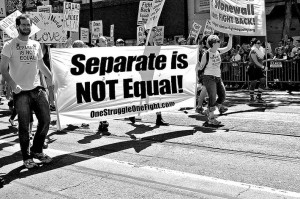
 

Separate is NOT equal - Stonewall - segregation - LGBT

Support Semi-Partisan Politics with a one-time or recurring donation:

Agree with this article? Violently disagree? Scroll down to leave a comment.

Follow Semi-Partisan Politics on TwitterFacebook and Medium.

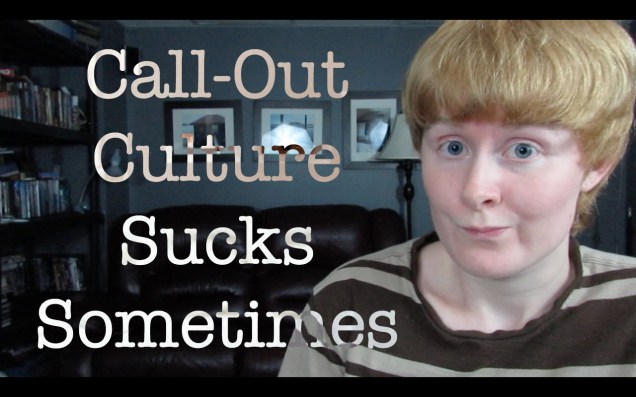
Tales From The Safe Space, Part 51 – The Social Justice Movement’s Toxic, Self-Defeating ‘Call-Out Culture’

Call-out culture sucks sometimes - social justice - SJWs - identity politics

Self-awareness is a rare, endangered commodity within the Cult of Social Justice and Identity Politics

This blog has previously written about the ways in which the Cult of Social Justice and Identity Politics is a revolution determined to eat its own – see here, here, here, here, here, and (most recently) here.

Back in December I reported that there have been potential fleeting flashes of self-awareness from within the social justice community, as certain members – typically those who at one time found themselves persecuted and ostracised by their former comrades for having committed some minor act of thought crime – came to realise that the “call-out culture” within the social justice movement is doing far more harm than good.

Today there is another such spark of self-reflection in the pages of Everyday Feminism, as writer Lola Phoenix offers her tribe a few tentative suggestions as to how they might present a slightly less insufferable face to the outside world.

Of course, Phoenix’s testimonial begins with the now-familiar recitation of personal oppressions and “marginalised identities” to serve as mitigation for the harsh truths she is about to deliver:

Six months ago, I really got called out.

And by “called out,” I mean that the person had more interest in collecting me like I was garbage in a very public way and less interest in helping me understand where I was going wrong.

Hmm, sounds familiar.

Despite my willingness to apologize, to try and learn, their attitude pulled me back into that whirlwind of cognitive ability confusion. As a person on the autistic spectrum, I can’t count the amount of times I’ve been unsure of what I’ve done wrong and have tried to figure out what I did.

Blah blah, you get the idea. But pre-emptive excuses aside, Phoenix goes on to engage in some fairly accurate self-reflection:

We’re not robots, and when we learn we’ve been oppressive in some way, we’re going to have feelings about that. And sometimes that needs to be expressed, but – as of now – there’s no really appropriate place to do that.

As a white person, I’ve seen myself do this to other white people who haven’t learned better. When they exhibit the attitudes I once held, I become embarrassed, enraged at their ignorance, and treat them accordingly.

But we have to keep in mind that so many of us committed to social justice are living in a culture where we aren’t taught how to handle or process anger effectively, so it comes out in abusive ways even when we don’t mean it to.

More:

There is a “callout culture” where ally theatre happens and people enjoy “calling out,” naming, and shaming, witch hunting, and publicly humiliating people.

I’ve been on the receiving end of that.

I do think there’s a difference between confronting someone about their behavior versus humiliating them.

Wow. This is an astonishingly frank admission. It is perhaps unfortunate that it took being on the receiving end of an SJW witch hunt for Phoenix to realise that enforcing ideological conformity through public shaming and strict social ostracising is a bad thing, but we should take what we are given.

Meanwhile, Sara Lynn Michener – coining the term CSJW, or “Counterproductive Social Justice Warrior – makes some equally valid observations for Empire South Magazine, including advice such as:

Disproportionate Punishment
Someone has made a legitimate mistake, and there are calls by CSJWs to essentially have them drawn and quartered, thereby eclipsing the original offense and opening it up further for ridicule. Example: it is true that the British astrophysicist who wore a shirt covered in B-Grade Vargas Girls to an event of international significance (that would have had impressionable science-loving little girls in its audience) made a poor wardrobe selection that day that also spoke volumes of the negative experiences of women in science and tech. But verbal abuse or calls to have him fired, rather than specifically explaining the harm caused, were counter productive and fuel for the opposition. This rule also applies when the person who erred apologizes, but the apology is deemed insufficient (often not because it was deemed insincere, but because more than a sincere apology is what is being demanded) and calls for the proverbial pound of flesh continue until the vultures move onto another body.

And:

Confusing Preaching to The Choir vs Outreach
Sometimes expressing outrage and drawing support from such a community is wonderful and gives you strength for the fight. I do it all the time, but I do it knowingly. It is not the same thing as outreach and one rarely lives in the same place as the other. When a group (or individual) truly seeks to explain something to a listening audience who are not yet the in-group but are sympathetic, curious, and ripe for conversion; there is no excuse for using the same hostile and demeaning snark that you use in the in-group. So, if you’re about to post about an issue, ask yourself: am I sharing this for the people who already know? Or for the people who don’t? And proceed accordingly, especially in the comments section. Here’s a hint: preaching to the in-group is easy. Outreach is very, very hard work that keeps you honest about why the issue matters.

And:

Not being able to adequately explain the why behind your thesis
This one is practiced so often by college educated CSJWs it makes me wonder how tough their professors were on them. If your argument relies on a label rather than proving it is a correct usage of said term, your argument will only ever make sense among those who already agree with you. Rhetoric is a slogan. A real argument is both more and less work depending on how you look at it, but if you’re accusing someone of something like Ableism and you can’t explain why or back up your argument, you’ve already lost.

And:

Rejecting Imperfect Members of the Resistance
Amy Schumer, Taylor Swift, and Lena Dunham are imperfect members of the resistance. I am an imperfect member of the resistance. So are you. Human beings tend to have faults. Famous people’s faults, whether they are even real or not, get nevertheless amplified all over the world. It’s fine to call out a celeb if they have genuinely said or done something problematic. But if you then never forgive them, bring it up every time they are invited to speak at a rally, and routinely say they have no place in the resistance because of things they have long since apologized for, then you will have a very small and ineffective resistance. I personally only accept flawed people in my resistance, including CSJWs who sound like they’re sitting at a high school cafeteria announcing YOU CAN’T SIT WITH US, when they do this.

The above point is a great observation. But note how the language could almost describe a Christian’s understanding of himself as a sinner, and the Church as a community of sinners. This is the extent to which Social Justice has become a new, secular religion for those involved – that we now see “love the sinner, hate the sin” discussions taking place in SJW Land.

And so from these and a growing number of other articles expressing unease at the way the Social Justice community polices itself and engages with the world, ther is at least a recognition that their own behaviours are making activist communities “toxic” for many people. Will it ultimately change anything? Probably not.

Mea culpas and moment of self-reflection such as this can be likened a man trying to find his way out of a pitch black cave with only a broken cigarette lighter for illumination. Press the button and it may spark briefly, revealing tantalising glimpses of a safe path through the interior, but no sooner does the spark appear than it is extinguished again, and the darkness returns. “Call-out culture” and public shaming is such an inherent part of the Social Justice movement that nobody in the ascendancy within the cult has any incentive to stop using the techniques of free speech suppression and ideological enforcement which they themselves practice and benefit from.

Some time ago, I described the Cult of Social Justice and Identity Politics as “a constant, bitchy, backbiting game of snakes and ladders, with one insufferable petty tyrant rising to the top of the Moral Virtue Pyramid only to be brought down by their jealous rivals, either for no reason at all, or for having unknowingly violated one of the many red lines that they themselves helped to draw across our political discourse.”

I still think that this is a fair and measured description of the movement as a whole. But if the social justice warriors could get their impulses for virtue signalling and heresy persecution in check – at least within their own tribe, if not to change their sanctimonious attitude toward non believers – then they might at least stop appearing so ridiculous and out of touch to so many outsiders.


Safe Space Notice - 2

Support Semi-Partisan Politics with a one-time or recurring donation:

Agree with this article? Violently disagree? Scroll down to leave a comment.

Follow Semi-Partisan Politics on TwitterFacebook and Medium.

The Daily Mash’s Unhealthy, Obsessive Brexit Complex

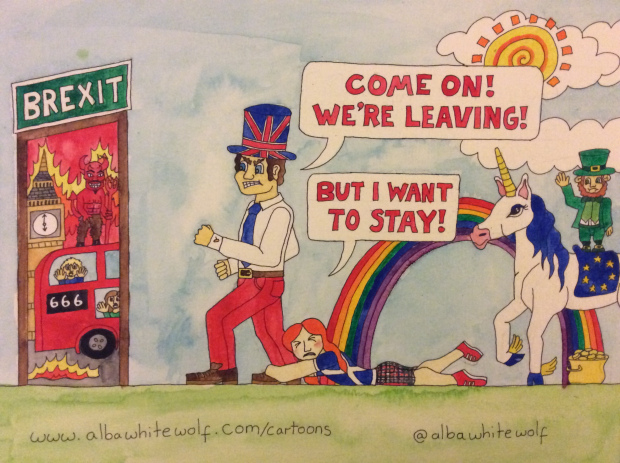
Brexit Apocalypse 2 - albawhitewolf

The Daily Mash should spend less time going for cheap laughs about supposedly racist, nostalgic Brexiteers and more time using satire to hold real power and privilege to account

Along with countless other non-racist, non-xenophobic Brexiteers who enjoy a good bit of political comedy and satire, I have been waiting patiently for the current virulent outbreak of Brexit fever to abate over at The Daily Mash, a satirical news website which at one time could be relied upon to provoke laughs no matter which party or ideology was in the cross-hairs.

Sadly, judging by today’s latest effort, there is still no sign of remission:

EVERY country in the former British Empire has demanded Britain resume full political control now it has proven it is great again.

Australia, India, Canada, Egypt and South Africa, among a host of others, have all dissolved their governments in a show of awestruck admiration for the British lion’s newfound mighty roar.

Kenya’s president Uluru Kenyatta said: “We never wanted Britain to stop ruling us in the first place – why ever would we? – but you just needed to grab hold of your mojo again.

“Don’t worry about giving us voting rights or any of that nonsense. Now you are once again a proud, resurgent nation unafraid of political correctness, we have absolute trust you will act in our best interest. And the world’s.

“I step down this afternoon. Oh man, I hope we get Michael Gove as governor. That guy is the best.”

The UK now commands a fifth of the world’s population and one-quarter of its total habitable land, which is as it should be.

Retired headmistress Margaret Gerving, from Guildford, said: “I don’t know why America is insisting on being independent. I’m sure they’ll stop being silly eventually.”

Of course, this is just the tip of the iceberg. Since a clear majority of Britons voted to leave the European in the June 2016 referendum, the Mash has covered the topic of Brexit and our changing relationship with the European Union with the spittle-flecked fury and haughty, casual moral superiority of an earnest but ill-informed sixth-former.

Thus we have been treated to headlines such as these:

Uniting behind Brexit a bit hard if you think it’s shit – which includes quotes such as “I’ve always believed that Europeans are our friends with whom we no longer want to have wars. So it’s hard to change to seeing them as potentially hostile weirdos whose food is poisonous”. Because of course voting to leave a supranational political union could be motivated by nothing else.

All man wants for Christmas is Brexit – which tells the story of Roy Hobbs, who “d[oes] not care about presents underneath the Christmas tree, and he just wants Britain to stand alone, stronger than it had ever known”.

Relieved Britain no longer biggest f*ck-up of 2016 – in which a character declares: “For months we’ve been the world’s dumbest dickheads, and now we’re actually if anything a useful marker on the road to the total collapse of liberal democracy”.

May confirms Brexit is now a religious cult – in which the Mash’s version of Theresa May declares: “We will form small, inward-looking communities where anyone who criticises Brexit will be subjected to weeks of brainwashing or human sacrifice. I am the one true prophet of Brexit, which means everything I say is a fact, such as ‘Liam Fox is good at whatever it is he is supposed to be doing’. I call it ‘going the full David Koresh’.” That last line is a snide reference to the Waco siege, in which four federal agents and 76 cultists died.

Brexit optimism highest among people who love setting fire to things – in which one demonic Brexiteer exclaims: “All I want from life is to instill fear while cackling like a maniac, so I’m delighted that the government is finally listening to people like me”.

These are but a few examples, chosen more or less at random.

Does Brexit deserve to be made fun of? Absolutely – nothing should be off the table when it comes to political humour. But the Mash’s lazy bias does its satire-loving readers a disservice by nearly completely exempting the Remain side – who, after all, make up most of the establishment that satirical publications normally exist to mock – from any scrutiny of their own.

Imagine the EU referendum result had gone the other way, and Britain had narrowly voted to remain. We Brexiteers (myself included) would not have taken the result well, would be making our displeasure widely known and probably vowing to hold another referendum as soon as possible. But rather than skewering the victorious Remain side for their wide-eyed europhilia and naive trust in the Magical EU Reform Unicorn (or “punching up”, as we apparently now call the intersection between humour and power dynamics) the Mash would instead be quick to laugh at the angry, disappointed Leavers. No matter which way the result went, the Mash would be laughing at Brexiteers right now. And that is both biased and lazy.

Of course, many Brexiteers are vaguely ridiculous and lend themselves to humour, just as many Remainers are glib, shallow, sanctimonious and uninformed. But good satire would poke fun at the real faults of Brexiteers – our sometimes room-emptying obsession with matters of sovereignty, democracy and regulatory matters, for example. There’s lots of comic material in there, even if extracting it takes slightly more effort. Going for the “oh, they’re just hankering for the days of empire” gag (as per the article quoted at the top of this post) is a cheap laugh, and a lazy one.

What’s more, it is wrong. If you actually take the time to talk to Brexiteers, even much of the UKIP brigade, you won’t hear a hankering for empire or a desire to “turn the clock back”. These are rationalisations dreamed up by London-dwelling media types who never socialise with anyone who lives north of Watford and so cannot imagine what might really motivate a person to vote for Brexit.

What you will hear if you do talk to Brexiteers in any number is a strong distrust of political institutions, a sense of personal insecurity or economic precariousness and a sense that time, technology and political machinations have wrought huge changes on Britain with almost no proper discussion or debate. A sense that while we must keep moving forward, government for once needs to prioritise the interests of those who can’t or who don’t want to be citizens of the world rather than those who are able to use the world as their playground.

And if that seems difficult or unwise to mock, then perhaps it is worth questioning whether the Mash and the London-centric elite are spending too much time “punching down” at people they consider inferior rather than holding power (and what they might call “privilege”) to proper account.

Consider this old Daily Mash article from the dying days of the last Labour government, skewering prime minister Gordon Brown’s assertion that a cut in National Insurance tax would somehow be “taking money out of the economy”:

GORDON Brown will once again focus Labour’s election campaign on national insurance after being deafened by the collapse of his own argument.

Mr Brown’s advisers had urged him not to return to the issue, but the prime minister just nodded and smiled and said their voices had gone all dull and fuzzy.

The argument has been collapsing in stages since last week with the final section crashing to the ground in a massive cloud of dust and bits during the Today programme, just after eight o’clock this morning.

Radio Four listener Tom Logan said: “I was spooning some mephedrone into my tea and listening to John Humphrys being a shit, when all of sudden there was this huge, violent noise.

“It was so loud I thought it must be coming from outside, but then I realised it was the last part of the prime minister’s argument on national insurance smashing into the ground like it had been kicked over by a giant toddler.

“I do hope no-one was hurt apart from John Humphrys.”

Within minutes of the argument toppling over, Guardian editor Peter Mandelson was seen scrabbling over the smoking rubble and attempting to rebuild it while mumbling, ’employers know nothing about employing people’ over and over again.

Now, this is funny because it pokes fun at an actual trait of New Labour politicians – that rather paternalistic view that government really does know more about employing people than the employers themselves.

By contrast, the worn-out old stereotype of Brexiteers as scarlet-faced, tweed-bedecked retired colonels hankering after a bygone age is self-evidently false. It fails the common sense test – more than half of voters opted for Brexit, and there just aren’t enough retired colonels out there to deliver that kind of result.

But rather than actually take the time to understand Brexiteers and work out what makes them tick so as to better lampoon them (humour, after all, is always better when it is closely observational), publications like The Daily Mash sit back smugly and fall back on the familiar narrative of grumpy old men hankering for empire.

And that, of course, is their right. Nobody has to read The Daily Mash, and despite Britain’s increasingly tenuous commitment to free speech they can mock and lampoon whoever they like, as should be the case.

But how much better would their comedy be – how much wryer and punchier their humour – if the Mash writers actually took the time to really get to know a few more Brexiteers (so as to at least make fun of them for the right reasons), or even (heaven forfend) turn that caustic wit back on their own side once in a while?


Brexit Jokes

Top image: Alba White Wolf

Bottom image: catchnews.com

Support Semi-Partisan Politics with a one-time or recurring donation:

Agree with this article? Violently disagree? Scroll down to leave a comment.

Follow Semi-Partisan Politics on TwitterFacebook and Medium.

The Liberal Elite, Here To Stay

Are the liberal elite living on borrowed time?

Rod Liddle thinks so:

For a start, the elite is not liberal in the classical liberal sense, but closer to the American sense of the word. It is certainly not ‘liberal’ if by that you mean tolerant: it is intolerant and authoritarian. And by elite I do not mean the elected government: establishment elites can survive most forms of government and easily outlast them.

The liberal elite we talk about today is beholden to a leftish cultural and political paradigm which predominates in all the non-elected institutions which run our lives. In the judiciary, for example. Within the BBC. In the running of our universities and in the courses they put before students. In the teaching profession. In the social services departments of every council in the land. At the top of the medical profession. On the boards of all the quangos — the lot of them, from those which hand out money in the arts to those which regulate our media and our utilities. It is a left-liberal paradigm, informed by affluence, which has been swallowed whole by all of these institutions and which is utterly intolerant of dissent.

Try being a social worker who thinks gay adoptions are problematic. Or a doctor who disapproves of abortion or transitioning. Or a student who quite likes Germaine Greer and wearing a sombrero. Or a teacher who thinks Trump is maybe OK. (The headmaster at a school in south London recently told pupils that if any child uttered the same sorts of words as Donald Trump about immigration, they’d be excluded.)

Try being a judge who thinks an awful lot of hate crimes are imaginary or vexatious. In all cases you’d be drummed out. No job. You’d be finished. There would be tribunals — where you would be judged by other upholders of the liberal elite — and you’d be out.

That is what we mean by the liberal elite. The template for how our society is governed and which antithetical political parties may battle, but in the short to medium term, lose.

Elites do change, though. I remember as a speechwriter for the Labour party in the early 1980s suggesting that we do something in support of the teachers, who were complaining about pay. ‘Fuck them — they’re all Tories,’ I was told. And so statistically they were, at the time. And in the 1970s the BBC, the Church of England, the judiciary and the emergent quangos were small ‘c’ conservative. Elites last for about two generations. Our liberal elite has lasted since about 1985. And my guess is that right now it is on the way out, which is why we are hearing this continual howling.

Liddle’s summary of the Control Left is pretty accurate, but I cannot share his confidence that the power and influence of this deeply anti-intellectual group of “intellectuals” and elites is on the wane – at least not yet.

Perhaps, if the counter-revolution were led by somebody other than Donald Trump, there would be cause for hope. Somebody with unimpeachable ethics, a record of respect toward women and minorities and impulse control greater than that of a ten-year-old might just be able to prevail against decades-old vested interests and a self-regarding and frequently biased media.

But unfortunately we have Donald Trump in America (whose successful recent speech to a joint session of Congress may have finally given him the veneer of presidentialness, but none of the substance) and Theresa May in Britain (who seems eager to combine the establishment’s usual haughty paternalism with a desire to be led by the Tory Right into the most calamitous and disruptive form of Brexit possible). These are hardly the two torchbearers one would choose to “Drain the Swamp” or do anything else remotely transformative.

And so there is the very real risk that Donald Trump’s floundering new administration will either drop the ball so badly in response to some external crisis, or else precipitate a crisis of their own through poor legislative and executive decisions, that they actually manage to make the establishment opposition – led by fresh young anti-establishment faces like Nancy Pelosi and Chuck Schumer – look good by comparison. And if these people get back into power, will they take even a moment of introspection to consider their role in the rise of Trump, or show any regard for the more legitimate concerns of his supporters? I think we all know the answer.

Similarly, if Theresa May’s government miscalculates in our EU secession negotiations and triggers some sort of abrupt and traumatic departure with no carryover provisions in place to govern customs, regulatory matters and the myriad programmes of cooperation with other EU countries, the economic pain will be real and the Tories will no longer look quite so invincible.

Besides, Rod Liddle devoted paragraphs to pointing out the extent to which so many of our institutions – from academia to the charity sector to the state church – are corrupted from within and turned into the exclusive domain of the liberal elite. It would be great to see reasoned conservatism re-establish a beachhead in some of these places, but it does not look very likely at present.

The hair-trigger sensitivity of many of these people leads them to see a harmful microaggression in the smallest and most inconsequential of human interactions, and they have shown no qualms about persecuting even those from their own tribe who happen to deviate even 1% from the current social justice / identity politics orthodoxy. What hope, then, do conservatives have of breaking back into those workplaces and institutions from where they have been so comprehensively exiled?

So while the screeching and whining from left-wing commentators and their allies embedded in our institutions has become deafening, I see little evidence that it will be followed by retreat. Like a transatlantic flight spent sitting in front of a screaming baby, we are in for a long and tortuous ride.


child-screaming-on-airplane

Support Semi-Partisan Politics with a one-time or recurring donation:

Agree with this article? Violently disagree? Scroll down to leave a comment.

Follow Semi-Partisan Politics on TwitterFacebook and Medium.


What Is The Point Of Theresa May?

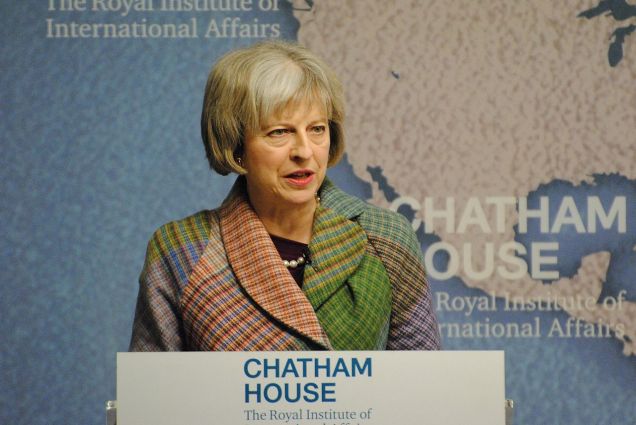
theresa-may

Right now, Britain needs a leader, not a placeholder – Theresa May needs to step up and set some ambitious national goals, or else be swept aside to make room for a real conservative leader

David Mellor doesn’t know what Theresa May stands for. And as Christopher Hope writes in the Telegraph, Mellor has good reason to be confused:

Theresa May is proving as Prime Minister that she is no Margaret Thatcher, a former Thatcherite minister has said, because she is not “seizing the initiative”.

David Mellor, who served under Baroness Thatcher for three years, said “the description of Theresa May as the new Margaret Thatcher is as wide of the mark as it could possibly be”.

Mr Mellor urged Mrs May to call a general election next year and win a larger House of Commons majority. The Tories have a consistently strong polling lead over Labour.

Mr Mellor was a minister in Lady Thatcher’s last government in four departments from 1987 to her resignation in November 1990.

He said Mrs May had shown herself “infirm of purpose”, most recently over the Christmas strikes at post offices, Southern Rail and Heathrow airport, where action will take place later this week.

He told Sky News’ Murnaghan: “When I was a minister for four years she treated me with even more disrespect than my mother did, but Margaret Thatcher knew what she wanted do and did it.

“I don’t think Theresa May knows what she wants to do. Her advisers appear to be the ones that create the headlines. I think she is sitting there and she is infirm of purpose, and she needs to seize the initiative.

“The main initiative she needs to seize is to have an election and get herself a mandate.”

This blog has never joined the calls for an early general election, not least because the laudable idea of having fixed term parliaments is rather undermined if we suspend the rule on the first occasion it becomes politically inconvenient. But if triggering a general election is what it takes to force Theresa May to really think about what kind of prime minister she wants to be (and hopefully give the British people a clue as well) then maybe we should just get on with it. Because right now Britain is idling in neutral at a time when we should be setting a firm course and all striving to pull in the same direction.

The underlying problem is that having succeeded to the office of prime minister unexpectedly in the most turbulent of times (in the wake of David Cameron’s resignation and Andrea Leadsom’s surprise departure from the following Conservative Party leadership contest), Theresa May evidently took office without ever having clearly thought about what it is that she wanted to achieve through her leadership of Britain (the recent Sunday Times interview is heavy on temperament and almost completely lacking in vision).

And it shows. Mellor cites Theresa May’s supposed “infirmity of purpose” when it comes to things like tackling the strikes on Southern Rail, but those are side issues. More troubling than May’s failure to get tough with striking railway workers is the fact that she used her first party conference speech as prime minister to declare war not on Labour and the vested interests of the Left, but on the libertarian Right.

What’s worrying is that Theresa May’s government has passed the Investigatory Powers Act 2016, dynamite for privacy and civil liberties, and is still toying with the idea of enforcing section 40 of the Crime and Courts Act and Part 2 of the Leveson Report, further curtailing freedom of the press. It is not just that we do not know enough about Theresa May’s agenda for Britain – what little we do no should give small government conservatives everywhere cause for concern.

Contrast this to the last great transformative Conservative prime minister, Margaret Thatcher, who had four years behind her as Leader of the Opposition in which to solidify her worldview and flesh it out with policy (notably from the Stepping Stones Report and Centre for Policy Studies think tank) before taking office. By the time Thatcher entered 10 Downing Street in May 1979, she had not only diagnosed Britain’s ailments but formed a fairly clear idea of how she intended to tackle them, even though the road ahead was inevitably marked by missteps and challenges.

Theresa May appears to have no such plan. If she has a burning ambition to change Britain from an X type of country to a Y type of country then she is keeping her cards very close to her chest, for there is no evidence of such a goal. All we have is her reputation of flinty-eyed authoritarianism and aversion to publicity, earned during six years at the Home Office, a grammar school fetish and some woolly words about focusing her government’s attention on helping the JAMs (people who are Just About Managing).

The danger, therefore, is that with Brexit on her plate, a populist rebellion afoot in the country and challenges abroad, Theresa May’s government will become so preoccupied with fighting fires and engaging in daily damage control that the big picture vision never emerges at all. Mellor is right to say that most of the useful tidbits of information about the government’s intentions have come not from the prime minister but from public spats between rival cabinet members. And who can be surprised that such turf wars are underway when there is no clear drumbeat emanating from Number 10?

Of course, Theresa May is by no means the first politician to reach 10 Downing Street without a plan for what to do in government. Gordon Brown famously spent so long plotting his own ascension and the downfall of Tony Blair that he cut a uniquely uninspired and uninspiring figure among world leaders, at least until the global financial crisis breathed some fire into his belly (even if his “solution” was hiking the top income tax rate up to an immoral 50 percent).

There are times when a bland and uninspiring individual, a technocrat, is the right leader for the moment – primarily when times are good and the key imperative is not to rock the boat. This scenario does not describe Britain in 2016. Brexit may be foremost of our challenges, but there are others, too. And from Theresa May’s cautious and unambitious start in office, it is difficult to see how she – and we – are to best confront them.


theresa-may-conservative-party-conference-2016-birmingham

Support Semi-Partisan Politics with a one-time or recurring donation:

Agree with this article? Violently disagree? Scroll down to leave a comment.

Follow Semi-Partisan Politics on TwitterFacebook and Medium.