Don’t Believe The Europhiles: There Is No Status Quo If We Vote To Remain

European Parliament

Anyone thinking of voting to Remain in the European Union through fear of the unknown must remember that the EU is on a journey of its own, and will look very different in ten, twenty and thirty years’ time


… The undiscovered Country, from whose bourn
No Traveller returns, Puzzles the will,
And makes us rather bear those ills we have,
Than fly to others that we know not of.

– Hamlet, Act III, Scene I


In a must-read piece, UK Unleashed invites us to imagine a near future in which Britain has made the mistake of voting to remain in the European Union in the coming referendum:

It’s 2030. Thirteen years previously, after a torrent of negative campaigning by the Remain side and having been mind-crippled by unparalleled EU funded FUD, the UK population voted to remain in a ‘reformed EU’. The fight was down to the wire and, yet again, pollsters were shown to be wide of the mark, yet surprisingly on message. But when the count came in, Remain won by a mere 2%.

This ‘significant majority’ was accepted as a mandate by the then Prime Minister David Cameron to take the the UK in to a new relationship with the EU. ‘The British Option’ as it was called, brought us to the outer ring in 2022 after it was ratified by the people of the UK in a second referendum. Although originally seen as a triumph against ‘ever closer union’, in 2030 there are now well established concerns. Whilst the likes of Norway (which continues to top the world ranking for prosperity) sit at the top tables of global bodies where the rules are hammered out, the UK are now further retracted and marginalised, neither taking a global position or one of prominence within the EU.

To compound matters, Montenegro, Serbia and Turkey have now all joined the ever growing federation, with Boznia Herzegovina and Kosovo also on the cusp of membership. Our margin of vote in the European Parliament and European Council are lower than ever and about to shrink yet again. In spite of complaints about the inability of any one member to stand up to the EU in any meaningful way, the committed europhiles, in thrall to their pay masters, repeat the mantra that we should be grateful to have the opportunity to ‘collaborate’. Our hands bound behind our backs, we’re unable to harness the power of the now maturing international markets, instead we remain chained to an ageing customs and political union in spite of the fact that EU exports have continued to decline year on year.

Unrealistic scaremongering? Hardly. Think of the organisation we joined back in 1973, and what a different beast it is today, both in size and competence. Then think of the current geopolitical crises and changes, and how they are already being used by the integrationists as a catalyst and excuse for further “essential reform”.

Only a fool could believe that the driving forces behind the EU think that their creation has reached a benign state of perfection, and that no further change is desirable. And only a fool could believe that the European Union’s response to the latest global challenges – from terrorism to climate change – will be anything other than “more Europe”.

This is a key point, because the chief argument of those who would keep Britain in the EU is the hysterical claim that leaving would be some terrible and unprecedented leap into the dark. Unable to wax lyrical about their beloved EU for fear of alienating vital swing voters – and because there is nothing remotely inspirational about the European Union – instead the europhiles hammer on relentlessly with the scaremongering notion that Brexit is scary while Britain’s future in the EU will be predictable, prosperous and permanently sunny.

Or as UK Unleashed memorably puts it:

I guess when you’re ensconced in the arms of the EU octopus and you’ve divested yourself of any sense of national identity, you’ll say what ever it takes to avoid being prised away. In their heads, these people probably don’t see themselves primarily as British, instead they’re EU nationals just waiting for the country to be hatched in the next treaty.

The europhiles are in absolutely no position to make such promises of security within the EU and destitution without. What little they know of the EU’s immediate future they cannot campaign on, because it would be repugnant to many British voters, and the rest is just as much a mystery to them as it is to everyone else. We simply do not know what future geopolitical challenges we will face, or precisely how they will be used by the arch-integrationists to continue the journey they began back in 1950.

All we can say with any degree of confidence is that the EU will look very different in 2050 than it looks today, and that the self-declared aspirations of many European national leaders and EU officials to pool even more sovereignty and undermine the nation state yet further will be in full fruition.

Dr. Richard North gives us a glimpse of what lies ahead:

Hidden in plain sight, as in various documents published in Europe including last September’s “State of the Union Address” by Commission President Jean-Claude Juncker, is the plan for a radical restructuring of the EU into two classes of member.

The 19 eurozone countries will move on to much closer political and economic union; while Britain and the rest become mere “associate members” (possibly also including countries outside the EU, such as Norway and Switzerland).

As Juncker explained, none of this is to be formally revealed until 2017, when the Commission issues a White Paper to trigger the laborious procedures now required for any new treaty. And these might not be concluded until 2025.

All of which completely transforms the game play. Mr Cameron can keep his original promise to hold a referendum in 2017, but only to ask the British people for permission to remain in the EU until the terms of the new treaty are clear. We will then have to hold a second referendum on whether we accept these terms.

Britain will then have the choice of belonging to the new inner core, the vanguard for the dissolution of the nation state, or membership of the outer rim of states, burdened with many of the same costs but with even less influence and fewer dubious benefits. That is what we can reasonably expect by voting to Remain – and if any EU supporter would care to argue otherwise, let them step forward and do so, presenting their own less dystopian vision of the future.

In reality, once the deceptive posturing of the Remain camp is stripped away, it is only the Leave campaign which gives the impression that they have given any thought at all to what life outside or inside the European Union might realistically look like for Britain beyond the next decade, or how such an exit from unwanted political union can be managed under a variety of scenarios.

And on this note it is extremely encouraging to see that Dr. Richard North, pre-eminent authority on the European Union and author of Flexcit (the best adaptive Brexit plan in existence), is partnering with Arron Banks and Leave.EU in a consultancy role to make Flexcit that group’s official exit plan.

This is great news, and means that one of the two largest Leave campaign groups (really the only one, since Vote Leave is teeming with people who don’t actually want to leave the European Union) actually has a robust, solid plan for Brexit. If Brexiteers learn about and support this excellent plan, we will be able to go into the referendum battle with the Remain camp’s best weapon – the false claim that Leave supporters have “no plan” for Brexit – broken in their hands.

The Remain camp’s whole fearmongering argument to persuade us to vote to stay in the European Union is that we are safer and more prosperous under our current arrangements, while Brexit would throw everything into flux, potentially create chaos and leave us worse off. Basically, their uninspiring campaign message is “better the devil you know than the devil you don’t.”

But that is not the choice before us in this referendum. The EU is changing, moving down a swift and pre-determined path to further integration for most member states with powerless irrelevance awaiting those other countries not wishing to join the core. There will be no “devil we know” to side with, but only devils we don’t. And of those, staying part of an ever-tightening political union for which most of us have no love or affinity is far more threatening a devil than having the faith and confidence that Britain can succeed as an independent country playing a full and unfiltered role on the world stage once again.

That’s the choice before us now. And since the Leave camp now has Flexcit on their side while the Remain camp has nothing but smears, scaremongering and a vision of the future they are too ashamed to articulate, the only devil to be avoided is the one which pledges fealty to Brussels.

Brexit - Flexcit - European Union

Agree with this article? Violently disagree? Scroll down to leave a comment.

Follow Semi-Partisan Politics on TwitterFacebook and Medium.

Rotherham & Cologne: A Tale Of Two Cities Betrayed By Political Correctness

Cologne - Sexual Harrassment Abuse - Virtue Signalling

High-handed elites with their fear and contempt for ordinary people are the greatest internal threat now facing our society

If Western civilisation does ever collapse in upon itself, it will not be the fault of radical Islam, UKIP, Jeremy Corbyn, Donald Trump or Kim Jong-Un’s home-made H-bomb.

It is becoming increasingly clear to me that the fastest route to national or civilisational decline is for our elites to persist in their policy of signalling their virtue by furiously ignoring inconvenient realities, and having infinitely more fear and contempt for their fellow citizens than any real, external threat to our freedom and security.

Consider the scandal now unfolding in Germany, where city officials and the media stand accused of covering up important news about a spate of sexual attacks in the city of Cologne, for reasons of political correctness and a painful reluctance to highlight a potential link between these attacks on women and the immigrant population.

From the New York Times:

The tensions simmering beneath Germany’s willingness to take in one million migrants blew into the open on Tuesday after reports that scores of young women in Cologne had been groped and robbed on New Year’s Eve by gangs of men described by the authorities as having “a North African or Arabic” appearance.

[..] The assaults initially were not highlighted by the police and were largely ignored by the German news media in the days afterward.

[..] The descriptions of the assailants — by the police and victims quoted in the news media — as young foreign men who spoke neither German nor English immediately stoked the debate over how to integrate such large numbers of migrants and focused new attention on how to deal with the influx of young, mostly Muslim men from more socially conservative cultures where women do not share the same freedoms and protections as men.

Shockingly, this story has only received significant traction over the past couple of days, despite the events taking place a week ago.

One can almost imagine the terrified police officials and news editors in Germany, sitting on this story of unquestionable public interest, yet paralysed into inaction by the all-consuming fear of appearing in any way racist – as though it were not perfectly possible to report the news in a sober and measured way, giving the facts without casting aspersions on an entire ethnic group or community.

But to the minds of many people in authority – not only in Germany, but across Europe – reporting a story which amounted to a question of public safety for the women of Cologne was remarkably not an open-and-shut case, but rather a morally ambiguous grey area fraught with hazard and difficulty.

The reason for this moral and professional failure is twofold. Firstly, there was the ever-present impulse to be seen as virtuous, progressive and in no way racist (as though noting the ethnicity of a criminal suspect is somehow smoking gun evidence of prejudicial thought). One cannot underestimate the corrosive effect that this pressure to be seen not just as tolerant but blindly uncritical of other cultures has on people who hold positions of trust in our society.

But secondly – and even more insidiously – there is the fear of “we the people”, and the nervous contempt with which elements of our political class view their fellow citizens. It is the mindset which whispers in the ear of police chiefs and news editors that they cannot possibly report a story about mass sexual harrasment in a major European city, because the particulars of the case might drive the ordinary “sheeple” into committing a murderous, anti-immigrant pogrom. It holds the people in such low regard that they are seen as mindless automatons liable to do anything suggested by Evil Mass Media.

Both of these noxious ideas are complete nonsense, of course. It is perfectly possible to report a pertinent social or ethnic dimension to an important news story without giving in to base racism or crude stereotyping, and most people are perfectly capable of watching or reading such a story without themselves being motivated to commit criminal acts against people who share the same appearance or ethnicity as the alleged suspects. Yet these are the poisonous ideas influencing people in positions of civic leadership throughout Europe.

In some ways, the scandal emerging out of Cologne resembles the Rotherham sexual abuse scandal in the UK, which finally made news headlines in Britain in 2013. Obviously there is no comparison in terms of the scale of the atrocity committed – in Rotherham, hundreds of girls were systematically abused and raped by gangs of men while the authorities turned a blind eye – but the first response of those in positions of civic authority has been startlingly similar. As in Rotherham, officials in Cologne first chose to bury their heads in the sand and wish the problem away rather than risk the reputational harm (or imagined public disorder) that would have arisen had they sounded the alarm.

As Mick Hume notes in his powerful and timely book “Trigger Warning: Is The Fear Of Being Offensive Killing Free Speech?“:

Why did the local authorities try to close down media reporting and public debate of the child sex scandal? Not because the council and police in Rotherham had some sort of soft spot for sex criminals. It was because they were afraid of being accused of racism, and exacerbating community tensions, by allowing it to be said that Asian men were abusing white girls. They did not want to suppress the story because it was false. They wanted to suppress it because it was true.

[..] In other words they feared the reaction of local people if the media were permitted to report the truth and people were allowed free discussion of the facts. Or to put it more bluntly, they suspected that the Rotherham public were a malleable lynch-mob-in-waiting, a collection of puppets that could be inflamed into race riots by a spark from a Home Office report or a newspaper investigation.

[..] The authorities feared that there might be race riots in Rotherham if locals heard a bad word about child sexual exploitation from the press or right-wing politicians. So interfering in the right of the public to know the facts and judge for themselves became the first instinct of liberal-minded officials and politicians. Rather than have uncomfortable truths in the public domain, they tried to keep the free-speech genie in the bottle.

Inevitably, this “liberal” interference only serves to make matters infinitely worse by allowing problems to fester unresolved.

And yet the consequences of allowing the people to hear or know the uncomfortable truth are never as calamitous as the elites always fear, as Mick Hume points out with respect to Rotherham:

This was not done in the name of restricting free speech of course, but of protecting the innocent and maintaining community cohesion. Whatever they called it, the result of interfering with free speech and limiting debate was, as always, to make matters worse. When the long-suppressed truth finally came out there were no race riots in Rotherham – people are not the mindless automatons that some appear to believe. But the scandal left deep divisions and scars that threatened to sink, never mind rock, the multicultural boat.

If this problem manifested itself only in cases of sexual abuse going unreported and unaddressed it would of course remain a horrendous sickness in our society and a grave failure of the state to protect half of its population. But it would not be an immediate, existential threat to large, modern countries like Britain and Germany.

However, this worrying trend is by no means limited to the sexual abuse of women, or the dereliction of duty by civic leaders in provincial cities. All around Britain – and indeed Europe – we see the same failure to tackle non-integration and non-assimilation with Western norms by recent migrants or their children. Even when the lack of commonly held British values and a shared common identity leads to whole families upping and departing for Syria to fight for ISIS against the country which gave them life and liberty, many of us refuse to face the problem square on.

It’s not just Rotherham. There is a festering crisis of British and Western values, and a determined unwillingness from some quarters – for reasons of political correctness and fear of the masses – to challenge cultures and behaviours which fall short of our hard fought, painstakingly-built commitment to freedom of speech, freedom of (or from) religion, respect for the role of law and equality for women.

But it is not the child rapists or locally-grown terrorists who are even the greatest problem. Evil as those deplorable crimes are, the people who currently present the bigger threat to our society are those in the political elite or positions of civic leadership who seek to make a public virtue out of their tolerance-at-all-costs approach to multiculturalism. Some of these people may mean well. But their misguided dogma threatens our country and our liberties with a slow death by a thousand cuts.

And it is this corrosive attitude – whether expressed in Cologne or Rotherham, London or Brussels – which we must fight against first and foremost.

Rotherham Sexual Abuse Scandal - Cologne Sexual Harrassment

Agree with this article? Violently disagree? Scroll down to leave a comment.

Follow Semi-Partisan Politics on TwitterFacebook and Medium.

You Wouldn’t Buy A Song Praising HMRC, So Stop Worshipping The NHS

NHS Choir - Harriet Nerva

Buying and praising the NHS Choir’s Christmas single is not “harmless fun”. In fact, anyone who truly believes in improving healthcare should see through this complacent, self-congratulatory piece of propaganda

It’s amazing how easy it is to be published in the Guardian, just so long as you hold the “correct” right-on, trendily left wing views, and have distinguished yourself with some suitably ostentatious act of public virtue-signalling.

Enter Harriet Nerva, junior doctor and newly ordained High Priestess of the NHS. Nerva is one of the principal architects of that sappy piece of virtue-signalling NHS propaganda inflicted on the (sadly often-willing) British populace this winter – the “Bridge Over You” single which predictably made it to Christmas No. 1 in the charts.

I explained at the time why singing hymns to a powerful government monopoly was neither a morally virtuous nor a productive thing to do, and was met with a predictable chorus of criticism and accusations of being a Christmas Grinch. But the argument against this latest piece of NHS-worship needs to be restated and expanded, particularly in light of the failure of other commentators to utter a critical word, and also because of the nauseating victory lap currently being taken by the #NHS4XmasNo1 campaign chiefs.

In her self-aggrandising victory speech, published in the Guardian, Nerva begins by declaring:

As a junior doctor, I started a campaign that united the public, staff and patients in its demand for a free and properly funded healthcare service for all.

Already it starts to become clear that this is all about the Harriet Nerva Show first and foremost, long before any other consideration. The article continues:

Since becoming a junior doctor 18 months ago, I have felt immensely proud to work for the NHS. In particular, I’ve been humbled by how well we cared for one patient in their dying days, and felt privileged to have forged a relationship with this person in the last few weeks of their life.

Again, this is boastful and irrelevant. Nerva isn’t “humbled” by anything, she is proud of her accomplishment – and that’s fine, but not when it is wrapped in the pretence of promoting the NHS, or when the fact that she gave good care to a dying patient is misused as an argument for persevering with one very specific model of healthcare delivery.

Nerva concludes by inadvertently calling the song what it really is – a religious hymn:

This campaign has made it clear that the public, staff and patients are singing from the same hymn sheet. We are united in the belief that we should have a free and properly funded healthcare service available to all in our society, one that values and respects its staff and users. The choir have sung, the public have spoken, and now it’s time to listen.

Meanwhile, the Mirror reports approvingly:

Harriet told Mirror Online: “I didn’t have any links with the choir but what they have produced is a fantastic celebration of the NHS”.

“Seeing the video moved me to tears. The context of it is very powerful. I qualified 15 months ago and I love the NHS, I’m very proud of it. And I feel getting it to Number One would bring to the public’s eye the fantastic service it provides in very challenging times”.

But this reasoning is nonsense. Everyone in Britain already knows about the excellent and important work done by doctors and nurses, and the vast majority support the NHS. It’s hardly as though there is some massive popular revolt against our system of nationalised healthcare.

Most people seem content with our current system when they bother to think about it at all, and (left-wing scaremongering aside) no major politician from any party has serious plans to dismantle what currently exists, let alone end the principle of healthcare free at the point of use.

So, since there is no imminent threat to the NHS (it survived eighteen years of Tory government before 1997, and will do so again), what is this really all about? What really motivated a junior doctor to make us endure this turgid hymn to the NHS?

NHS Choir - Christmas Single - 3

By prancing around with her Twitter hashtags and handwritten signs, Harriet Nerva isn’t just saying that she shares our presumed love for the NHS or has a strong devotion to providing healthcare. What she is really saying is that she is a better person than you, because she A) works for the NHS, and B) organised a huge act of public NHS-worship.

“Think you’re a good person just because you like the NHS?”, Nerva is saying. “Well I’m ten times better than you, because I got the British people to collectively sing a hymn to the NHS on Christmas Day. I love the NHS so much that I made this extraordinarily extravagant public gesture. What did you do?”

And of course short of sacrificing ourselves on a huge pyre as a burnt offering to the NHS, there is nothing that we can do to better her accomplishment. Harriet Nerva wins.

But this is noisy, shallow virtue-signalling, and nothing more. I’m sorry if it sounds harsh or seems unpleasant to rain all over what first looks like a harmless act of charity, but the NHS Choir’s Christmas single is so much more than that. And so much worse. It is yet another part of the vast tapestry of reflexive NHS worship which smothers Britain, and prevents us from looking critically and dispassionately at one of the most important issues in our society.

And we need to wake up, stop patting ourselves on the back for the accomplishments of previous generations, and recognise that singing hymns to an outdated healthcare delivery model from the 1940s is going to do nothing – nada, zilch – to ensure that Britons enjoy the best healthcare in the world in this century.

NHS Worship - London Olympic Games 1

It is therefore heartening to see a few other brave souls also now daring to stick their heads above the parapet and call the NHS Christmas single what it is – emotionally manipulative propaganda.

My Conservatives for Liberty colleague and Creative Director, Paul Nizinskyj, also picks up on the pseudo-religious undertones beneath this latest act of NHS-worship:

This was encouraged by a message on the music video, which urged people to “Show how much you #LoveYourNHS” by buying the single. Well, this is a concept I struggle with, because I have no love for a catastrophically flawed system of healthcare which seriously fails its patients, despite the best efforts of its frontline staff.

But that distinction – between the structure of the NHS and the people who work for it – is one we seem to struggle with in this country. So, instead of a conversation about why the NHS continues to fail the people who pay for it, we again exalted it as an infallible deity, this time in a kind of Christmas Day papal coronation.

One of the Left’s greatest successes has been to conflate “Our NHS” with “healthcare” in the minds of the British people, so that the two concepts effectively merge to become one and the same. This was a war of words, and the Left won a total victory – now, even those people who are naturally sceptical of government monopolies often speak of the two terms interchangeably, and carve out an illogical exception for the NHS when they extol the virtues of competition and privatisation.

But as Nizinskyj points out:

I’m certain dedicated health professionals would be dedicated and professional under whichever system of healthcare they were working, but the results of that hard work often depend on whether the system is working with them or against them. And, when it comes to the NHS, I’m afraid it’s working against them.

This is the point which continually eludes the NHS priests and their congregation of grateful but uncritical Britons. Yes, of course the doctors and nurses who saved your life / delivered your baby / cared for your dying relative did an amazing job. But that is a reflection on them, not on the system in which they operate.

Lives are saved, babies are delivered and dying relatives cared for in healthcare systems all over the world. Many of these other healthcare systems do the job very well, if not better, than the NHS. Many of these other healthcare systems are also free at the point of use. Very few of them are like the American system, which is always cynically held up as a bogeyman to scare British voters and shut down debate. And yet mysteriously, none of these other healthcare systems copy the NHS model.

Think about that for a moment. Every day, people are treated with love and dedication in hospitals and healthcare systems around the world, and in many cases receive comparable or better care without being stuck with a bill that they can’t afford. Yes, poor people actually receive medical care in other countries, not just Britain. And yet we are not able to even look at these other systems or ask ourselves the question whether the decision we made as a country in 1948 is still the best choice in 2016.

Why are we not able to do this? Why can we not look at best practice from around the world and strive to emulate and build on these ideas so that we have the very best healthcare in the world, rather than being satisfied with an ebbing and subsiding parity? Because of people like Harriet Nerva, and the closed-minded viewpoint of legions of others like her.

NHS Choir - Harriet Nerva - 2

There are two forces are at work here. First, there is the British public’s irrational, unshakeable devotion to “Our NHS”, about which a bad word can never be spoken. Sure, you can criticise waiting lists, falling standards or the inevitable winter crises, but politicians question the wisdom of sticking with the NHS model itself at great peril – and so none do.

And secondly, there is the growing phenomenon of online virtue-signalling, fuelled by social media, in which your political stances are worn and discarded like this year’s latest fashion, and where your stance on key social issues is taken to determine whether you are a “good” or “bad” person. Thus thousands of Twitter bios proudly proclaim that the account owner is a “lefty” or that “I voted for Corbyn”, while people looking for love (or something else) on dating sites like Tinder will often have “don’t bother if you are a Tory”, or other dismissive words to that effect, emblazoned on their profiles.

Take the British public’s “pre-existing condition” of an uncritically sentimental attachment to the NHS and add the social cachet and sense of identity which now comes from blaring one’s political views online and wearing political stances like a fashion statement, and this is what you get: people taking selfies of themselves holding up devotional banners praising the NHS, and even more people singing hymns in honour of Saint Aneurin Bevan’s sacramental gift to our nation.

It’s the easiest thing in the world to get swept up in the NHS love-fest. You are guaranteed to get smiles from strangers and likes on social media with every unthinking post and re-tweet of a “Love Your NHS” meme. You will suffer no negative consequences at all for declaring your blind loyalty to this one particular branch of government, and in fact will be praised for doing so. Just by clicking a few buttons and sharing a couple of posts on social media, 90% of the population will think you are magnificent.

But it is not magnificent. It’s self-aggrandising, counterproductive and wrong. It actively detracts from efforts to improve healthcare for Britons, and it stifles and prejudices a much needed public debate before it can even take place.

I’m sorry to be Scrooge this winter, but there’s no other way of saying this: if you bought the NHS Christmas single, you are part of the problem, not the solution.

Christmas number 1 race

Agree with this article? Violently disagree? Scroll down to leave a comment.

Follow Semi-Partisan Politics on TwitterFacebook and Medium.

Je Suis Tory Scum

Tory Scum - Left Wing Hatred

The hysterical left will always call conservatives “Tory scum” and hate us with a blind, unthinking rage. It’s time to stop cowering at their attacks and apologising for our values

As 2015 draws to an end, we still have four and a half more years of David Cameron’s wishy-washy, ideologically rootless, Conservative In Name Only government to look forward to, followed by a general election which will almost certainly deliver another five years of blandness.

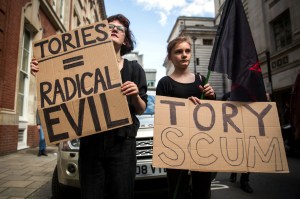
For small government conservatives and libertarians, this continual betrayal of principle is bad enough. But as an added insult, it also means four more years of being spat on and called “Tory scum” by demented far-left types who view David Cameron and George Osborne’s half-hearted attempts to pare back the state as the modern-day equivalent of Nazi war crimes, and who have no reservations in publicly saying so. Not very appealing.

That’s why the time has come for conservatives of all stripes to finally seize back the word “Tory” from the haters and reclaim it with pride, rather than meekly and apologetically crawling around and apologising for our values – values which saved this country from decline and irrelevance three decades ago, and can do so again if only we fully unleash them.

In that spirit, Tony Parsons’ article from earlier this year in GQ magazine – in which he “came out” as a reluctant member of the Tory Scum collective – is a great opening salvo in the fight back against the hysterical Left.

In his article, entitled “Why I’ve Become Tory Scum”, Tony Parsons calls out the Labour Party and other forces on the Left for the sanctimonious nature of their campaigning during the general election, and their utter inability to empathise with their opponents – or even entertain the thought that those who oppose them might be doing so from a position of legitimate, morally valid disagreement.

Parsons points out:

The general election was decided not by shy Tories but by us reluctant Conservatives. The millions like me who saw nothing but catastrophe in Labour’s addiction to high taxes and big spending, their loathing of success, the way they could use a word like “mansion” with a straight face and, above all, that endless pious prattle about the NHS – as though the British have no other identity but as a sickly, enfeebled, diseased people in need of having our bottoms wiped by the state from dawn till dusk. 

Sadly, Parsons may be right about the British as an enfeebled and dependent people in thrall to the NHS, judging by the current exercise in mass virtue-signalling underway to make this awful song Christmas no. 1 in the charts.

But the truth is that David Cameron’s government is very much an unremarkable continuation of New Labour. Far from being a son of Thatcher, Cameron and his leadership team are very much the heirs to Blair, and would bear comparison with many centre-left governments around the world. The Conservative Party, even under Thatcher, has in many respects always been to the left of even the Democratic Party in the United States, and certainly is so now.

Of course, you would not think that the Conservatives were in any way moderate, judging by the hysteria among many vocal parts of the Left, who present David Cameron’s steady-as-she-goes paternalism and tentative deficit reduction as some kind of outrageous economic shock treatment combined with “human rights” abuses worthy of the Nazis.

Tony Parsons ponders why this is so:

Why are those of us who believe in a different economic model – one where aspiration is encouraged, where the state gets out of your way and doesn’t spend money it doesn’t have – morally reprehensible? Exactly why are we scum? History suggests that, when presented with the chance to vote for socialism the British people always run as fast as we can in the opposite direction. It doesn’t make us bad people. But the left have lost the argument and are reduced to shrieking abuse.

But then the hysterical far left have always talked about conservatives thus, and they always will. Parsons recognises this as he writes:

The loud left are as pertinent to modern Britain as blacksmiths. No wonder their protests are increasingly ugly. They react with furious disbelief at the result of a democratic election. They rave about balancing the nation’s books as if it was like drowning kittens in a sack. They scream in our faces about their own compassion while bandying around epithets like “scum” and “filth” with the vicious abandon of Nazis talking about Jews.

Since the abuse will never end, clearly there is nothing to be gained from running from it any longer. Nor is there anything to be gained by continually apologising for core conservative principles – free individuals and strong families, fiscal conservatism and a prohibitive national defence – as the current Conservative leadership sadly continues to do.

What British conservatism and libertarianism really need is their own version of Jeremy Corbyn – someone who unapologetically sticks to their principles, refusing to water them down for political expediency, and who seeks to lead and persuade rather than conform to the results of the latest opinion poll or focus group.

Or to use a West Wing analogy, British conservatism needs a Matthew Santos-like figure, someone willing to proudly wear the “Tory” label just like Santos refused to apologise for being a liberal in the famous presidential debate episode:


Speaking up for American liberalism in a way that one can only wish David Cameron or George Osborne would do for small government conservatism, Santos says to his Republican opponent:

What did liberals do that was so offensive to the liberal party? I’ll tell you what they did. Liberals got women the right to vote. Liberals got African-Americans the right to vote. Liberals created social security and lifted millions of elderly people out of poverty. Liberals ended segregation. Liberals passed the Civil Rights Act, Voting Rights Act. Liberals created Medicare. Liberals passed the Clean Air Act, Clean Water Act. What did conservatives do? They opposed every single one of those things. Every one.

So when you try to hurl that label at my feet – liberal – as if it were something to be ashamed of, something dirty, something to run away from, it won’t work, Senator. Because I will pick up that label and I will wear it as a badge of honour.

Of course it is almost unimaginable for a conservative to ever talk this way, with such passion, partly because we tend not to make such grand claims for ourselves in reshaping the world or forcibly changing human nature in pursuance of our goals. It is not in our nature to brag about our accomplishments, because the biggest accomplishment a conservative can aim for in government is to get out of the way and help remove obstacles from others so that they might reach their full potential.

But more than this, British conservatives since Margaret Thatcher have had precious little to brag about. Locked out of office under thirteen years of New Labour, the Conservative Party which emerged under David Cameron has made so many compromises with triangulating, Blairite centrism that there are almost no genuinely conservative policy victories or changes in the country which we can claim.

What are we supposed to brag about? Remember when the Tories stood up to the growing climate of intolerance toward freedom of expression, and formally codified a British citizen’s right to free speech? We can’t say that because it didn’t happen. Indeed, under Theresa May Britain is becoming an even more authoritarian police state than it was before, with human beings languishing in our prisons simply for saying, singing, or tweeting the “wrong” thing.

Remember when George Osborne struck a blow for fiscal conservatism, rallied the country with his argument that it was morally obscene for government to spend more on debt repayments than education or the military, and achieved a real budget surplus in order to finally begin paying down the national debt? We can’t say that either, because although Osborne is happy for the public and lazy journalists to believe that the Tories are “paying down Britain’s debts”, in reality the government is doing no such thing.

Conservative supporters truly have the worst of both worlds at present. We are attacked by the furious Left for an ideologically-motivated attack on the state and its poorest dependants, while in reality almost zero real conservative reform is being enacted. We are stuck with the leftist abuse, but have absolutely nothing positive to show for it.

As this blog asked when Jeremy Corbyn was on the cusp of winning the Labour leadership contest, finally giving one of Britain’s two main parties a leader who demonstrably believed in something more than the acquisition and keeping of power:

If David Cameron’s Conservative Party was voted out of office today, what will future historians and political commentators say about this government fifty years from now? What will be the Cameron / Osborne legacy? What edifices of stone, statute and policy will remain standing as testament to their time in office? Try to picture it clearly.

Are you happy with what you see?

No real conservative should be happy with what they see right now. Assuming that the political pendulum will at some point swing back in favour of the Labour Party, we conservatives have almost nothing to show after five years of David Cameron other than a half-finished job clearing the budget deficit. We have a reanimated Ted Heath sitting in Downing Street, not a worthy heir to Margaret Thatcher.

But just as the American Tea Party lay conspicuously dormant for the many years of fiscal profligacy and budget-busting spending under the George W. Bush administration only to miraculously awaken when a man named Barack Hussein Obama won the presidency, so the hysterical British Left are now shrieking bloody murder over a set of very pedestrian, middle-of-the-road centrist policies being enacted by the Conservative Party after having airily ignored the very same governing philosophy when the now-hated Blairites were in charge.

As conservatives, we realise there is no point in launching a futile battle against human nature or the instinct of many on the Left to demonise that which they do not or cannot understand. They will continue to call us “Tory Scum” and we have no control over that.

But we do have the power to take back ownership of the label “Tory” and refuse to see it as an insult.

We do have the power to point out that there is nothing virtuous or compassionate about throwing more money at unreformed healthcare and welfare systems, or spreading the wealth around so much that wealth creation is destroyed or driven overseas.

We do have the power to proclaim the importance of fiscal conservatism, not out of some wonkish obsession with balancing the books but because running up further government debt today is a blatant act of intergenerational theft, living at the expense of our children and grandchildren. And because as we have seen with other countries, excessive national debt can become a foreign policy and national security issue too.

We do have the power to point out to anyone who will listen that the modern Left love to parade their virtue and ideological purity but have apparently given up on coming up with alternative policies of their own, and to demand that Labour produce some costed tax and spending plans rather than simply railing against the inhumanity of the Evil Tories.

We do have the power to point out the many ways in which David Cameron’s pitiful excuse for a Conservative government ignores or betrays real conservative values, and to declare “not in my name”.

We do have the power to say “Oui, Je Suis Tory Scum – and I wish that our prime minister was a real conservative too, rather than a reheated Blairite with an ominous, socialist plan for every stage of our lives“.

The Left are not going to change, so we had better get used to the spitting, the vandalism, and the overwrought, emotional and short-termist way in which they discuss public policy.

But we can change. We can stop lying down and taking it every time a virtue-signalling lefty pontificates on welfare without offering a plan of their own, or seeks to win an argument on healthcare by stoking the public’s idolatry of the NHS.

We can stop fighting on the Left’s terms.

And who knows, if small government conservatives and libertarians actually succeed in getting off the back foot for the first time since Margaret Thatcher left 10 Downing Street, we might even manage to salvage something from David Cameron’s woeful premiership.

Bankers Toffs And Tory Scum - General Election 2015 - London Protests - Downing Street

Agree with this article? Violently disagree? Scroll down to leave a comment.

Follow Semi-Partisan Politics on TwitterFacebook and Medium.

Postcard From America: Adult Education Is Key To Future Prosperity

I’m currently back in the United States to celebrate Christmas in Texas. These short “Postcards from America” will document a few of my thoughts as I escape the political whirlwind of Westminster and look back at Britain from the vantage point of our closest ally

In America, not everyone waits passively for government to improve their life circumstances. Aided by a thriving community college sector, people take their futures into their own hands

While sitting in the cinema waiting for Star Wars: The Force Awakens to begin, I was struck by the number of local advertisements for regional schools, community colleges and universities which were shown.

By my reckoning, at least 40% of the commercials screened over a fifteen minute period were promoting some kind of educational service. Contrast this with the United Kingdom, where local commercials of any kind are a rarity, and most national commercials these days tend to be for banks, fast-moving consumer goods, the EE mobile phone network (featuring Kevin Bacon) or one of the limited number of other companies able to afford a national cinema campaign.

An example of the type of commercial screened at the south Texas cinema I attended is shown above. Typically, they feature personal testimonials from ordinary people who explain simply and positively how going back into education has helped them in their careers, how the various modes of study fitted in around their existing home and work commitments, and how easy/affordable it turned out to be.

These degrees and diplomas provide a springboard into skilled, middle class jobs, many of which are well paid and non-outsourceable. Dental nurses, IT engineers, electricians, car mechanics and many other such career opportunities. Recognising that not everybody can be – or wants to be – an elite lawyer or doctor, these institutions equip people with tangible skills which actively help them in the labour market, ensuring that their career options are far greater than the prospect of 40 years working at the 7-eleven, or some other minimum wage drudgery.

This emphasis on adult education is one sign of a more active and engaged citizenry, of a people who understand that their self advancement and personal destiny is in their own hands, not those of the government.

To be fair, some British politicians are also coming to realise the importance of adult education to keep our own workforce skilled, adaptable and capable of commanding high wages rather than minimum wages. During the Labour leadership campaign, Jeremy Corbyn floated his plan for a National Education Service to do for lifelong learning what the NHS did for healthcare.

From the Conservatives, however, there has been nothing. Not a squeak from Education Secretary Nicky Morgan, who supposedly has future leadership ambitions of her own and therefore might be expected to have a substantive policy or two up her sleeve. What are the Conservative government’s bright ideas for a more market-oriented, privately delivered solution to the adult education gap?

Banging on about apprenticeships is all very well, but what of adults over 25 who cannot take an apprenticeship under the current schemes, or who want to work in a field where none exist? What of the 55-year-old steelworker made redundant with few other transferable skills?

A conservative government worth its salt would look at Jeremy Corbyn’s proposal for a National Education Service, balk at the more nakedly socialist aspects, but then consider how a smaller and leaner government might be able to promote the education of the adult workforce in pursuance of the national interest. But of course our current Coke Zero Conservative government is not worth its salt.

If Britain is to prosper in this globalised age – and if our poorest, most disadvantaged fellow citizens are to be spared from a harsh life of minimum wage drudgery – we need a learning revolution in the United Kingdom, a British Apollo Program for education.

What party, what future leader will rise to the occasion and propose a solution equal to the task at hand?

Community College

Agree with this article? Violently disagree? Scroll down to leave a comment.

Follow Semi-Partisan Politics on TwitterFacebook and Medium.