Just when you think the infantilisation of students and policing of normal human behaviour could not possibly get any more ridiculous, it does.
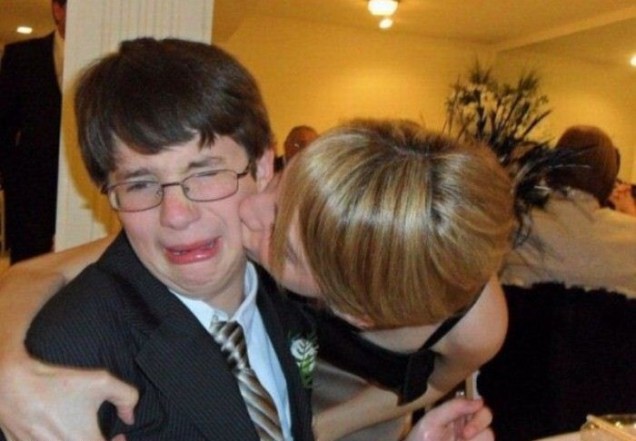
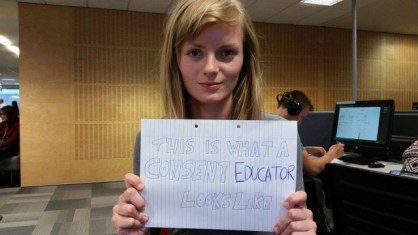
This time, the University of Southern California takes the spotlight for organising a “Consent Carnival” to dispense the usual patronising lessons to the already-converted.
Affirmative: We’re really excited to share this kiss with you and we’re letting you know!
Coherent: We’re present and able to recognize exactly what’s happening when we give this kiss to you.
Willing: We made the decision to give you this kiss ourselves, without pressure or manipulation from you or anybody else.
Ongoing: Should you come back for another kiss, check in to see if we’d still like to give you one.
Mutual: Sure, we offered you a kiss, but that doesn’t mean you have to accept it. Coming over to our table doesn’t forfeit your right to say no.
Note the particular absurdity of step four, “ongoing”. What, precisely, is the statute of limitations on an initial act of consent? If two kisses are one second apart, does the second kiss require a new act of consent? How about five seconds? Thirty seconds? One minute? Five minutes? Thirty minutes?
And for this ludicrous act of infantilising nonsense to mean anything, evidence of consent-checking needs to be written down or recorded in some way, should it become necessary to prove consent in the event of future dispute. So freshmen should probably all be given checklists to carry around with them in the event that they hook up with someone while at university.
Signatures should be mandatory – preferably witnessed and countersigned by a trusted third party. Sure, turning natural, healthy human relationships into risk-minimising contractual agreements may strip away any intimacy or spontaneity from our lives, but that’s the price we have to pay. To cleanse ourselves of our “rape culture”.
Better yet, since police forces across America are already considering equipping even more of their officers with body cameras, perhaps the US government should just order one for every citizen and make it a criminal offence to not wear it at all times. I’m sure they would get a great discount for ordering in bulk.
Surely that is the best way to deal with the endemic “rape culture” in our society and university campuses. After all, if we all receive mandatory training in how to deal with every possible scenario which may emerge in the course human relationships and surrender our privacy to constant on-body video surveillance (since good people have nothing to hide), then all of our problems will be solved.
Because without the consent classes and the checklists and the body cameras and the safe spaces, we will all revert to our primal, animalistic roots, and be a constant danger to anybody who strays too close to us.
Thank the Lord for the University of Southern California and their kissing booth, saving humanity one sanctimonious lecture at a time.
–
Agree with this article? Violently disagree? Scroll down to leave a comment.
No, you are not a cat simply because you “identify” as one. And we should all be wary of where the rise of the Politics of Identity is leading us
When future aliens discover the ruins of human civilisation and wonder what set our demise in motion, they will likely identify the period through which we are now living – the time where we finally became so arrogant that we believed we could bend objective reality to our will, physically becoming something simply because we mentally “identified” as that particular object or state of being. They will say that we sowed the seeds of our destruction when we abandoned reason and put our faith in verbal alchemy.
A story is going viral today (see video above) which would be hilarious if it wasn’t so terrifying. It involves Nano, a twenty year-old woman from Norway who identifies as a cat, having come to this “realisation” when she was sixteen and apparently indulged in her belief by friends, family and psychologists alike.
The young woman shows off her cat characteristics by wearing fake ears and an artificial tail. She communicates by meowing.
“I realised I was a cat when I was 16 when doctors and psychologists found out what was “the thing” with me. Under my birth there was a genetic defect,” she explains in the video.
[..] The cat woman wears a pair of pink fluffy paws with which to groom herself, and feels especially like doing so when she is in contact with water.
When asked if she was born as the wrong species, she said: “Yes, born in the wrong species.”
But terrifying it is, because stories like this are no longer so far-fetched, and Nano’s claims are not so unreasonable – at least not according to the insistent logic of modern day identity culture, which makes each one of us the little tin-pot god of our own reality, able to pick up and discard identities as core as gender or even species, in some cases on a whim.
And this is not the first such case. Just last month in Canada, a 52 year old formerly married father of seven revealed to the world that he no longer identified as a man, but rather as a six year old girl called Stefonknee.
Stefonknee (pronounced ‘Stef-on-knee’) Wolscht, 52, of Toronto, says she realized she was transgender – rather that simply a cross-dresser – at age 46, and split from her wife, Maria, after she told her husband to ‘stop being trans or leave’.
Now, Stefonknee lives with friends who she calls her ‘adoptive mommy and daddy’ as a six-year-old girl, dressing in children’s clothing and spending her time playing and coloring with her adoptive parents’ grandchildren.
Stefonknee says her ‘adoptive’ family, which consists of an older couple and their children and young grandchildren, are completely accepting of her identifying as a little girl.
She says she’s living as a six-year-old girl because it’s something she could never do when was in grade school.
‘I can’t deny I was married. I can’t deny I have children,’ she says in the video. ‘But I’ve moved forward now and I’ve gone back to being a child. I don’t want to be an adult right now.’
She’s moved forward, so that’s fine, then. Good for Stefonknee. Never mind her abandoned wife or seven young children who are doubtless hurt, confused and humiliated by what their father is doing. Stefonknee just doesn’t have time for all of that adult stuff right now, so she is going to put on a gingham dress and regress to a pre-pubescent age, until she gets tired of that and wants to try something different.
This is pure narcissism, plain and simple. He didn’t want to be an adult anymore, so he clicked his fingers and became a six year old girl instead? How are we to unpack this? Are we to accept his Wolscht’s statement that she is now female, since transgender acceptance is now (rightly, I believe) much more widely accepted and tolerated?
But if we do so – if we accept Wolscht’s statement that she is now female – do we not also then have to accept her insistence that she has also turned the clock back and become six years old again?
The ludicrous thing here is that Wolscht’s own identity is floating, as she freely admits later in the article:
She says she previously lived as an eight-year-old girl, until the couple’s granddaughter asked her to be the younger sister instead.
‘A year ago I was eight and she was seven. And she said to me: “I want you to be the little sister, so I’ll be nine.” I said: “Well, I don’t mind going to six.” So I’ve been six ever since.’
So according to this jaw-dropping reasoning, our identity is not even fixed and core to ourselves (if unmoored from reality). Now, our identity is a commodity which can be haggled over and traded. And if winning the friendship of a young girl means that a formerly 52 year old man has to downgrade from being an 8 year old to a 6 year old girl, that’s absolutely fine, apparently. Who are we to judge in any of this?
Never mind the callousness of a father of seven doing such a thing to his own children, putting them through this ordeal in pursuit of an identity which he openly admits is free-floating and liable to change again in future anyway. That’s bad enough. But how are we all – individuals, employers (the six year old girl apparently has a job driving a slow plough in winter) or government agencies – supposed to relate to somebody who decides that they “identify” as a different age and gender?
If Stefonknee is really six years old she should be in school, and the local authority should by current laws be hounding her adoptive “parents” to ensure that she is receiving a proper education. But would the identity culture cheerleaders seriously propose sending what was once a 52-year-old man to primary school with young children? Surely, under today’s logic they have to?
Stefonknee has identified as a young girl, and therefore she must be treated like one in every way. Anything less – such as homeschooling – would be discrimination against 6-year-old girls who happen to have the bodies of 52-year-old men. The kind of women who are harmed by a performance of the Vagina Monologues.
Meanwhile, Stefonknee’s employer when she drives the snow plough in winter will need to be hauled before the court and prosecuted for infringing on child labour laws. The courts would probably take a very dim view indeed of any business hiring a young girl to operate heavy machinery, and since justice must be blind, Stefonknee’s carefree decision to become a little girl should put her employer’s livelihood and liberty in grave jeopardy.
It’s easy to laugh at these scenarios, but they are going to come up more and more frequently if – as will inevitably happen when stories like this gain traction – more people are tempted to follow in the dangerous footsteps of Wolscht, or the somewhat less threatening (but no less absurd) paw prints of Nano the Norwegian cat woman.
For what is to say that Nano and Wolscht are not the “new normal”? The people being hounded and “No Platformed” for their old-fashioned views on transgender issues are guilty only of holding thoughts which were incredibly mainstream just a couple of decades ago, yet in that short space of time they have been completely overtaken by received wisdom and the new orthodoxy of intolerant tolerance. What is to say that in thirty years’ time, those who question a person’s ability to discard their entire life and “become” a cat or a young child are considered as bigoted as today’s “transphobic” holdouts?
Nobody can say that this is unlikely to happen. The world has changed so much in just a few decades, and promises to change even more in the coming years. Social attitudes have changed enormously in this time – what is to say that the warm, fuzzy embrace of unquestioning tolerance and affirmation will not expand to embrace people like Nano and Wolscht by 2050?
In 2050, maybe the future version of Eddie Redmayne will be starring in a movie, not just playing a male-to-female transsexual person (how boring that will be by then) but turning in another Oscar-winning performance for his sensitive portrayal of the pioneering early 21st century woman who identified as a cat, or the brave Canadian man who threw away his family in pursuit of his new identity as a pre-pubescent girl.
But that’s fine. Since we seem intent on burying our heads in the sand and denying that there is anything wrong with our new Politics of Identity, by that time our Prime Minister will probably identify as a Beagle, the Home Secretary will be a barn owl except on Tuesdays, and the Chancellor of the Exchequer will be a goldfish who looks suspiciously like George Osborne’s grown-up kid wearing a wetsuit, Number 11 Downing Street having been converted into a walk-in aquarium in deference to their “mental safety”.
And Nona the Norwegian cat woman will be the very least of our problems.
–
Agree with this article? Violently disagree? Scroll down to leave a comment.
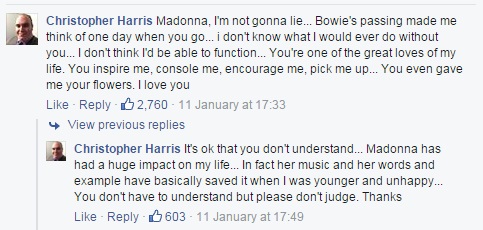
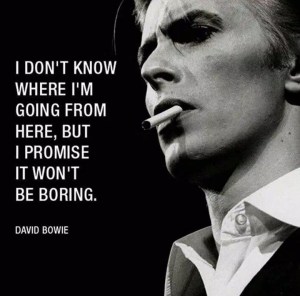
It goes much deeper than the pro-forma grief athleticism which the internet does so much to encourage. Yes, we can easily find examples of people going too far in their vicarious grief – often with extremely awkward effect:
But there is also something more than just anonymous people assuming a hysterical degree of mourning more appropriate for the passing of family members and close friends.
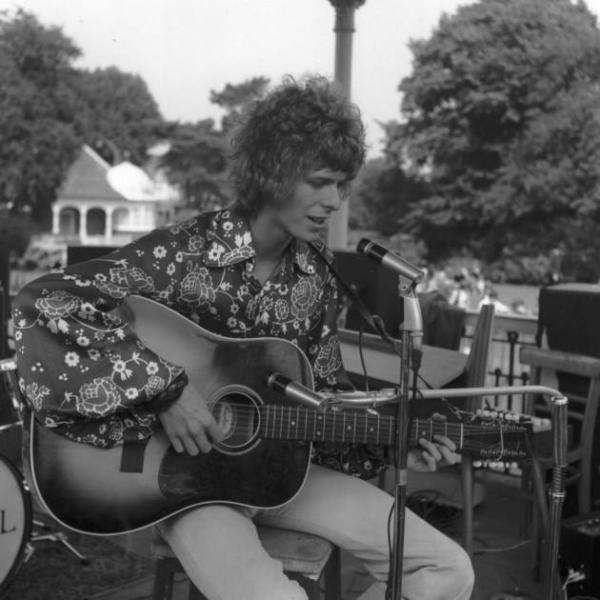
The piece begins by pointing out that while Bowie’s success was far from assured in the early years, it was made more likely by the greater sense of freedom and possibility which reigned in the early post-war decades, from the 1960s to the 1980s.
Davenport points out:
It’s worth remembering that Bowie slogged on the margins for ages, in two-bit bands, recording very minor songs, before finally finding his voice. Back then, British society created a kind of free space in which young people who were willing to take the unpredictable route of cultural experimentation could do so.
This should give some small measure of hope and a reminder to many of us toiling away in relative obscurity – be it in the arts or elsewhere – that success is rarely instant, and the lasting success we savour the most almost always requires a supreme degree of effort to be ploughed in to our endeavours before any results are seen.
But unfortunately, many aspects of our contemporary society conspire against encouraging this personal risk-taking and reinvention, as Davenport goes on to explain:
Today, in obsessively trying to ‘support’ and mollycoddle young people, society unwittingly robs them of the independence, resilience and drive that Bowie showed in his graft and in his shift from being a nobody to a zeitgeist-changing genius.
Where Bowie encapsulated a genuine sense of freedom and possibility, of total and frequent reinvention, today’s young people find themselves living in an era that discourages risk-taking, puts off adulthood, and erects official scaffolding around their lives. Young people have internalised a culture of anti-freedom.
We can see this in its most extreme form in the desire of some Western-born youths to join the death cult of ISIS, who seem to think that a repressive Caliphate which does all their thinking for them is a really great idea. We see it on university campuses, where student leaders make hectoring demands for Safe Spaces and ban controversial speakers, songs, newspapers or comedians. We see it with the daily emergence of yet another moronic petition calling for someone or something to be banned or punished for daring to ‘offend’ others. For all the celebrations of Bowie’s achievements, what he represented is actually in very short supply today. His death should serve as a reminder, or rather a wake-up call, of some of the backward social changes of the past 20 years.
That’s not to say that there is no great new talent emerging seven decades after the birth of David Bowie – clearly there is. But time and again, we see the biggest acts and pop stars of today are more eager to ostentatiously embrace prevailing social values as an act of public virtue-signalling rather than court controversy by cutting across today’s strictly policed social norms.
Lady Gaga took no risk when she sang “I’m on the right track baby, I was born this way” – indeed it opened the door to stadiums full of even more lucrative fans. That’s not to say that she was wrong to do so; Lady Gaga’s advocacy of gay rights is laudable. But how often do you see an emerging pop star court real controversy or confound society’s expectations these days? You can blame some of this on commercialisation, sure, but not all of it. Something deeper is at work.
When emerging artists see ordinary people shamed and ostracised for saying the “wrong” thing or even just adopting the wrong tone on social media, how many will have the courage to incorporate anything truly daring or potentially “offensive” in their acts, or create spontaneously from the heart without first processing everything through the paranoid filter of societal acceptability?
No, trigger warnings and safe spaces are not directly to blame for the X Factor or One Direction. But all of these unsavoury phenomena – and the societal trends which create them – are indelibly linked.
Why, then, has this particular death hit many of us so hard? Perhaps because deep down, we realise that we have lost something more rare and precious even than David Bowie – the possibility of ever producing another like him.
–
Agree with this article? Violently disagree? Scroll down to leave a comment.
I’m currently back in the United States to celebrate Christmas in Texas. These short “Postcards from America” will document a few of my thoughts as I escape the political whirlwind of Westminster and look back at Britain from the vantage point of our closest ally
–
In America, not everyone waits passively for government to improve their life circumstances. Aided by a thriving community college sector, people take their futures into their own hands
While sitting in the cinema waiting for Star Wars: The Force Awakens to begin, I was struck by the number of local advertisements for regional schools, community colleges and universities which were shown.
By my reckoning, at least 40% of the commercials screened over a fifteen minute period were promoting some kind of educational service. Contrast this with the United Kingdom, where local commercials of any kind are a rarity, and most national commercials these days tend to be for banks, fast-moving consumer goods, the EE mobile phone network (featuring Kevin Bacon) or one of the limited number of other companies able to afford a national cinema campaign.
An example of the type of commercial screened at the south Texas cinema I attended is shown above. Typically, they feature personal testimonials from ordinary people who explain simply and positively how going back into education has helped them in their careers, how the various modes of study fitted in around their existing home and work commitments, and how easy/affordable it turned out to be.
These degrees and diplomas provide a springboard into skilled, middle class jobs, many of which are well paid and non-outsourceable. Dental nurses, IT engineers, electricians, car mechanics and many other such career opportunities. Recognising that not everybody can be – or wants to be – an elite lawyer or doctor, these institutions equip people with tangible skills which actively help them in the labour market, ensuring that their career options are far greater than the prospect of 40 years working at the 7-eleven, or some other minimum wage drudgery.
This emphasis on adult education is one sign of a more active and engaged citizenry, of a people who understand that their self advancement and personal destiny is in their own hands, not those of the government.
To be fair, some British politicians are also coming to realise the importance of adult education to keep our own workforce skilled, adaptable and capable of commanding high wages rather than minimum wages. During the Labour leadership campaign, Jeremy Corbyn floated his plan for a National Education Service to do for lifelong learning what the NHS did for healthcare.
Banging on about apprenticeships is all very well, but what of adults over 25 who cannot take an apprenticeship under the current schemes, or who want to work in a field where none exist? What of the 55-year-old steelworker made redundant with few other transferable skills?
A conservative government worth its salt would look at Jeremy Corbyn’s proposal for a National Education Service, balk at the more nakedly socialist aspects, but then consider how a smaller and leaner government might be able to promote the education of the adult workforce in pursuance of the national interest. But of course our current Coke Zero Conservative government is not worth its salt.
If Britain is to prosper in this globalised age – and if our poorest, most disadvantaged fellow citizens are to be spared from a harsh life of minimum wage drudgery – we need a learning revolution in the United Kingdom, a British Apollo Program for education.
What party, what future leader will rise to the occasion and propose a solution equal to the task at hand?
–
Agree with this article? Violently disagree? Scroll down to leave a comment.







 Semi-Partisan Politics